Introduction
The Global Autonomous driving software has moved past pilot programs and into commercial deployment. It is the AI, perception, and planning stack that lets vehicles steer, brake, and navigate on their own. Demand comes from safety requirements, logistics cost pressure, urban congestion, and the industry’s shift to software-defined and electric vehicles. Supportive regulation also helps. Deployment is now measurable: Waymo runs about 500,000 paid rides a week, and Aurora’s driverless trucks have logged more than 500,000 commercial miles. Still, revenue is concentrated in L2 ADAS, while L4 platforms remain mostly unprofitable.
Market Size & Statistics
- The global Autonomous Driving Software market was worth USD 1.5 billion in 2023.
- It is expected to reach about USD 5.3 billion by 2033.
- The market is projected to grow at a 13.50% CAGR from 2024 to 2033.
- North America held more than 36.8% of the market in 2023, worth USD 0.5 billion in revenue.
- The L2 autonomy segment held more than 60.1% of the market in 2023.
- Perception and planning software held more than 41.5% of the market in 2023.
- The internal combustion engine (ICE) propulsion segment held more than 64.3% of the market in 2023.
- Passenger cars held more than 67.4% of the market in 2023.
- The report uses 2023 as its base year, covers 2019–2022 as the historic period, and forecasts 2024–2033.
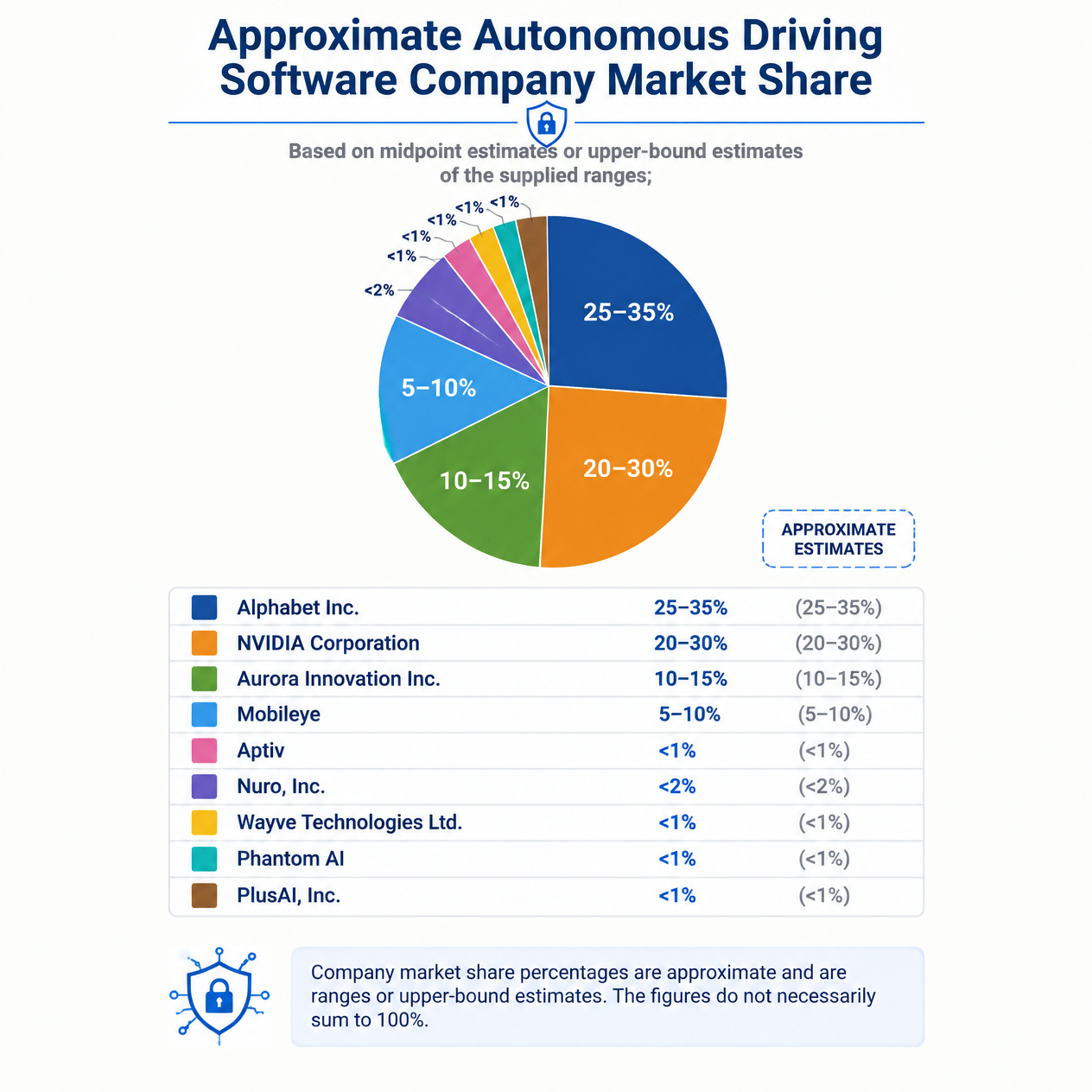
The shares below are analytical estimates, built from segment revenue and deployment scale.
| Company | Segment Evidence | Est. Relative Share / Position |
|---|---|---|
| Mobileye | FY2026 revenue guidance of USD 1.995–2.020 billion; EyeQ chips in more than 200 million vehicles | Leader in L2 ADAS volume; est. ~25–35% |
| NVIDIA | Automotive revenue of USD 2.3 billion in FY2026, up 39%; DRIVE AV software in the Mercedes-Benz CLA | Leading compute and software platform; est. ~20–30% (much of it hardware) |
| Alphabet (Waymo) | ~500,000 paid rides a week in 15 U.S. cities; revenue not disclosed, with a third-party estimate of a ~USD 355 million run rate | L4 robotaxi leader; est. ~10–15% |
| Aptiv | Data Unavailable (no ADAS-specific disclosure retrieved) | Major Tier-1 ADAS supplier; est. ~5–10% |
| Aurora Innovation | Q3 2026 revenue of USD 3 million; ~USD 9 million expected for 2026 | L4 trucking leader; <1% |
| PlusAI | Targeting USD 40–50 million in contracted revenue for 2026; USD 800 million SPAC valuation | L4 trucking challenger; <2% |
| Wayve | USD 8.6 billion valuation after a USD 1.2 billion Series D | Pre-revenue at scale; <1% |
| Nuro | Driverless testing of Lucid Gravity robotaxis for Uber in four cities; revenue Data Unavailable | Licensing-led; <1% |
Top Companies List
- Alphabet Inc.
- NVIDIA Corporation
- Aurora Innovation Inc.
- Mobileye
- Aptiv
- Nuro, Inc.
- Wayve Technologies Ltd.
- Phantom AI
- PlusAI, Inc.
Alphabet Inc.
About Alphabet Inc.: Alphabet runs Google’s search, cloud and AI businesses, and it also owns Waymo, the leading robotaxi company. Waymo’s lead rests on its Waymo Driver software, more than 300 million fully driverless miles, service in 15 major U.S. cities and a $126 billion valuation. Few companies can match that scale in autonomous driving software.
a) Company Overview Table
| Attribute | Company Data |
|---|---|
| Alphabet Inc. | Holding company for Google, Waymo and other ventures (“Other Bets”) |
| Ticker Symbol | NASDAQ: GOOGL (Class A), GOOG (Class C) |
| Industry | Internet services, cloud computing, AI and autonomous mobility |
| Headquarters | Mountain View, California, USA |
| Founded | 1998 (Google); Alphabet set up as the parent company in 2015 |
| Founders | Larry Page and Sergey Brin |
| Current CEO | Sundar Pichai |
| Latest Quarterly Revenue | $127.6 billion (Q3 2026, quarter ended Sept 30, 2026) |
| YoY Revenue Growth | 25%, the 13th straight quarter of double-digit growth |
| Primary Segments | Google Services, Google Cloud and Other Bets (which includes Waymo) |
b) Financial Details
Alphabet does not report Waymo’s revenue or losses on its own, so the closest available figure is the Other Bets segment. In Q3 2026, Other Bets brought in $372 million, up 8.1% from $344 million a year earlier. Its operating loss widened to $2.047 billion from $1.426 billion, an increase of 43.5%. Alphabet says Other Bets revenue comes mainly from autonomous transportation services and internet services, so Waymo’s paid rides likely make up much of it. The segment is only about 0.29% of Alphabet’s total revenue, yet its loss is more than five times its revenue.
Management said the larger loss reflects spending to expand Waymo. On the operating side, Waymo passed 300 million fully driverless miles in the quarter and launched public service in San Antonio, San Diego and Tampa. It plans to expand into Canada, Germany, Singapore and Spain. Early in 2026, Waymo was reported to be giving more than 450,000 paid rides a week, with annualized revenue estimated in the hundreds of millions of dollars.
c) Strategic Developments
- October 2026, debt financing: Waymo closed its first-ever debt deal, a $5 billion term loan. PIMCO, Blackstone and Sixth Street were the lead lenders, with Capital Group, Loomis Sayles and T. Rowe Price also lending significant amounts.
- February 2026, equity round: Waymo raised $16 billion at a $126 billion post-money valuation, which is reported as the largest funding round ever for an autonomous-driving company.
- Who invested in the $16 billion round: Dragoneer, DST Global and Sequoia Capital led it. Andreessen Horowitz, Mubadala Capital, Bessemer, Silver Lake, Tiger Global, T. Rowe Price, Fidelity, CapitalG and GV also took part, and Alphabet remains the majority owner.
- Expansion plans for 2026: The money is meant to take Waymo into more than 20 additional cities, including its first international markets, London and Tokyo.
- October 2024, earlier round: Waymo raised $5.6 billion at a $45 billion valuation. Alphabet led the round, and Waymo has now raised about $27 billion in total.
- Uber partnership: Uber’s app offers Waymo robotaxi rides in Austin and Atlanta.
- Earlier industrial partners: Waymo’s 2020 round brought in Magna, which assembles Waymo vehicles, and AutoNation, which services them. Waymo has also worked with Lyft, Fiat Chrysler and Jaguar Land Rover.
- Freight pilots: Waymo Via has run freight hauling pilots with UPS and J.B. Hunt in Texas and Arizona.
NVIDIA Corporation
About NVIDIA Corporation: NVIDIA leads the world in accelerated computing, and its moat is the CUDA AI software ecosystem. In autonomous driving it covers the whole development cycle. It sells data-center training hardware, DRIVE AGX Thor chips for the car, the Hyperion Level 4 platform, Halos safety tools and Alpamayo, its open reasoning AI models for driving.
a) Company Overview Table
| Attribute | Company Data |
|---|---|
| NVIDIA Corporation | Accelerated computing and AI platform company |
| Ticker Symbol | NASDAQ: NVDA |
| Industry | Semiconductors, AI computing and software |
| Headquarters | Santa Clara, California, USA |
| Founded | 1993 |
| Founders | Jensen Huang, Chris Malachowsky and Curtis Priem |
| Current CEO | Colette Kress was interim CEO when Q3 FY2027 results came out, after Jensen Huang resigned. Later reports say Huang is back. |
| Latest Quarterly Revenue | $115.8 billion (Q3 FY2027, quarter ended Oct 25, 2026) |
| YoY Revenue Growth | 103% (20% quarter over quarter) |
| Primary Segments | Compute & Networking ($106.0 billion) and Graphics ($9.8 billion). Market platforms are Data Center ($107.6 billion) and Edge Computing ($8.2 billion). |
b) Financial Details
NVIDIA no longer reports automotive revenue on its own. It now groups PCs, gaming, automotive and robotics into the Edge Computing platform. That platform brought in $8.2 billion in Q3 FY2027, up 42% from a year earlier and 14% from the previous quarter. One third-party breakdown puts automotive at about 1.1% of net sales, which would be roughly $1.2–1.3 billion. That figure is an estimate, not a number NVIDIA reported.
Automotive is a small part of revenue, but management pointed to strong progress in the quarter. Hyperion and Alpamayo are helping Mercedes-Benz and Bolt with Lucid build robotaxi fleets, Einride develop Level 4 autonomous trucks and Volvo Cars advance automated driving. NVIDIA expects the first production vehicles running distilled Alpamayo models around late 2026 or early 2027. Software and per-vehicle revenue should start to show up after that. For Q4 FY2027, NVIDIA guided to about $130 billion in revenue, plus or minus 3%.
c) Strategic Developments
- January 2026, Alpamayo launch at CES: NVIDIA released Alpamayo, a family of open reasoning models for driving. It includes Alpamayo 1, the AlpaSim simulator and open datasets, and JLR, Lucid, Uber and Berkeley DeepDrive have shown interest.
- October 2026, GTC Berlin: Bolt chose Alpamayo for its European robotaxi program on future Lucid vehicles. It plans to start collecting driving data in Madrid in 2027, subject to regulatory approval.
- Mercedes-Benz: The two companies extended their work to Level 3 and Level 4 driving. MB.DRIVE ASSIST PRO will be available to order in Germany from the first half of 2027.
- Volvo Cars: Volvo is building Hyperion and Alpamayo software into its future vehicles.
- Einride: Einride is building its next-generation Einride Driver for autonomous trucks on Hyperion, Alpamayo and Cosmos.
- Aptiv: Aptiv expanded its work with NVIDIA to offer production-ready automated-driving systems on Hyperion and Halos.
- Volkswagen Commercial Vehicles: It is showcasing Hyperion use cases for automated vehicles and robotaxi fleets.
- Uber and Porsche: NVIDIA has a partnership with Uber on autonomous vehicle data. It also works on a Porsche-led project that uses simulation and fleet data to evaluate driving models.
- New products: NVIDIA introduced Alpamayo 2 Edge, a model that runs in the car, and Alpamayo 2 Super. It also launched Halos SAFE, a framework that helps developers produce evidence of system safety.
- November 2026, Kakao Mobility: Kakao Mobility signed a memorandum of understanding with NVIDIA to work on Level 4 autonomous driving.
- November 2026, Autobrains: Autobrains is building Alpamayo 2 Super’s reasoning into its real-time driving agents.
- DRIVE partners: Long-standing DRIVE partners include General Motors, Toyota, Hyundai Motor Group, BYD, Geely, Rivian, Li Auto, XPENG, NIO, Nuro, Polestar and Pony.ai.
Aurora Innovation Inc.
About Aurora Innovation Inc.: Aurora leads the self-driving freight market with the Aurora Driver, a Level 4 system that runs fully driverless Class 8 trucks on public U.S. highways. Its advantages are more than 500,000 commercial driverless miles, 10 approved Sun Belt routes and partnerships with Volvo, PACCAR, Roush and NVIDIA. Customers can buy its service on a per-mile basis.
a) Company Overview Table
| Attribute | Company Data |
|---|---|
| Aurora Innovation Inc. | Pure-play developer of self-driving technology for freight trucking |
| Ticker Symbol | NASDAQ: AUR |
| Industry | Autonomous vehicle software and self-driving freight |
| Headquarters | Pittsburgh, Pennsylvania, USA |
| Founded | 2017 |
| Founders | Chris Urmson, Sterling Anderson and Drew Bagnell |
| Current CEO | Chris Urmson |
| Latest Quarterly Revenue | $3 million (Q3 2026, quarter ended Sept 30, 2026) |
| YoY Revenue Growth | 200% (from $1 million in Q3 2025) |
| Primary Segments | Single segment: the Aurora Driver, sold as Transportation-as-a-Service (TaaS) and Driver-as-a-Service (DaaS) |
b) Financial Details
Aurora earned $3 million in Q3 2026, up from $1 million a year earlier. The money came from commercial loads, some fully driverless and some with a safety operator on board. Higher utilization, new routes and higher fuel surcharges drove the increase. Net loss widened to $234 million from $201 million. The operating loss was $257 million, which includes $54 million of stock-based compensation. Aurora used about $170 million in operating cash and spent about $36 million on capital projects, mostly hardware kits and truck production.
It still ended the quarter with more than $1 billion in cash and short-term investments. Truck production is running about six weeks behind plan, so the 200-driverless-truck milestone has moved to the end of February 2027. As a result, Aurora cut its 2026 revenue guidance from $14–16 million to about $9 million. It expects to use about $250 million of cash in Q4. The company still targets more than 1,000 trucks by the end of 2027, plus more than 30,000 trucks and over $5 billion in revenue by 2030. It also lowered its long-term gross margin target to 60% and now expects positive gross profit in the first half of 2027.
c) Strategic Developments
- October 2026, Charger Logistics: Aurora signed a non-binding memorandum of understanding (MOU) under which Charger plans to buy up to 500 Aurora Driver-powered trucks. Deliveries would run through 2027 and 2028 under the DaaS model.
- Hirschbach Motor Lines: The two companies expanded their partnership, and Hirschbach plans to own 500 Aurora Driver-powered trucks. Deliveries are expected to start in 2027 under a multi-year deal worth hundreds of millions of dollars.
- Volvo Autonomous Solutions: Aurora is building the Aurora Driver into Volvo’s VNL Autonomous trucks. Volvo’s driverless trucks are set to launch in Q1 2027, with up to 300 trucks planned.
- July 2026, second-generation trucks: Aurora launched its second-generation driverless trucks, built on the International LT Series. Its second-generation hardware kit is designed to last one million miles at less than half the previous cost.
- Roush manufacturing: Roush is fitting trucks for Aurora at a dedicated facility and is aiming for about 20 trucks per week, or 1,000 a year, by early December 2026.
- Supply chain: Fabrinet supplies the second-generation hardware kits, and AUMOVIO is developing the third-generation hardware. PACCAR is working with Aurora so that hardware can be installed directly on the truck assembly line.
- Freight customers: McLane, a Berkshire Hathaway subsidiary, and Werner run driverless hauls in Texas. Their trucks average more than 225,000 miles a year, over double the usage of a traditional truck.
- Wider partner network: Partners include NVIDIA, FedEx, Ryder, Schneider, Toyota, Uber, Uber Freight, Volvo Trucks and Detmar Logistics.
- September 2026, Investor Day: At its Dallas Investor Day, Aurora gave what it called industry-first passenger rides in trucks with no human driver, on part of the Dallas-to-Houston route. It also hosted a partner summit with more than 35 private-fleet carriers.
Mobileye
About Mobileye: Mobileye is the world’s biggest supplier of vision-based driver-assistance systems. Its EyeQ chips are in more than 200 million vehicles. Its moat combines custom EyeQ chips, proprietary computer-vision software and crowd-sourced REM mapping. That covers everything from basic and Surround ADAS to SuperVision, Chauffeur and Drive, its robotaxi system.
a) Company Overview Table
| Attribute | Company Data |
|---|---|
| Mobileye | Mobileye Global Inc., a developer of advanced driver-assistance (ADAS) and autonomous driving technology |
| Ticker Symbol | NASDAQ: MBLY |
| Industry | Automotive semiconductors, ADAS and autonomous driving software |
| Headquarters | Jerusalem, Israel |
| Founded | 1999 |
| Founders | Prof. Amnon Shashua and Ziv Aviram |
| Current CEO | Prof. Amnon Shashua, who will become chairman once a successor is appointed |
| Latest Quarterly Revenue | $492 million (Q3 2026, quarter ended Sept 26, 2026) |
| YoY Revenue Growth | -2.4% (from $504 million in Q3 2025) |
| Primary Segments | Mobileye (EyeQ ADAS, SuperVision, Chauffeur and Drive) and Other (mainly Mentee Robotics) |
b) Financial Details
Mobileye’s Q3 2026 revenue was $492 million, down 2% from $504 million a year earlier. That was better than the 5–6% drop the company had guided to, and it beat consensus of about $477 million. Revenue fell because the average system price dropped 5%. More of the volume came from export vehicles built by Chinese carmakers, which carry less software and sell at lower prices, and SuperVision volumes were also lower. Profitability improved anyway.
Gross margin rose almost 5 percentage points, the GAAP operating loss narrowed 25% to $82 million, and adjusted operating income rose 20%. Net loss narrowed 30% to $67 million, or $0.08 per share, while adjusted EPS was $0.11. Year to date, revenue is up 8%, adjusted operating income is up 42% and operating cash flow is over $300 million. Mobileye’s full-year guidance implies Q4 revenue of about $460 million, down roughly 8.5% from Q3, and adjusted operating income of about $60 million.
c) Strategic Developments
- January 2026, Mentee Robotics: At CES 2026, Mobileye agreed to buy Mentee Robotics, an Israeli humanoid-robot AI startup, for about $900 million. The deal extends Mobileye into physical AI, and it closed in Q1 2026.
- CES 2026 design win: Mobileye announced a major win with a large automaker covering about nine million vehicles, which supports its growth in Surround ADAS.
- Autonomous driving programs: At CES, Mobileye highlighted progress on its Surround ADAS and large autonomous driving programs.
- Robotaxi rollout: Mobileye has announced a plan to roll out robotaxis using Mobileye Drive, along with a raised 2026 outlook.
- Leadership transition: Founder Prof. Amnon Shashua will step down as CEO once a successor is named and will become chairman.
- Raised 2026 guidance: Full-year revenue guidance is now $1.935–2.015 billion, helped partly by Israel’s R&D credit law.
- Analyst coverage: In November 2026, Seaport Global started coverage with a Buy rating, and Piper Sandler repeated its Overweight rating with a $12 price target.
Aptiv
About Aptiv: Aptiv is a Tier-1 automotive technology supplier that gives carmakers ADAS and software-defined vehicle platforms they can scale across their lineups. Its moat comes from deep OEM relationships, in-house Gen 8 radar, Wind River software and an open, AI-driven ADAS stack. Its new PRISM platform offers hands-free L2++ driving at about half the cost of comparable systems.
a) Company Overview Table
| Attribute | Company Data |
|---|---|
| Aptiv | Aptiv PLC, a global industrial technology company focused on ADAS, software and engineered components |
| Ticker Symbol | NYSE: APTV |
| Industry | Automotive technology, ADAS, vehicle software and connectivity |
| Headquarters | Schaffhausen, Switzerland |
| Founded | 1994 as Delphi Automotive, a General Motors unit; renamed Aptiv in 2017 |
| Founders | Spun off from General Motors (no individual founders) |
| Current CEO | Kevin P. Clark |
| Latest Quarterly Revenue | $3.2 billion ($3,199 million, Q3 2026, quarter ended Sept 30, 2026) |
| YoY Revenue Growth | 2.3% (from $3.13 billion on a comparable basis that excludes the EDS spin-off) |
| Primary Segments | Intelligent Systems (ADAS, software and Wind River) and Engineered Components |
b) Financial Details
Q3 2026 was Aptiv’s second full quarter after it spun off the Electrical Distribution Systems business as Versigent. Revenue reached a third-quarter record of $3,199 million, up 2.3% from a comparable $3.13 billion. On an adjusted basis, non-automotive revenue grew 11% while automotive revenue fell 1%. GAAP net income from continuing operations was $194 million, or $0.94 per share, compared with a $355 million loss a year earlier.
Adjusted EPS of $1.42 beat the $1.33 consensus, but it was 4.1% lower than last year. Growth in Engineered Components was offset by a sharp profit drop in Intelligent Systems, the segment that holds Aptiv’s ADAS and autonomy software business. That points to heavy ongoing investment and price pressure in ADAS. For Q4 2026, Aptiv guided to revenue of $3.11–3.21 billion and full-year revenue for the new Aptiv of $12.65–12.75 billion. Management was cautious about 2027.
c) Strategic Developments
- November 2026, PRISM launch: Aptiv launched the PRISM ADAS platform. It combines AI-driven driving intelligence, an open and scalable architecture and continuous learning, and Aptiv says it matches leading hands-free systems at half the cost.
- October 2026, NVIDIA: Aptiv expanded its collaboration with NVIDIA to make highly automated driving more affordable, using NVIDIA’s Hyperion and Halos platforms.
- April 2026, Versigent spin-off: Aptiv completed a tax-free spin-off of its Electrical Distribution Systems business as Versigent PLC (NYSE: VGNT). The move leaves Aptiv focused on ADAS, software and higher-margin technology.
- March 2026, spin-off financing: Subsidiaries tied to the spin-off priced an upsized $1.6 billion private offering of senior notes, and Aptiv upsized a cash tender offer.
- January 2026, CES: Aptiv showed a next-generation end-to-end AI ADAS platform for hands-free L2++ driving on highways and city streets. The platform lets carmakers keep control of their own software.
- January 2026, commercial vehicles: A top global commercial-vehicle maker chose Aptiv’s Gen 6 ADAS platform.
- October 2025, Gen 8 radar: Aptiv unveiled its Gen 8 radar family, designed for next-generation ADAS.
- November 2026, awards and analyst coverage: Aptiv won several 2026 Automotive News PACE Awards. Seaport started coverage with a Buy rating, while Baird downgraded the stock to Hold.
Nuro, Inc.
About Nuro, Inc.: Nuro licenses the Nuro Driver, a Level 4 “universal autonomy” platform, along with its Nuro Toolkit. Automakers and mobility platforms can use them for robotaxis, commercial fleets and personal vehicles. Its edge comes from an end-to-end AI driving stack and validation skills built during years of autonomous delivery. Its main deal is the Lucid-Uber program, with at least 35,000 robotaxis committed.
a) Company Overview Table
| Attribute | Company Data |
|---|---|
| Nuro, Inc. | Developer and licensor of Level 4 autonomous driving software |
| Ticker Symbol | Private (not publicly listed) |
| Industry | Autonomous vehicle software and AI |
| Headquarters | Mountain View, California, USA |
| Founded | 2016 |
| Founders | Jiajun Zhu and Dave Ferguson |
| Current CEO | Jiajun Zhu |
| Latest Quarterly Revenue | Not disclosed (private company) |
| YoY Revenue Growth | Not disclosed. Last confirmed valuation was $6 billion (Series E, August 2025); implied secondary-market valuation is about $14.1 billion (November 2026) |
| Primary Segments | Licensing of the Nuro Driver and Nuro Toolkit for robotaxis, commercial fleets and personal vehicles |
b) Financial Details
Nuro is private and does not report quarterly results, so the best financial signals are its funding, valuation and deal flow. It has raised about $2.3 billion over five confirmed rounds. The most recent was a $203 million Series E in August 2025 at a $6 billion valuation, which was about 30% below its earlier peak. Secondary-market trading on Clarity and Forge implied a valuation of about $14.1 billion as of November 22, 2026, a gain of roughly 135%. Its largest revenue source in the near term should be licensing the Nuro Driver to Uber.
Uber has reportedly agreed to invest nearly $500 million in Nuro. It has also committed to buy at least 35,000 Lucid vehicles running the Nuro Driver over about six years, up from 20,000 at first. Revenue from that deal depends on the commercial launch, which has slipped from late 2026 to Q1 2027 in the Bay Area, with Houston expected in mid-2027. Nuro recently hired Mike Mancini as Chief Financial Officer, which points to more mature financial operations as it moves toward commercialization.
c) Strategic Developments
- November 2026, driverless testing: Nuro, Lucid and Uber began fully driverless testing on public roads in Palo Alto, Mountain View, Los Altos and Sunnyvale. Lucid delivered more than 100 Gravity robotaxis, and employee-only rides start soon.
- Uber investment: Uber reportedly agreed to invest nearly $500 million in Nuro and has committed about $500 million to Lucid. That makes Nuro and Lucid among Uber’s largest bets among more than 30 autonomous vehicle partners.
- Fleet commitment: Uber has licensed the Nuro Driver and committed to at least 35,000 Lucid vehicles running it, including the Gravity and future Lucid midsize models. Uber will own and operate the fleet with partners, and the cars will be available only on the Uber app.
- June 2026, Houston: Houston was named the second market, with launch expected in mid-2027. Uber has secured a 50,000 sq ft depot there for fleet operations.
- May 2026, California permit: The California DMV granted Nuro a permit for driverless testing.
- January 2026, CES: Lucid, Nuro and Uber unveiled their production-intent Gravity robotaxi and began on-road testing with safety drivers.
- August 2025, Series E: Nuro raised $203 million at a $6 billion valuation to grow its licensing business.
- July 2025, Lucid-Uber program: The global robotaxi program was announced, combining Lucid’s vehicles, Nuro’s Level 4 platform and Uber’s ride-hailing network.
- 2026, leadership hires: Nuro appointed Rajiv Bhatia as Chief Product Officer and Mike Mancini as Chief Financial Officer to lead commercial launches and platform expansion.
Wayve Technologies Ltd.
About Wayve Technologies Ltd.: Wayve pioneered “embodied AI” for driving. Its end-to-end, mapless Wayve AI Driver learns to drive from data and works across different vehicles, sensors and chips, so it can adapt to new cities quickly. It covers L2+ hands-off through L4 driverless driving. Its main programs are Nissan’s ProPILOT system and Uber robotaxi trials in London and Tokyo.
a) Company Overview Table
| Attribute | Company Data |
|---|---|
| Wayve Technologies Ltd. | Developer of embodied AI software for assisted and autonomous driving |
| Ticker Symbol | Private (not publicly listed) |
| Industry | Autonomous driving software and embodied AI |
| Headquarters | London, United Kingdom |
| Founded | 2017 |
| Founders | Alex Kendall and Amar Shah |
| Current CEO | Alex Kendall |
| Latest Quarterly Revenue | Not disclosed (private company) |
| YoY Revenue Growth | Not disclosed. Last confirmed valuation was $8.6 billion (Series D, February 2026); implied secondary-market valuation is about $21.4 billion (November 2026) |
| Primary Segments | Licensing of the Wayve AI Driver for automaker ADAS (L2+ to L3) and for L4 robotaxi deployments |
b) Financial Details
Wayve is private and does not publish quarterly revenue, so its funding and deployment progress are the main financial signals. In February 2026, it closed a $1.2 billion Series D at an $8.6 billion post-money valuation. Eclipse, Balderton and SoftBank Vision Fund 2 led the round, and Microsoft, NVIDIA, Uber, Mercedes-Benz, Nissan and Stellantis also invested. Together with milestone-based money from Uber, Wayve has secured $1.5 billion in total.
In April 2026, AMD, Arm and Qualcomm added a $60 million extension. That brings Wayve’s equity raised since 2018 to about $2.5–2.8 billion. A tender offer in July 2026 was priced at the same $8.6 billion valuation, while secondary-market trading implied about $21.4 billion as of November 24, 2026. Uber’s extra investment, reportedly up to $300 million, depends on hitting robotaxi milestones in London. Wayve’s revenue should come from licensing, through supervised Uber ride-hailing in London since September 3, 2026, and supervised software in consumer cars from 2027.
c) Strategic Developments
- February 2026, Series D: Wayve raised $1.2 billion at an $8.6 billion valuation, led by Eclipse, Balderton and SoftBank Vision Fund 2. Microsoft, NVIDIA, Uber, Mercedes-Benz, Nissan and Stellantis also invested, and Uber added milestone-based capital for a total of $1.5 billion.
- April 2026, chipmaker investment: AMD, Arm and Qualcomm invested $60 million as a Series D extension. The goal is to run the Wayve AI Driver on many types of automotive computer.
- September 2026, London launch: Uber started its first supervised autonomous ride-hailing service in London, using Ford Mustang Mach-E vehicles powered by the Wayve AI Driver.
- March 2026, Tokyo: Wayve, Uber and Nissan signed a memorandum of understanding for a robotaxi pilot in Tokyo by late 2026. It will use the Nissan LEAF with the Wayve AI Driver, and Uber’s first autonomous vehicle partnership in Japan.
- August 2026, Tokyo operator: Uber Japan signed taxi operator Hinomaru Kotsu to run day-to-day fleet operations for the Tokyo pilot.
- March 2026, GTC: Wayve and Nissan showed a robotaxi prototype built on NVIDIA DRIVE Hyperion for the Uber trials.
- Stellantis: Stellantis, Wayve and Uber announced a partnership to explore developing and deploying Level 4 robotaxis worldwide.
- Global expansion: Wayve and Uber plan robotaxi trials in more than 10 cities worldwide. Under the model, Wayve supplies the AI Driver, automakers provide L4-capable vehicles and Uber owns and operates the fleets.
Phantom AI
About Phantom AI: Phantom AI builds modular, software-defined ADAS that runs on many types of hardware. Its PhantomVision computer vision and PhantomDrive stack cover vision, sensor fusion and vehicle control. Its edge is low-cost L2/L2+ safety features that meet Euro NCAP standards, built by former Tesla and Hyundai engineers. It is now a Harbinger subsidiary, and ZF licenses its technology for passenger cars.
a) Company Overview Table
| Attribute | Company Data |
|---|---|
| Phantom AI | Phantom AI, Inc., a developer of ADAS and autonomous driving software, now a subsidiary of Harbinger Motors |
| Ticker Symbol | Private (acquired by Harbinger Motors, which is also private) |
| Industry | ADAS and autonomous driving software |
| Headquarters | Mountain View, California, USA |
| Founded | 2016 |
| Founders | Dr. Hyunggi Cho (former Tesla ADAS engineer) and Chan Kyu Lee (former Hyundai ADAS and autonomous driving engineer) |
| Current CEO | Dr. Hyunggi Cho (co-founder and CEO) |
| Latest Quarterly Revenue | Not disclosed (private subsidiary) |
| YoY Revenue Growth | Not disclosed. Harbinger expects “millions” of dollars in software-services revenue in 2026 |
| Primary Segments | PhantomVision (computer vision) and PhantomDrive (sensor fusion and control), licensed to Tier-1 suppliers and OEMs |
b) Financial Details
Phantom AI is private and now sits inside Harbinger Motors, so it reports no quarterly results. Harbinger completed the acquisition in November 2025 and announced it on February 25, 2026. Atlanticus Advisors advised Phantom AI on the deal, and the price was not disclosed. Before the sale, Phantom AI had raised about $80.2 million. The last round was a $36.5 million Series C in February 2023, led by KT Investment and Renaissance Asset Management with InterVest, Shinhan GIB and Samsung Ventures, at a reported valuation of about $146 million.
After the deal, Phantom AI earns money as Harbinger’s software-services unit. The anchor deal is a license with ZF for passenger-car ADAS. Harbinger CEO John Harris expects this business to bring in “millions” of dollars in 2026, which he described as not material next to truck sales. Harbinger’s financial backing has also grown. It closed a $240 million Series D on November 5, 2026, after FedEx placed a binding order for 2,000 electric trucks. Phantom AI’s team of about 30 people still works from Mountain View.
c) Strategic Developments
- November 2025 to February 2026, Harbinger acquisition: Harbinger Motors acquired Phantom AI in its first acquisition, aiming to own more of its vehicle technology and add software revenue.
- February 2026, ZF license: ZF Group’s passenger-car ADAS unit agreed to license Phantom AI’s computer vision. ZF is the first customer since the acquisition, and the two companies plan to work toward more advanced autonomous driving.
- 2026, Harbinger trucks: Phantom AI’s technology is going into Harbinger’s medium-duty electric and hybrid vehicles. Features include automatic emergency braking, adaptive cruise control and lane keeping.
- March 2026, Work Truck Week: Harbinger showed its HC Series low-cab-forward truck and plans to roll out more ADAS features across its lineup.
- November 2026, Harbinger Series D: Harbinger, Phantom AI’s parent company, raised $240 million with Fidelity as a new investor. That funding supports continued work on Phantom’s ADAS.
- February 2023, Series C: Phantom AI raised $36.5 million from KT Investment, Renaissance Asset Management, InterVest, Shinhan GIB and Samsung Ventures for production development, bringing total funding to about $80.2 million.
- 2023, SK Telecom: SK Telecom invested in Phantom AI and planned to include its software in a self-driving package with SAPEON AI chips.
- Renesas: Phantom AI has worked with Renesas to develop complete ADAS systems.
PlusAI, Inc.
About PlusAI, Inc.: PlusAI is a physical AI company that develops SuperDrive, a Level 4 “virtual driver” for heavy trucks. Its moat is factory integration: truck makers including TRATON (Scania, MAN, International), IVECO, and Hyundai build SuperDrive into production trucks instead of retrofitting them. Driverless commercial launches are targeted for 2027 in the U.S. and Europe.
a) Company Overview Table
| Attribute | Company Data |
|---|---|
| PlusAI, Inc. | Developer of AI-based Level 4 virtual driver software for factory-built autonomous trucks |
| Ticker Symbol | Private. Pending Nasdaq listing through a merger with Texas Ventures Acquisition III Corp. (Nasdaq: TVA) |
| Industry | Autonomous trucking software and physical AI |
| Headquarters | Santa Clara, California, USA |
| Founded | 2016 |
| Founders | David Liu, Hao Zheng and Tim Daly |
| Current CEO | David Liu |
| Latest Quarterly Revenue | Not publicly reported (pre-listing private company) |
| YoY Revenue Growth | Not disclosed. Valued at about $800 million in the planned merger with Texas Ventures III |
| Primary Segments | SuperDrive Level 4 virtual driver software, licensed to truck makers for factory-built autonomous trucks |
b) Financial Details
PlusAI is still private while its public listing is pending, so it has not published standard quarterly revenue. Its current revenue comes mainly from development and engineering work with truck makers, ahead of commercial launches in 2027. On September 3, 2026, PlusAI agreed to merge with Texas Ventures Acquisition III Corp., a SPAC backed by Yorkville Advisors funds. The deal values PlusAI at about $800 million. Closing requires shareholder approval and at least $40 million of available cash, and the registration statement was filed with the SEC on October 9, 2026.
The deal came after an earlier planned merger with Churchill Capital Corp IX, which was expected to list PlusAI as “PLS” but never closed. The new financing is meant to fund PlusAI’s commercialization plan through 2027. TRATON also offered up to $25 million in non-dilutive R&D funding, on a non-binding term sheet. In return, it would receive warrants tied to up to $400 million of future deployment revenue and a board seat. That deal shows how future licensing revenue would be shared with a key truck-maker partner.
c) Strategic Developments
- September 2026, new SPAC merger: PlusAI signed a definitive merger agreement with Texas Ventures Acquisition III Corp. at a valuation of about $800 million. The combined company will trade on Nasdaq under the PlusAI name.
- January 2026, TRATON partnership: TRATON proposed up to $25 million in non-dilutive R&D funding to speed up factory integration of SuperDrive at Scania, MAN and International. It would also get warrants tied to up to $400 million of deployment revenue and a board seat.
- January 2026, IVECO program in Spain: IVECO and PlusAI launched Southern Europe’s first Level 4 heavy-truck program with logistics firm Sesé and the Government of Aragon. Two trucks will run on the roughly 300 km Madrid–Zaragoza corridor in multi-year trials starting in 2026.
- March 2026, SuperDrive 6.0: PlusAI released SuperDrive 6.0, which adds night driving and handling of construction zones as it moves toward commercial driverless operations.
- April 2026, International and Ryder trial: Ryder is running a factory-integrated International truck on a daily 600-mile I-35 route between Laredo and Temple, Texas. Early results include 100% on-time delivery and 92% of the route driven autonomously, with a safety driver on board.
- Hyundai Motor Company: Hyundai is building SuperDrive into its factory-built autonomous trucks.
- Ecosystem partners: Partners include NVIDIA, Ryder, Bosch, DSV and Goodyear.
- 2025 to 2026, recognition: SuperDrive was named to Fast Company’s 2025 Next Big Things in Tech list and its 2026 World Changing Ideas list.
Conclusion
Autonomous driving software has moved from experiments to real commercial use, but the money is still uneven. The market is worth about USD 1.5 billion in 2023 and is projected to reach about USD 5.3 billion by 2033, growing at a 13.5% CAGR. For now, most revenue comes from L2 ADAS in passenger cars, where Mobileye, NVIDIA and Aptiv lead. They have high volumes, long relationships with automakers, and full-stack platforms that cover chips, perception and planning.
Alphabet’s Waymo leads in L4 robotaxis, with about 500,000 paid rides a week, more than 300 million fully driverless miles and a USD 126 billion valuation. That progress is costly: Other Bets lost more than USD 2 billion in a single quarter. Aurora and PlusAI are pushing driverless trucking toward commercial scale. Nuro, Wayve and Phantom AI are betting on licensing models that let automakers and mobility platforms use their software across vehicles, sensors and chips.
Over the next few years, the main question is whether companies can turn their technical lead into profitable scale. Partnerships will be central to that. Uber, NVIDIA, Volvo, TRATON, Lucid, Nissan and Stellantis keep appearing across these companies as fleet operators, investors, vehicle makers and compute providers. This points to a collaborative ecosystem rather than a winner-take-all market. Several near-term milestones will test whether L4 business models can work.