Introduction
The Bitcoin ecosystem spans exchanges, wallets, mining pools, and payment processors. Market.us values it at USD 21.5 billion in 2023, projects USD 220.3 billion by 2033, and identifies institutional adoption as its main growth driver. Near-term conditions are tough. Bitcoin fell to USD 55,106 on November 21, 2026, 56.3% below its October 2025 record of USD 126,080, amid outflows from spot ETFs and USD 2.7 billion in liquidations of leveraged positions. Activity is concentrated: Binance accounted for 28.5% of spot trading in September 2026, and three mining pools produce most new blocks.
Market Size & Statistics
- The global Bitcoin market was valued at USD 21.5 billion in the 2023 base year.
- The market is projected to exceed USD 27.1 billion in 2024.
- The market is expected to reach USD 220.3 billion by 2033.
- The market is forecast to grow at a CAGR of 26.2% from 2024 to 2033.
- The Exchanges segment led the market by application in 2023, with more than 48% share.
- The BFSI sector led the market by end use in 2023, with more than 35% share.
- North America led the regional market in 2023 with more than 32% share.
- Demand for Bitcoin in North America reached USD 6.8 billion in 2023.
- The report uses 2018–2022 as the historical period and 2024–2033 as the forecast period.
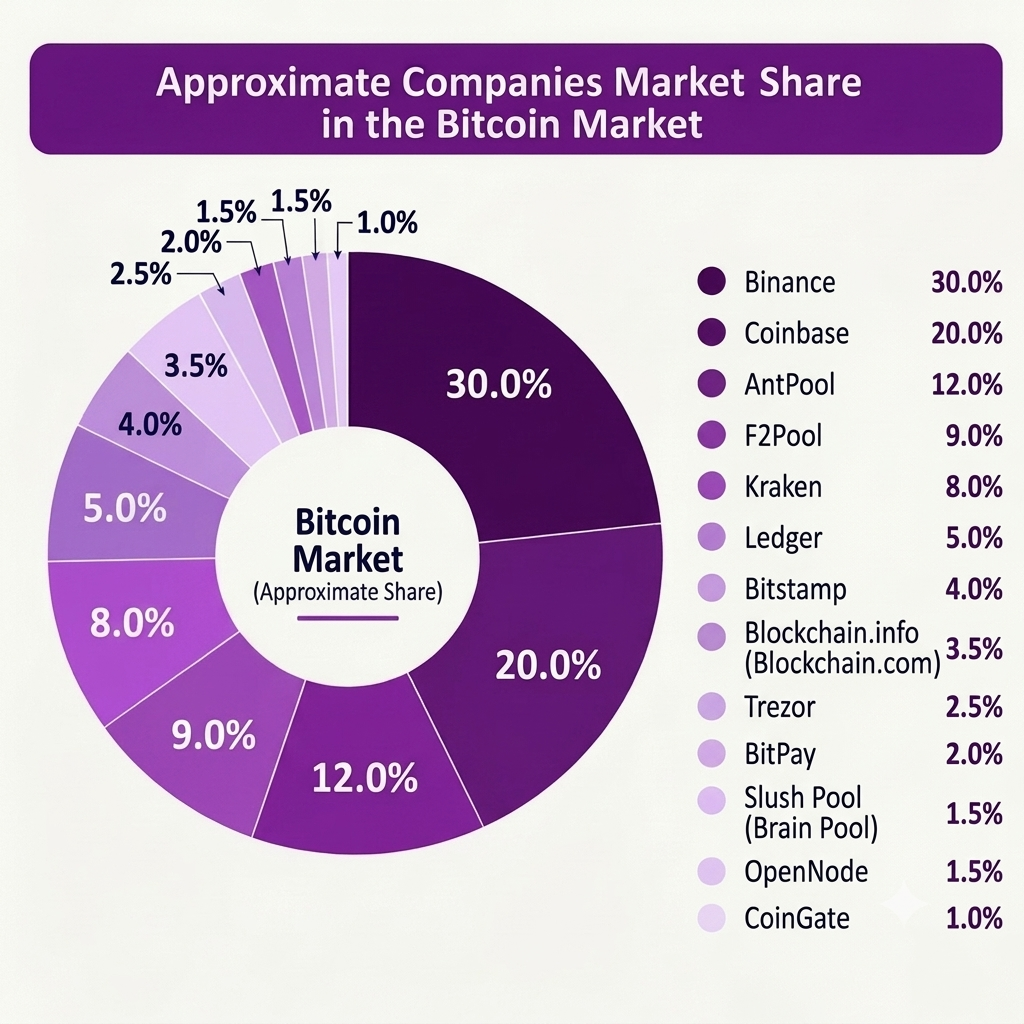
| Rank | Company | Estimated Share (%) | Basis for Estimate |
|---|---|---|---|
| 1 | Binance | 30.0% | Largest exchange: 28.5% of all spot volume and 45.3% of derivatives volume (September 2026), and 42.7% of spot volume among the top 10 exchanges (Q3 2026) |
| 2 | Coinbase | 20.0% | Leading US-regulated exchange, 5.86% of spot volume in September 2026; Bitcoin custody for institutions and ETFs |
| 3 | AntPool | 12.0% | Bitmain’s mining pool, with about 17–21% of network hashrate in 2026 |
| 4 | F2Pool | 9.0% | One of the oldest major mining pools, with about 16–18% of network hashrate in 2026 |
| 5 | Kraken | 8.0% | Top-tier exchange, with bitcoin reserves at 102.9% of client balances (June 2026) |
| 6 | Ledger | 5.0% | Leading maker of hardware wallets for storing bitcoin offline |
| 7 | Bitstamp | 4.0% | Long-established exchange with European and US licences |
| 8 | Blockchain.info (Blockchain.com) | 3.5% | Early non-custodial wallet and block explorer, plus an exchange |
| 9 | Trezor | 2.5% | Pioneer of open-source hardware wallets |
| 10 | BitPay | 2.0% | Largest Bitcoin payment processor for merchants |
| 11 | Slush Pool (Brain Pool) | 1.5% | First Bitcoin mining pool; small share of hashrate today |
| 12 | OpenNode | 1.5% | Bitcoin and Lightning payment processing |
| 13 | CoinGate | 1.0% | Payment gateway for European merchants |
Top Companies List
- Binance
- Coinbase
- AntPool
- F2Pool
- Kraken
- Ledger
- Bitstamp
- Blockchain.info
- Trezor
- BitPay
- Slush Pool
- OpenNode
- CoinGate
Binance
About Binance
Binance is the world’s largest cryptocurrency exchange, with more than 320 million registered users. It held 28.5% of all spot trading and 45.3% of derivatives trading in September 2026. Its advantage is deep liquidity and global reach. In Bitcoin, it holds about 617,000 BTC for customers and publishes regular proof-of-reserves reports showing those holdings are fully backed.
a) Company Overview Table
| Attribute | Company Data |
|---|---|
| Binance | Privately held global cryptocurrency exchange and digital asset ecosystem (Binance Holdings Ltd.) |
| Ticker Symbol | Not publicly listed (private company); native token BNB (a crypto asset, not equity) |
| Industry | Digital assets: centralised spot and derivatives exchange for cryptocurrencies, custody and Web3 services |
| Headquarters | No official global headquarters; regional hubs including Abu Dhabi and Dubai, UAE |
| Founded | 2017 |
| Founders | Changpeng Zhao (CZ) and Yi He |
| Current CEO | Richard Teng (Co-CEO since November 2023) and Yi He (Co-CEO since December 2025) |
| Latest Quarterly Revenue | Not disclosed (private); annual revenue estimates range from about USD 5 billion (CZ) to USD 16–17 billion (Forbes) |
| YoY Revenue Growth | Not disclosed; Forbes put 2024 and 2025 revenue at similar levels; 2025 trading volume about USD 34 trillion |
| Primary Segments | Spot trading (including BTC pairs), derivatives (futures and options), Binance Earn, custody and proof of reserves, BNB Chain ecosystem, payments, tokenized commodities and stocks |
b) Financial Details
Binance doesn’t publish financial results, so there are no quarterly figures to analyse. The best measures of its bitcoin business are market share and reserves. CoinDesk Research data shows it handled 28.5% of all spot trading and 45.3% of derivatives trading in September 2026, and 42.7% of spot trading among the top 10 exchanges in Q3 2026, up from 38.7% in Q2. Customers held about 657,000 BTC on Binance in its August 1, 2026 report.
CoinGlass shows the reserve wallets peaking at about 663,660 BTC on October 28 and falling to about 617,420 BTC by November 24. The main reason was the October 29 security breach, in which attackers stole about USD 6.3 billion. On November 1, as withdrawals resumed in phases, Binance processed about USD 4.65 billion in withdrawals against USD 1.01 billion in deposits, a net outflow of about USD 3.64 billion.
That was about 2.1% of its USD 171 billion in assets under management. Binance says it has covered the full loss. Its November 12 proof-of-reserves report, covering 198 tokens, showed bitcoin at 100.05% of customer balances and ether at 100.02%.
c) Strategic Developments
- Security breach and recovery (October 29 – November 2026): Attackers took about USD 6.3 billion through several breach points. Binance said it covered all affected assets, brought in outside security reviewers, and resumed withdrawals in phases from November 1.
- Wider proof of reserves (November 12–19, 2026): The report grew to cover 198 tokens, from 44 on November 4 and 10 before the breach, with zero-knowledge proofs showing bitcoin backed at 100.05%.
- Investment in Circle and USDC (2026): Binance made a USD 100 million equity investment in Circle and renewed its partnership to promote the USDC stablecoin worldwide, particularly in emerging markets.
- Expansion into commodities and stocks (from January 2026): Binance launched precious metals trading, which within three months exceeded the volume of several established commodities exchanges. Petrochemicals, tokenized stocks and pre-IPO shares followed.
- Co-CEO structure (December 2025): Co-founder Yi He became co-CEO alongside Richard Teng.
- US Justice Department forfeiture action (September 2026): Richard Teng disputed claims that a DOJ forfeiture action was aimed specifically at Binance.
- Possible IPO: In 2024, Teng said Binance did not need an IPO; in June 2025, he said he wouldn’t rule one out.
Coinbase
About Coinbase
Coinbase is the leading regulated US crypto platform, and its “Everything Exchange” combines spot, derivatives, and prediction-market trading. Its strength is regulatory trust and its role as custodian for most US spot bitcoin ETFs. In bitcoin, it held a record 10.7% share of crypto trading volume in Q3 2026, holds 18,000 BTC of its own, and supports lending against BTC collateral.
a) Company Overview Table
| Attribute | Company Data |
|---|---|
| Coinbase | Coinbase Global, Inc., a publicly listed crypto exchange, custody, and on-chain infrastructure company |
| Ticker Symbol | NASDAQ: COIN |
| Industry | Digital assets: crypto exchange, custody, derivatives, staking, stablecoins, and prediction markets |
| Headquarters | Remote-first (no physical headquarters); historically based in San Francisco, California, USA |
| Founded | 2012 |
| Founders | Brian Armstrong and Fred Ehrsam |
| Current CEO | Brian Armstrong (Co-founder, Chairman and CEO) |
| Latest Quarterly Revenue | USD 1.216 billion total revenue (Q3 2026); transaction revenue USD 590.2 million |
| YoY Revenue Growth | -35% total revenue; -44% transaction revenue (flat quarter-on-quarter) |
| Primary Segments | Transaction revenue (consumer and institutional spot trading including BTC, derivatives through Deribit, prediction markets), Subscription & Services (USDC stablecoin revenue, staking, custody, Coinbase One, BTC-backed lending), Base and other on-chain products |
b) Financial Details
Weak Bitcoin trading weighed on Coinbase’s Q3 2026 results. Total revenue fell 35% year over year to USD 1.216 billion, slightly ahead of the USD 1.21 billion consensus, and flat on Q2. Transaction revenue fell 44% to USD 590.2 million. Total crypto market trading volume dropped 10% from Q2, and price volatility fell to multi-year lows.
Coinbase’s consumer spot volume fell 9% and derivatives volume 6%. Consumer transaction revenue held at about USD 450 million, while institutional transaction revenue fell 8% to USD 92 million. Its share of crypto trading volume rose for the fourth quarter in a row, to a record 10.7%, up from 10.3% in Q2 and 5.6% a year earlier.
Subscription and services revenue was USD 570 million, about 49% of net revenue. Net income was USD 719 million (diluted EPS USD 2.51), adjusted net income USD 78 million, and adjusted EBITDA USD 333 million, up 60% from Q2. The adjusted operating margin shrank to 2.5% from 23.8%. Coinbase kept adding bitcoin to its own balance sheet, reaching 18,000 BTC, including USD 88 million bought in Q1 2026.
c) Strategic Developments
- Bitcoin on the balance sheet (Q3 2026): Coinbase bought its 18,000th bitcoin, including USD 88 million purchased in Q1 2026, and management said bitcoin volumes are rebounding and more institutions are onboarding.
- BTC as collateral: CEO Brian Armstrong highlighted the growing use of bitcoin as collateral for loans and derivatives, a trend Coinbase’s lending products are built around.
- Deribit acquisition (completed August 2025): Gave Coinbase a leading platform for bitcoin options. Derivatives and prediction markets together make up about 25% of transaction revenue.
- Prediction markets with Kalshi (launched February 2026): Passed USD 200 million in annualised revenue in Q3, offsetting lower spot bitcoin trading. Daily prediction traders rose more than 60% from Q2.
- Bitcoin ETF options: Coinbase supports the institutional market for listed options on spot bitcoin ETFs on NYSE and Cboe.
- Analyst view (November 2026): Wedbush rated Coinbase a buy, arguing that recurring revenue such as staking, custody, USDC, subscriptions, and prediction markets is undervalued. The stock hit a 52-week low of USD 98.50 on November 25, 2026.
AntPool
About AntPool
AntPool is one of the two largest Bitcoin mining pools, with about 22% of the network hashrate in November 2026. It is closely linked to Bitmain, the leading maker of mining machines. Its advantages are scale and its connection to Bitmain’s huge base of Antminer machines. It offers several payout methods (FPPS, PPS+, PPLNS, and solo), merges Namecoin and Fractal Bitcoin alongside Bitcoin, and holds SOC 1 and SOC 2 Type II security audits.
a) Company Overview Table
| Attribute | Company Data |
|---|---|
| AntPool | Privately held Bitcoin and multi-coin mining pool operated by Antpool Technologies Pte. Ltd.; spun out of Bitmain (independent since May 2021) |
| Ticker Symbol | Not publicly listed (private company) |
| Industry | Bitcoin mining infrastructure: pooled hashrate, block production and payouts to miners |
| Headquarters | Singapore |
| Founded | 2014 (launched by Bitmain) |
| Founders | Bitmain Technologies, co-founded by Jihan Wu and Micree Zhan |
| Current CEO | Not publicly confirmed in available sources |
| Latest Quarterly Revenue | Not disclosed (private); pool hashrate about 226–229 EH/s, out of about 1,048 EH/s for the whole network (November 2026) |
| YoY Revenue Growth | Not disclosed; share of blocks rose from about 17–20% in mid-2026 to about 22% by late November 2026 |
| Primary Segments | BTC mining pool (FPPS 4%, PPLNS 0–2%, PPS+, solo), merge-mining (Namecoin, Fractal Bitcoin), Smart Pool (switches between BTC, BCH and BSV), mining for other coins (LTC, DOGE, ZEC, KAS and others) |
b) Financial Details
AntPool doesn’t publish financial results, so its quarterly revenue is unknown. Its scale in bitcoin is clear from on-chain data. In late November 2026, Hashrate Index put it at 22.17% of network hashrate, about 229 EH/s, against Foundry USA’s 22.26%. Mempool.space showed them tied at 22.18%, with 242 blocks each over the trailing week. AntPool’s own dashboard showed 226 EH/s out of about 1,048 EH/s for the whole network.
Its share has risen through 2026, from about 17–19% in mid-year, helped by miners leaving Binance Pool before it closed on November 10, 2026. A pool earns from the fees it keeps: about 4% under FPPS, 0–2% under PPLNS, and 4% under PPS+. Conditions for its miners are severe.
Bitcoin’s November drop pushed hashprice, the daily revenue per unit of mining power, to a record low of about USD 0.0287 per TH per day. AntPool’s own data shows electricity now takes more than 97% of revenue for newer machines such as the Antminer T21 at USD 0.06 per kWh. That puts pressure on how much hashrate stays with the pool.
c) Strategic Developments
- Tied for first place (November 2026): Drew level with Foundry USA at about 22.2% of network hashrate, ending Foundry’s long run as the clear leader.
- BTC earnings compensation (November 20, 2026): AntPool announced a compensation programme for BTC miners’ earnings during the hashprice crash.
- Stratum V2 Working Group (May 2026): AntPool joined the working group behind the next-generation mining protocol, which improves security and gives miners more control over block construction.
- SOC 1 and SOC 2 Type II certification (January 20, 2026): Independent audits of its security and internal controls, aimed at institutional and listed mining clients.
- Network events in 2026: AntPool lost a two-block reorg (two competing versions of the chain, settled in Foundry’s favour) in March. It mined a block that didn’t signal for the proposed BIP-110 upgrade in August, and was caught up in a one-block reorg involving SpiderPool in September. These raised concerns about the concentration of mining power.
- Coin list changes (2026): Stopped mining for ETHW (July 16), Ravencoin (August 14), and TRMP, SHIC, CRC, and JKC (July 10) to focus on its main SHA-256 mining business.
- Separation from Bitmain (May 2021): According to Bitmain’s corporate history, AntPool became independent of Bitmain in May 2021, though the two remain closely aligned.
F2Pool
About F2Pool
F2Pool, founded in Beijing in 2013, is one of the oldest Bitcoin mining pools still operating at scale. It now runs as a geographically distributed pool supporting Bitcoin and more than 40 other proof-of-work networks. Its advantages are a long track record and a large, multi-coin base of miners. It consistently ranks in the top three, with about 15–17% of the Bitcoin network hashrate in November 2026.
a) Company Overview Table
| Attribute | Company Data |
|---|---|
| F2Pool | Privately held Bitcoin and multi-coin mining pool (also known as Discus Fish); merged with Stakefish in 2024 and operating under Farm Farm Inc. |
| Ticker Symbol | Not publicly listed (private company) |
| Industry | Bitcoin mining infrastructure: pooled hashrate, block production, and payouts to miners |
| Headquarters | Founded in Beijing, China; now operates as a geographically distributed pool |
| Founded | 2013 (public launch May 2013) |
| Founders | Chun Wang and Mao Shixing (Discus Fish) |
| Current CEO | Not publicly confirmed in available sources; Chun Wang is listed as co-founder and is also CEO of Stakefish |
| Latest Quarterly Revenue | Not disclosed (private); about 15–17% of network hashrate, out of about 1,040 EH/s (November 2026) |
| YoY Revenue Growth | Not disclosed; hashrate share estimates ranged from about 10% to 18% during 2026 |
| Primary Segments | BTC mining pool (FPPS 4.0%, PPLNS 2.0%; minimum payout 0.005 BTC), merge-mining (Namecoin, Fractal Bitcoin, Hathor, Elastos and others), mining for other coins (LTC, ETC, ZEC, KAS and more than 40 networks), staking through stakefish |
b) Financial Details
F2Pool doesn’t publish financial results, so its quarterly revenue is unknown. Pool data is the best measure of its bitcoin business. In early November 2026, Pickaxe put F2Pool at about 15–17% of network hashrate, third behind Foundry USA and AntPool, which were each at about 22%.
In July 2026, Axis Intelligence’s tabulation of mempool.space data had it at 17.8%. Hashrate Index put it at 10.41% in April 2026, so estimates vary depending on the date and how pools are counted. The pool’s revenue comes from its fees, now listed as 4.0% under FPPS and 2.0% under PPLNS. Those are at the higher end of the market.
Conditions for its miners are severe. Bitcoin traded at about USD 61,600 in late November; network hashrate was about 1,023–1,042 EH/s, and difficulty was expected to fall about 5.7% at the next adjustment. Together, these have pushed hash price, the daily revenue per unit of mining power, to record lows.
c) Strategic Developments
- Merger with stakefish (2024): F2Pool combined its proof-of-work mining with stakefish’s proof-of-stake validation, and the combined business began operating under Fram Farm Inc.
- Merge-mining expansion: F2Pool lets miners earn extra coins such as Namecoin, Fractal Bitcoin, Hathor, and Elastos alongside Bitcoin, with no extra hardware.
- Stratum V2 roadmap (2026): Support for the next-generation mining protocol is planned, but Stratum V1 remains the default for retail miners.
- Founders’ profile: Co-founder Chun Wang financed and commanded SpaceX’s Fram2 polar orbital mission and announced a crewed Mars flyby mission on May 21, 2026, raising the brand’s profile. These are his personal activities, not F2Pool business deals.
- Funding and acquisitions: I found no disclosed funding rounds or acquisitions specific to bitcoin in 2026.
Kraken
About Kraken
Kraken, owned by Payward, is one of the oldest bitcoin exchanges still operating, founded in 2011. It is known for strong security, regulatory licences and deep BTC/fiat markets. It is expanding into futures (NinjaTrader, Bitnomial), tokenized stocks (xStocks), and banking. Its share of industry spot trading volume rose to 6.5% in September 2026, and the Kraken app offers cashback in bitcoin.
a) Company Overview Table
| Attribute | Company Data |
|---|---|
| Kraken | Payward, Inc. (doing business as Kraken), a privately held crypto exchange and multi-asset financial platform |
| Ticker Symbol | Not publicly listed (private company); confidential draft IPO filing submitted November 2025, with no listing date set |
| Industry | Digital assets and fintech: crypto spot and derivatives exchange, futures brokerage, tokenized stocks, payments and banking |
| Headquarters | Remote-first; official press releases are datelined Cheyenne, Wyoming, USA |
| Founded | 2011 (exchange launched in 2013) |
| Founders | Jesse Powell (with early co-founders Thanh Luu and Michael Gronager) |
| Current CEO | Arjun Sethi and Dave Ripley (Co-CEOs since October 2024) |
| Latest Quarterly Revenue | USD 487 million total platform margin (Q3 2026), the company’s new metric replacing adjusted revenue; adjusted EBITDA USD 60 million |
| YoY Revenue Growth | -12% total platform margin (+12% quarter-on-quarter); adjusted EBITDA -67% |
| Primary Segments | Crypto spot trading (including BTC/fiat), derivatives and futures (Kraken Derivatives, NinjaTrader, Bitnomial), xStocks tokenized stocks, payments and banking (Krak app, Reap cards, bank in Lithuania), staking and custody, asset management (Tribe Capital, pending) |
b) Financial Details
Payward’s Q3 2026 highlights, published November 13, show a recovery from Q2 that still falls short of the 2025 crypto peak. Total platform margin was USD 487 million, up 12% from USD 436 million in Q2 but down 12% year over year. Adjusted EBITDA rose to USD 60 million from USD 23 million in Q2, but fell 67% from Q3 2025, when adjusted revenue peaked at USD 648 million.
Total platform transaction volume was USD 353 billion, up 22% from Q2 but down 30% year over year, mainly because crypto prices were weaker. Bitcoin rose about 40% between mid-August and early October, then fell back on inflation and US election worries. Kraken still gained share.
Its slice of industry spot volume rose to 6.5% in September 2026 from 3.3% a year earlier, even as industry spot volume fell 7% from Q2, according to CoinMarketCap. Contracts traded rose 84% year over year to 66 million, helped by NinjaTrader, and funded accounts rose 37% to 7.1 million. Payward doesn’t break out revenue from bitcoin specifically.
c) Strategic Developments
- Tribe Capital acquisition (November 18–19, 2026): Payward agreed to buy the venture capital and asset management firm, which has about USD 2.7 billion in assets. Terms were not disclosed. Tribe is co-founded and chaired by Kraken co-CEO Arjun Sethi.
- Acquisition spree (since March 2025): Payward has bought 10 companies, including futures broker NinjaTrader, crypto clearing house Bitnomial, and a bank in Lithuania, expanding its bitcoin derivatives and banking businesses.
- Bitcoin spending through Reap (Q3 2026): Reap launched a Virtual Asset Ledger that lets clients of its card-issuing platform spend bitcoin and other crypto from their existing balances.
- xStocks and the London Stock Exchange (Q3 2026): Plans to offer the 100 largest London-listed companies as tokenized xStocks and, subject to regulatory approval, to trade them on LSE 24. Kraken also ran an IPO Access offering for Jersey Mike’s Subs.
- AI agents (Q3 2026): AI became a fifth pillar of Payward’s strategy, with plans for an AI agent layer across all of its apps.
- IPO status: Payward confidentially filed a draft S-1 on November 19, 2025, raised about USD 800 million at a reported USD 20 billion valuation, and paused the listing in March 2026. A listing is reported to be no earlier than Q2 2027.
- Krak credit cards: New US credit cards offer up to 4% cashback in US dollars or bitcoin.
Ledger
About Ledger
Ledger is a Paris-based maker of hardware wallets. More than 8 million of its devices have been sold in over 165 countries. Its advantage is its secure-chip technology and the Donjon security research lab. In bitcoin, Ledger says it secures almost 30% of bitcoin held by retail investors, and its CEO calls “Bitcoin on a Ledger” the safest place to store value.
a) Company Overview Table
| Attribute | Company Data |
|---|---|
| Ledger | Ledger SAS, a privately held French maker of hardware wallets and security infrastructure for digital assets |
| Ticker Symbol | Not publicly listed (private company); planned NYSE IPO valued at more than USD 4 billion paused in May 2026 |
| Industry | Digital asset security: hardware wallets, self-custody software, enterprise custody |
| Headquarters | Paris, France (with offices in Vierzon, New York and other locations) |
| Founded | 2014 |
| Founders | Eric Larchevêque, Thomas France, Nicolas Bacca, Joël Pobeda, Cédric Mesnil and other co-founders |
| Current CEO | Pascal Gauthier (CEO since 2019; Chairman and CEO) |
| Latest Quarterly Revenue | Not disclosed (private); reported record 2025 annual revenue “in the hundreds of millions” of dollars |
| YoY Revenue Growth | Not disclosed; 2025 described as a record year |
| Primary Segments | Hardware wallets (Nano, Stax, Flex, Gen5, Atom), Ledger Wallet app (buy, sell, swap, earn, spend), Ledger Enterprise custody, security research (Donjon) |
b) Financial Details
Ledger doesn’t publish quarterly results, and no Q3 2026 figures are available. The latest reliable data comes from reports in January 2026 about its IPO preparations. They said Ledger had record revenue in 2025 “in the hundreds of millions” of dollars, held more than USD 100 billion of customers’ bitcoin, and was seeking a valuation of more than USD 4 billion.
That is well above the USD 1.5 billion of its 2021 Series C round, which raised USD 380 million. The deal’s advisers warned that Ledger’s revenue depends on consumer hardware cycles, as the 2022 downturn showed. That risk appeared in 2026. Ledger paused the IPO in May as the crypto market fell, and bitcoin slid to about USD 60,000 by November.
The company says it has sold more than 8 million devices and secures almost 30% of retail-held bitcoin. It is facing a tampered-device investigation that began with CryptoBilis in October 2026. Early claims put losses at USD 70 million to 103 million across 335 wallets, and Bitquery has tracked another USD 1.68 million stolen from 16 wallets in Berlin and Dubai. Ledger hasn’t confirmed loss figures and says its chip and operating system are not compromised.
c) Strategic Developments
- IPO process (January–May 2026): Ledger hired Goldman Sachs, Jefferies, and Barclays for a New York listing valued at more than USD 4 billion, then paused it in May 2026 because of market conditions. Private fundraising remains an option.
- Ledger Atom launch (October 2026, announced at Ledger Op3n): A security and privacy device that acts as both the interface and the signing device for Ledger Wallet transactions, including bitcoin. It integrates with the OpenClaw AI agent tool. Founder’s Edition reservations cost USD 849.
- New Ledger Nano and Ledger Wallet (2026): The flagship device was redesigned, and the companion app rebranded, with updated buy, sell, earn, and swap features for BTC holders.
- Tampering investigation (October–November 2026): CEO Pascal Gauthier is leading the response to tampered devices bought from CryptoBilis, with later cases in Berlin and Dubai. One case involved the newer Nano Gen5.
- CTO departure (November 19–20, 2026): Chief Technology Officer Charles Guillemet, who built the Donjon security lab, will leave at the end of 2026 to start a security company.
- Funding history: Ledger raised a USD 380 million Series C in 2021 at a valuation of more than USD 1.5 billion. No funding rounds have been announced for 2026.
Bitstamp
About Bitstamp
Bitstamp, founded in 2011, is the world’s longest-running cryptocurrency exchange. Now part of Robinhood, it is known for strict regulatory compliance, strong links to the banking system and institution-grade bitcoin liquidity. Its advantages are a MiCA licence covering the whole EU and an AA rating from the research firm Kaiko. In bitcoin, it supplies the infrastructure behind Robinhood’s international and institutional trading and perpetual futures.
a) Company Overview Table
| Attribute | Company Data |
|---|---|
| Bitstamp | Bitstamp Ltd. (“Bitstamp by Robinhood”), a cryptocurrency exchange wholly owned by Robinhood Markets, Inc. since June 2, 2025 |
| Ticker Symbol | No standalone listing; parent Robinhood Markets trades as NASDAQ: HOOD |
| Industry | Digital assets: regulated crypto spot and derivatives exchange for retail and institutional clients |
| Headquarters | Luxembourg (Bitstamp Europe S.A., licensed under MiCA) and London, UK; founded in Slovenia |
| Founded | 2011 |
| Founders | Nejc Kodrič and Damijan Merlak |
| Current CEO | JB Graftieaux (CEO at the time Robinhood completed the acquisition; current title not reconfirmed for 2026) |
| Latest Quarterly Revenue | Not reported separately; Bitstamp handled USD 29 billion of trading in Q3 2026, and Robinhood’s total crypto revenue was USD 120 million |
| YoY Revenue Growth | Bitstamp volume -28%; Robinhood crypto revenue -55% (+20% quarter-on-quarter) |
| Primary Segments | Spot crypto trading (including BTC/fiat), crypto and multi-asset perpetual futures, institutional trading through APIs and partner platforms, crypto infrastructure for Robinhood in the EU and UK |
b) Financial Details
Bitstamp doesn’t publish standalone financial results. The best guide is Robinhood’s Q3 2026 report, released October 27, 2026. Bitstamp handled USD 29 billion of trading in the quarter, down 28% year over year. That was 58% of Robinhood’s USD 50 billion total crypto volume, which fell 38%.
The Robinhood app’s own crypto volume fell 48% to USD 21 billion. Robinhood’s crypto transaction revenue fell 55% to USD 120 million, from USD 268 million a year earlier. That beat the USD 114.1 million consensus, rose 20% from Q2, and was 8.4% of Robinhood’s record USD 1.42 billion total revenue.
Bitstamp’s mostly institutional business earns less per dollar traded than Robinhood’s retail trading, so its revenue is smaller than its volume share suggests. Lower prices for bitcoin and other crypto also hit customer assets, which fell to about USD 38 billion, under 10% of Robinhood’s USD 396 billion total.
c) Strategic Developments
- US perpetual futures (announced September 29, 2026): Robinhood Derivatives is offering BTC perpetual futures with up to 10x leverage to eligible US customers through Bitstamp, charging 0.01% per trade until the end of 2026.
- Multi-asset perpetual futures (2026): Traders can take positions in commodities, currencies, equity indices and crypto perpetuals from a single pool of collateral. EU crypto perpetuals launched generally on April 9, 2026.
- Institutional connections (November 6, 2026): Trading Technologies (TT), ABEX and Trever now offer access to Bitstamp’s spot and derivatives markets.
- Migration to the Robinhood app (from October 15, 2026): Selected Bitstamp Europe retail users in the EEA and Switzerland are invited to manage their accounts through the Robinhood app.
- UK expansion (August 2026): Robinhood’s UK app added commission-free trading of more than 50 cryptocurrencies, powered by Bitstamp.
- Regulation and ratings (February–March 2026): Bitstamp obtained a virtual asset registration in the British Virgin Islands and ranked second in Kaiko’s Q1 2026 exchange ranking, its fifth AA rating in a row.
- Acquisition by Robinhood (closed June 2, 2025): The deal, worth about USD 200 million, expanded Robinhood’s crypto business internationally and with institutional clients.
Blockchain.info
About Blockchain.info
Blockchain.info, now Blockchain.com, has been a bitcoin company since 2011. It started as a block explorer, the site people use to look up bitcoin transactions, and grew into a widely used self-custody wallet with about 95 million wallets created. Its advantage is its trusted brand and an explorer that remains central to Bitcoin. It now combines self-custody with trading, BTC-backed loans, perpetual futures, and institutional API access.
a) Company Overview Table
| Attribute | Company Data |
|---|---|
| Blockchain.info | Now Blockchain.com (Blockchain.com Group Holdings Inc.), a privately held crypto wallet, exchange, and block explorer company |
| Ticker Symbol | Not publicly listed (private company); confidential draft IPO filing submitted May 21, 2026 |
| Industry | Digital assets: self-custody wallets, brokerage and exchange, block explorer, institutional trading and lending |
| Headquarters | London, UK, with US headquarters in Dallas, Texas |
| Founded | 2011 |
| Founders | Peter Smith, Nicolas Cary and Ben Reeves |
| Current CEO | Peter Smith (CEO and Executive Chairman) and Lane Kasselman (Co-CEO since November 2025) |
| Latest Quarterly Revenue | Not disclosed (private); third-party estimate of 2025 revenue of about USD 160 million (not from the company) |
| YoY Revenue Growth | Not disclosed; company says revenue grew about 1,500% over the four years to early 2024 and it has been profitable on an adjusted basis for three years |
| Primary Segments | Self-custody wallet (including BTC), brokerage and exchange, block explorer, crypto-backed loans, perpetual futures (via Hyperliquid), prediction markets (Polymarket, SnapMarkets), tokenized stocks, institutional API trading |
b) Financial Details
Blockchain.com has never published revenue or EBITDA figures, so there are no Q3 2026 results to analyse. The best financial guides are its IPO disclosures and outside estimates. It filed confidentially for an IPO on May 21, 2026. Bloomberg reported in September that it was seeking to raise about USD 500 million at a valuation of USD 4 billion to 6 billion. That is below its last private valuation of about USD 7 billion and its 2022 peak of USD 14 billion.
The company says revenue grew about 1,500% over the four years to early 2024 and that it has been profitable on an adjusted basis for three years. Third-party estimates put 2025 revenue in the low hundreds of millions of dollars, with one tracker at about USD 160 million, but none comes from the company.
QuantLogix reports about 95 million wallets and USD 1.1 trillion of lifetime trading volume. The listing window is weak: bitcoin was just above USD 60,000 in late November 2026, and Gemini shares are down about 85% from their IPO price.
c) Strategic Developments
- IPO process (May–September 2026): Blockchain.com filed confidentially for a US IPO in May, and Bloomberg reported a target raise of about USD 500 million at a valuation of USD 4 billion to 6 billion. No exchange or price range has been set.
- CFTC licence applications (October 9, 2026): Applied to become a designated contract market and register as a futures commission merchant, which would let it offer crypto derivatives and event contracts in the US.
- NYSE tokenized stocks partnership (September 23, 2026): Agreed with the New York Stock Exchange to explore blockchain-based tokens for NYSE-listed stocks and ETFs.
- Institutional API trading (November 6, 2026): Launched 24/7 API trading access for institutions.
- BTC-backed loans and perpetual futures (April–May 2026): Launched crypto-backed loans worldwide and perpetual futures inside its self-custody wallet, with leverage up to 40x through Hyperliquid.
- Licences (2026): Received UK FCA registration in February, adding to its EU MiCA licence, and a full Cayman Islands custody licence (VASP) in August.
- Stack BTC investment (March 9, 2026): Invested in the bitcoin treasury company Stack BTC alongside Nigel Farage and Kwasi Kwarteng.
- Prediction markets (2026): Launched SnapMarkets in May and offers Polymarket markets to some international customers.
Trezor
About Trezor
Trezor, made by SatoshiLabs, released the first bitcoin hardware wallet in 2013 and remains a leader in self-custody. Its advantages are fully open-source firmware and the Safe 7, the first wallet with a transparent, inspectable secure chip (TROPIC01) built to resist future quantum attacks. Trezor Suite supports Bitcoin users with multisig, CoinJoin privacy history, passphrases of up to 128 characters, and address-safety warnings.
a) Company Overview Table
| Attribute | Company Data |
|---|---|
| Trezor | Trezor brand of SatoshiLabs s.r.o., a privately held Czech maker of open-source hardware wallets |
| Ticker Symbol | Not publicly listed (private company) |
| Industry | Digital asset security: hardware wallets and self-custody software |
| Headquarters | Prague, Czech Republic |
| Founded | 2013 (SatoshiLabs); first Trezor Model One shipped in 2014 |
| Founders | Marek “Slush” Palatinus and Pavol “Stick” Rusnák |
| Current CEO | Not confirmed in 2026 sources (Matěj Žák has previously been reported as CEO) |
| Latest Quarterly Revenue | Not disclosed (private); annual estimates conflict, at about USD 6.7 million (GetLatka, December 2025) and USD 47.2 million (Quantumrun, 2025) |
| YoY Revenue Growth | Not disclosed; no reliable figure for growth |
| Primary Segments | Hardware wallets (Safe 7, Safe 5, Safe 3, Model T, Model One), Trezor Suite desktop and mobile apps (including BTC buy, sell, swap, and CoinJoin history), Keep Metal backup, accessories |
b) Financial Details
SatoshiLabs doesn’t publish financial results, so there are no quarterly figures for Trezor. The two public revenue estimates are far apart: about USD 6.7 million a year from GetLatka (December 2025) and USD 47.2 million from Quantumrun (2025). Neither comes from the company, so both should be treated as unverified. Recent news points more to operating costs and risks to the brand than to revenue gains.
Trezor confirmed hardware implants in three Safe 5 devices bought through the former reseller CryptoBilis between August 20 and September 23, 2026, sold directly or through its Tokopedia and Shopee stores. In response, it cut about 80% of its resellers, which could reduce sales in Southeast Asia. It also offered free replacements to anyone who bought from CryptoBilis from March 2026 onward.
On top of that, breaches at its shipping partners exposed customer data: 13,689 customers through ShipMonk in August, and about 27,000 orders through Skladon on November 7. As of November 24, Trezor said it had found no confirmed crypto losses from the implants and no compromised Safe 7 devices.
c) Strategic Developments
- Response to tampered devices (October–November 2026): Trezor issued a warning about CryptoBilis on October 30, released firmware 2.13.1 on November 11 to block the known implants, and cut about 80% of its resellers to secure its supply chain.
- Safe 7 launch: The first hardware wallet with a transparent, inspectable secure chip (TROPIC01) and a design built to resist future quantum attacks. Trezor said funds remained safe after Ledger’s Donjon lab found a TROPIC01 chip flaw in physical-access testing in June 2026.
- Trezor Suite updates (October–November 2026): Passphrases can now be up to 128 characters, after weak backups on some Coldcard devices led to thefts. Suite now warns before sending to addresses you have never used, to counter phishing, and supports more networks (Arc, Stellar Soroban and Solana v1 transactions).
- Breach disclosures (August and November 2026): Disclosed the ShipMonk breach (13,689 customers) on August 13 and the Skladon breach (about 27,000 orders) on November 16. Trezor’s own systems and wallet backups were not affected.
- Theft investigation (November 21–24, 2026): Trezor is investigating the reported theft of more than USD 600,000 from a Safe 7 paired with an iPhone. It said the device came directly from Trezor and showed no implant.
- Funding: No external funding rounds or acquisitions were announced in 2026. SatoshiLabs funds itself and is linked to the chip designer Tropic Square and the Braiins mining businesses.
BitPay
About BitPay
BitPay, founded in 2011, is the world’s longest-operating cryptocurrency payments company. It lets merchants accept bitcoin and stablecoins and settle in cash, and offers a self-custody wallet for consumers. Its advantages are 15 years of merchant relationships, regulatory licences including MiCA, and tools for paying with bitcoin: payment processing, payouts, gift cards from more than 200 brands, bill payments and travel bookings.
a) Company Overview Table
| Attribute | Company Data |
|---|---|
| BitPay | BitPay, Inc., a privately held cryptocurrency payments processor and self-custody wallet provider |
| Ticker Symbol | Not publicly listed (private company) |
| Industry | Fintech and digital assets: crypto payment processing, payouts, and consumer wallets |
| Headquarters | Atlanta, Georgia, USA (EU subsidiary BitPay B.V., Netherlands) |
| Founded | 2011 |
| Founders | Stephen Pair and Tony Gallippi |
| Current CEO | Stephen Pair (CEO and Co-founder) |
| Latest Quarterly Revenue | Not disclosed (private); 2025 payment volume worth “hundreds of millions of dollars” |
| YoY Revenue Growth | Not disclosed; payment volume +12% in 2025, stablecoin volume +50% |
| Primary Segments | Merchant payment processing (BTC, stablecoins and other assets), business payouts, BitPay Wallet (buy, sell, swap, Threshold Signature wallets), gift cards (200+ brands), Bill Pay, BitPay Travel, auction payments |
b) Financial Details
BitPay doesn’t publish revenue or quarterly results, so the best guides are the business figures it releases. According to its Decrypted 2025 report, payment volume grew 12% in 2025, worth “hundreds of millions of dollars”, with an average transaction of USD 800. Stablecoins made up 40% of payment volume, up from 30% in 2024.
Payouts rose to 19% of transactions from 13%, and wallet users bought, sold and swapped more than USD 100 million of crypto through BitPay’s partners. In June 2026, BitPay said it had processed more than 900,000 payments, with volume up 12% year over year, stablecoin volume up 50%, and stablecoins now almost half of all volume.
The steady rise of stablecoins means bitcoin’s share of payment volume is shrinking, likely to about half or less, even though total volume is growing. In November 2026, Chief Revenue Officer Bill Zielke said bitcoin and stablecoins complement each other rather than compete. Bitcoin’s slide to about USD 60,000 in November likely reduced how much bitcoin users chose to spend, but BitPay has not published figures for Q3 or Q4 2026.
c) Strategic Developments
- Threshold Signature wallets (November 18, 2026): Launched a beta of shared wallets in the BitPay app that split control of the private key between several people, for jointly held bitcoin.
- One-tap crypto buying (November 5, 2026): Introduced a checkout powered by MoonPay that lets users buy BTC and other crypto with Apple Pay, Google Pay, cards, and SEPA in more than 100 countries.
- Gift card expansion (November 19, 2026): Added more than 50 brands in 2026, bringing the total to over 200, including DoorDash, Gap, H&M, Nintendo and IKEA, all payable in bitcoin.
- MiCA licence (July 16, 2026): BitPay B.V. in the Netherlands obtained a MiCA licence, letting it offer regulated crypto and stablecoin payments across the EU.
- Network and market expansion (2026): Added XRP to the wallet in August, added support for Solana (SOL) and its stablecoins, and launched crypto payments and the wallet app in the UK.
- Bitcoin spending partners: BitPay Travel, run with Xeni, lets users book flights, hotels, and car rentals with bitcoin. Users can also bid with bitcoin at auction houses such as Sotheby’s, Heritage Auctions, and Fanatics Collect.
- Funding: BitPay has raised more than USD 70 million from investors including Index Ventures, Founders Fund, Aquiline, Menlo Ventures and Richard Branson. No new funding round was announced in 2026.
Slush Pool
About Slush Pool
Slush Pool, renamed Braiins Pool, is the world’s longest-running Bitcoin mining pool, launched in 2010, with more than 1.29 million BTC mined. Its advantage is protocol leadership: it created the Stratum mining protocol, co-developed Stratum V2, and makes Braiins OS miner firmware. It offers FPPS payouts, Lightning payouts, no KYC requirement, and zero pool fees for miners running Braiins OS.
a) Company Overview Table
| Attribute | Company Data |
|---|---|
| Slush Pool | Now Braiins Pool, operated by Braiins (Braiins Systems s.r.o.), a privately held Czech company making Bitcoin mining pool, firmware, and software products |
| Ticker Symbol | Not publicly listed (private company) |
| Industry | Bitcoin mining infrastructure: mining pool, miner firmware, hashrate marketplace, and mining software |
| Headquarters | Prague, Czech Republic |
| Founded | 2010 (first public Bitcoin mining pool); rebranded as Braiins Pool in 2022 |
| Founders | Marek “Slush” Palatinus (with Pavol “Stick” Rusnák, co-founder of the parent company) |
| Current CEO | Eli Nagar (CEO of Braiins since September 2022) |
| Latest Quarterly Revenue | Not disclosed (private); pool hashrate about 13.9–16.1 EH/s, about 1.6% of the network (November 2026) |
| YoY Revenue Growth | Not disclosed; historical share of network hashrate about 1–3% |
| Primary Segments | Braiins Pool (FPPS, solo, Lightning payouts, 0% fee with Braiins OS), Braiins OS miner firmware, Stratum V2 software, Braiins Hashpower marketplace, mining management and monitoring tools |
b) Financial Details
Braiins doesn’t publish financial results, so there are no quarterly revenue figures. Its live dashboard shows about 13.91 EH/s of hashrate, 177,359 active workers, 13,112 active users, and 1,294,383 BTC mined since 2010. MiningRadar measures about 16.1 EH/s, or 1.6% of the tracked network hashrate. That makes Braiins Pool much smaller than Foundry USA and AntPool, each at about 22%, but it has stayed in the top ten.
The pool earns its revenue from the fees it keeps on FPPS payouts. It charges no pool fee to miners running Braiins OS, which encourages them to use its firmware. The firmware, in turn, generates revenue from devfees, a small share of hashrate the firmware directs to Braiins.
Conditions were difficult in late 2026, with hash price at record lows, bitcoin at about USD 60,000 and difficulty down 9.13% to 134.82T on November 25. On November 20, forged internet routes redirected more than 1,000 mining sites on unencrypted Stratum V1 connections to an imposter pool. Braiins said this added pressure on miners’ revenue but published no figure for the bitcoin diverted.
c) Strategic Developments
- Hashrate hijacking alert (November 25, 2026): Braiins warned that forged internet routes on November 20 redirected more than 1,000 mining sites to a fake pool. It tested seven miner firmwares on November 20 and 23 and urged miners to switch to encrypted Stratum V2.
- Stratum V2 leadership: Braiins Pool supports Stratum V2 natively, which encrypts mining connections and lets miners choose which transactions go into their blocks. Braiins co-wrote the protocol, though under 5% of total hashrate used it in mid-2026.
- Industry engagement (2026): CEO Eli Nagar presented Braiins’ approach to mining at Bitmain’s WDMS Global 2026 in Hong Kong and spoke at the Energy Investors Forum 2026. Braiins also sponsored NABS 2026.
- Payout features (2026): FPPS payouts start at a minimum of 0.0002 BTC, with free on-chain payouts from 0.005 BTC. Lightning payouts are instant, and a separate solo mining option is available.
- Related businesses: CEO Eli Nagar sits on the board of Firefish, a bitcoin-backed lending platform. Braiins is linked to SatoshiLabs, the maker of Trezor, through its founders.
- Funding: I found no disclosed external funding rounds or acquisitions in 2026.
OpenNode
About OpenNode
OpenNode is a bitcoin-only payment processor that lets businesses accept bitcoin and send bitcoin payouts, including over the Lightning Network, through APIs, e-commerce plugins, and hosted checkouts. Its advantages are early expertise in Lightning, instant settlement, and split settlement, which lets merchants keep part of each payment in BTC and convert the rest to local currency.
a) Company Overview Table
| Attribute | Company Data |
|---|---|
| OpenNode | OpenNode, Inc., a privately held bitcoin and Lightning payment processor (Delaware corporation) |
| Ticker Symbol | Not publicly listed (private company) |
| Industry | Fintech and digital assets: bitcoin payment processing, payouts and settlement infrastructure |
| Headquarters | California, USA (third-party databases list Los Angeles; CEO based in Miami, Florida) |
| Founded | 2018 |
| Founders | Afnan Rahman and João Almeida |
| Current CEO | Matthew Fox (CEO since October 2022, according to his LinkedIn profile) |
| Latest Quarterly Revenue | Not disclosed (private company) |
| YoY Revenue Growth | Not disclosed |
| Primary Segments | Bitcoin and Lightning payment processing (API, hosted checkout, payment buttons, e-commerce plugins), payouts and payroll, invoicing, in-person point-of-sale, conversion and split settlement into local currencies |
b) Financial Details
OpenNode doesn’t publish financial results, and I found no estimates of its revenue, payment volume or merchant numbers for 2026. Its pricing shows how it makes money. According to its help centre (updated August 11, 2026), payment and payout processing fees are typically 1%.
It charges no setup, monthly, or minimum fees, and no conversion fees. Scheduled weekly bitcoin withdrawals and on-demand Lightning withdrawals are free, while on-demand on-chain withdrawals cost 1%, with a minimum of 0.002 BTC. Revenue therefore depends directly on the value of bitcoin payments it processes.
Bitcoin’s fall to about USD 60,000 in November 2026 and weaker crypto spending, seen in Robinhood’s 55% drop in crypto revenue in Q3, point to a difficult environment. That is an inference from market conditions, not from OpenNode’s own figures. As of October 9, 2026, Coins Rate found its payment, node, API, and withdrawal services fully operational.
c) Strategic Developments
- Series A (early 2022): Raised USD 20 million led by Kingsway Capital, with Cathay Innovation, Draper Associates, LAUNCH, Twitter, Avon Ventures and Tim Draper. Total funding is about USD 21.3 million, including a USD 1.3 million seed round in November 2018 led by Draper Associates.
- Change of CEO (October 2022): Matthew Fox, a former investment banker and managing partner of an investment firm, became CEO.
- Ecommerce plugins: Official plugins for Shopify, BigCommerce, WooCommerce, Magento, PrestaShop and OpenCart let online merchants accept bitcoin and Lightning payments.
- Split settlement and conversion: Merchants can keep a chosen share of each payment in BTC and convert the rest into EUR, GBP, USD or other local currencies, from more than 190 billing currencies.
- Compliance: OpenNode is a registered money services business with anti-money-laundering and OFAC sanctions controls, and offers multisignature support, withdrawal limits, and IP whitelisting.
- 2026 activity: I found no funding rounds, acquisitions, or partnerships announced in 2026.
CoinGate
About CoinGate
CoinGate, founded in Vilnius in 2014, is a crypto payment gateway that lets businesses accept bitcoin and stablecoins, settle in fiat currencies and send payouts in bulk. Its main advantage is regulation: it holds both a MiCA licence and a payment institution licence from the Bank of Lithuania. It has processed more than 7 million payments, and bitcoin remains its most-used network, with Lightning handling 9.6% of BTC payments.
a) Company Overview Table
| Attribute | Company Data |
|---|---|
| CoinGate | CoinGate, operated by UAB Decentralized, a privately held Lithuanian crypto and stablecoin payment gateway |
| Ticker Symbol | Not publicly listed (private company) |
| Industry | Fintech and digital assets: crypto payment processing, settlement, billing, and payouts |
| Headquarters | Vilnius, Lithuania |
| Founded | 2014 |
| Founders | Irmantas Bačiulis (CTO and Co-founder); the full list of founders is not confirmed in available sources |
| Current CEO | Vilius Semėnas |
| Latest Quarterly Revenue | Not disclosed (private); annual estimates of about USD 8.5–8.7 million (GetLatka, Prospeo) |
| YoY Revenue Growth | Not disclosed; paid orders +21.4% year over year in H1 2026 |
| Primary Segments | Merchant crypto payment processing (BTC, Lightning, USDC, EURC and others), fiat settlement (EUR, GBP, USD), billing and recurring invoices, payouts through API and batches, e-commerce plugins, gift cards |
b) Financial Details
CoinGate doesn’t publish financial results. The best guide to recent performance is its H1 2026 Crypto Payments Data Report. It processed 782,403 paid orders in the first half of 2026, about one every 20 seconds, up 21.4% from H1 2025 and level with H2 2025.
Bitcoin’s role in payments is shrinking. USDC overtook BTC as the most-used payment asset, at 22.1% against 21.0%, although Bitcoin remained the most-used network, and the Lightning Network handled 9.6% of BTC payments. Merchants converted 75.4% of orders to fiat, and the share settled in crypto has fallen for three half-years in a row.
That points to growing demand from businesses for payments in stablecoins and cash rather than BTC. Payouts rose sharply to 8,155, from 957 a year earlier, with 93.2% sent through the API. Data firms estimate annual revenue at about USD 8.5–8.7 million. CoinGate’s fee is listed as 1% per payment on the Standard plan, so revenue tracks payment volume. Its status page shows API uptime of about 99.985% at the end of November 2026.
c) Strategic Developments
- MiCA and payment institution licences (December 16–17, 2025): The Bank of Lithuania granted UAB Decentralized a MiCA crypto-asset service provider licence (LB002323) and a payment institution licence. CoinGate kept operating when Lithuania began enforcing MiCA on January 1, 2026, and more than 370 registered crypto firms lost the right to operate.
- Bitcoin Cash restored (October 12, 2026): BCH returned to checkout, settlement, and crypto payouts.
- Binance Pay Marketplace (November 2026): CoinGate Gift Cards is a participating merchant in Binance Pay’s promotion offering up to 10% off.
- 2026 product roadmap: Plans include recurring invoices, dedicated deposit addresses, on-chain subscriptions, real-time payouts and withdrawals, USD deposits via SWIFT, yield on idle balances, and payouts using only an email address.
- Operational changes (2026): Settlements moved to a weekly cycle with a EUR 50 minimum withdrawal, and the list of supported assets was cut to 13, with Bitcoin still the main network.
- Funding: I found no disclosed funding rounds or acquisitions in 2026.
Conclusion
The Bitcoin ecosystem has grown into a broad industry of exchanges, custodians, mining pools, wallet makers, and payment processors, with institutional adoption as its main long-term driver. In the near term, though, conditions are tough. Sharp price declines, outflows from spot ETFs and large liquidations of leveraged positions have weakened trading activity and squeezed revenues. A few large players still dominate.
Binance leads global trading, but its security breach showed the risks of holding so much in one place. Coinbase is turning its regulatory trust and its role as an ETF custodian into a more varied business built on custody, stablecoins, derivatives and prediction markets. In mining, a small number of pools such as AntPool and Foundry produce most new blocks, which keeps concerns about centralisation alive.
The industry’s next phase will depend on how well companies handle volatility, security risk and tighter regulation. Miners are under heavy pressure as falling hash price and high electricity costs eat into their margins. That pushes them toward larger pools, better protocols, and more efficient operations. Exchanges are expanding transparent proof-of-reserves reporting and moving into recurring revenue sources to depend less on trading volume.
Hardware wallet makers and payment processors serve users who want to hold bitcoin themselves and merchants who want to accept it. The companies most likely to last are the ones that combine strong security, regulatory credibility, transparent reserves, and diversified income, so they can survive downturns and benefit from the next wave of institutional adoption.