Report Overview
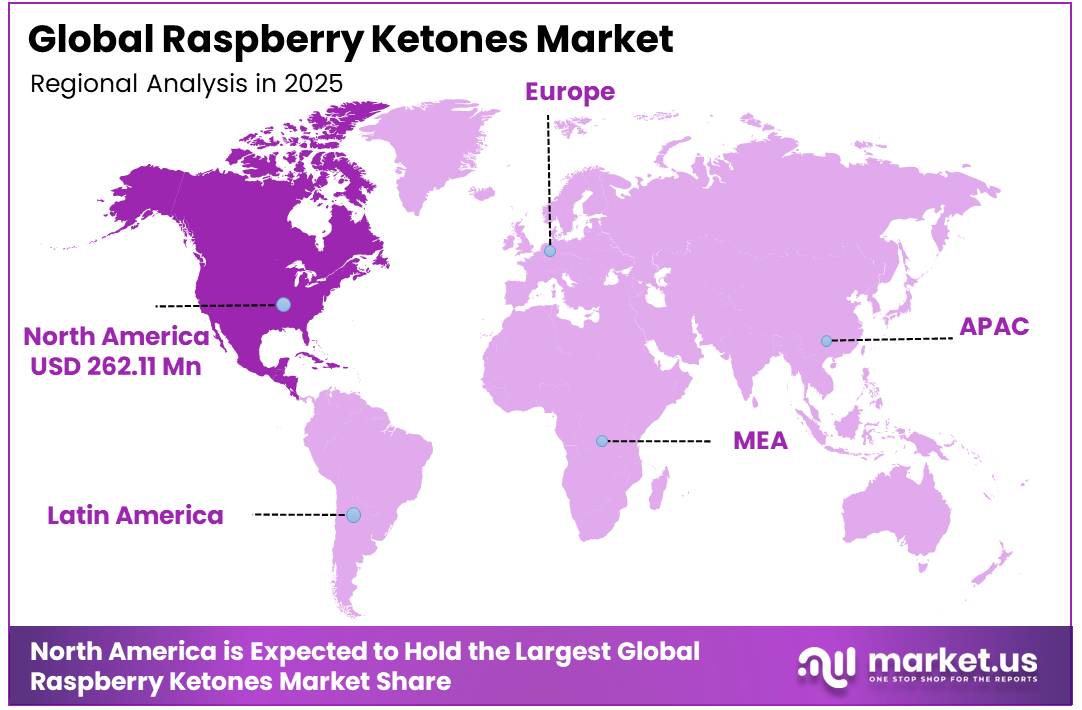
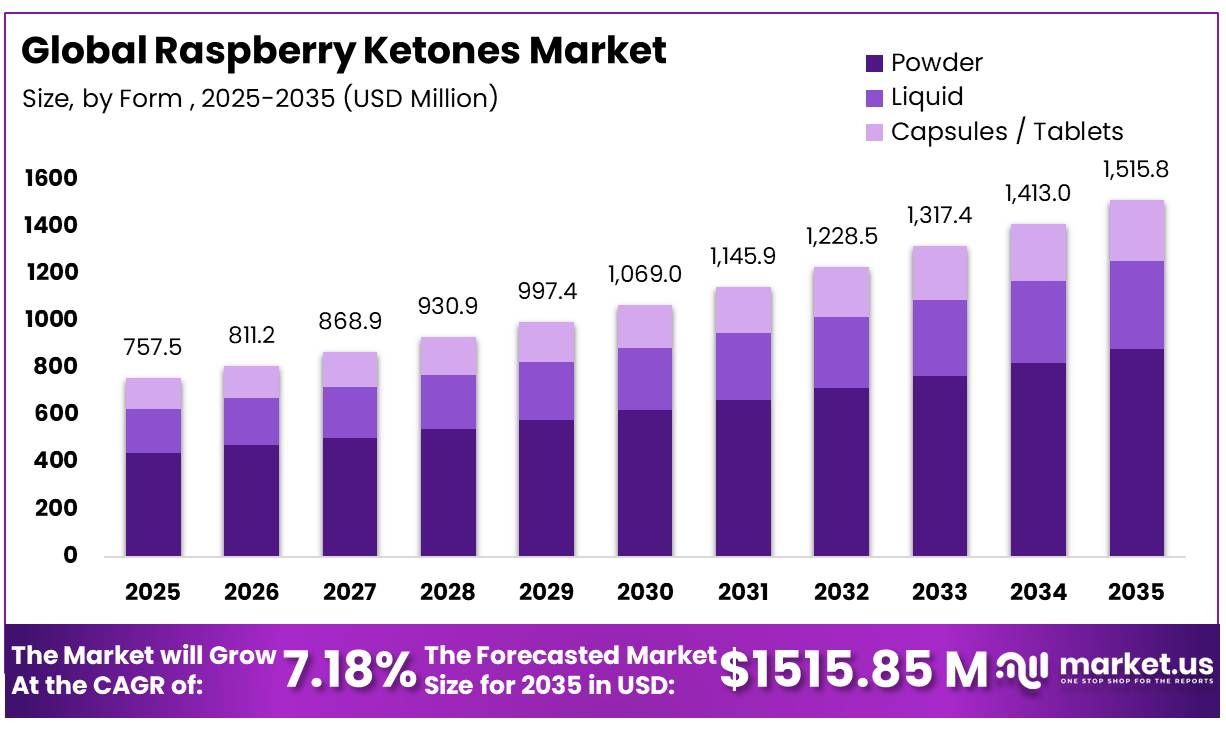
In 2025, the Global Raspberry Ketones Market was valued at USD 757.53 Million, and between 2026 and 2035, this market is estimated to register a CAGR of 7.18%, reaching about USD 1515.85 Million by 2035. North America held a dominant market position, capturing more than a 34.60% share, holding USD 262.11 Million in revenue.
Raspberry ketone is a specialty aroma chemical identified as 4-(4-hydroxyphenyl)-2-butanone, with molecular formula C10H12O2 and CAS number 5471-51-2. It occurs naturally in raspberries and other fruits, but extraction yields are only about 1–4 milligrams per kilogram of fruit. This low recovery makes direct botanical extraction costly and supports the industrial use of synthetic and biotechnology-based production routes. The industry serves food flavours, perfumes, cosmetics and dietary supplements.
- In the United States, the Food and Drug Administration lists raspberry ketone as a flavouring agent or adjuvant under 21 CFR 172.515, with FEMA number 2588 and JECFA flavour number 728. This regulatory recognition supports its established use in low-dose flavour systems, while producers must still meet purity, labelling and intended-use requirements
Key Takeaways
- The Global raspberry ketones market was valued at USD 757.53 million in 2025.
- The Global market is projected to grow at a CAGR of 7.18% and is estimated to reach USD 1,515.85 million by 2035.
- On the basis of form, powder dominated the market, constituting 58.20% of the total market share.
- Based on the application, perfume and fragrance dominated the raspberry ketones market, with a substantial market share of around 43.20%.
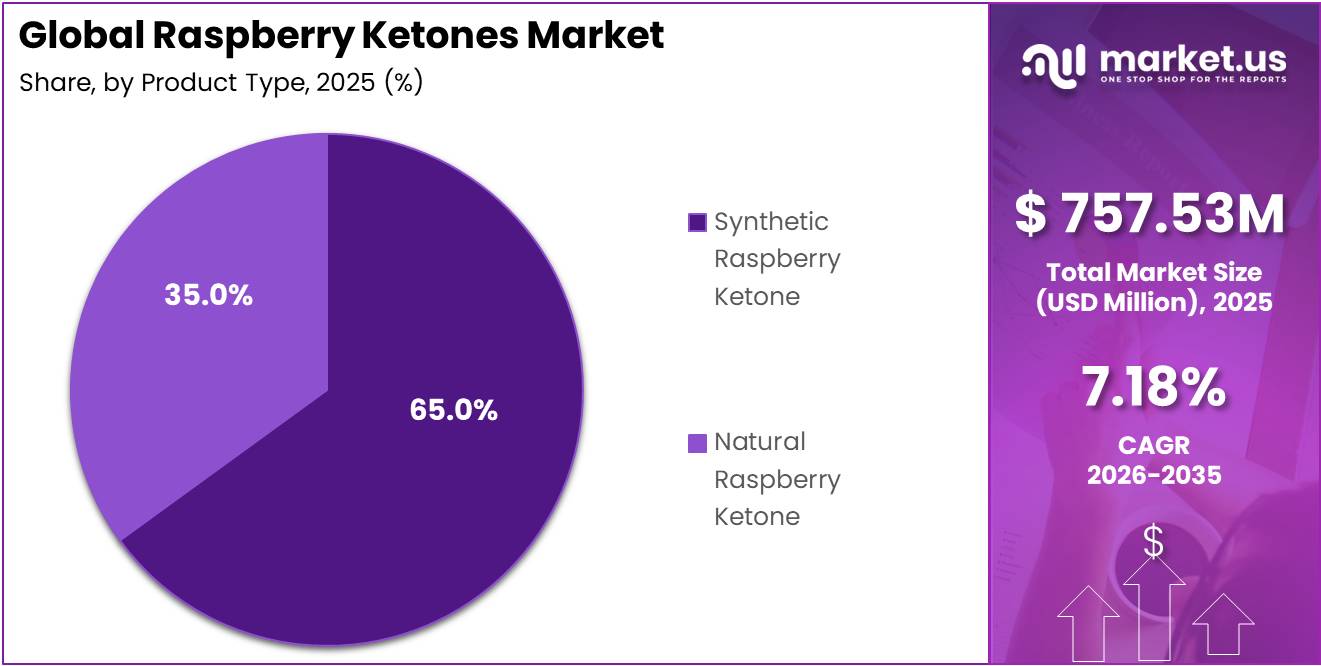
- Based on the product type, synthetic raspberry ketone led the market, comprising 65.00% of the total market.
- Among the distribution channels, B2B bulk held a major share in the raspberry ketones market, accounting for 58.10% of the market share.
- In 2025, North America was the most dominant region in the raspberry ketones market, accounting for 34.60% of the total global market.
Demand is strengthened by the scale of downstream fragrance and personal-care manufacturing. Cosmetics Europe reported that European cosmetics and personal-care retail sales reached €110 billion in 2025.
- Fragrances and perfumes represented €17.1 billion, while cosmetic exports totalled €29.8 billion. The United States supplement channel also provides commercial exposure: the NIH Dietary Supplement Label Database contains more than 200,000 product labels, although it includes both current and discontinued products.
Future opportunities are expected to centre on cleaner synthesis, fermentation and precision biomanufacturing. A peer-reviewed cell-free biosynthesis study achieved 33.7% conversion, equal to 337 micromolar raspberry ketone, after operating initially at 0.63 micromolar per minute for up to six hours. Such methods could reduce dependence on fruit extraction, improve batch consistency and support natural-positioned ingredients.
Growth will nevertheless depend on stronger toxicology evidence, transparent sourcing and careful separation between permitted flavour use and high-dose supplement claims. Suppliers that combine scalable production, verified purity and regulatory documentation are likely to gain stronger positions across fragrance, cosmetic and food applications. Formulator partnerships can accelerate customized grades, traceability systems and lower-impact manufacturing across international supply chains.
Form Analysis
Powder Leads with 58.20% as Easy Handling Supports Wider Formulation Use
In 2025, Powder form held a dominant market position, capturing more than a 58.20% share. The segment remained ahead because powdered raspberry ketone is practical for measuring, blending, storage, and transportation across formulations. Its solid format supports controlled dosing in dry mixes, capsules, tablets, fragrance compounds, and other ingredient systems. Powder reduces leakage risk during handling and can be incorporated into production batches without requiring liquid-specific storage equipment, supporting use across fragrance, food, supplement, and personal care manufacturing.
- In October 2025, according to dsm-firmenich, its advanced powder technology was designed to address six common formulation issues, including stability, taste, uniformity, and flow, while supporting consistent performance in premix applications.
Liquid raspberry ketone is the fastest growing segment because it can be incorporated directly into perfumes, cosmetic blends, beverages, and other fluid formulations. Its ready-to-use format supports dispersion and can reduce additional dissolution steps during production. Liquid formats are useful when manufacturers require accurate dosing into continuous mixing systems or want more even distribution throughout fluid products. Wider use of convenient ingredient formats is supporting adoption across fragrance and formulation applications.
Application Analysis
Perfume & Fragrance Leads with 43.20% as Its Fruity Aroma Supports Broad Product Use
In 2025, Perfume & Fragrance held a dominant market position, capturing more than a 43.20% share. The segment remained central because raspberry ketone provides a fruity raspberry note that suits fine fragrances and scented personal care products. Fragrance formulators use the ingredient in perfumes, body sprays, deodorants, soaps, and related products where a recognizable berry character is required. Its odor profile also helps build fruity and gourmand accords while supporting consistency across production batches.
- In June 2026, according to Cosmetics Europe, Europe’s cosmetics and personal care retail sales reached €110 billion in 2025, while fragrances and perfumes were valued at €17.1 billion and skin care reached €32.3 billion.
Dietary Supplements are the fastest growing segment as raspberry ketone continues to appear in capsules, powders, and wellness formulations. Manufacturers value its familiar fruit-derived identity and compatibility with supplement formats, although positioning depends on applicable safety and labeling requirements. Growth in wellness retail and specialized nutrition channels is improving product visibility. Demand for convenient supplement formats is supporting wider availability, particularly among brands targeting consumers seeking fruit-associated ingredients in everyday wellness products.
Product Type Analysis
Synthetic Raspberry Ketone Leads with 65.00% as Consistent Quality Supports Commercial Supply
In 2025, Synthetic Raspberry Ketone held a dominant market position, capturing more than a 65.00% share. The segment remained ahead because synthetic production provides consistent aroma, controlled specifications, and dependable availability for manufacturing. It is suited to perfumes, flavoring systems, cosmetics, and supplement formulations where manufacturers require repeatable quality across batches.
- In July 2025, according to the International Fragrance Association, its updated Transparency List contained 3,691 fragrance and functional ingredients, including 3,312 fragrance ingredients and 1,021 Natural Complex Substances used across the global fragrance industry.
Natural Raspberry Ketone is the fastest growing segment as manufacturers respond to demand for naturally sourced and clean-label ingredients. Natural variants are positioned for premium fragrances, personal care products, and selected food or supplement applications where ingredient origin carries value. Advances in extraction, fermentation, and biotechnology are improving commercial possibilities, while attention to traceability and sustainable sourcing is supporting interest among brands seeking ingredient stories and naturally positioned formulations.
Distribution Analysis
B2B (Bulk) Leads with 58.10% as Large-Volume Purchasing Supports Consistent Industrial Supply
In 2025, B2B (Bulk) held a dominant market position, capturing more than a 58.10% share. The channel remained preferred by fragrance houses, supplement producers, cosmetic manufacturers, and food formulators that require ingredient supply for production. Bulk purchasing helps industrial buyers coordinate procurement, maintain specification consistency, and plan inventory across manufacturing cycles.
- In May 2026, according to the U.S. Census Bureau, first-quarter 2026 retail e-commerce sales reached $326.7 billion, increased 9.8% from the first quarter of 2025, and represented 16.9% of total U.S. retail sales.
Online Retail is the fastest growing segment as laboratories, small manufacturers, independent formulators, and individual buyers seek convenient access to specialty ingredients. Digital channels allow purchasers to compare formats, review technical information, and order smaller quantities without bulk contracts. Expanding e-commerce activity, easier product discovery, and delivery are improving accessibility.
Key Market Segments
By Form
- Powder
- Liquid
- Capsules / Tablets
By Application
- Perfume & Fragrance
- Dietary Supplements
- Cosmetics & Personal Care
- Food & Beverages
- Pharmaceuticals
By Product Type
- Synthetic Raspberry Ketone
- Natural Raspberry Ketone
By Distribution Channel
- B2B (Bulk)
- Online Retail
- Specialty Stores