


Report Overview
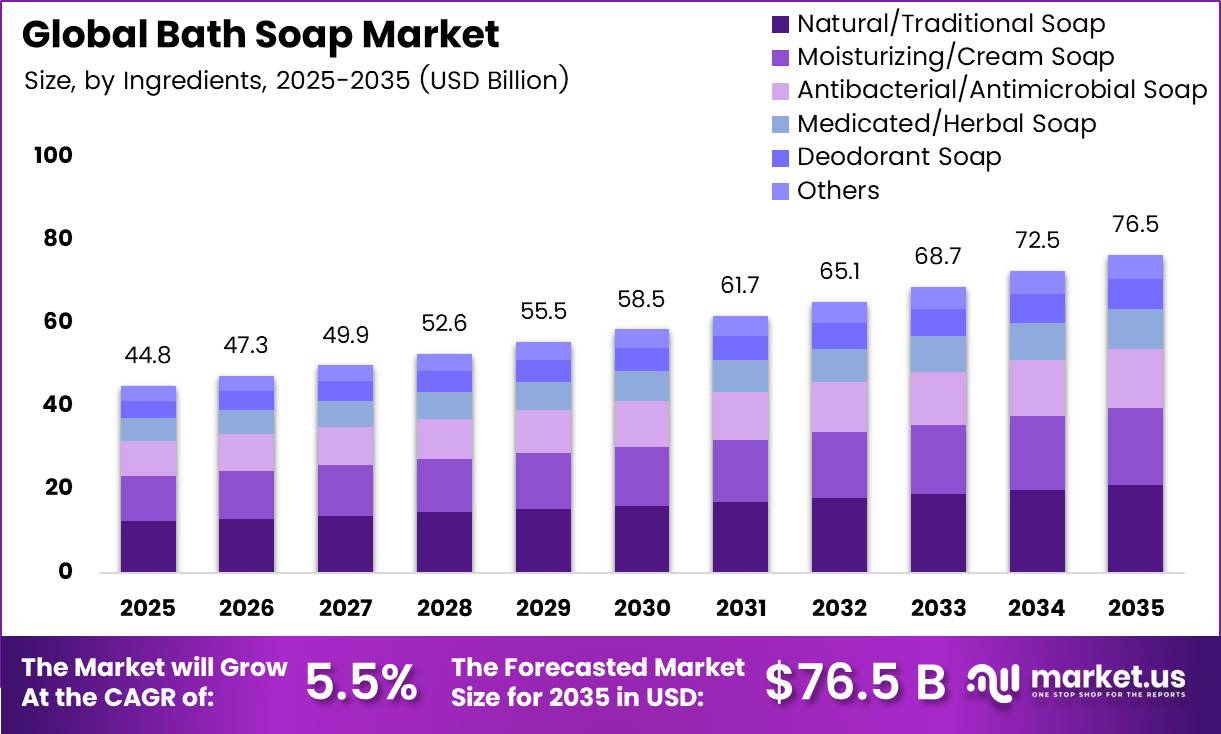
Global Bath Soap Market size is expected to be worth around USD 76.5 Billion by 2035 from USD 44.8 Billion in 2025, growing at a CAGR of 5.5% during the forecast period 2026 to 2035. This trajectory places bath soap among the most consistently expanding personal care categories globally. Investors entering now have a decade-long window before market saturation pressures intensify.
The bath soap market covers cleansing products applied directly to the body during bathing or handwashing routines. It spans bar soaps and liquid soaps across five end-use and ingredient categories. Distribution runs through modern retail, pharmacies, online channels, and convenience stores. This structural breadth means no single channel or format controls the market.
Key Takeaways
- Bath Soap Market size in 2025 stands at USD 44.8 Billion, forecast to reach USD 76.5 Billion by 2035.
- The market grows at a CAGR of 5.5% from 2026 to 2035.
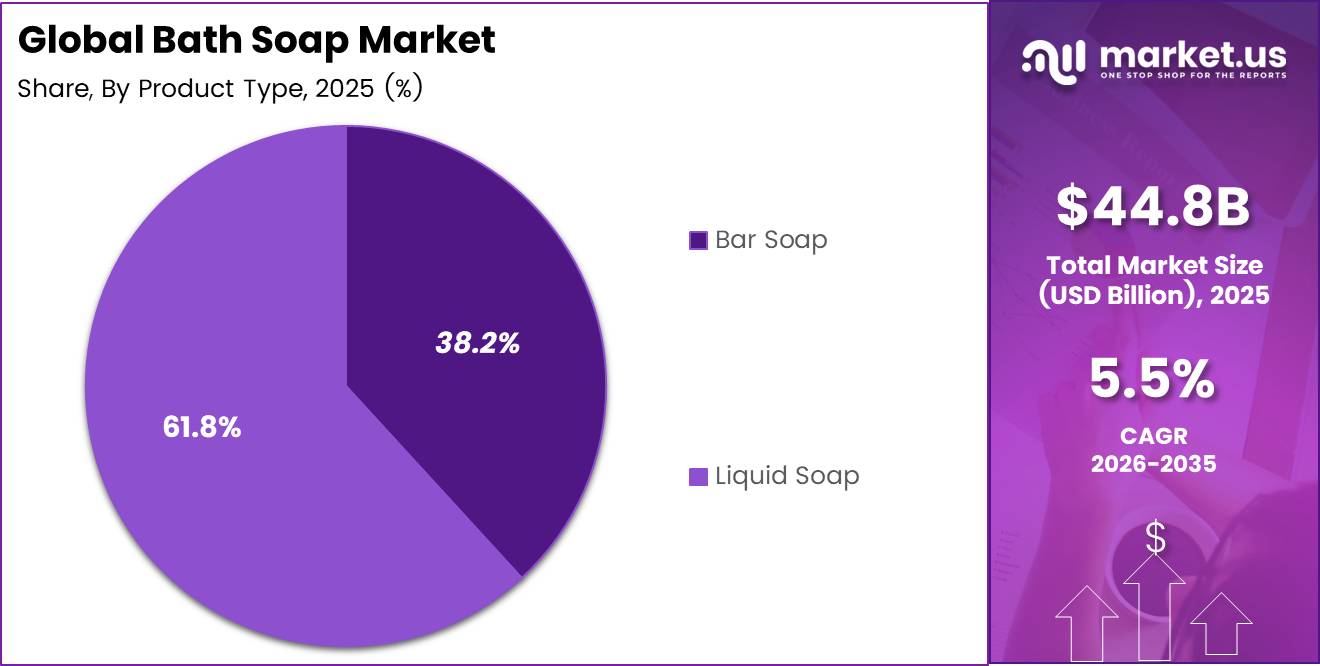
- Liquid Soap dominates By Product Type with a 61.8% share.
- Natural/Traditional Soap leads By Ingredients with a 27.5% share.
- Supermarkets and Hypermarkets lead By Distribution Channel with a 44.5% share.
- Women dominate By End User with a 54.5% share.
- Household (Residential) leads By Application with a 78.5% share.
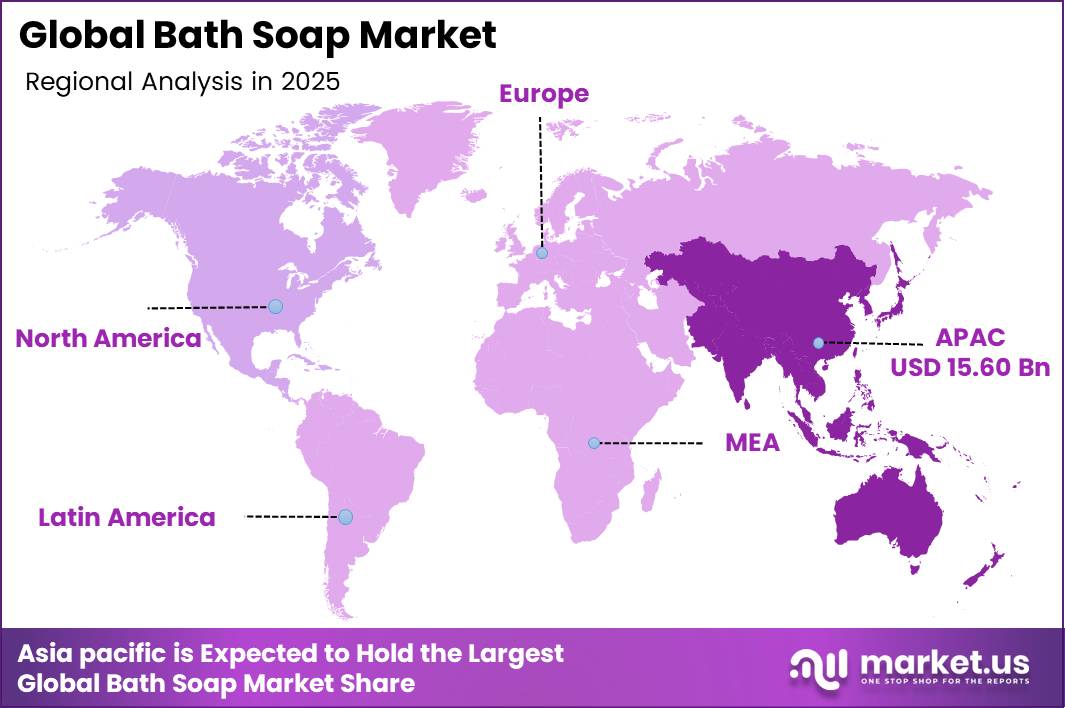
- Asia Pacific dominates By Region with a 34.8% share, valued at USD 15.23 Billion.
According to the CDC, handwashing with soap can reduce diarrheal disease incidence by about 30% and respiratory illnesses by about 20%. These figures anchor bath soap demand to measurable public-health outcomes rather than discretionary spending cycles. This means soap consumption carries a non-negotiable replenishment floor that other personal care categories do not share.
Data from WHO and UNICEF shows 43% of the world’s population lacked access to handwashing facilities with soap and water at home in 2022. This gap represents a structural demand pipeline, not a saturated market. Governments and NGOs actively closing this access gap convert into direct volume growth for value-format soap producers. In February 2026, Bath and Body Works launched its Disney Princess Collection across multiple international markets, signaling that even mainstream brands are expanding format and geographic reach simultaneously.
Product Type Analysis
Liquid Soap dominates with 61.8% due to convenience, dispensing format, and hygiene perception.
In 2025, Liquid Soap held a dominant market position in the By Product Type segment of the Bath Soap Market, with a 61.8% share. CDC guidance confirms that both bar soap and liquid soap are equally effective for removing germs from hands. However, liquid soap’s dispensing format reduces cross-contamination risk in shared-use settings. This perception advantage drives institutional and household buyers toward liquid formats across developed markets.
Bar Soap holds 38.2% of the product type segment. CDC research shows that washing hands for 15 to 30 seconds removes significantly more germs than shorter durations, a behavioral anchor that benefits bar soap equally. Bar formats carry lower per-unit cost and generate less plastic waste per wash. These attributes make bar soap structurally competitive in price-sensitive and eco-aware segments alike.
Ingredients Analysis
Natural/Traditional Soap dominates with 27.5% due to clean-label preference and multi-generational trust.
In 2025, Natural/Traditional Soap held a dominant market position in the By Ingredients segment of the Bath Soap Market, with a 27.5% share. Approximately 1.8 million children under five die each year from diarrheal diseases and pneumonia, conditions that handwashing with soap directly reduces. Natural soap formats benefit from this public-health mandate while simultaneously attracting ingredient-conscious buyers. Producers who lead with safety and efficacy positioning capture dual demand from health and wellness segments.
Moisturizing/Cream Soap holds 24.3% of the ingredients segment. This sub-segment captures consumers who treat daily cleansing as a skincare step rather than a hygiene function. Cream-based formulations command higher shelf prices and generate stronger repeat purchase rates. Brands investing in dermatologist endorsement and skin-benefit claims within this sub-segment build defensible pricing power.
Antibacterial/Antimicrobial Soap holds 18.6% of the ingredients segment. The U.S. FDA found no evidence that antibacterial soaps outperform plain soap and water in household illness prevention. The FDA also banned 19 antibacterial ingredients, including triclosan and triclocarban, from consumer wash products due to insufficient safety data. Brands in this sub-segment face regulatory pressure to reformulate or reposition, which raises product development costs and narrows the approved ingredient pool.
Medicated/Herbal Soap holds 12.4%, Deodorant Soap holds 9.5%, and Others account for the remaining 7.7% of the ingredients segment collectively. In March 2026, Matsukiyo Cocokara launched ARGELAN body soaps formulated with 100% essential-oil fragrances as part of its organic care range expansion. This launch signals that herbal and clean-formulation positioning continues to attract mid-tier brand investment even outside premium price points.
Distribution Channel Analysis
Supermarkets and Hypermarkets dominate with 44.5% due to physical accessibility and high basket frequency.
In 2025, Supermarkets and Hypermarkets held a dominant market position in the By Distribution Channel segment of the Bath Soap Market, with a 44.5% share. In 2022, 57% of the global population, or 4.6 billion people, had access to a handwashing facility with soap and water at home. As access infrastructure improves, modern retail remains the primary replenishment channel for soap. Brands with strong shelf positioning in supermarket chains capture the highest-frequency replacement purchase cycle.
Convenience Stores, Online Retail, Pharmacies and Drug Stores, and Others hold the remaining distribution share. Online retail is gaining structural relevance as D2C personal care platforms enable subscription formats and skin-type personalization. This shifts replenishment from impulse-driven in-store decisions toward algorithm-driven reorder models. Brands that build proprietary digital channels reduce dependency on physical shelf placement fees.
End User Analysis
Women dominate with 54.5% due to higher purchase frequency and multi-product bathing routines.
In 2025, Women held a dominant market position in the By End User segment of the Bath Soap Market, with a 54.5% share. Handwashing with soap could protect about 1 out of every 3 young children who get sick with diarrhea, according to CDC data. Women as primary household buyers drive soap procurement decisions for children, reinforcing their category dominance beyond personal use. Brands targeting mothers with family hygiene messaging unlock both the women’s and children’s demand pools simultaneously.
Men and Unisex formats hold the remaining end-user share. Gender-neutral positioning attracts minimalist buyers who reject gender-segmented packaging. This sub-segment supports premium pricing through ingredient differentiation rather than branding differentiation. Brands that enter with clean, unisex positioning avoid the SKU proliferation cost of separate male and female product lines.
Application Analysis
Household (Residential) dominates with 78.5% due to daily replenishment cycles and multi-user consumption.
In 2025, Household (Residential) held a dominant market position in the By Application segment of the Bath Soap Market, with a 78.5% share. CDC research indicates that handwashing with soap could help prevent nearly 1 out of every 5 respiratory infections among young children. This public-health benefit keeps household soap on every family’s essential goods list regardless of economic conditions. High replenishment frequency makes residential buyers the most predictable volume base in the entire category.
Commercial applications hold the remaining application share and include hospitality, healthcare, and institutional settings. These buyers prioritize cost-per-use efficiency and bulk supply reliability over brand identity. Suppliers who offer private-label institutional formats with documented hygiene credentials compete effectively in tenders. This segment offers margin stability even when consumer retail pricing comes under pressure.
Key Market Segments
By Product Type
- Bar Soap
- Liquid Soap
By Ingredients
- Natural/Traditional Soap
- Moisturizing/Cream Soap
- Antibacterial/Antimicrobial Soap
- Medicated/Herbal Soap
- Deodorant Soap
- Others
By Distribution Channel
- Supermarkets and Hypermarkets
- Convenience Stores
- Online Retail
- Pharmacies and Drug Stores
- Others
By End User
- Women
- Men
- Unisex
By Application
- Household (Residential)
- Commercial
Regional Analysis
Asia Pacific Dominates the Bath Soap Market with a Market Share of 34.8%, Valued at USD 15.23 Billion
Asia Pacific commands 34.8% of the global bath soap market. High population density, improving sanitation infrastructure, and a large base of price-sensitive consumers drive sustained volume demand. Governments across South Asia and Southeast Asia treat soap as a public-health essential, supporting institutional procurement alongside retail sales. This dual demand structure gives the region a structurally higher consumption floor than any other geography.
North America holds a significant share driven by premium product demand, high per-capita spending on personal care, and well-developed modern retail infrastructure. Consumers in the US actively trade up toward dermatologist-tested and skin-specific formulations. This premiumization pattern supports margin expansion for brands investing in clinical efficacy positioning. However, regulatory scrutiny on antimicrobial ingredients adds reformulation pressure for legacy product lines.
Europe maintains a strong market position shaped by strict packaging compliance, sustainability mandates, and high consumer awareness of ingredient safety. In December 2025, Lush opened a new retail store in Scotland, extending its distribution footprint for soap and bath products across the region. EU Regulation 2025/40, entering application from August 2026, raises recyclability and producer-responsibility requirements. Brands that complete packaging redesigns ahead of the deadline gain a compliance advantage over slower competitors.
Latin America shows consistent volume growth anchored by urbanization, rising middle-class incomes, and expanding modern retail penetration in Brazil and Mexico. Value-format and multipack soap products dominate purchasing decisions in this region. As e-commerce infrastructure develops, online soap sales are beginning to grow alongside traditional retail channels. This creates entry opportunities for regional brands that can compete on price while building digital distribution capability.
Key Regions and Countries
North America
- US
- Canada
Europe
- Germany
- France
- The UK
- Spain
- Italy
- Rest of Europe
Asia Pacific
- China
- Japan
- South Korea
- India
- Australia
- Rest of APAC
Latin America
- Brazil
- Mexico
- Rest of Latin America
Middle East and Africa
- GCC
- South Africa
- Rest of MEA
Market Dynamics
Market Opportunity Analysis - Underserved geographies and underdeveloped sub-segments offer entry points for focused new players
Latin America remains structurally underpenetrated relative to its urban population size. Brazil and Mexico lead regional soap consumption, but rural and peri-urban segments in both countries still rely on value-format bar soaps with limited brand diversity. As per our research, e-commerce infrastructure is beginning to connect these underserved buyers to a broader product range. Brands that enter with affordable multipack formats and digital distribution first will build the replenishment loyalty that premium entrants later struggle to displace.
The Commercial application segment holds a smaller share at present but offers disproportionate margin stability. Hospitality, healthcare, and institutional buyers in APAC tourism hubs, the Middle East, and Europe commit to bulk volumes under longer contract cycles. This reduces the revenue volatility that consumer retail segments carry. New entrants with documented hygiene credentials and cost-per-use pricing models can win tenders that established consumer brands are structurally unable to compete for.
The Men and Unisex end-user sub-segments hold a collective minority share today but represent the fastest-repositioning opportunity in the category. Gender-neutral soap positioning reduces SKU proliferation costs and supports premium pricing through ingredient differentiation rather than gender-segmented branding. Brands entering this sub-segment target a buyer cohort that actively rejects conventional personal care marketing. This creates a lower-cost brand-building path in markets where legacy players hold dominant shelf positions through fragmented gender-targeted SKU strategies.
The Medicated/Herbal Soap sub-segment holds 12.4% of the ingredients segment but sits at the intersection of two long-term structural trends: rising self-care health consciousness and expanding access to pharmacy retail channels. In India, Southeast Asia, Africa, and Latin America, medicated-adjacent soap formats offer a credible entry into both pharmacy and modern retail distribution simultaneously. By contrast, pure cosmetic soap brands must compete solely on retail shelf placement. This dual-channel access gives medicated and herbal soap entrants a structural distribution advantage over single-channel competitors.
Technology and Innovation Landscape - Formulation science, sustainable packaging, and traceability systems define the next competitive frontier
Functional active integration is reshaping the Moisturizing/Cream Soap sub-segment from a basic personal care category into a daily skincare delivery system. Ingredients such as niacinamide, ceramides, and hyaluronic acid, previously confined to premium facial skincare, are now entering bath soap formulations. Brands that achieve clinically validated active delivery through rinse-off soap formats can justify premium price positioning without requiring consumers to add separate skincare steps to their routine.
Moisture-Lock Veil technology, introduced by Lion Corporation in its hadakara Beauty Premium launch in January 2026, represents a technical differentiation approach that elevates body soap beyond basic cleansing. The combination of a dual peptide complex with a veil-forming delivery mechanism positions body soap as an active skincare product. Brands that develop proprietary delivery technologies rather than relying on commodity active ingredients build defensible intellectual property within an otherwise commoditized mass-market category.
Blockchain and batch-level traceability systems are becoming operational necessities for palm-derived soap producers serving EU-linked supply chains. EU deforestation compliance requires geolocation-linked due diligence and pre-clearance documentation across multi-tier supplier networks. Manufacturers that implement supplier geodata standardization and third-party verification programs ahead of the compliance deadline reduce procurement cycle friction by closing documentation failure risk before it delays SKU launches. This traceability capability becomes a competitive asset when premium buyers screen suppliers for ESG compliance documentation.
Cold-process artisan soap production is gaining traction as a transparency-driven manufacturing method with direct commercial implications. Cold processing preserves natural glycerin and allows full ingredient disclosure at batch level, satisfying consumer demand for transparent sourcing without requiring brand-level certification programs. Independent producers using cold-process methods can command premium pricing in direct-to-consumer and specialty retail channels. This creates a viable manufacturing pathway for niche entrants who cannot access the scale economies of industrial saponification.
Drivers
WHO and UNICEF released global community hand-hygiene guidelines in October 2025, positioning plain soap and water as the minimum requirement for routine hygiene across five identified use moments. This policy shift anchors bath soap demand to public-health behavior rather than discretionary spending alone. The commercial effect is strongest in South Asia, Africa, and lower-middle-income APAC corridors where soap penetration still has room to deepen. This driver can credibly add around 1.1 percentage points to CAGR by increasing usage frequency and raising the floor under replacement demand.
Premium naturals, dermatology-led upgrading, modern retail expansion, and e-commerce assortment growth compound the public-health driver across higher-income markets. Urbanization and household formation in India, Indonesia, the Philippines, and Vietnam extend volume growth into the long term. Input-cost normalization supports affordability in APAC manufacturing hubs, MENA import markets, and Africa value segments. Together these structural forces align commercial demand with public-health need across every major geography.
| Driver | (~) % Impact on CAGR Forecast | Geographic Relevance | Impact Timeline |
|---|---|---|---|
| Hygiene compliance and public-health normalization | +1.1% | APAC mass markets, Africa, South Asia, public institutions globally | Short term |
| Premium naturals and dermatology-led upgrading | +1.4% | North America core, EU, urban APAC, GCC premium pockets | Medium term |
| Modern retail and e-commerce assortment expansion | +0.9% | India, Southeast Asia, China, Latin America, North America | Short term |
| Packaging and formulation compliance reset | +0.7% | EU core, UK alignment markets, ASEAN spill-over, India premium/formal trade | Medium term |
| Input-cost normalization supporting affordability | +0.8% | APAC manufacturing hubs, MENA importers, Africa value segments, Latin America | Short term |
| Urbanization and household formation in value soap corridors | +1.2% | India, Indonesia, Philippines, Vietnam, Sub-Saharan Africa | Long term |
Restraints
Packaging and extended producer responsibility regulations have converted packaging from a pass-through cost into a compliance-intensive cost center, particularly in the EU and India. EU Regulation 2025/40, which entered into force in February 2025 and applies from August 2026, introduces recyclability standards, packaging minimization rules, and harmonized producer-responsibility obligations. India’s plastic packaging regime adds portal registration, state-level data disclosure, and CPCB accountability for producers. For bath soap brands with high SKU fragmentation, these rules can raise packaging conversion and compliance costs by an estimated 3 to 6% per unit in regulated markets.
These obligations divert CapEx toward artwork changes, traceability systems, and recycled-content sourcing rather than brand expansion. Packaging redesign cycles extend by 6 to 12 months under the new frameworks. This slows new-product launches and constrains the pace at which brands can respond to shifting consumer preferences. The modeled impact is a 1.1% deduction to CAGR concentrated in the EU, India, and export-oriented suppliers serving those markets.
| Restraint | (~) % Impact on CAGR Forecast | Geographic Relevance | Impact Timeline |
|---|---|---|---|
| Oils and fats volatility | -1.4% | APAC core, Africa, LATAM | Short term (≤ 2 years) |
| Packaging/EPR cost load | -1.1% | EU, India, UK exporters | Medium term (2-4 years) |
| Freight and route disruption | -0.8% | APAC-EU corridors, MENA, Africa | Short term (≤ 2 years) |
| Downtrading in mass soap | -0.9% | South Asia, SSA, LATAM | Medium term (2-4 years) |
| Palm traceability burden | -0.7% | EU-linked supply chains, SE Asia | Long term (≥ 4 years) |
Challenges
Palm-derived inputs remain commercially essential to bath soap manufacturing, but EU deforestation regulations have transformed sourcing from a simple procurement task into a systems-integration challenge. Compliance now requires geolocation-linked due diligence, annual system reviews, pre-clearance documentation tied to customs processes, and multi-tier supplier audits. Even suppliers outside the EU face friction through documentation failure risk and ERP retrofitting across networks that may involve hundreds of small upstream entities. This pushes procurement cycle times out by 15 to 45 days and raises compliance overhead by an estimated 0.6% to 1.3% of COGS for export-oriented or premium bath soap portfolios.
The growth drag comes less from lost demand than from slower new-SKU launches and constrained reformulation agility. Brands respond through blockchain traceability programs, supplier geodata standardization, and partial recipe redesign toward lower-risk certified inputs. Each of these responses requires multiple planning cycles. This keeps the palm traceability challenge a long-horizon structural issue, modeled at a 0.8 percentage-point CAGR friction drag, rather than a short-lived disruption.
| Challenge | (~) % CAGR Friction Drag | Geographic Relevance | Mitigation Horizon |
|---|---|---|---|
| Feedstock cost volatility | -1.2% | APAC sourcing hubs, EU importers, MENA converters | Medium term (2-4 years) |
| Palm traceability burden | -0.8% | EU regulatory hubs, SE Asia exporters, global premium brands | Long term (≥ 4 years) |
| Packaging transition complexity | -0.7% | North America core, EU regulatory hubs, urban APAC retail | Medium term (2-4 years) |
| Maritime route instability | -0.6% | Europe-MENA lanes, India-EU corridors, Asia-Africa trade | Short term (≤ 2 years) |
| Manufacturing skills erosion | -0.5% | India clusters, ASEAN plants, North America legacy sites | Medium term (2-4 years) |
| Channel premiumization mismatch | -0.4% | North America core, EU modern trade, top-tier APAC cities | Medium term (2-4 years) |
Opportunities
Refill and circular formats represent a structural revenue redesign opportunity for bath soap brands. Most current sales still come from conventional single-purchase formats, while future upside sits in refillable systems, concentrated bar multipacks, and low-packaging formats. France and India have already advanced restrictions on single-use plastics, making packaging-light formats commercially attractive ahead of any global treaty. If refill-compatible bars reduce packaging cost by 8% to 15% per unit and lower logistics volume by 10% to 20%, brands can redirect that saving into 200 to 400 basis points of margin improvement or a 5% to 8% shelf-price advantage.
A portfolio that converts 12% to 15% of urban premium users into refill or circular models could produce an estimated 7% to 10% revenue uplift from higher purchase frequency, lower churn, and improved retailer placement. This opportunity is most concentrated in the EU, UK, and affluent Indian metros where sustainability is becoming a product-selection criterion. The category remains under-monetized relative to the circularity narrative in these markets. Early movers who build refill infrastructure before competitors gain first-mover placement advantages with sustainability-oriented retailers.
| Opportunity | (~) % Potential CAGR Upside | Geographic Relevance | Execution Window |
|---|---|---|---|
| Dermocosmetic soap bars | +1.6% | North America, EU, Japan, urban India | Short term (≤ 2 years) |
| Refill and circular formats | +1.2% | EU, UK, North America, India metros | Medium term (2-4 years) |
| D2C personalization engines | +1.4% | North America, India, SEA, Brazil | Short term (≤ 2 years) |
| Medicated-adjacent roll-ups | +1.8% | India, SEA, Africa, LatAm | Medium term (2-4 years) |
| Premium male and teen sub-lines | +1.0% | India, MENA, LatAm, Southeast Asia | Short term (≤ 2 years) |
| Hospitality and institutional bars | +0.9% | APAC tourism hubs, Middle East, Europe | Long term (≥ 4 years) |
Key Company Insights
Unilever PLC commands scale advantages in both mass and premium bath soap segments across global markets. In April 2025, Unilever acquired Wild Cosmetics, a premium refillable body-care company, positioning itself early in the circular format transition. As per our research, global handwashing rates after potential fecal contact stand at only 19%, a demand gap that Unilever’s mass-market hygiene portfolio is structurally positioned to address through high-volume, affordable formats.
Wipro Enterprises Private Limited operates through a regional brand portfolio strategy centered on India and emerging markets. In April 2026, Wipro Consumer Care launched Chandrika Soundarya, a premium beauty soap targeting experience-led bathing demand. As per our research, 2.0 billion people worldwide still lacked a basic handwashing facility with soap and water at home in 2022, and 3.5 billion lacked safely managed sanitation services. These access gaps define the long-term volume ceiling for Wipro’s value-format and accessible-premium positioning in South Asian and African markets.
Key Players
- Unilever PLC
- Procter and Gamble Company
- Johnson and Johnson
- Colgate-Palmolive Company
- L’Oreal S.A.
- Beiersdorf AG
- Reckitt Benckiser Group PLC
- Kao Corporation
- Henkel AG and Co. KGaA
- Himalaya Wellness Company
- Godrej Consumer Products Limited
- Wipro Enterprises Private Limited
- Bath and Body Works, LLC
- Dr. Bronner’s
- EO Products
- Others
Recent Developments
- May 2026 – Lush Malaysia launched its world-exclusive Coral Soap, dedicating 75% of sales proceeds (excluding tax) to marine conservation through Reef Check Malaysia.
- January 2026 – Lion Corporation launched hadakara Beauty Premium Moist Body Care Soap, featuring Moisture-Lock Veil technology and a dual peptide complex to strengthen its premium body soap segment.
- January 2026 – Alaffia reintroduced its Good Soap line and launched Good Fizz bath products to expand its ethical and affordable personal cleansing portfolio.
- October 2025 – Lush introduced its 2025 Diwali Collection, expanding its seasonal bath and soap offerings with newly developed fragrance concepts and limited-edition bathing products.
- March 2026 – Bath and Body Works partnered with Vera Bradley to introduce a limited-edition body-care collection featuring new fragrance formats and gift-oriented personal cleansing products.
Report Scope
| Report Features | Description |
|---|---|
| Market Value (2025) | USD 44.8 Billion |
| Forecast Revenue (2035) | USD 76.5 Billion |
| CAGR (2026-2035) | 5.5% |
| Base Year for Estimation | 2025 |
| Historic Period | 2020-2024 |
| Forecast Period | 2026-2035 |
| Report Coverage | Revenue Forecast, Market Dynamics, Market Opportunity Analysis, Technology and Innovation Landscape, Competitive Landscape, Recent Developments |
| Segments Covered | By Product Type (Bar Soap, Liquid Soap); By Ingredients (Natural/Traditional Soap, Moisturizing/Cream Soap, Antibacterial/Antimicrobial Soap, Medicated/Herbal Soap, Deodorant Soap, Others); By Distribution Channel (Supermarkets and Hypermarkets, Convenience Stores, Online Retail, Pharmacies and Drug Stores, Others); By End User (Women, Men, Unisex); By Application (Household/Residential, Commercial) |
| Regional Analysis | North America (US and Canada), Europe (Germany, France, The UK, Spain, Italy, and Rest of Europe), Asia Pacific (China, Japan, South Korea, India, Australia, and Rest of APAC), Latin America (Brazil, Mexico, and Rest of Latin America), Middle East and Africa (GCC, South Africa, and Rest of MEA) |
| Competitive Landscape | Unilever PLC, Procter and Gamble Company, Johnson and Johnson, Colgate-Palmolive Company, L’Oreal S.A., Beiersdorf AG, Reckitt Benckiser Group PLC, Kao Corporation, Henkel AG and Co. KGaA, Himalaya Wellness Company, Godrej Consumer Products Limited, Wipro Enterprises Private Limited, Bath and Body Works LLC, Dr. Bronner’s, EO Products, Others |
| Customization Scope | Customization for segments, region/country-level will be provided. Additional customization can be done based on requirements. |
| Purchase Options | We have three licenses to opt for: Single User License, Multi-User License (Up to 5 Users), Corporate Use License (Unlimited User and Printable PDF) |





































