


Report Overview
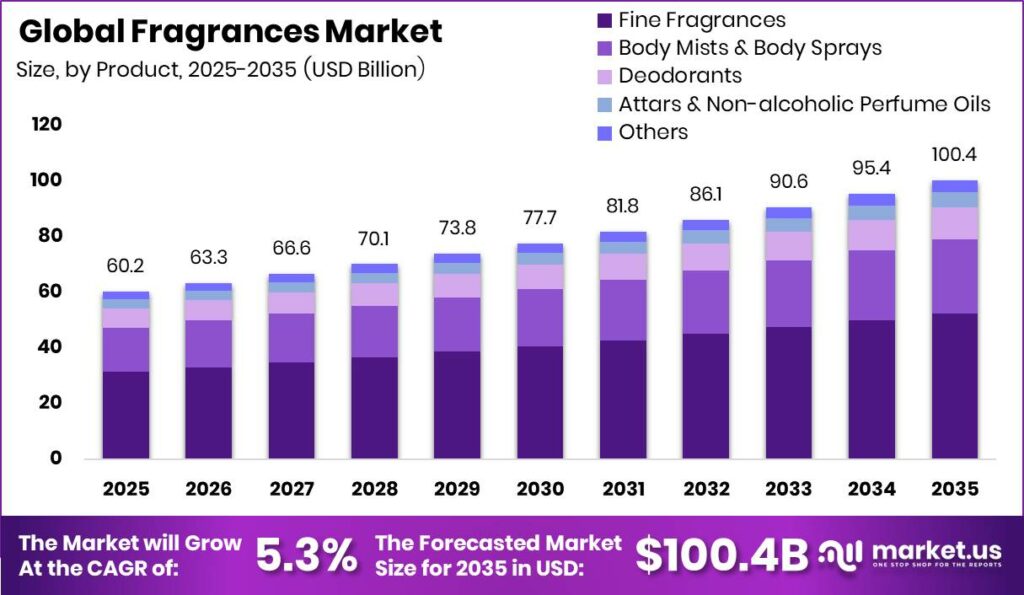
Global Fragrances Market size is expected to be worth around USD 100.4 Billion by 2035 from USD 60.2 Billion in 2025, growing at a CAGR of 5.3% during the forecast period 2026 to 2035. This trajectory signals steady value creation. Investors gain a decade-long runway to build durable brand equity and channel positions before growth normalizes.
The Perfume Market covers alcohol-based fine fragrances, body mists, deodorants, non-alcoholic perfume oils, and home and car scenting products. This means the market spans mass, prestige, and niche price tiers across personal and ambient use. Therefore, participants must segment portfolios by price and application to defend margin across very different buyer motivations.
Key Takeaways
- Global Fragrances Market will reach USD 100.4 Billion by 2035 from USD 60.2 Billion in 2025 at a CAGR of 5.3%.
- Fine Fragrances led the By Product segment with a 52.3% share in 2025.
- Women accounted for 56.4% of the By End Use segment, while Men remained the fastest growing group.
- Personal Fragrance dominated the By Application segment at 63.6%, with Ambient Scenting growing fastest.
- Specialty Stores held 30.4% of the By Distribution Channel segment, and Online/E-commerce grew fastest.
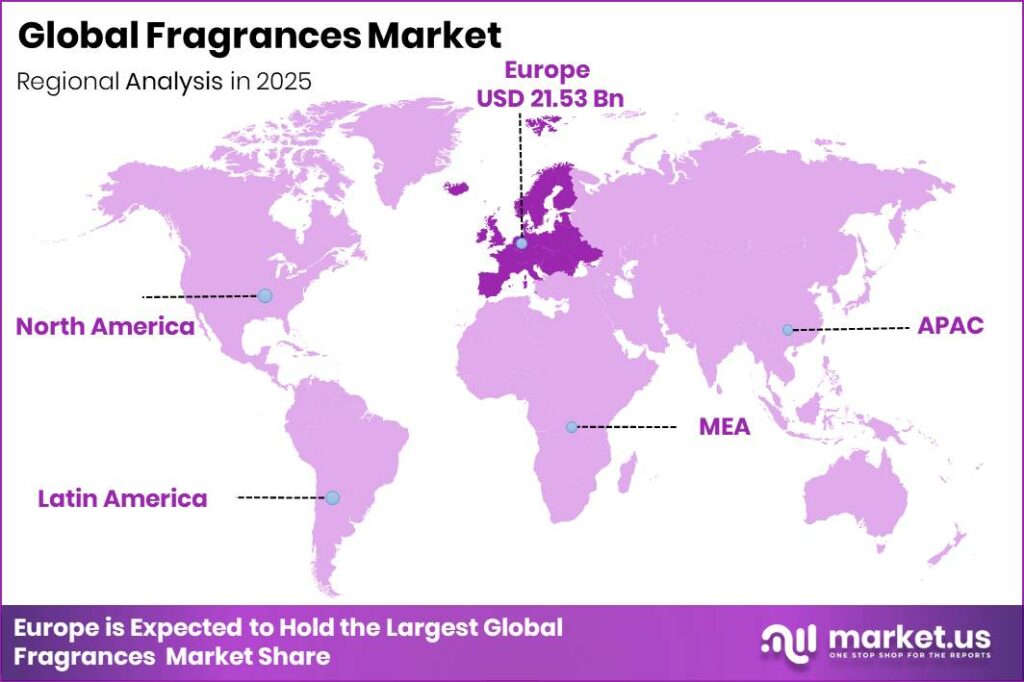
- Europe led all regions with a 35.8% share valued at USD 21.53 Billion in 2025.
Government ingredient and labelling rules shape how brands formulate and sell across regions. As a result, compliance capability now functions as a competitive moat rather than a back-office cost. Companies with in-house regulatory teams launch faster and absorb reformulation shocks better than smaller rivals dependent on outside labs.
As per our research, Coty Consumer Beauty revenue reached USD 2,072.7 Million in FY2025, down 8% year over year. This decline reflects mass-tier pressure as buyers trade up to prestige scents. Consequently, brands over-indexed on mass fragrance face structural revenue risk unless they migrate portfolios upward.
Symrise recorded EUR 50 Million in cost savings during fiscal 2025, beating its EUR 40 Million target, while dsm-firmenich captured EUR 65 Million in synergies. These efficiency gains strengthen supplier balance sheets. This creates room for reinvestment into biotech ingredients that end-use brands increasingly demand.
Product Analysis
Fine Fragrances dominates with 52.3% due to prestige pricing and brand loyalty.
In 2025, Fine Fragrances held a dominant market position in the By Product segment of Fragrances Market, with a 52.3% share. UN Comtrade data for HS code 3303 shows global perfume and toilet water exports exceeded USD 18 Billion in 2023. This concentration confirms fine fragrance as the category value anchor. Brands that win shelf and digital space here capture the richest margin pool first.
Body Mists and Body Sprays serve entry-level buyers seeking affordable daily scent. ITC Trade Map records rising body spray shipments across emerging markets, with unit volumes climbing double digits through 2023. This role positions mists as a trial funnel. Companies use them to convert first-time users toward higher-priced fine fragrance later.
Deodorants function as high-frequency, repeat-purchase products with broad household penetration. World Bank consumption indicators link deodorant demand to rising urban middle-class populations across Asia and Africa. This structural base gives stable volume. Manufacturers rely on deodorants to fund riskier premium launches through predictable cash flow.
Attars and Non-alcoholic Perfume Oils rank as the fastest growing product line, driven by Gulf and Islamic-market demand. National statistics offices in the UAE report attar retail expansion tied to tourism and local heritage buying. Others, including layering concentrates, hold the remaining share collectively. This signals a clear premium alcohol-free white space for early movers.
End Use Analysis
Women dominates with 56.4% due to broad daily and occasion usage.
In 2025, Women held a dominant market position in the By End Use segment of Fragrances Market, with a 56.4% share. World Bank data links female fragrance spend to rising female labor participation above 50% in many economies. This spending base underpins category stability. Brands that build loyalty programs here lock in repeat revenue across decades of buying.
Men represent the fastest growing end-use group, reflecting new grooming routines across Asia Pacific. UNIDO manufacturing output data shows expanding men’s personal care production lines through 2023. This shift widens the addressable buyer pool. Companies that launch dedicated masculine lines now capture share before the segment saturates.
Application Analysis
Personal Fragrance dominates with 63.6% due to daily self-expression demand.
In 2025, Personal Fragrance held a dominant market position in the By Application segment of Fragrances Market, with a 63.6% share. FAO aromatic crop data confirms most essential oil output flows into personal scent formulation. This concentration defines where raw materials go. Suppliers securing long-term oil contracts protect personal fragrance production against price shocks.
Home Fragrance covers candles, diffusers, and linen sprays for ambient household use. ITC Trade Map shows scented candle exports surpassing USD 2 Billion globally in 2023. This role diversifies brand revenue beyond the body. Fine fragrance houses extend equity into homes to raise total customer spend per year.
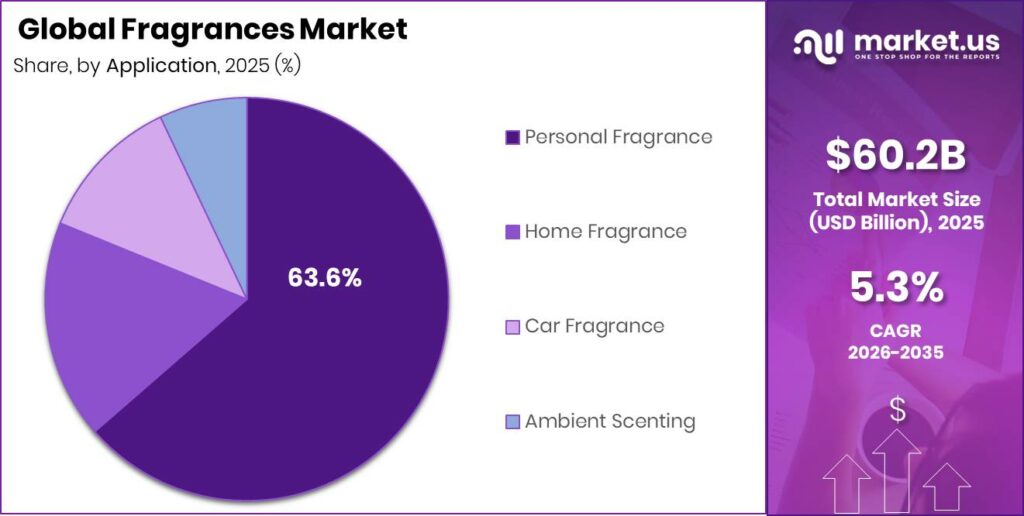
Car Fragrance targets in-vehicle scenting through vents and hanging diffusers. Customs databases record steady air-freshener unit shipments across auto-heavy markets. This niche links fragrance demand to vehicle ownership growth. Brands bundle car scents with signature perfumes to deepen everyday exposure to their olfactory identity.
Ambient Scenting ranks as the fastest growing application, led by hotels, retail, and offices. UNIDO industrial data notes rising commercial diffusion equipment output through 2023. This creates a business-to-business revenue channel. Early movers who sign hospitality contracts build recurring institutional demand rivals struggle to displace.
Distribution Channel Analysis
Specialty Stores dominates with 30.4% due to expert trial and advice.
In 2025, Specialty Stores held a dominant market position in the By Distribution Channel segment of Fragrances Market, with a 30.4% share. National retail statistics confirm perfumery chains as the leading fragrance format across Europe. This channel enables physical scent trial. Brands prioritize specialty listings because guided sampling lifts conversion better than any other format.
Hypermarkets and Supermarkets serve high-traffic mass buyers seeking convenience and price. World Bank retail indicators tie grocery fragrance sales to broad household reach across regions. This role drives volume rather than value. Mass brands defend supermarket shelf space to sustain the unit throughput that funds their operations.
Department Stores anchor prestige buying through branded counters and seasonal launches. ITC Trade Map data links department store demand to concentrated prestige import flows in mature markets. This format builds brand theater. Prestige houses invest in counter staff and displays to justify premium price points to shoppers.
Online/E-commerce ranks as the fastest growing channel, reshaping discovery and repeat purchase. ITU data shows global internet penetration above 67%, enabling direct digital selling worldwide. Others, including travel retail, hold the remaining share collectively. This shift rewards brands that master sampling programs to overcome the online scent-trial gap.
Key Market Segments
By Product
- Fine Fragrances
- Body Mists & Body Sprays
- Deodorants
- Attars & Non-alcoholic Perfume Oils
- Others
By End Use
- Men
- Women
By Application
- Personal Fragrance
- Home Fragrance
- Car Fragrance
- Ambient Scenting
By Distribution Channel
- Hypermarkets/Supermarkets
- Department Stores
- Specialty Stores
- Online/E-commerce
- Others
Regional Analysis
Europe Dominates the Fragrances Market with a Market Share of 35.8%, Valued at USD 21.53 Billion
Europe led the Fragrances Market in 2025 with a 35.8% share valued at USD 21.53 Billion. This lead reflects deep perfumery heritage in France and strong specialty retail networks. As a result, European houses set global scent trends and control much of the prestige supply chain. Brands entering the market must respect this established creative and distribution authority.
Asia Pacific stands as the fastest growing region, powered by rising middle-class buyers in China and India. This means first-time prestige adoption is expanding the total buyer base quickly. Coty confirmed continued prestige focus in March 2026, including Marc Jacobs Beauty expansion and Swarovski fragrance rollouts across 2026 to 2027. Therefore, brands that localize early will capture loyalty before competition intensifies.
Key Regions and Countries
North America
- US
- Canada
Europe
- Germany
- France
- The UK
- Spain
- Italy
- Rest of Europe
Asia Pacific
- China
- Japan
- South Korea
- India
- Australia
- Rest of APAC
Latin America
- Brazil
- Mexico
- Rest of Latin America
Middle East and Africa
- GCC
- South Africa
- Rest of MEA
Market Dynamics
Market Opportunity Analysis - Underserved segments and regions open clear entry points for new players
The Attars and Non-alcoholic Perfume Oils line is underexploited outside Gulf markets despite ranking as the fastest growing product. This gap reflects limited alcohol-free options in Western prestige ranges. Therefore, brands launching premium oil-based scents can serve Islamic and clean-beauty buyers before large houses build dedicated lines.
The Men end-use segment stays underpenetrated even while growing fastest across Asia Pacific. This reflects a low adoption baseline among first-time male buyers. Consequently, brands that build dedicated masculine ranges in China, India, and South Korea can lock loyalty ahead of slower incumbents.
Ambient Scenting sits underserved despite being the fastest growing application, since most brands focus on personal fragrance. This creates open space in hotel, retail, and office scenting contracts. As a result, early movers securing institutional accounts build recurring business-to-business revenue that competitors cannot easily displace.
Online/E-commerce remains under-optimized even as the fastest growing channel, because scent trial is hard to replicate digitally. This gap holds back conversion for brands lacking sampling programs. Instead, players investing in discovery kits and returns-friendly models can convert digital traffic into repeat prestige buyers.
Technology and Innovation Landscape - Automation and AI reshape fragrance creation and production economics
IFF introduced a smart dosing robot that lifted sample output to 200 batches in 8 hours, down from a 24 hour cycle, a roughly 3 times faster turnaround in 2025. This speed cuts development lead times sharply. Therefore, manufacturers adopting automated dosing bring new scents to market faster than manual rivals.
AI-based compliance automation reduced manual operational workload by 30% across fragrance and flavor workflows in a 2025 case study. This efficiency frees regulatory teams to handle more launches. Consequently, brands that deploy compliance AI absorb IFRA and EU rule changes at lower cost and higher speed.
Machine learning systems now predict consumer scent preferences with 92% accuracy, while generative AI produces 1,000 virtual scent molecules per hour for formulation screening in 2026. This capability compresses creative discovery cycles. As a result, houses using these tools cut trial-and-error cost and launch better-targeted fragrances.
IFF confirmed that 77% of new fragrance and flavor innovation projects from 2023 to 2025 carried a validated sustainability value proposition. This share signals a durable shift toward green formulation. Therefore, suppliers embedding sustainability early win preference from brands facing rising consumer and regulatory scrutiny.
Drivers
The core driver is a structural consumer shift away from mass fragrance priced at USD 15 to 45 per 50 ml toward prestige brands at USD 80 to 200 and niche houses at USD 180 to 600 or more. This premiumisation lifts revenue per bottle and expands gross margin by an estimated 12 to 22 percentage points. Consequently, brands that enrich product mix defend profit even when volumes soften.
Market.us data shows prestige fragrance grew an estimated 8 to 11% annually through 2023 to 2025, outpacing total category growth near 5 to 7%. In China, prestige tiers priced at CNY 800 to 3,000 represented an estimated 55 to 65% of fragrance import value. This means new buyers enter directly at premium points. Therefore, houses expanding niche portfolios capture the fastest-growing margin pool first.
| Driver | (~) % Impact on CAGR Forecast | Geographic Relevance | Impact Timeline |
|---|---|---|---|
| Premiumisation & Trading-Up Trend Driving Prestige & Niche Fragrance Category Expansion Across Emerging & Mature Markets | +1.70% | United States, China, GCC, Europe, India, Southeast Asia, Latin America | Short term (≤ 2 years) |
| Rising Middle-Class & Aspirational Consumer Base in Asia Pacific & Middle East Driving First-Time Fine Fragrance Adoption | +1.20% | China, India, Indonesia, Vietnam, Saudi Arabia, UAE, Egypt, Turkey | Short term (≤ 2 years) |
| Gender-Neutral & Unisex Fragrance Proliferation Expanding the Addressable Consumer Universe Per SKU | +0.72% | United States, United Kingdom, France, Germany, South Korea, Japan, Australia | Short term (≤ 2 years) |
| Social Commerce & Influencer-Led Fragrance Discovery Accelerating Trial & Repeat Purchase Conversion | +0.62% | United States, China, United Kingdom, Brazil, India, Southeast Asia, GCC | Short term (≤ 2 years) |
| Fragrance Layering Culture Increasing Average Volume Purchased Per Consumer Occasion | +0.48% | GCC, United States, United Kingdom, France, South Korea, China | Medium term (2–4 years) |
| Home & Lifestyle Fragrance Category Expansion (Candles, Diffusers, Linen Sprays) Supplementing Fine Fragrance Revenue | +0.38% | United States, Europe, Australia, Japan, South Korea, China | Short term (≤ 2 years) |
Restraints
The root cause is tightening International Fragrance Association standards, led by the 49th Amendment published in January 2023 and effective January 2025 for new launches. The EU Cosmetics Regulation update requires labelling of 56 fragrance allergens above 0.001% in leave-on products. This means iconic formulas using oakmoss and certain musks need costly reformulation. As a result, ingredient palettes narrow across the industry.
Reformulating a prestige fragrance requires 12 to 36 months of perfumer work and panel testing costing USD 150,000 to 600,000 per round. Rejected reformulations cut loyal-buyer repurchase by an estimated 15 to 30%. This creates dual margin pressure across affected portfolios. Therefore, only well-capitalized houses absorb these compliance shocks without losing shelf position.
| Restraint | (~) % Impact on CAGR Forecast | Geographic Relevance | Impact Timeline |
|---|---|---|---|
| IFRA & EU Cosmetics Regulation Ingredient Restriction & Allergen Labelling Mandates Constraining Iconic Formula Compositions | -1.20% | European Union, United Kingdom, Switzerland, Australia, Canada — IFRA signatory markets | Short term (≤ 2 years) |
| Consumer Fragrance Sensitivity & Allergen Awareness Suppressing Trial & Repeat Purchase Among Sensitised Demographics | -0.65% | United States, Europe, Australia, Canada, Japan | Short term (≤ 2 years) |
| Grey Market & Counterfeit Fragrance Proliferation Cannibalising Authentic Sales in High-Growth Emerging Markets | -0.45% | India, Southeast Asia, Latin America, Sub-Saharan Africa, Eastern Europe | Short term (≤ 2 years) |
| Duty & Import Tariff Escalation on Fragrance & Cosmetic Imports Suppressing Prestige Brand Access in Tariff-Sensitive Markets | -0.32% | India, Brazil, Indonesia, Turkey, Argentina — high import duty markets | Short term (≤ 2 years) |
Challenges
The structural vulnerability is geographic concentration of premium natural raw materials. Bulgarian rose absolute comes from an estimated 3,000 to 5,000 hectares, while Indonesian smallholders supply roughly 70% of global patchouli oil. This means supply is irreplaceable yet exposed to climate and disease shocks. Consequently, natural-forward brands face constant formulation and pricing risk.
Bulgarian rose absolute swung between EUR 4,500 and EUR 9,000 per kg across 2020 to 2024 harvests, a 100% price range. Meanwhile, an estimated 62 to 74% of premium buyers prefer natural ingredients. This creates a revenue opening in supply-secure sourcing. Therefore, brands that lock traceable natural contracts convert volatility into a trusted positioning advantage.
| Challenge | (~) % CAGR Friction Drag | Geographic Relevance | Mitigation Horizon |
|---|---|---|---|
| Natural & Sustainable Ingredient Supply Volatility | -0.85% | Global — sourcing concentrated in France, Indonesia, India, Madagascar, Bulgaria, Morocco | Long term (≥ 4 years) |
| Fragrance Olfactory Education Gap in Emerging Markets | -0.62% | India, China (Tier-3 cities), Southeast Asia, Sub-Saharan Africa, Latin America | Long term (≥ 4 years) |
| Online Channel Inability to Replicate In-Store Olfactory Trial | -0.50% | Global — most acute in DTC e-commerce-dependent brand architectures | Long term (≥ 4 years) |
| Master Perfumer & Senior Evaluator Talent Scarcity | -0.35% | France, United States, United Kingdom, Switzerland, Germany — fragrance creation hubs | Long term (≥ 4 years) |
| SKU Proliferation & Retail Shelf Capacity Constraints | -0.25% | United States, Europe, China — organised prestige retail environments | Medium term (2–4 years) |
Opportunities
Bespoke and AI-personalised fragrance creation remains untapped white space, with fewer than 15 to 20 scaled DTC platforms globally as of 2025 to 2026. Over 600 Million active fragrance buyers lack access outside costly USD 500 to 5,000 atelier services. This means a huge mid-prestige audience sits unserved. Therefore, early platform builders capture a wide-open personalisation market.
Consumer research shows 48 to 62% of buyers aged 25 to 45 will pay a 20 to 40% premium for customised formulas. AI-guided formulation cuts perfumer labour per batch by an estimated 60 to 75%. This raises per-customer value while protecting margin. As a result, investors funding AI personalisation can lift gross margin toward 68 to 78% versus standard prestige.
| Opportunity | (~) % Potential CAGR Upside | Geographic Relevance | Execution Window |
|---|---|---|---|
| Bespoke & AI-Personalised Fragrance Creation as a Premium DTC Subscription & One-Time Monetisation Model | +1.40% | United States, United Kingdom, France, Germany, China, Japan, GCC, Australia | Medium term (2–4 years) |
| GCC & Islamic Market Expansion with Halal-Certified & Alcohol-Free Fragrance Formulations | +0.95% | Saudi Arabia, UAE, Indonesia, Malaysia, Egypt, Pakistan, Turkey, Nigeria | Short term (≤ 2 years) |
| Biotech & Fermentation-Derived Fragrance Ingredient Innovation Replacing Endangered or Restricted Naturals | +0.72% | United States, France, Germany, Switzerland, Japan, Singapore | Long term (≥ 4 years) |
| Men’s Fine Fragrance Category Deepening in Asia Pacific Markets with Low Male Fragrance Adoption Baseline | +0.55% | China, India, Japan, South Korea, Southeast Asia | Medium term (2–4 years) |
| Fragrance Subscription & Discovery Box Services Accelerating Category Trial & Repeat Purchase Frequency | +0.38% | United States, United Kingdom, Germany, France, Australia, Canada | Short term (≤ 2 years) |
Key Company Insights
Amorepacific Corporation positions around Korean beauty heritage and a strong Asia Pacific base, aligning it with the fastest growing regional demand. This regional depth gives it early access to first-time prestige buyers in China and Southeast Asia. However, its heavier skincare weighting leaves fragrance under-scaled, creating risk if rivals expand scent portfolios faster across the same high-growth markets.
Coty Inc. anchors its strategy in prestige fragrance, with Prestige revenue of USD 3,820.2 Million in FY2025 against total net revenues of USD 5,892.9 Million. This prestige tilt matches the premiumisation trend and protects margin. However, the 4% total revenue decline signals mass-tier weakness that pressures near-term growth. Visit Coty for corporate detail.
Key Players
- Amorepacific Corporation
- Chanel
- Coty Inc.
- Estée Lauder Companies Inc.
- Firmenich
- Givaudan
- International Flavors & Fragrances Inc.
- L’Oréal Group
- Procter & Gamble
- Puig
- Shiseido Company
- Symrise AG
- Unilever
Recent Developments
- October 2025: Kering agreed to sell its beauty division to L’Oréal for EUR 4 Billion, including Creed and 50 year fragrance licenses for brands such as Bottega Veneta and Balenciaga.
- March 2026: L’Oréal completed the acquisition of Kering Beauté, adding Creed to its luxury fragrance portfolio and finalizing long term fragrance licensing agreements.
Geopolitical Impact Analysis
According to the WTO, escalating import duties directly raise landed costs for fragrance brands shipping across borders. Coty disclosed USD 14.0 Million in tariff-related costs in H1 FY2026, while several emerging markets apply fragrance import duties above 20%. This means prestige access narrows in tariff-heavy economies. Consequently, brands localize filling and packaging to protect margin and shelf price.
As reported by UNCTAD, supply chain rerouting and higher freight rates lengthen delivery times for aromatic raw materials sourced from France, Indonesia, and Madagascar. Container shipping costs stayed elevated well above pre-2020 baselines, with some lanes rising over 100% during recent disruptions. This inflates natural ingredient landed cost. Therefore, houses diversify sourcing and hold larger buffer stocks to stabilize production.
Report Scope
| Report Features | Description |
|---|---|
| Market Value (2025) | USD 60.2 Billion |
| Forecast Revenue (2035) | USD 100.4 Billion |
| CAGR (2026-2035) | 5.3% |
| Base Year for Estimation | 2025 |
| Historic Period | 2020-2024 |
| Forecast Period | 2026-2035 |
| Report Coverage | Revenue Forecast, Market Dynamics, Market Opportunity Analysis, Technology and Innovation Landscape, Competitive Landscape, Recent Developments |
| Segments Covered | By Product (Fine Fragrances, Body Mists & Body Sprays, Deodorants, Attars & Non-alcoholic Perfume Oils, Others), By End Use (Men, Women), By Application (Personal Fragrance, Home Fragrance, Car Fragrance, Ambient Scenting), By Distribution Channel (Hypermarkets/Supermarkets, Department Stores, Specialty Stores, Online/E-commerce, Others) |
| Regional Analysis | North America (US and Canada), Europe (Germany, France, The UK, Spain, Italy, and Rest of Europe), Asia Pacific (China, Japan, South Korea, India, Australia, and Rest of APAC), Latin America (Brazil, Mexico, and Rest of Latin America), Middle East and Africa (GCC, South Africa, and Rest of MEA) |
| Competitive Landscape | Amorepacific Corporation, Chanel, Coty Inc., Estée Lauder Companies Inc., Firmenich, Givaudan, International Flavors & Fragrances Inc., L’Oréal Group, Procter & Gamble, Puig, Shiseido Company, Symrise AG, Unilever |
| Customization Scope | Customization for segments, region / country-level will be provided. Additional customization can be done based on requirements. |
| Purchase Options | We have three licenses to opt for: Single User License | Multi-User License (Up to 5 Users) | Corporate Use License (Unlimited User and Printable PDF) |





































