


Report Overview
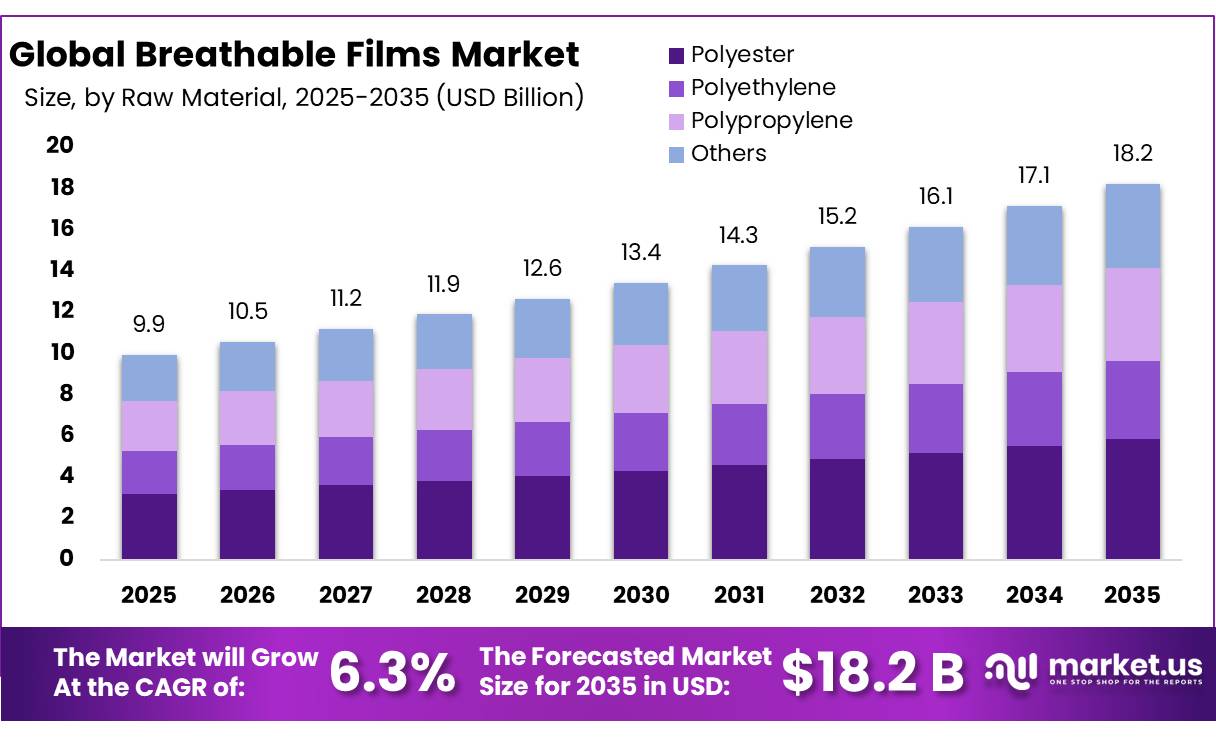
In 2025, the Global Breathable Films Market was valued at USD 9.9 billion, and between 2026 and 2035, this market is estimated to register a CAGR of 6.3%, reaching about USD 18.2 billion by 2035. In 2025, North America held a dominant market position, capturing more than a 40.00% share, holding USD 0.4 Billion revenue.
The breathable films market is characterized by materials that allow vapor transmission while maintaining liquid resistance, serving applications across personal care, medical, industrial, and construction sectors. Rising demand in hygiene products, surgical gowns, and wound care drives adoption, supported by the need for comfort, moisture management, and barrier protection.
- U.S. CDC data released in April 2026 recorded 3,606,400 births in 2025, while the general fertility rate stood at 53.1 births per 1,000 women aged 15–44. This large annual newborn population creates recurring consumption of diapers and related hygiene products that commonly use breathable polyethylene backsheets to improve comfort and moisture management.
Material performance is also improving. Dow’s DOWLEX™ 2027G polyethylene, designed for breathable hygiene films, has a density of 0.941 g/cm³, a melting point of 127°C, and transverse tear strength of 210 g. Such properties help converters manufacture thinner films at high processing speeds while retaining toughness and temperature resistance. Dow – DOWLEX 2027G Polyethylene The industry is therefore moving toward downgauged structures that reduce resin consumption without compromising barrier or mechanical performance.
- The U.S. Census Bureau reported that approximately 1,358,700 housing units were started during 2025, while December housing starts operated at an annualized rate of 1,404,000 units. Breathable roofing membranes and housewraps are used to control moisture while helping protect insulation and building envelopes. The European Commission aims to renovate 35 million buildings by 2030, creating opportunities for vapor-permeable membranes in roof and wall upgrades.
Future growth is increasingly linked to sustainable polymers, PFAS-free membranes, thinner hygiene films, recyclable structures, and bio-based materials. Arkema’s Pebax® Rnew® 30R51 breathable grade contains 45% bio-based material and can deliver around 30% higher moisture-vapor transmission than other grades in its range. Arkema – Breathable Film Technology These developments should expand opportunities in medical protection, premium hygiene, energy-efficient buildings, technical clothing, and lower-carbon film structures as manufacturers focus on comfort, reduced material use, and improved environmental performance.
Key Takeaways
- The global breathable films market was valued at USD 9.9 billion in 2025.
- The global market is projected to grow at a CAGR of 6.3% and is estimated to reach USD 18.2 billion by 2035.
- On the basis of raw material, polyester breathable films dominated the market, constituting 2% of the total market share.
- Among the film types, microporous breathable films held a major share in the market, 7% of the market share.
- Among the end-uses, the personal care & hygiene sector is the most considerable within the market, accounting for around 7% of the revenue.
- In 2025, the Asia Pacific was the most dominant region in the breathable films market, accounting for 8% of the total global consumption.
Raw Material Analysis
Polyester Breathable Films are a Prominent Segment in the Market.
Polyester represents the leading raw material segment in the breathable films market, accounting for 32.2% of total usage. Its prominence is largely attributed to its high tensile strength, dimensional stability, and resistance to stretching or shrinking, which make it suitable for both personal care and industrial applications. Polyester-based breathable films provide consistent vapor permeability while maintaining effective liquid barrier properties, enhancing comfort and protection in hygiene products, medical garments, and protective apparel.
The material’s compatibility with multilayered and laminated constructions further expands its versatility across packaging and construction applications. Additionally, polyester can be engineered for durability, chemical resistance, and thermal stability, enabling long-lasting performance in demanding operational environments. Its wide availability and adaptability in extrusion and coating processes reinforce its role as the preferred choice among manufacturers aiming to balance functional performance with production efficiency.
Film Type Analysis
Microporous Breathable Films Held a Major Share of the Market.
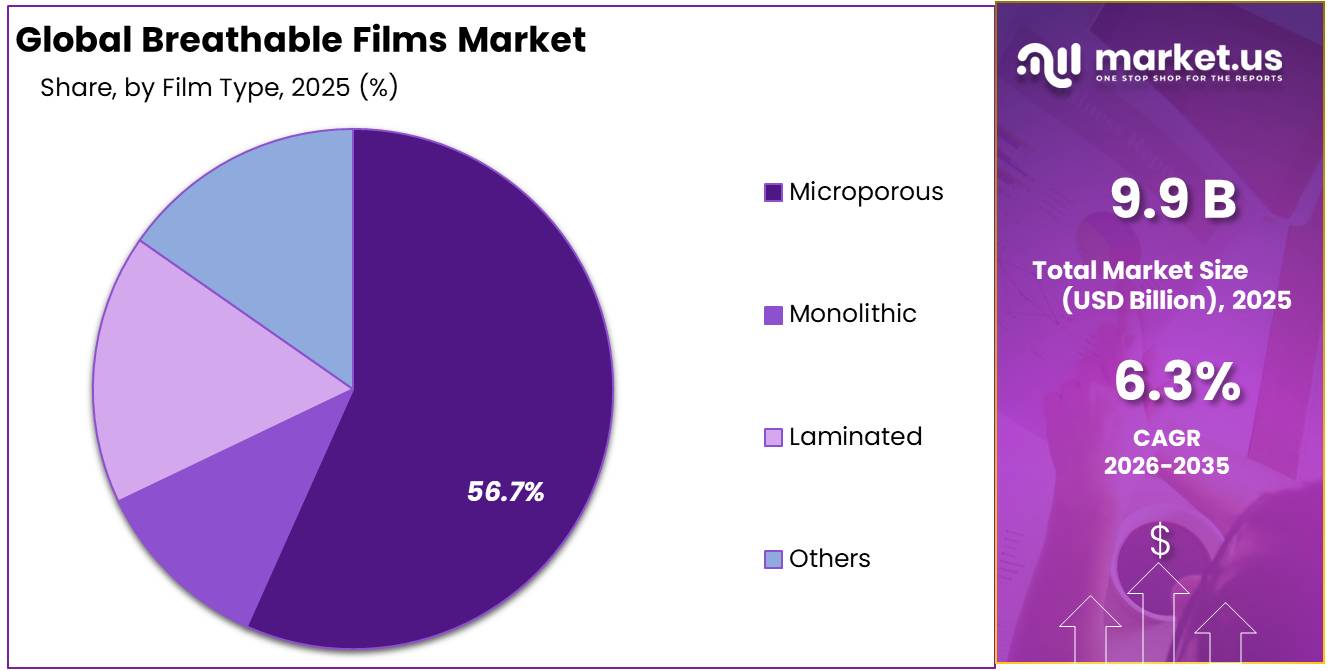
Microporous films dominate the breathable films market, accounting for 56.7% of total usage. Their structure, characterized by a network of micro-sized pores, allows for effective vapor transmission while maintaining resistance to liquids, making them highly suitable for personal care, medical, and industrial applications. In hygiene products such as diapers and sanitary items, microporous films enhance comfort by allowing moisture vapor to escape while keeping the surface dry.
In medical applications, including surgical gowns and wound care products, these films support barrier protection against fluids while maintaining breathability. Their compatibility with multilayer and laminated constructions further increases their functional versatility. The ability to customize pore size and density enables precise control over permeability and mechanical strength, reinforcing microporous films as the preferred choice for applications requiring both protection and comfort.
End-Use Analysis
Breathable Films Are Mostly Utilized in the Personal Care & Hygiene Sector.
Personal Care & Hygiene represents the largest end-use segment in the breathable films market, accounting for 38.7% of total consumption. The segment’s dominance is driven by the widespread use of breathable films in diapers, adult incontinence products, and sanitary napkins, where moisture management, comfort, and skin protection are critical. Breathable films allow vapor to escape while preventing liquid leakage, reducing irritation and improving user experience.
The growing awareness of hygiene standards, combined with rising population and urbanization in the Asia-Pacific and other regions, has further fueled demand. Material versatility, such as microporous and multilayered films, enables manufacturers to optimize softness, strength, and barrier performance for diverse personal care applications. This functional reliability makes Personal Care & Hygiene the most significant application area, setting the benchmark for performance requirements across other sectors.
Key Market Segments
By Raw Material
- Polyester
- Polyethylene
- Polypropylene
- Others
By Film Type
- Microporous
- Monolithic
- Laminated
- Others
By End-Use Industry
- Personal Care & Hygiene
- Medical & Healthcare
- Building & Construction
- Industrial Protective Apparels
- Packaging
- Sports Apparels
- Others
Driver Analysis
Adult Incontinence Adoption
Adult incontinence is the most durable volume driver for breathable-film demand because adult briefs, protective underwear, pads and underpads require microporous backsheet films that balance vapor permeability, liquid barrier performance, softness, stretch and noise reduction, while the addressable user base expands with ageing populations and higher home-care utilization. More than 9% of the global population is already aged 65 years or older, and reported urinary-incontinence prevalence among people aged 65+ is approximately 27%, while women-specific prevalence estimates span roughly 24–45% depending on age and measurement method; these indicators point to a large untreated or under-served consumer pool rather than only incremental product switching.
Mature regions such as North America, Europe and Japan generate high value per user, while China provides scale and Southeast Asia and Latin America provide conversion upside as retail access and stigma reduction improve. This demographic-led consumption engine is expected to add approximately +2.7 percentage points to baseline Breathable Films Market CAGR over a long-term horizon because usage frequency is recurring, less cyclical than construction demand and increasingly supported by institutional procurement and home-delivery channels.
Drivers Impact Analysis
| Driver | (~) % Impact on CAGR Forecast | Geographic Relevance | Impact Timeline |
|---|---|---|---|
| Adult incontinence adoption | +2.7% | North America, EU, Japan, China | Long term (≥4 years) |
| Premium diaper thinness | +2.2% | China, India, ASEAN, Latin America | Medium term (2–4 years) |
| Medical wound-care expansion | +1.8% | North America, EU, Japan, South Korea | Medium term (2–4 years) |
| PPWR recyclable-film redesign | +1.6% | EU core, UK, global exporters | Short term (≤2 years) |
| PPE and protective apparel | +1.3% | North America, EU, APAC industrial hubs | Medium term (2–4 years) |
| Breathable building membranes | +1.1% | Europe, North America, China, Gulf | Long term (≥4 years) |
Restraint Analysis
Polyolefin Resin Price Volatility
Breathable films are overwhelmingly polyethylene- and polypropylene-based, and both feedstocks have swung sharply through 2025-2026: polypropylene surged to roughly 9,150 CNY per tonne on September 1, 2026, up over 15% in a single trading day, while US domestic PP nonwoven resin saw a 4-cents-per-pound hike in February 2026 alone, compounding a 25.74% year-on-year upstream resin cost increase recorded by March 2026.
Because resin typically represents 55-65% of total breathable-film production cost, this scale of feedstock volatility directly compresses converter gross margins by an estimated 400-600 basis points when pass-through pricing lags spot-cost movements by the typical 60-90 day contract-repricing cycle common in hygiene and medical film supply agreements; the strategic consequence is that mid-sized converters lacking captive feedstock integration are forced to either absorb margin erosion or renegotiate annual supply contracts mid-cycle, both of which delay planned capacity-expansion CapEx by an estimated 6-9 months as balance-sheet risk appetite tightens.
Restraint Impact Analysis
| Restraint | (~) % Impact on CAGR Forecast | Geographic Relevance | Impact Timeline |
|---|---|---|---|
| Polyolefin resin price volatility (PE/PP feedstock) | -1.9% | Global, acute in import-dependent APAC and EU | Short term (≤2 years) |
| EU PFAS ban in food-contact and hygiene packaging | -1.5% | EU core, spill-over to exporters in Asia | Short term (≤2 years) |
| US state-level PFAS bans and disclosure mandates | -1.2% | North America, California/Minnesota/Vermont core | Medium term (2-4 years) |
| Thin-gauge downgauging limits and micro-porous tooling costs | -1.0% | Global, acute in hygiene-product manufacturing hubs | Medium term (2-4 years) |
| Tariff-driven feedstock and equipment cost inflation | -0.9% | North America core, China-EU trade corridors | Short term (≤2 years) |
| Biodegradable-film substitution and compostability mandates | -0.7% | EU core, select APAC markets | Long term (≥4 years) |
Opportunity Analysis
Reusable Logistics Film Systems
The EU Packaging and Packaging Waste Regulation creates a future white space in reusable transport protection rather than merely increasing demand for conventional single-use breathable films: by 2030, at least 40% of eligible transport packaging within the EU must be reusable, and the long-range target rises to 70% by 2040, forcing manufacturers, distributors, and e-commerce supply chains to shift from disposable wrapping toward managed reuse systems.
A reusable film product capable of surviving 25–50 logistics cycles could reduce packaging cost per shipment by roughly 25–45% for high-volume users despite carrying an initial selling price 4–8 times higher than a single-use alternative; for the supplier, the revenue model can lift customer retention, convert irregular film orders into contracted annuity-style billing, and potentially expand EBITDA margins by 300–600 basis points once reverse-logistics utilization exceeds approximately 65%.
This is not a baseline market driver because most breathable-film converters still sell commodity rolls on a per-kilogram basis; the upside depends on building collection networks, cleaning partnerships, RFID/QR asset tracking, and commercial contracts with retailers, 3PLs, and large consumer-goods manufacturers before the 2030 compliance requirement turns reuse into a procurement standard.
Opportunity Impact Analysis
| Opportunity | (~) % Potential CAGR Upside | Geographic Relevance | Execution Window |
|---|---|---|---|
| Reusable logistics film systems | +2.2% | EU core, North America | Medium term (2-4 years) |
| PFAS-free premium barrier films | +2.0% | EU, US, Japan | Short term (≤2 years) |
| Adult-care private-label films | +1.8% | India, China, Southeast Asia | Medium term (2-4 years) |
| Smart traceable film platforms | +1.5% | EU, North America | Medium term (2-4 years) |
| Building-envelope membrane pivot | +1.4% | EU, Gulf, North America | Medium term (2-4 years) |
| Converter M&A roll-ups | +1.2% | EU, North America, APAC | Short term (≤2 years) |
Challenges Analysis
Multilayer Recycling Complexity
Breathable films are commonly engineered as mineral-filled PE, PP, nonwoven, adhesive, pigment, and coating combinations to balance liquid resistance, moisture-vapor transmission, softness, printability, and sealing performance; this material architecture sustains current product performance but creates a persistent circularity challenge because multilayer flexible films are difficult to separate and recycle into high-value applications at commercial scale.
The European Food Safety Authority’s 2026 circularity call explicitly identifies multilayer flexible food-contact films as difficult to recycle and notes that a closed-loop market from post-consumer flexible packaging back into food-contact packaging has not yet been established at scale. The commercial friction becomes more significant as the PPWR moves from general compliance in August 2026 toward recyclability criteria from 2030, scale-based recycling expectations by 2035, and at least recyclability Grade B from 2038.
In practical unit-economic terms, converting a high-performance multilayer structure into a recyclable alternative can require 12–24 months of material redevelopment, 6–12 customer qualification trials, and an estimated 5–15% increase in initial formulation cost before scale economies are achieved; sustained mitigation requires design-for-recycling teams, supplier co-development with resin and adhesive manufacturers, and investment in compatible mineral-fill, coating, and tie-layer technologies rather than a one-time compliance project.
Challenges Impact Analysis
| Challenge | (~) % CAGR Friction | Geographic Relevance | Mitigation Horizon |
|---|---|---|---|
| Multilayer recycling complexity | -1.4% | EU core, North America, APAC | Long term (≥4 years) |
| Extrusion talent gap | -1.2% | North America, EU, India | Medium term (2-4 years) |
| Red Sea freight volatility | -1.0% | EU-APAC corridors, Middle East | Medium term (2-4 years) |
| Thin-film yield instability | -0.9% | Global hygiene hubs | Medium term (2-4 years) |
| Certification workload escalation | -0.8% | EU, US, Japan | Medium term (2-4 years) |
| Fragmented collection infrastructure | -0.7% | EU, ASEAN, Latin America | Long term (≥4 years) |
Geopolitical Impact Analysis
Supply Chain Disruptions and Material Volatility Amid Geopolitical Uncertainty.
Current geopolitical tensions, including trade restrictions, sanctions, and export controls, have affected the supply chains for polymers and additives used in breathable film production. The U.S. Department of Commerce (DOC) reported that export controls on certain chemical intermediates from specific regions have disrupted the availability of high-purity polyethylene and polypropylene resins, which are critical for microporous and laminated films.
The U.S. International Trade Commission (USITC) indicates that tariffs on imported polymers have led to increased logistical complexity and extended lead times for manufacturers relying on cross-border supply chains. The U.S. Energy Information Administration (EIA) notes that fluctuations in crude oil prices, exacerbated by geopolitical instability, directly influence the cost of petroleum-derived raw materials used in film extrusion.
Furthermore, the U.S. Department of Transportation (DOT) has documented shipping delays and container shortages affecting global trade routes, which impact the timely delivery of raw materials and finished films. These factors collectively challenge operational continuity and inventory management, necessitating adjustments in sourcing strategies, stockpiling practices, and production scheduling to maintain consistent output across medical, personal care, and industrial applications.
Regional Analysis
Asia Pacific Held the Largest Share of the Global Breathable Films Market.
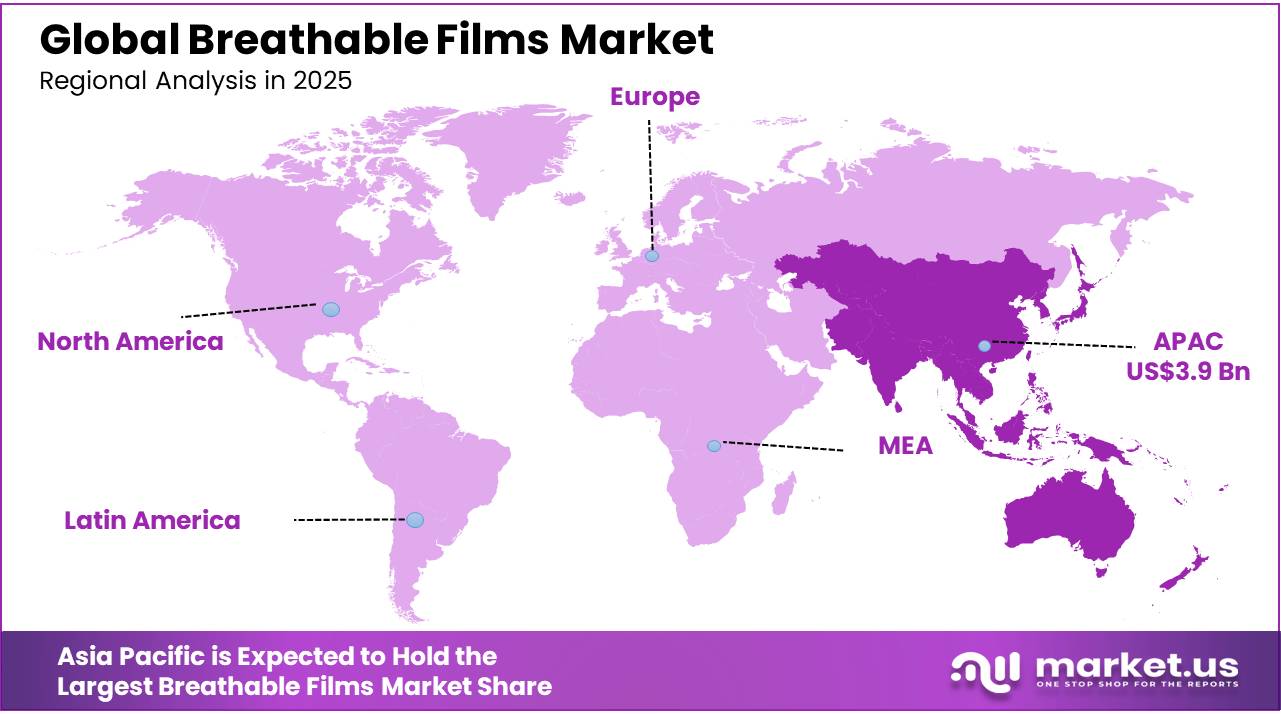
In 2025, the Asia Pacific dominated the global breathable films market, holding about 39.8% of the total global consumption. The region represents a significant hub for breathable film utilization, driven by high demand in personal care, medical, and industrial applications. According to the United Nations Population Fund (UNFPA), the region accounts for over 60% of the global population of women of reproductive age, underpinning substantial consumption of menstrual and hygiene products that incorporate breathable films for comfort and moisture management.
The World Health Organization (WHO) reports that Asia hosts approximately 50% of the global healthcare workforce, supporting extensive use of surgical gowns, drapes, and wound care products that rely on breathable films for infection control and user comfort. Rapid urbanization and industrialization in countries such as China and India have increased the adoption of industrial protective apparel, where laminated and multilayered films provide durability and breathability.
Key Regions and Countries
- North America
- The US
- Canada
- Europe
- Germany
- France
- The UK
- Spain
- Italy
- Russia & CIS
- Rest of Europe
- APAC
- China
- Japan
- South Korea
- India
- ASEAN
- Rest of APAC
- Latin America
- Brazil
- Mexico
- Rest of Latin America
- Middle East & Africa
- GCC
- South Africa
- Rest of MEA
Key Players Analysis
Manufacturers of breathable films focus on several strategic activities to strengthen their competitive position and enhance market share. Innovation in polymer formulations and film structures is central, including the development of microporous, monolithic, and multilayered films tailored to specific applications such as medical, personal care, and industrial protective apparel. Companies prioritize operational efficiency through investment in advanced extrusion, coating, and lamination technologies to ensure consistent quality and reduce waste.
Sustainability initiatives, including the integration of bio-based and recyclable polymers, are increasingly emphasized to meet regulatory standards and consumer preferences. Additionally, manufacturers establish robust supply chains, strategic partnerships with raw material suppliers, and collaborations with end-use product manufacturers to ensure timely delivery and customization, enabling differentiation in terms of performance, reliability, and application-specific functionality.
The Major Players in The Industry
- Arkema
- Fatra, a.s.
- Nitto Denko Corporation
- Rahil Foam Pvt. Ltd.
- RKW North America, Inc.
- SILON s.r.o
- SKYMARK
- American Polyfilm
- Innovia Films
- Mitsui Chemicals, Inc.
- Omya AG
- Safeco Hygiene
- Ametek Mocon
- LUCOBIT Aktiengesellschaft
- MEDPOS
- Pelsan Tekstil A.S.
- Other Key Players
Key Development
- In May 2025, Pelsan Tekstil A.S., a global leader in breathable film technologies for hygiene and medical applications, announced to open its first U.S. production facility in Wayne County, Goldsboro, investing US$82.6 million and creating 216 jobs.
Report Scope
| Report Features | Description |
|---|---|
| Market Value (2025) | US$9.9 Bn |
| Forecast Revenue (2035) | US$18.2 Bn |
| CAGR (2026-2035) | 6.3% |
| Base Year for Estimation | 2025 |
| Historic Period | 2020-2024 |
| Forecast Period | 2026-2035 |
| Report Coverage | Revenue Forecast, Market Dynamics, Competitive Landscape, Recent Developments |
| Segments Covered | By Raw Material (Polyester, Polyethylene, Polypropylene, and Others), By Film Type (Microporous, Monolithic, Laminated, and Others), By End-Use (Personal Care & Hygiene, Medical & Healthcare, Building & Construction, Industrial Protective Apparels, Packaging, Sports Apparels, and Others) |
| Regional Analysis | North America – The US & Canada; Europe – Germany, France, The UK, Spain, Italy, Russia & CIS, Rest of Europe; APAC– China, Japan, South Korea, India, ASEAN & Rest of APAC; Latin America– Brazil, Mexico & Rest of Latin America; Middle East & Africa– GCC, South Africa, & Rest of MEA |
| Competitive Landscape | Arkema, Fatra, a.s., Nitto Denko Corporation, Rahil Foam Pvt. Ltd., RKW North America, Inc., SILON s.r.o, SKYMARK, American Polyfilm, Innovia Films, Mitsui Chemicals, Inc., Omya AG, Safeco Hygiene, Ametek Mocon, LUCOBIT Aktiengesellschaft, MEDPOS, Pelsan Tekstil A.S., and Other Players. |
| Customization Scope | Customization for segments, region/country-level will be provided. Moreover, additional customization can be done based on the requirements. |
| Purchase Options | We have three licenses to opt for: Single User License, Multi-User License (Up to 5 Users), Corporate Use License (Unlimited Users and Printable PDF) |





































