


Report Overview
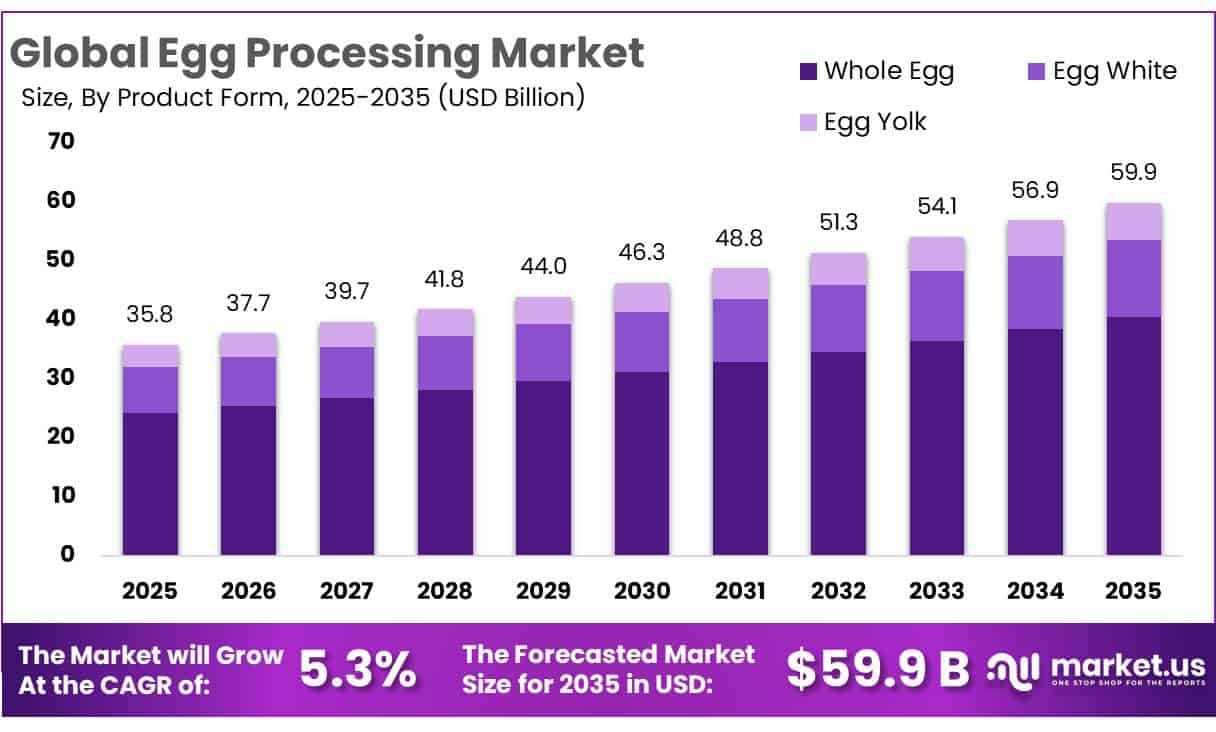
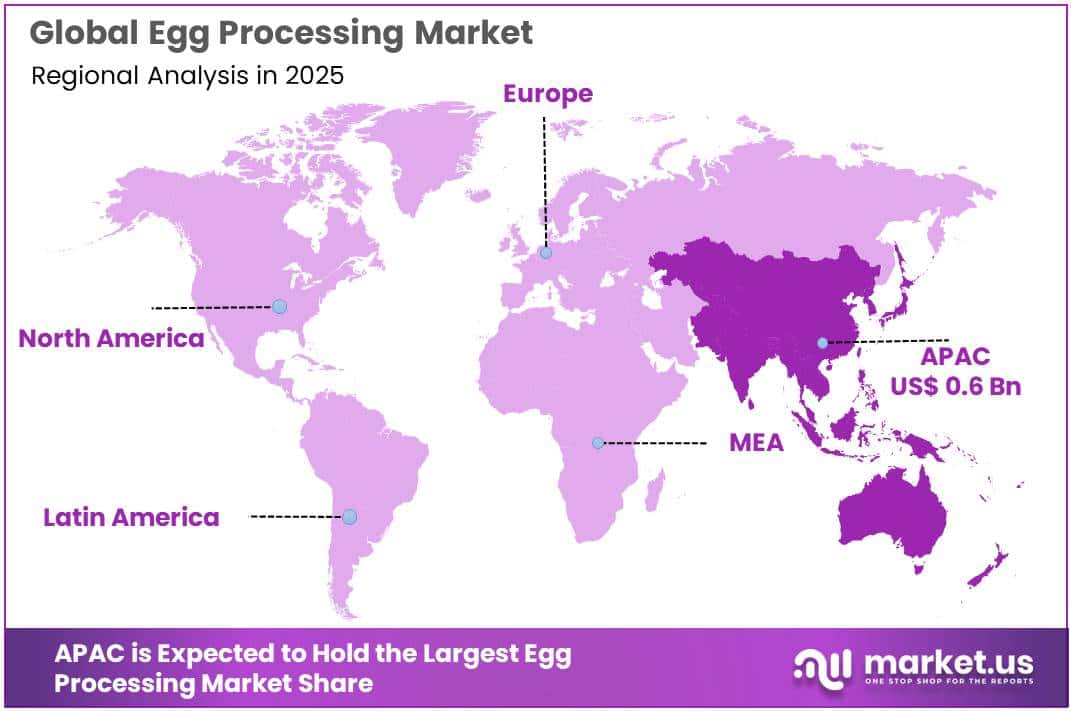
The Global Egg Processing Market size is expected to be worth around USD 59.9 Billion by 2035, from USD 35.8 Billion in 2025, growing at a CAGR of 5.3% during the forecast period from 2026 to 2035. In 2025, Asia Pacific held a dominant market position, capturing more than a 32.5% share, holding USD 0.6 Billion revenue.
Egg processing is an established food-ingredient industry that converts shell eggs into liquid whole egg, yolk, albumen, frozen products, and dried powders for bakery, confectionery, mayonnaise, sauces, prepared foods, and foodservice applications. FAO reported that world egg production reached 100 million tonnes in 2024, with hen eggs accounting for 94% of the total. This large raw-material base supports investment in automated breaking, separation, filtration, pasteurization, drying, and hygienic packaging systems.
- USDA FSIS states that egg-product processing can include breaking, filtering, mixing, stabilizing, blending, pasteurizing, cooling, freezing, drying, and packaging at inspected plants. In the United States, FSIS inspected 2.8 billion pounds of liquid, frozen, and dried egg products in 2024, showing the substantial commercial scale of the processed-egg supply chain.
Key Takeaways
- Egg Processing Market size is expected to be worth around USD 59.9 Billion by 2035, from USD 35.8 Billion in 2025, growing at a CAGR of 5.3%.
- Whole Egg held a dominant market position, capturing more than a 67.50% share.
- Liquid Egg Products held a dominant market position, capturing more than a 38.50% share.
- Bakery & Confectionery held a dominant market position, capturing more than a 41.5% share.
- Egg Breakers & Separators held a dominant market position, capturing more than a 29.50% share.
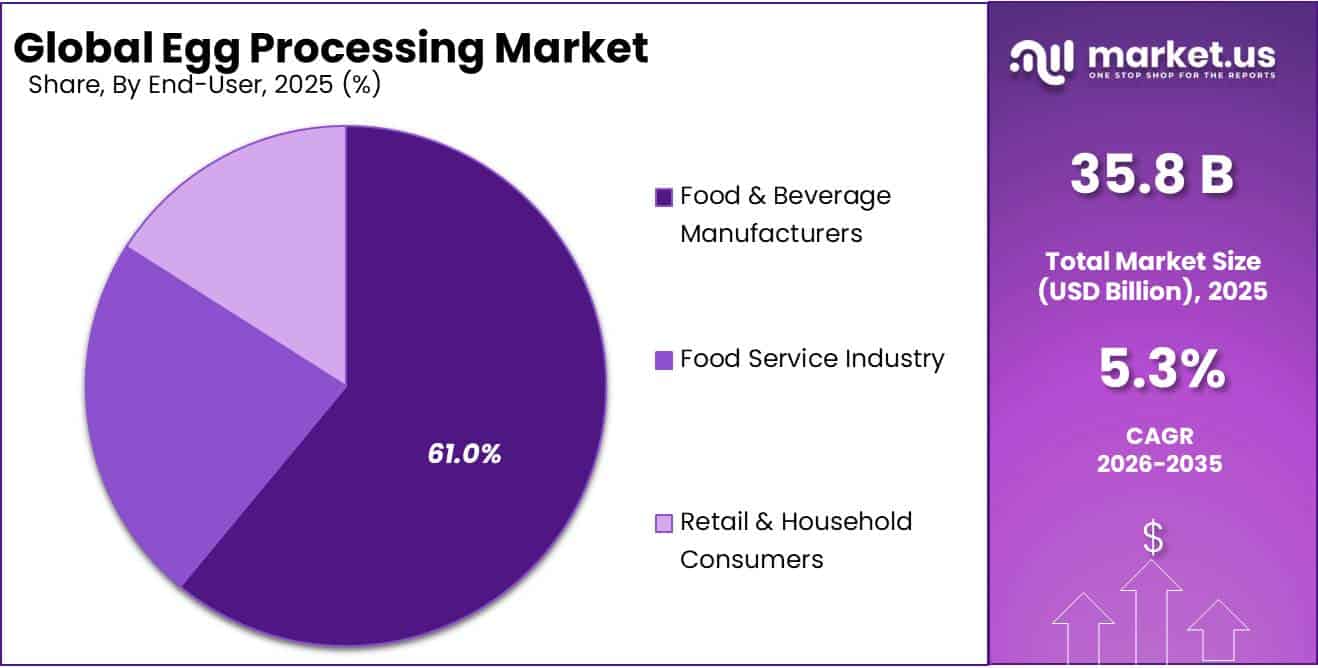
- Food & Beverage Manufacturers held a dominant market position, capturing more than a 61.00% share.
- Asia Pacific held the leading position in the Egg Processing Market, accounting for 32.50% of global revenue and generating about USD 0.65 billion.
Raw-material availability remains a major market driver. USDA reported that U.S. egg production totaled 105 billion eggs in 2025, including 90.1 billion table eggs, although total output declined 4% from 2024. In Europe, the European Commission’s 2025 forecast placed production at about 6 million tonnes of eggs for consumption and 621,000 tonnes of hatching eggs. These volumes provide processors with a broad supply base for industrial food manufacturing.
Trade is another supporting factor for processors serving international food manufacturers. European Commission data showed EU egg exports increased 0.1% in volume and 5% in value during 2025 compared with 2024. This reflects continuing demand for eggs and egg-based products across external markets and encourages investment in quality control, cold-chain management, and export-compliant processing.
- Supply security, however, remains a key industry issue. USDA estimated that the HPAI wave from October 2024 through March 10, 2025 caused the loss of 50.7 million laying hens and 1.8 million pullets. To strengthen resilience, USDA announced a USD 1 billion strategy in February 2025 to combat avian influenza, improve biosecurity, and protect poultry supply. Such measures support future investment in traceability, sanitation, disease prevention, and flexible sourcing.
The European Commission expects EU egg production to increase around 0.5% per year through 2035, while per-capita egg consumption is projected to rise at a similar 0.5% annual rate to 14 kg. This outlook indicates steady long-term demand for efficient processing capacity, safer shelf-stable products, and customized egg ingredients.
By Product Form Analysis
Whole Egg dominates the Egg Processing Market with a 67.50% share
In 2025, “Whole Egg” held a dominant market position, capturing more than a 67.50% share. The segment remains widely used because whole egg provides protein, fat, emulsification, binding, color, and texture in a single ingredient, making it practical for bakery, sauces, prepared meals, and foodservice production.
- USDA data released in 2026 showed that federally inspected processors produced 63.497 million pounds of whole egg product in January, equivalent to 111% of the volume recorded in the same month a year earlier. The strong processing volume reflects the continued preference for convenient, standardized, and pasteurized whole egg ingredients in large-scale food manufacturing.
Egg White holds an important position in the egg processing industry due to its high protein content, foaming ability, binding performance, and low-fat profile. Demand is supported by bakeries, confectionery producers, nutrition-food manufacturers, and foodservice operators that require separated and pasteurized albumen in consistent form.
USDA reported that federally inspected facilities produced 31.186 million pounds of egg white products in January 2026, compared with 30.166 million pounds in January 2025, placing the latest volume at 103% of the previous-year level. These figures indicate steady industrial use of processed egg whites, particularly where manufacturers require reliable functional protein without the fat contained in yolk.
By Processing Format Analysis
Liquid Egg Products lead the Egg Processing Market with a 38.50% share
In 2025, “Liquid Egg Products” held a dominant market position, capturing more than a 38.50% share. Liquid eggs remain widely preferred in commercial bakeries, sauces, prepared foods, and foodservice operations because they reduce shell handling and allow easier mixing, portioning, and continuous processing.
USDA Agricultural Marketing Service data showed that federally inspected facilities produced 40.856 million pounds of liquid whole egg and 16.168 million pounds of liquid egg white during the week ending March 7, 2026. These production levels underline the strong role of liquid formats in high-volume egg processing operations.
Dried Egg Products continue to hold an important place in egg processing because they offer longer shelf life, lower storage requirements, and easier transportation compared with refrigerated liquid formats. USDA Agricultural Marketing Service data showed dried egg production of 2.948 million pounds during the week ending March 7, 2026.
Cumulative dried production reached 29.319 million pounds during 2026 up to that period, representing an 82.1% increase from the comparable prior-year level. This growth supports the use of dried eggs in bakery mixes, confectionery, dry food formulations, institutional foods, and other applications that require stable egg ingredients.
By Application Analysis
Bakery & Confectionery leads the Egg Processing Market with a 41.5% share
In 2025, “Bakery & Confectionery” held a dominant market position, capturing more than a 41.5% share. Processed eggs remain widely used in cakes, cookies, pastries, breads, chocolates, fillings, and other confectionery products because they provide binding, aeration, emulsification, moisture, and texture.
USDA Farm Service Agency data published in 2026 showed that U.S. sugar deliveries to bakery, cereal, and related-product manufacturers reached 784,947 short tons on an actual-weight basis through January, while confectionery and related-product manufacturers received 372,487 short tons.
Processed Foods & Ready-to-Eat (RTE) represents an important application area for processed eggs as manufacturers increasingly require convenient ingredients that can be blended directly into prepared meals, sandwiches, breakfast foods, sauces, frozen products, and other ready-to-serve items.
USDA Economic Research Service data showed that U.S. food-away-from-home spending, which covers prepared meals and snacks for immediate consumption, reached USD 1.41 trillion in 2025 and represented 56.3% of total food expenditure. Limited-service establishments alone generated USD 516.1 billion in inflation-adjusted food sales, indicating a sizeable demand base for standardized, easy-to-handle ingredients such as liquid and pre-processed eggs.
By Machinery & Equipment Analysis
Egg Breakers & Separators dominate the Egg Processing Market with a 29.50% share
In 2025, “Egg Breakers & Separators” held a dominant market position, capturing more than a 29.50% share. These machines form the first major processing step in industrial plants by automatically cracking shell eggs and separating whole egg, white, and yolk with less manual handling and more consistent output.
- USDA data for the week ending August 15, 2026 showed that federally inspected facilities broke 1,629,483 cases of eggs. Year-to-date processing reached 54,037,056 cases, compared with 47,948,969 cases during the corresponding 2025 period, representing an increase of 12.7%.
USDA reported that facilities produced 39.274 million pounds of liquid whole egg, 15.241 million pounds of liquid egg white, and 7.928 million pounds of liquid yolk during the week ending August 15, 2026. These volumes create a substantial processing load for pasteurization and product-conditioning equipment.
By End-Use Sector Analysis
Food & Beverage Manufacturers dominate the Egg Processing Market with a 61.00% share
In 2025, “Food & Beverage Manufacturers” held a dominant market position, capturing more than a 61.00% share. Processed eggs are widely used by bakery, confectionery, sauce, dressing, prepared-food, and specialty-food producers because liquid, dried, and separated egg ingredients simplify handling and provide consistent binding, emulsification, texture, and protein content.
- U.S. Bureau of Labor Statistics data showed that food manufacturing employed about 1.769 million workers on a seasonally adjusted basis in December 2025. USDA also reported that inflation-adjusted food-at-home expenditures reached USD 1.10 trillion in 2025, indicating the large consumer market served by packaged and manufactured food producers.
Food Service Industry remains an important end-use sector for processed eggs as restaurants, cafeterias, caterers, hotels, and quick-service outlets require convenient ingredients that reduce preparation time and provide consistent portion control. USDA Economic Research Service reported that food-away-from-home spending reached USD 1.41 trillion in 2025 and represented 56.3% of total U.S. food expenditures.
Limited-service restaurants alone recorded USD 516.1 billion in inflation-adjusted food sales, supporting continued demand for liquid whole eggs, separated egg products, and other ready-to-use egg ingredients across commercial kitchens.
Key Market Segments
By Product Form
- Whole Egg
- Egg White
- Egg Yolk
By Processing Format
- Liquid Egg Products
- Dried Egg Products
- Frozen Egg Products
By Application
- Bakery & Confectionery
- Processed Foods & Ready-to-Eat (RTE)
- Soups, Sauces & Dressings
- Dietary Supplements & Pharma
By Machinery & Equipment
- Egg Breakers & Separators
- Pasteurizers & Homogenizers
- Palletizers & Depalletizers
- Drying Systems
- Washers & Loaders
By End-Use Sector
- Food & Beverage Manufacturers
- Food Service Industry
- Retail & Household Consumers
Driver Analysis
Foodservice Ingredient Standardization
Foodservice chains, commissaries, meal-kit producers, institutional kitchens, and industrial caterers are shifting toward liquid and pre-separated egg products because standardized packs reduce cracking labor, shell waste, batch inconsistency, food-safety exposure, and back-of-house handling time. In 2022, 29.7% of the 93.1 billion eggs consumed in the United States were processed egg products rather than shell eggs, demonstrating that the ingredient channel is already material but still leaves a large conversion pool in restaurants, bakeries, schools, hospitals, and prepared-food manufacturing.
A quick-service restaurant or centralized kitchen using 10,000-50,000 eggs weekly can replace manual breaking with bag-in-box liquid whole egg, yolk, or albumen, reducing shell handling and allowing portion-controlled dispensing; at scale, even a 5-10 second reduction in preparation time per egg-based serving creates meaningful labor savings in high-wage markets. This changes processor economics from seasonal shell-egg selling toward recurring B2B contracts with predictable pack sizes, fat and solids specifications, allergen documentation, and delivery schedules, improving plant utilization and reducing the revenue volatility associated with shell-egg retail pricing.
The driver is strongest in North America and Europe, where centralized foodservice procurement and food-safety compliance are mature, but it is increasingly relevant in urban APAC corridors as chain restaurants, institutional catering, and frozen or ready-to-heat breakfast formats expand; the two-to-four-year effect reflects menu redesign cycles, distributor qualification, and cold-chain investments rather than a one-quarter demand shift.
Drivers Impact Analysis
| Driver | (~) % Impact on CAGR Forecast | Geographic Relevance | Impact Timeline |
|---|---|---|---|
| Salmonella-control processing upgrades | +1.5% | North America, EU, APAC export hubs | Short term (≤ 2 years) |
| Foodservice ingredient standardization | +1.4% | North America, EU, APAC urban corridors | Medium term (2-4 years) |
| High-protein convenience demand | +1.2% | North America, EU, APAC urban markets | Long term (≥ 4 years) |
| Cage-free supply-chain conversion | +1.0% | North America, EU, Australia, developed APAC | Medium term (2-4 years) |
| Bakery and industrial egg use | +0.9% | Europe, North America, China, India | Medium term (2-4 years) |
| Automation and yield optimization | +0.8% | Global; North America, EU, China | Short term (≤ 2 years) |
Restraint Analysis
HPAI Flock-Loss Volatility
Highly pathogenic avian influenza is the most immediate demand-side restraint because egg processors cannot convert eggs that are unavailable: during January 2025, approximately 18.8 million commercial layers were affected in the United States, average layer inventory fell to roughly 363 million birds, and total January egg production declined 4% year on year to 8.86 billion eggs.
A processor designed to break 1 million eggs per day can lose 10-30% of planned throughput during a regional outbreak, while labor, refrigeration, pasteurization, depreciation, and quality-assurance overhead remain largely fixed; a 15% volume shortfall can therefore compress EBITDA by an estimated 300-700 basis points if the facility cannot secure replacement eggs from another region.
USDA’s USD 1 billion HPAI response strategy and more than USD 70 million in increased-indemnity payments since February 2025 demonstrate the scale of the production-risk intervention required, but such funding limits farm losses rather than restoring immediate processing feedstock.
This imposes a -1.8 percentage-point short-term CAGR drag across North America, Europe, and high-density Asian production areas because recurring outbreaks force processors to hold higher inventory buffers, accept lower line utilization, renegotiate supply contracts, and delay capacity additions until flock replacement normalizes.
Restraint Impact Analysis
| Restraint | (~) % Impact on CAGR Forecast | Geographic Relevance | Impact Timeline |
|---|---|---|---|
| HPAI flock-loss volatility | -1.8% | North America, EU, APAC poultry corridors | Short term (≤ 2 years) |
| Shell-egg input inflation | -1.3% | Global; North America, EU, import-dependent APAC | Short term (≤ 2 years) |
| Biosecurity and compliance CapEx | -0.9% | North America, EU, export-oriented APAC | Medium term (2-4 years) |
| Cage-free supply conversion costs | -0.8% | North America, EU, Australia, developed APAC | Medium term (2-4 years) |
| Cold-chain energy burden | -0.7% | EU, North America, APAC import corridors | Medium term (2-4 years) |
| Trade and import uncertainty | -0.6% | North America, EU, MENA, APAC | Short term (≤ 2 years) |
Opportunity Analysis
Eggshell Biorefinery Platforms
Eggshells are approximately 95% calcium carbonate, 1% magnesium carbonate, and 1% calcium phosphate, while global egg-breaking operations generate more than 2 million tonnes of eggshell by-products annually; even a 1-million-eggs-per-day processor can generate roughly 5-6 tonnes of shells daily, creating an annual 1,500-2,000 tonne secondary-material stream that is largely unmonetized today.
A dedicated separation and fine-grinding module costing an estimated USD 1-3 million could turn a disposal burden into calcium carbonate for food, feed, fertilizer, ceramics, packaging, and construction markets, while membrane extraction provides a higher-margin route into nutraceutical, cosmetics, and biomedical supply chains; the commercial gain can add USD 15-50 per tonne of recovered calcium product and multiples of that amount for purified membrane fractions.
This is not a baseline driver because it depends on processors building new quality systems, downstream qualification, and off-take partnerships rather than merely increasing egg throughput, but it can lift EBITDA by 100-300 basis points at large facilities while reducing waste-hauling cost and improving sustainability metrics.
Opportunity Impact Analysis
| Opportunity | (~) % Potential CAGR Upside | Geographic Relevance | Execution Window |
|---|---|---|---|
| Eggshell biorefinery platforms | +1.4% | EU, North America, China, India | Medium term (2-4 years) |
| Functional albumen specialization | +1.3% | North America, EU, APAC premium nutrition | Medium term (2-4 years) |
| Precision-fermented protein hybrids | +1.1% | North America, EU, Singapore, APAC | Long term (≥ 4 years) |
| Export-grade drying hubs | +1.0% | North America, EU, Brazil, India, MENA | Medium term (2-4 years) |
| Egg-processing-as-a-service | +0.9% | North America, EU, APAC foodservice hubs | Short term (≤ 2 years) |
| Regional processor M&A roll-ups | +0.8% | India, Southeast Asia, Latin America, Africa | Short term (≤ 2 years) |
Challenges Analysis
HPAI Biosecurity Execution
A processing company sourcing from 50-150 farms must therefore maintain layered supplier biosecurity—including visitor controls, PPE changes, vehicle and crate disinfection, controlled feed and water access, wildlife exclusion, 30-day new-bird isolation, daily contact logs, farm testing, and geographically separated sourcing—which can raise procurement and assurance cost by an estimated USD 0.01-0.04 per dozen before direct egg-cost inflation.
The risk is structurally persistent because wild birds and their droppings remain a major transmission pathway, while a single non-compliant supplier can disrupt a regional collection network, plant-scheduling plan, and export certification sequence; current guidance explicitly emphasizes securing vents, limiting standing water, restricting inter-farm visits, cleaning equipment, and using PPE and footbaths between sheds.
Processors must consequently use supplier-risk scoring, regional diversification, digital traceability, validated sanitation audits, outbreak-contingency inventory, and live disease-surveillance data; these reduce loss severity but cannot eliminate recurring exposure, making this a long-term -1.0 percentage-point friction across global poultry-processing systems.
Challenges Impact Analysis
| Challenge | (~) % CAGR Friction Drag | Geographic Relevance | Mitigation Horizon |
|---|---|---|---|
| HPAI biosecurity execution | -1.0% | Global poultry corridors | Long term (≥ 4 years) |
| Volatile feedstock allocation | -0.8% | North America, EU, APAC | Medium term (2-4 years) |
| Skilled processing labor gap | -0.7% | North America, EU, APAC manufacturing hubs | Long term (≥ 4 years) |
| Cold-chain network variability | -0.6% | APAC, MENA, Africa, Latin America | Medium term (2-4 years) |
| Multi-format yield management | -0.5% | Global industrial processors | Medium term (2-4 years) |
| Traceability data fragmentation | -0.4% | EU, North America, APAC exporters | Medium term (2-4 years) |
Geopolitical Impact Analysis
The ongoing Russia–Ukraine war and wider Middle East shipping disruptions are affecting the egg processing industry mainly through feed, energy, freight, and packaging costs. Eggs depend heavily on corn, wheat, barley, and soybean-based poultry feed, so instability in Black Sea grain flows can quickly influence farm input prices and the cost of raw eggs.
- USDA reported in 2026 that Ukrainian grain exports during July–December 2025 averaged 2.5 million metric tons per month, around 30% below the comparable period, with Russian attacks on energy, rail, ports, and vessels constraining exports. This creates greater uncertainty for poultry producers and processors dependent on internationally traded feed grains.
Shipping risks add another layer of pressure. UNCTAD reported that more than 80% of world merchandise trade moves by sea, while maritime trade growth slowed to only 0.5% in 2025 as geopolitical tensions forced longer routes and raised operating costs. In 2026, UNCTAD also reported that shipping through the Strait of Hormuz had fallen by more than 95% during the regional conflict.
Regional Insights
In 2025, Asia Pacific held the leading position in the Egg Processing Market, accounting for 32.50% of global revenue and generating about USD 0.65 billion. The region benefits from an egg-production base, expanding packaged-food manufacturing, and increasing use of liquid and dried egg ingredients.
China’s National Bureau of Statistics reported egg output of 34.98 million tonnes in 2025, despite a 2.5% annual decline. This scale supports investment in automated breaking, separation, pasteurization, drying, and packaging systems, while bakery, confectionery, foodservice, and ready-meal industries continue to strengthen processed-egg demand across regional markets. China National Bureau of Statistics
Asia Pacific is expected to remain an active growth area for egg processing as manufacturers shift from shell-egg handling toward convenient, standardized ingredients. Export-oriented production supports this transition. Japan’s Ministry of Agriculture reported egg exports of 21,396 tonnes in 2025, valued at JPY 8.14 billion, with export value increasing 14.5% year over year; figures include processed products.
Key Regions and Countries Insights
- North America
- US
- Canada
- Europe
- Germany
- France
- The UK
- Spain
- Italy
- Rest of Europe
- Asia Pacific
- China
- Japan
- South Korea
- India
- Australia
- Rest of APAC
- Latin America
- Brazil
- Mexico
- Rest of Latin America
- Middle East & Africa
- GCC
- South Africa
- Rest of MEA
Key Players Analysis
Cal-Maine Foods, Inc. remains a major integrated egg producer and processor, with operations covering production, grading, packaging, and distribution. In fiscal 2025, the company generated USD 4.3 billion in net sales, sold 1.283 billion dozen eggs, and produced 1.136 billion dozen eggs. Specialty eggs represented 36.7% of total dozens sold. Its scale, expanding production capacity, and acquisition-led growth strengthen its ability to supply retail, foodservice, and food-manufacturing customers requiring dependable egg volumes and consistent processing quality across multiple customer channels.
Michael Foods, Inc., owned by Post Holdings, is a major supplier of egg and refrigerated food products to foodservice and food-ingredient customers. In fiscal 2025, Post’s Foodservice segment, which primarily includes egg and potato products, recorded USD 2.641 billion in net sales, up 14.5%, while segment adjusted EBITDA reached USD 532.9 million. Eggs and egg products represented 29.6% of Post Holdings’ total product sales mix, highlighting the strategic importance of Michael Foods within the group’s processing portfolio across key markets.
Rose Acre Farms, Inc. is a vertically integrated egg producer serving retail, foodservice, and industrial customers with shell, liquid, dried, and protein-based egg products. The company currently operates 17 facilities across 7 U.S. states and uses 3 geographically diverse breaker plants to support liquid egg supply. Rose Acre opened its first egg dryer plant in 1994 and continues to produce pasteurized liquid whole egg, whites, yolks, dried whole egg, dried yolk, and egg-white protein powder for commercial customers at scale.
Top Key Players Outlook
- Cal-Maine Foods, Inc.
- Michael Foods, Inc. (Post Holdings)
- Rose Acre Farms, Inc.
- Rembrandt Enterprises, Inc.
- Eurovo Group
- Interovo Egg Group B.V.
- Groupe Avril
- IGRECA S.A.
- Bouwhuis Enthoven B.V.
- SKM Egg Products Export (India) Limited
- Ovobel Foods Limited
- Kewpie Corporation
- Daybreak Foods, Inc.
- Wabash Valley Produce, Inc.
- Hillandale Farms
Recent Developments
- In March 2025, CEO Andrew Herr described Rembrandt as a leading egg company focused on food ingredients and foodservice applications, reflecting its continued growth strategy. Its portfolio covers 9 major product categories, including liquid, dried, frozen, cage-free, hard-cooked, pre-cooked, enzyme-modified and sports-nutrition egg products.
- In June 2026, Eurovo Group announced approval of the D.O.M.A.N.I. integrated poultry-and-egg supply-chain program; Italy’s Agriculture Ministry approved about EUR 32.30 million in total incentives for the wider program, supporting modernization, sustainability and processing-chain investment.
- In September 2025, Interovo Egg Group B.V. egg-products facility achieved a 95.7% KAT audit score, with certification valid through December 2026, strengthening access to customers requiring controlled alternative-housing standards.
Report Scope
| Report Features | Description |
|---|---|
| Market Value (2025) | USD 35.8 Bn |
| Forecast Revenue (2035) | USD 59.9 Bn |
| CAGR (2026-2035) | 5.3% |
| Base Year for Estimation | 2025 |
| Historic Period | 2020-2024 |
| Forecast Period | 2026-2035 |
| Report Coverage | Revenue Forecast, Market Dynamics, Competitive Landscape, Recent Developments |
| Segments Covered | By Product Form (Whole Egg, Egg White, Egg Yolk), By Processing Format (Liquid Egg Products, Dried Egg Products, Frozen Egg Products), By Application (Bakery & Confectionery, Processed Foods & Ready-to-Eat (RTE), Soups, Sauces & Dressings, Dietary Supplements & Pharma), By Machinery & Equipment (Egg Breakers & Separators, Pasteurizers & Homogenizers, Palletizers & Depalletizers, Drying Systems, Washers & Loaders), By End-Use Sector (Food & Beverage Manufacturers, Food Service Industry, Retail & Household Consumers) |
| Regional Analysis | North America – US, Canada; Europe – Germany, France, The UK, Spain, Italy, Rest of Europe; Asia Pacific – China, Japan, South Korea, India, Australia, Singapore, Rest of APAC; Latin America – Brazil, Mexico, Rest of Latin America; Middle East & Africa – GCC, South Africa, Rest of MEA |
| Competitive Landscape | Cal-Maine Foods, Inc., Michael Foods, Inc. (Post Holdings), Rose Acre Farms, Inc., Rembrandt Enterprises, Inc., Eurovo Group, Interovo Egg Group B.V., Groupe Avril, IGRECA S.A., Bouwhuis Enthoven B.V., SKM Egg Products Export (India) Limited, Ovobel Foods Limited, Kewpie Corporation, Daybreak Foods, Inc., Wabash Valley Produce, Inc., Hillandale Farms, |
| Customization Scope | Customization for segments, region/country-level will be provided. Moreover, additional customization can be done based on the requirements. |
| Purchase Options | We have three licenses to opt for: Single User License, Multi-User License (Up to 5 Users), Corporate Use License (Unlimited User and Printable PDF) |





































