


Report Overview
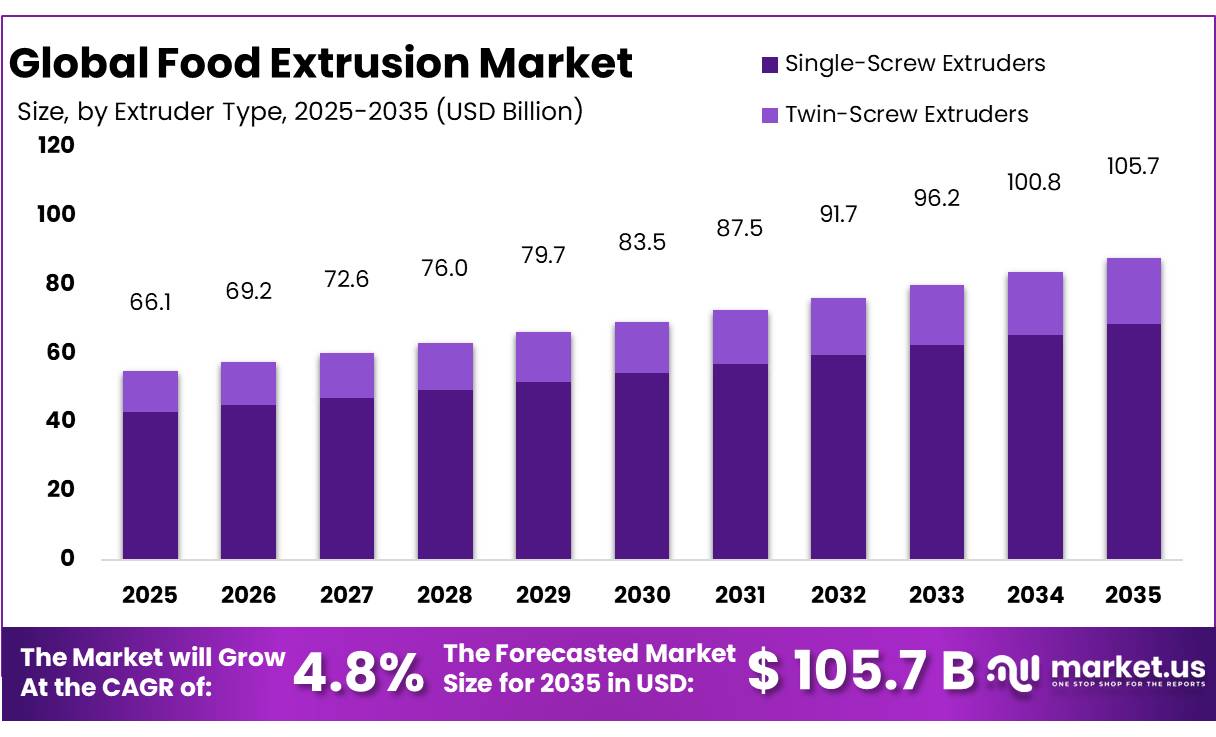
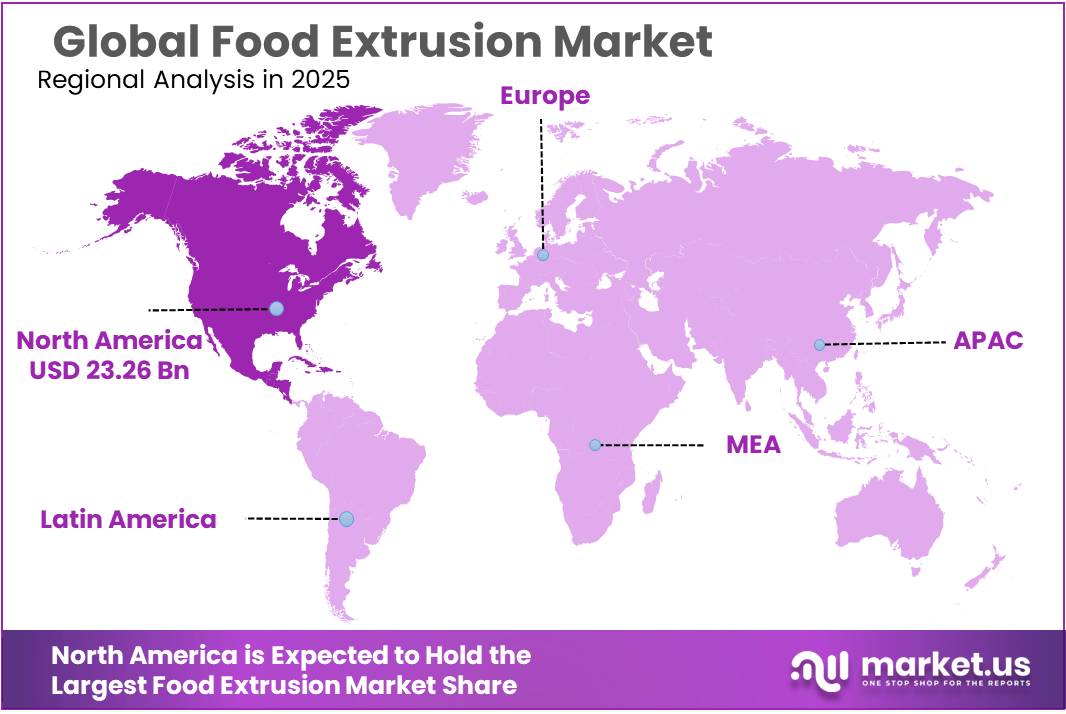
In 2025, the Global Food Extrusion Market was valued at USD 66.1 Billion, and between 2026 and 2035, this market is estimated to register a CAGR of 4.8%, reaching about USD 105.7 Billion by 2035. North America held a dominant market position, capturing more than a 35.2% share, holding USD 23.26 Billion in revenue.
Food extrusion is a continuous processing technology that combines mixing, cooking, shearing, pressure development and shaping within one production line. It is widely applied in breakfast cereals, expanded snacks, pasta, textured proteins and dry pet food. Industrial development is shifting toward co-rotating twin-screw systems and high-moisture extrusion because manufacturers require consistent texture, flexible formulations, higher throughput and improved control of thermal and mechanical energy.
- FAO estimated global cereal production at 3,036 million tonnes in 2025, an increase of 5.8% from the previous year. Its 2026 outlook placed cereal output at about 2,982 million tonnes and forecast cereal consumption for food to increase by 1.0%. This large grain base supports corn, wheat and other starch-rich extrusion feedstocks, although processors remain exposed to commodity and energy-cost volatility.
Pet food represents another important industrial outlet. FEDIAF reported in June 2026 that Europe had approximately 306 million pets and 140 million pet-owning households, representing 49% of households. The industry association also reports approximately €29.4 billion in annual pet food sales and around 8.6 million tonnes of products sold each year. This scale supports continued investment in extrusion systems for shaped kibble, high-protein formulations and functional animal nutrition.
Alternative proteins are creating a stronger technology-led growth path. FAO identifies extrusion, shearing and spinning as important methods for creating fibrous structures from plant proteins. USDA research published in 2026 tested pea-protein extrusion at 130°C and 150°C and found that 0.05% glutathione at 150°C produced the strongest texture among the tested reducing-agent conditions. These developments show how ingredient chemistry and thermal-mechanical control can improve high-moisture meat analogues.
- The U.S. Department of Energy’s 2025 Better Plants program covered more than 270 partners and 3,700 plants, representing about 14% of the U.S. manufacturing footprint, including food and chemical industries. Participating facilities achieved US$14.1 billion in cost savings, saved 2.8 quadrillion Btu of energy and recorded an average annual energy-intensity improvement of 1.8%. These practices are relevant to extrusion plants operating motors, heaters, dryers, cooling systems and compressed-air equipment.
Public-sector initiatives are also encouraging digital food manufacturing. In 2025, seven Chinese government departments issued a food-industry digital-transformation implementation program covering 2025–2030. The European Commission also launched an energy-efficiency roadmap in June 2025, noting that EU energy consumption would be approximately 27% higher without efficiency improvements achieved over the preceding 20 years. Such programs strengthen opportunities for automated dosing, inline sensors, smart drives and data-based process optimization.
Key Takeaways
- Food Extrusion Market was valued at USD 66.1 Billion, and between 2026 and 2035, this market is estimated to register a CAGR of 4.8%, reaching about USD 105.7 Billion by 2035.
- Single-Screw Extruders held a dominant market position, capturing more than a 51.50% share.
- Hot Extrusion held a dominant market position, capturing more than a 66.00% share.
- Savory Snacks held a dominant market position, capturing more than a 53.90% share.
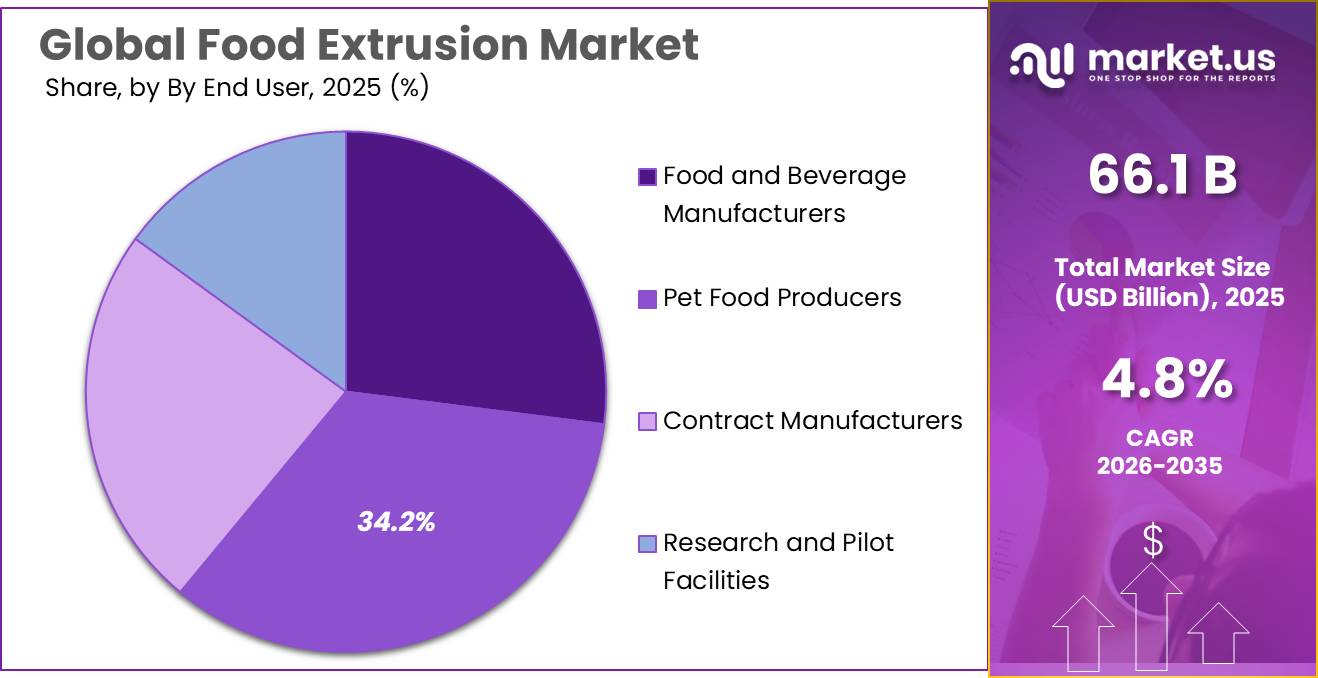
- Food and Beverage Manufacturers held a dominant market position, capturing more than a 54.00% share.
- North America held the leading position in the Food Extrusion Market in 2025, accounting for 35.20% of global revenue and generating about USD 23.26 billion.
By Extruder Type Analysis
Single-Screw Extruders dominate with a 51.50% share.
In 2025, Single-Screw Extruders held a dominant market position, capturing more than a 51.50% share. Their strong position is mainly linked to simple equipment design, easier operation, lower processing complexity, and suitability for high-volume products such as expanded snacks, cereals, pasta, and grain-based foods. A 2025 scientific study available through the U.S. National Institutes of Health notes that single-screw extruders are characterized by low cost and operational simplicity, which supports their use in conventional food-processing lines. The availability of grain feedstock also supports extrusion activity.
- In September 2025, the U.S. Department of Agriculture forecast U.S. corn production at 16.8 billion bushels, providing a substantial raw-material base for cereal and corn-based processed foods.
Twin-Screw Extruders are increasingly used for complex food formulations where manufacturers need uniform ingredient mixing, controlled heating, consistent shear, and stable material movement. A 2025 study hosted by the U.S. National Institutes of Health reports that twin-screw systems provide more precise control over mixing, heating, and shear compared with single-screw equipment, supporting their use in advanced snacks, protein-rich foods, and other formulated products. Pet food is another important extrusion application.
- USDA Foreign Agricultural Service data show that U.S. dog and cat food exports reached USD 2.44 billion in 2025, indicating substantial commercial activity in an end-use sector where extrusion processing is widely applied. This creates further scope for twin-screw technology as producers develop premium, functional, and more complex food formulations.
By Process Analysis
Hot Extrusion dominates with a 66.00% share.
In 2025, Hot Extrusion held a dominant market position, capturing more than a 66.00% share. The process remains widely preferred for producing expanded snacks, breakfast cereals, textured foods, and other ready-to-eat products because heating, mixing, cooking, and shaping can take place continuously within the extrusion line. Strong demand for corn-based processed foods continues to support the use of hot extrusion.
- In its 2025 Grain and Feed Annual, the U.S. Department of Agriculture Foreign Agricultural Service projected Malaysia’s food, seed, and industrial corn consumption at 355 thousand metric tons for the 2025/26 marketing year, specifically noting notable growth in the country’s extruded snack segment.
Cold Extrusion is increasingly used for products such as pasta, dough-based foods, confectionery items, and selected protein formulations where substantial cooking inside the extruder is not required. The process allows manufacturers to shape and compress food material while limiting thermal exposure, making it useful for formulations in which texture, moisture, or heat-sensitive ingredients need tighter control. The availability of cereal raw materials continues to provide a strong processing base.
- In June 2026, the U.S. Department of Agriculture reported 920 million bushels of wheat in storage across the United States, indicating a substantial supply base for wheat-based processed foods, including products suitable for cold-forming and extrusion applications.
By Product Type Analysis
Savory Snacks dominate with a 53.90% share
In 2025, Savory Snacks held a dominant market position, capturing more than a 53.90% share. The segment benefits from the widespread use of extrusion for producing corn-based snacks, puffs, curls, crisps, and other ready-to-eat products with consistent shape and texture. Raw-material availability also supports large-scale production.
- In 2026, the U.S. Department of Agriculture’s National Agricultural Statistics Service reported that U.S. corn stocks totaled 9.02 billion bushels as of March, indicating a substantial grain supply base available to food and other processing industries. This supports stable production opportunities for corn-based extruded savory products.
Breakfast Cereals remain an important food extrusion application because the process allows manufacturers to cook, shape, expand, and texturize cereal formulations in a continuous production system. The segment is also being influenced by changing nutrition requirements, encouraging producers to reformulate extruded cereals while maintaining taste and texture.
- In 2025, the U.S. Department of Agriculture specified that breakfast cereals served under relevant federal child nutrition programs must contain no more than 6 grams of added sugars per dry ounce, strengthening the focus on lower-sugar cereal formulations and controlled ingredient processing.
By End User Analysis
Food and Beverage Manufacturers dominate with a 54.00% share
In 2025, Food and Beverage Manufacturers held a dominant market position, capturing more than a 54.00% share. These manufacturers remain major users of extrusion technology because it supports continuous mixing, cooking, shaping, and texturizing while maintaining consistent output across large production runs. The scale of the food-processing industry continues to support equipment demand.
- According to the U.S. Bureau of Labor Statistics, U.S. food manufacturing employed about 1.76 million workers in July 2026, showing the large industrial base involved in producing packaged and processed foods. This broad manufacturing network creates steady opportunities for extrusion systems that improve production efficiency, product consistency, and formulation flexibility.
Pet Food Producers represent an important end-user group because extrusion is widely used to manufacture cooked and dry kibble as well as other shaped pet food products. USDA APHIS identifies crunchy kibble-type pet foods as products manufactured through an extrusion process, highlighting the established role of this technology in commercial pet food production. Demand from the sector remains substantial.
- USDA Foreign Agricultural Service data show that U.S. dog and cat food exports reached USD 2.44 billion in 2025, with export volume reaching 814,658 metric tons. This level of trade supports continued investment by pet food producers in efficient extrusion lines capable of handling different proteins, grains, functional ingredients, and product shapes.
Key Market Segments
By Extruder Type
- Single-Screw Extruders
- Twin-Screw Extruders
By Process
- Hot Extrusion
- Cold Extrusion
By Product Type
- Savory Snacks
- Breakfast Cereals
- Flours and Starches
- Textured Proteins and Meat Analogues
- Others
By End User
- Food and Beverage Manufacturers
- Pet Food Producers
- Contract Manufacturers
- Research and Pilot Facilities
Driver Analysis
Circular packaging and low-waste processing
Packaging regulation and sustainability commitments are increasing pressure on food manufacturers to reduce material use, improve recyclability, limit contamination risk and prevent product loss, indirectly favoring extrusion systems that deliver consistent product dimensions, lower breakage and stable shelf-life performance. The EU Packaging and Packaging Waste Regulation, Regulation (EU) 2025/40, entered into force on February 11, 2025 and begins applying from August 12, 2026.
Although extrusion equipment does not manufacture packaging, it materially affects packaging economics: consistent bulk density and particle size improve pack-fill accuracy, reduce fines and breakage, and enable transitions to thinner or lower-headspace packs without raising consumer complaints. Processors are therefore likely to prioritize energy-efficient motors, heat recovery, scrap recirculation where food-safety rules permit, and tighter process control that reduces off-spec output.
Drivers Impact Analysis
| Driver | (~) % Impact on CAGR | Geographic Relevance | Impact Timeline |
|---|---|---|---|
| Protein texturization for meat alternatives | +1.4 pp | North America, EU, China, India | Medium term (2–4 years) |
| Premium pet-food and aquafeed expansion | +1.1 pp | North America, EU, China, Brazil, Southeast Asia | Medium term (2–4 years) |
| Functional snacks and fortified staples | +0.9 pp | India, ASEAN, Middle East, Africa, Latin America | Short term (≤2 years) |
| Twin-screw automation and digital control | +1.0 pp | North America, EU, Japan, China, India | Medium term (2–4 years) |
| Compliance, traceability, and hygienic upgrades | +0.6 pp | EU, North America, export-oriented APAC | Short term (≤2 years) |
| Circular packaging and low-waste processing | +0.5 pp | EU core, UK, North America, APAC exporters | Long term (≥4 years) |
Restraint Analysis
Grain-input price volatility
Raw-material volatility constrains food-extrusion demand because cereals, starches, pulses, protein concentrates, oils and flavor systems account for the dominant share of an extruded product’s conversion cost, leaving processors unable to justify capacity additions when gross margins become unstable. The FAO Food Price Index averaged 130.3 points in June 2026, 2.2% above the year-earlier level, while the cereal sub-index was 2.7% higher year on year despite a 3.5% month-on-month decline; in May, world wheat prices were 7.8% above the prior year and maize prices 3.9% higher, demonstrating that temporary monthly price relief does not remove procurement risk.
For a snack, cereal or feed processor, a 5–10% movement in maize, wheat, rice, pea protein or edible oil procurement cost can compress contribution margins more rapidly than retail prices can be reset, especially in value-priced packaged foods with annual distributor contracts; the response is shorter purchasing cycles, reduced SKU proliferation, lower inventories and postponed extruder purchases. This restraint is most pronounced in India, Africa, Latin America and import-dependent Asian markets, where currency depreciation amplifies global commodity movements, while multinational processors defer new high-moisture protein lines until they can secure reliable multi-origin input contracts and formulation flexibility.
Restraint Impact Analysis
| Restraint | (~) % Impact on CAGR Forecast | Geographic Relevance | Impact Timeline |
|---|---|---|---|
| Grain-input price volatility | -1.2 pp | Global; India, EU, APAC | Short term (≤2 years) |
| High CapEx and financing costs | -1.0 pp | North America, EU, India, ASEAN | Medium term (2–4 years) |
| Energy-intensive processing | -0.8 pp | EU, India, China, MENA | Short term (≤2 years) |
| Skilled-operator shortage | -0.7 pp | North America, EU, Australia, APAC | Medium term (2–4 years) |
| Metal tariffs and equipment lead times | -0.6 pp | North America, EU, import-dependent APAC | Short term (≤2 years) |
| Compliance and packaging redesign | -0.5 pp | EU, North America, export APAC | Short term (≤2 years) |
Opportunity Analysis
Fermentation–extrusion protein platforms
The white space is not conventional plant-based food demand—which already informs baseline protein-extrusion activity but an integrated business model in which ingredient producers, fermentation specialists and extruder OEMs jointly sell validated “ingredient-to-finished-format” platforms for hybrid proteins, rather than leaving processors to solve taste, functionality and texture independently. High-moisture extrusion operates at roughly 60–65% moisture and can create meat-like products without the rehydration step required by low-moisture TVP, which is commonly processed at 30–40% moisture; this creates a credible route to chilled or frozen meat-alternative formats but requires repeatable coordination of fermentation-derived flavor improvement, protein solubility and extrusion rheology.
A supplier that converts this complexity into pre-qualified formulations, leased pilot access, application engineering and royalty-bearing recipe libraries can reduce a customer’s 12–24-month development cycle toward 6–12 months, improve line commissioning utilization, and move revenue from one-off machinery into formulation services, consumables and technical support.
Opportunity Impact Analysis
| Opportunity | (~) % Potential CAGR Upside | Geographic Relevance | Execution Window |
|---|---|---|---|
| Fermentation–extrusion protein platforms | +1.7 pp | North America, EU, China, India | Medium term (2–4 years) |
| Contract extrusion networks | +1.3 pp | India, ASEAN, MENA, Latin America | Short term (≤2 years) |
| Upcycled by-product formulations | +1.1 pp | EU, North America, Brazil, APAC | Medium term (2–4 years) |
| Traceability-as-a-service retrofits | +0.9 pp | North America, EU, export APAC | Short term (≤2 years) |
| Public nutrition procurement formats | +0.8 pp | North America, India, Africa, ASEAN | Medium term (2–4 years) |
| Aftermarket roll-ups and outcome contracts | +1.0 pp | Global installed base | Medium term (2–4 years) |
Challenges Analysis
Variable Ingredient Functionality
The core technical challenge is not raw-material availability alone but lot-to-lot variation in moisture, particle size, starch damage, protein solubility, fiber fraction, fat content and anti-nutritional compounds, which changes material flow, specific mechanical energy, die pressure, expansion and final texture even when a plant runs the same nominal recipe.
In practical operating terms, a 1–2 percentage-point shift in incoming moisture can require changes in water addition, screw speed and barrel temperature, while an uncorrected deviation can lower throughput, increase fines, create density variability or force rework and disposal; this makes customer qualification cycles longer and discourages rapid multi-SKU expansion.
Challenges Impact Analysis
| Challenge | (~) % CAGR Friction Drag | Geographic Relevance | Mitigation Horizon |
|---|---|---|---|
| Variable ingredient functionality | -1.1 pp | India, APAC, EU, North America | Medium term (2–4 years) |
| Specialist talent pipeline | -0.9 pp | North America, EU, Australia, APAC | Long term (≥4 years) |
| Critical-spares supply exposure | -0.7 pp | EU–APAC corridors, North America | Medium term (2–4 years) |
| Wear-intensive process conditions | -0.7 pp | Global pet food, aquafeed, proteins | Medium term (2–4 years) |
| Legacy controls integration | -0.6 pp | North America, EU, India, China | Long term (≥4 years) |
| OT cyber-resilience gaps | -0.5 pp | North America, EU, advanced APAC | Medium term (2–4 years) |
Geopolitical Impact Analysis
Ongoing Wars Increase Grain, Energy, and Logistics Pressure on Food Extrusion
The ongoing Russia-Ukraine war and renewed Middle East conflict are creating cost and supply-chain pressure for the food extrusion industry. Extruded snacks, breakfast cereals, pet food, pasta, and protein products depend on grains, vegetable oils, energy, packaging, and international freight. Disruption around Ukraine continues to affect Black Sea grain flows. USDA reported in April 2026 that Ukraine exported 9.7 million metric tons of wheat during the 2025/26 marketing period through March, down 23% from the comparable period, showing how war-related logistics and production risks can tighten ingredient availability for processors.
At the same time, instability around the Strait of Hormuz is raising energy and shipping uncertainty. UN reporting noted that vessel traffic through the Strait fell from around 130 ships per day before the 2026 crisis to single digits in early March. Higher fuel, insurance, and rerouting costs can increase operating expenses for extrusion plants because these facilities rely on electricity, thermal energy, and movement of bulk ingredients. Food manufacturers are therefore increasing supplier diversification, regional sourcing, inventory buffers, and energy-efficiency measures.
Regional Insights
North America Dominates the Food Extrusion Market, While Asia Pacific Shows the Fastest Growth
North America held the leading position in the Food Extrusion Market in 2025, accounting for 35.20% of global revenue and generating about USD 23.26 billion. The region benefits from a large processed-food industry, established snack and cereal production, high pet-food consumption, and broad use of automated extrusion lines.
- In the United States, food and beverage manufacturing supported about 2.1 million jobs, and the U.S. Bureau of Labor Statistics expects employment to rise above 2.2 million by 2034. Canada adds further processing strength: Statistics Canada reported food-product manufacturing sales of CAD 13.2 billion in June 2025, the highest level on record, after a 2.5% monthly increase. These conditions support continued investment in efficient single-screw and twin-screw systems for snacks, cereals, proteins, and pet food.
Asia Pacific is expected to be the fastest-growing regional market as food processors expand capacity, modernize production lines, and respond to rising demand for convenient packaged foods. China remains a major contributor to this trend.
- The National Bureau of Statistics reported that value added from processing agricultural and sideline food products increased 5.6% in 2025, while overall manufacturing value added rose 6.4%. China’s catering industry also generated CNY 5,798.2 billion in revenue in 2025, increasing 3.2% from the previous year. This growing food-processing and consumption base encourages greater use of extrusion for savory snacks, breakfast cereals, textured proteins, instant foods, and pet-food products.
Key Regions and Countries Insights
- North America
- US
- Canada
- Europe
- Germany
- France
- The UK
- Spain
- Italy
- Rest of Europe
- Asia Pacific
- China
- Japan
- South Korea
- India
- Australia
- Rest of APAC
- Latin America
- Brazil
- Mexico
- Rest of Latin America
- Middle East & Africa
- GCC
- South Africa
- Rest of MEA
Key Players Analysis
Bühler Holding AG remains a major supplier of extrusion and processing systems for cereals, snacks, plant proteins, pet food, and other formulated foods. In 2025, its Grains & Food business generated CHF 2,164 million in turnover and CHF 2,147 million in order intake. The company also reported order growth of more than 25% in Grain Handling. Its broad food-processing portfolio, engineering capability, and global service network support its competitive position in industrial extrusion and integrated food production lines at scale.
Coperion GmbH is a major processing-equipment supplier with strong capabilities in twin-screw extrusion, feeding, weighing, ingredient handling, and complete food production systems. In 2025, Coperion stated that it employed more than 5,000 people and operated through over 50 sales and service companies worldwide. Its Food, Health & Nutrition division combines brands including Baker Perkins, DIOSNA, Kemutec, Peerless, and VMI. This expanded portfolio strengthens Coperion’s position in snacks, bakery, pet food, and other extrusion-based applications across international food-processing markets today globally.
GEA Group AG serves food manufacturers with processing, mixing, forming, heating, and related technologies that complement extrusion-based production lines. In 2025, GEA generated EUR 5,495.4 million in revenue, while order intake reached EUR 5,924.1 million. The company employed 18,628 full-time-equivalent workers at year-end, and service revenue represented 40.0% of total sales. Its large installed base, engineering resources, and global customer support strengthen its role in automated food processing, efficiency improvement, and production-line modernization across major international food manufacturing markets today.
Top Key Players Outlook
- Bühler Holding AG
- Coperion GmbH (Zeppelin Group)
- GEA Group AG
- Clextral (Groupe Legris Industries)
- Baker Perkins Ltd (Schenck)
- Wenger Manufacturing, Inc.
- Amandus Kahl GmbH & Co. KG (KAHL Group)
- Pavan SpA (GEA)
- Triott Group B.V. (Almex)
- Akron Tool & Die Co. (Diamond America)
- American Extrusion International
- Leistritz AG
- ANDRITZ AG
- The Bonnot Company
- FAMSUN (Muyang)
Recent Developments
- In May 2026, American Extrusion International expanded its international visibility by participating in interpack 2026 in Düsseldorf, held from 7-13 May, where the company was listed in Hall 3, Stand A74. Its current product portfolio includes the Advantage 100 single-screw extruder with output of 350-400 kg/hour, a 100 HP main drive, and design capability for continuous 24-hour, 7-day operation, supporting large snack-food production lines.
- In January 2025, Clextral USA introduced its Galaxy Texturing Technology, a new vegetable-protein processing line combining continuous extrusion with shear-cell fibrillation. The system can process up to 400 kg per hour, supporting production of larger and more flexible meat-alternative products; a live demonstration was scheduled at its Tampa pilot plant on March 12, 2025.
- In May 2026, Baker Perkins Master range currently delivers production capacities from 250 to 2,500 kg/hour, with motor sizes reaching 519 kW on larger configurations, giving manufacturers flexibility from medium to high-volume food production.
Report Scope
| Report Features | Description |
|---|---|
| Market Value (2025) | USD 66.1 Bn |
| Forecast Revenue (2035) | USD 105.7 Bn |
| CAGR (2026-2035) | 4.8% |
| Base Year for Estimation | 2025 |
| Historic Period | 2020-2024 |
| Forecast Period | 2026-2035 |
| Report Coverage | Revenue Forecast, Market Dynamics, Competitive Landscape, Recent Developments |
| Segments Covered | By Extruder Type (Single-Screw Extruders, Twin-Screw Extruders), By Process (Hot Extrusion, Cold Extrusion), By Product Type (Savory Snacks, Breakfast Cereals, Flours and Starches, Textured Proteins and Meat Analogues, Others), By End User (Food and Beverage Manufacturers, Pet Food Producers, Contract Manufacturers, Research and Pilot Facilities) |
| Regional Analysis | North America – US, Canada; Europe – Germany, France, The UK, Spain, Italy, Rest of Europe; Asia Pacific – China, Japan, South Korea, India, Australia, Singapore, Rest of APAC; Latin America – Brazil, Mexico, Rest of Latin America; Middle East & Africa – GCC, South Africa, Rest of MEA |
| Competitive Landscape | Bühler Holding AG, Coperion GmbH (Zeppelin Group), GEA Group AG, Clextral (Groupe Legris Industries), Baker Perkins Ltd (Schenck), Wenger Manufacturing, Inc., Amandus Kahl GmbH & Co. KG (KAHL Group), Pavan SpA (GEA), Triott Group B.V. (Almex), Akron Tool & Die Co. (Diamond America), American Extrusion International, Leistritz AG, ANDRITZ AG, The Bonnot Company, FAMSUN (Muyang) |
| Customization Scope | Customization for segments, region/country-level will be provided. Moreover, additional customization can be done based on the requirements. |
| Purchase Options | We have three licenses to opt for: Single User License, Multi-User License (Up to 5 Users), Corporate Use License (Unlimited User and Printable PDF) |





































