


Report Overview
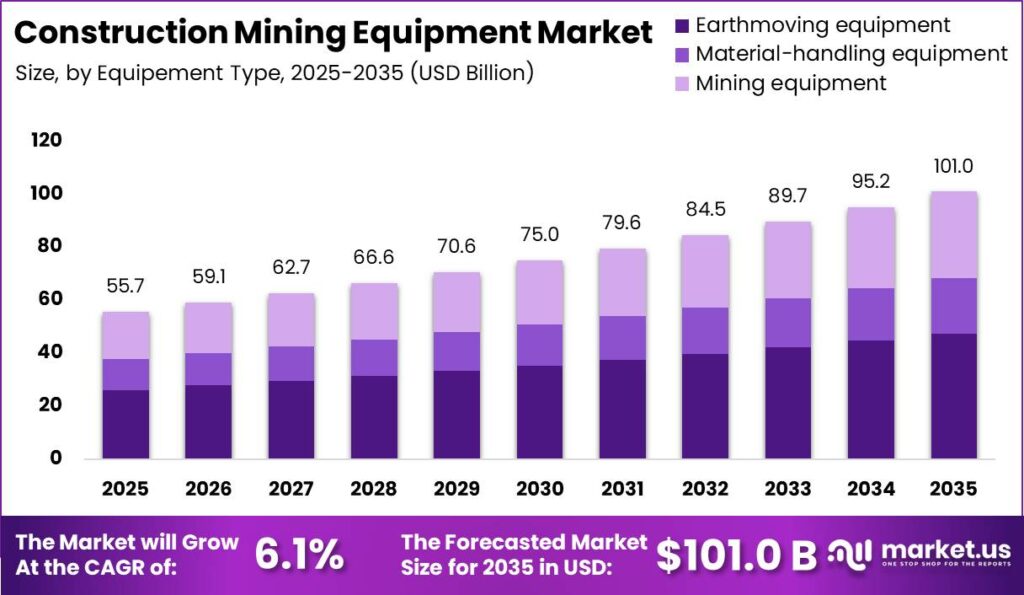
Global Construction Mining Equipment Market size is expected to be worth around USD 101.00 Billion by 2035 from USD 55.7 Billion in 2025, growing at a CAGR of 6.1% during the forecast period 2026 to 2035.
Construction mining equipment covers the machines that move earth, handle materials, and extract minerals across construction sites and mines. The market spans excavators, loaders, cranes, forklifts, and dedicated mining machinery, each engineered for high load cycles and harsh operating terrain. This means buyers evaluate equipment on uptime and total cost of ownership rather than sticker price alone. Therefore, OEMs that bundle machines with financing, telematics, and parts support win repeat fleet contracts over single-unit sellers.
Key Takeaways
- Global Construction Mining Equipment Market size is valued at USD 55.7 Billion in 2025 and is projected to reach USD 101.00 Billion by 2035.
- The market is set to expand at a CAGR of 6.1% between 2026 and 2035.
- Earthmoving Equipment leads the By Equipment Type segment with a 47.00% share.
- Internal Combustion Engine propulsion dominates the By Propulsion segment with an 89.00% share.
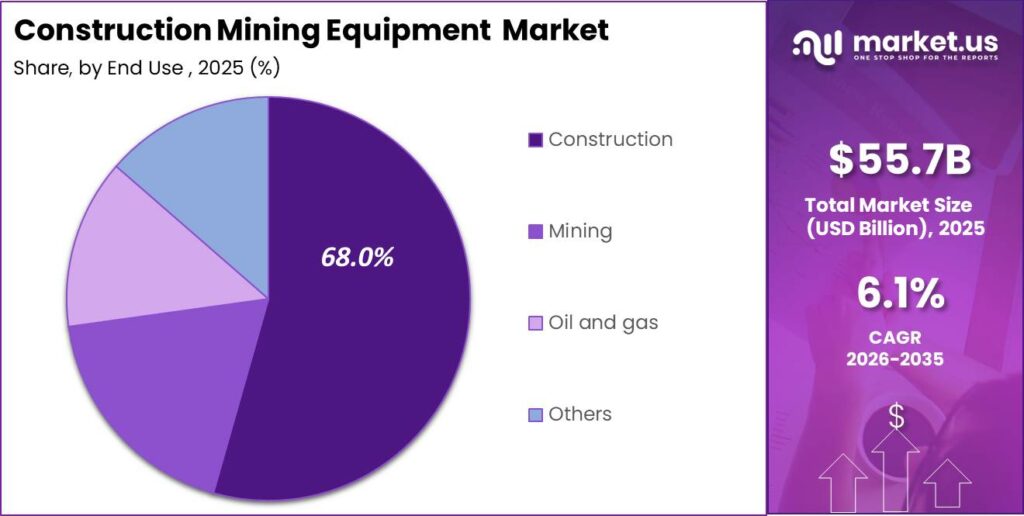
- Construction leads the By End-Use Industry segment with a 68.00% share.
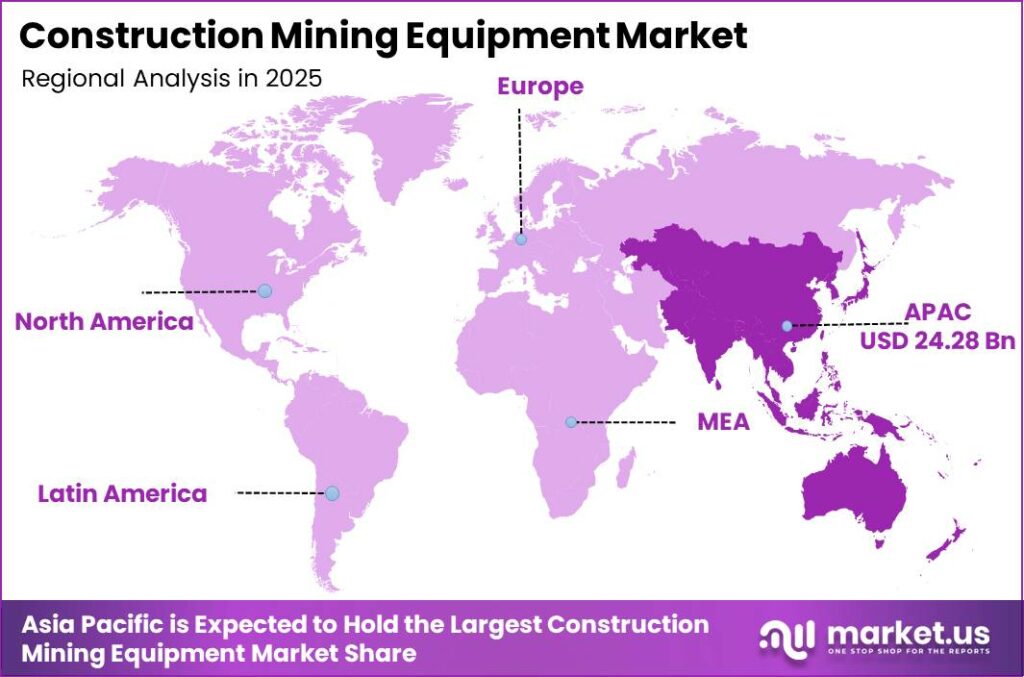
- Asia-Pacific dominates the regional landscape with a 43.60% share, valued at USD 24.28 Billion.
Government capital programs are reshaping how fast equipment fleets turn over. As reported by the U.S. Census Bureau, construction spending reached approximately USD 2.20 Trillion in 2024, a base that keeps excavator and loader utilization high across public and private jobsites. This means contractors carry heavier machine hours per unit, which shortens replacement cycles and lifts parts and service revenue for OEMs. Consequently, dealers positioned near active construction corridors gain a durable service advantage over distant competitors.
Highway and transport funding is compounding this equipment demand. Data from the Federal Highway Administration shows more than USD 70 Billion was allocated for highway infrastructure investments under the Bipartisan Infrastructure Law in FY2024. This signals sustained motor grader, crawler excavator, and compaction equipment orders tied to multi-year federal project pipelines. As a result, manufacturers with government-contract track records can secure backlog visibility that smaller regional players cannot match.
Emission compliance is redirecting fleet composition worldwide. Figures from the European Commission’s Connecting Europe Facility show over €33 Billion was allocated for transport infrastructure projects during 2021 to 2027. This creates prolonged excavator and crane demand tied to rail and road corridor construction across member states. However, contractors must sequence purchases around procurement cycles rather than steady annual demand. This reflects a funding pattern that favors OEMs with flexible delivery schedules over rigid production lines.
In January 2025, Volvo Construction Equipment introduced next-generation articulated haulers with upgraded fuel efficiency and automation features. This signals sustained OEM investment in heavy hauling capacity even as electrification gains attention elsewhere in the portfolio. Contractors managing large earthmoving fleets benefit from lower fuel cost per tonne moved. Therefore, hauler upgrades give incumbent OEMs a retention tool against newer entrants targeting only electric niches.
Equipment Type Analysis
Earthmoving Equipment dominates with 47.0% due to high jobsite excavation and grading demand.
In 2025, Earthmoving Equipment held a dominant market position in the By Equipment Type segment of Construction Mining Equipment Market, with a 47.0% share. Crawler excavators, loaders, bulldozers, and motor graders form the operational core of most construction and quarry fleets. The International Federation of Robotics reported more than 542,000 industrial robots were installed globally in 2024, reflecting the automation wave now reaching excavator and loader control systems. This means fleet buyers increasingly weigh automation readiness alongside horsepower when selecting new machines.
Cranes, telescopic handlers, and forklifts form the Material-Handling Equipment group, which supports lifting and site logistics rather than digging or grading. According to the World Industrial Truck Statistics program, global forklift shipments reached 2.1 Million units in 2023, underscoring how deeply material handling is embedded in industrial and construction logistics. This scale gives component suppliers a stable aftermarket revenue base tied to hydraulic and mast parts. As a result, OEMs with broad forklift dealer networks capture recurring service contracts beyond the initial sale.
Mining Equipment functions as a distinct category built for extraction rather than general site work, spanning haul trucks, drills, and shovels engineered for continuous heavy-duty cycles. In January 2025, Volvo Construction Equipment introduced next-generation articulated haulers with improved automation, a design direction that increasingly crosses over into mining-adjacent hauling applications. This creates cross-segment demand for hauler platforms usable in both quarry and mine settings. Consequently, OEMs that engineer shared platforms across earthmoving and mining reduce tooling costs while widening addressable fleets.
Propulsion Analysis
Internal Combustion Engine dominates with 89.0% due to established diesel refueling infrastructure worldwide.
In 2025, Internal Combustion Engine held a dominant market position in the By Propulsion segment of Construction Mining Equipment Market, with a 89.0% share. Diesel, gasoline, and CNG/LNG variants remain the default choice because refueling networks and technician training are already built around combustion platforms. U.S. EPA Tier 4 Final standards reduced particulate matter emissions from new non-road diesel engines by around 90% compared with earlier engine generations. This means compliant diesel machines can still meet strict air-quality rules, extending the runway for combustion equipment sales.
European Union Stage V emission regulations introduced stricter particulate number limits for non-road mobile machinery, accelerating replacement of older diesel equipment across member states. This regulatory pressure pushes fleet owners toward newer Stage V compliant units rather than electric conversion in the near term. Contractors operating across EU borders face compliance deadlines that directly affect resale value of pre-Stage V machines. Therefore, dealers stocking certified Stage V inventory gain pricing leverage during replacement cycles.
Electric propulsion, covering battery electric, tethered electric, and cable electric machines, serves underground and emission-restricted sites where diesel exhaust handling is costly. The International Energy Agency reported lithium demand increased by nearly 30% in 2023 due to battery manufacturing growth, directly raising input costs for battery-electric equipment makers. ABB states mine ventilation can represent up to 50% of underground mining energy consumption, which strengthens the case for battery-electric machines that cut ventilation load. In August 2025, Liebherr launched the R 920 G8-E, its first factory-built electric crawler excavator for zero-emission applications. This signals OEMs are moving electric platforms from pilot projects into standard production catalogs.
End-Use Industry Analysis
Construction dominates with 68.0% due to sustained global building and infrastructure activity.
In 2025, Construction held a dominant market position in the By End-Use Industry segment of Construction Mining Equipment Market, with a 68.0% share. Residential, commercial, and industrial construction alongside infrastructure projects drive continuous demand for excavators, loaders, and compaction machines. Figures from the European Commission’s Connecting Europe Facility show over €33 Billion was allocated for transport infrastructure during 2021 to 2027. This means infrastructure sub-segments alone can sustain multi-year equipment order books independent of housing cycles.
Mining, covering metal mining, coal mining, non-metallic mineral mining, and quarrying, functions as the second major end-use category and depends on commodity-specific extraction cycles. The U.S. Geological Survey reported global copper mine production reached approximately 23 Million metric tons in 2024, a volume that keeps large excavator and haul truck orders flowing from copper-producing regions. The International Energy Agency estimates global demand for critical minerals used in clean energy technologies could rise up to 3.5 times by 2030. This means mining equipment demand is increasingly tied to the energy transition rather than traditional commodity cycles alone.
Coal mining remains a meaningful demand pool despite its declining long-term share of new mine investment. The International Energy Agency reported global coal production is set to exceed 9 Billion tons in 2024, sustaining haul truck and shovel replacement in existing operations even as new coal project approvals slow. Oil and gas, along with other smaller end-use categories including quarrying support equipment, hold the remaining share collectively. Together these categories anchor a steady base load of aftermarket parts and rental demand outside the dominant construction and mining pools.
Key Market Segments
By Equipment Type
- Earthmoving Equipment
- Crawler Excavators
- Loaders
- Bulldozers
- Motor Graders
- Others
- Material-Handling Equipment
- Cranes
- Telescopic Handlers
- Forklifts
- Mining Equipment
By Propulsion
- Internal Combustion Engine
- Diesel
- Gasoline
- CNG/LNG
- Electric
- Battery Electric
- Tethered Electric
- Cable Electric
- Others
By End-Use Industry
- Construction
- Residential Construction
- Commercial Construction
- Industrial Construction
- Infrastructure
- Mining
- Metal Mining
- Iron Ore
- Copper
- Nickel
- Others
- Coal Mining
- Non-Metallic Mineral Mining
- Quarrying
- Metal Mining
- Oil And Gas
- Others
Regional Analysis
Asia-Pacific Dominates the Construction Mining Equipment Market with a Market Share of 43.60%, Valued at USD 24.28 Billion
Asia-Pacific leads global demand because large-scale urbanization, mining expansion, and government-funded transport corridors run concurrently across China, India, and Southeast Asia. The region’s 43.60% share, worth USD 24.28 Billion, reflects sustained excavator, loader, and haul truck orders tied to both construction and mineral extraction. This means regional dealers face continuous fleet replacement cycles rather than seasonal demand spikes. Consequently, OEMs prioritizing Asia-Pacific production capacity secure faster delivery timelines than import-dependent competitors.
North America and Europe represent the fastest-growing compliance-driven markets as fleet operators replace older diesel machines to meet tightening emission rules. In June 2025, Volvo Construction Equipment announced an investment of more than USD 260 Million to expand global crawler excavator production capacity across Sweden, South Korea, and North America. This signals OEMs are positioning manufacturing closer to regulated demand centers rather than relying solely on centralized production. Therefore, contractors in these regions gain shorter lead times for compliant replacement units.
Key Regions and Countries
North America
- US
- Canada
Europe
- Germany
- France
- The UK
- Spain
- Italy
- Rest of Europe
Asia Pacific
- China
- Japan
- South Korea
- India
- Australia
- Rest of APAC
Latin America
- Brazil
- Mexico
- Rest of Latin America
Middle East and Africa
- GCC
- South Africa
- Rest of MEA
Market Dynamics
Market Opportunity Analysis - Underserved segments and regions offer distinct entry points for challenger brands.
Material-Handling Equipment remains underexploited relative to Earthmoving Equipment despite steady forklift and crane demand across construction logistics. New entrants focused on telescopic handlers and compact cranes can compete on service responsiveness rather than matching Earthmoving Equipment’s scale. This creates room for regional specialists to win contracts that global OEMs treat as secondary. Therefore, a focused Material-Handling strategy can outperform a broad but thin product line.
Electric propulsion sits far behind Internal Combustion Engine’s 89.0% share, leaving battery electric and tethered electric platforms largely open outside underground mining niches. Vendors entering early can establish service and charging infrastructure before larger OEMs commit full production lines. This means first movers in electric propulsion secure technician training and parts advantages before the segment scales. Consequently, electric platform investment now compounds into brand loyalty later.
Latin America and the Middle East and Africa trail Asia-Pacific’s 43.60% regional share, signaling room for dealer network expansion. Instead of competing directly against entrenched Asia-Pacific distribution, new entrants can build exclusive territory agreements in these underserved regions. This approach avoids price wars with established players while capturing early mover advantage in growing mining corridors. As a result, regional expansion offers a lower-risk path than head-on competition in saturated markets.
Oil and Gas end-use, folded within the smaller remaining End-Use Industry categories, receives limited dedicated equipment attention compared to Construction and Mining. Suppliers who tailor machine specifications to pipeline and well-site logistics can differentiate from generalist equipment lines. This reflects an opportunity to build a niche product catalog rather than compete on the broad Construction segment. Therefore, specialization in this smaller category can still generate durable margin.
Technology and Innovation Landscape - Automation, connectivity, and electrification are redefining equipment competitiveness
Telematics-enabled predictive maintenance is becoming a baseline expectation rather than a premium feature across construction and mining fleets. Caterpillar’s VisionLink platform supports monitoring of more than 1.5 Million connected assets worldwide for fleet management and predictive maintenance. This means fleet owners can schedule service before failures occur, cutting unplanned downtime costs. Consequently, OEMs without comparable telematics platforms risk losing large fleet contracts to connectivity leaders.
Autonomous haulage is moving from pilot programs into standard mining operations. Caterpillar’s autonomous haulage systems have moved more than 5 Billion tonnes of material in mining operations globally. This scale demonstrates autonomous hauling is now proven at production volume rather than experimental. Therefore, mining operators evaluating new haul fleets increasingly default to autonomy-ready platforms over conventional manned trucks.
Remote monitoring is expanding across a much larger installed base than autonomy alone. Komatsu’s Komtrax system provides remote monitoring capabilities across more than 700,000 machines globally. This wide deployment shows remote monitoring has already reached mainstream adoption beyond flagship autonomous fleets. As a result, remote monitoring capability now functions as a baseline purchase criterion rather than a differentiator.
Electric powertrain innovation is advancing from concept to factory production. In August 2025, Liebherr launched the R 920 G8-E, its first factory-built electric crawler excavator for zero-emission construction and underground applications. This signals electrification has moved past prototype stage into serial manufacturing for major OEMs. Buyers targeting emission-restricted urban sites now have a validated production option rather than a custom retrofit.
Drivers
Infrastructure programs shifted from planning toward equipment-intensive execution during 2024 and 2025, converting highway, rail, and grid allocations into direct excavator, loader, and compaction equipment orders. OECD tracking shows the global infrastructure investment gap could reach 18 trillion dollars by 2040, while U.S. Census Bureau data placed annualized public construction spending above 541 billion dollars by May 2026. This shifts OEMs toward multiyear fleet agreements and parts contracts, contributing an estimated +1.5% to the 6.1% baseline CAGR.
| Driver | (~) % Impact on CAGR Forecast | Geographic Relevance | Impact Timeline |
|---|---|---|---|
| Public Infrastructure Execution | +1.5% | North America, Asia-Pacific, Europe | Short term (2 years or less) |
| Critical-Mineral Mine Expansion | +1.2% | Australia, Latin America, Africa, Canada | Medium term (2 to 4 years) |
| Urbanization-Led Earthmoving Demand | +0.9% | India, Southeast Asia, Middle East, Africa | Long term (4 years or more) |
| Fleet-Replacement Cycle | +0.7% | North America, Europe, Japan | Short term (2 years or less) |
| Quarrying Capacity Additions | +0.5% | Asia-Pacific, Middle East, Africa | Medium term (2 to 4 years) |
| Contractor Mechanization | +0.4% | India, Southeast Asia, Latin America | Long term (4 years or more) |
Restraints
Expensive credit blocks purchases directly because contractors and smaller mine operators typically fund machines through leases and secured loans whose debt service rises when rates stay elevated. The IMF’s April 2025 assessment found emerging economies faced their highest real financing costs in roughly a decade. World Bank monitoring shows infrastructure delivery depends on viable risk allocation, leaving leveraged contractors exposed when funding costs exceed project margins. This bottleneck lengthens replacement intervals, removing an estimated -1.3% from the 6.1% baseline.
| Restraint | (~) % Impact on CAGR Forecast | Geographic Relevance | Impact Timeline |
|---|---|---|---|
| Prohibitive Equipment Financing | -1.3% | Emerging Markets, Europe, North America | Short term (2 years or less) |
| Imported-Metals Tariff Exposure | -1.0% | United States and Trade-Linked Suppliers | Short term (2 years or less) |
| Construction-Permit Delays | -0.7% | Europe, North America, Latin America | Medium term (2 to 4 years) |
| Mining-License Moratoria | -0.6% | Selected Latin American, African and Asian Markets | Medium term (2 to 4 years) |
| Housing-Construction Weakness | -0.5% | China, Europe, Selected Advanced Economies | Short term (2 years or less) |
| Dealer-Credit Constraints | -0.3% | Africa, Latin America, Southeast Asia | Short term (2 years or less) |
Tariff exposure on imported metals compounds the financing pressure across trade-linked supply chains. World Bank standards analysis notes nearly 90% of global trade is affected by nontariff measures, adding qualification friction on top of direct tariff costs. Contractors facing both permit delays and mining-license moratoria in select markets postpone fleet decisions until regulatory clarity returns. This combination of financing and trade friction means dealers must extend financing terms just to hold existing sales pace.
Challenges
Volatile input, logistics, and factory-conversion costs remain a structural vulnerability because heavy equipment combines high steel content with engines, hydraulics, and electronic controls sourced through concentrated tiers. A major equipment manufacturer reported unfavorable manufacturing costs above 1 billion dollars in the fourth quarter of 2025, as full-year operating margin fell from 20.2% in 2024 to 16.5% in 2025. This challenge could remove roughly 1.1% from the market’s maximum attainable CAGR.
| Challenge | (~) % CAGR Friction Drag | Geographic Relevance | Mitigation Horizon |
|---|---|---|---|
| Manufacturing Cost Volatility | -1.1% | Global | Short term (2 years or less) |
| Skilled Technician Deficit | -0.8% | North America, Europe, Australia, India | Long term (4 years or more) |
| Powertrain Compliance Complexity | -0.7% | Europe, North America, Japan, South Korea | Medium term (2 to 4 years) |
| Electronics Supply Concentration | -0.6% | Global, Asia-Centric Supply Chains | Medium term (2 to 4 years) |
| Mixed-Fleet Data Fragmentation | -0.4% | Global Mining and Large Contractors | Medium term (2 to 4 years) |
| Remote-Site Service Logistics | -0.3% | Africa, Australia, Latin America, Central Asia | Long term (4 years or more) |
Skilled technician shortages compound the cost pressure by slowing service turnaround on increasingly complex powertrains. Powertrain compliance complexity across Europe, North America, Japan, and South Korea forces OEMs to certify multiple engine variants for the same chassis platform. Electronics supply concentration in Asia-centric chains adds further lead-time risk during component shortages. Together these frictions push contractors toward OEMs offering bundled service contracts, creating a new revenue stream in extended maintenance agreements.
Opportunities
Autonomous retrofits represent meaningful white space because deployment currently concentrates in large, controlled mine environments while much of the installed fleet lacks interoperable automation systems. The IEA’s 2025 critical-minerals outlook identifies sustained investment expansion across copper, lithium, nickel, and rare earth supply chains. Converting legacy machines through sensor and software kits could lower automation cost per unit by an estimated 30% to 50% versus full-fleet replacement, adding approximately +1.4% to CAGR for early movers.
| Opportunity | (~) % Potential CAGR Upside | Geographic Relevance | Execution Window |
|---|---|---|---|
| Autonomous Fleet Retrofits | +1.4% | Australia, Americas, Africa, Central Asia | Medium term (2 to 4 years) |
| Equipment-as-a-Service Platforms | +1.1% | Global Contractor and Quarry Markets | Medium term (2 to 4 years) |
| Zero-Emission Site Fleets | +0.9% | Europe, North America, Japan, Urban Asia | Long term (4 years or more) |
| Circular Component Remanufacturing | +0.7% | Global Installed-Base Markets | Medium term (2 to 4 years) |
| Predictive-Uptime Subscriptions | +0.6% | Global Mining and Fleet Operators | Short term (2 years or less) |
| Emerging-Market Rental Roll-Ups | +0.5% | India, Southeast Asia, Africa, Latin America | Long term (4 years or more) |
Equipment-as-a-service platforms open a second growth path by letting mid-sized contractors access machines without full ownership costs. Zero-emission site fleets create parallel opportunity in Europe, North America, and urban Asia where city governments restrict diesel machinery on active sites. Circular component remanufacturing extends revenue across the global installed base long after initial machine sales close. Early movers combining these three paths could capture margin pools that transaction-only competitors miss entirely.
Key Company Insights
Caterpillar holds a structural advantage through its VisionLink platform, which supports monitoring of more than 1.5 Million connected assets worldwide, alongside autonomous haulage systems that have moved more than 5 Billion tonnes of material in mining operations. In March 2026, the company showcased new connected equipment and expanded digital fleet management solutions at CONEXPO-CON/AGG 2026. This scale of connected and autonomous deployment creates a data advantage smaller rivals cannot replicate quickly.
Komatsu competes on remote monitoring depth rather than raw fleet size, with its Komtrax system providing remote monitoring capabilities across more than 700,000 machines globally. Its Autonomous Haulage System has deployed more than 500 autonomous haul trucks worldwide across active mining operations. This broad monitoring footprint gives Komatsu strong service-contract retention. However, its autonomous truck count still trails the largest rival, leaving room for share gains as mine operators expand automation.
Key Players
-
- Caterpillar Inc.
- Komatsu Ltd.
- XCMG Group
- SANY Heavy Industry
- John Deere
- Volvo Construction Equipment
- Liebherr Group
- Hitachi Construction Machinery
- Zoomlion Heavy Industry
- Sandvik AB
- JCB
- Epiroc AB
- Terex Corporation
- LiuGong Machinery
- HD Hyundai Infracore
- Kubota Corporation
- Kobelco Construction Machinery
- Sumitomo Heavy Industries
- Wacker Neuson Group
- Astec Industries
Recent Developments
- January 2026: Caterpillar unveiled its next generation of autonomous construction machines with AI-enabled excavation, loading, grading, and material handling capabilities at CES 2026.
- March 2026: Caterpillar launched the new Cat 6040 mining shovel, designed to improve productivity and operational efficiency for mining applications.
- March 2026: Caterpillar and Fortescue extended their agreement to deploy Cat MineStar Command for hauling across Fortescue’s Western Australia mining operations.
- May 2026: Carmeuse selected Caterpillar’s Autonomous Hauling Solution for deployment at its Drummond Island limestone mining operation, expanding autonomous mining equipment adoption.
Geopolitical Impact Analysis
Trade friction is reshaping component sourcing across the equipment supply chain. According to the WTO, nontariff measures now affect a majority of global merchandise trade flows, adding certification delays to cross-border component shipments. The World Shipping Council has reported container transit disruptions adding several days to typical trans-Pacific routes during periods of regional conflict. This means manufacturers sourcing hydraulic components and electronic controls face longer, less predictable lead times. Consequently, OEMs are qualifying dual suppliers across separate trade corridors to protect production schedules.
Energy volatility tied to regional conflict directly affects fuel costs for diesel-dependent fleets. As reported by the IEA, benchmark oil price swings of over 10 dollars per barrel occurred within single quarters during recent supply disruptions. The IMF has noted that energy price shocks of this scale can add measurable points to industrial input cost indices within affected economies. This raises operating costs for the 89.0% of equipment still running on internal combustion engines. Therefore, fleet operators in energy-volatile regions are accelerating evaluation of electric and hybrid alternatives to reduce fuel exposure.
Report Scope
| Report Features | Description |
|---|---|
| Market Value (2025) | USD 55.7 Billion |
| Forecast Revenue (2035) | USD 101.00 Billion |
| CAGR (2026-2035) | 6.1% |
| Base Year for Estimation | 2025 |
| Historic Period | 2020-2024 |
| Forecast Period | 2026-2035 |
| Report Coverage | Revenue Forecast, Market Dynamics, Market Opportunity Analysis, Technology and Innovation Landscape, Competitive Landscape, Recent Developments |
| Segments Covered | By Equipment Type (Earthmoving Equipment: Crawler Excavators, Loaders, Bulldozers, Motor Graders, Others; Material-Handling Equipment: Cranes, Telescopic Handlers, Forklifts; Mining Equipment), By Propulsion (Internal Combustion Engine: Diesel, Gasoline, CNG/LNG; Electric: Battery Electric, Tethered Electric, Cable Electric; Others), By End-Use Industry (Construction: Residential Construction, Commercial Construction, Industrial Construction, Infrastructure; Mining: Metal Mining (Iron Ore, Copper, Nickel, Others), Coal Mining, Non-Metallic Mineral Mining, Quarrying; Oil And Gas; Others) |
| Regional Analysis | North America (US and Canada), Europe (Germany, France, The UK, Spain, Italy, and Rest of Europe), Asia Pacific (China, Japan, South Korea, India, Australia, and Rest of APAC), Latin America (Brazil, Mexico, and Rest of Latin America), Middle East and Africa (GCC, South Africa, and Rest of MEA) |
| Competitive Landscape | Caterpillar, Komatsu, Volvo Construction Equipment, Liebherr, ABB |
| Customization Scope | Customization for segments, region / country-level will be provided. Additional customization can be done based on requirements. |
| Purchase Options | We have three licenses to opt for: Single User License | Multi-User License (Up to 5 Users) | Corporate Use License (Unlimited User and Printable PDF) |





































