


Report Overview
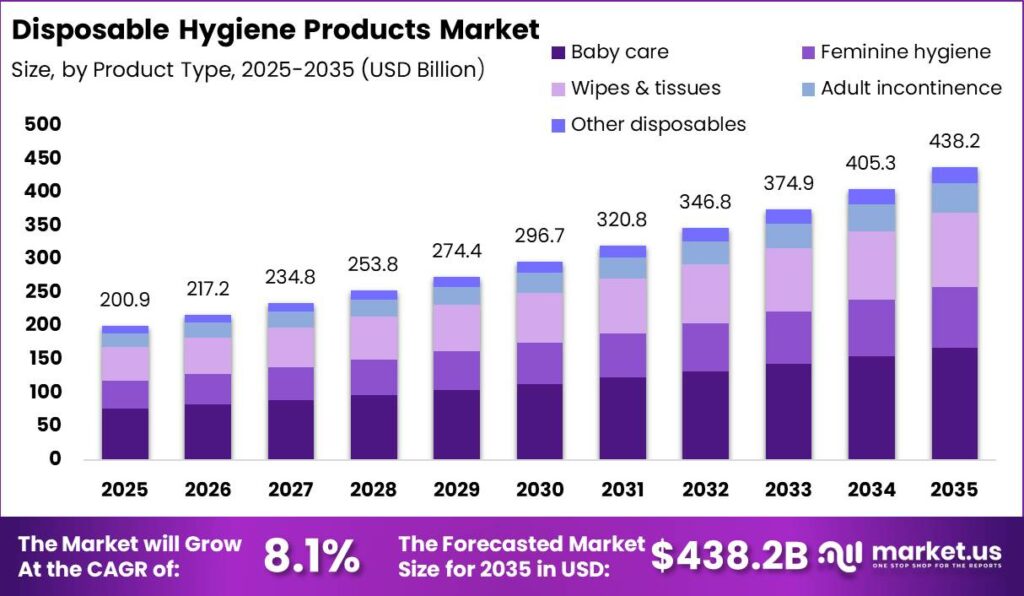
Disposable Hygiene Products Market size is expected to be worth around USD 438.2 Billion by 2035 from USD 200.9 Billion in 2025, growing at a CAGR of 8.1% during the forecast period 2026 to 2035. This growth reflects widening product penetration across baby care, feminine hygiene, and adult incontinence categories. Manufacturers that scale affordable formats capture first-mover volume in underserved regions.
The market covers single-use absorbent products designed for personal hygiene across infant, female, and elderly users. This structure spans baby diapers, sanitary napkins, wipes, adult incontinence pads, and institutional disposables. Products rely on layered cores built from nonwoven fabrics, super absorbent polymers, and fluff pulp. This layered design links raw material sourcing directly to product performance, so material supply shifts move manufacturer margins quickly.
Government hygiene programs and sanitation missions expand institutional procurement across emerging markets. Public subsidy schemes convert first-time users, who later trade up to branded products. As a result, manufacturers gain a demand pipeline that lowers the cost of acquiring new commercial buyers over time. This creates durable volume growth in high-population markets where penetration remains far below saturation levels.
Key Takeaways
- Global market size reached USD 200.9 Billion in 2025 and will hit USD 438.2 Billion by 2035 at a CAGR of 8.1%.
- Baby care led the By Product Type segment with a 38.3% share.
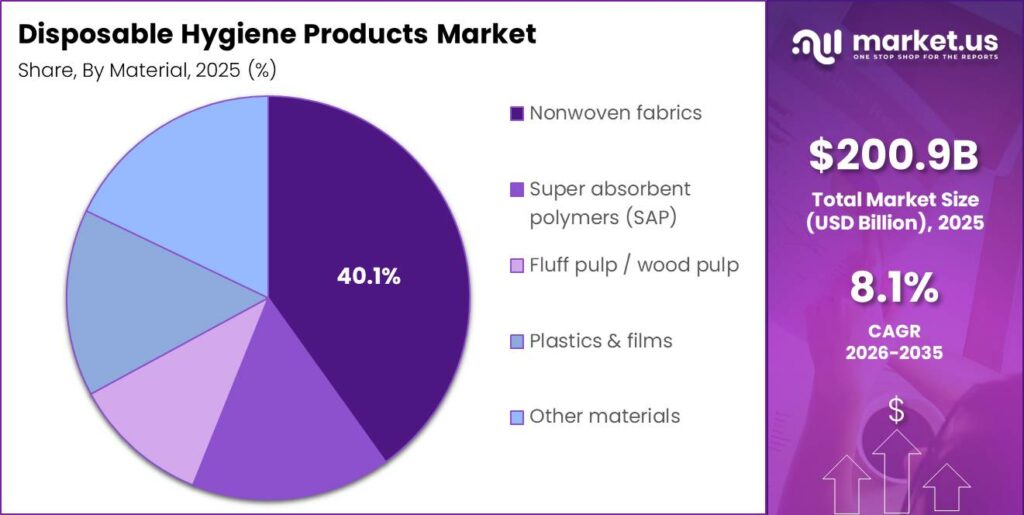
- Nonwoven fabrics led the By Material segment with a 40.1% share.
- Infants and babies led the By End-user segment with a 38.3% share.
- Supermarkets and hypermarkets led the By Distribution Channel segment with a 42.2% share.
- Asia Pacific dominated all regions with a 40.1% share, valued at USD 80.6 Billion.
Regulators now scrutinize disposal because used products strain municipal systems. According to the US Environmental Protection Agency, disposable diapers contribute roughly 4.1 million tons to municipal solid waste each year, equal to 1.4% of total generation. This waste load pushes producers toward compostable cores. Companies that redesign early avoid future compliance penalties and protect category reputation.
Urban sanitation strain compounds the disposal challenge across dense cities. Research from Springer indicates that absorbent hygiene products form a major under-addressed waste stream, causing measurable drainage blockage during peak disposal cycles. This signals rising infrastructure cost for municipalities. Manufacturers that fund take-back systems gain regulatory goodwill and shield themselves from restrictive future legislation.
Product Type Analysis
Baby care dominates with 38.3% due to universal infant hygiene consumption.
In 2025, Baby care held a dominant market position in the By Product Type segment of Disposable Hygiene Products Market, with a 38.3% share. UN Comtrade classifies diapers and napkin liners for babies under HS code 9619, tracking billions in cross-border shipments each year. This heavy trade flow rewards manufacturers with regional converting plants. Local production near demand centers cuts freight cost and protects margin.
Feminine hygiene products serve recurring monthly demand across a large female base. HS code 9619 also covers sanitary towels, confirming steady global movement of these goods. Kimberly-Clark’s Kotex redesign added a Gravity Core system with 5X leak protection in February 2026. This performance upgrade lets brands defend premium shelf positions against low-cost private-label rivals.
Wipes and tissues cover daily cleaning needs across households and travel use. Trade databases record consistent shipment volumes under absorbent paper product codes. This steady demand base supports high production utilization. Manufacturers that run continuous lines lower unit cost and win price-sensitive bulk retail contracts.
Adult incontinence products anchor demand among aging populations, while other disposables hold the remaining share collectively. Rising elderly populations in Japan and Germany expand per-capita consumption of these products. This demographic shift creates a defensible premium segment. Companies that build discreet formats capture loyal elderly buyers early.
Material Analysis
Nonwoven fabrics dominate with 40.1% due to soft skin-contact surface performance.
In 2025, Nonwoven fabrics held a dominant market position in the By Material segment of Disposable Hygiene Products Market, with a 40.1% share. Nonwovens form the topsheet and backsheet in most products classified under HS 9619. This material anchors both comfort and fluid transfer. Suppliers with scaled polypropylene capacity secure long-term contracts with major converters.
Super absorbent polymers deliver the core fluid-locking function inside diapers and pads. Research from ScienceDirect shows SAP transforms liquid into a cross-linked hydrogel network that immobilizes fluid within the core. This chemistry drives thinner, higher-capacity products. Manufacturers that secure stable SAP supply protect production continuity and pricing.
Fluff pulp and wood pulp provide bulk absorbency and structural body to the core. Global pulp trade moves millions of tons annually through customs databases. This commodity exposure links product cost to timber and pulp markets. Companies that hedge pulp contracts stabilize margins against raw material swings.
Plastics and films seal moisture and shape the product, while other materials hold the remaining share collectively. Polyethylene films form the leak barrier in most disposable formats. This barrier function faces rising regulatory pressure on plastic content. Producers that pilot bio-based films position early for tightening packaging rules.
End-user Analysis
Infants and babies dominate with 38.3% due to daily multi-change consumption patterns.
In 2025, Infants and babies held a dominant market position in the By End-user segment of Disposable Hygiene Products Market, with a 38.3% share. Baby diapers move heavily under HS code 9619 across import-dependent developing markets. This high change frequency drives repeat purchase volume. Brands that build trust with new parents lock in years of recurring spend.
Women form a large recurring demand base for feminine hygiene products. National statistical offices report menstruating populations numbering in the hundreds of millions across Asia. This scale creates a deep conversion runway. Companies that price for affordability capture unconverted users before competitors reach them.
Adults and elderly drive incontinence demand tied to rising longevity. World Bank data shows the share of people over 65 climbing steadily across mature economies. This aging trend expands a high-value category. Firms that design dignity-focused formats win loyalty in premium care channels.
General household and institutional buyers procure disposables in bulk for clinical and facility use. Hospitals and care homes purchase high-absorbency products to meet hygiene standards. This bulk demand rewards reliable supply. Manufacturers with dependable logistics secure long institutional contracts.
Distribution Channel Analysis
Supermarkets and hypermarkets dominate with 42.2% due to broad household shopping reach.
In 2025, Supermarkets and hypermarkets held a dominant market position in the By Distribution Channel segment of Disposable Hygiene Products Market, with a 42.2% share. Large-format retail captures roughly 40% of general retail consumer sales per industry channel data. This footprint gives hygiene brands mass visibility. Suppliers that win shelf space here reach the widest buyer base fast.
Pharmacies and drug stores serve buyers seeking trusted, health-linked hygiene products. These outlets attract shoppers wanting professional guidance on incontinence and feminine care. This trust factor supports premium pricing. Brands that position clinically in pharmacies protect higher margins.
Online retail and e-commerce expand access through subscription and doorstep delivery. Urban logistics networks now support recurring hygiene product replenishment models. This channel lowers repeat purchase friction. Companies that build direct subscriptions capture predictable recurring revenue.
Convenience and specialty stores fill urgent and niche purchase needs, holding the remaining share collectively. These outlets serve last-minute and premium-focused buyers. This immediacy supports impulse and top-up sales. Brands that stock small packs here capture incremental volume.
Key Market Segments
By Product Type
- Baby care
- Feminine hygiene
- Wipes & tissues
- Adult incontinence
- Other disposables
By Material
- Nonwoven fabrics
- Super absorbent polymers (SAP)
- Fluff pulp / wood pulp
- Plastics & films
- Other materials
By End-user
- Infants / babies
- Women
- Adults / elderly
- General / household & institutional
By Distribution Channel
- Supermarkets & hypermarkets
- Pharmacies & drug stores
- Online retail / e-commerce
- Convenience & specialty stores
Regional Analysis
Asia Pacific Dominates the Disposable Hygiene Products Market with a Market Share of 40.1%, Valued at USD 80.6 Billion
Asia Pacific led the market with a 40.1% share, valued at USD 80.6 Billion in 2025. Large infant populations and rising incomes drive fast baby diaper adoption across the region. This scale rewards local manufacturing investment. In March 2026, AGEasy launched adult diaper pants offering up to 12 hours of leak protection through a 3-layer core. This innovation signals rising demand for advanced elderly care formats across the region.
Emerging markets across Asia and Africa show the fastest growth as penetration climbs from low bases. Rising female literacy and expanding retail reach convert new users each year. This creates a compounding demand trajectory unlike saturated Western markets. Companies that enter early with affordable products build durable brand loyalty before rivals arrive.

Key Regions and Countries
North America
- US
- Canada
Europe
- Germany
- France
- The UK
- Spain
- Italy
- Rest of Europe
Asia Pacific
- China
- Japan
- South Korea
- India
- Australia
- Rest of APAC
Latin America
- Brazil
- Mexico
- Rest of Latin America
Middle East and Africa
- GCC
- South Africa
- Rest of MEA
Market Dynamics
Market Opportunity Analysis - Underpenetrated regions and premium niches offer clear entry points for new players
Asia Pacific holds the largest regional share at 40.1%, yet adult incontinence remains underexploited within it. Aging populations across China and Japan expand demand faster than local premium supply meets it. This means new entrants can build discreet formats before incumbents fully scale. Companies that localize production near demand centers capture loyal elderly buyers early.
Feminine hygiene stays underexploited despite its large recurring female base. Millions of women in emerging Asia remain unconverted to disposable products. As a result, affordability-led brands find open runway ahead of premium players. Firms that price for mass access build share before competitors reach these buyers.
Online retail remains a smaller channel than supermarkets, which hold 42.2% of sales. This channel gap leaves subscription models underused for recurring hygiene purchases. Therefore, brands that build direct delivery lock in predictable repeat revenue. Early digital entrants gain data on buyer habits that later rivals cannot easily match.
Technology and Innovation Landscape - Absorbent core science and smart materials redefine product performance
Super absorbent polymers drive the core of product performance across the market. This chemistry transforms liquid into a locked hydrogel that prevents free fluid movement. This function enables thinner, higher-capacity products. Manufacturers that master SAP integration deliver comfort gains that justify premium pricing.
Nonwoven fabric engineering shapes both comfort and fluid transfer in every product. Advances in topsheet softness and bonding improve skin contact and dryness. This means brands can differentiate on feel, not just absorption. Companies investing in nonwoven innovation defend premium positions against low-cost rivals.
Layered core construction combines pulp, SAP, and films for targeted performance. Recent designs add multi-layer distribution systems that extend protection duration. This creates measurable advantages in elderly and overnight care. Firms that refine core architecture win trust in high-value clinical segments.
Drivers
Rising awareness and expanding product penetration in emerging markets drive the strongest demand growth. Female literacy campaigns, urban retail expansion into smaller cities, and rising incomes together make disposable hygiene products affordable per use. In India, sanitary napkin penetration reached an estimated 36 to 42% of menstruating women by 2024, against a base near 355 to 375 million women. This gap represents millions of unconverted buyers. Brands that lead on affordability capture this pipeline first.
Government programs accelerate first-time trial and later commercial conversion. India’s Jan Aushadhi scheme distributed subsidized pads at INR 1 per pad through over 10,000 outlets by 2024. New users trade up to branded products within 12 to 24 months. This creates a low-cost acquisition funnel. Manufacturers that build flexible lines producing both mass and premium variants win share across both tiers.
| Driver | (~) % Impact on CAGR Forecast | Geographic Relevance | Impact Timeline |
|---|---|---|---|
| Rising Awareness & Expanding Sanitary Napkin & Diaper Penetration in Emerging Markets | +2.60% | India, Sub-Saharan Africa, Southeast Asia, Latin America, South Asia | Short term (≤ 2 years) |
| Ageing Population Growth Driving Adult Incontinence Product Demand in Mature Economies | +1.80% | Japan, Germany, Italy, United States, South Korea, France, United Kingdom | Short term (≤ 2 years) |
| Post-COVID Hygiene Consciousness & Infection Prevention Sustaining Elevated Wipe & Pad Category Volume | +1.10% | Global — most acute in Asia Pacific, North America, Europe | Short term (≤ 2 years) |
| Rising Birth Rate & Infant Population in Africa & South Asia Expanding Baby Diaper Addressable Base | +0.85% | Nigeria, Ethiopia, DRC, Tanzania, Pakistan, Bangladesh, Egypt | Medium term (2–4 years) |
| Premiumisation & Skin-Friendly Material Innovation Driving ASP Upgrades in Baby & Feminine Care | +0.65% | China, United States, Europe, Japan, GCC, South Korea | Medium term (2–4 years) |
| Government & NGO Menstrual Hygiene Management Programmes Expanding Institutional Procurement | +0.42% | India, Sub-Saharan Africa, Bangladesh, Nepal, Southeast Asia | Short term (≤ 2 years) |
Restraints
Single-use plastic legislation raises costs for conventional product formulations. Plastic backsheets, nonwoven topsheets, and SAP together make up 60 to 75% of a pad or diaper by weight. The EU Single-Use Plastics Directive and producer responsibility fees add roughly EUR 0.008 to 0.025 per unit in compliance cost. This directly erodes thin mass-market margins. Manufacturers face pressure to reformulate without losing absorption performance.
Sustainable material substitutes remain costly at current volumes. Bio-based nonwovens carry a 35 to 60% cost premium over polypropylene, and biodegradable films add up to EUR 0.040 per unit. At retail prices near EUR 0.12 to 0.25 per pad, this creates a 12 to 25% material cost jump. This gap cannot pass fully to consumers. European producers risk a structural cost disadvantage against unregulated imports.
| Restraint | (~) % Impact on CAGR Forecast | Geographic Relevance | Impact Timeline |
|---|---|---|---|
| Single-Use Plastic & Non-Woven Legislation Banning or Taxing Conventional Disposable Hygiene Products | -1.50% | European Union, United Kingdom, France, Germany, India, Canada, Australia | Short term (≤ 2 years) |
| Reusable & Washable Menstrual Product Substitution Competing Directly with Disposable Pad & Cup Market | -0.85% | Europe, North America, Australia, urban India, South Korea, Japan | Short term (≤ 2 years) |
| Superabsorbent Polymer (SAP) & Fluff Pulp Raw Material Cost Inflation Compressing Manufacturer Margins | -0.60% | Global — SAP production concentrated in Germany, Japan, United States, China | Short term (≤ 2 years) |
| Affordability & Price Sensitivity Limiting Premium Product Conversion in Low-Income Market Segments | -0.38% | Sub-Saharan Africa, South Asia, Southeast Asia, Latin America | Medium term (2–4 years) |
Challenges
Waste management infrastructure lags behind fast product penetration in emerging markets. Used hygiene products are non-biodegradable and hard to handle in landfills. In India, an estimated 121 to 150 billion used napkins are generated yearly, yet fewer than 20% enter treated waste streams. This gap creates environmental and reputational risk. Producers that fund disposal solutions protect the category from restrictive rules.
Multi-material laminate construction blocks recycling and composting. Products combine film, nonwoven, SAP, and pulp in inseparable layers, failing EN 13432 compostable standards. Controlled incineration above 850°C costs USD 150,000 to 300,000 per tonne of capacity. This infrastructure is absent where penetration grows fastest. Companies that invest in take-back systems open a new service revenue stream.
| Challenge | (~) % CAGR Friction Drag | Geographic Relevance | Mitigation Horizon |
|---|---|---|---|
| Solid Waste Management & Used Product Disposal Infrastructure Gap | -0.90% | Sub-Saharan Africa, South Asia, Southeast Asia, Latin America | Long term (≥ 4 years) |
| Private Label & Local Brand Price Erosion in Mid-Tier Segments | -0.70% | Europe, North America, China, India, Brazil, Turkey | Long term (≥ 4 years) |
| Converting Equipment & SAP Supply Chain Lead Time Volatility | -0.55% | Global — most acute for capacity expansion projects in emerging markets | Medium term (2–4 years) |
| Cultural Taboo & Menstrual Stigma Suppressing Rural Demand Conversion | -0.40% | Sub-Saharan Africa, South Asia, Middle East, North Africa | Long term (≥ 4 years) |
| Counterfeit & Substandard Product Market Erosion in Informal Trade Channels | -0.28% | Sub-Saharan Africa, Southeast Asia, Latin America, South Asia | Long term (≥ 4 years) |
Opportunities
Biodegradable and plant-based products open premium white space in developed markets. As of 2025, certified sustainable products held fewer than 4 to 6% of total value, yet 45 to 58% of Western buyers would pay a 15 to 30% premium for proven sustainable options. This gap signals unmet demand. Early movers with scaled green lines capture loyal ESG buyers before mainstream rivals enter.
Scaled converting infrastructure unlocks the margin case for sustainable products. At commercial scale, biodegradable core premiums narrow from 65% to near 18 to 28%, enabling gross margin gains of 8 to 14 percentage points. A dedicated green line costs EUR 15,000,000 to 45,000,000. This scale suits large consumer goods groups. Firms that invest within a 2 to 4 year window lead the coming regulatory shift.
| Opportunity | (~) % Potential CAGR Upside | Geographic Relevance | Execution Window |
|---|---|---|---|
| Biodegradable & Plant-Based Hygiene Product Premiumisation Capturing ESG-Driven Buyer Segment | +1.60% | Europe, North America, Australia, Japan, South Korea, urban China | Medium term (2–4 years) |
| Adult Incontinence Product Market Development in Underpenetrated Asia Pacific Ageing Markets | +1.20% | China, Japan, South Korea, India, Thailand, Malaysia, Indonesia | Medium term (2–4 years) |
| D2C Subscription & Femtech Platform Integration for Premium Menstrual & Incontinence Categories | +0.85% | United States, United Kingdom, Germany, Australia, South Korea, Brazil | Long term (≥ 4 years) |
| Sub-Saharan Africa Local Manufacturing Capacity Investment for Import Substitution & Cost-Led Penetration | +0.65% | Nigeria, Kenya, Ethiopia, Ghana, Tanzania, South Africa | Long term (≥ 4 years) |
| Male Incontinence & Post-Surgical Hygiene Product Category Formalisation | +0.38% | United States, Europe, Japan, Australia, Canada | Long term (≥ 4 years) |
Key Company Insights
Procter & Gamble Co. holds a structural advantage through global baby and feminine care brands backed by deep converting scale. This breadth lets the company absorb material cost shifts better than smaller rivals. Research from a peer-reviewed 2025 waste review shows 100% of absorbent hygiene products still reach landfill or incineration. This gap exposes reputational risk unless the firm accelerates compostable core investment.
Kimberly-Clark Corporation strengthens its position through continuous product innovation and category leadership in tissue and feminine care. Its Kotex core upgrades defend premium shelf space against price-driven private labels. This innovation focus supports higher margins in mature markets. However, heavy exposure to plastic-intensive formats leaves the company vulnerable to tightening single-use plastic regulation.
Key Players
- Procter & Gamble Co.
- Kimberly-Clark Corporation
- Unicharm Corporation
- Essity AB
- Kao Corporation
- Ontex Group NV
- Johnson & Johnson
- Hengan International Group
- Daio Paper Corporation
- First Quality Enterprises Inc.
- Drylock Technologies
- Domtar Corporation
- Edgewell Personal Care
- Svenska Cellulosa Aktiebolaget (SCA)
- The Honest Company
- Others
Recent Developments
- February 2026: Essity completed the acquisition of Edgewell Personal Care’s feminine care business for USD 340 million, adding Carefree, Stayfree, and o.b. to strengthen its North American hygiene portfolio.
- July 2026: Kimberly-Clark launched Arbex, a USD 3.4 billion global tissue and hygiene joint venture with Suzano, operating across 70+ markets and 22 manufacturing facilities.
- October 2025: Charmin introduced Forever Roll, an oversized toilet paper roll containing approximately 1,700 sheets designed to last up to 30 days in a two-person household.
Geopolitical Impact Analysis
According to the World Trade Organization, global merchandise trade growth slowed to roughly 2.7% in recent years as tariff tensions rose. Hygiene producers depend on cross-border SAP and pulp flows concentrated in Germany, Japan, and China. This means tariff shifts on chemical inputs raise core material costs directly. Manufacturers that diversify sourcing across regions protect production continuity and pricing stability.
Data from the IEA shows energy prices swung sharply, with natural gas costs rising over 30% during recent supply disruptions. Nonwoven and film production consume heavy energy, so these swings lift unit costs across converting lines. This creates margin pressure for petrochemical-intensive formats. Companies that hedge energy contracts and localize converting near demand shield margins from volatility.
Report Scope
| Report Features | Description |
|---|---|
| Market Value (2025) | USD 200.9 Billion |
| Forecast Revenue (2035) | USD 438.2 Billion |
| CAGR (2026-2035) | 8.1% |
| Base Year for Estimation | 2025 |
| Historic Period | 2020-2024 |
| Forecast Period | 2026-2035 |
| Report Coverage | Revenue Forecast, Market Dynamics, Market Opportunity Analysis, Technology and Innovation Landscape, Competitive Landscape, Recent Developments |
| Segments Covered | By Product Type (Baby Care, Feminine Hygiene, Wipes & Tissues, Adult Incontinence, Other Disposables), By Material (Nonwoven Fabrics, Super Absorbent Polymers (SAP), Fluff Pulp / Wood Pulp, Plastics & Films, Other Materials), By End-user (Infants / Babies, Women, Adults / Elderly, General / Household & Institutional), By Distribution Channel (Supermarkets & Hypermarkets, Pharmacies & Drug Stores, Online Retail / E-commerce, Convenience & Specialty Stores) |
| Regional Analysis | North America (US and Canada), Europe (Germany, France, The UK, Spain, Italy, and Rest of Europe), Asia Pacific (China, Japan, South Korea, India, Australia, and Rest of APAC), Latin America (Brazil, Mexico, and Rest of Latin America), Middle East and Africa (GCC, South Africa, and Rest of MEA) |
| Competitive Landscape | Procter & Gamble Co., Kimberly-Clark Corporation, Unicharm Corporation, Essity AB, Kao Corporation, Ontex Group NV, Johnson & Johnson, Hengan International Group, Daio Paper Corporation, First Quality Enterprises Inc., Drylock Technologies, Domtar Corporation, Edgewell Personal Care, Svenska Cellulosa Aktiebolaget (SCA), The Honest Company, Others |
| Customization Scope | Customization for segments, region / country-level will be provided. Additional customization can be done based on requirements. |
| Purchase Options | We have three licenses to opt for: Single User License | Multi-User License (Up to 5 Users) | Corporate Use License (Unlimited User and Printable PDF) |





































