


Report Overview
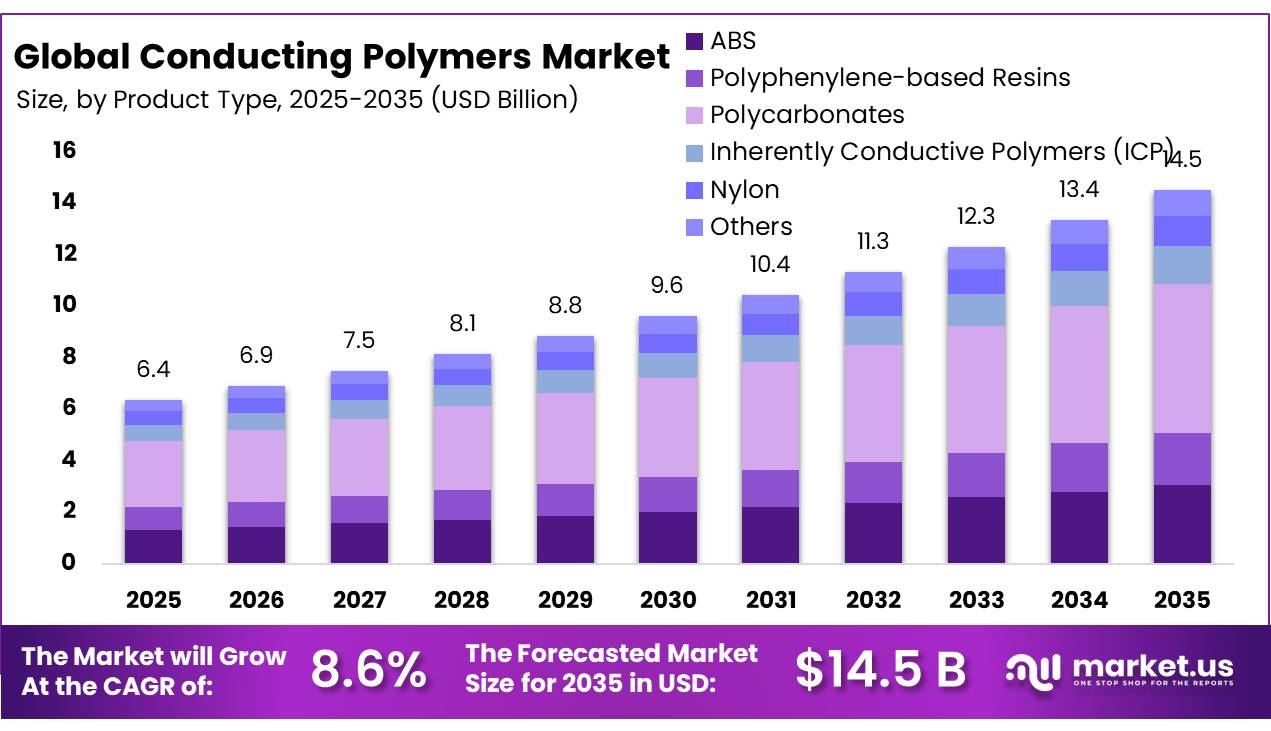
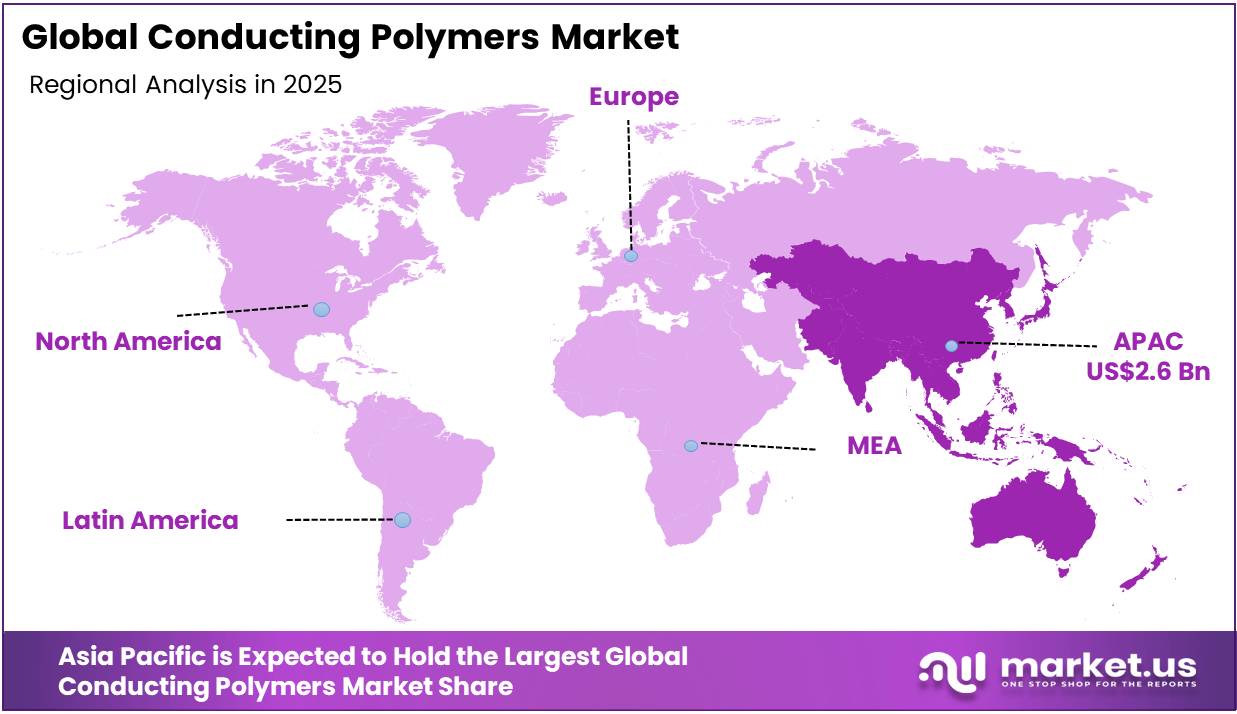
In 2025, the Global Conducting Polymers Market was valued at USD 6.4 billion, and between 2026 and 2035, this market is estimated to register a CAGR of 8.6%, reaching about USD 14.5 billion by 2035. In 2025, Asia Pacific held a dominant market position, capturing more than a 40.5% share, holding USD 1.4 Billion revenue.
The conducting polymers market is shaped by materials that combine polymer processability with electrical or thermal conductivity, enabling their use in electronics, automotive systems, energy storage, and protective packaging. Product categories such as conductive ABS, polycarbonate, and nylon-based compounds, polyphenylene-based resins, and inherently conductive polymers are widely used across applications requiring anti-static protection, signal stability, and lightweight conductive structures.
Electrically conductive variants dominate demand, particularly in sensors, batteries, capacitors, and EMI shielding components, while thermally conductive grades are gaining relevance in heat management applications in compact electronic devices.
- According to a report by the International Energy Agency (IEA), electric car sales exceeded 17 million globally in 2024, reaching a sales share of more than 20%.
- In 2025, global renewable energy capacity reached a record, nearing half of all power capacity, with 692 GW added (a 15.5% annual increase), driven heavily by solar, which accounted for nearly 75% of new additions. Globally, renewables accounted for 85.6% of all new power capacity added, with cumulative capacity surpassing 5,100 GW.
Expansion of electric mobility, miniaturized consumer electronics, and renewable-energy infrastructure has increased integration of these materials in functional components. Conducting polymers are being further incorporated into flexible and printed electronics, where mechanical flexibility and solution processability support next-generation device architectures.
- In 2001, the Asia Pacific market surpassed all other regional markets in sales of semiconductors, as electronic equipment production shifted to the region. It has multiplied in size since then, from US$39.8 billion to US$333.4 billion in 2024.
Asia Pacific remains the primary production and consumption base due to its large-scale electronics manufacturing ecosystem and strong semiconductor supply chains, followed by North America and Europe, where advanced applications in automotive electrification and energy systems are prominent. Continuous material innovation, including improved conductivity through nanofiller integration and hybrid composites, is enhancing performance consistency and broadening industrial adoption across high-growth technology sectors.
Key Takeaways
- The global conducting polymers market was valued at USD 6.4 billion in 2025.
- The global market is projected to grow at a CAGR of 8.6% and is estimated to reach USD 14.5 billion by 2035.
- On the basis of product type, polycarbonates dominated the market, constituting 40.5% of the total market share.
- Based on the conductivity type, electrically conductive polymers led the market, comprising 85.4% of the total market.
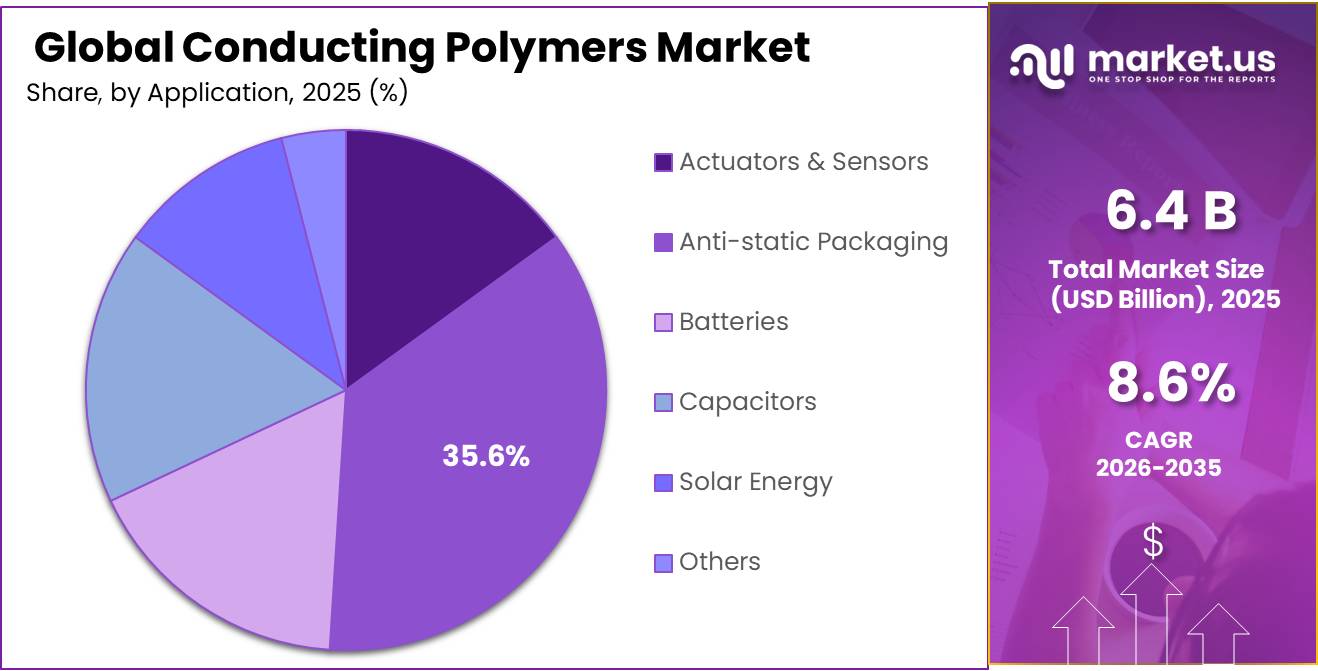
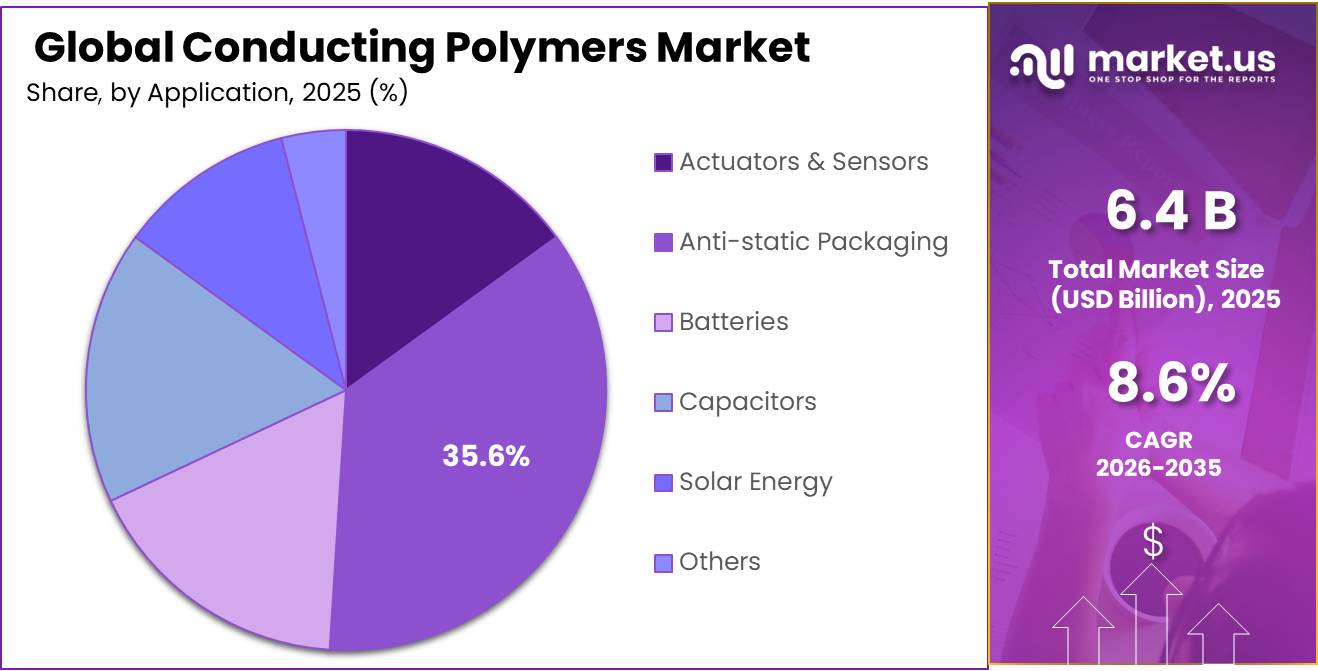
- Among the applications, anti-static packaging held a major share in the conducting polymers market, 35.6% of the market share.
- In 2025, the Asia Pacific was the most dominant region in the conducting polymers market, accounting for 40.5% of the total global consumption.
Product Type Analysis
Polycarbonates are a Prominent Segment in the Market.
Polycarbonates represent the dominant product type within the conducting polymers market, accounting for approximately 40.5% share due to their balanced combination of mechanical strength, thermal resistance, and adaptability to conductive modification. Their inherent dimensional stability and transparency make them highly suitable for electronic housings, optical components, and precision-engineered parts where conductivity and structural integrity must coexist.
This makes them widely adopted in automotive electronics, consumer devices, and industrial equipment requiring electromagnetic interference shielding and anti-static properties. Their compatibility with injection molding and extrusion processes further strengthens large-scale manufacturability. Increasing integration into electric vehicle components, sensor systems, and compact electronic assemblies continues to reinforce their role as a preferred conductive polymer substrate across high-performance engineering applications.
Conductivity Type Analysis
Electrically Conductive Polymers Held a Major Share of the Conducting Polymers Market.
Electrically conductive polymers represent the dominant segment within the conductivity type category, accounting for approximately 85.4% share due to their extensive use across electronics, automotive systems, and energy-related applications. Their ability to facilitate controlled electron flow makes them essential in components such as sensors, capacitors, batteries, anti-static packaging, and electromagnetic interference shielding materials.
These polymers are widely engineered using conductive fillers and inherently conductive formulations to achieve tailored conductivity levels while maintaining flexibility and lightweight characteristics. Their compatibility with miniaturized and complex electronic architectures has further strengthened adoption in consumer electronics and printed circuit systems. Growing integration in electric vehicles and smart devices continues to reinforce demand, as manufacturers seek materials that combine conductivity with design adaptability.
Application Analysis
Conducting Polymers Are Widely Utilized in the Anti-Static Packaging Sector.
Anti-static packaging represents the dominant application segment, accounting for approximately 35.6% share in the conducting polymers market due to its extensive use in electronics manufacturing, semiconductor handling, and sensitive component transportation. Conducting polymers are widely incorporated into packaging materials to prevent electrostatic discharge, which can damage microchips, circuit boards, and precision electronic assemblies.
Increasing production of semiconductors, consumer electronics, and automotive electronic systems has strengthened demand for reliable ESD protection solutions. Additionally, the shift toward miniaturized and highly sensitive electronic devices has heightened the need for advanced protective materials. Continuous improvements in polymer compounding and conductivity control are further enhancing performance consistency, reinforcing the role of anti-static packaging as a critical functional application area within the conducting polymers ecosystem.
Key Market Segments
By Product Type
- ABS
- Polyphenylene-based Resins
- Polycarbonates
- Inherently Conductive Polymers (ICP)
- Nylon
- Others
By Conductivity Type
- Electrically Conductive
- Thermally Conductive
By Application
- Actuators & Sensors
- Anti-static Packaging
- Batteries
- Capacitors
- Solar Energy
- Others
Driver Analysis
Flexible Electronics Replacing Brittle ITO
Flexible-display, organic-photovoltaic, flexible-OLED, e-textile, sensor, and transparent-electrode applications are increasing demand for conducting polymers because indium tin oxide remains electrically effective but is brittle, vacuum-deposition dependent, and poorly suited to repeated bending, folding, stretching, or low-temperature roll-to-roll manufacturing.
PEDOT:PSS is increasingly used as a transparent electrode, hole-transport layer, interconnector, electroactive layer, and motion-sensing conductor because it is water-dispersible, compatible with printing and coating methods, mechanically flexible, and optically transparent. A key process breakthrough in 2026 enabled photo-patternable PEDOT:PSS features down to 2 micrometers through blending with a photosensitive interpenetrating network, improving compatibility with photolithography and allowing conducting-polymer films to move closer to conventional microfabrication resolution.
This changes the commercial model from small-volume specialty inks into high-throughput functional layers supplied to display, sensor, and printed-electronics manufacturers: a roll-to-roll coated polymer electrode can eliminate multiple brittle sputtered-oxide deposition and patterning steps, lower substrate-temperature requirements to below 150°C in many formulations, and enable conformable product geometries that cannot use glass-based ITO architectures.
The value capture is strongest in China, South Korea, Taiwan, Japan, Europe, and North America, where display and electronics supply chains can absorb material qualification costs; if PEDOT:PSS and related formulations achieve stable sheet resistance below 100 ohms per square alongside visible-light transmittance above 85-90%, the material can capture a larger share of flexible-electronics bills of materials, supporting an estimated +1.5 percentage-point uplift to baseline CAGR through 2028-2030.
Drivers Impact Analysis
| Driver | (~) % Impact on CAGR Forecast | Geographic Relevance | Impact Timeline |
|---|---|---|---|
| Flexible electronics replacing brittle ITO | +1.5% | APAC core, North America, EU | Medium term (2-4 years) |
| Wearable bioelectronics and health sensors | +1.3% | North America, EU, Japan, South Korea | Medium term (2-4 years) |
| Battery and supercapacitor integration | +1.1% | China, South Korea, Japan, EU, US | Long term (≥ 4 years) |
| EV lightweight EMI shielding | +1.0% | China, North America, EU, Japan | Medium term (2-4 years) |
| Hydrogen-system coating demand | +0.8% | EU, North America, China, Japan | Long term (≥ 4 years) |
| Corrosion-protection coating substitution | +0.7% | GCC, North America, EU, APAC | Short term (≤ 2 years) |
Restraint Analysis
Moisture and Thermal Instability
PEDOT:PSS can offer high visible-light transparency, solution processability, and conductivity, but its sulfonic-acid functionality can corrode indium tin oxide electrodes and destabilize adjacent layers in optoelectronic stacks; research on perovskite devices specifically identifies PEDOT:PSS acidity as a cause of ITO corrosion and reduced device stability.
Under high humidity, polymer films can absorb water, swell, lose cohesion, and develop microcracks during repeated flexing; in flexible electronics, a 5-10% decline in conductivity or a modest increase in sheet resistance can impair sensor signal quality, touch performance, electrode uniformity, or power-device efficiency. The commercial effect is that OEMs often require encapsulation layers, neutralized formulations, crosslinkers, barrier films, secondary dopants, and accelerated-aging validation, increasing the materials stack and process cost by a modeled 10-25% compared with initial laboratory prototypes.
Longer-term durability challenges also delay adoption in automotive, outdoor photovoltaics, marine sensing, implantables, and hydrogen-adjacent electronics, where requirements can extend from hundreds of test hours to 1,000-5,000-hour qualification programs; this medium-term restraint is modeled to deduct 1.2 percentage points from achievable market CAGR until durable neutral, hydrophobic, self-healing, or hybrid inorganic-polymer formulations become more widely qualified.
Restraint Impact Analysis
| Restraint | (~) % Impact on CAGR Forecast | Geographic Relevance | Impact Timeline |
|---|---|---|---|
| Moisture and thermal instability | -1.2% | APAC, North America, EU | Medium term (2-4 years) |
| High-performance formulation cost | -1.0% | North America, EU, APAC | Short term (≤ 2 years) |
| Conductivity batch variation | -0.8% | APAC electronics corridors, EU, US | Medium term (2-4 years) |
| Limited high-temperature capability | -0.7% | EV, hydrogen, aerospace markets | Long term (≥ 4 years) |
| Toxic precursor scrutiny | -0.6% | EU, North America, Japan | Medium term (2-4 years) |
| Fragmented material qualification standards | -0.5% | Global electronics, mobility, medical | Medium term (2-4 years) |
Opportunity Analysis
Neural-Interface Material Platforms
PEDOT:PSS is particularly relevant for brain-computer interfaces, cortical recording, peripheral-nerve electrodes, neurostimulation, and bioelectronic transducers because it combines solution processing with biocompatibility and mechanical compliance; published assessments place PEDOT:PSS modulus in a broad 0.1-10 MPa range, materially closer to soft tissue than conventional inorganic microelectrodes, although still above brain tissue at roughly 1-4 kPa.
A polymer coating that reduces electrode impedance by 50-90% at biologically relevant frequencies can improve signal quality and lower stimulation-voltage requirements, while a 10-20% increase in usable electrode life can materially improve the economics of implanted devices that carry expensive surgical and regulatory costs.
The go-to-market white space is therefore a full platform rather than raw polymer sales: ISO 10993-tested formulations, electrode-coating protocols, sterilization data, neural-cell compatibility datasets, contract coating, regulatory documentation, and licensing agreements with neurotechnology OEMs; companies that secure design-in status before clinical platform standardization could add approximately +1.4 percentage points to market CAGR after 2030.
Opportunity Impact Analysis
| Opportunity | (~) % Potential CAGR Upside | Geographic Relevance | Execution Window |
|---|---|---|---|
| Neural-interface material platforms | +1.4% | North America, EU, Japan, South Korea | Long term (≥ 4 years) |
| Smart-textile licensing ecosystems | +1.2% | EU, North America, China, South Korea | Medium term (2-4 years) |
| PFAS sensor-material systems | +1.0% | North America, EU, Japan, APAC urban hubs | Medium term (2-4 years) |
| Printed electronics foundry partnerships | +0.9% | China, Taiwan, South Korea, EU, US | Short term (≤ 2 years) |
| Circular conductive-polymer formulations | +0.8% | EU core, Japan, North America | Long term (≥ 4 years) |
| EMI-shielding compound roll-ups | +0.7% | China, North America, EU, Japan | Medium term (2-4 years) |
Challenges Analysis
Scale-Up Reproducibility Control
The central scale-up challenge is converting laboratory-grade conducting polymer performance into consistent commercial output across hundreds or thousands of kilograms of dispersion, powder, coating, filament, film, or compounded resin, because conductivity depends on polymer-chain order, molecular-weight distribution, oxidation state, dopant ratio, solvent composition, pH, solids content, humidity, shear history, drying profile, annealing condition, substrate surface energy, and conductive-filler dispersion.
Sensor research published in 2026 notes that reported performance from PEDOT:PSS, PANI, PPy, and polythiophene systems is often not directly comparable because polymer formulation, film morphology, electrode geometry, electrolyte chemistry, calibration protocol, and data treatment differ widely, while inter-batch and inter-laboratory reproducibility are rarely measured beyond small sample sizes. In practical manufacturing, a 2-5% shift in solids concentration or a 5-10°C drying variation can change film thickness, morphology, sheet resistance, adhesion, or optical transmission enough to cause out-of-spec sensor, display, electrode, or shielding performance; for conductive composites, small filler-dispersion changes around the electrical percolation threshold can produce order-of-magnitude resistivity shifts.
Vapor-phase polymerization can improve PEDOT ordering and batch consistency, but requires specialized tooling and more controlled production than basic aqueous coating. Manufacturers must build inline rheology measurement, four-point-probe conductivity testing, spectral thickness control, humidity-conditioned coating lines, automated dosing, statistical process control, and lot-specific certificates of analysis, which can add a modeled 7-15% to conversion cost and extend customer qualification by 6-18 months; until these controls become standardized, reproducibility friction is estimated to impose a -0.9 percentage-point drag on maximum CAGR across APAC electronics manufacturing, North American advanced materials suppliers, and EU specialty-coating markets.
Challenges Impact Analysis
| Challenge | (~) % CAGR Friction Drag | Geographic Relevance | Mitigation Horizon |
|---|---|---|---|
| Scale-up reproducibility control | -0.9% | APAC, North America, EU | Medium term (2-4 years) |
| Interface adhesion durability | -0.8% | Wearables, sensors, EVs, bioelectronics | Long term (≥ 4 years) |
| Electrochemical cycling degradation | -0.8% | Energy storage, biosensors, hydrogen | Long term (≥ 4 years) |
| Multi-layer device integration | -0.7% | APAC electronics, EU, North America | Medium term (2-4 years) |
| Specialty input supply concentration | -0.6% | North America, EU, APAC | Medium term (2-4 years) |
| Cross-application testing burden | -0.5% | Global medical, mobility, electronics | Long term (≥ 4 years) |
Geopolitical Impact Analysis
Geopolitical Disruptions and Strategic Material Reconfiguration in Conducting Polymer Supply Chains.
Current geopolitical tensions are increasing operational uncertainty across the conducting polymers market by disrupting semiconductor, electronics, and specialty chemical supply chains that depend on conductive polymer materials. Export controls on advanced semiconductor technologies and critical minerals have intensified procurement risks for raw materials used in conductive compounds, electronic coatings, and energy-storage components. The repeated U.S. export-control measures targeting advanced semiconductor technologies have contributed to the restructuring of global electronics supply chains and manufacturing networks.
- Supply concentration of critical semiconductor materials further amplifies vulnerability. More than 70% of the global supply for several semiconductor-related raw materials, including cobalt and germanium, is concentrated in a few countries, increasing exposure to export restrictions and geopolitical disruptions. China accounts for roughly 80% of refined gallium production, a material essential for compound semiconductors used in advanced electronics. In 2025, gallium prices reportedly increased by 123% following export restrictions and Middle East supply disruptions affecting aluminum and helium production.
These disruptions are affecting electronics and battery manufacturing industries that consume conductive polymers in sensors, capacitors, antistatic packaging, and flexible circuits. Manufacturers are increasingly diversifying suppliers, regionalizing production, and expanding inventory buffers to reduce exposure to trade restrictions and logistics instability.
Regional Analysis
Asia Pacific Held the Largest Share of the Global Conducting Polymers Market.
In 2025, the Asia Pacific dominated the global conducting polymers market, holding about 40.5% of the total global consumption, primarily due to its concentration of electronics manufacturing, semiconductor production, and consumer device assembly hubs. China remains the single largest contributor, supported by large-scale production of computing and communication devices that extensively use conductive polymer materials in sensors, EMI shielding, and flexible circuits.
- China remains the largest country market within Asia Pacific, accounting for nearly 46% of regional demand and around 24% of global consumption of semiconductors.
Japan, South Korea, Taiwan, and Singapore maintain strong positions in semiconductor and advanced electronics manufacturing, collectively supporting high consumption of conducting polymers in precision components and miniaturized systems. Japan’s manufacturing sector alone accounts for roughly 20% of national GDP, with electronics and components forming a key industrial base.
Similarly, India’s electronics production reached about INR11.3 lakh crore in 2024-25, increasing nearly six-fold over a decade, reflecting the rapid scaling of domestic assembly and component ecosystems. Strong integration of supply chains, high-volume electronics assembly, and government-backed manufacturing incentives across the region continue to reinforce Asia Pacific’s role as the primary consumption and production hub for conducting polymers used in batteries, capacitors, sensors, and anti-static packaging applications.
Key Regions and Countries Covered
- North America
- The US
- Canada
- Europe
- Germany
- France
- The UK
- Spain
- Italy
- Russia & CIS
- Rest of Europe
- APAC
- China
- Japan
- South Korea
- India
- ASEAN
- Rest of APAC
- Latin America
- Brazil
- Mexico
- Rest of Latin America
- Middle East & Africa
- GCC
- South Africa
- Rest of MEA
Key Players Analysis
Manufacturers of conducting polymers are concentrating on material innovation to improve conductivity, thermal stability, and mechanical flexibility, particularly through advanced compounding with carbon nanotubes, graphene, and metal-oxide additives. Significant emphasis is placed on developing application-specific grades for electronics, automotive electrification, and energy storage systems, enabling tighter integration into batteries, capacitors, and sensor technologies. Firms are investing in scalable production techniques, such as in-situ polymerization and solution processing, to reduce manufacturing complexity and improve consistency.
Strategic collaboration with OEMs in the automotive and electronics sectors supports early-stage material customization and faster product validation. Additionally, companies are expanding R&D in flexible and printed electronics to align with the emerging demand for wearable devices and lightweight circuits. Geographic expansion into high-volume manufacturing hubs in the Asia Pacific further strengthens supply chain proximity and customer responsiveness, while sustainability-focused formulations are being introduced to meet evolving regulatory and environmental expectations.
The Major Players in The Industry
- 3M
- Solvay
- SABIC
- PolyOne Corporation
- Lehmann&Voss&Co.
- RTP Company
- Parker Hannifin
- Premix OY
- Heraeus Group
- The Lubrizol Corporation
- Covestro
- Smartech Global Solutions Ltd
- APAQ TECHNOLOGY CO., LTD.
- PolyJoule, Inc.
- Z-Polymers, Inc.
- Other Key Players
Key Development
- In May 2026, PolyJoule announced the launch of its third-generation conductive polymer battery technology featuring self-extinguishing capability. Developed from proprietary MIT-origin chemistry, the new system incorporates an advanced conductive polymer cathode and liquid salt electrolyte to enhance energy storage safety and performance.
- In March 2026, Z-Polymers, Inc. secured a strategic investment from Kureha Corporation to support the development of next-generation high-performance polymer materials and expand advanced specialty chemical innovation capabilities.
Report Scope
| Report Features | Description |
|---|---|
| Market Value (2025) | US$6.4 Bn |
| Forecast Revenue (2035) | US$14.5 Bn |
| CAGR (2026-2035) | 8.6% |
| Base Year for Estimation | 2025 |
| Historic Period | 2020-2024 |
| Forecast Period | 2026-2035 |
| Report Coverage | Revenue Forecast, Market Dynamics, Competitive Landscape, Recent Developments |
| Segments Covered | By Product Type (ABS, Polyphenylene-based Resins, Polycarbonates, Inherently Conductive Polymers (ICP), Nylon, and Others), By Conductivity Type (Electrically Conductive and Thermally Conductive), By Application (Actuators & Sensors, Anti-static Packaging, Batteries, Capacitors, Solar Energy, and Others) |
| Regional Analysis | North America – The US & Canada; Europe – Germany, France, The UK, Spain, Italy, Russia & CIS, Rest of Europe; APAC– China, Japan, South Korea, India, ASEAN & Rest of APAC; Latin America– Brazil, Mexico & Rest of Latin America; Middle East & Africa– GCC, South Africa, & Rest of MEA |
| Competitive Landscape | 3M, Solvay, SABIC, PolyOne Corporation, Lehmann&Voss&Co., RTP Company, Parker Hannifin, Premix OY, Heraeus Group, The Lubrizol Corporation, Covestro, Smartech Global Solutions Ltd, APAQ TECHNOLOGY CO., LTD., PolyJoule, Inc., Z-Polymers, Inc., and Other Players. |
| Customization Scope | Customization for segments, region/country-level will be provided. Moreover, additional customization can be done based on the requirements. |
| Purchase Options | We have three licenses to opt for: Single User License, Multi-User License (Up to 5 Users), Corporate Use License (Unlimited Users and Printable PDF) |





































