


Report Overview
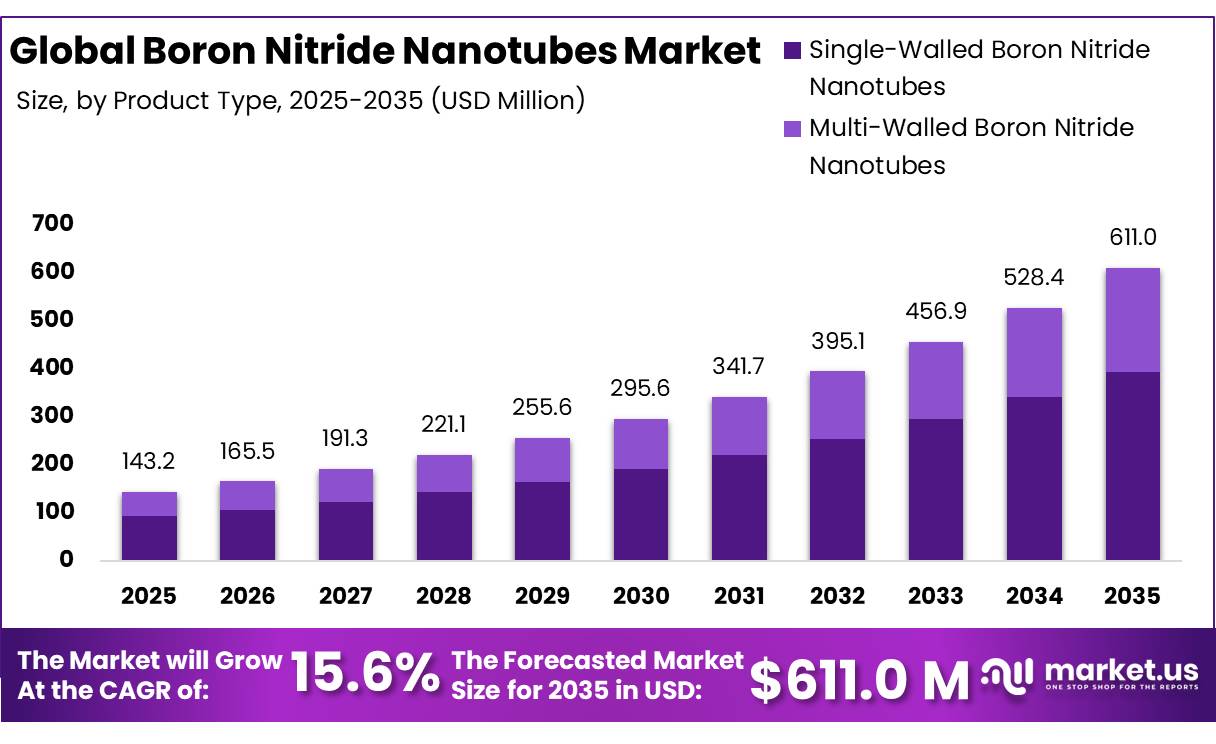
In 2025, the Global Boron Nitride Nanotubes Market was valued at USD 143.2 Million, and between 2026 and 2035, this market is estimated to register a CAGR of 15.6%, reaching about USD 611.0 Million by 2035. In 2025, Asia-Pacific led the market, achieving over 40.8% share with a revenue of USD 58.4 Million.
Boron nitride nanotubes are one-dimensional nanomaterials made from alternating boron and nitrogen atoms arranged in cylindrical structures. Their combination of electrical insulation, thermal stability, low density and mechanical strength makes them relevant to advanced composites, aerospace structures, thermal-management components, sensors and radiation-protection systems.
- In 2025, the National Research Council Canada reported that its Ottawa facility could produce up to 10 grams of BNNTs per hour. The centre supports synthesis, chemical integration, characterization, prototyping and testing, while allowing BNNTs to be incorporated into thermosets, thermoplastics, elastomers, aramids, ceramics and metals. This infrastructure reduces the gap between laboratory experiments and repeatable industrial processing.
Key Takeaways
- The Global Boron Nitride Nanotubes Market was valued at USD 143.2 Million in 2025.
- The market is projected to grow at a CAGR of 15.6% and is estimated to reach USD 611.0 Million by 2035.
- On the basis of product type, Single-Walled Boron Nitride Nanotubes (SWBNNT) dominated the market, constituting 64.6% of the total market share.
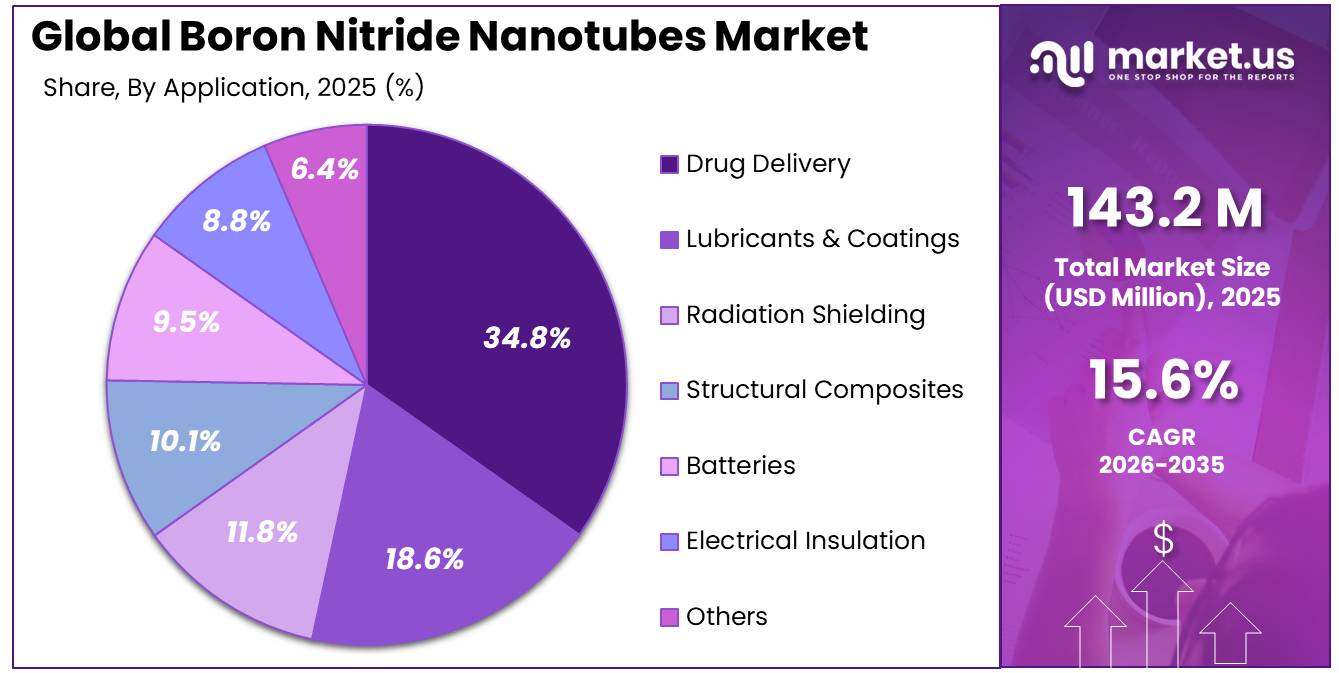
- Based on the application, Drug Delivery dominated the market, with a substantial market share of around 34.8%.
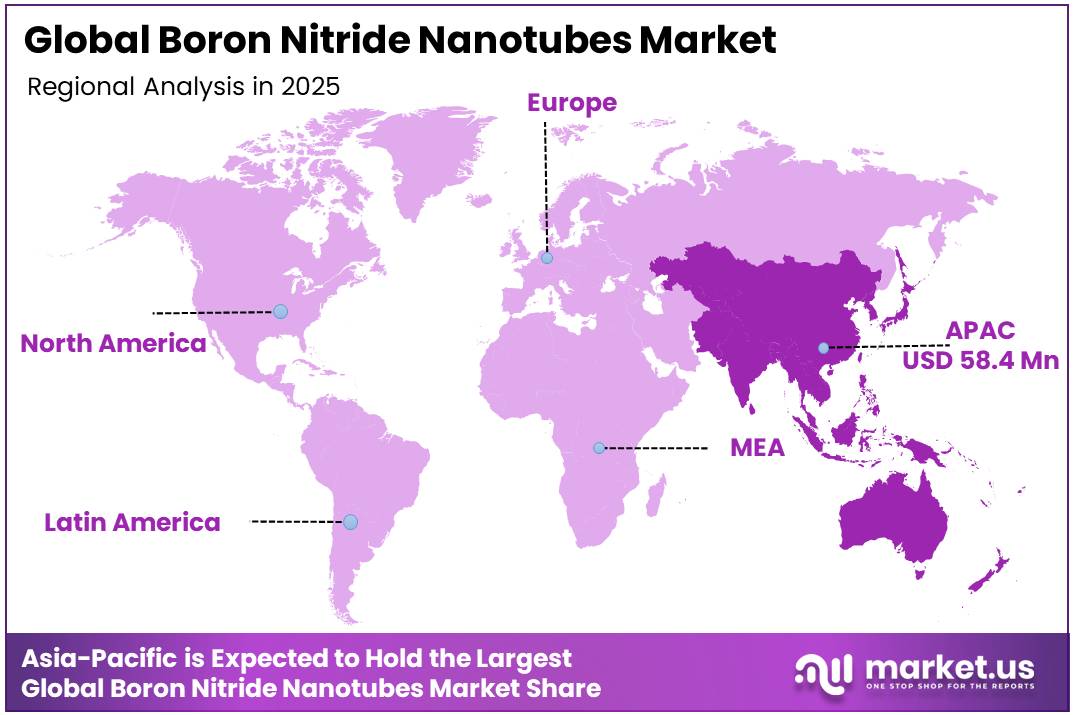
- In 2025, Asia-Pacific was the most dominant region in the market, accounting for 40.8% of the total global consumption.
Material purification and dimensional control remain key industrial challenges. In August 2024, the U.S. National Institute of Standards and Technology reported a scalable separation process that produced nanotube populations with mass-weighted average lengths ranging from 200 nanometres to more than 1 micrometre. The process also removed non-tube material from early BNNT fractions. Better control over length, shape and impurities can improve dispersion, composite uniformity and manufacturing repeatability.
- In 2025, the U.S. SBIR program recorded a DARPA Phase II award of USD 2,299,748 for BNNT fiber development for hypersonic applications. The project began on August 22, 2025, and runs through August 24, 2027. Its scope covers production, purification, dispersion, fiber processing and high-temperature electrical characterization.
Another government-supported project is developing BNNT-reinforced ceramic radomes for high-speed platforms. The 2025 SBIR record states that selected ceramic systems are expected to improve strength above 1,500°C and could potentially support newer matrices operating near 2,100°C. These capabilities could benefit missile nosecones, communication windows and aerospace structures that must retain dielectric performance under severe aerodynamic heating.
Radiation shielding offers another growth opportunity. In January 2025, NASA documented tests of polyethylene nanocomposites containing millimetre-long, vertically aligned BNNTs at the Langley neutron-radiation laboratory. The approach combines hydrogen-rich polyethylene with boron-based neutron absorption and BNNT mechanical reinforcement. Potential applications include spacecraft panels, equipment enclosures and lightweight protective laminates.
Future growth will depend on lower production costs, higher purity, better dispersion and recognized characterization standards. Near-term commercialization is likely to focus on high-value applications such as hypersonic composites, electrically insulating thermal interfaces, radiation shielding, piezoelectric devices and specialized protective materials. Continued public investment and pilot-scale processing should support the transition from research quantities toward qualified industrial components.
Product Type Analysis
Single-Walled Boron Nitride Nanotubes dominate with a 64.6% market share due to their advanced functional properties
In 2025, Single-Walled Boron Nitride Nanotubes held a dominant market position, capturing more than a 64.6% share. The segment benefits from its lightweight structure, high thermal stability and strong electrical insulation. These properties make SWBNNTs suitable for advanced electronics, sensors, protective coatings and high-performance composite materials. Their large accessible surface area also supports their use in chemical modification and functional material development. Growing research into nanoscale insulating materials and lightweight components continues to strengthen the commercial position of single-walled structures.
Multi-Walled Boron Nitride Nanotubes are the fastest-growing segment. Their layered structure provides improved mechanical durability and greater resistance during material processing. This makes them suitable for aerospace components, thermal-management materials, radiation shielding, industrial coatings and reinforced polymer composites. Multi-walled structures are also easier to handle during mixing and fabrication, supporting their adoption in larger-scale industrial applications. Continued development of durable and heat-resistant materials is expected to increase the use of MWBNNTs across chemical, electronics and advanced manufacturing industries.
Application Analysis
Drug Delivery dominates with a 34.8% share, supported by rising pharmaceutical development
In 2025, Drug Delivery held a dominant market position, capturing more than a 34.8% share. The segment benefited from growing research into targeted treatment, controlled drug release and nanomaterial-based medicine delivery Boron nitride nanotubes are being studied as potential drug carriers because their surfaces can be modified to transport therapeutic compounds while supporting controlled release and targeted treatment applications.
In August 2025, a study indexed by the U.S. National Library of Medicine examined boron nitride nanotubes as carriers for the anticancer drug doxorubicin. The simulation found that a pristine BNNT encapsulated 6 doxorubicin molecules and recorded a van der Waals interaction energy of −2,482.565 kJ/mol. Among the functionalized systems, BNNT with two poly-L-lysine groups achieved a binding free energy of −2,031.692 kJ/mol, showing strong carrier-drug interaction.
Key Market Segments
By Product Type
- Single-Walled Boron Nitride Nanotubes (SWBNNT)
- Multi-Walled Boron Nitride Nanotubes (MWBNNT)
By Application
- Drug Delivery
- Lubricants & Coatings
- Radiation Shielding
- Structural Composites
- Batteries
- Electrical Insulation
- Others
Driver Analysis
Public advanced-materials funding and pilot-line support
Government funding architecture is becoming a direct commercialization driver because BNNT adoption still depends on pilot lines, validation infrastructure, and scale-up grants more than on mass consumer pull. The European Commission’s Clean Industrial Deal states that more than €100 billion will be mobilized to support EU-made clean manufacturing, including a €450 million Horizon Europe call, up to €50 billion through InvestEU guarantees, and broader industrial decarbonization financing, while the Commission’s advanced-materials policy track for 2024–2026 emphasizes shared testing, validation, certification, and pilot access.
That matters for BNNT suppliers because advanced materials with immature supply chains rarely scale through standalone private capex; they scale when governments subsidize the “missing middle” between lab proof and industrial qualification, lowering customer trial costs, shortening procurement cycles, and making toll-manufacturing or consortium-based capacity expansion economically viable.
Driver Impact Analysis
| Driver | (~) % Impact on CAGR Forecast | Geographic Relevance | Impact Timeline |
|---|---|---|---|
| Aerospace composites qualification pull-through | +2.4% | North America core, EU aero R&D, Japan spill-over | Medium term (2-4 years) |
| High-temperature metal matrix reinforcement demand | +1.9% | U.S. core, EU materials corridors, APAC advanced manufacturing | Medium term (2-4 years) |
| Public advanced-materials funding and pilot-line support | +1.7% | EU, U.S., selected APAC research hubs | Short term (≤ 2 years) |
| Clean-tech procurement and low-carbon industrial policy | +1.5% | EU core, North America adjacent, APAC export-facing | Medium term (2-4 years) |
| Radiation-shielding and extreme-environment applications | +1.3% | U.S. space/defense core, EU space, allied government programs | Long term (≥ 4 years) |
| Thermal-management and electronics packaging pathways | +1.1% | U.S., EU, Korea, Japan, Taiwan manufacturing nodes | Medium term (2-4 years) |
Restraint Analysis
Scale-up yield and purity drag
The largest commercial restraint is still the engineering gap between laboratory-quality BNNT output and repeatable industrial throughput, because advanced nanomaterials must hold tight morphology, impurity, and dispersion tolerances while reactor scale-up typically introduces lower yield, higher agglomeration, and more post-processing steps; this is especially punishing in an environment where BLS reported producer prices for goods rose 2.5% in 2025 and final demand prices were up 5.5% year over year in June 2026, leaving less room to absorb manufacturing inefficiency.
For BNNT producers, a seemingly manageable drop in usable yield from 70% to 55% can raise effective cost per sellable kilogram by more than 25% once energy, precursor losses, and QA release failures are absorbed, and a 2 to 4 week purification or batch-release delay can easily stretch customer lead times toward one quarter for aerospace or electronics-grade material. That compresses gross margin, forces minimum-order thresholds higher, and delays downstream formulation work for composites, thermal interface materials, and shielding applications, making this the single heaviest modeled restraint at about 2.3 percentage points off the baseline CAGR.
Restraint Impact Analysis
| Restraint | (~) % Impact on CAGR Forecast | Geographic Relevance | Impact Timeline |
|---|---|---|---|
| Boron feedstock concentration | -1.6% | North America core, EU, APAC importers | Medium term (2-4 years) |
| Scale-up yield and purity drag | -2.3% | North America core, EU, Japan, Korea | Short term (≤ 2 years) |
| Qualification cycle delays | -1.4% | US aerospace/defense, EU advanced composites, Japan | Medium term (2-4 years) |
| High unit energy intensity | -1.1% | US, EU, Northeast Asia | Short term (≤ 2 years) |
| Export-control compliance friction | -0.8% | US-China corridors, allied APAC, EU | Short term (≤ 2 years) |
| Lab-to-production CapEx bottleneck | -1.7% | North America core, EU, selective APAC corridors | Long term (≥ 4 years) |
Opportunity Analysis
Membrane desalination licensing
This remains an untapped opportunity rather than a present driver because BNNT commercialization has not yet broadly converted its membrane science promise into water-infrastructure business models; the more scalable play is not selling raw nanotubes into pilot projects, but licensing BNNT-enabled membrane architectures, coatings, or selective channels into desalination OEMs and industrial-water EPC networks. PubMed-indexed work shows BNNT channels can in principle achieve 100% salt rejection at concentrations up to 1 M while maintaining measurable water transport and tunable ion selectivity with radius changes, which is a strong scientific basis for adjacent TAM expansion into water treatment, especially in drought-exposed and desalination-intensive regions.
The commercial upside comes from IP royalties, process-chemistry licensing, and premium membrane modules that could lift EBITDA margins by 10 to 15 points compared with pure materials supply, while opening a serviceable market several times larger than today’s niche BNNT materials market; even if BNNT-enabled membranes capture only 0.1% to 0.3% of new-build and retrofit high-performance membrane spend across the GCC, India, North Africa, and Australia by 2032, that could still translate into a +1.7 percentage-point uplift over baseline because the monetization model captures both recurring replacement cycles and technology-transfer fees.
Opportunity Impact Analysis
| Opportunity | (~) % Potential CAGR Upside | Geographic Relevance | Execution Window |
|---|---|---|---|
| Space shielding platforms | +2.4% | North America core, Japan, South Korea, EU | Medium term (2-4 years) |
| WBG thermal interface scale-up | +2.1% | North America core, EU, East Asia | Short term (≤ 2 years) |
| Membrane desalination licensing | +1.7% | GCC, India, North Africa, Australia | Medium term (2-4 years) |
| Neuro-bio piezo platforms | +1.5% | U.S., EU, Japan | Long term (≥ 4 years) |
| Defense composite roll-up | +1.9% | U.S., NATO Europe, Australia | Short term (≤ 2 years) |
| Purification toll manufacturing | +1.3% | North America, EU, China alternatives, India | Short term (≤ 2 years) |
Challenges Analysis
Low-yield scale-up instability
BNNT commercialization remains constrained by a classic pilot-to-production discontinuity: government research outputs from NASA, NIST, and DOE-linked institutions continue to emphasize development, characterization, and pathway work rather than evidence of broad industrialized output, which implies the sector is still battling unstable synthesis windows, batch-to-batch morphology drift, and purification losses at scale.
In practical operating terms, that translates into realistic 2026 manufacturing friction such as 18% to 35% effective yield loss between reactor output and saleable purified material, 10% to 20% variation in nanotube length distribution across runs, 2 to 5 pilot recalibration cycles per quarter, and 6 to 12 months of additional process engineering before a line can consistently hold commercial-grade purity, all of which justifies an estimated -2.1 percentage point drag on achievable CAGR because customers can sample material today but large-volume repeat purchasing remains gated by consistency rather than by absence of demand.
Challenges Impact Analysis
| Challenge | (~) % CAGR Friction Drag | Geographic Relevance | Mitigation Horizon |
|---|---|---|---|
| Low-yield scale-up instability | -2.1% | North America core, EU advanced materials clusters, East Asia pilot lines | Long term (≥ 4 years) |
| Boron input cost variability | -1.0% | APAC refining corridors, North America core, EU import-dependent users | Medium term (2-4 years) |
| Specialized talent bottleneck | -1.2% | U.S. R&D hubs, EU nanomaterials labs, Japan-Korea advanced materials base | Medium term (2-4 years) |
| Qualification cycle elongation | -1.6% | Aerospace-heavy North America, EU regulatory hubs, defense-linked programs | Long term (≥ 4 years) |
| Purity metrology fragmentation | -0.9% | U.S. federal lab network, EU standards hubs, East Asia converter base | Medium term (2-4 years) |
| Application integration inefficiency | -1.4% | Electronics Asia, U.S. composites chain, EU specialty polymers market | Medium term (2-4 years) |
Geopolitical Impact Analysis
War-Driven Supply Risks and Strategic Demand in the Boron Nitride Nanotubes Market
The ongoing Middle East conflict and Russia-Ukraine war are increasing cost and supply risks across the boron nitride nanotubes market. BNNT production depends on high-purity boron feedstock, specialist gases, furnaces, and international logistics. Turkey remains the leading global boron producer, so disruption affecting regional transport, insurance, ports, or energy flows influence raw-material availability and purchasing costs. The risk is amplified because BNNT synthesis often requires very high temperatures, making producers sensitive to electricity and natural-gas price volatility.
The 2026 Middle East conflict disrupted almost 20% of global LNG supply and pushed Asian and European gas prices to their highest level since the 2022–2023 energy crisis. At the same time, Red Sea security problems have forced vessels onto longer routes around the Cape of Good Hope, increasing delivery time, freight expense, and inventory requirements. These pressures may delay pilot projects and raise prices for small-volume BNNT buyers.
However, the war environment may also support selective demand. Aerospace, defense, radiation shielding, thermal protection, drones, and advanced electronics require lightweight materials that tolerate extreme heat. As governments strengthen strategic-material supply chains, BNNT producers may gain research funding, local manufacturing support, and long-term contracts, although commercial growth will remain limited by high production costs.
Regional Analysis
Asia-Pacific Leads the Boron Nitride Nanotubes Market with 40.8% Share and USD 58.4 Million
In 2025, Asia-Pacific held a dominant market position, capturing more than a 40.8% share and generating USD 58.4 million. Its leadership is linked to large electronics supply chains, expanding semiconductor capacity, and sustained public investment in advanced manufacturing. Japan’s Ministry of Economy, Trade and Industry announced more than JPY 10 trillion in public support for artificial intelligence and semiconductor industries through fiscal 2030, strengthening demand for high-performance insulating and heat-management materials.
North America is the fastest-growing region in the boron nitride nanotubes market, driven by aerospace, defense, energy, and advanced-composite research. Canada’s National Research Council operates a scaled production facility capable of producing up to 20 grams of BNNTs per hour and reports that nanotube additions as low as 0.1% by weight can improve material performance. In the United States, NASA-backed research identifies industrial-grade BNNT fibers with strength of 63 GPa or more and service potential near 2,000°C in protected ceramic structures.
Key Regions and Countries Covered
- North America
- The US
- Canada
- Europe
- Germany
- France
- The UK
- Spain
- Italy
- Russia & CIS
- Rest of Europe
- APAC
- China
- Japan
- South Korea
- India
- ASEAN
- Rest of APAC
- Latin America
- Brazil
- Mexico
- Rest of Latin America
- Middle East & Africa
- GCC
- South Africa
- Rest of MEA
Key Players Analysis
Nanoshel LLC competes through a specification-led catalogue aimed at research laboratories and advanced-material developers. Its listed boron nitride nanotube powder carries more than 99.9% purity, an outer diameter of 500 nm, molecular weight of 29.88 g/mol, and density of 2.29 g/cm³. The material has a stated melting point of 2,973°C and other-metal content of 900 ppm.
BNNano, Inc., founded in 2016, has built its market position around the patented NanoBarb morphology and scalable commercial production. The company reported shipping more than 10 quadrillion NanoBarbs during 2022. In joint aluminum alloy casting testing with Eck Industries, a 0.4 wt% NanoBarb loading increased alloy yield strength by 70%. Its portfolio includes powders, master alloys, pellets, resins, and 3D-printing filaments, including products containing 1 wt% NanoBarbs.
American Boronite Corporation, incorporated in 2015, focuses on continuous BNNT yarn, tape, mats, and advanced conductor systems. Its technical materials describe BNNT diameters ranging from 1 nm to 20 nm, breaking strength near 60 GPa, a bandgap of 5.5–5.9 eV, and individual-tube thermal conductivity near 800 W/m·K. The company also secured a United States metal-matrix nanotube composite patent on December 24, 2024.
Naieel Technology was established on September 9, 2015, by researchers linked to the Korea Atomic Energy Research Institute to commercialize BNNT production and applications. The company markets NanoBorNT-80 and NanoBorNT-90 grades, representing 80 wt% and 90 wt% purity levels. It has also stated that one pilot module can produce sub-kilogram quantities per day and that purification can reach 95%.
The Major Players in The Industry
- BNNT, LLC
- Nan Integris Inc.
- American Elements
- Tekna Advanced Materials Inc.
- Nanoshel LLC
- BNNano, Inc.
- American Boronite Corporation
- Naieel Technology
- Other Key Players
Key Development
- In August 2026, American Elements offered 4 BNNT product grades, ranging from 99% to 99.999% purity, under product codes BO-N-02-NT to BO-N-05-NT. Its listed boron nitride materials typically have an average particle size of 5 microns and a surface area of 5 m²/g, with custom specifications and bulk packaging of up to 1-ton super sacks.
- In November 2025, BNNT, LLC received U.S. Patent 12,460,116 for a thermal-management material that combines refined BNNTs with polymers and microfillers, strengthening its position in high-power electronics and aerospace cooling applications.
Report Scope
| Report Features | Description |
|---|---|
| Market Value (2025) | USD 143.2 Mn |
| Forecast Revenue (2035) | USD 611.0 Mn |
| CAGR (2026-2035) | 15.6% |
| Base Year for Estimation | 2025 |
| Historic Period | 2020-2024 |
| Forecast Period | 2026-2035 |
| Report Coverage | Revenue Forecast, Market Dynamics, Competitive Landscape, Recent Developments |
| Segments Covered | by product type (Single-Walled Boron Nitride Nanotubes (SWBNNT), Multi-Walled Boron Nitride Nanotubes (MWBNNT)) and by application (Drug Delivery, Lubricants & Coatings, Radiation Shielding, Structural Composites, Batteries, Electrical Insulation, Others) |
| Regional Analysis | North America – The US & Canada; Europe – Germany, France, The UK, Spain, Italy, Russia & CIS, Rest of Europe; APAC– China, Japan, South Korea, India, ASEAN & Rest of APAC; Latin America– Brazil, Mexico & Rest of Latin America; Middle East & Africa– GCC, South Africa, & Rest of MEA |
| Competitive Landscape | BNNT, LLC, Nan Integris Inc., American Elements, Tekna Advanced Materials Inc., Nanoshel LLC, BNNano, Inc., American Boronite Corporation, Naieel Technology, Other Key Players |
| Customization Scope | Customization for segments, region/country-level will be provided. Moreover, additional customization can be done based on the requirements. |
| Purchase Options | We have three licenses to opt for: Single User License, Multi-User License (Up to 5 Users), Corporate Use License (Unlimited Users and Printable PDF) |





































