


Report Overview
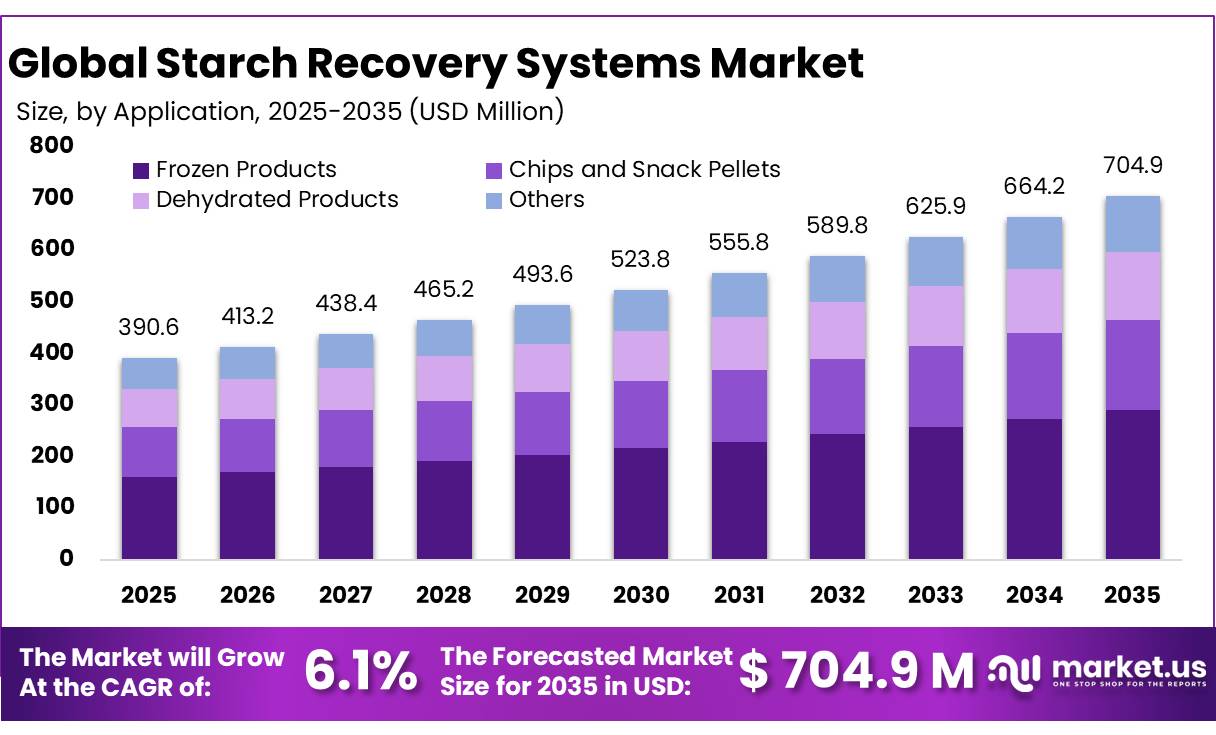
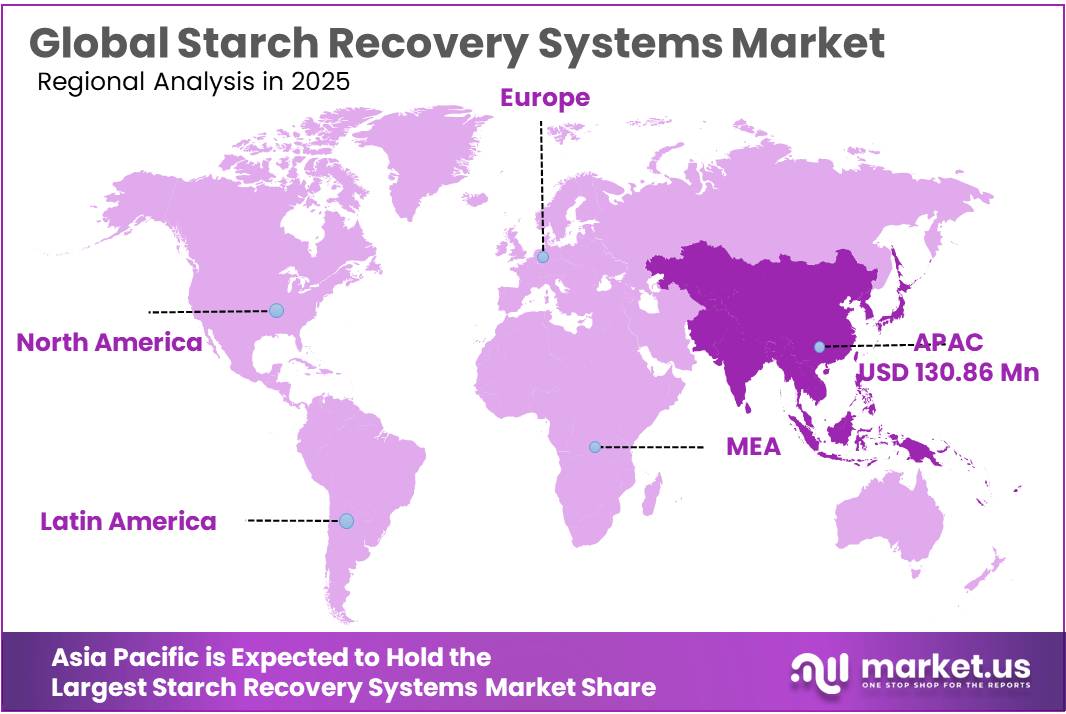
The Global Starch Recovery Systems Market size is expected to be worth around USD 704.9 Million by 2035, from USD 390.6 Million in 2025, growing at a CAGR of 6.1% during the forecast period from 2026 to 2035. In 2025, Asia Pacific held a dominant market position, capturing more than a 33.5% share, holding USD 130.8 Million revenue.
Starch recovery systems are becoming an important part of modern food and starch-processing plants because they separate usable starch from process water instead of sending it to wastewater treatment. These systems commonly combine screening, centrifugation, hydrocyclones, dewatering, and water recirculation.
- Starch Europe reports that the European starch industry operates 70 production facilities across 18 EU member states and processes about 22 million tonnes of agricultural raw materials each year. In 2024, the sector produced around 9.8 million tonnes of starch and starch derivatives, compared with 8.7 million tonnes in 2004. European consumption is around 7.2 million tonnes, with 54% used in food, 2% in feed, and 44% in non-food applications.
Potato processing represents another strong demand base. The Food and Agriculture Organization reported that global potato production reached a record 383 million tonnes in 2023. In the United States, USDA data show that potatoes used for processing reached 274 million cwt in 2024. Frozen French fries and other frozen products consumed 163 million cwt, while chips and shoestring potatoes accounted for 55.8 million.
- An EPA-supported potato-starch study showed that a traditional facility processing 450 metric tonnes of potatoes per day could produce around 4,500 m³ of effluent containing approximately 18,000 kg of dissolved solids per day. Modern recovery equipment can capture starch and other solids before they increase treatment loads.
Technology development is increasingly focused on combining starch recovery with water recycling and energy-efficient separation. GEA reported a potato-starch installation designed to treat as much as 110 tonnes of water per hour through mechanical vapor recompression evaporation.
Future opportunities are also being strengthened by circular-economy and food-waste policies. The European Commission reports that more than 58 million tonnes of food waste are generated annually in the EU, with 19% originating from food and beverage manufacturing, representing an estimated economic loss of around €132 billion.
Key Takeaways
- Starch Recovery Systems Market size is expected to be worth around USD 704.9 Million by 2035, from USD 390.6 Million in 2025, growing at a CAGR of 6.1%.
- Hydrocyclones and Centrifuges held a dominant market position, capturing more than a 34.00% share.
- Large-Scale Plants held a dominant market position, capturing more than a 45.00% share.
- Frozen Products held a dominant market position, capturing more than a 41.2% share.
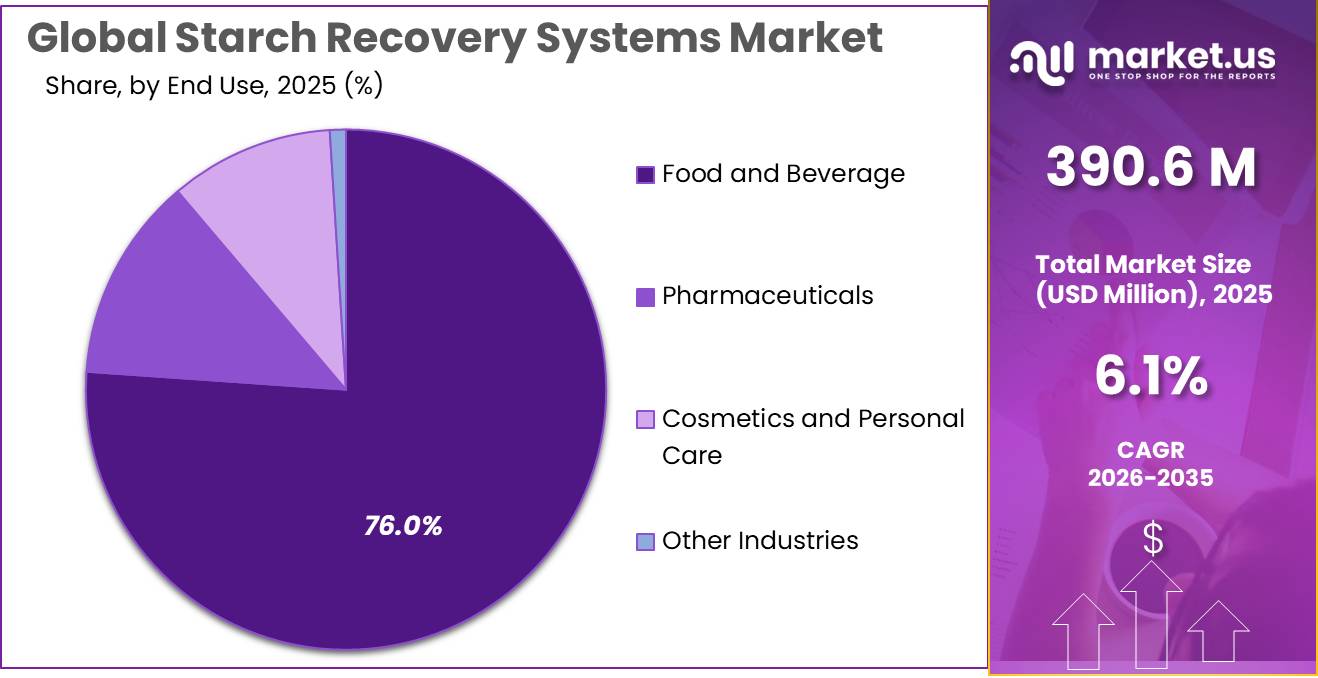
- Food and Beverage held a dominant market position, capturing more than a 76.00% share.
- Asia Pacific held a dominant market position, capturing more than a 33.50% share and reaching 130.86 BN in value.
By Component Analysis
Hydrocyclones and Centrifuges Hold 34.00% Share as High-Efficiency Separation Supports Starch Recovery
In 2025, “Hydrocyclones and Centrifuges” held a dominant market position, capturing more than a 34.00% share. These components remain central to starch recovery because they can separate, concentrate, wash, and dewater starch while removing fibre, protein, and other impurities from process streams. Hydrocyclones are particularly useful for continuous starch washing, while centrifuges support fruit-water separation, fibre dewatering, protein recovery, and final starch concentration.
The large volume of raw material entering food-processing plants supports the need for efficient separation equipment. According to the USDA National Agricultural Statistics Service, U.S. potato production reached 413 million cwt in 2025. USDA – Crop Production 2025 Summary In the 2025/26 season, USDA reported that processors had used 192.18 million cwt of potatoes through May 2026 across the surveyed processing states.
Refining Sieves form an important part of starch recovery systems because they remove fibre and coarse solids before starch enters downstream concentration and washing stages. In potato-starch processing, refining and conical sieve systems help separate starch-rich liquid from pulp while reducing the amount of unwanted fibre reaching separators and hydrocyclones.
By Plant Size Analysis
Large-Scale Plants Hold 45.00% Share as High-Volume Processing Requires Continuous Starch Recovery
In 2025, “Large-Scale Plants” held a dominant market position, capturing more than a 45.00% share. Large processing facilities generally handle continuous flows of potatoes, corn, wheat, and other starch-bearing materials, creating a strong requirement for high-capacity hydrocyclones, centrifuges, refining sieves, and water-recovery equipment. Alfa Laval states that its RH multicyclone systems are primarily designed for large-capacity corn wet-milling plants operating at grind rates above 900 tons per day, showing the processing intensity where automated starch washing and recovery become commercially important.
Government processing statistics also show the scale of raw-material movement supporting large industrial plants. In June 2026, the USDA reported that potato processors across eight surveyed U.S. states had used 192 million cwt during the season, compared with 184 million cwt at the same point in the previous season. The USDA also estimated U.S. potato production at 413 million cwt in 2025.
Medium-Scale Plants represent an important part of the Starch Recovery Systems Market as regional processors increasingly seek flexible equipment that improves product recovery without requiring the infrastructure of very large processing complexes. These plants commonly use modular hydrocyclones, compact centrifuges, sieves, and clarification systems to recover starch from processing water and improve raw-material utilization.
By Application Analysis
Frozen Products Lead with 41.2% Share as High-Volume Potato Processing Increases Starch Recovery Needs
In 2025, Frozen Products held a dominant market position, capturing more than a 41.2% share. Frozen potato processing produces starch-rich water during cutting, blanching, washing, and preparation, making starch recovery systems important for improving raw-material utilization and reducing solids entering wastewater streams. Large frozen-food plants commonly use hydrocyclones, centrifuges, and screening equipment to separate recoverable starch before water is reused or treated. In March 2026, USDA reported that U.S. frozen French fries held in cold storage reached 1.06 billion pounds, while total frozen potato inventories reached approximately 1.30 billion pounds.
- USDA data also show that potato-processing activity remained substantial during the 2025/26 season. By June 2026, processors across eight surveyed U.S. states had used about 192 million cwt of potatoes. June 2026 This large processing base favors starch recovery equipment because frozen-product manufacturers can recover solids that would otherwise be lost with wash water.
Chips and Snack Pellets represent an important application area for starch recovery systems, particularly in potato-chip and formed-snack facilities where raw materials pass through repeated washing, slicing, rinsing, and preparation stages. Free starch released from cut potato surfaces enters processing water and can increase solids loading if it is not removed. Recovery systems allow processors to separate this material before downstream wastewater treatment while maintaining cleaner process-water circuits and improving raw-material efficiency.
By End Use Analysis
Food and Beverage Leads with 76.00% Share as High-Volume Processing Creates Strong Starch Recovery Demand
In 2025, Food and Beverage held a dominant market position, capturing more than a 76.00% share. The segment remained the main user of starch recovery systems because potato, corn, wheat, snack, frozen-food, and other food-processing plants generate starch-rich process water during washing, cutting, grinding, separation, and product preparation. In 2025, U.S. potato production reached approximately 412.86 million cwt, providing a substantial raw-material base for food-processing facilities that can benefit from starch recovery.
Food and Beverage processing also generates sustained equipment demand because of the large quantity of potatoes entering industrial processing lines. According to the USDA National Agricultural Statistics Service, processors across eight surveyed U.S. states used approximately 192 million cwt of potatoes during the 2025/26 season through June 2026. This scale of processing increases the importance of separating free starch from wash water before discharge or reuse.
Government statistics for 2026 further show the strength of starch-intensive food processing. USDA Economic Research Service data reported 1.06 billion pounds of frozen French fries in U.S. cold storage at the end of March 2026. When other frozen potato products were included, inventories reached approximately 1.3 billion pounds. These large production and inventory volumes indicate substantial potato-processing activity, where starch is released during peeling, cutting, rinsing, and blanching operations.
Key Market Segments
By Component
- Refining Sieves
- Hydrocyclones and Centrifuges
- Vacuum Filters
- Screw Conveyors
- Filling Stations
- Others
By Plant Size
- Large-Scale Plants
- Medium-Scale Plants
- Small-Scale Plants
By Application
- Frozen Products
- Chips and Snack Pellets
- Dehydrated Products
- Others
By End Use
- Food and Beverage
- Pharmaceuticals
- Cosmetics and Personal Care
- Other Industries
Driver Analysis
Water-Discharge Compliance
EU food, drink, and milk BAT conclusions cover 37 individual requirements, including 8 on energy efficiency, 3 on resource efficiency, 2 on water consumption and wastewater discharge, and 2 on emissions to water; starch production is explicitly within the covered industry scope, making separation, water optimization, and effluent-quality control embedded in operating-permit economics rather than discretionary sustainability expenditure.
A recovery train combining primary screening, hydrocyclones, decanter centrifuges, dissolved-air flotation, membrane concentration, and automated solids monitoring can lower the organic load that enters biological treatment while producing a secondary starch stream for feed, fermentation, adhesives, paper, or lower-grade industrial applications; for a 100-tonne-per-day wet-starch facility, recovering even 0.5–1.5 tonnes of dry-solids-equivalent per day converts a disposal burden into roughly 150–450 tonnes annually of saleable or internally reusable material.
This shifts the commercial model from capital-equipment selling toward compliance-guaranteed projects that can justify fixed fees, performance bonuses, and multi-year maintenance contracts, supporting an estimated +1.8 percentage-point CAGR contribution through 2028 as operators seek lower discharge-risk exposure and improved permit defensibility.
Drivers Impact Analysis
| Driver | (~) % Impact on CAGR Forecast | Geographic Relevance | Impact Timeline |
|---|---|---|---|
| Water-Discharge Compliance | +1.8 pp | EU; North America; China | Short term (≤2 years) |
| Starch Yield Monetization | +1.5 pp | APAC; Latin America; Europe | Medium term (2–4 years) |
| Circular Byproduct Valorization | +1.2 pp | EU; North America; APAC | Medium term (2–4 years) |
| Water-Reuse Economics | +1.1 pp | Water-stressed APAC; MENA; Latin America | Short term (≤2 years) |
| Biogas-Integrated Recovery | +0.9 pp | Europe; India; Southeast Asia | Medium term (2–4 years) |
| Digital Process Optimization | +0.7 pp | North America; EU; China | Medium term (2–4 years) |
Restraint Analysis
High Upfront CapEx
Starch recovery systems impose a high initial capital threshold because commercially viable installations require more than a hydrocyclone or decanter: a typical industrial train may include coarse screening, equalization, pumps, hydrocyclones, high-speed centrifuges, dissolved-air flotation, polymer dosing, sludge dewatering, tanks, CIP connections, PLC/SCADA controls, and sometimes membrane polishing or anaerobic-digestion interfaces, creating a project that can consume 5–15% of a small-to-medium processor’s annual capital budget before civil works and commissioning.
The economics are most difficult in cassava, potato, maize, and tapioca facilities where recovered starch is a secondary-grade output with variable pricing, while electricity, polymer, water, maintenance, and operator costs are incurred immediately; a 100–250 cubic-metre-per-day system can plausibly require $0.3–$1.2 million of installed capital, and a 500–1,000 cubic-metre-per-day integrated recovery-and-reuse project can reach $1.5–$4.0 million depending on solids loading, automation, corrosion protection, and wastewater discharge standards. Starch-rich wastewater can contain COD near 12,000 mg/L, requiring robust pretreatment rather than low-cost settling alone, and integrated treatment therefore raises both equipment count and energy consumption.
The commercial consequence is delayed CapEx approval, preference for lower-cost end-of-pipe treatment, and selection of smaller systems that recover less value; this suppresses average selling price and aftermarket potential, particularly in emerging processing clusters. The resulting -1.7 percentage-point CAGR deduction is most material in APAC, Latin America, and Africa, where project finance, stable offtake contracts, and waste-disposal pricing are less developed; suppliers must counter with modular skids, shared-savings contracts, leasing, local fabrication, performance guarantees, and phased installations that recover solids first and add water reuse only after verified payback.
Restraint Impact Analysis
| Restraint | (~) % Impact on CAGR Forecast | Geographic Relevance | Impact Timeline |
|---|---|---|---|
| High Upfront CapEx | -1.7 pp | APAC; Latin America; Africa | Medium term (2–4 years) |
| Low-Grade Starch Value | -1.4 pp | Global; commodity processors | Short term (≤2 years) |
| Membrane Fouling Burden | -1.1 pp | Europe; North America; APAC | Medium term (2–4 years) |
| Food-Grade Traceability Limits | -0.9 pp | EU; North America; Japan | Medium term (2–4 years) |
| Feedstock Throughput Volatility | -0.8 pp | APAC; North America; Europe | Medium term (2–4 years) |
| Water-Reuse Validation Cost | -0.7 pp | EU; MENA; water-stressed APAC | Short term (≤2 years) |
Opportunity Analysis
Recovery-as-a-Service
Recovery-as-a-Service is a white-space monetization model because starch-recovery suppliers predominantly sell centrifuges, hydrocyclones, membranes, and turnkey systems as one-time capital equipment, leaving smaller cassava, potato, maize, rice, and tapioca processors unable to fund installations even when loss-reduction economics are positive; the strategic pivot is to retain equipment ownership and charge a fixed monthly fee plus a share of verified recovered solids, avoided wastewater-treatment cost, or reduced fresh-water use.
This is distinct from the present driver of wastewater compliance because it changes the buyer’s financing and risk allocation: for an illustrative 250 m3/day plant, a $450,000–$750,000 skid could be deployed under a 5–7-year contract at $9,000–$15,000 monthly availability fees plus 10–20% of documented starch-value gains, allowing the supplier to generate $0.54–$0.90 million of contracted base revenue before performance fees while the processor avoids upfront capital expenditure.
The approach is commercially credible because public policy increasingly encourages manufacturing-side loss reduction and byproduct upcycling: the U.S. federal food-loss strategy specifically identifies recovery of processing byproducts for food or feed where feasible, and the EU’s 2025 Waste Framework Directive amendment requires a 10% reduction in food waste from processing and manufacturing by 2030.
Scaled financing pools, local service partners, remote monitoring, and standardized consumables can reduce customer-acquisition cost by 20–35% versus individually engineered projects, while enabling recurring revenue, spare-parts pull-through, and operating-data ownership; if service contracts penetrate only 10–15% of sub-$2 million recovery projects in emerging markets, this model could add approximately +1.7 percentage points above baseline CAGR during 2026–2028.
Opportunity Impact Analysis
| Opportunity | (~) % Potential CAGR Upside | Geographic Relevance | Execution Window |
|---|---|---|---|
| Recovery-as-a-Service | +1.7 pp | APAC; Latin America; Africa | Short term (≤2 years) |
| Food-Grade Closed Loops | +1.5 pp | EU; North America; Japan | Medium term (2–4 years) |
| Biorefinery Co-Product Hubs | +1.3 pp | Europe; India; Southeast Asia | Medium term (2–4 years) |
| Water-Reuse Package Sales | +1.1 pp | MENA; APAC; U.S. West | Short term (≤2 years) |
| Modular SME Processing | +0.9 pp | India; ASEAN; Africa | Medium term (2–4 years) |
| Biopolymer Conversion Partnerships | +0.8 pp | EU; North America; China | Long term (≥4 years) |
Challenges Analysis
Seasonal Influent Variability
Starch recovery systems must operate across highly unstable influent conditions because raw-material variety, harvest season, wash-water ratios, shift changes, storage duration, and upstream milling efficiency can alter pH, solids concentration, COD, particle size, protein loading, and viscosity faster than a fixed-speed separator or membrane control loop can respond.
Corn-starch wastewater can vary from roughly 5,000–15,000 mg/L COD, cassava/tapioca from 8,000–25,000 mg/L, wheat from 6,000–18,000 mg/L, and sweet-potato processing from 5,000–12,000 mg/L; cassava plants typically operate only 60–120-day campaigns, while a line changeover can reportedly change influent COD by a factor of three within one hour.
This does not halt recovery-system sales, but it lowers realized solids capture, destabilizes polymer dosing and centrifuge cut-points, overloads equalization tanks, increases off-spec recovered starch, and can force operators to bypass advanced recovery stages during peak loading; an illustrative 20% flow increase combined with a 50% rise in solids can reduce usable recovery yield by 3–8 percentage points if the installed unit lacks turndown capacity and automated feed-forward control.
The modeled -1.1 percentage-point CAGR friction reflects extended commissioning, customer reluctance to purchase fixed-capacity equipment, and higher warranty exposure; suppliers need variable-frequency pumps, oversized equalization, online density/turbidity/COD proxies, digital recipes by crop and season, and modular separation stages that maintain stable residence time from 40% to 120% of nominal load.
Challenges Impact Analysis
| Challenge | (~) % CAGR Friction Drag | Geographic Relevance | Mitigation Horizon |
|---|---|---|---|
| Seasonal Influent Variability | -1.1 pp | APAC; Europe; Latin America | Medium term (2–4 years) |
| Fouling and CIP Intensity | -1.0 pp | Global; membrane-intensive plants | Medium term (2–4 years) |
| Skilled Operator Shortage | -0.9 pp | North America; EU; APAC | Long term (≥4 years) |
| Sanitary Data Integration | -0.7 pp | EU; North America; Japan | Medium term (2–4 years) |
| Equipment Logistics Volatility | -0.6 pp | EU–APAC trade routes; Africa | Short term (≤2 years) |
| Byproduct Offtake Instability | -0.5 pp | Global; commodity processing hubs | Medium term (2–4 years) |
Geopolitical Impact Analysis
Russia–Ukraine War and Middle East Disruptions Raise Starch Recovery System Costs
The continuing Russia–Ukraine war is affecting the Starch Recovery Systems market through grain supply uncertainty, energy pressure, freight disruption, and higher operating risk for food-processing plants. Starch recovery equipment is closely linked with potato, corn, and wheat processing, so unstable agricultural trade can influence plant utilization and equipment investment decisions.
USDA reported in February 2026 that Ukraine’s average grain exports during the first half of the 2025/26 marketing year were 30% slower than a year earlier, while Russian attacks continued to affect ports, rail networks, and energy infrastructure. This can tighten raw-material movement for starch processors and increase logistics planning needs.
Middle East conflict has added another layer of pressure. European Commission-linked analysis reported that, before the 2026 disruption, the Strait of Hormuz carried 13% of global seaborne chemicals trade, while the World Bank fertilizer price index rose more than 12% in the first quarter of 2026. Higher fuel, fertilizer, insurance, and shipping costs can raise crop and processing expenses.
Regional Insights
Asia Pacific Leads with 33.50% Share and 130.86 BN Value, Supported by Large Starch-Crop Processing Volumes
In 2025, Asia Pacific held a dominant market position, capturing more than a 33.50% share and reaching 130.86 BN in value. The region benefits from a large corn, potato, wheat, and processed-food manufacturing base, creating steady demand for hydrocyclones, centrifuges, refining sieves, and water-recovery systems.
China remains particularly important to this industrial base. USDA Foreign Agricultural Service data show that China produced approximately 301.24 million metric tons of corn in 2025/26, representing 22.6% of global corn production. Large starch-bearing crop volumes support continuous processing and encourage manufacturers to improve starch yield, process-water recycling, and by-product recovery.
Regional demand is also supported by significant grain movements across East and Southeast Asia. USDA estimated East Asian corn imports at 39.58 million metric tons in 2025/26, while Southeast Asian imports reached approximately 22.66 million metric tons. In addition, USDA reported a 136,000-metric-ton corn sale to South Korea for delivery during 2025/26 in April 2026. Such raw-material flows strengthen the operating environment for industrial starch processors seeking automated recovery, higher extraction efficiency, and lower wastewater loading.
North America is developing as a fast-growing regional opportunity, supported by highly automated food plants and substantial corn and potato processing. USDA reported U.S. corn production of 432.34 million metric tons in 2025/26, equal to 32.5% of global production. Potato processors across eight U.S. states also used 192 million cwt during the 2025/26 season through June 2026, an increase of 4% from the previous year.
Key Regions and Countries Insights
- North America
- US
- Canada
- Europe
- Germany
- France
- The UK
- Spain
- Italy
- Rest of Europe
- Asia Pacific
- China
- Japan
- South Korea
- India
- Australia
- Rest of APAC
- Latin America
- Brazil
- Mexico
- Rest of Latin America
- Middle East & Africa
- GCC
- South Africa
- Rest of MEA
Key Players Analysis
ANDRITZ AG maintains a strong position in starch recovery through centrifuges, filtration, screening, dewatering, and drying systems. The company has completed more than 400 starch installations worldwide, covering corn, wheat, potato, tapioca, rice, and pea processing. Its horizontal peeler centrifuges can handle capacities of up to 300 tons per day. In 2025, ANDRITZ generated revenue of €7.88 billion, recorded orders worth €8.91 billion, and employed 30,346 people across more than 80 countries, supporting a broad global service network.
GEA Group Aktiengesellschaft supports starch processors with decanters, nozzle separators, hydrocyclones, washing systems, and water-efficient separation technologies. Its wheat-starch hybrid washing process requires around 2.5–2.7 m³ of fresh water per ton of wheat flour and can achieve final starch protein content below 0.3% on a dry-solids basis. In 2025, GEA reported revenue of €5.50 billion, order intake of €5.92 billion, and 18,628 employees. Its order backlog reached €3.34 billion, supporting continued technology investment.
Alfa Laval AB serves starch recovery plants through hydrocyclones, multicyclones, decanter centrifuges, separators, screens, and dewatering systems. Its corn wet-milling process has been installed in more than 170 plants worldwide, while over 1,800 Merco separators have been installed since the 1970s. These systems support starch-gluten separation, clarification, washing, and recovery from process effluent. In 2025, Alfa Laval recorded sales of SEK 69.6 billion, employed more than 23,670 people, and served customers across approximately 100 countries, strengthening its global starch-processing presence.
Top Key Players Outlook
- ANDRITZ AG
- GEA Group Aktiengesellschaft
- Alfa Laval AB
- Flottweg SE
- Bühler Holding AG
- SiccaDania A/S
- Myande Group Co., Ltd.
- HAUS Centrifuge Technologies
- Hiller Separation & Process GmbH
- Rosenqvists Food Technologies AB
- NivobaHovex B.V.
- Larsson Starch Technology AB
- Flo-Mech Ltd.
- Stamex Technology
- Kiron Food Processing Technologies LLP
Recent Developments
- In March 2026, Flottweg SE started construction of a 3,100 m² logistics facility scheduled for commissioning in Q4 2026. These investments are supported by strong company performance: Flottweg generated €312 million revenue in 2025, up 9.67%, with exports above 80% and 1,260 employees worldwide.
- In June 2026, HAUS detailed a major €35 million expansion of its Aydın headquarters, covering 100,000 m², including an 8,000 m² Science and Innovation Center, 1,600 m² testing and prototype area, and 1,800 m² training center.
Report Scope
| Report Features | Description |
|---|---|
| Market Value (2025) | USD 390.6 Mn |
| Forecast Revenue (2035) | USD 704.9 Mn |
| CAGR (2026-2035) | 6.1% |
| Base Year for Estimation | 2025 |
| Historic Period | 2020-2024 |
| Forecast Period | 2026-2035 |
| Report Coverage | Revenue Forecast, Market Dynamics, Competitive Landscape, Recent Developments |
| Segments Covered | By Component (Refining Sieves, Hydrocyclones and Centrifuges, Vacuum Filters, Screw Conveyors, Filling Stations, Others), By Plant Size (Large-Scale Plants, Medium-Scale Plants, Small-Scale Plants), By Application (Frozen Products, Chips and Snack Pellets, Dehydrated Products, Others), By End Use (Food and Beverage, Pharmaceuticals, Cosmetics and Personal Care, Other Industries) |
| Regional Analysis | North America – US, Canada; Europe – Germany, France, The UK, Spain, Italy, Rest of Europe; Asia Pacific – China, Japan, South Korea, India, Australia, Singapore, Rest of APAC; Latin America – Brazil, Mexico, Rest of Latin America; Middle East & Africa – GCC, South Africa, Rest of MEA |
| Competitive Landscape | ANDRITZ AG, GEA Group Aktiengesellschaft, Alfa Laval AB, Flottweg SE, Bühler Holding AG, SiccaDania A/S, Myande Group Co., Ltd., HAUS Centrifuge Technologies, Hiller Separation & Process GmbH, Rosenqvists Food Technologies AB, NivobaHovex B.V., Larsson Starch Technology AB, Flo-Mech Ltd., Stamex Technology, Kiron Food Processing Technologies LLP |
| Customization Scope | Customization for segments, region/country-level will be provided. Moreover, additional customization can be done based on the requirements. |
| Purchase Options | We have three licenses to opt for: Single User License, Multi-User License (Up to 5 Users), Corporate Use License (Unlimited User and Printable PDF) |





































