


Report Overview
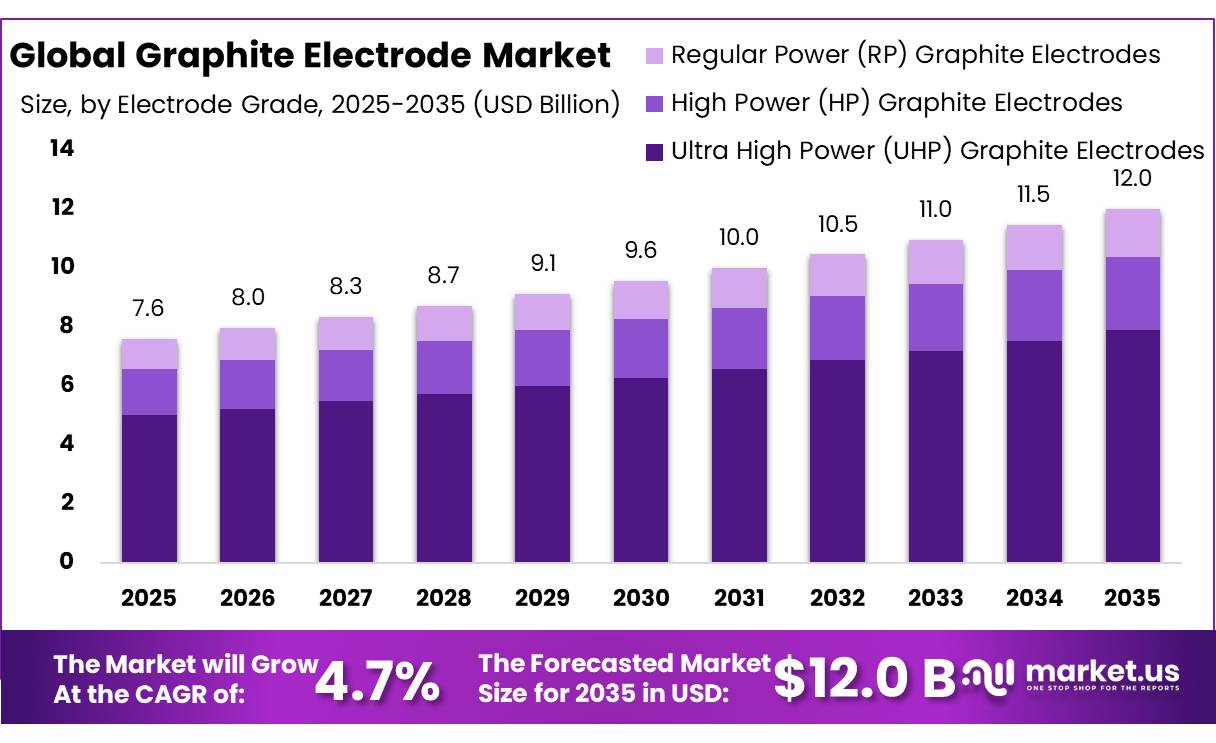
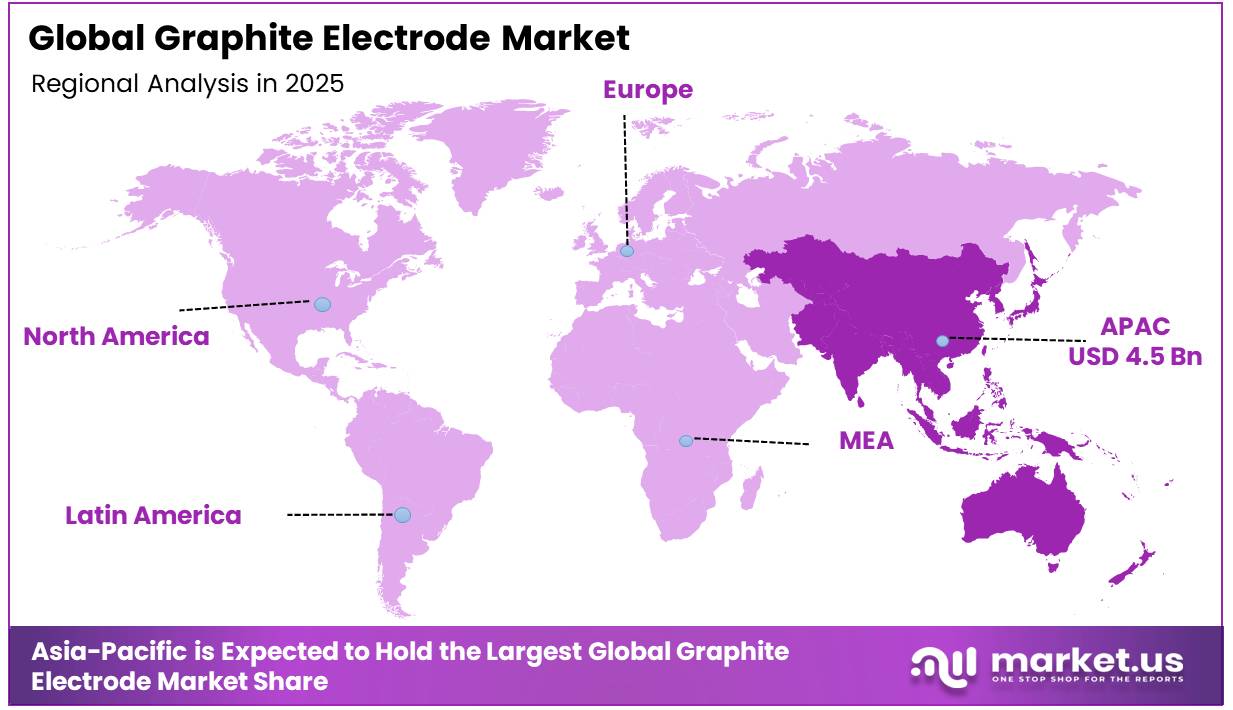
In 2025, the Global Graphite Electrode Market was valued at USD 7.6 billion, and between 2026 and 2035, this market is estimated to register a CAGR of 4.7%, reaching about USD 12.0 billion by 2035. In 2025, Asia Pacific held a dominant market position, capturing more than a 59.8% share, holding USD 4.5 Billion revenue.
The global graphite electrode market is closely linked to electric arc furnace (EAF) steelmaking, where electrodes serve as the primary conductive medium to melt scrap steel and maintain high-temperature operations. Ultra high power (UHP) electrodes dominate in large-capacity furnaces, while high power (HP) and regular power (RP) grades serve medium and smaller-scale operations.
- According to World Steel Association data, global crude steel production reached 1.89 billion metric tons in 2023, while electric arc furnaces accounted for approximately 28.6% of total steel output worldwide.
Asia Pacific represents the largest regional market, driven by China, India, and Japan, where growing steel production, increasing EAF penetration, and industrial decarbonization initiatives are boosting electrode consumption. Supply-side dynamics are shaped by the concentrated production of needle coke, the critical raw material, which is vulnerable to geopolitical tensions, export restrictions, and refinery disruptions.
- According to the World Steel Association, the global crude steel production was 1.4 billion tons in 2024.
Technological trends emphasize high-performance, low-consumption electrodes to improve furnace efficiency and reduce operational costs, while green steel initiatives and scrap-based production create sustained opportunities. Market activity is governed by a combination of steel production patterns, raw material availability, and advancements in electrode design and operational efficiency.
Key Takeaways
- The global graphite electrode market was valued at USD 7.6 billion in 2025.
- The global market is projected to grow at a CAGR of 4.7% and is estimated to reach USD 12.0 billion by 2035.
- On the basis of electrode grade, ultra-high power (UHP) graphite electrodes dominated the market, constituting 65.7% of the total market share.
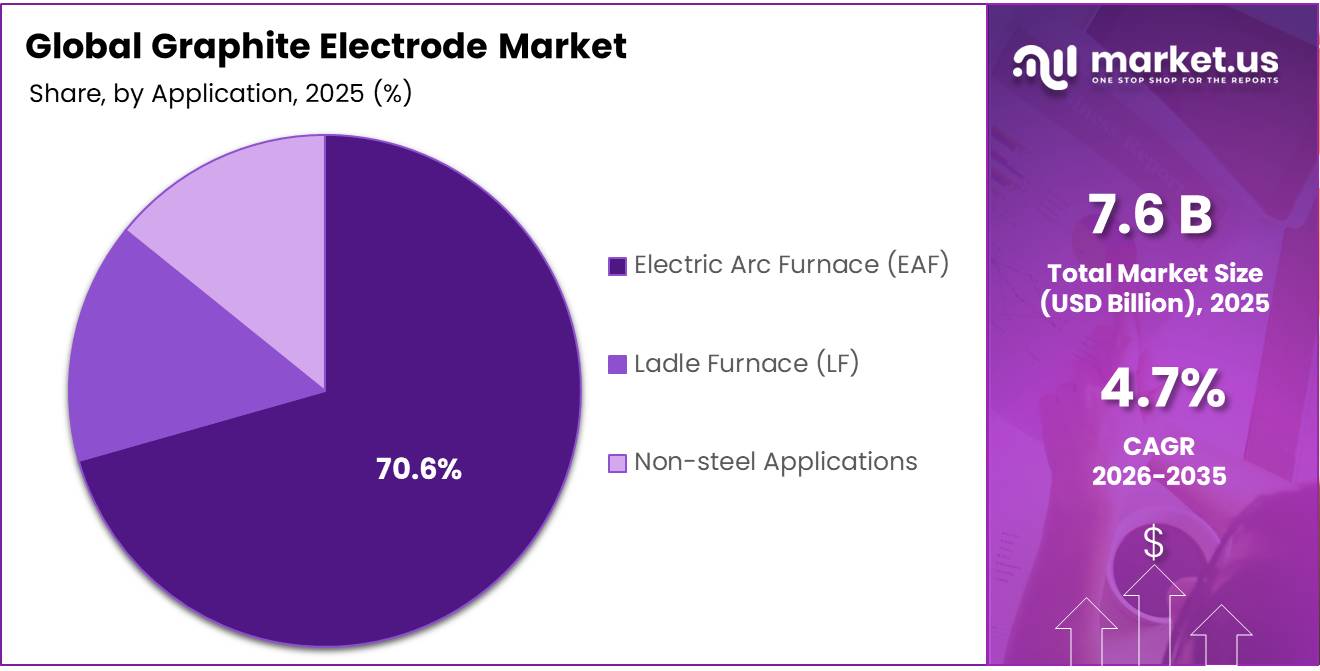
- Among the applications, the electric arc furnace (EAF) held a major share in the graphite electrode market, 70.6% of the market share.
- In 2025, the Asia Pacific was the most dominant region in the graphite electrode market, accounting for 59.8% of the total global consumption.
Graphite Electrode Analysis
Ultra High Power (UHP) Graphite Electrodes Dominated the Market.
Ultra High Power (UHP) graphite electrodes represent the dominant segment, accounting for 65.7% of overall market consumption. These electrodes are engineered to withstand extremely high current densities, typically exceeding 25 A/cm², making them essential for large-capacity electric arc furnaces (EAFs) and secondary steelmaking operations. Their high thermal conductivity, low electrical resistivity, and superior oxidation resistance enable stable melting cycles, reduced electrode consumption, and minimized downtime, which are critical for modern high-efficiency steel plants.
The segment’s dominance is reinforced by the global trend toward scrap-based steel production and industrial decarbonization initiatives, which increasingly favor UHP electrodes for energy-efficient, low-emission operations. Continuous technological advancements, including improved electrode density and enhanced nipple designs, further strengthen their performance advantage over high power (HP) and regular power (RP) alternatives.
Application Analysis
Electric Arc Furnace (EAF) Held Major Share of the Graphite Electrode Market.
The Electric Arc Furnace (EAF) segment dominates the graphite electrode market, accounting for 70.6% of total consumption. EAF steelmaking relies extensively on graphite electrodes to conduct high electrical currents required to melt scrap steel and maintain precise temperature control during the steelmaking process. The segment’s prominence is driven by the global shift toward scrap-based and low-emission steel production, as EAFs offer greater operational flexibility and lower carbon intensity compared to conventional blast furnaces.
High-capacity UHP electrodes are extensively used in EAF operations to enhance energy efficiency, reduce electrode consumption, and minimize downtime. Regional developments, particularly in the Asia Pacific, where EAF adoption is expanding in China, India, and Japan, further reinforce this segment’s dominance. The integration of modern furnace technologies and decarbonization initiatives continues to sustain robust demand for EAF-grade graphite electrodes.
Key Market Segments
By Electrode Grade
- Ultra High Power (UHP) Graphite Electrodes
- High Power (HP) Graphite Electrodes
- Regular Power (RP) Graphite Electrodes
By Application
- Electric Arc Furnace (EAF)
- Ladle Furnace (LF)
- Non-steel Applications
Driver Analysis
EAF Steel Route Expansion
Electric arc furnace expansion is the principal demand engine for graphite electrodes because each tonne of EAF steel requires the furnace’s graphite-electrode column to transfer electrical energy into molten scrap or DRI, creating a direct consumables linkage between installed EAF capacity, furnace utilization, heat size, tap-to-tap time, and electrode consumption.
Global crude steel production totaled 1,849.4 million tonnes in 2025, and EAFs represented 30.3% of global output, up 1.2 percentage points from 2024; a one-percentage-point further increase in EAF share against a roughly 1.85-billion-tonne steel base represents around 18.5 million tonnes of steel shifted toward the electrode-intensive route.
Typical EAF electricity consumption is approximately 440 kWh per tonne of liquid steel, and electrode consumption generally sits within a 1.5–2.5 kg-per-tonne range for efficient UHP operations, implying that every additional 1 million tonnes of EAF steel can create approximately 1,500–2,500 tonnes of graphite-electrode demand before considering furnace practice, scrap quality, power input, and oxygen injection.
The commercial shift is material: integrated steelmakers are reallocating capital away from blast-furnace/BOF routes toward scrap-EAF and DRI-EAF systems, converting electrode suppliers from cyclical maintenance vendors into strategic consumables partners that must assure UHP grades, 600–750 mm diameters, machining precision, joint-pin reliability, and multi-year availability; the modeled +2.7 percentage-point CAGR contribution is strongest in the United States, Europe, India, MENA, and selected Asian steel markets where EAF/DRI projects are being commissioned or approved.
Drivers Impact Analysis
| Driver(~) | % Impact on CAGR | Geographic Relevance | Impact Timeline |
|---|---|---|---|
| EAF steel route expansion | +2.7% | North America, EU, India, MENA | Medium term (2-4 years) |
| CBAM-led low-carbon steel | +1.9% | EU core, Turkey, India, MENA | Short to medium term |
| Scrap availability and circularity | +1.6% | North America, EU, China, Japan | Medium term (2-4 years) |
| UHP furnace productivity upgrades | +1.5% | China, India, U.S., EU | Short term (≤ 2 years) |
| Infrastructure steel intensity | +1.3% | India, ASEAN, MENA, Latin America | Medium to long term |
| Regional electrode supply localization | +1.1% | India, MENA, North America, EU | Medium term (2-4 years) |
Restraint Analysis
Weak Steel Demand
Graphite-electrode demand is immediately restrained by weak steel consumption because approximately 70% of global crude steel is still produced through blast-furnace/basic-oxygen-furnace routes, while EAF output accounts for only around 30% of worldwide steelmaking; consequently, even a favorable long-term EAF conversion story cannot fully offset a short-cycle reduction in total steel orders, melt-shop operating hours, and electrode replacement rates. World crude steel production declined to 1,849.4 million tonnes in 2025, and worldsteel’s April 2026 outlook projected only 0.3% growth in global steel demand to 1,724 million tonnes during 2026, after demand conditions were weakened by construction softness, manufacturing uncertainty, geopolitical instability, and lower Chinese consumption.
For an EAF operator consuming roughly 1.5–2.5 kg of graphite electrode per tonne of liquid steel, a 10% cut in mill utilization at a 1-million-tonne annual facility can defer about 150–250 tonnes of electrode purchasing, while inventory destocking typically magnifies the effect because mills first consume 30–90 days of on-site stock before returning to the market. This directly reduces electrode producers’ volume visibility, increases competition for limited tenders, shifts purchases toward smaller order lots, and weakens premium UHP grade realization, producing an estimated -2.3 percentage-point drag on baseline CAGR across China, Europe, and North America through at least 2027.
Restraint Impact Analysis
| Restraint(~) | % Impact on CAGR Forecast | Geographic Relevance | Impact Timeline |
|---|---|---|---|
| Weak steel demand | -2.3% | China core, EU, North America | Short term (≤ 2 years) |
| Global steel overcapacity | -1.9% | China, EU, Turkey, Asia | Medium term (2-4 years) |
| Needle-coke cost volatility | -1.6% | Global UHP supply chain | Short term (≤ 2 years) |
| Trade-duty fragmentation | -1.4% | U.S., EU, Japan, India | Medium term (2-4 years) |
| High EAF power costs | -1.3% | EU, Japan, Korea, India | Short term (≤ 2 years) |
| China construction downturn | -1.2% | China core, Asia spill-over | Medium term (2-4 years) |
Opportunity Analysis
Green-Steel Qualified Electrodes
The most immediate white-space opportunity is to convert graphite electrodes from a high-carbon industrial consumable into a documented component of low-carbon steel procurement, because steelmakers increasingly require product-level emissions evidence while most electrode suppliers still compete mainly on diameter, UHP grade, breakage resistance, and delivered price.
India’s Green Steel Taxonomy, notified in December 2024, classifies qualifying finished steel below 2.2 tCO2e per tonne, with five-star steel below 1.6 tCO2e per tonne; scrap-EAF routes using renewable electricity can operate around 0.8–1.2 tCO2 per tonne, giving EAF mills and their consumable suppliers an incentive to document input-carbon intensity and traceability.
In Europe, CBAM entered its definitive phase on January 1, 2026, while free EU ETS allowances are scheduled to phase down as the mechanism advances toward 2034, increasing the commercial value of verified lower-emissions steel and the need to quantify embodied emissions through raw-material supply chains.
Successful development of a verifiable “green electrode” portfolio could add an estimated +2.1 percentage points to market CAGR in the EU, India, MENA, Turkey, and North America, where carbon procurement is becoming a differentiator rather than a generic operating cost.
Opportunity Impact Analysis
| Opportunity(~) | % Potential CAGR Upside | Geographic Relevance | Execution Window |
|---|---|---|---|
| Green-steel qualified electrodes | +2.1% | EU, India, MENA, North America | Short term (≤ 2 years) |
| Consumption-guarantee contracts | +1.8% | China, India, U.S., EU | Short to medium term |
| Electrode recycling and regraphitization | +1.6% | EU, North America, Japan, Korea | Medium term (2-4 years) |
| Silicon and ferroalloy diversification | +1.5% | China, India, Norway, MENA | Medium term (2-4 years) |
| Regional needle-coke integration | +1.4% | India, North America, EU, MENA | Medium to long term |
| M&A-led furnace solutions platforms | +1.2% | Global steel and alloy hubs | Short to medium term |
Challenges Analysis
Energy-Intensive Graphitization
Graphitization is the graphite-electrode industry’s most persistent operating challenge because it requires carbon bodies to be heat-treated above approximately 2,300–2,500°C, consumes around 3,200–4,800 kWh of electricity per tonne during graphitization alone, and can push total electrode-manufacturing energy demand to approximately 7,700–7,800 kWh per tonne when calcination, mixing, baking, impregnation, rebaking, machining, and ancillary systems are included.
Electricity used in graphitization can account for about 20–35% of total production cost, so a $20/MWh increase in industrial power pricing can add roughly $64–96 per tonne to graphitization cost before carbon allowances, natural gas, electrode scrap, labor, packing, and freight; moreover, conventional synthetic-graphite production can generate more than 10 tonnes of CO2-equivalent per tonne of finished graphite where electricity is coal-heavy.
Internal-series furnace concepts can potentially reduce electricity intensity by 20–30%, and lowering process temperature from around 2,800°C toward below 2,600°C may save 500–800 kWh per tonne, but such changes require multi-year capital deployment, quality validation, and UHP customer approvals. This creates a modeled -1.5 percentage-point drag on the industry’s maximum CAGR across China, India, Europe, and North America until producers modernize furnace fleets, secure competitive power, recover process heat, and integrate renewable electricity into graphitization operations.
Challenges Impact Analysis
| Challenge(~) | % CAGR Friction Drag | Geographic Relevance | Mitigation Horizon |
|---|---|---|---|
| Energy-intensive graphitization | -1.5% | China, India, EU, North America | Long term (≥ 4 years) |
| Needle-coke quality qualification | -1.2% | Global UHP supply chain | Medium term (2-4 years) |
| Carbon-footprint traceability | -1.0% | EU, India, MENA, North America | Medium term (2-4 years) |
| UHP electrode reliability | -0.9% | China, India, EU, U.S. | Medium term (2-4 years) |
| Metallurgical talent shortages | -0.7% | Global steel and graphite hubs | Long term (≥ 4 years) |
| Geopolitical carbon supply risk | -0.8% | China-linked global corridors | Medium term (2-4 years) |
Geopolitical Impact Analysis
Geopolitical Stressors Reshaping Supply Security in the Graphite Electrode Ecosystem.
Geopolitical tensions are increasingly influencing the graphite electrodes market through disruptions in upstream raw material flows, trade restrictions, and regional supply concentration risks. Needle coke, which accounts for a major portion of ultra-high power (UHP) electrode production, remains highly geographically concentrated, with China representing the majority of global capacity and a dominant share of refined output.
Trade frictions and industrial policy shifts have further contributed to supply instability in electrode manufacturing inputs. Environmental enforcement actions in China have resulted in the closure or idling of production capacity, tightening global supply, and pushing needle coke prices sharply higher. This volatility transmits directly into graphite electrode pricing and procurement cycles for steelmakers operating electric arc furnaces.
At the demand interface, countries prioritizing domestic steel self-sufficiency and strategic materials security are increasingly scrutinizing carbon-intensive imports, indirectly reshaping electrode trade flows. Combined with concentrated upstream supply, these dynamics amplify cyclic shortages and create uneven regional access to electrodes, reinforcing the market’s sensitivity to geopolitical developments across energy, industrial policy, and trade governance frameworks.
Regional Analysis
Asia Pacific Held the Largest Share of the Global Graphite Electrode Market.
In 2025, the Asia Pacific dominated the global graphite electrode market, holding about 59.8% of the total global consumption, supported by its position as the world’s largest steel-producing region and the rapid expansion of electric arc furnace (EAF) capacity. China is the single largest national market, supported by several EAF units and government-driven policies promoting scrap utilization and emission reduction under industrial decarbonization frameworks.
Regional consumption is reinforced by industrial clustering in Japan and South Korea, where high-grade steel production and silicon metal manufacturing sustain demand for ultra-high power (UHP) electrodes. Asia Pacific further hosts a significant share of global electrode production capacity, particularly in China, which supports both domestic consumption and export flows. The region’s combined consumption, with strong integration between steel expansion, infrastructure development, and electrification of metallurgical processes, helps dominate the market.
Key Regions and Countries Covered
- North America
- The US
- Canada
- Europe
- Germany
- France
- The UK
- Spain
- Italy
- Russia & CIS
- Rest of Europe
- APAC
- China
- Japan
- South Korea
- India
- ASEAN
- Rest of APAC
- Latin America
- Brazil
- Mexico
- Rest of Latin America
- Middle East & Africa
- GCC
- South Africa
- Rest of MEA
Key Players Analysis
Manufacturers of graphite electrodes focus on enhancing product quality, as the development of ultra-high power (UHP) and high-durability electrodes allows producers to cater to large-capacity electric arc furnaces and specialized steel applications, reducing breakage and improving operational efficiency. Securing long-term supply agreements for needle coke and other critical raw materials mitigates the risk of raw material volatility.
Investment in advanced manufacturing technologies, such as high-temperature graphitization and automated quality control, improves consistency and production efficiency. Geographic expansion and the establishment of local production facilities near key steel clusters reduce logistics costs and lead times. Additionally, environmental compliance initiatives, including energy-efficient processes and emission reduction measures, help maintain operational continuity and meet regulatory requirements, further enhancing reputation and reliability among steelmakers.
The Major Players in The Industry
- El 6 LLC
- Fangda Carbon New Material Technology Co., Ltd
- GrafTech International
- Graphite India Limited
- HEG Limited
- Jilin Carbon New Material Co., Ltd.
- Kaifeng Pingmei New Carbon Materials Technology Co., Ltd
- Liaoning Dantan Technology Group Co., Ltd (Dan Carbon)
- Nantong Yangzi Carbon Co. Ltd
- Nippon Carbon Co. Ltd
- Resonac Holdings Corporation
- Sangraf International Inc.
- SEC Carbon Limited
- Tokai Carbon Co. Ltd
- Other Key Players
Key Development
- In December 2025, El 6 Group, the largest producer of graphite and carbon-based products in the Eurasian Economic Union (EAEU), inaugurated a fully integrated manufacturing facility aimed at producing high-density, high-strength graphite products.
- In May 2026, GrafTech International announced that it would raise graphite electrode prices by US$600 to US$1,200 per metric ton, depending on the region, effective immediately for uncommitted volumes.
Report Scope
| Report Features | Description |
|---|---|
| Market Value (2025) | USD 7.6 Bn |
| Forecast Revenue (2035) | USD 4.7 Bn |
| CAGR (2026-2035) | 12.0% |
| Base Year for Estimation | 2025 |
| Historic Period | 2020-2024 |
| Forecast Period | 2026-2035 |
| Report Coverage | Revenue Forecast, Market Dynamics, Competitive Landscape, Recent Developments |
| Segments Covered | By Electrode Grade (Ultra High Power (UHP) Graphite Electrodes, High Power (HP) Graphite Electrodes, and Regular Power (RP) Graphite Electrodes), By Application (Electric Arc Furnace (EAF), Ladle Furnace (LF), and Non-steel Applications) |
| Regional Analysis | North America – The US & Canada; Europe – Germany, France, The UK, Spain, Italy, Russia & CIS, Rest of Europe; APAC– China, Japan, South Korea, India, ASEAN & Rest of APAC; Latin America– Brazil, Mexico & Rest of Latin America; Middle East & Africa– GCC, South Africa, & Rest of MEA |
| Competitive Landscape | El 6 LLC, Fangda Carbon New Material Technology Co., Ltd., GrafTech International, Graphite India Limited, HEG Limited, Jilin Carbon New Material Co., Ltd., Kaifeng Pingmei New Carbon Materials Technology Co., Ltd., Liaoning Dantan Technology Group Co., Ltd. (Dan Carbon), Nantong Yangzi Carbon Co., Ltd., Nippon Carbon Co., Ltd., Resonac Holdings Corporation, Sangraf International Inc., SEC Carbon Limited, Tokai Carbon Co., Ltd., and Other Players. |
| Customization Scope | Customization for segments, region/country-level will be provided. Moreover, additional customization can be done based on the requirements. |
| Purchase Options | We have three licenses to opt for: Single User License, Multi-User License (Up to 5 Users), Corporate Use License (Unlimited Users and Printable PDF) |





































