One Stop Shop For Reports One Stop Shop For Reports
  • All Reports
  • All Sectors
    • Chemicals & Materials
      • Advanced Materials
      • Bulk Chemicals
      • Coatings | Paints and Additives
      • Composites
      • Renewable | Speciality chemicals
    • Consumer Goods
      • Baby Products
      • Consumer Electronics
      • Consumer Packaging
      • Cosmetics & Personal Care
      • Homecare & Decor
      • Luxury & premium products
    • Energy and Power
      • Energy Efficiency and Conservation
      • Green | Renewable Energy
      • Non Renewable | Conventional Energy
      • Power Equipment and Devices
    • Life Science
      • Biotechnology
      • Diagnostics
      • Healthcare
      • Healthcare IT
      • Medical Devices & Supplies
      • Pharmaceuticals
    • Food and Beverage
      • Agriculture & Agri Products
      • Beverages
      • Food Ingredients
      • Food Services and Hospitality
      • Nutraceutical | Wellness Food
      • Processed & Frozen Foods
    • Automotive and Transportation
      • Automotive components
      • Automotive Logistics
      • Automotive systems and accessories
    • Information and Communications Technology
      • E Commerce and Outsourcing
      • Entertainment & Media
      • High Tech | Enterprise & Consumer IT
      • Information & Network Security
      • Mobility | Telecom & Wireless
      • Software and Services
    • Semiconductor and Electronics
      • Semiconductor Materials and Components
      • Display Technology
      • Electronics System and Components
      • Emerging technologies
      • Security and Surveillance
      • Sensors and Controls
    • Building and Construction
      • Construction Materials
      • HVAC
      • Residential Construction and Improvement
      • Roads & Highways
    • Manufacturing
      • Manufacturing Services
      • Heavy Manufacturing
      • Packaging
      • Engineering | Equipment and Machinery
  • Who Trust Us
  • [email protected]
  • +1 718 874 1545 (International)
  • +91 78878 22626 (Asia)

More Results

One Stop Shop For Reports One Stop Shop For Reports
  • All Reports
  • All Sectors
    • Chemicals & Materials
      • Advanced Materials
      • Bulk Chemicals
      • Coatings | Paints and Additives
      • Composites
      • Renewable | Speciality chemicals
    • Consumer Goods
      • Baby Products
      • Consumer Electronics
      • Consumer Packaging
      • Cosmetics & Personal Care
      • Homecare & Decor
      • Luxury & premium products
    • Energy and Power
      • Energy Efficiency and Conservation
      • Green | Renewable Energy
      • Non Renewable | Conventional Energy
      • Power Equipment and Devices
    • Life Science
      • Biotechnology
      • Diagnostics
      • Healthcare
      • Healthcare IT
      • Medical Devices & Supplies
      • Pharmaceuticals
    • Food and Beverage
      • Agriculture & Agri Products
      • Beverages
      • Food Ingredients
      • Food Services and Hospitality
      • Nutraceutical | Wellness Food
      • Processed & Frozen Foods
    • Automotive and Transportation
      • Automotive components
      • Automotive Logistics
      • Automotive systems and accessories
    • Information and Communications Technology
      • E Commerce and Outsourcing
      • Entertainment & Media
      • High Tech | Enterprise & Consumer IT
      • Information & Network Security
      • Mobility | Telecom & Wireless
      • Software and Services
    • Semiconductor and Electronics
      • Semiconductor Materials and Components
      • Display Technology
      • Electronics System and Components
      • Emerging technologies
      • Security and Surveillance
      • Sensors and Controls
    • Building and Construction
      • Construction Materials
      • HVAC
      • Residential Construction and Improvement
      • Roads & Highways
    • Manufacturing
      • Manufacturing Services
      • Heavy Manufacturing
      • Packaging
      • Engineering | Equipment and Machinery
  • Who Trust Us
Home ➤ Energy and Power ➤ Small Nuclear Reactor Market
Small Nuclear Reactor Market
Published date: August 2026 • Formats:
[email protected] +1 718 874 1545
Request Sample Schedule a Call
Table of Contents
  • Report Overview
  • Key Takeaways
  • Product Analysis
  • Connectivity Analysis
  • Deployment Analysis
  • Power Rating Analysis
  • Application Analysis
  • Key Market Segments
  • Driver Analysis
  • Restraint Analysis
  • Opportunity Analysis
  • Challenges Analysis
  • Geopolitical Impact Analysis
  • Regional Analysis
  • Key Players Analysis
  • Key Development
  • Report Scope
  • Home ➤ Energy and Power ➤ Small Nuclear Reactor Market

Small Nuclear Reactor Market Size, Share And Analysis Report By Product (Heavy Water Reactors, Light Water Reactors, High-temperature Reactors, and Others), By Connectivity (Off-grid and Grid-connected), By Deployment (Single-Module Power Plant and Multi-Module Power Plant), By Power Rating (Upto 100 MW, 101-200 MW, and Above 200 MW), By Application (Industrial, Power Generation, Desalination, and Hydrogen Production), By Region and Companies - Industry Segment Outlook, Market Assessment, Competition Scenario, Trends and Forecast 2026-2035

  • Published date: August 2026
  • Report ID: 191835
  • Number of Pages: 221
  • Format:
Fact Checked
Small Nuclear Reactor Market https://market.us/report/small-nuclear-reactor-market/
Cite this Research
  • Overview
  • Table of Contents
  • Segmentation
  • currency-icon
    Revenue, 2025 (US$B)
    6.3 Bn
    growth-icon
    Forecast, 2035 (US$B)
    10.2 Bn
    chart-icon
    CAGR, 2025 - 2035
    5.0%
    globe-icon
    Leading Region
    Asia-Pacific

    Quick Navigation

    • Report Overview
    • Key Takeaways
    • Product Analysis
    • Connectivity Analysis
    • Deployment Analysis
    • Power Rating Analysis
    • Application Analysis
    • Key Market Segments
    • Driver Analysis
    • Restraint Analysis
    • Opportunity Analysis
    • Challenges Analysis
    • Geopolitical Impact Analysis
    • Regional Analysis
    • Key Players Analysis
    • Key Development
    • Report Scope

    Report Overview

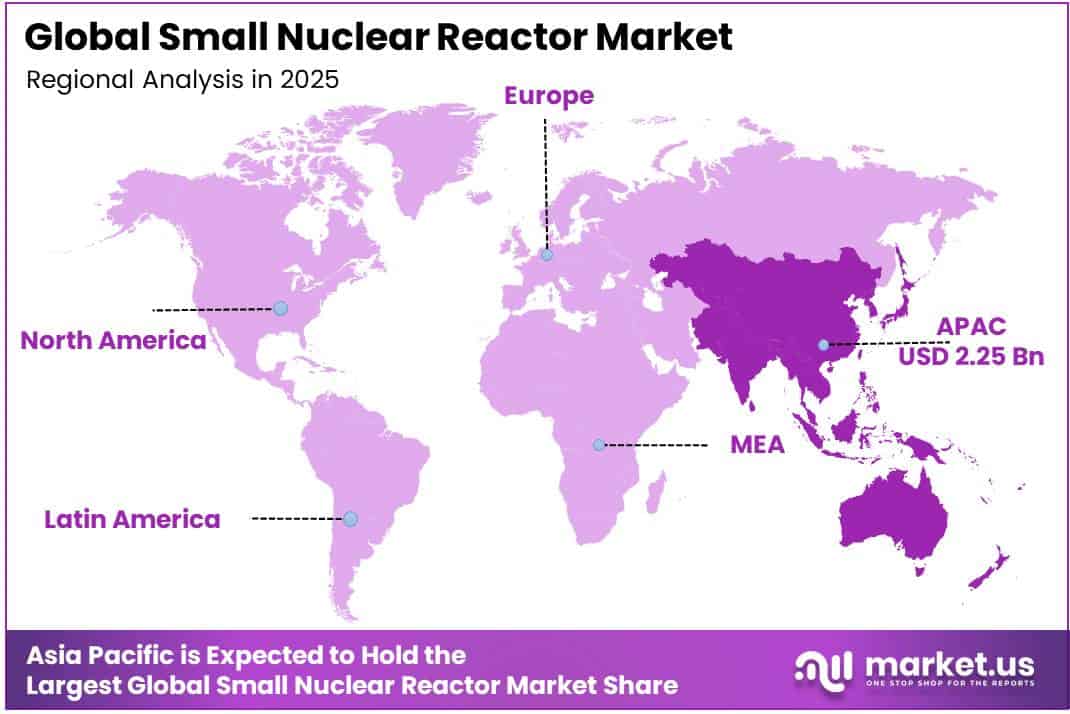
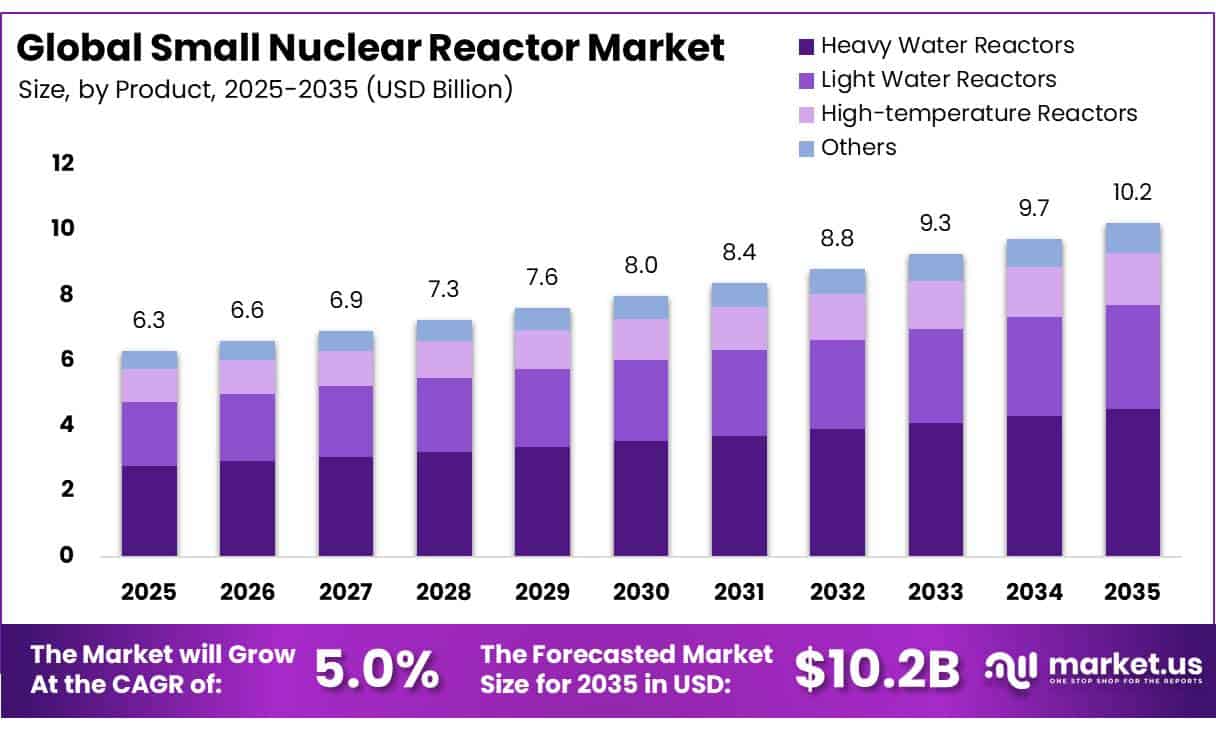
    In 2025, the Global Small Nuclear Reactor Market Market was valued at USD 6.3 billion, and between 2026 and 2035, this market is estimated to register a CAGR of 5.0%, reaching about USD 10.2 billion by 2035. Asia-Pacific held a dominant market position, capturing more than a 35.67% share, holding USD 2.25 billion in revenue.

    Small nuclear reactors are emerging as an option for utilities, industries, remote systems, and countries seeking firm low-carbon electricity with smaller project sizes than conventional plants.

    • In July 2025, the International Atomic Energy Agency reported about 70 small modular reactor designs at active stages of development and deployment worldwide. Its Power Reactor Information System also lists China’s Linglong-1 as under construction with a design net capacity of 100 megawatts electrical, showing movement from design pipelines toward deployment.
    Key Takeaways

    • The global small nuclear reactor market was valued at USD 6.3 billion in 2025.
    • The global market is projected to grow at a CAGR of 5.0% and is estimated to reach USD 10.2 billion by 2035.
    • On the basis of product, Heavy Water Reactors dominated the market, constituting 44.21% of the total market share.
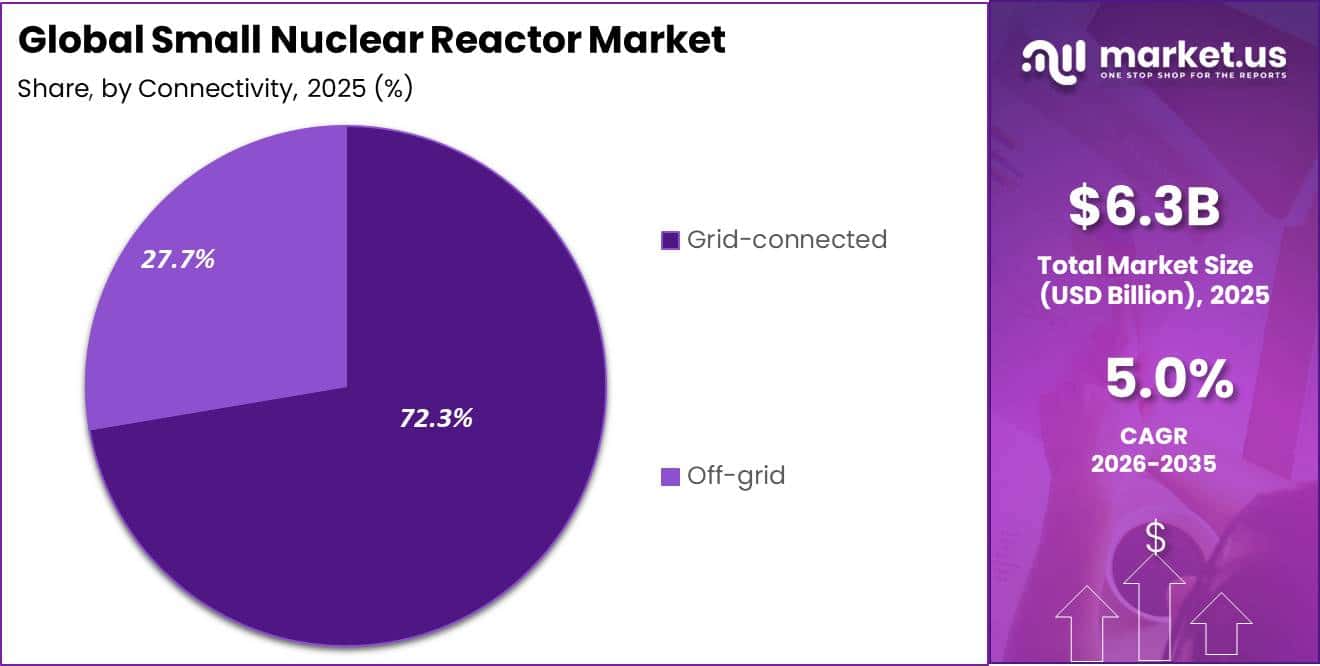
    • Based on connectivity, Grid-connected dominated the small nuclear reactor market, with a substantial market share of around 72.34%.
    • Based on deployment, Multi-Module Power Plant led the market, comprising 67.80% of the total market.
    • Among the power ratings, 101-200 MW held a major share in the small nuclear reactor market, accounting for 62.34% of the market share.
    • Among the applications, Industrial was the most considerable within the market, accounting for around 42.12% of the revenue.
    • In 2025, Asia-Pacific was the most dominant region in the small nuclear reactor market, accounting for 35.67% of the total market share.

    The industrial scenario is shaped by licensing progress and standardized modular configurations. In May 2025, the U.S. Nuclear Regulatory Commission completed its review of NuScale’s US460 standard design approval. The approved light-water configuration specifies 77 megawatts electrical per nuclear power module, six modules, and 462 megawatts electrical of total plant output. Regulatory milestones of this kind can improve confidence among utilities, engineering contractors, equipment suppliers, and investors evaluating repeatable reactor designs for grid and industrial applications.

    • Government support is strengthening the supply chain and creating opportunities for reactor vendors, fuel suppliers, fabricators, and engineering companies. In March 2025, the U.S. Department of Energy reissued a $900 million Generation III Plus small modular reactor solicitation. In May 2026, its supply-chain selections included $8.8 million for Framatome to expand fuel fabrication in Washington, adding approximately 200 metric tons of uranium annual capacity.

    Deployment opportunities are expanding through national energy-security programmes. In April 2026, Great British Energy Nuclear signed a contract with Rolls-Royce Small Modular Reactor for the United Kingdom’s first project. The planned three-unit development is expected to provide at least 1.4 gigawatts electrical, enough electricity for around three million homes for more than 60 years. The National Wealth Fund committed up to £599 million, supporting technology development, private investment, industrial capability, and global commercialization.

    Product Analysis

    Heavy Water Reactors dominate with 44.21% through established nuclear operations

    In 2025, Heavy Water Reactors held a dominant market position, capturing more than a 44.21% share. Their leadership is supported by established operating experience, strong fuel flexibility, and suitability for countries with existing heavy-water reactor infrastructure. These reactors remain relevant for utilities seeking dependable baseload generation, long operating cycles, and domestic fuel-cycle options within nuclear power systems.

    • In May 2025, according to the Government of Ontario, the Darlington New Nuclear Project was approved to begin construction of the first of four small modular reactors. The planned fleet will provide 1,200 megawatts of electricity, enough to power 1.2 million homes, while operations could support up to 2,000 jobs each year.

    Light Water Reactors are the growing segment, supported by wider commercial familiarity, standardized reactor technology, and expanding small modular reactor projects. Their use of ordinary water as coolant and moderator simplifies integration with established nuclear supply chains. New light-water designs are attracting utilities because modular construction, repeatable components, and grid-scale deployment can reduce project complexity while supporting cleaner electricity generation, industrial energy demand, and future capacity additions across major markets.

    Connectivity Analysis

    In 2025, Grid-connected held a dominant market position, capturing more than a 72.34% share. The segment remained prominent because small nuclear reactors can supply electricity into transmission and distribution networks. Utilities can integrate modular reactors with grid infrastructure while supporting baseload generation, system stability, and replacement of retiring thermal capacity across electricity markets.

    • In July 2025, according to the U.S. Department of Energy, Westinghouse’s eVinci microreactor was designed to produce 5 megawatts of electricity on sites as small as two acres. Radiant’s Kaleidos design was rated at 1.2 megawatts electric and designed to operate for five years before refueling.

    Off-grid is the growing segment, supported by demand for dependable power in remote communities, mining operations, military facilities, data centers, and isolated industrial sites. Compact reactors can serve locations where extending transmission infrastructure is difficult or costly. Factory-built designs, transportable components, long refueling intervals, and continuous generation capability strengthen their suitability for independent microgrids and remote energy systems requiring resilient electricity supplies.
    Deployment Analysis

    Multi-Module Power Plant dominates with 67.80% through flexible staged capacity

    In 2025, Multi-Module Power Plant held a dominant market position, capturing more than a 67.80% share. The segment remained preferred because multiple reactor modules can be added in stages as electricity demand increases. This configuration also allows operators to maintain generation from operating modules while another unit undergoes maintenance, supporting dependable output, flexible capacity planning, and efficient use of shared site infrastructure.

    • In December 2025, according to the U.S. Department of Energy, Tennessee Valley Authority and Holtec Government Services were selected to receive up to $800 million in combined federal cost-shared funding. Each project team was allocated up to $400 million, while Holtec planned to deploy two SMR-300 reactors at the Palisades Nuclear Generating Station site in Michigan.

    Single-Module Power Plant is the growing segment, supported by simpler project layouts and lower initial capacity requirements. A single reactor module can suit utilities, industrial facilities, remote energy systems, and sites replacing smaller fossil-fuel units. Reduced site complexity, modular construction, and easier capacity matching make this deployment approach attractive where developers seek phased nuclear investment without committing immediately to larger multi-unit projects.

    Power Rating Analysis

    101-200 MW dominates with 62.34% through balanced power output

    In 2025, 101-200 MW held a dominant market position, capturing more than a 62.34% share. This power range remained attractive because it offers a practical balance between electricity output, site requirements, capital exposure, and integration with regional grids. Reactors in this category can support utilities and industrial users seeking dependable generation without the scale and construction complexity associated with larger conventional nuclear plants.

    • In May 2025, according to the U.S. Department of Energy, X-energy’s Xe-100 small modular reactor was designed to produce 80 megawatts of electric output or 200 megawatts of process heat. A single reactor was designed to operate for 60 years, while the planned Seadrift facility supports manufacturing of more than 4 billion pounds of chemical products annually.

    Upto 100 MW is the growing segment, supported by interest in compact reactors for industrial sites, remote communities, data centers, mines, military facilities, and isolated grids. Smaller units can match local electricity demand more closely while reducing site requirements. Factory fabrication, modular installation, flexible deployment, and suitability for combined electricity and process-heat applications are strengthening interest in lower-capacity nuclear systems.

    Application Analysis

    Industrial dominates with 42.12% through dependable process energy demand

    In 2025, Industrial held a dominant market position, capturing more than a 42.12% share. The segment remained important because small nuclear reactors can provide dependable electricity and process heat for manufacturing, chemicals, metals, mining, and other energy-intensive operations. Their compact design, steady output, and ability to operate near industrial facilities support applications that require reliable power and high-temperature heat with lower carbon emissions.

    • In March 2026, according to the U.S. Department of Energy, a $40 billion United States-Japan energy partnership was announced for deployment of BWRX-300 small modular reactors in Tennessee and Alabama, with the planned projects targeting 3 gigawatts of clean baseload power.

    Power Generation is the fastest growing segment, supported by rising interest in firm, low-carbon electricity and replacement capacity for retiring fossil-fuel plants. Small nuclear reactors can provide continuous generation while complementing variable renewable resources and strengthening grid reliability. Modular construction also allows utilities to add capacity in stages, match regional demand, and use existing power sites, making these reactors increasingly suitable for future electricity systems requiring dependable generation and greater energy security across major energy markets.

    Key Market Segments

    By Product

    • Heavy Water Reactors
    • Light Water Reactors
    • High-temperature Reactors
    • Others

    By Connectivity

    • Off-grid
    • Grid-connected

    By Deployment

    • Single-Module Power Plant
    • Multi-Module Power Plant

    By Power Rating

    • Upto 100 MW
    • 101-200 MW
    • Above 200 MW

    By Application

    • Industrial
    • Power Generation
    • Desalination
    • Hydrogen Production

    Driver Analysis

    AI Data-Centre Firm-Power Procurement

    AI-scale computing is changing the small nuclear reactor (SMR) market from a utility-led equipment opportunity into a contracted clean-power infrastructure market, particularly where hyperscalers face multi-year grid-connection queues, volatile wholesale power costs, and carbon-accounting pressure. Global data-centre electricity demand is projected to rise from roughly 415 TWh in 2024 to approximately 945 TWh by 2030 an increase of about 530 TWh, or nearly 15% annual growth and the IEA expects the first SMRs to begin coming online around 2030, with nuclear contributing incremental generation for data-centre demand especially in China, Japan, and the United States.

    The strategic value is greatest for 50–300 MWe units that can be phased alongside campus expansion, deliver high availability, and reduce the need for oversized transmission upgrades; however, the revenue effect will remain back-end loaded because data-centre offtake announcements can support project finance before physical reactor deliveries begin. The IEA identifies plans of varying maturity for as much as 25 GW of SMR capacity, substantially linked to rising data-centre load, establishing this as the strongest private-sector demand catalyst in the current pipeline.

    Drivers Impact Analysis

    Driver (~) % Impact on CAGR Geographic Relevance Impact Timeline
    AI data-centre firm-power procurement +2.0 pp North America core, China, Japan, EU hubs Medium term (2–4 years)
    Nuclear policy and licensing reform +1.7 pp US, EU, Canada, UK, APAC Short term (≤ 2 years)
    Energy security and industrial decarbonisation +1.5 pp EU, East Asia, North America Medium term (2–4 years)
    Public financing and risk-sharing +1.4 pp US, Canada, Europe, OECD Asia Short term (≤ 2 years)
    Fleet standardisation and modular supply chains +1.2 pp Canada, US, Europe, China Long term (≥ 4 years)
    Remote-grid, defence and process-heat demand +0.9 pp North America, Nordics, APAC, remote regions Medium term (2–4 years)

    Restraint Analysis

    Capital Cost Overruns and FOAK Economics

    The root cause of margin destruction in the SMR segment is the persistent gap between pre-construction cost estimates and realized capital expenditure, a pattern documented across nearly every first-of-a-kind (FOAK) project to date: NuScale’s Utah program tripled from roughly $3 billion to over $9 billion before cancellation in November 2023, the Argentine CAREM SMR has logged a cumulative overrun near 700% relative to its original budget, and operating SMR units in China and Russia have historically run 300–400% over initial projections; layering onto this, per-MW capital intensity for early Western SMR designs is now tracking in the $15–20 million/MW range, and in cases like TerraPower’s Natrium the all-in figure implies close to $30 million/MW nearly double the ~$15–17 million/MW benchmark of large-scale AP1000/Vogtle-class builds.

    The quantitative bottleneck compounds through financing structures: with construction timelines of 5–7 years and interest-during-construction charges accruing on multi-billion-dollar balance sheets before any megawatt-hour revenue materializes, a single 24-month schedule slip can add 8–12% to total project cost purely through carrying costs and re-mobilization of contractors.

    Restraint Impact Analysis

    Restraint (~) % Impact on CAGR Forecast Geographic Relevance Impact Timeline
    Capital cost overruns and FOAK economics -2.3 pp North America core, EU, Argentina/LatAm spill-over Medium term (2–4 years)
    HALEU fuel supply scarcity -1.9 pp US, Canada, UK; indirect APAC exposure Short term (≤ 2 years)
    Heavy forging and component bottlenecks -1.6 pp Global, concentrated in Japan/South Korea/China supply, US/EU demand Medium term (2–4 years)
    Skilled nuclear workforce shortage -1.3 pp US, EU, Sweden/Nordics, UK Long term (≥ 4 years)
    Licensing, siting and public-financing friction -1.1 pp US state-level, EU member-state variance, LatAm Short term (≤ 2 years)
    Public perception and local opposition risk -0.7 pp EU (Germany/Austria legacy sentiment), some US states Long term (≥ 4 years)

    Opportunity Analysis

    Data-Centre Energy-as-a-Service

    The highest-value white space is not simply selling an SMR to a utility for grid generation—an activity increasingly reflected in the baseline but structuring dedicated, behind-the-meter or proximate “firm clean power” contracts for hyperscale AI campuses, where a reactor developer retains asset ownership and monetizes capacity, energy, resilience, and carbon attributes under 15–25-year take-or-pay agreements. Global data-centre electricity generation is expected to move from approximately 460 TWh in 2024 to more than 1,000 TWh by 2030 and 1,300 TWh by 2035, while the IEA expects SMRs to begin contributing meaningfully after 2030; plans of varying maturity already cover up to 25 GW of SMR capacity largely associated with increasing data-centre demand.

    For a 250–300 MWe campus-scale project operating near 90% capacity factor, annual output approaches 2.0–2.4 TWh; at a modeled blended contracted value of $95–135/MWh after capacity and reliability premiums, gross annual revenue can reach roughly $190–325 million before ancillary heat and carbon services. Value capture therefore shifts from one-off reactor-equipment margins of approximately 8–15% toward recurring contracted infrastructure returns, potentially lifting project-level EBITDA margins by 8–12 percentage points once fleet procurement lowers fixed O&M and financing costs.

    Opportunity Impact Analysis

    Opportunity (~) % Potential CAGR Geographic Relevance Execution Window
    Data-centre energy-as-a-service +2.4 pp North America core, Nordics, Japan, Singapore Medium term (2–4 years)
    Industrial heat and steam contracts +1.9 pp US Gulf Coast, EU industry belts, Japan, Korea Medium term (2–4 years)
    Coal-site replacement platforms +1.6 pp India, US, Poland, South Africa, Indonesia Medium term (2–4 years)
    LEU-fuelled reactor portfolio pivot +1.4 pp US, Canada, UK, EU Short term (≤ 2 years)
    Floating power and remote microgrids +1.1 pp Arctic, islands, Southeast Asia, Africa Long term (≥ 4 years)
    Fleet-service and supply-chain roll-ups +1.0 pp North America, Europe, Japan, South Korea Short term (≤ 2 years)

    Challenges Analysis

    Qualified Workforce Renewal

    SMR growth is exposed to a multi-decade capability-transfer problem rather than an immediate inability to hire: the EU nuclear sector alone employs approximately 500,000 people, many approaching retirement, while the UK estimates that roughly 123,000 workers will be needed this decade to meet national nuclear objectives, even as reactor developers compete with defence, aerospace, grid expansion, offshore wind, semiconductor plants, and AI data-centre construction for the same controls engineers, machinists, project managers, welders, cybersecurity specialists, and quality-assurance personnel.

    The difficulty is amplified by certification time: a graduate engineer may require 2–5 years of controlled nuclear-project experience before independently approving safety-significant work, while advanced welders, non-destructive-examination technicians, radiation-protection staff, and licensed control-room operators need role-specific training, security vetting, and documented qualification that cannot be rapidly substituted by general construction labor. Industry estimates point to a requirement for nearly 55,000 additional advanced-nuclear workers in the United States by 2030 and around 375,000 by 2050, meaning even a 5% annual workforce expansion leaves a gap if several national build programs execute simultaneously.

    Companies must therefore develop pooled labor models, pre-fund apprenticeships 24–48 months before site mobilization, create cross-border qualification reciprocity, use digital work packages and remote expert inspection to raise senior-worker productivity, and lock multiyear labor agreements; without these actions, labor scarcity will continue adding a modeled 7–12% premium to specialized construction packages and force sequential rather than parallel module builds.

    Challenges Impact Analysis

    Challenge (~) % CAGR Friction Geographic Relevance Mitigation Horizon
    Design fragmentation -1.4 pp North America, EU, APAC suppliers Long term (≥ 4 years)
    Qualified workforce renewal -1.2 pp US, UK, EU, Canada Long term (≥ 4 years)
    Nuclear-grade throughput scaling -1.1 pp US/EU demand; Japan/Korea supply Medium term (2–4 years)
    Fuel logistics standardization -1.0 pp US, Canada, UK, EU Medium term (2–4 years)
    First-fleet learning execution -0.9 pp North America core, Canada, UK, Poland Medium term (2–4 years)
    Cyber-physical assurance burden -0.6 pp All regulated markets Long term (≥ 4 years)

    Geopolitical Impact Analysis

    Nuclear Fuel Security and Localization Reshaping Reactor Deployment

    Current geopolitical tensions are reshaping the Small Nuclear Reactor Market through uranium supply security, sanctions, fuel localization, and tighter control of nuclear technology. The U.S. Department of Energy states that the United States imports 20% to 25% of enriched uranium from Russia. A federal ban restricts Russian low-enriched uranium imports through December 31, 2040, increasing pressure to establish alternative sources.

    • In 2025, the Euratom Supply Agency reported that Russia supplied 15.98% of natural uranium delivered to European Union utilities. Russian providers also represented 24.40% of conversion services and 22.55% of enrichment services, showing important parts of the nuclear fuel cycle remain exposed to supply disruption and policy changes.

    Governments are responding through domestic enrichment and allied supply-chain development. In January 2026, the U.S. Department of Energy announced $2.7 billion to expand low-enriched uranium and High-Assay Low-Enriched Uranium enrichment services over the next 10 years. These investments support fuel availability for advanced reactors while reducing dependence on overseas enrichment.

    The United Kingdom is pursuing a similar strategy for next-generation reactor fuel. In February 2026, the government stated that Russia remained the only commercial supplier of High-Assay Low-Enriched Uranium and confirmed investment of up to £300 million to establish a domestic supply chain. Such localization supports reactor deployment but requires licensing, qualification, and manufacturing capacity.

    Regional Analysis

    Asia-Pacific Leads with 35.67% Share and US$2.25 Billion

    In 2025, Asia-Pacific held a dominant position in the Small Nuclear Reactor Market, capturing more than a 35.67% share and generating US$2.25 billion in revenue. The region benefits from expanding nuclear construction, established reactor manufacturing, and growing demand for low-carbon power.

    • In February 2026, China’s National Nuclear Safety Administration reported 59 operating nuclear units with 62,518.74 megawatts electrical of installed capacity. Nuclear generation reached 467.019 terawatt-hours in 2025, accounting for 4.82% of national electricity generation.

    Europe is the fastest growing region, supported by coordinated policy, energy-security priorities, and industrial participation in small modular reactor development. In March 2026, the European Commission adopted its Small Modular Reactor Strategy, setting out 9 actions to support first projects becoming operational in the early 2030s. Preliminary assessments indicate European Union small modular reactor capacity could reach between 17 gigawatts and 53 gigawatts by 2050, strengthening opportunities for reactor developers, utilities, suppliers, and engineering companies

    Key Regions and Countries Covered

    • North America
      • The US
      • Canada
    • Europe
      • Germany
      • France
      • The UK
      • Spain
      • Italy
      • Russia & CIS
      • Rest of Europe
    • APAC
      • China
      • Japan
      • South Korea
      • India
      • ASEAN
      • Rest of APAC
    • Latin America
      • Brazil
      • Mexico
      • Rest of Latin America
    • Middle East & Africa
      • GCC
      • South Africa
      • Rest of MEA

    Key Players Analysis

    Small nuclear reactor developers are strengthening competitive positions through licensing progress, supply-chain localization, fuel security, and modular manufacturing. In 2026, GE Hitachi Nuclear Energy expanded BWRX-300 commercialization through a March agreement between GE Vernova and Hitachi to explore deployment in Southeast Asia and involve qualified Japanese suppliers. X-energy strengthened its supplier strategy through a March partnership with IHI Corporation, supporting manufacturing of nuclear-grade components for its Xe-100 program and an 11-gigawatt commercial pipeline.

    Competition is also shifting toward industrial applications, fuel capability, and faster project execution. NuScale Power expanded its fuel supply network with Framatome in March 2026, including European fabrication facilities and U.S. production. Kairos Power advanced vertical integration by producing more than 60,000 surrogate fuel pebbles in June 2026 while improving automated manufacturing systems. These moves show that leading developers compete on standardized designs, qualified suppliers, fuel availability, construction learning, and repeatable deployment.

    Market Key Players

    • State Atomic Energy Corporation Rosatom (Russia)
    • Westinghouse Electric Company (US)
    • MITSUBISHI HEAVY INDUSTRIES, LTD. (Japan)
    • GE Hitachi Nuclear Energy (US)
    • AtkinsRéalis (Canada)
    • Rolls-Royce plc (UK)
    • NuScale Power, LLC. (US)
    • ULTRA SAFE NUCLEAR (US)
    • Terrestrial Energy Inc. (US)
    • Moltex Energy (Canada)
    • X-Energy, LLC.  (US)
    • Holtec International (US)
    • General Atomics (US)
    • Kairos Power (US)
    • Other Key Players

    Key Development

    • In July 2026, Rolls-Royce plc expanded its small modular reactor partnership with ČEZ and the Czech Ministry of Industry and Trade through a Memorandum of Understanding covering site preparation at Tušimice and Dětmarovice. The agreement supports plans for up to 3 GW of small modular reactor capacity in Czechia.
    • In May 2026, AtkinsRéalis signed a 20-year strategic alliance with First American Nuclear to serve as the exclusive engineering, procurement, and construction management provider for EAGL-1 small modular reactor projects in North America. The agreement covers services worth up to US$250 million during the first 5 years.
    • In January 2026, Westinghouse Electric Company signed a Memorandum of Understanding with Tetra Tech Canada to support development and deployment of its AP300 small modular reactor and AP1000 reactor projects in Ontario, strengthening engineering and domestic project-development capabilities for future nuclear construction.

    Report Scope

    Report Features Description
    Market Value (2025) USD 6.3 Bn
    Forecast Revenue (2035) USD 10.2 Bn
    CAGR (2026-2035) 5.0%
    Base Year for Estimation 2025
    Historic Period 2020-2024
    Forecast Period 2026-2035
    Report Coverage Revenue Forecast, Market Dynamics, Competitive Landscape, Recent Developments
    Segments Covered By Product (Heavy Water Reactors, Light Water Reactors, High-temperature Reactors, and Others), By Connectivity (Off-grid and Grid-connected), By Deployment (Single-Module Power Plant and Multi-Module Power Plant), By Power Rating (Upto 100 MW, 101-200 MW, and Above 200 MW), By Application (Industrial, Power Generation, Desalination, and Hydrogen Production)
    Regional Analysis North America – The US & Canada; Europe – Germany, France, The UK, Spain, Italy, Russia & CIS, Rest of Europe; APAC– China, Japan, South Korea, India, ASEAN & Rest of APAC; Latin America– Brazil, Mexico & Rest of Latin America; Middle East & Africa– GCC, South Africa, & Rest of MEA
    Competitive Landscape State Atomic Energy Corporation Rosatom (Russia), Westinghouse Electric Company (US), MITSUBISHI HEAVY INDUSTRIES, LTD. (Japan), GE Hitachi Nuclear Energy (US), AtkinsRéalis (Canada), Rolls-Royce plc (UK), NuScale Power, LLC. (US), ULTRA SAFE NUCLEAR (US), Terrestrial Energy Inc. (US), Moltex Energy (Canada), X-Energy, LLC. (US), Holtec International (US), General Atomics (US), Kairos Power (US), and Other Key Players.
    Customization Scope State Atomic Energy Corporation Rosatom (Russia), Westinghouse Electric Company (US), MITSUBISHI HEAVY INDUSTRIES, LTD. (Japan), GE Hitachi Nuclear Energy (US), AtkinsRéalis (Canada), Rolls-Royce plc (UK), NuScale Power, LLC. (US), ULTRA SAFE NUCLEAR (US), Terrestrial Energy Inc. (US), Moltex Energy (Canada), X-Energy, LLC. (US), Holtec International (US), General Atomics (US), Kairos Power (US), and Other Key Players.
    Purchase Options We have three licenses to opt for: Single User License, Multi-User License (Up to 5 Users), Corporate Use License (Unlimited Users and Printable PDF)


    keyboard_arrow_up
  • Segments Sub-segments
    By Product
    • Heavy Water Reactors
    • Light Water Reactors
    • High-temperature Reactors
    • Others
    By Connectivity
    • Grid-connected
    • Off-grid
    By Deployment
    • Single-Module Power Plant
    • Multi-Module Power Plant
    By Power Rating
    • Upto 100 MW
    • 101-200 MW
    • Above 200 MW
    By Application
    • Industrial
    • Power Generation
    • Desalination
    • Hydrogen Production

     
    North America Europe Asia Pacific Latin America Middle East & Africa
    • US
    • Canada
    • Germany
    • France
    • The UK
    • Spain
    • Italy
    • Rest of Europe
    • China
    • Japan
    • South Korea
    • India
    • Australia
    • Rest of APAC
    • Brazil
    • Mexico
    • Rest of Latin America
    • GCC
    • South Africa
    • Rest of MEA
Small Nuclear Reactor Market
Published date: August 2026
add_shopping_cartBuy Now get_appDownload Sample

Related Reports

  • Renewable Aviation Fuel Market

  • Offshore Mooring System Market
  • Direct Methanol Fuel Cell Market
  • Synchronous Generator Market
  • Zonal Isolation Market
  • Solar Simulator Market
  • Oil and Gas Infrastructure Market
  • Tidal Energy Market
  • Silent Generator Market
  • Vessel Energy Storage System Market
Small Nuclear Reactor Market
  • 191835
  • August 2026
    • ★★★★★
      ★★★★★
Buy Now
Trusted by more than 17382 organizations globally
  • Client Logo
  • Client Logo
  • Client Logo
  • Client Logo
  • Client Logo
  • Client Logo
  • Client Logo
  • Client Logo
  • Client Logo
  • Client Logo
  • Client Logo
  • Client Logo
  • Client Logo
  • Client Logo
  • Client Logo
  • Client Logo

Our Clients

philips
pentair
suez
ecowater
ergobaby
fabricato
genomatica
lenzing
lilly
siemens
honeywell
valspar
pactiv
petsure
schweitzer-online
sappi
pfizer
unilabs
lonza
BD
mckinsey
hilti
✖
Request a Sample Report
We'll get back to you as quickly as possible
CAPTCHA Code

✖
Request a Sample Report
We'll get back to you as quickly as possible
CAPTCHA Code

  • location_on420 Lexington Avenue, Suite 300 New York City, NY 10170,

    United States
  • phone+1 718 874 1545 (International)
  • phone+91 78878 22626 (Asia)
  • email[email protected]
  • Facebook Logo
  • Twitter Logo
  • LinkedIn Logo
Find Help
  • Contact Us
  • How to Order
Legal
  • Privacy Policy
  • Refund Policy
  • Frequently Asked Questions
  • Terms and Conditions
Explore
  • About Us
  • Our Clients
  • Media Mentions
  • Infographics
  • Statistics and Facts
  • Research Methodology
  • Why Choose Us?
Secured Payment Options

© 2026 Market.Us. All Rights Reserved.