


Report Overview
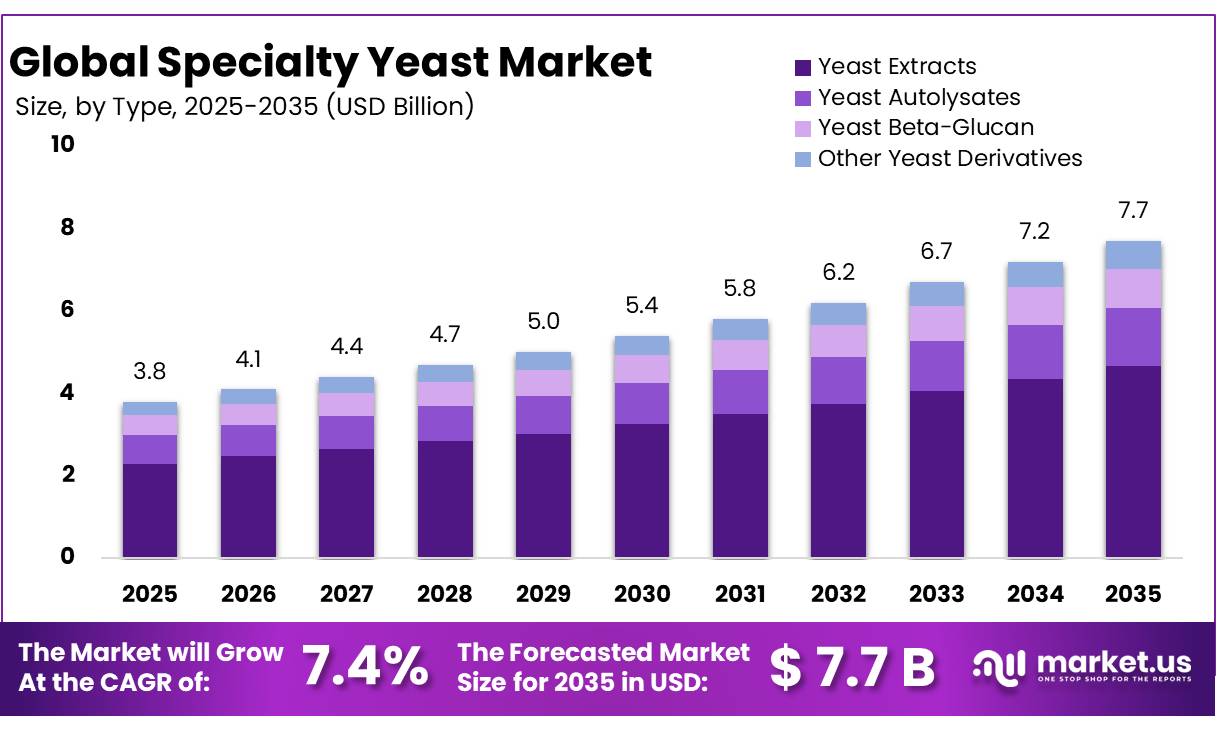
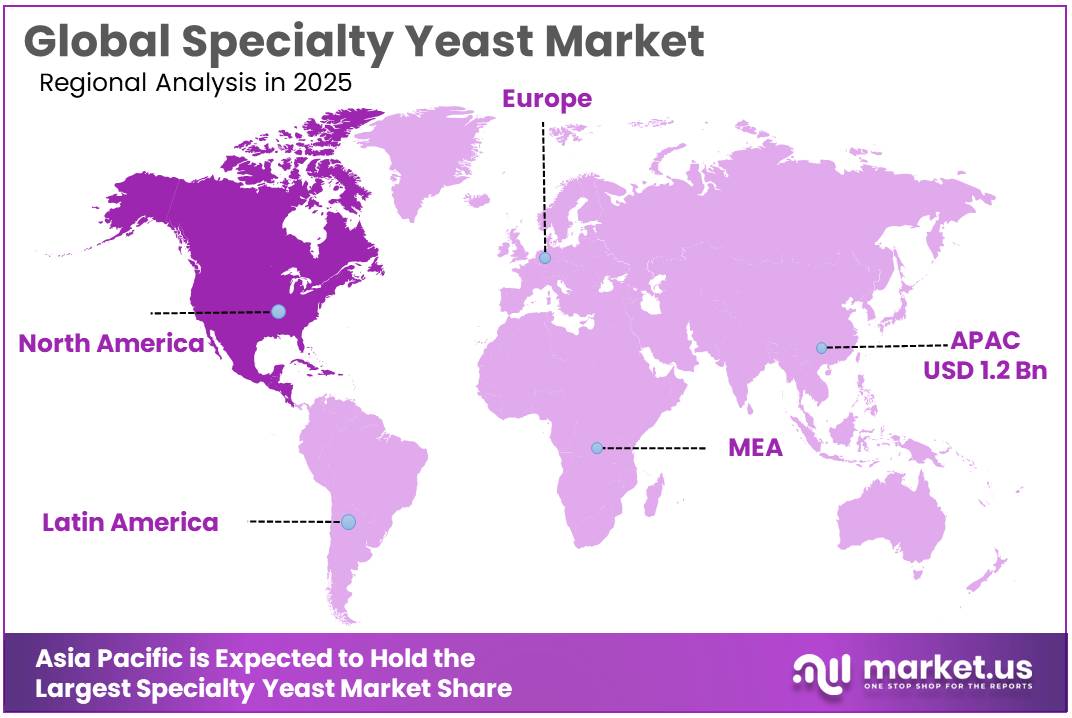
In 2025, the Global Specialty Yeast Market valued at USD 3.8 billion, and between 2026 and 2035, this market is estimated to register a CAGR of 7.4%, reaching about USD 7.7 billion by 2035. Asia Pacific held a dominant market position, capturing more than a 27.1% share, holding USD 1.2 billion in revenue.
Specialty yeast represents a value-added branch of industrial fermentation in which selected yeast strains and yeast-derived fractions are used beyond conventional baking. Products include yeast extracts, inactive yeast, autolysates, cell-wall fractions, probiotic yeast, nutritional yeast and fermentation cultures for food, beverages, animal nutrition and biotechnology. The sector already operates on a large industrial base. Lesaffre reports turnover of €3.2 billion, employs 11,700 people and draws its workforce from 100 nationalities, illustrating the scale of fermentation expertise supporting specialty yeast development.
- Associated British Foods states that AB Mauri sells yeast and bakery ingredients in more than 100 countries, operates 55 plants and has a manufacturing presence across 32 countries. Its broader specialty portfolio includes yeast extracts, inactive dry yeast, yeast cell wall, probiotic yeast and autolysed yeast.
Key Takeaways
- Specialty Yeast Market valued at USD 3.8 billion, and between 2026 and 2035, this market is estimated to register a CAGR of 7.4%, reaching about USD 7.7 billion by 2035.
- Yeast Extracts held a dominant market position, capturing more than a 60.5% share.
- Saccharomyces cerevisiae held a dominant market position, capturing more than a 72.1% share.
- Food held a dominant market position, capturing more than a 58.1% share.
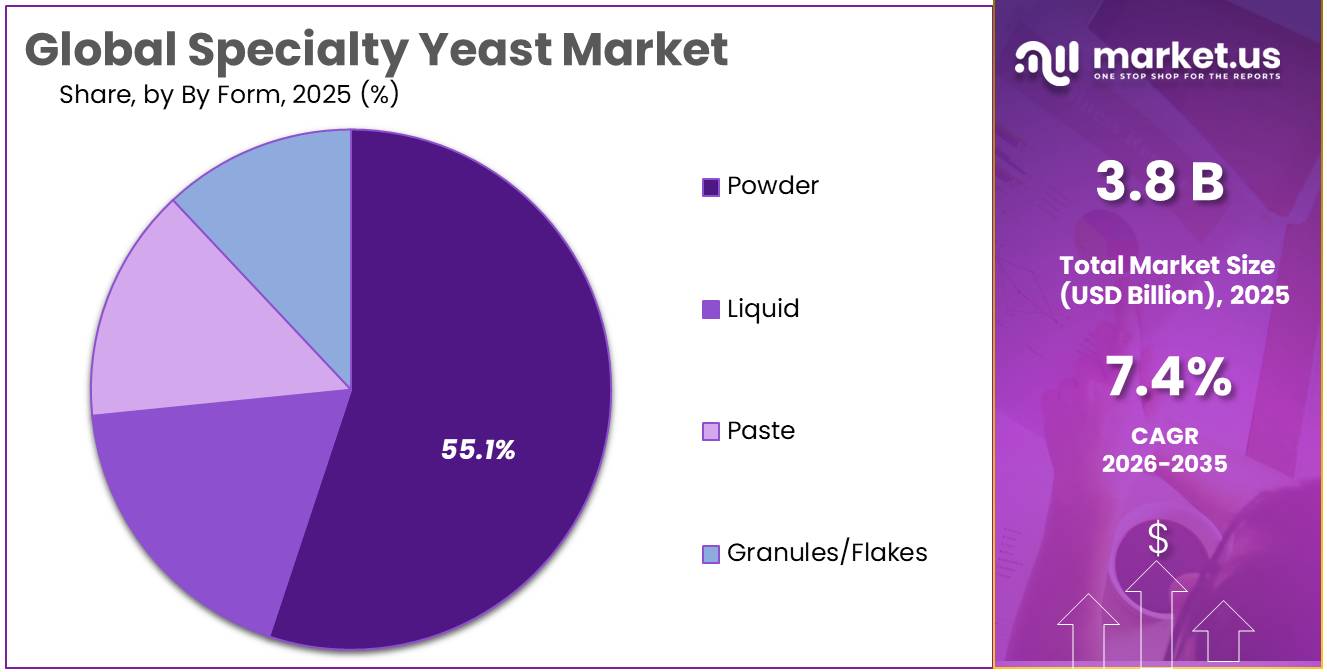
- Powder held a dominant market position, capturing more than a 55.1% share.
- B2B / Industrial held a dominant market position, capturing more than a 78.1% share.
- Asia Pacific held the dominant regional position, accounting for 27.1% of the Specialty Yeast Market and generating about USD 1.02 billion in revenue.
This infrastructure allows producers to move specialty yeast from traditional flavour enhancement into nutrition, biotechnology, alcoholic beverages, bioethanol and animal-feed applications, while using local production networks to serve different formulation, regulatory and processing requirements.
Food and feed demand remains an important growth driver. FAO expects world cereal utilization to reach 2,922 million tonnes, representing a 1.6% annual increase, while poultry and swine together account for more than 70% of grain used in livestock feeding. These volumes support demand for technologies that improve feed efficiency and nutritional performance. Specialty yeast ingredients can therefore gain relevance as palatability enhancers, functional nutrients, fermentation aids and feed-support ingredients, especially as livestock and aquaculture producers seek better conversion efficiency, gut-health support and more effective use of existing feed resources.
Production efficiency is becoming equally important because fermentation is energy intensive. ABF reports that its Ingredients businesses consumed 1,238 GWh of energy, with consumption rising 7% as production volumes increased, while 27% of total energy came from renewable sources. This operating profile is encouraging producers to invest in better aeration, heat recovery, biogas use, renewable electricity and process optimization. For specialty yeast suppliers, lower energy intensity can improve cost competitiveness while helping food, nutrition and biotechnology customers reduce the environmental footprint associated with ingredient sourcing.
Future growth opportunities are strongest in precision fermentation, circular feedstocks and higher-value nutritional ingredients. The Circular Bio-based Europe Joint Undertaking has opened a €170.7 million project call, including €20 million for diversification of nutritional food ingredient sources and €14 million for biotechnology routes that valorise residual biomass. The European Innovation Council is also explicitly supporting precision fermentation for sustainable food and feed ingredients.
By Type Analysis
Yeast Extracts lead the Specialty Yeast Market with a 60.5% share
In 2025, Yeast Extracts held a dominant market position, capturing more than a 60.5% share. Their leading position is supported by broad use as natural flavor-building ingredients in soups, sauces, seasonings, snacks, ready meals, and beverages. A USDA Foreign Agricultural Service report published in December 2025 specifically identifies yeast extracts and flavor enhancers made using Saccharomyces cerevisiae for savory flavors, snacks, and beverages, showing their established position in commercial food processing.
- In September 2025, EU retail volumes for food, drinks, and tobacco increased by 0.5% year over year, indicating steady downstream activity in food categories where flavor-enhancing ingredients are widely used.
Yeast Autolysates are increasingly used in processed foods, fermentation applications, nutritional formulations, and animal feed because the controlled breakdown of yeast cells releases proteins, amino acids, peptides, minerals, and other useful cellular components. The U.S. Department of Agriculture identifies autolyzed yeast as a flavor-enhancing ingredient used in regulated meat and poultry products, supporting its established role in food formulations.
- Animal nutrition also provides a sizeable application base. USDA data show that global chicken meat production reached 104.4 million metric tons in the 2024/2025 marketing period, while global pork production reached 116.26 million metric tons during the same period. These large production volumes support continued demand for functional feed ingredients, including yeast-derived autolysates used to improve palatability and nutritional formulation.
By Species Analysis
Saccharomyces cerevisiae dominates the Specialty Yeast Market with a 72.1% share
In 2025, Saccharomyces cerevisiae held a dominant market position, capturing more than a 72.1% share. Its dominance is closely linked to its long-established fermentation performance, easy industrial cultivation, and ability to support food, beverage, nutritional, and biotechnology applications. Regulatory activity also shows continued commercial development of this species.
- In 2025, the U.S. FDA completed GRAS review of Saccharomyces cerevisiae BY-1248 for wine fermentation at 10⁷ cells/mL of grape must or 0.2 g of active dry yeast/L, with the agency stating that it had no questions regarding the notifier’s GRAS conclusion. This regulatory acceptance supports wider development of specialized S. cerevisiae strains with targeted flavor and fermentation characteristics.
Pichia pastoris continues to gain industrial attention as a specialized yeast platform, particularly for producing enzymes, proteins, and other fermentation-derived ingredients. Its ability to achieve high cell densities and efficiently express selected proteins makes it useful where manufacturers require more specialized functionality than conventional yeast fermentation. Current regulatory activity highlights this industrial potential.
- In 2025, the U.S. FDA closed GRAS Notice 1201 for a lipase enzyme preparation produced using Komagataella phaffii, an industrial yeast closely associated with the Pichia pastoris production platform. The enzyme was intended for use at up to 95.1 mg Total Organic Solids/kg of raw material in cheese, enzyme-modified dairy ingredients, and plant-based dairy alternatives. NCBI also recognizes Pichia pastoris within the modern Komagataella yeast classification used in biotechnology.
By Application Analysis
Food dominates the Specialty Yeast Market with a 58.1% share
In 2025, Food held a dominant market position, capturing more than a 58.1% share. The segment benefits from specialty yeast being used for fermentation, natural flavor development, nutritional enrichment, and improving the sensory profile of processed foods and beverages.
- In 2025, the U.S. FDA completed its review of Saccharomyces cerevisiae BY-1568 for use in non-alcoholic beer production at up to 9 × 10⁶ cells/mL of wort, with the finished beverage containing less than 0.5% alcohol by volume. This regulatory activity shows how specialized yeast strains are increasingly being developed for targeted food and beverage applications, supporting continued demand from manufacturers seeking fermentation performance, clean-label ingredients, and differentiated taste profiles.
Feed is an important application for specialty yeast because live yeast, inactive yeast, yeast cultures, and yeast-derived fractions are increasingly incorporated into animal nutrition formulations. In 2025, the European Commission expanded authorization for a Saccharomyces cerevisiae CNCM I-1077 preparation across several ruminant, camelid, and equine applications. The regulation also lowered the minimum inclusion level for lamb feed from 3 × 10⁹ CFU/kg to 1 × 10⁹ CFU/kg in complete feed containing 12% moisture. Such regulatory approvals strengthen the commercial base for specialty yeast in feed by supporting its use as a digestibility enhancer and gut-flora stabilizer in modern livestock nutrition.
By Form Analysis
Powder dominates the Specialty Yeast Market with a 55.1% share
In 2025, Powder held a dominant market position, capturing more than a 55.1% share. Powdered specialty yeast is widely suitable for dry premixes, nutritional formulations, animal feed, and processed foods because manufacturers can handle and dose it efficiently. Government data also support the commercial relevance of dried yeast formats.
- In 2026, the U.S. FDA reviewed a dried Saccharomyces cerevisiae ingredient produced through fermentation, heat inactivation, and spray drying. Its finished-product specifications included at least 50% crude protein on a dry-matter basis and no more than 10% moisture. The FDA also reported its intended use at up to 15% of the diet for adult dogs, demonstrating the practical use of concentrated dried yeast ingredients in formulated nutrition products.
Liquid specialty yeast is mainly suited to brewing, beverage fermentation, biotechnology, and other applications where active yeast cultures need to remain dispersed and ready for fermentation. In 2025, the U.S. FDA completed its evaluation of Saccharomyces cerevisiae OYR-542, which was specifically described as a liquid yeast slurry used as a brewing starter culture.
- Its intended application level was approximately 1 × 10⁶ cells/mL of wort per degree Plato. The liquid preparation was specified to contain more than 3% yeast solids and more than 98% viable cells. These characteristics show why liquid forms remain useful in applications where manufacturers value high cell viability, immediate dispersion, and direct addition into fermentation vessels.
By Distrubution Channel Analysis
B2B / Industrial dominates the Specialty Yeast Market with a 78.1% share
In 2025, B2B / Industrial held a dominant market position, capturing more than a 78.1% share. Specialty yeast is mainly handled as an industrial ingredient, with manufacturers purchasing yeast extracts, autolysates, cultures, and inactive yeast in bulk for controlled production processes. Direct industrial supply is preferred because buyers require consistent specifications, traceability, technical support, and dependable delivery volumes.
- According to the U.S. Census Bureau, U.S. manufacturers recorded shipments worth USD 652.1 billion in June 2026. Such large manufacturing flows create a strong environment for ingredient suppliers that work directly with processors under regular supply agreements rather than relying mainly on consumer retail channels.
B2C / Retail & Online is developing as a complementary distribution route for specialty yeast products aimed directly at households, home bakers, health-conscious consumers, and small food-service users. Packaged nutritional yeast and specialty baking products are particularly suitable for supermarkets, specialty stores, and e-commerce because they can be sold in smaller consumer-ready formats. Government retail data show the growing scale of digital purchasing.
- The U.S. Census Bureau reported that retail e-commerce sales reached USD 326.7 billion in the first quarter of 2026. This expanding digital retail environment gives specialty yeast producers a wider route to consumers, particularly for shelf-stable powders and packaged products that can be stored, shipped, compared, and reordered easily through online platforms.
Key Market Segments
By Type
- Yeast Extracts
- Yeast Autolysates
- Yeast Beta-Glucan
- Other Yeast Derivatives
By Species
- Saccharomyces cerevisiae
- Kluyveromyces
- Pichia pastoris
- Others
By Application
- Food
- Beverages
- Feed
- Others (Nutraceutical, Pharma, Bioethanol)
By Form
- Powder
- Liquid
- Paste
- Granules/Flakes
By Distrubution Channel
- B2B / Industrial
- B2C / Retail & Online
Driver Analysis
Ethanol-grade strain demand
Ethanol expansion increases demand for high-temperature, high-osmotic-pressure, inhibitor-tolerant and high-yield fermentation strains, especially when plants process variable sugar, molasses, corn or grain feedstocks and seek to raise litres per tonne without proportionately expanding tankage. India is the near-term catalyst: its Ethanol Blending Programme targeted 20% ethanol blending by 2025–26, while reporting indicates that the country achieved a 20% blending level in 2025–26 after starting below 1.5% in 2013–14.
For specialty-yeast vendors, the commercial opportunity lies in recurring strain replacement, plant-specific inoculation protocols, contamination management, technical service and co-products optimization—not just one-time yeast supply. The limitation is input-price linkage: stronger bioethanol economics can also tighten molasses availability and raise feedstock costs for food-grade yeast production, creating a two-sided effect in which industrial-strain revenue rises but conventional yeast margins face sugar-substrate volatility. U.S. and Brazilian biofuel policies add regional demand resilience, although annual blending mandates, refinery exemptions and feedstock allocation can make production scheduling volatile.
Drivers Impact Analysis
| Driver | (~) % Impact on CAGR | Geographic Relevance | Impact Timeline |
|---|---|---|---|
| Clean-label yeast extracts | +1.4 pp | North America, EU, Japan, urban APAC | Medium term (2–4 years) |
| Functional nutrition & beta-glucans | +1.2 pp | North America, EU, China, India | Medium term (2–4 years) |
| Premium bakery & convenience foods | +1.1 pp | India, China, ASEAN, Middle East, EU | Short term (≤ 2 years) |
| Antibiotic-free feed yeast | +1.0 pp | EU, China, Southeast Asia, Brazil | Medium term (2–4 years) |
| Ethanol-grade strain demand | +0.8 pp | India, U.S., Brazil, ASEAN | Short term (≤ 2 years) |
| Precision-fermentation platforms | +0.7 pp | U.S., Singapore, Israel, EU, China | Long term (≥ 4 years) |
Restraint Analysis
Molasses Feedstock Volatility
Specialty yeast economics remain exposed to sugar, molasses, glucose syrup and nutrient-substrate availability because carbon feedstock is typically the largest variable input after energy in aerobic fermentation, and its cost cannot always be passed through to bakery, feed or food-manufacturing customers bound by annual supply contracts. Although global raw-sugar pricing softened into 2026 with one sector outlook placing average raw sugar around USD 363–370 per tonne in 2026 versus about USD 384 per tonne in 2025 this does not eliminate localized risk because molasses availability is determined by cane crush, diversion toward ethanol, export controls, quality variation and competing feed demand rather than only world raw-sugar benchmarks.
In India and Brazil, higher ethanol blending requirements can redirect cane-derived intermediates into fuel alcohol, shortening spot availability of fermentation-grade molasses; India reached 20% ethanol blending in 2025–26, intensifying the linkage between fuel-policy execution and substrate allocation. A 10–20% delivered-cost increase in molasses or refined sugar can cut gross margin by roughly 150–400 basis points for a producer with limited hedging, especially where specialty-extract contracts lock selling prices for 6–12 months; producers therefore need multi-feedstock fermenters, dual sourcing, inventory buffers and formula-based pass-through clauses, all of which increase working capital or reduce price competitiveness.
Restraint Impact Analysis
| Restraint | (~) % Impact on CAGR | Geographic Relevance | Impact Timeline |
|---|---|---|---|
| Molasses feedstock volatility | -1.3 pp | India, Brazil, EU, Southeast Asia | Short term (≤ 2 years) |
| Energy-intensive fermentation | -1.0 pp | EU, North America, Japan, Korea | Medium term (2–4 years) |
| Regulatory approval friction | -0.9 pp | EU, U.S., China, Japan | Long term (≥ 4 years) |
| Food-safety compliance burden | -0.8 pp | U.S., EU, China, export APAC | Short term (≤ 2 years) |
| Low-cost commodity competition | -0.8 pp | India, China, ASEAN, Africa | Medium term (2–4 years) |
| Capacity and scale-up risk | -0.7 pp | North America, EU, APAC hubs | Medium term (2–4 years) |
Opportunity Analysis
Precision-Fermentation CDMO
This is an opportunity rather than a current driver because most conventional specialty-yeast producers still sell biomass or extracts by tonne, whereas the future value pool shifts to multi-year development fees, capacity reservations, technology-transfer charges and recurring batch revenue tied to customer intellectual property; a successful operator could move from gross margins of roughly 20–30% in bulk active yeast toward 35–55% blended gross margin on specialized development and purification work, subject to utilization.
The U.S. is the earliest monetization market: by 2026, multiple precision-fermented proteins had secured U.S. market access while Europe had not approved a comparable food protein; U.S. GRAS pathways can take around one year, versus commonly 2.5–4 years or longer under the EU novel-food route. A producer that converts even 10–15% of 50–100 m³ fermenter capacity into fee-based campaigns, maintains 70%+ utilization, and charges separately for process development can add approximately 1.8 percentage points to company-level growth above baseline, while avoiding the higher consumer-brand acquisition costs associated with launching its own finished foods.
Opportunity Impact Analysis
| Opportunity | (~) % Potential CAGR | Geographic Relevance | Execution Window |
|---|---|---|---|
| Precision-fermentation CDMO | +1.8 pp | U.S., Singapore, Israel, EU | Medium term (2–4 years) |
| Pet-food functional proteins | +1.3 pp | North America, EU, Japan, China | Short term (≤ 2 years) |
| Feed additive solution bundles | +1.2 pp | India, Brazil, China, ASEAN | Medium term (2–4 years) |
| Upcycled yeast circularity | +1.0 pp | EU, North America, Brazil, India | Medium term (2–4 years) |
| Digital fermentation services | +0.8 pp | North America, EU, East Asia | Medium term (2–4 years) |
| Regional M&A platform roll-ups | +0.7 pp | India, ASEAN, LatAm, Africa | Long term (≥ 4 years) |
Challenges Analysis
Strain Scale-Up Variability
Specialty yeast development faces a continuous scale-up gap because strain performance in 5–50 litre laboratory vessels does not predict economics in 50–250 m³ industrial fermenters, where oxygen-transfer limits, foam control, heat removal, shear, contamination load and variable feedstock quality alter viable-cell count, metabolite profile and downstream recovery. A strain that achieves high biomass yield in pilot trials can lose an estimated 5–15% of productivity after transfer to commercial conditions, while a 1–2 percentage-point decline in dry-matter recovery or viable-cell activity can eliminate the margin premium on freeze-tolerant bakery yeast, nutritional yeast or high-purity extract fractions.
The challenge is amplified by a limited supply of food-grade pilot capacity: full validation typically requires 3–6 consecutive commercial-equivalent batches, 6–18 months of process-development iteration and 12–24 months before a customer accepts a changed strain or specification. Precision-fermentation research identifies industrial scale-up, consistency and cost efficiency as central persistent limitations, reinforcing the need for digital-twin modelling, high-throughput strain screening, standardized raw-material specifications and modular pilot infrastructure rather than isolated laboratory innovation. Companies that cannot translate fermentation yields into repeatable commercial batches risk tying up tanks in low-yield campaigns, increasing conversion cost by an estimated 10–25% and losing credibility with high-volume food and feed customers.
Challenges Impact Analysis
| Challenge | (~) % CAGR Friction | Geographic Relevance | Mitigation Horizon |
|---|---|---|---|
| Strain Scale-Up Variability | -1.1 pp | North America, EU, East Asia | Long term (≥ 4 years) |
| Bioprocess Talent Gap | -0.9 pp | EU, U.S., India, Singapore | Medium term (2–4 years) |
| Volatile Logistics Corridors | -0.8 pp | EU–Asia, Gulf, Africa, APAC | Short term (≤ 2 years) |
| Water-Effluent Intensity | -0.8 pp | India, China, EU, U.S. | Long term (≥ 4 years) |
| Fragmented Application Evidence | -0.7 pp | Global, especially APAC and LatAm | Medium term (2–4 years) |
| Customer Qualification Cycles | -0.6 pp | North America, EU, Japan, Korea | Medium term (2–4 years) |
Geopolitical Impact Analysis
Geopolitical Impact: Wars Raise Energy and Logistics Risks for Specialty Yeast
Ongoing wars are creating an operating environment for the Specialty Yeast market. The Russia–Ukraine conflict continues to affect Black Sea trade patterns, while Middle East tensions are disrupting energy and shipping corridors. Specialty yeast producers depend on sugar- and grain-based fermentation inputs, electricity, packaging materials, and reliable maritime transport. Disruption in these areas can raise production costs and delay deliveries to food, beverage, feed, and biotechnology customers.
- UNCTAD reported that by May 2025, tonnage moving through the Suez Canal was still 70% below 2023 levels as vessels continued to avoid the Red Sea route. Longer voyages increase freight expenses and lead times for raw materials and yeast products. In 2026, UNCTAD also reported that ship transits through the Strait of Hormuz had nearly halted during regional military escalation, while Brent crude moved above USD 90 per barrel.
Energy pressure is also important for fermentation plants. The European Commission expects EU energy inflation to exceed 11% in the second quarter of 2026 and remain above 10% for the rest of the year. Specialty yeast suppliers are prioritizing regional sourcing, efficient fermentation, inventory buffers, and diversified logistics.
Regional Insights
Asia Pacific leads the Specialty Yeast Market with a 27.1% share and USD 1.02 billion in revenue.
In 2025, Asia Pacific held the dominant regional position, accounting for 27.1% of the Specialty Yeast Market and generating about USD 1.02 billion in revenue.
China had more than 100,000 registered food-processing companies in 2025, with food and agricultural processing revenue estimated at USD 2.5 trillion. Its food-service industry also reached USD 812 billion and expanded 3.2% during the year. Japan provided another sizeable demand base, with its food-processing industry valued at USD 174 billion in 2025. These industries support regular demand for yeast extracts, autolysates, specialty cultures, nutritional yeast, and fermentation ingredients used across processed food and feed production.
Asia Pacific is also positioned for the fastest regional expansion based on current food-industry and ingredient-demand indicators. Thailand had 54% of its population living in urban areas in 2025, creating a larger consumer base for convenient and processed foods. USDA reported Thailand’s food-processing industry at USD 36.0 billion, while food ingredient exports reached USD 5.8 billion and imports totaled USD 3.4 billion. Japan’s 2026 food-industry assessment also identified growth in health foods, soft drinks, frozen foods, and shelf-stable products. Continued urbanization, food innovation, fermentation investment, and demand for functional nutrition should keep specialty yeast adoption expanding across the region in coming years.
Key Regions and Countries Insights
- North America
- US
- Canada
- Europe
- Germany
- France
- The UK
- Spain
- Italy
- Rest of Europe
- Asia Pacific
- China
- Japan
- South Korea
- India
- Australia
- Rest of APAC
- Latin America
- Brazil
- Mexico
- Rest of Latin America
- Middle East & Africa
- GCC
- South Africa
- Rest of MEA
Key Players Analysis
Lesaffre Group remains a major specialty yeast supplier, supported by a broad fermentation platform serving food, nutrition, health, and biotechnology customers. The company reports turnover of €3.2 billion, employs 11,700 people, operates through more than 62 countries, distributes products in 180 countries, and maintains 70 applied science centers. Its long-standing yeast expertise supports yeast extracts, nutritional ingredients, probiotics, and fermentation solutions. This scale gives Lesaffre strong technical reach, localized customer support, and capacity to develop higher-value specialty yeast applications globally.
Angel Yeast Co., Ltd. is expanding its specialty yeast platform across yeast extracts, nutritional yeast, yeast protein, animal nutrition, and biotechnology. The company employs more than 12,000 people, sells products in over 170 countries, and operates 33 production bases. In 2025, its yeast protein line reached 11,000 tons of annual output. Angel also reported 2024 revenue above RMB 15 billion and invested RMB 780 million in research and development, strengthening its ability to scale fermentation-based ingredients and specialty yeast solutions.
Associated British Foods plc participates in specialty yeast mainly through AB Mauri, its global yeast and bakery ingredients business. AB Mauri operates 52 plants across 32 countries and sells into more than 100 countries. In 2025, ABF’s Ingredients segment generated £2.041 billion in external revenue and £257 million in adjusted operating profit, with an adjusted margin of 12.6%. The group also reported prior-year acquisitions in specialty yeast and bakery ingredients, strengthening AB Mauri’s portfolio, production footprint, and customer reach internationally.
Top Key Players Outlook
- Lesaffre Group
- Lallemand Inc.
- AngelYeast Co., Ltd.
- Associated British Foods plc
- Kerry Group plc
- Archer Daniels Midland Company (ADM)
- Novonesis
- DSM-Firmenich
- Alltech, Inc.
- Oriental Yeast Co., Ltd.
- Leiber GmbH
- Kemin Industries, Inc.
- Synergy Flavors
- Sensient Technologies Corporation
- Pak Group
- Others
Recent Developments
- In February 2026, dsm-firmenich agreed to divest Animal Nutrition & Health to CVC Capital Partners for about €2.2 billion, including an earn-out of up to €0.5 billion, while retaining a 20% equity stake; this followed the €1.5 billion sale of its Feed Enzymes activities in 2025.
- February 2026 with the official launch of Akralos Animal Nutrition, operating more than 40 feed mills across the U.S. and Canada and employing over 1,400 team members.
- In February 2026, Synergy introduced its new Authentic Dairy Flavors portfolio in powder, spray-dried, emulsion, and paste formats. Initial customer applications demonstrated up to a 37% reduction in dairy commodity usage, supporting cost-efficient savory formulation and complementing the company’s yeast-based taste-enhancement capabilities.
Report Scope
| Report Features | Description |
|---|---|
| Market Value (2025) | USD 3.8 Bn |
| Forecast Revenue (2035) | USD 7.7 Bn |
| CAGR (2026-2035) | 7.4% |
| Base Year for Estimation | 2025 |
| Historic Period | 2020-2024 |
| Forecast Period | 2026-2035 |
| Report Coverage | Revenue Forecast, Market Dynamics, Competitive Landscape, Recent Developments |
| Segments Covered | By Type (Yeast Extracts, Yeast Autolysates, Yeast Beta-Glucan, Other Yeast Derivatives), By Species (Saccharomyces cerevisiae, Kluyveromyces, Pichia pastoris, Others), By Application (Food, Beverages, Feed, Others (Nutraceutical, Pharma, Bioethanol)), By Form (Powder, Liquid, Paste, Granules/Flakes), By Distrubution Channel (B2B / Industrial, B2C / Retail And Online) |
| Regional Analysis | North America – US, Canada; Europe – Germany, France, The UK, Spain, Italy, Rest of Europe; Asia Pacific – China, Japan, South Korea, India, Australia, Singapore, Rest of APAC; Latin America – Brazil, Mexico, Rest of Latin America; Middle East & Africa – GCC, South Africa, Rest of MEA |
| Competitive Landscape | Lesaffre Group, Lallemand Inc., AngelYeast Co., Ltd., Associated British Foods plc, Kerry Group plc, Archer Daniels Midland Company (ADM), Novonesis, DSM-Firmenich, Alltech, Inc., Oriental Yeast Co., Ltd., Leiber GmbH, Kemin Industries, Inc., Synergy Flavors, Sensient Technologies Corporation, Pak Group, Others |
| Customization Scope | Customization for segments, region/country-level will be provided. Moreover, additional customization can be done based on the requirements. |
| Purchase Options | We have three licenses to opt for: Single User License, Multi-User License (Up to 5 Users), Corporate Use License (Unlimited User and Printable PDF) |





































