


Report Overview
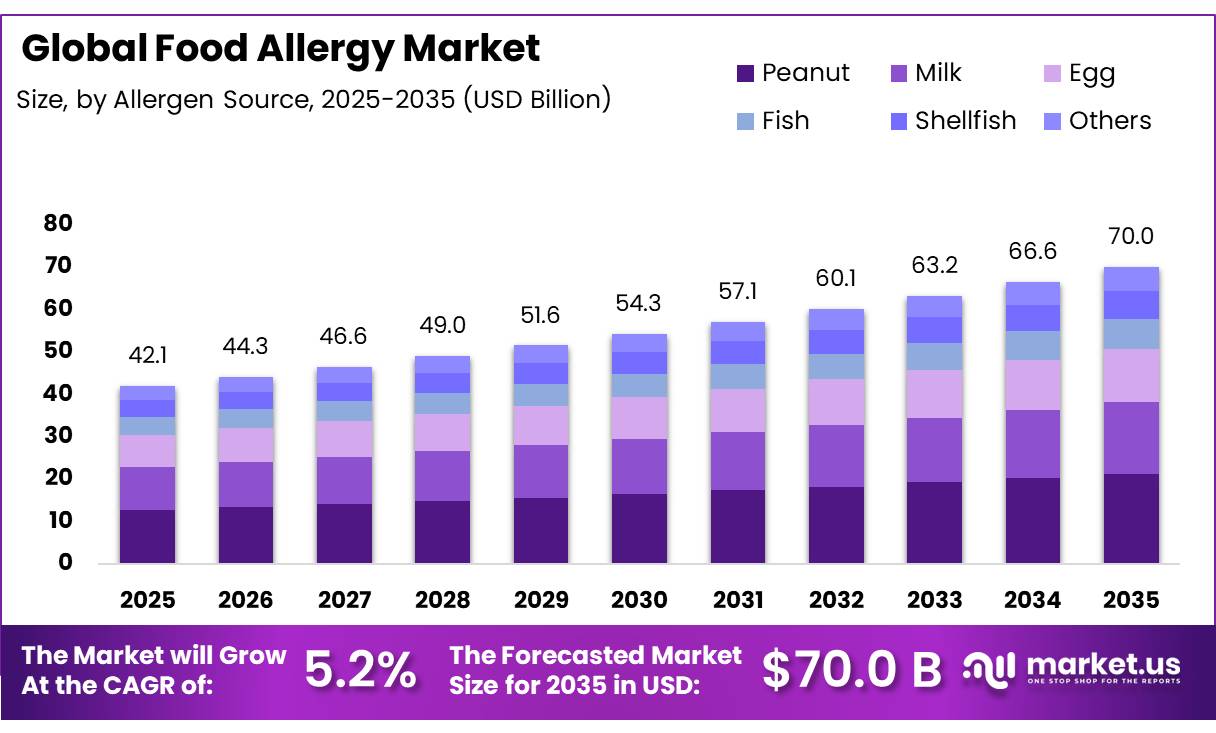
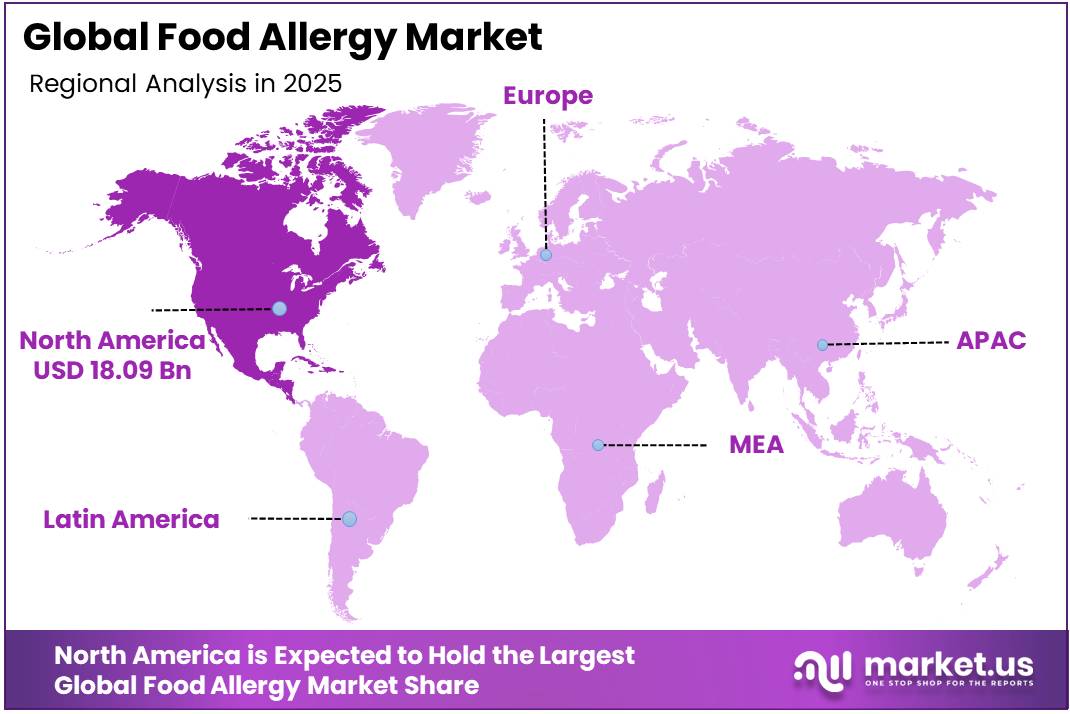
In 2025, the Global Food Allergy Market was valued at USD 42.1 billion, and between 2026 and 2035, this market is estimated to register a CAGR of 5.2%, reaching about USD 70.0 billion by 2035. North America held a dominant market position, capturing more than a 43.0% share, holding USD 18.09 billion in revenue.
The Food Allergy Market includes diagnostic services, emergency medicines, immunotherapies, specialist consultations, and pharmacy access for people vulnerable to severe reactions.
- The United States Centers for Disease Control and Prevention estimates that food allergies affect 8% of children, equal to about 2 students per classroom. It also reports that 40% of affected children have received emergency-department treatment, sustaining demand for rapid diagnosis, epinephrine availability, clinical monitoring, and coordinated care pathways across healthcare settings and pharmacies.
Key Takeaways
- The global food allergy market was valued at USD 42.1 billion in 2025.
- The global market is projected to grow at a CAGR of 5.2% and is estimated to reach USD 70.0 billion by 2035.
- On the basis of allergen source, peanut dominated the market, constituting 30.5% of the total market share.
- Based on treatment, antihistamines dominated the food allergy market, with a substantial market share of around 35.0%.
- Based on diagnosis, blood tests led the market, comprising 39.0% of the total market.
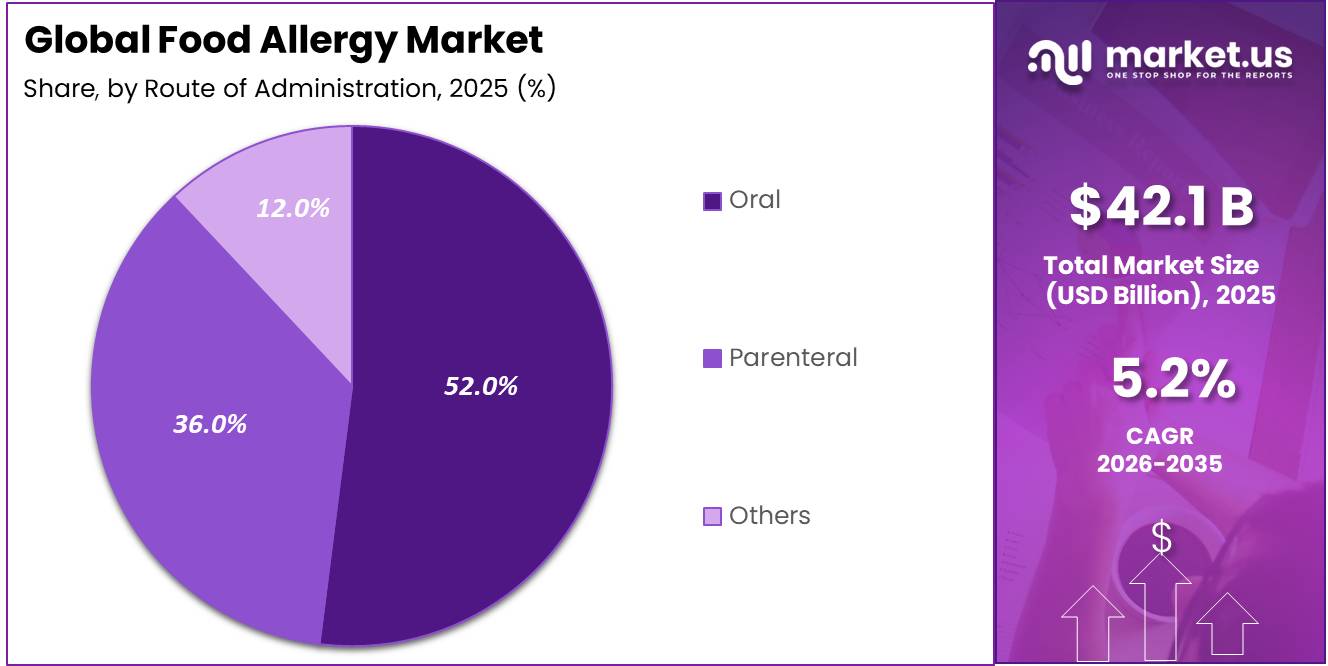
- Based on route of administration, oral administration held a major share in the food allergy market, accounting for 52.0% of the market share.
- Among end users, hospitals accounted for 42.0% of the food allergy market.
- Among distribution channels, hospital pharmacies accounted for around 43.0% of the market revenue.
- In 2025, North America was the most dominant region in the food allergy market, accounting for 43.0% of the total market share.
Treatment innovation is widening commercial opportunities beyond allergen avoidance and injectable rescue medicines. The United States Food and Drug Administration evaluated omalizumab through a controlled study involving 168 participants with peanut allergy and additional food allergies. Following treatment, 68% of recipients tolerated the tested peanut dose without moderate or severe symptoms, compared with 6% receiving placebo. These results support growth in biologics, specialist administration, patient monitoring, companion diagnostics, and reimbursement pathways for multi-food allergy management.
- In January 2026, the United States Food and Drug Administration posted a recall involving 12-ounce packaged foods distributed across 3 states after milk was omitted from product labels. The incident illustrates how routine inspection can uncover allergen-control failures, encouraging producers to strengthen supplier checks, packaging reviews, laboratory screening, employee training, and digital records before products reach consumer retail channels.
Government action is expanding emergency-treatment access and supporting product innovation. In March 2025, the United States Food and Drug Administration broadened approval of epinephrine nasal spray to children aged 4 years and older within the specified pediatric weight range. The authorized treatment delivers a 1 milligram dose through a single-use device. This initiative creates opportunities for needle-free rescue products, caregiver education, school preparedness, hospital protocols, pharmacy stocking, and distribution models designed to improve anaphylaxis response.
Allergen Source Analysis
Peanut Leads with a 30.50% Share as Diagnosis and Treatment Demand Expands
In 2025, Peanut held a dominant market position, capturing more than a 30.50% share of the Food Allergy Market. Its leadership reflects the high clinical attention given to peanut reactions, which can occur after accidental exposure and often require careful diagnosis, avoidance plans, emergency treatment, and specialist supervision. Strong awareness among caregivers, schools, food manufacturers, hospitals, and pharmacies also supports demand for peanut-specific testing, labeling, patient education, and immunotherapy services.
- For instance, in February 2025, according to the National Institutes of Health, researchers reported a treatment approach using gradually increased peanut butter doses for children with high-threshold peanut allergy, supporting further interest in supervised oral immunotherapy and personalized allergy care.
Milk is the growing segment because it remains a common allergen across infants, children, and adults and can appear in numerous processed foods. Demand is increasing for accurate diagnosis, clearer ingredient labeling, suitable nutritional substitutes, and treatment support. Hospitals, clinics, diagnostic centers, and pharmacies are expanding services for milk-allergic patients, while food producers are improving allergen controls, production separation, and packaging communication to reduce accidental exposure and strengthen consumer confidence.
Treatment Analysis
Antihistamines Lead with a 35.00% Share as Accessible Symptom Relief Supports Demand
In 2025, Antihistamines held a dominant market position, capturing more than a 35.00% share of the Food Allergy Market. Their leadership reflects broad use for relieving mild allergic symptoms such as itching, hives, swelling, and nasal discomfort after accidental food exposure. Easy availability, dosing formats, and use across hospitals, clinics, pharmacies, and home care support demand. They remain important as supportive medicines when patients require symptom control and medical observation.
- For instance, in March 2026, according to ARS Pharmaceuticals, the United States Food and Drug Administration approved updated labeling for neffy epinephrine nasal spray that removed the previous age requirement, widening access for eligible patients based on body weight.
Epinephrine/Adrenaline is the growing segment because it remains central to emergency treatment when food reactions progress to anaphylaxis. Demand is rising for auto-injectors, nasal delivery products, hospital supplies, school preparedness kits, and pharmacy stocking. Greater awareness of rapid treatment, caregiver training, emergency action plans, and needle-free administration is improving readiness among families and institutions. Product innovation that makes administration simpler and faster is supporting wider adoption across community and clinical settings.
Diagnosis Analysis
Blood Tests Lead with a 39.00% Share Through Accessible Laboratory Diagnosis
In 2025, Blood Tests held a dominant market position, capturing more than a 39.00% share of the Food Allergy Market. Their leadership was supported by sample collection, laboratory availability, and the ability to assess allergen-specific immunoglobulin E without exposing patients to suspected foods. Blood testing is useful when skin conditions, medicine use, age, or reaction risk may limit skin-based procedures. It also supports evaluation and planning across hospitals, clinics, and diagnostic centers.
- For instance, in June 2026, according to the United States Food and Drug Administration, the agency updated product classification information for allergen delivery needles used in skin-prick and intradermal allergy testing, clarifying their diagnostic purpose and regulatory pathway.
Skin-Prick Tests are the growing segment because they provide assessment of sensitization during a clinical visit. They require limited equipment, allow suspected allergens to be examined together, and give visible results for interpretation alongside medical history. Wider allergy awareness, specialist access, standardized extracts, trained staff, and demand for timely diagnosis are supporting their use in hospitals and clinics, particularly when physicians need confirmation before additional testing or supervised food challenges.
Route of Administration Analysis
Oral Administration Leads with a 52.00% Share Due to Convenient Treatment Delivery
In 2025, Oral held a dominant market position, capturing more than a 52.00% share of the Food Allergy Market. Its leadership was supported by the convenience of oral medicines and therapies used across care settings. Antihistamine tablets, liquid formulations, and supervised oral immunotherapy fit established care routines while supporting symptom management and desensitization. Familiar administration, flexible formulations, and patient acceptance continue to strengthen demand, particularly for long-term treatment and supportive care.
- For instance, in January 2025, according to the United States National Library of Medicine, a multicenter study evaluated subcutaneous dupilumab in children with peanut allergy, highlighting clinical interest in injectable biologic approaches for food-allergy management.
Parenteral is the growing segment because injectable treatment remains essential when severe reactions require rapid medical intervention or when biologic therapy is prescribed under supervision. Epinephrine auto-injectors support emergency response, while injectable monoclonal antibodies offer an additional pathway for reducing sensitivity to accidental exposure. Greater awareness of anaphylaxis preparedness, wider availability of emergency devices, caregiver training, and expanding specialist use of biologics are encouraging adoption across hospitals, clinics, schools, pharmacies, and community care environments.
End User Analysis
Hospitals Lead with a 42.00% Share Through Emergency and Specialist Care
In 2025, Hospitals held a dominant market position, capturing more than a 42.00% share of the Food Allergy Market. Their leadership reflects the need for emergency treatment, specialist evaluation, testing, monitored food challenges, and observation after severe reactions. Hospitals bring allergists, emergency physicians, nurses, dietitians, and diagnostic teams together, allowing patients to receive coordinated care. Access to epinephrine, resuscitation support, biologic administration, and monitoring further strengthens their role in complex cases and anaphylaxis management.
- For instance, in September 2025, according to the American Academy of Allergy, Asthma & Immunology, the organization held its Practice of Food Allergy virtual meeting, covering clinical procedures, nutrition, psychosocial support, billing, and standard operating practices for food allergy services.
Clinics are the growing segment because they provide accessible consultations, follow-up care, skin testing, treatment planning, and patient education closer to communities. Their appointment-based model supports routine monitoring and long-term management without hospital admission. Expanding allergist networks, specialized food allergy programs, supervised immunotherapy, digital scheduling, and coordinated referrals improve convenience. Clinics also help families review avoidance plans, emergency medicines, dietary concerns, and progress between hospital visits.
Distribution Channel Analysis
Hospital Pharmacies Lead with a 43.00% Share Through Integrated Prescription Access
In 2025, Hospital Pharmacies held a dominant market position, capturing more than a 43.00% share of the Food Allergy Market. Their leadership reflects direct access to emergency medicines, biologic therapies, antihistamines, and specialist prescriptions following hospital diagnosis or treatment. Pharmacists can coordinate closely with allergy teams, confirm medicine availability, explain administration, and support discharge planning. This integrated model is especially important for patients requiring monitored therapy, rapid replacement of rescue medicines, or continued care after severe allergic reactions.
- For instance, in October 2025, according to CVS Health, CVS Pharmacy continued its partnership with Food Allergy Research & Education as the exclusive pharmacy retail sponsor of the Teal Pumpkin Project, supporting safer community participation for children with food allergies.
Retail Pharmacies are the growing segment because they provide convenient neighborhood access to prescribed and over-the-counter allergy products. Their extended operating hours, refill services, pharmacist counselling, and broad distribution networks help patients maintain emergency preparedness. Growing awareness of anaphylaxis, wider availability of epinephrine products, digital prescription processing, and closer coordination with healthcare providers are supporting retail pharmacy use for ongoing food-allergy management.
Key Market Segments
By Allergen Source
- Peanut
- Milk
- Egg
- Fish
- Shellfish
- Others
By Treatment
- Antihistamines
- Epinephrine/Adrenaline
- Oral Immunotherapy
- Other Immunotherapies
- Others
By Diagnosis
- Blood Tests
- Skin-Prick Tests
- Oral Food Challenge
- Elimination Diet
- Others
By Route of Administration
- Oral
- Parenteral
- Others
By End User
- Hospitals
- Clinics
- Diagnostic Centers
- Ambulatory Surgical Centers
By Distribution Channel
- Hospital Pharmacies
- Retail Pharmacies
- Online Pharmacies
- Others
Driver Analysis
Biologic-enabled multi-food risk reduction adoption
FDA approval of omalizumab in February 2024 changed the food allergy market from a predominantly avoidance-and-emergency category into an active risk-reduction segment, because it created a reimbursable physician-managed intervention usable across multiple foods rather than only a single-allergen desensitization pathway.
That matters commercially because multi-food patients are often the highest-cost and highest-anxiety cohort, and the addressable treatment pool is material: U.S. public-health reporting in 2024 showed food allergy in 6.7% of adults and 5.3% of children, while NIH still frames the broader burden closer to about 8% of children and nearly 11% of adults depending on case definition and survey methodology.
Strategically, this driver shifts the business model toward recurring therapy revenue, monitoring visits, and combination care bundles, and it supports the estimated +2.2 percentage-point uplift because it widens the treatable population faster than clinic-built desensitization programs can scale.
Drivers Impact Analysis
| Driver | (~) % Impact on CAGR Forecast | Geographic Relevance | Impact Timeline |
|---|---|---|---|
| Biologic-enabled multi-food risk reduction adoption | +2.2% | North America core, EU tertiary centers, APAC premium urban markets | Short term (≤ 2 years) |
| Oral immunotherapy protocol expansion in specialty allergy clinics | +1.8% | U.S. core, Canada selective, Western Europe emerging, Australia developed corridors | Medium term (2-4 years) |
| Stricter allergen labeling and compliance-driven testing demand | +1.4% | U.S., EU, UK aligned markets, APAC export manufacturing hubs | Short term (≤ 2 years) |
| Persistent diagnosed prevalence and high patient-intensity burden | +1.6% | North America core, EU, Japan, South Korea, urban China | Medium term (2-4 years) |
| Molecular diagnostics and challenge reduction workflows | +1.1% | U.S. academic centers, EU hospital labs, developed APAC diagnostics hubs | Medium term (2-4 years) |
| New regulatory pathways improving allergen product commercialization | +0.9% | EU core, UK spill-over, selected global developers using Europe-first strategies | Long term (≥ 4 years) |
Restraint Analysis
Fragmented global labeling rules
The FDA enforces labeling for eight major allergens plus sesame in the U.S., yet has not formally defined quantitative threshold levels, leading to a reliance on good manufacturing practice and qualitative risk judgment rather than harmonized numerical benchmarks, while the EU mandates labeling for a wider set of 14 allergens and emphasizes clear labeling of allergens in both prepacked and non-prepacked foods.
Public discussions and position papers in 2025 and 2026 have called for harmonized European allergen monitoring and reviewed threshold concepts, but these initiatives are still in evolution, leaving manufacturers to adopt precautionary “may contain” practices inconsistently and sometimes over-label, which can reduce consumer trust and contribute to diet restriction without necessarily improving safety.
For the food allergy market, these regulatory frictions delay the launch of standardized global allergen-labeled product lines, slow international roll-out of innovative allergen-free brands, and discourage smaller firms from entering export markets due to perceived compliance risk, resulting in an estimated -1.5 percentage-point drag on CAGR in cross-border trade-dependent regions over a 2–4 year horizon.
Restraint Impact Analysis
| Restraint | (~) % Impact on CAGR | Geographic Relevance | Impact Timeline |
|---|---|---|---|
| High cost of care and products | -2.3% | North America core, EU, high-income APAC | Short term (≤ 2 years) |
| Complex allergen supply chains | -1.9% | Global branded food, APAC export hubs | Medium term (2-4 years) |
| Fragmented global labeling rules | -1.5% | EU, North America, APAC exporters | Medium term (2-4 years) |
| Limited specialist and OIT capacity | -1.8% | U.S. community clinics, EU regional centers, emerging APAC | Long term (≥ 4 years) |
| Payer and reimbursement friction for advanced therapies | -1.6% | U.S. commercial plans, EU mixed systems, Asia private-pay | Medium term (2-4 years) |
| Slow adoption of robust allergen management in SMEs | -1.2% | EU and APAC food SMEs, emerging markets | Long term (≥ 4 years) |
Opportunity Analysis
Integrated digital food allergy care platforms
Today’s apps mostly provide real-time environmental allergen data or community-based food-allergy content, but they are rarely integrated with EHRs, payer workflows, or specialty clinic scheduling, meaning that adherence tracking for complex treatments like oral immunotherapy or biologic regimens is still largely manual.
With U.S. adult food allergy prevalence above 10% in some surveys and children around 8%, even capturing 10–15% of this pool in North America and a smaller fraction in Europe and developed APAC would translate into a sizeable TAM in the mid-single-digit billions of recurring digital revenue annually, plus incremental drug adherence uplift improving therapy ROI for manufacturers. If executed over the next two years via partnerships between allergists, payers, and health-tech companies, this platform play could realistically add about +2.4 percentage points to the market CAGR by raising adherence, facilitating earlier diagnosis, and enabling new risk-based pricing models that sit entirely on top of current baseline growth.
Opportunity Impact Analysis
| Opportunity | (~) % Potential CAGR Upside | Geographic Relevance | Execution Window |
|---|---|---|---|
| Integrated digital food allergy care platforms | +2.4% | North America core, EU, developed APAC | Short term (≤ 2 years) |
| AI-enhanced precision diagnostics and risk stratification | +2.1% | NA/EU tertiary centers, APAC urban hospitals | Medium term (2-4 years) |
| Advanced food processing for reduced allergenicity product lines | +1.9% | Global CPG, APAC manufacturing hubs, EU retailers | Medium term (2-4 years) |
| Microbiome-based modulation and adjunct therapies | +1.7% | North America and EU early adopters | Long term (≥ 4 years) |
| Emerging-market allergy care networks and branded access models | +1.8% | Emerging Asia, Latin America, Middle East | Long term (≥ 4 years) |
| Enterprise cloud allergen-control and testing platforms | +1.5% | Global manufacturers, food-service chains | Medium term (2-4 years) |
Challenges Analysis
Complex multi-level allergen supply chains
Industry guidance highlights that over 170 food types can trigger reactions and that regulatory regimes recognize nine major allergens in the U.S. and up to 14 in the EU and UK, adding additional allergic sources like celery, lupin, mustard, sulphites, and sulphur dioxide, which means that the mapping of allergen risk across a modern supply chain is non-trivial and dynamic. To manage this, companies are expected to perform independent hazard analyses, determine critical control points, establish critical limits, and monitor and verify suppliers through certificates of analysis, regular audits, and occasional testing for undeclared allergens.
This challenge manifests as higher-than-ideal transaction costs per unit, extended lead times for new formulations, and cautious capacity expansions, resulting in an estimated -1.4 percentage-point friction drag on the market’s maximum growth potential with a mitigation horizon of 2–4 years as digital traceability, supplier collaboration platforms, and standardized practices diffuse across global supply chains.
Challenges Impact Analysis
| Challenge | (~) % CAGR Friction | Geographic Relevance | Mitigation Horizon |
|---|---|---|---|
| Limited access to advanced diagnostics | -1.7% | North America, EU, selected APAC | Long term (≥ 4 years) |
| Complex multi-level allergen supply chains | -1.4% | Global food manufacturers, APAC export hubs | Medium term (2-4 years) |
| Fragmented clinical data and outcome tracking | -1.2% | NA/EU health systems, APAC urban hospitals | Medium term (2-4 years) |
| Workforce and specialist capability constraints | -1.3% | U.S., EU regional centers, emerging markets | Long term (≥ 4 years) |
| Evolving and non-threshold-based regulatory expectations | -1.1% | U.S. regulatory hubs, EU, global exporters | Medium term (2-4 years) |
| Operationalizing rigorous HACCP-based allergen management | -1.0% | EU/NA manufacturers, APAC supply chains | Long term (≥ 4 years) |
Geopolitical Impact Analysis
Geopolitical Realignment and Cross-Border Regulation Reshaping the Food Allergy Market
Geopolitical disruption affects the Food Allergy Market because allergen-free products and seafood cross borders. United States Food and Drug Administration data show imports represent 15% of the food supply, from more than 200 countries or territories and 125,000 facilities and farms. Seafood dependence reaches 94%, increasing exposure to shipping restrictions.
- Trade policy affects procurement. The United States Trade Representative finalized Section 301 tariff increases reaching 100% for syringes, needles, and medical gloves, with implementation dates varying by product. These measures can raise costs for skin testing, injectable epinephrine, biologic administration, and hospital preparedness, while encouraging suppliers to qualify alternative manufacturers.
Regulatory enforcement is becoming more assertive across borders. On May 6, 2025, the Food and Drug Administration announced expanded unannounced inspections of foreign facilities producing foods, essential medicines, and medical products for United States consumers. Stronger scrutiny may interrupt supply, but improve confidence in allergen controls, medicine quality, and documentation.
International standard setting creates a separate opportunity. The 49th Codex Committee on Food Labelling met from May 11 to 15, 2026, with precautionary allergen-labelling guidance considered at Step 7. Greater alignment could reduce duplicated packaging, simplify exports, and improve consumer consistency, although national differences will continue shaping compliance costs globally.
Regional Analysis
North America Leads While Europe Expands Fastest
North America held the dominant position in the Food Allergy Market, capturing 43.00% of global revenue, equal to USD 18.09 billion. Leadership is supported by strong hospital access, widespread allergy testing, established pharmacy networks, and growing availability of emergency treatments.
- The Canadian Food Inspection Agency recorded 67 allergen-related food recalls during its latest fiscal reporting period, highlighting continued demand for diagnostic services, epinephrine products, labeling controls, patient education, and specialist allergy care across the region.
Europe is the fastest-growing region as healthcare providers, regulators, food producers, and pharmacies strengthen allergy diagnosis, labeling, and emergency-response systems. The latest Food Standards Agency survey found that 4% of respondents reported a food allergy. Among people managing food hypersensitivity, 87% trusted written information when identifying unsafe foods, compared with 63% who trusted verbal guidance.
Key Regions and Countries Covered
- North America
- The US
- Canada
- Europe
- Germany
- France
- The UK
- Spain
- Italy
- Russia & CIS
- Rest of Europe
- APAC
- China
- Japan
- South Korea
- India
- ASEAN
- Rest of APAC
- Latin America
- Brazil
- Mexico
- Rest of Latin America
- Middle East & Africa
- GCC
- South Africa
- Rest of MEA
Key Players Analysis
Food allergy companies compete through differentiated therapies, precise diagnostics, regulatory execution, and access across hospitals and pharmacies. In 2026, ALK-Abelló advanced its peanut-allergy tablet toward Phase 3 after reporting a successful Phase 2 outcome, while Roche and Genentech benefited from demand for Xolair across food allergy and allergic conditions. These developments strengthen competition around oral immunotherapy, biologics, emergency treatment, and patient management.
Diagnostic capability and commercial reach also influence market positioning. Thermo Fisher Scientific expanded molecular allergy testing with walnut and hazelnut components, helping laboratories distinguish primary sensitization from cross-reactivity. Regeneron Pharmaceuticals and Sanofi continued building their immunology pipeline, while Nestlé Health Science, DBV Technologies, Stallergenes Greer, and Allergy Therapeutics maintained positions through allergy portfolios and research programs.
Companies increasingly combine clinical evidence, physician education, manufacturing quality, reimbursement support, and regional partnerships to improve adoption, protect market presence, and build stronger relationships with specialists, diagnostic laboratories, pharmacies, caregivers, and patients.
Market Key Players
- Nestlé Health Science (Aimmune Therapeutics)
- ALK-Abelló A/S
- Hoffmann-La Roche Ltd/Genentech
- Novartis AG
- Sanofi S.A.
- Regeneron Pharmaceuticals, Inc.
- Thermo Fisher Scientific Inc.
- Danaher Corporation
- DBV Technologies S.A.
- Stallergenes Greer
- Allergy Therapeutics plc
- Viatris Inc.
- Teva Pharmaceutical Industries Ltd.
- Aravax Pty Ltd.
- Prota Therapeutics Pty Ltd.
Key Development
- In June 2026, DBV Technologies S.A. provided a regulatory update for the Biologics License Application of its VIASKIN Peanut Patch for peanut-allergic children aged four through seven years. The company continued working with the United States Food and Drug Administration to prepare the application for submission.
- In March 2026, Allergy Therapeutics plc reported positive biomarker results from its Phase I/IIa PROTECT trial of VLP Peanut. The findings followed achievement of the trial’s primary safety endpoint and supported the candidate’s immunomodulatory potential for treating peanut allergy.
- In April 2026, Aravax Pty Ltd. appointed Carsten Hellmann and Andrew Oxtoby to its Board of Directors. Their allergy-therapy development and commercialization experience is expected to support Phase 3 preparation for PVX108, the company’s peanut-allergy immunotherapy candidate.
Report Scope
| Report Features | Description |
|---|---|
| Market Value (2025) | USD 42.1 Bn |
| Forecast Revenue (2035) | USD 70.0 Bn |
| CAGR (2026-2035) | 5.2% |
| Base Year for Estimation | 2025 |
| Historic Period | 2020-2024 |
| Forecast Period | 2026-2035 |
| Report Coverage | Revenue Forecast, Market Dynamics, Competitive Landscape, Recent Developments |
| Segments Covered | By Allergen Source (Peanut, Milk, Egg, Fish, Shellfish, and Others), By Treatment (Antihistamines, Epinephrine/Adrenaline, Oral Immunotherapy, Other Immunotherapies, and Others), By Diagnosis (Blood Tests, Skin-Prick Tests, Oral Food Challenge, Elimination Diet, and Others), By Route of Administration (Oral, Parenteral, and Others), By End User (Hospitals, Clinics, Diagnostic Centers, and Ambulatory Surgical Centers), By Distribution Channel (Hospital Pharmacies, Retail Pharmacies, Online Pharmacies, and Others) |
| Regional Analysis | North America – The US & Canada; Europe – Germany, France, The UK, Spain, Italy, Russia & CIS, Rest of Europe; APAC– China, Japan, South Korea, India, ASEAN & Rest of APAC; Latin America– Brazil, Mexico & Rest of Latin America; Middle East & Africa– GCC, South Africa, & Rest of MEA |
| Competitive Landscape | Nestlé Health Science (Aimmune Therapeutics), ALK-Abelló A/S, F. Hoffmann-La Roche Ltd/Genentech, Novartis AG, Sanofi S.A., Regeneron Pharmaceuticals, Inc., Thermo Fisher Scientific Inc., Danaher Corporation, DBV Technologies S.A., Stallergenes Greer, Allergy Therapeutics plc, Viatris Inc., Teva Pharmaceutical Industries Ltd., Aravax Pty Ltd., and Prota Therapeutics Pty Ltd. |
| Customization Scope | Customization for segments, region/country-level will be provided. Moreover, additional customization can be done based on the requirements. |
| Purchase Options | We have three licenses to opt for: Single User License, Multi-User License (Up to 5 Users), Corporate Use License (Unlimited Users and Printable PDF) |





































