


Market Overview
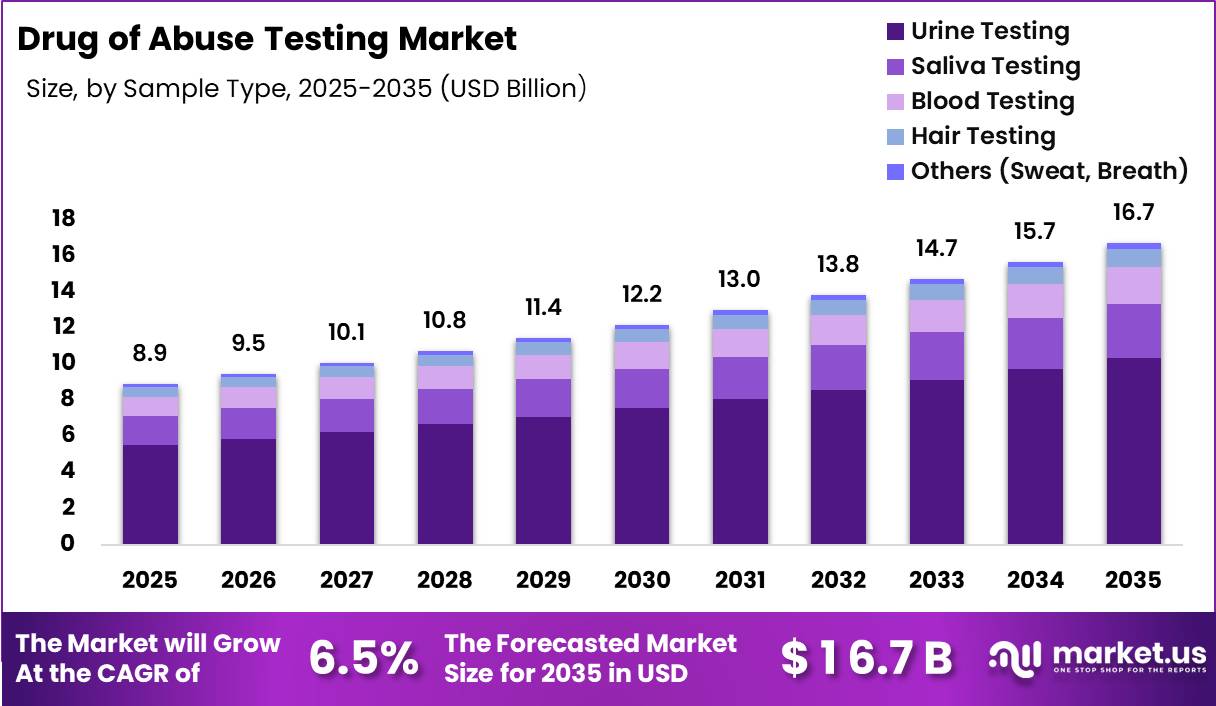
Global Drug of Abuse Testing Market size is expected to be worth around US$ 16.7 Billion by 2035 from US$ 8.9 Billion in 2025, growing at a CAGR of 6.5% during the forecast period from 2026 to 2035. In 2025, North America led the market, achieving over 43.0% share with a revenue of US$ 3.8 Billion.
The global Drug of Abuse Testing Market is witnessing sustained growth as healthcare providers, employers, law enforcement agencies, and government organizations strengthen efforts to detect substance misuse and improve public safety. Drug testing has become an essential component of workplace safety programs, clinical toxicology, rehabilitation monitoring, criminal justice systems, and emergency healthcare.
Advances in immunoassay screening, chromatography, mass spectrometry, and rapid point-of-care testing have improved analytical accuracy while reducing turnaround times. Growing adoption of oral fluid testing, alongside traditional urine-based screening, is further expanding testing options for employers and healthcare facilities.
According to the U.S. Substance Abuse and Mental Health Services Administration (SAMHSA), federal workplace drug testing programs now support both urine and oral fluid specimen testing through certified laboratories under updated mandatory guidelines, reflecting continued modernization of testing practices.
The market is also supported by increasing regulatory oversight and the rising need for reliable toxicology testing amid ongoing substance use challenges. SAMHSA reports that federally regulated drug testing includes five primary drug categories: amphetamines, cocaine, marijuana, opioids/opiates, and phencyclidine (PCP).
Updated federal testing guidelines also authorize fentanyl testing effective from July 7, 2025, strengthening surveillance for synthetic opioids. In addition, testing is performed exclusively through HHS-certified laboratories, with Medical Review Officers verifying positive results to ensure accuracy and compliance.
These developments are encouraging healthcare providers and employers to invest in advanced testing platforms that deliver rapid, reliable, and standardized results while supporting prevention, treatment, and workplace safety initiatives.
Key Takeaways
- Market Size: Global Drug of Abuse Testing Market size is expected to be worth around US$ 16.7 Billion by 2035 from US$ 8.9 Billion in 2025.
- Market Share: The market is growing at a CAGR of 6.5% during the forecast period from 2026 to 2035.
- Sample Type: Urine Testing dominates the Drug of Abuse Testing Market, accounting for 62.0% of the market share in 2025.
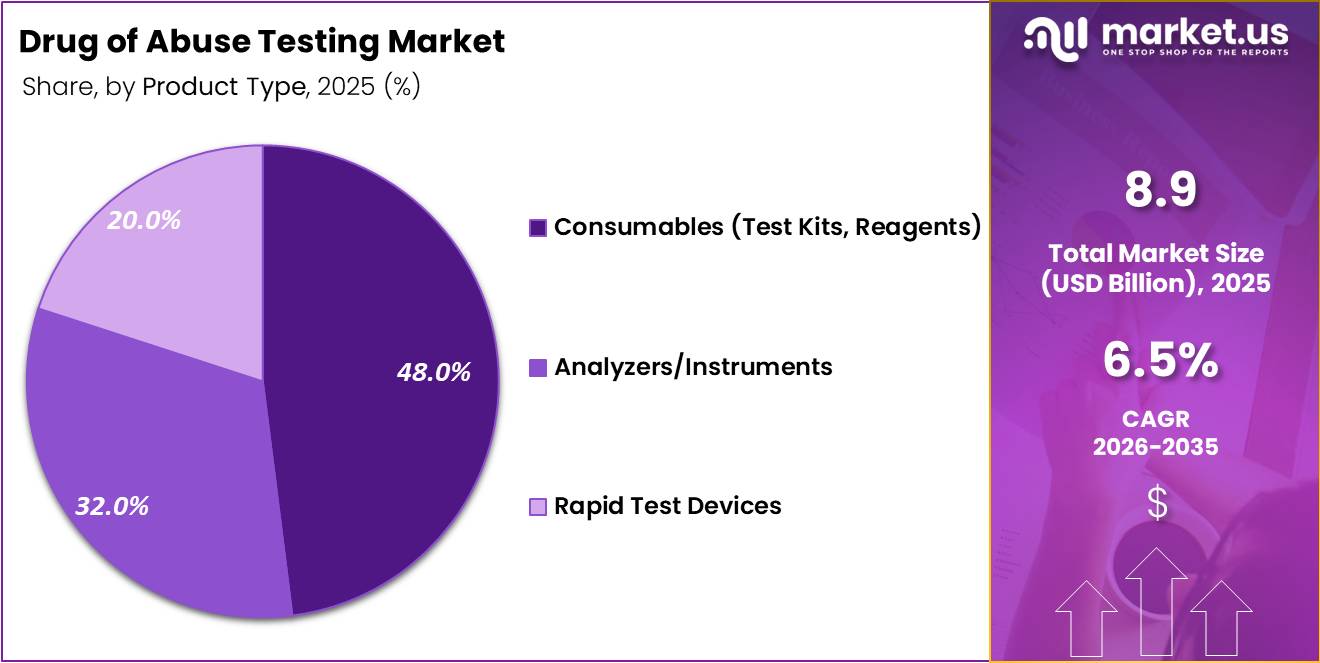
- Product Type: Consumables (Test Kits, Reagents) lead the Drug of Abuse Testing Market with 48.0% market share in 2025.
- Test Type: Immunoassay Testing accounts for 55.0% of the Drug of Abuse Testing Market in 2025.
- End User: Workplace Testing dominates the Drug of Abuse Testing Market with 34.0% market share in 2025.
- Drug Type Tested: Cannabis (THC) leads the Drug of Abuse Testing Market with 31.0% market share in 2025.
- Distribution Channel: Hospital Pharmacies account for 41.0% of the Drug of Abuse Testing Market in 2025.
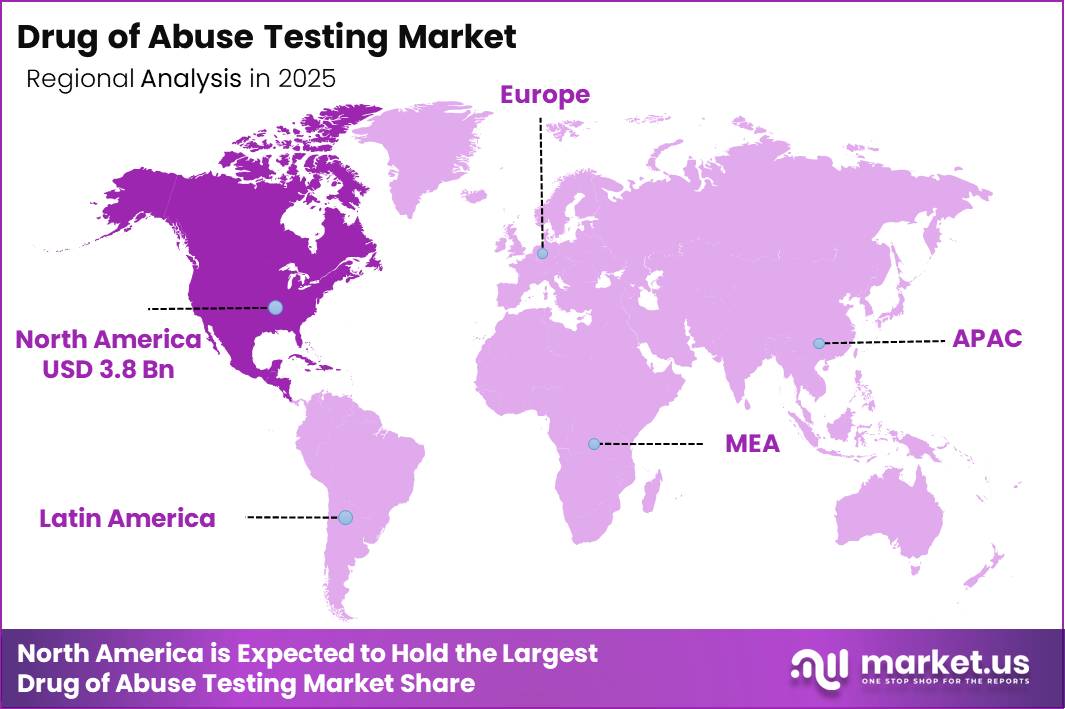
- Regional Analysis: In 2025, North America led the market, achieving over 43.0% share with a revenue of US$ 3.8 Billion.
Sample Type Analysis
Urine Testing dominates the Drug of Abuse Testing Market.
Urine Testing dominates the Drug of Abuse Testing Market, accounting for 62.0% of the market share in 2025 due to its widespread acceptance, cost-effectiveness, and ability to detect a broad range of illicit and prescription drugs over a practical detection window.
It remains the preferred sample type for workplace screening, pre-employment testing, law enforcement, rehabilitation programs, and clinical diagnostics because collection procedures are standardized and supported by well-established regulatory guidelines. Urine testing is also compatible with both rapid screening kits and laboratory confirmation methods, making it suitable for high-volume testing environments while maintaining reliable analytical performance.
Saliva Testing (18.0%) is gaining adoption because of its non-invasive collection process, reduced risk of sample adulteration, and effectiveness in identifying recent drug consumption, particularly for roadside and workplace testing. Blood Testing (12.0%) provides highly accurate confirmation of current drug intoxication and is frequently used in emergency medicine and forensic investigations despite its invasive nature.
Hair Testing (6.0%) supports long-term drug use assessment over several months and is increasingly utilized in legal and employment-related cases requiring historical substance use records. Others (Sweat, Breath) (2.0%) occupy a niche role, serving specialized monitoring applications, including continuous drug surveillance and alcohol detection in correctional, transportation, and rehabilitation settings.
Product Type Analysis
Consumables lead the Drug of Abuse Testing Market.
Consumables (Test Kits, Reagents) lead the Drug of Abuse Testing Market with 48.0% market share in 2025, driven by recurring demand across hospitals, diagnostic laboratories, workplace screening programs, rehabilitation centers, and law enforcement agencies. Every screening procedure requires fresh test kits, reagents, calibrators, and quality-control materials, creating continuous purchasing cycles regardless of instrument ownership.
The increasing volume of routine drug screening, combined with rapid testing adoption and expanding compliance requirements, continues to strengthen demand for consumables. Manufacturers also introduce multi-drug panels and improved reagents to enhance testing accuracy and workflow efficiency.
Analyzers/Instruments (32.0%) represent the second-largest segment, supported by growing investments in automated laboratory systems capable of handling large testing volumes with greater precision and standardized reporting. Advanced analyzers integrated with laboratory information systems improve productivity and reduce manual intervention.
Rapid Test Devices (20.0%) continue to experience steady growth because they provide immediate results at the point of care without requiring sophisticated laboratory infrastructure. These portable devices are widely used for workplace testing, roadside drug screening, emergency departments, schools, and rehabilitation centers where rapid clinical or operational decisions are essential.
Continuous technological improvements are expanding the sensitivity, portability, and ease of use of rapid testing products.
Test Type Analysis
Immunoassay Testing dominates the Drug of Abuse Testing Market.
Immunoassay Testing accounts for 55.0% of the Drug of Abuse Testing Market in 2025, making it the leading testing method because of its rapid turnaround time, affordability, and suitability for high-volume screening. Immunoassays enable simultaneous detection of multiple drug classes using automated laboratory analyzers or rapid point-of-care devices.
The technique is widely adopted across hospitals, clinical laboratories, workplace testing programs, rehabilitation centers, and criminal justice settings as the primary screening approach before confirmatory analysis. Continuous improvements in antibody specificity and automation further enhance testing efficiency while supporting large-scale screening initiatives.
Chromatography (GC-MS/LC-MS) remains the gold standard for confirmatory drug analysis owing to its exceptional sensitivity, specificity, and ability to accurately identify individual drug compounds and metabolites. These systems are extensively utilized in forensic laboratories, toxicology centers, and reference laboratories where legally defensible results are required.
Point-of-Care Testing continues to expand as healthcare providers, employers, and law enforcement agencies increasingly require immediate test outcomes outside conventional laboratories. Portable testing devices support faster clinical decisions, roadside enforcement, emergency care, and workplace compliance programs while reducing turnaround times and improving operational efficiency in decentralized testing environments.
End User Analysis
Workplace Testing dominates the Drug of Abuse Testing Market.
Workplace Testing dominates the Drug of Abuse Testing Market with 34.0% market share in 2025, supported by stringent occupational safety regulations, corporate drug-free workplace policies, and increasing pre-employment and random employee screening programs.
Industries including transportation, manufacturing, construction, mining, and energy continue to implement comprehensive testing protocols to minimize workplace accidents, improve productivity, and maintain regulatory compliance. Employers increasingly rely on both laboratory-based and rapid testing solutions to ensure workforce safety while reducing operational risks associated with substance misuse.
Criminal Justice & Law Enforcement represents a significant application segment, utilizing drug testing for probation monitoring, roadside enforcement, correctional facilities, and forensic investigations. Hospitals & Clinics continue to expand testing volumes due to emergency toxicology assessments, overdose management, and routine clinical diagnostics supporting patient care.
Drug Rehabilitation Centers extensively employ repeated drug testing to monitor treatment progress, verify patient compliance, and reduce relapse risks throughout recovery programs. Others include educational institutions, military organizations, sports authorities, and community health initiatives where drug screening supports public safety, regulatory compliance, and preventive healthcare.
Growing awareness of substance abuse and expanding government initiatives continue to strengthen demand across all end-user categories.
Drug Type Tested Analysis
Cannabis (THC) leads the Drug of Abuse Testing Market.
Cannabis (THC) leads the Drug of Abuse Testing Market with 31.0% market share in 2025, reflecting its widespread consumption, evolving legalization policies, and continued workplace and forensic screening requirements.
Despite changing regulatory frameworks in several countries, employers, transportation authorities, and law enforcement agencies continue to routinely screen for THC because impairment can significantly affect workplace safety and public health. The availability of reliable multi-panel screening kits and confirmatory laboratory methods further supports the high testing volume associated with cannabis detection.
Opioids represent another major testing segment due to the continuing global burden of prescription opioid misuse and illicit opioid abuse, prompting extensive screening in healthcare facilities, rehabilitation programs, and forensic investigations.
Cocaine testing remains important within workplace, criminal justice, and emergency healthcare settings because of its stimulant effects and associated public safety concerns. Amphetamines are routinely included in standard drug panels owing to increasing misuse of both prescription stimulants and illicit methamphetamine.
Benzodiazepines continue to generate consistent testing demand because of widespread therapeutic use and potential abuse. Others include barbiturates, methadone, synthetic cannabinoids, phencyclidine, and emerging psychoactive substances requiring specialized analytical detection methods.
Distribution Channel Analysis
Hospital Pharmacies leads the Drug of Abuse Testing Market.
Hospital Pharmacies account for 41.0% of the Drug of Abuse Testing Market in 2025, making them the largest distribution channel due to their central role in supplying diagnostic consumables, rapid test kits, reagents, and laboratory products within healthcare facilities.
Hospitals maintain consistent procurement cycles to support emergency departments, toxicology laboratories, intensive care units, and outpatient services where timely drug screening is essential for diagnosis and treatment decisions. Strong relationships between manufacturers and hospital procurement networks further strengthen this distribution channel.
Direct Sales (B2B) represents a substantial segment as manufacturers increasingly supply diagnostic laboratories, workplace testing providers, government agencies, rehabilitation centers, and forensic laboratories through dedicated commercial agreements. This approach enables customized service, technical support, bulk procurement, and long-term supply contracts.
Online Platforms are expanding rapidly as healthcare providers and authorized diagnostic facilities increasingly adopt digital procurement channels for purchasing test kits, reagents, consumables, and accessories.
E-commerce platforms improve purchasing convenience, inventory management, and product accessibility, particularly for decentralized healthcare providers and smaller diagnostic centers, supporting broader market penetration and efficient supply chain management.
Key Market Segments
Sample Type
- Urine Testing
- Saliva Testing
- Blood Testing
- Hair Testing
- Others (Sweat, Breath)
Product Type
- Consumables (Test Kits, Reagents)
- Analyzers/Instruments
- Rapid Test Devices
Test Type
- Immunoassay Testing
- Chromatography (GC-MS/LC-MS)
- Point-of-Care Testing
End User
- Workplace Testing
- Criminal Justice & Law Enforcement
- Hospitals & Clinics
- Drug Rehabilitation Centers
- Others
Drug Type Tested
- Cannabis (THC)
- Opioids
- Cocaine
- Amphetamines
- Benzodiazepines
- Others
Distribution Channel
- Hospital Pharmacies
- Direct Sales (B2B)
- Online Platforms
Drivers
Fentanyl led polysubstance surveillance demand.
Synthetic opioids remain the main structural demand engine for drugofabuse testing even as overall overdose deaths have started to fall, because the market responds more to complexity of detection than to a single year’s mortality direction.
CDC states that 2023 overdose deaths were still heavily shaped by synthetic opioids, primarily illicit fentanyl, and NIDA notes that the vast majority of recent overdose deaths involved illicitly manufactured fentanyl and other potent synthetic opioids, often mixed into other drugs without user awareness.
CDC’s provisional dashboard, updated in May 2026, also continues to track synthetic opioids, cocaine, and psychostimulants as overlapping categories, which is commercially important because one death or one suspected exposure can implicate multiple analytes and justify broader screening menus rather than narrow singleclass tests.
| Driver | (~) % Impact on CAGR Forecast | Geographic Relevance | Impact Timeline |
|---|---|---|---|
| Fentanyl-led polysubstance surveillance demand | +1.6% | North America core, selected EU toxicology centers, APAC urban hospitals | Short term (≤ 2 years) |
| Oral-fluid workplace testing adoption | +1.2% | U.S. federal transport core, North America employer base, Australia spill-over | Short term (≤ 2 years) |
| CMS reimbursement discipline favoring medically necessary testing | +0.9% | U.S. clinical labs, pain clinics, addiction treatment networks | Medium term (2-4 years) |
| Shift from presumptive strips to instrument-based confirmatory panels | +1.1% | U.S. and EU reference labs, hospital labs, large employer programs | Medium term (2-4 years) |
| Expansion of decentralized and home-use screening pathways | +0.8% | North America retail and telehealth channels, EU self-care pockets | Medium term (2-4 years) |
| Better overdose data infrastructure and public-health response procurement | +0.7% | U.S. state labs, public-health agencies, sentinel hospital systems | Long term (≥ 4 years) |
Challenges
Adulterant detection complexity in evolving illicit drug markets.
The evolving illicit drug landscape is placing increasing pressure on traditional toxicology testing workflows. Conventional immunoassay panels, primarily designed for opioids, amphetamines, cannabis, and cocaine, are often inadequate for detecting emerging substances such as fentanyl analogs, norfentanyl, and xylazine, which frequently require dedicated screening assays or LC-MS/MS confirmation.
The FDA’s 2026 authorization of a urine visual test for norfentanyl at a 5 ng/mL cutoff highlights the continued development of substance-specific assays rather than universal screening platforms. At the same time, research from NIH/NIDA and Johns Hopkins demonstrates variable urine detection windows, ranging from approximately 0.5–5.5 days for fentanyl, 2.7–10.7 days for norfentanyl, and 0.6–5.1 days for xylazine.
These variations increase uncertainty in specimen timing, cutoff selection, and false-negative risk. Consequently, laboratories experience an estimated 8–15% increase in per-specimen testing costs, higher reflex confirmation rates, and longer turnaround times, driving demand for modular assay menus, frequent validation, and region-specific surveillance.
| Challenge | (~) % CAGR Friction Drag | Geographic Relevance | Mitigation Horizon |
|---|---|---|---|
| Adulterant detection complexity | -1.3% | North America core, EU toxicology centers, APAC urban labs | Medium term (2-4 years) |
| Confirmatory capacity bottlenecks | -1.1% | U.S. reference-lab corridors, EU regulatory hubs, GCC import-dependent labs | Medium term (2-4 years) |
| Laboratory workforce attrition | -1.0% | North America core, rural U.S., Western Europe, ANZ | Long term (≥ 4 years) |
| CLIA-compliance operating drag | -0.8% | U.S. provider-office labs, hospital toxicology networks, independent labs | Short term (≤ 2 years) |
| Reimbursement code-price lag | -0.9% | U.S. Medicare-exposed labs, hospital outreach labs, national reference chains | Medium term (2-4 years) |
| Demand-pattern volatility | -0.7% | North America core, public-sector screening programs, employer testing channels | Medium term (2-4 years) |
Restraints
Regulatory complexity and timetoapproval for DoA IVDs.
The second restraint is the high regulatory friction around drug of abuse invitro diagnostics, where the U.S. FDA treats most DoA tests as Class II devices requiring 510(k) clearance, detailed toxicology evaluation, and, for homeuse or OTC products, additional usability and labeling requirements, while other major markets impose their own conformity assessments and performance standards.
In the U.S., device sponsors must generate analytical and clinical performance data across multiple matrices, show robust cutoff sensitivity and specificity aligned with federal workplace panels, and then navigate 510(k) reviews that can realistically stretch 9 to 18 months for novel configurations, particularly when combined panels or new collection kits are involved.
Parallel to this, federal Mandatory Guidelines for federal workplace programs periodically revise panel compositions and cutoffs such as expanded opioid coverage, forcing manufacturers and laboratories to revalidate assays and instruments, tying up RD and validation capacity for 6 to 12 months with minimal incremental revenue.
When these lag times are embedded into productlaunch models, the practical outcome is a 2 to 3 year delay between technological readiness and full commercial ramp in key markets, which, even under conservative assumptions of 20 to 25% of future revenues tied to new assay generations, equates to an estimated 1.5% point reduction in global DoA testing CAGR over the 2026 baseline horizon, particularly in the U.S., EU notifiedbody regimes, and highly regulated GCC and East Asian markets.
| Restraint | (~) % Impact on CAGR Forecast | Geographic Relevance | Impact Timeline |
|---|---|---|---|
| Fragmented and restrictive workplace drug-testing laws | -1.8% | North America, EU, selective APAC | Long term (≥ 4 years) |
| Regulatory complexity and time-to-approval for DoA IVDs | -1.5% | U.S., EU, Japan, Middle East | Medium term (2-4 years) |
| Lab capacity constraints and qualified workforce shortage | -1.4% | North America, EU, India, Latin America | Medium term (2-4 years) |
| Cost pressures and payer constraints on confirmatory testing | -1.2% | U.S., EU, public-payer markets | Short–Medium term (≤ 4 years) |
| Transition to oral fluid and multi-matrix testing standards | -1.0% | U.S., Canada, EU, Australia | Short–Medium term (≤ 4 years) |
| Data privacy, consent, and litigation risk in non-federal settings | -0.9% | North America, EU, high-income APAC | Long term (≥ 4 years) |
Opportunity
Oral-Fluid Workplace Testing Conversion and Compliance Upside.
Routine urine-based workplace drug testing is already well established, making the transition to oral fluid testing a significant market opportunity rather than a core growth driver. The greatest potential lies in shifting existing testing volumes toward faster, more convenient oral fluid workflows that increase testing frequency while reducing operational complexity.
This opportunity has become more practical following the implementation of updated federal workplace drug testing guidelines by the U.S. Department of Health and Human Services (HHS) and SAMHSA, effective July 7, 2025, which formally recognize certified oral fluid testing alongside urine testing. HHS-certified urine and oral fluid laboratories are expected to remain the foundation of compliant workplace testing programs.
Oral fluid testing offers several operational advantages, including simplified specimen collection, reduced need for same-sex observers, lower collection-site infrastructure requirements, and improved suitability for random, post-incident, and mobile workforce testing.
These benefits are expected to increase annual testing events per covered employee by approximately 10% to 18%, reduce collection-related costs by 15% to 25%, and improve gross margins by 300 to 600 basis points for vertically integrated providers that manage both collection services and laboratory confirmation.
Additionally, companies that bundle oral fluid testing with compliance software, mobile collection networks, and Medical Review Officer (MRO) services can generate recurring revenue streams, supporting market growth of approximately 2.1% points above the baseline CAGR.
| Opportunity | (~) % Potential CAGR Upside | Geographic Relevance | Execution Window |
|---|---|---|---|
| Oral-fluid workplace shift | +2.1% | North America core, EU | Short term (≤ 2 years) |
| Novel adulterant panel expansion | +1.8% | U.S. Northeast, Midwest, Canada | Short term (≤ 2 years) |
| ED-to-recovery reflex testing | +1.6% | U.S. urban systems, EU metros | Medium term (2-4 years) |
| Harm-reduction diagnostics bundling | +1.9% | North America, Western Europe | Medium term (2-4 years) |
| Home-collection telehealth toxicology | +2.3% | U.S., Canada, Australia | Medium term (2-4 years) |
| Public-sector lab roll-up platforms | +1.4% | U.S. states, EU, LATAM public buyers | Long term (≥ 4 years) |
Regional Analysis
North America dominated the Drug of Abuse Testing Market in 2025.
In 2025, North America dominated the Drug of Abuse Testing Market, accounting for over 43.0% of the global market and generating approximately US$ 3.8 billion in revenue. The region’s leadership is supported by widespread implementation of workplace drug screening programs, strict regulatory requirements for safety-sensitive industries, and a well-established healthcare and laboratory infrastructure.
Drug testing is routinely conducted across transportation, manufacturing, law enforcement, healthcare, and government sectors to promote workplace safety and regulatory compliance. The presence of advanced diagnostic laboratories, high adoption of rapid testing technologies, and continuous investments in toxicology services further strengthen regional market growth.
The United States represents the largest contributor within North America, driven by extensive pre-employment, random, and post-incident drug testing across both public and private organizations. Increasing concerns regarding opioid misuse, synthetic drug consumption, and substance abuse among adolescents and adults have encouraged broader adoption of urine, saliva, blood, and hair testing methods.
Canada also contributes steadily through growing awareness of substance abuse, expansion of rehabilitation programs, and increased demand for testing in occupational health and clinical settings. Technological advancements, including highly sensitive immunoassays, portable point-of-care testing devices, and laboratory automation, continue to improve testing accuracy and turnaround times.
Furthermore, ongoing collaborations between healthcare providers, employers, and government agencies to strengthen substance abuse prevention and monitoring programs are expected to sustain North America’s leading position in the Drug of Abuse Testing Market throughout the forecast period.
Key Regions and Countries
North America
- The US
- Canada
Europe
- Germany
- France
- The U.K.
- Italy
- Spain
- Russia & CIS
- Rest of Europe
Asia Pacific
- China
- India
- Japan
- South Korea
- ASEAN
- Australia & New Zealand
- Rest of Asia Pacific
Middle East & Africa
- GCC
- South Africa
- Rest of Middle East & Africa
Latin America
- Brazil
- Mexico
- Rest of Latin America
Key Player Analysis
The Drug of Abuse Testing Market is moderately consolidated, with leading diagnostic manufacturers and laboratory service providers competing through technological innovation, product reliability, and broad testing portfolios.
Companies are increasingly focused on developing rapid, highly sensitive, and automated drug screening solutions that meet the growing demand from healthcare facilities, workplaces, forensic laboratories, and law enforcement agencies. Competition is driven by continuous improvements in testing accuracy, workflow efficiency, and regulatory compliance.
Among the leading participants, Thermo Fisher Scientific Inc., Abbott Laboratories, Roche Diagnostics, Siemens Healthineers AG, and Danaher Corporation maintain strong market positions through sustained investments in research and development, strategic collaborations, and product innovation.
These companies continue to expand their immunoassay platforms, laboratory automation systems, and point-of-care testing capabilities while integrating digital workflow solutions to improve sample management and reporting efficiency. Their competitive strategies also emphasize ecosystem-based offerings that combine instruments, reagents, software, and laboratory connectivity into comprehensive testing solutions.
By strengthening partnerships with healthcare providers, clinical laboratories, and occupational health organizations, these companies enhance operational efficiency and support faster, more reliable drug testing across clinical, workplace, and forensic applications, reinforcing their leadership in the evolving Drug of Abuse Testing Market.
Top Key Players
- Thermo Fisher Scientific Inc.
- Roche Diagnostics
- Abbott Laboratories
- Siemens Healthineers AG
- Danaher Corporation
- bioMérieux SA
- Quest Diagnostics Inc.
- Labcorp Holdings Inc.
- Lifeloc Technologies Inc.
- Drägerwerk AG
- OraSure Technologies Inc.
- Abbott Rapid Diagnostics
- IDEXX Laboratories Inc.
- Randox Laboratories Ltd.
- Premier Biotech Inc.
Recent Developments
- In October 2025, Thermo Fisher Scientific Inc. announced a definitive agreement to acquire Clario Holdings, Inc. for approximately USD 8.88 billion. The acquisition strengthens Thermo Fisher’s clinical research and digital trial capabilities by adding advanced endpoint data solutions, imaging, and wearable data technologies that support faster and more efficient drug development.
- In August 2025, Quest Diagnostics Inc. completed the acquisition of select clinical testing assets from Fresenius Medical Care’s Spectra Laboratories. The deal expands Quest’s renal diagnostics portfolio and supports long-term laboratory service agreements for dialysis centers, strengthening its specialty diagnostics network.
- In February 2026, Labcorp Holdings Inc. announced a strategic investment to build a 500,000-square-foot state-of-the-art Central Laboratory facility. The expansion is designed to increase testing capacity, support growing demand for specialty diagnostics, and improve laboratory workflow efficiency.
- In March 2026, Abbott Laboratories completed the acquisition of Exact Sciences, significantly expanding its presence in cancer diagnostics and molecular testing. The transaction enhances Abbott’s diagnostics portfolio and strengthens its position in precision medicine and advanced laboratory testing.
Report Scope
| Report Features | Description |
|---|---|
| Market Value (2025) | US$ 8.9 Billion |
| Forecast Revenue (2035) | US$ 16.7 Billion |
| CAGR (2026-2035) | 6.5% |
| Base Year for Estimation | 2025 |
| Historic Period | 2020-2024 |
| Forecast Period | 2026-2035 |
| Report Coverage | Revenue Forecast, Market Dynamics, Competitive Landscape, Recent Developments |
| Segments Covered | By Sample Type (Urine Testing, Saliva Testing, Blood Testing, Hair Testing, Others (Sweat, Breath)), By Product Type (Consumables (Test Kits, Reagents), Analyzers/Instruments, Rapid Test Devices), By Test Type (Immunoassay Testing, Chromatography (GC-MS/LC-MS), Point-of-Care Testing), By End User (Workplace Testing, Criminal Justice & Law Enforcement, Hospitals & Clinics, Drug Rehabilitation Centers, Others), By Drug Type Tested (Cannabis (THC), Opioids, Cocaine, Amphetamines, Benzodiazepines, Others), By Distribution Channel (Hospital Pharmacies, Direct Sales (B2B), Online Platforms) |
| Regional Analysis | North America – The US, Canada; Europe – Germany, France, U.K., Italy, Spain, Russia & CIS, Rest of Europe; Asia Pacific – China, India, Japan, South Korea, ASEAN, Australia & New Zealand, Rest of Asia Pacific; Middle East & Africa – GCC, South Africa, Rest of Middle East & Africa; Latin America – Brazil, Mexico, Rest of Latin America |
| Competitive Landscape | Thermo Fisher Scientific Inc., Roche Diagnostics, Abbott Laboratories, Siemens Healthineers AG, Danaher Corporation, bioMérieux SA, Quest Diagnostics Inc., Labcorp Holdings Inc., Lifeloc Technologies Inc., Drägerwerk AG, OraSure Technologies Inc., Abbott Rapid Diagnostics, IDEXX Laboratories Inc., Randox Laboratories Ltd., Premier Biotech Inc. |
| Customization Scope | Customization for segments, region/country-level will be provided. Moreover, additional customization can be done based on the requirements. |
| Purchase Options | We have three licenses to opt for: Single User License, Multi-User License (Up to 5 Users), Corporate Use License (Unlimited User and Printable PDF) |





































