


Report Overview
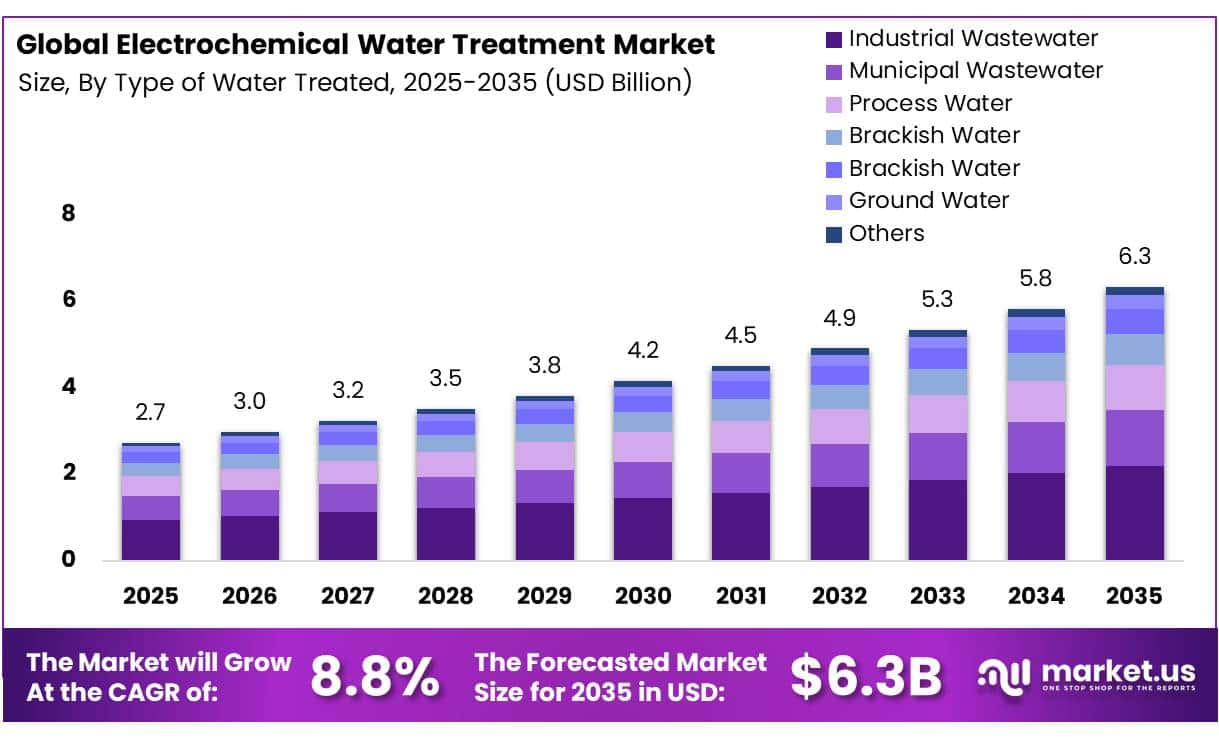
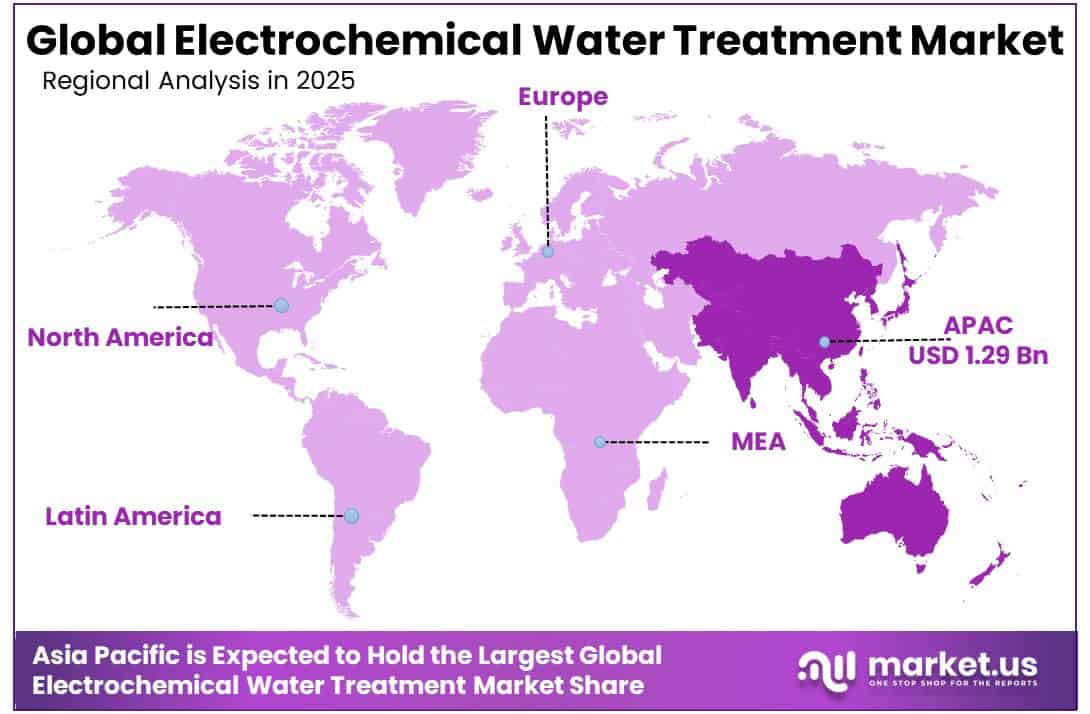
In 2025, the Global Electrochemical Water Treatment Market was valued at USD 2.7 Billion, and between 2026 and 2035, this market is estimated to register a CAGR of 8.8%, reaching about USD 6.3 Billion by 2035. Asia-Pacific held a dominant market position, capturing more than a 47.23% share, holding USD 1.29 Billion in revenue.
Electrochemical water treatment refers to processes such as electrocoagulation, electrooxidation, and electrodialysis that use electrical current to remove contaminants from water without heavy chemical dosing. Demand for such technologies is underpinned by acute global water stress: 2.2 billion people lacked safely managed drinking water and 3.4 billion lacked safely managed sanitation as of 2024, according to the United Nations Sustainable Development Goals Report 2025.
- In the United States, the Environmental Protection Agency’s 2024 National Primary Drinking Water Regulation for per- and polyfluoroalkyl substances applies to roughly 66,000 public water systems, with the Environmental Protection Agency estimating that 6-10% of these systems may need to take corrective action, ultimately protecting approximately 100 million people from per- and polyfluoroalkyl substances exposure.
Key Takeaways
- The Global Electrochemical Water Treatment Market was valued at USD 2.7 billion in 2025.
- The global market is projected to grow at a CAGR of 8.8% and is estimated to reach USD 6.3 billion by 2035.
- On the basis of type of water treated, Industrial Wastewater dominated the market, constituting 34.78% of the total market share.
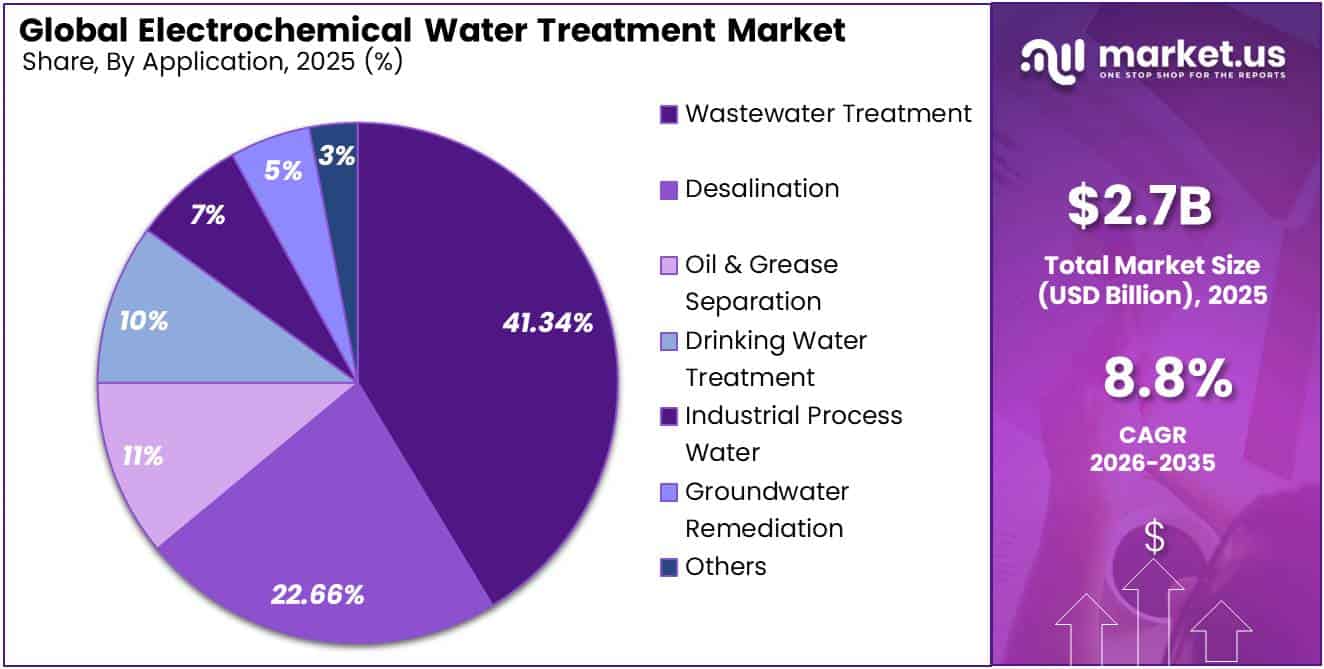
- Based on the application, Wastewater Treatment dominated the market, accounting for 41.34% of the total market share.
- In 2025, Asia-Pacific was the most dominant region in the electrochemical water treatment market, accounting for 47.23% of the global market.
Growth is driven by tightening discharge standards and the search for chemical-light treatment alternatives. The Environmental Protection Agency made close to one billion dollars available through the Bipartisan Infrastructure Law specifically to help utilities address per- and polyfluoroalkyl substances contamination, forming part of a nine-billion-dollar federal commitment to emerging contaminants, creating opportunities for electrochemical process adoption in advanced water purification.
- Government initiatives further reinforce this trajectory. The Environmental Protection Agency’s Clean Water State Revolving Fund has, building on 55.7 billion dollars in federal capitalization, delivered 181.4 billion dollars in low-interest financing through more than 51,000 loans to communities through 2024. In the European Union, Regulation (EU) 2020/741 on minimum requirements for water reuse, applicable across member states since 26 June 2023, established harmonized water-quality standards to encourage treated-water reuse in agricultural irrigation, indirectly supporting demand for advanced electrochemical treatment technologies.
By Type of Water Treated
Industrial Wastewater dominates with 34.78% share due to its critical role in treating complex industrial effluents.
In 2025, Industrial Wastewater held a dominant market position, capturing more than a 34.78% share in the electrochemical water treatment market by type of water treated. The strong position of this segment was supported by the growing need to treat wastewater generated from manufacturing, chemicals, mining, food processing, power generation, and other industrial activities before discharge or reuse. Electrochemical water treatment is widely used because it can remove heavy metals, organic pollutants, suspended solids, and other difficult contaminants without requiring large amounts of added chemicals.
Municipal Wastewater is expected to witness steady growth over the forecast period as cities and local authorities continue to upgrade wastewater treatment infrastructure to meet rising environmental and public health requirements. Growing urban populations and increasing wastewater volumes are encouraging municipalities to adopt modern treatment technologies that improve water quality and support water reuse initiatives. Electrochemical treatment is gaining attention in municipal applications because it offers effective contaminant removal, lower chemical consumption, and flexibility in treating different wastewater streams.
By Application
Wastewater Treatment leads with 41.34% share driven by rising demand for efficient water purification.
In 2025, Wastewater Treatment held a dominant market position, capturing more than a 41.34% share in the electrochemical water treatment market by application. The segment maintained its leading position as industries and public utilities continued to prioritize effective treatment of wastewater before discharge or reuse. Electrochemical treatment technologies are increasingly used because they can remove a wide range of contaminants while reducing the need for excessive chemical additives and supporting cleaner treatment processes.
Desalination is expected to register the fastest growth during the forecast period as the need for reliable freshwater supplies continues to increase in water-stressed regions. Electrochemical technologies are gaining interest in desalination applications because they can improve treatment efficiency and support better water quality while helping optimize overall system performance.
Key Market Segments
By Type of Water Treated
- Industrial Wastewater
- Municipal Wastewater
- Process Water
- Brackish Water
- Seawater
- Ground Water
- Storm Water
- Others
By Application
- Desalination
- Oil & Grease Separation
- Drinking Water Treatment
- Wastewater Treatment
- Industrial Process Water
- Groundwater Remediation
- Cooling Water Treatment
- Heavy Metal Removal
- Others
Driver Analysis
PFAS and micropollutant destruction
Emerging-contaminant regulation is shifting electrochemical oxidation from a niche polishing option into a strategic destruction technology, particularly where customers want to avoid simply transferring contaminants into spent carbon, regenerant brine, or incineration streams. In the United States, the enforceable drinking-water limits for PFOA and PFOS are 4 ng/L each, with compliance beginning on 26 April 2029; current implementation discussions could provide eligible systems up to 2031, but the compliance pipeline is already driving treatability testing, pilot installations, and engineering design activity during 2026–2028.
In Europe, the revised Urban Wastewater Treatment Directive requires quaternary treatment for micropollutant removal at large plants by 2045 and places at least 80% of the incremental cost on pharmaceutical and cosmetics producers, creating a clearer economic route for advanced oxidation and electrochemical package suppliers. The revenue implication is a shift toward high-margin containerized reactors, electrode replacement programs, water-quality assurance, and destruction-verification services; however, suppliers must overcome boron-doped diamond electrode economics, since a prior EPA technology brief cited commercial BDD electrode costs near US$7,125/m², making high-concentration side-stream treatment materially more viable than treating full dilute municipal flow.
Drivers Impact Analysis
| Driver | (~) % Impact on CAGR | Geographic Relevance | Impact Timeline |
|---|---|---|---|
| PFAS and micropollutant destruction | +2.1 pp | North America, EU, Japan, Korea | Short term (≤ 2 years) |
| Industrial water reuse economics | +1.8 pp | China, India, GCC, US Southwest | Medium term (2–4 years) |
| EU wastewater directive upgrades | +1.6 pp | EU core, UK spill-over | Medium term (2–4 years) |
| Decentralized industrial treatment | +1.4 pp | APAC, GCC, Latin America | Short term (≤ 2 years) |
| Lower chemical and sludge intensity | +1.2 pp | Global industrial clusters | Medium term (2–4 years) |
| Electrode durability and hybrid systems | +1.0 pp | North America, EU, China | Long term (≥ 4 years) |
Restraint Analysis
Power Cost Exposure
Electricity intensity remains the largest immediate operating-cost restraint because electrocoagulation, electro-oxidation, electrodialysis, and electrodisinfection convert variable grid tariffs directly into treatment-cost volatility, unlike many conventional systems whose principal variable cost is bulk chemicals. Published electrocoagulation operating ranges span approximately 0.1–18.5 kWh/m³, while electrode consumption can range from 0.01–0.31 kg of aluminum per m³, indicating that a system optimized for a low-conductivity or high-organic-load wastewater can rapidly lose its economic advantage if current density, retention time, or electrode replacement rises.
The pressure is strongest in Europe: the 2025 EU wholesale electricity benchmark averaged about €85/MWh, with country averages ranging from €41/MWh in Finland to €116/MWh in Italy, and energy-intensive industrial electricity prices remained roughly double US levels and more than 50% above Chinese levels. This dispersion forces suppliers to add solar, storage, load-shifting, or tariff-indexation clauses to contracts; without them, project IRRs weaken, customers defer CapEx, and vendors absorb margin risk under fixed-price water-as-a-service agreements.
Restraint Impact Analysis
| Restraint | (~) % Impact on CAGR | Geographic Relevance | Impact Timeline |
|---|---|---|---|
| Power-cost exposure | -1.9 pp | EU, Japan, India metros | Short term (≤ 2 years) |
| Electrode wear and fouling | -1.7 pp | Global industrial sites | Medium term (2–4 years) |
| High installed-cost hurdle | -1.5 pp | APAC, Latin America, Africa | Short term (≤ 2 years) |
| Scale-up performance risk | -1.4 pp | North America, EU, China | Medium term (2–4 years) |
| By-product compliance risk | -1.2 pp | North America, EU, GCC | Short term (≤ 2 years) |
| Fragmented standards and proof | -1.0 pp | India, ASEAN, Latin America | Long term (≥ 4 years) |
Opportunity Analysis
PFAS destruction services
PFAS treatment is already a demand driver, but the untapped opportunity is a specialized destruction-as-a-service business that treats concentrated spent ion-exchange regenerant, reverse-osmosis reject, landfill leachate, firefighting-foam residuals, and industrial side streams rather than selling conventional separation equipment that merely transfers PFAS to another waste medium. EPA’s current strategy identifies electrochemical oxidation among the destruction technologies under study and announced nearly US$1 billion in additional funding to states for PFAS response in 2026, while US drinking-water compliance obligations for applicable PFAS limits begin in 2029.
The value proposition is distinct from baseline filtration demand: instead of charging for water throughput alone, suppliers can charge per kilogram of PFAS destroyed, per concentrate batch processed, or under multi-year liability-transfer service contracts; in a conservative internal model, concentrating a 1,000 m³/day dilute stream by 10–50 times before electrochemical oxidation can reduce active-reactor throughput by 90%–98%, materially improving electrode utilization and allowing a premium service margin if total organic fluorine, fluoride release, perchlorate, chlorate, and energy use are independently verified.
Opportunity Impact Analysis
| Opportunity | (~) % Potential CAGR | Geographic Relevance | Execution Window |
|---|---|---|---|
| Water-as-a-service reuse | +2.0 pp | India, GCC, China, US Southwest | Medium term (2–4 years) |
| PFAS destruction services | +1.8 pp | North America, EU, Australia | Short term (≤ 2 years) |
| Brine mineral recovery | +1.6 pp | US, Chile, Argentina, China | Medium term (2–4 years) |
| Industrial-park water hubs | +1.5 pp | India, ASEAN, GCC, Africa | Medium term (2–4 years) |
| Digital electrode-as-a-service | +1.2 pp | North America, EU, China | Short term (≤ 2 years) |
| M&A-led integrated platforms | +1.0 pp | North America, EU, APAC | Medium term (2–4 years) |
Challenges Analysis
OT Cybersecurity Exposure
Electrochemical treatment increasingly relies on programmable rectifiers, remote PLC access, cloud dashboards, online sensors, automated dosing interfaces, and SCADA-linked control systems, creating a cyber-physical operating challenge in which an intrusion can alter current setpoints, disable alarms, interrupt treatment, or corrupt compliance data without permanently freezing market demand. EPA reported that it identified cybersecurity vulnerabilities at 277 water systems and helped eliminate 350 vulnerabilities during 2025; its enforcement activity also found that more than 70% of inspected systems since September 2023 were non-compliant with basic risk-and-resilience requirements.
The operational relevance is direct: unsecured human-machine interfaces can permit unauthorized users to view or adjust real-time treatment settings, potentially disrupting wastewater processing or damaging equipment. An internal 2026 risk model assumes that cyber hardening asset inventories, network segmentation, multi-factor authentication, patching, secure remote access, backup controllers, and incident response adds 1%–3% to installed project cost and 0.5%–1.5% to annual service cost, but avoids far larger exposure from contractual downtime penalties, regulatory non-compliance, damaged electrodes, or reputational loss; suppliers that fail to embed these controls will face longer utility procurement reviews and exclusion from digitally connected projects.
Challenges Impact Analysis
| Challenge | (~) % CAGR Friction | Geographic Relevance | Mitigation Horizon |
|---|---|---|---|
| Variable Influent Control | -1.5 pp | Global industrial sites | Medium term (2–4 years) |
| Electrode Supply Qualification | -1.3 pp | EU, North America, China | Medium term (2–4 years) |
| Specialist Operator Gap | -1.2 pp | North America, EU, APAC | Long term (≥ 4 years) |
| OT Cybersecurity Exposure | -1.0 pp | North America, EU, GCC | Short term (≤ 2 years) |
| Residuals Chain Management | -0.9 pp | EU, North America, Asia | Medium term (2–4 years) |
| Grid-Process Integration | -0.8 pp | EU, India, MENA, Africa | Long term (≥ 4 years) |
Geopolitical Impact Analysis
Geopolitical Impact Analysis: Ongoing Conflicts Reshape Vector Control Priorities.
The ongoing conflicts in the Middle East have increased pressure on the electrochemical water treatment market by disrupting energy supply chains, raising transportation costs, and delaying the delivery of treatment equipment, electrodes, membranes, and industrial chemicals. Water treatment projects are highly dependent on stable electricity and industrial supply networks, making them sensitive to geopolitical disruptions.
- According to the International Energy Agency (IEA), around 20 million barrels of oil per day moved through the Strait of Hormuz in 2025, representing about 25% of global seaborne oil trade, making the route critical for global industrial operations.
The conflicts have also highlighted the strategic importance of reliable water infrastructure. The United Nations Environment Programme (UNEP) reported in 2025 that only 9 of 54 water storage reservoirs and pumping facilities in Gaza remained active, while the remaining desalination capacity had fallen to 31% of its pre-conflict level, with wastewater treatment facilities no longer operational. These disruptions have reinforced the need for modern, decentralized water treatment systems that can support emergency water supply, wastewater recycling, and infrastructure resilience during crises.
Regional Analysis
Electrochemical Water Treatment Market – Regional Analysis (Asia Pacific).
Asia-Pacific emerged as the dominant region in the Electrochemical Water Treatment Market, accounting for a 47.23% share and a valuation of 1.29 billion in 2025. This leadership reflects severe regional water stress and expanding wastewater treatment obligations across major economies. According to the United Nations Economic and Social Commission for Asia and the Pacific, around 1.9 billion people in Asia and the Pacific lack access to safely managed drinking water and sanitation services, while the region holds only 36% of the world’s water resources despite housing two-thirds of the global population, giving it the lowest per capita water availability worldwide.
China, a key contributor to regional demand, has set formal treatment targets that reinforce this growth. Per the United States International Trade Administration, citing China’s National Development and Reform Commission, Ministry of Housing and Urban-Rural Development, and Ministry of Ecology and Environment, the country aims to achieve a sewage treatment rate above 95% in county-level cities and a recycled water utilization rate above 25% in water-scarce prefecture-level cities by 2025.
Key Regions and Countries
- North America
- The US
- Canada
- Europe
- Germany
- France
- The UK
- Spain
- Italy
- Russia & CIS
- Rest of Europe
- APAC
- China
- Japan
- South Korea
- India
- ASEAN
- Rest of APAC
- Latin America
- Brazil
- Mexico
- Rest of Latin America
- Middle East & Africa
- GCC
- South Africa
- Rest of MEA
Key Players Analysis
The Electrochemical Water Treatment Market is shaped by companies that focus on technology development, process efficiency, and application-specific solutions to strengthen their competitive position. A major priority is improving electrochemical reactors, electrode materials, membrane performance, and system automation to achieve higher contaminant removal while reducing energy use and chemical consumption.
Manufacturers also invest in modular treatment systems that can be deployed across industrial facilities, municipal plants, and decentralized water projects with lower installation time and easier maintenance. Continuous research on advanced oxidation, electrocoagulation, electrodialysis, and electrochemical disinfection technologies helps companies address stricter water quality regulations and growing demand for sustainable treatment. Digital monitoring, remote system management, and predictive maintenance are becoming important features that improve operational reliability and reduce lifecycle costs for customers.
Leading participants such as Voltea, REDstack, BioIonix, Axine Water, OLI Systems, WaterTectonics, New Sky Energy, Veolia, Thermax, Ion Exchange (India), SUEZ, INDRA Water, Membrion, HydroNovation, and other key players are strengthening their market presence through product innovation, strategic partnerships, pilot installations, and expansion into high-demand industrial sectors.
The Major Players in The Industry
- Voltea
- REDstack
- BioIonix
- Axine Water
- OLI Systems
- WaterTectonics
- New Sky Energy
- Veolia
- Thermax
- Ion Exchange (India)
- SUEZ
- INDRA Water
- Membrion
- HydroNovation
- Other Key Players
Key Development
- In March 2025, Axine Water Technologies and Nijhuis Saur Industries announced, at Aquatech Amsterdam, their intention to enter a supplier partnership under which Nijhuis Saur Industries will assemble, manufacture, and supply Axine’s electraCLEAR-enabled PFAS Destruct electrochemical oxidation solution across Europe.
- In September 2025, Axine Water Technologies appointed Andrew Mrasek as chief revenue officer to lead the company’s global commercial strategy and revenue expansion amid growing demand for its electrochemical oxidation-based industrial wastewater treatment solutions.
- In October 2025, Membrion closed a 20 million dollar Series B1 funding round, anchored by Pangaea Ventures, PureTerra Ventures, Ecolab Inc., and W. L. Gore and Associates, bringing its total funding to 43 million dollars since inception to scale deployment of its ceramic electrodialysis-based industrial wastewater treatment systems.
- In March 2026, Veolia announced the acquisition of Enviropacific, an Australian soil remediation player, in a transaction valued at approximately 220 million Australian dollars (enterprise value), strengthening the company’s per- and polyfluoroalkyl substances (PFAS) treatment, soil remediation, and water treatment capabilities in Australia.
Report Scope
| Report Features | Description |
|---|---|
| Market Value (2025) | USD 2.7 Bn |
| Forecast Revenue (2035) | USD 6.3 Bn |
| CAGR (2026 2035) | 8.8% |
| Base Year for Estimation | 2025 |
| Historic Period | 2020-2024 |
| Forecast Period | 2026-2035 |
| Report Coverage | Revenue Forecast, Market Dynamics, Competitive Landscape, Recent Developments |
| Segments Covered | By Type of Water Treated (Industrial Wastewater, Municipal Wastewater, Process Water, Brackish Water, Seawater, Ground Water, Storm Water, Others), By Application (Desalination, Oil & Grease Separation, Drinking Water Treatment, Wastewater Treatment, Industrial Process Water, Groundwater Remediation, Cooling Water Treatment, Heavy Metal Removal, Others) |
| Regional Analysis | North America The US & Canada; Europe Germany, France, The UK, Spain, Italy, Russia & CIS, Rest of Europe; APAC China, Japan, South Korea, India, ASEAN & Rest of APAC; Latin America Brazil, Mexico & Rest of Latin America; Middle East & Africa GCC, South Africa, & Rest of MEA |
| Competitive Landscape | Voltea, REDstack, BioIonix, Axine Water, OLI Systems, WaterTectonics, New Sky Energy, Veolia, Thermax, Ion Exchange (India), SUEZ, INDRA Water, Membrion, HydroNovation, and Other Key Players |
| Customization Scope | Customization for segments, region/country level will be provided. Moreover, additional customization can be done based on the requirements. |
| Purchase Options | We have three licenses to opt for: Single User License, Multi User License (Up to 5 Users), Corporate Use License (Unlimited Users and Printable PDF) |





































