


Report Overview
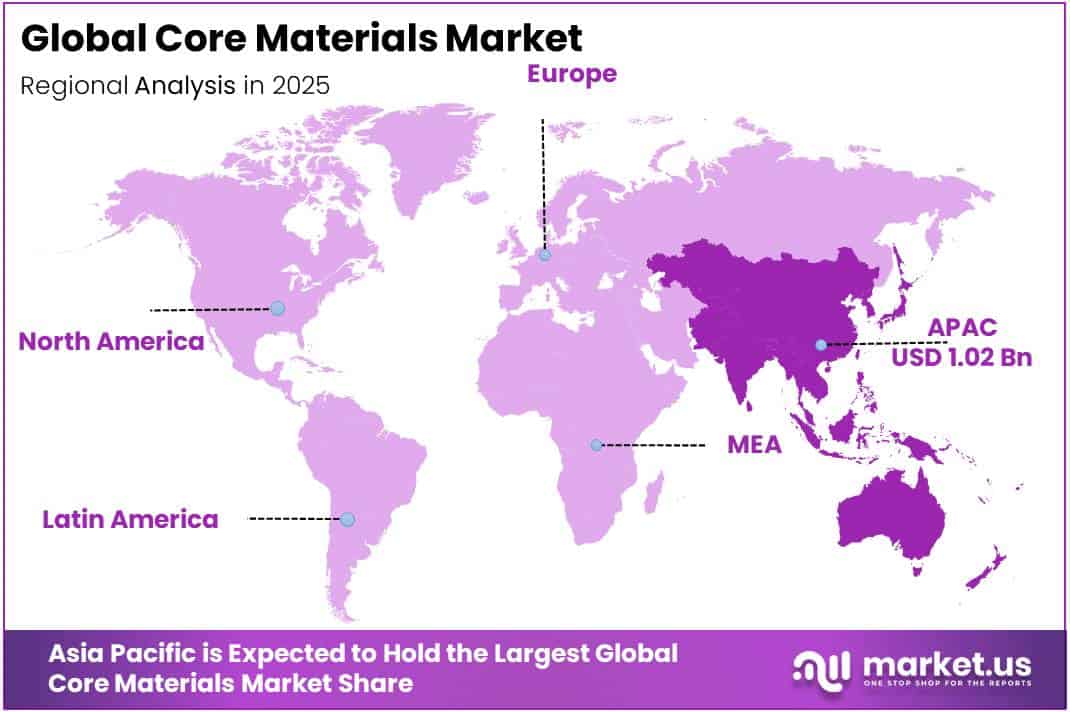
In 2025, the Global Core Materials Market was valued at USD 2.9 Billion, and between 2026 and 2035, this market is estimated to register a CAGR of 9.0%, reaching about USD 6.9 Billion by 2035. Asia Pacific held a dominant market position, capturing more than a 34.6% share, holding USD 1.02 Billion in revenue.
The core materials market encompasses foam, balsa wood, and honeycomb structures used as lightweight cores within fiberglass and carbon fiber sandwich composite panels. These materials are integrated into wind turbine blades, marine hulls, aerospace components, and construction panels to enhance stiffness, reduce structural weight, and improve fatigue resistance.
- According to the United States Department of Energy (DOE), the average nameplate capacity of newly installed United States wind turbines reached 3.4 megawatts (MW) in 2023, up 5% from 2022 and 375% since 1998-1999. The average rotor diameter of newly installed turbines exceeded 133.8 meters in 2023, while hub heights rose 83% since 1998-1999 to approximately 103.4 meters, expanding blade surface area requiring core material reinforcement.
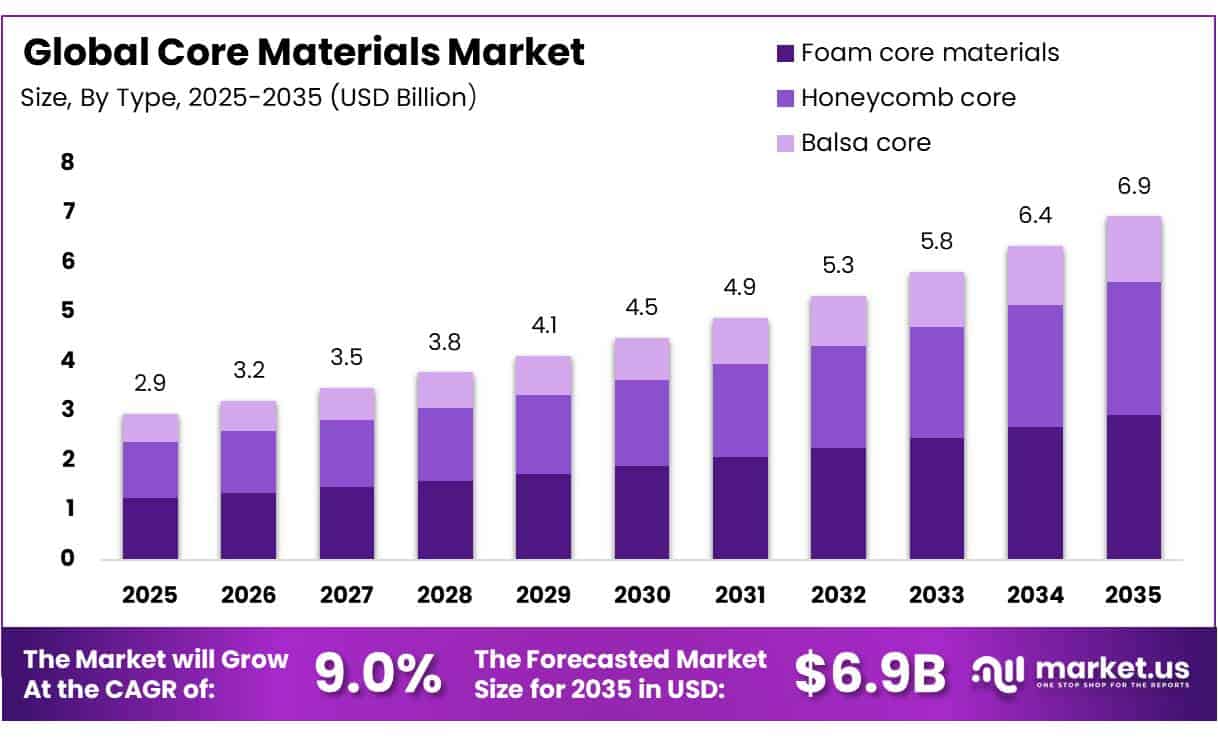
Expanding renewable energy installations remain a primary driving factor. Per the International Renewable Energy Agency (IRENA), global wind energy capacity additions reached 159 gigawatts (GW) in 2025, contributing to total global renewable power capacity of 5,149 GW, a 15.5% annual increase. This sustained expansion of wind energy infrastructure directly increases demand for foam and balsa core materials used in blade manufacturing.
Regulatory and industry-led sustainability initiatives present notable growth opportunities. WindEurope, representing Europe’s wind industry, confirmed a self-imposed landfill ban on decommissioned wind turbine blades effective 1 January 2026, covering 290 gigawatts (GW) of installed European wind capacity, of which 80 GW will reach end of operational life by 2030.
Annual decommissioned blade material is projected to rise to 55,000 tonnes by 2030. The European Commission is also preparing a Circular Economy Act to introduce dedicated waste codes for decommissioned turbine blades, supporting sustainable core material recovery.
Key Takeaways
- The Global Core Materials Market was valued at USD 2.9 billion in 2025.
- The global market is projected to grow at a CAGR of 9.0% and is estimated to reach USD 6.9 billion by 2035.
- On the basis of type, Foam core materials dominated the market, constituting 42.3% of the total market share.
- Based on the core material, PET foam dominated the market, accounting for 24.6% of the total market share.
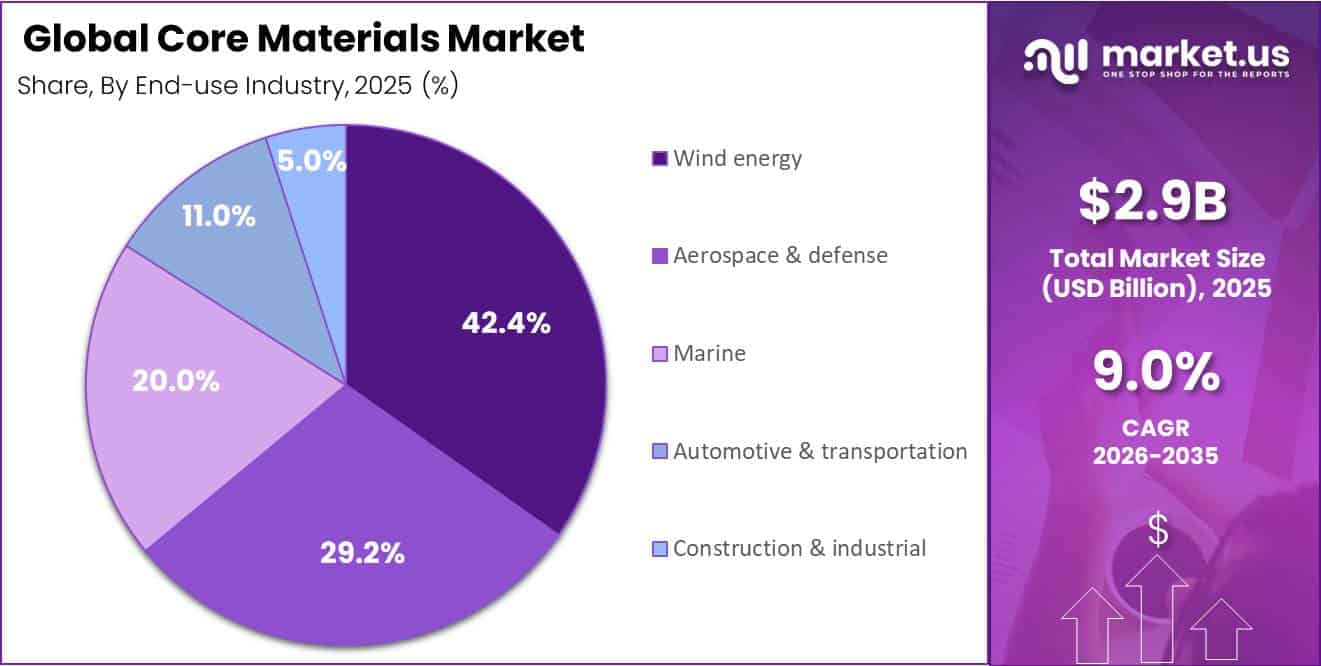
- Based on the end-use industry, Wind energy dominated the market, accounting for 34.8% of the total market share.
- Based on the honeycomb material, Aluminum honeycomb dominated the market, accounting for 28.7% of the total market share.
- In 2025, Asia Pacific was the most dominant region in the core materials market, accounting for 34.6% of the global market.
By Type
Foam core materials dominates with 42.3% share due to its broad use in lightweight composite manufacturing.
In 2025, Foam core materials held a dominant market position, capturing more than a 42.3% share. Their leading position was supported by widespread use in composite structures that require high strength with low weight across industries such as wind energy, aerospace, marine, transportation, and construction. Foam core materials are valued for their consistent mechanical performance, ease of processing, moisture resistance, and compatibility with advanced composite manufacturing methods.
Honeycomb core is expected to register the fastest growth during the forecast period. The increasing need for lightweight materials with high strength and excellent energy absorption is encouraging greater adoption of honeycomb core structures in advanced manufacturing applications. Their use is expanding in industries that require improved fuel efficiency, structural performance, and material optimization, particularly in aerospace, transportation, and renewable energy equipment.
By Core Material
PET foam dominates with 24.6% share due to its lightweight structure and strong recyclability.
In 2025, PET foam held a dominant market position, capturing more than a 24.6% share. Its leadership was supported by increasing demand for lightweight and durable core materials used in composite manufacturing across transportation, construction, marine, and renewable energy applications. PET foam is widely recognized for its good mechanical strength, resistance to moisture, and ability to be recycled, making it suitable for manufacturers seeking reliable and more sustainable material options.
PVC foam is expected to register the fastest growth during the forecast period. Its expanding use is supported by its excellent balance of strength, durability, chemical resistance, and ease of fabrication in composite structures. During 2026, manufacturers increasingly adopted PVC foam for applications requiring reliable structural performance under demanding operating conditions, particularly in transportation, marine, and infrastructure projects.
By End-use Industry
Wind energy dominates with 34.8% share as demand for lightweight turbine components continues to rise.
In 2025, Wind energy held a dominant market position, capturing more than a 34.8% share. Its leading position was driven by the extensive use of composite core materials in wind turbine blades, where lightweight construction, high stiffness, and long-term durability are essential for efficient power generation. Foam and honeycomb core materials help manufacturers produce longer and stronger blades while reducing overall weight, supporting improved operational performance.
Aerospace & defense is expected to register the fastest growth during the forecast period. The increasing focus on reducing aircraft weight, improving fuel efficiency, and enhancing structural performance is driving higher demand for advanced core materials in aircraft, spacecraft, and defense equipment. During 2026, manufacturers continued to expand the use of lightweight composite structures to meet strict performance and safety requirements while improving operational efficiency.
By Honeycomb Material
Aluminum honeycomb dominates with 28.7% share due to its high strength and lightweight performance.
In 2025, Aluminum honeycomb held a dominant market position, capturing more than a 28.7% share. Its leading position was supported by its excellent strength-to-weight ratio, corrosion resistance, and ability to withstand demanding structural applications across aerospace, transportation, marine, and industrial manufacturing. Aluminum honeycomb is widely used where lightweight construction and high structural rigidity are essential, helping manufacturers improve performance while reducing overall material weight.
Aramid/Nomex honeycomb is expected to register the fastest growth during the forecast period. Rising demand for advanced composite materials with excellent fire resistance, impact strength, and fatigue performance is increasing its adoption in aerospace, defense, and other high-performance manufacturing sectors. During 2026, manufacturers continued to expand the use of aramid-based honeycomb structures in applications where lightweight construction and enhanced safety are critical.
Key Market Segments
By Type
- Foam core materials
- Balsa core
- Honeycomb core
By Core Material
- PVC foam
- PET foam
- SAN foam
- PMI foam
- Other foams
By End-use Industry
- Wind energy
- Aerospace & defense
- Marine
- Automotive & transportation
- Construction & industrial
By Honeycomb Material
- Aluminum honeycomb
- Aramid/Nomex honeycomb
- Thermoplastic honeycomb
- Other honeycomb
Driver Analysis
Offshore Wind Blade Scaling
Offshore wind turbine upscaling is the strongest structural demand driver for core materials because increasing rotor diameters, longer blade lengths, higher turbine ratings, and harsher offshore operating conditions require lightweight sandwich structures with high shear strength, fatigue resistance, dimensional stability, resin compatibility, and controlled density. Offshore blade designs have shifted from rotor diameters of around 154 metres in 2019 toward approximately 236 metres for 15 MW-class platforms, while core material demand per blade expands sharply as blade length rises because the area requiring sandwich reinforcement grows faster than turbine count declines.
A 100-metre-plus offshore blade can contain several tonnes of balsa, PVC, PET, SAN, or hybrid core structures concentrated in shells, trailing edges, shear webs, spar-adjacent regions, nacelle covers, and internal reinforcement zones; a 15 MW turbine with three blades can therefore consume an estimated 15–35 metric tons of engineered core material depending on design, density, material mix, and blade geometry.
For core-material suppliers, the driver changes the business model from supplying commodity sheets to co-engineering validated kits, CNC-cut structures, infusion-ready materials, blade-specific density gradients, and long-term supply agreements with wind OEMs and blade manufacturers; this offshore wind expansion is estimated to add approximately +1.9 percentage points to the 2026 baseline CAGR across Europe, China, North America, and wider Asia-Pacific through the long term.
Drivers Impact Analysis
| Driver | (~) % Impact on CAGR Forecast | Geographic Relevance | Impact Timeline |
|---|---|---|---|
| Offshore Wind Blade Scaling | +1.9 pp | Europe, China, North America, Asia-Pacific | Long term (≥ 4 years) |
| Aerospace Production Recovery | +1.5 pp | North America, EU, China, Japan | Medium term (2–4 years) |
| EV Lightweighting and Safety | +1.4 pp | China, Europe, North America, Korea | Medium term (2–4 years) |
| Marine Fuel-Efficiency Demand | +1.0 pp | Europe, China, Japan, Korea, GCC | Medium term (2–4 years) |
| Recycled PET Core Adoption | +1.2 pp | EU, North America, China, Australia | Medium term (2–4 years) |
| Hydrogen Infrastructure Composites | +0.8 pp | EU, North America, China, Japan, Korea | Long term (≥ 4 years) |
Restraint Analysis
High Conversion Cost Base
Core-material suppliers face a high structural conversion-cost burden because PVC, PET, SAN, PMI, polyurethane, balsa, and honeycomb products require energy-intensive foaming, extrusion, curing, cutting, scoring, perforation, CNC kitting, resin-flow engineering, surface treatment, quality inspection, and increasingly traceable documentation before they can be installed in wind blades, aircraft panels, marine hulls, transport structures, and industrial sandwich assemblies.
The cost profile is significantly more complex than that of bulk polymers: raw polymers, additives, blowing agents, films, adhesives, and reinforcements commonly represent 45–65% of finished cost, while energy and utilities represent 8–15%, labor and conversion 10–18%, scrap and quality loss 3–8%, and machining, packaging, logistics, and technical service the balance. For a premium PMI or aerospace-grade honeycomb product, a 10% increase in resin, energy, or specialty-paper input cost can raise ex-factory cost by approximately 4–7%, while customers in wind, marine, and automotive markets may accept only 30–60% pass-through during annual contract negotiations.
The margin problem is more acute when core suppliers must provide pre-kitted, infusion-ready, density-graded, or contour-machined solutions, because CNC yield loss can reach 8–20% depending on blade geometry and cut complexity, and a single customer design change can leave several months of inventory unusable. Core-material producers have responded with automated cutting, recycled PET, regional manufacturing, and higher-value kit design, but annual-report evidence from major industry suppliers confirms that freight volatility, energy costs, and complex scope 3 data requirements continue to pressure material sourcing and logistics economics.
Restraint Impact Analysis
| Restraint | (~) % Impact on CAGR Forecast | Geographic Relevance | Impact Timeline |
|---|---|---|---|
| High Conversion Cost Base | -1.6 pp | Global; EU, North America, APAC | Short term (≤ 2 years) |
| Balsa Supply Concentration | -1.4 pp | Ecuador, Europe, China, North America | Medium term (2–4 years) |
| Wind OEM Price Pressure | -1.3 pp | Europe, China, North America | Medium term (2–4 years) |
| Aerospace Qualification Delays | -1.2 pp | North America, EU, Japan, China | Long term (≥ 4 years) |
| Composite Recycling Cost Gap | -1.1 pp | EU, North America, China | Long term (≥ 4 years) |
| Freight and Trade Volatility | -0.9 pp | Asia–EU, Asia–U.S., global corridors | Short term (≤ 2 years) |
Opportunity Analysis
Circular Thermoplastic Core Systems
Circular thermoplastic core systems represent the largest strategic upside because wind-blade, marine, transportation, and industrial sandwich structures still rely heavily on thermoset resin systems that are difficult to separate and recycle at end of life, while future procurement increasingly favors materials that demonstrate recycled content, recoverability, lower embedded carbon, and traceable circularity.
Thermoplastic core systems can potentially reduce cradle-to-grave greenhouse-gas emissions by 15–30% relative to conventional thermoset sandwich assemblies, depending on recycled-polymer content, manufacturing energy, transport distance, and end-of-life route, while enabling closed-loop PET, PP, PA, or PMMA core recovery where density, contamination, and adhesive design permit separation.
The commercial model moves beyond selling USD 5–20 per kg foam toward a higher-value circular-material package including recycled-content certification, material passports, take-back contracts, recycled-feedstock supply, resin-compatible surface treatments, and design-for-disassembly engineering; this can support a 10–25% selling-price premium and 300–600 basis points of margin expansion for verified circular systems.
Opportunity Impact Analysis
| Opportunity | (~) % Potential CAGR Upside | Geographic Relevance | Execution Window |
|---|---|---|---|
| Circular Thermoplastic Core Systems | +1.8 pp | EU, North America, China, Japan | Medium term (2–4 years) |
| Floating-Wind Core Platforms | +1.5 pp | Europe, Japan, Korea, U.S., China | Long term (≥ 4 years) |
| High-Rate Automotive Sandwiching | +1.4 pp | China, Europe, North America, Korea | Medium term (2–4 years) |
| Aerospace Retrofit and MRO Panels | +1.1 pp | North America, EU, Middle East, Asia | Medium term (2–4 years) |
| Localized CNC Kit Networks | +1.0 pp | India, ASEAN, GCC, LATAM | Short term (≤ 2 years) |
| Hydrogen Enclosure Core Systems | +0.9 pp | EU, North America, China, Japan, Korea | Long term (≥ 4 years) |
Challenges Analysis
Composite Skills Availability Gap
The Core Materials Market is constrained by a persistent shortage of engineers, technicians, machinists, infusion specialists, non-destructive testing personnel, process engineers, and composite-repair professionals who understand the interaction of foam, balsa, honeycomb, fiber architecture, resin flow, vacuum integrity, cure cycles, machining tolerances, bonding, and structural fatigue. Aerospace and wind supply chains experienced workforce reductions during earlier production downturns, and as aircraft and renewable-energy production recovered, suppliers had to rebuild capability amid labor shortages, inflation, material constraints, and fragile balance sheets.
The operational impact is substantial because core materials are highly process-sensitive: a technician must control density selection, core orientation, scarf joints, grooving, perforation, resin flow, vacuum bagging, pressure balance, cure temperature, bondline thickness, and trim accuracy; an error in any one step can create voids, resin-rich zones, dry spots, core crush, delamination, uneven laminate thickness, or reduced fatigue life.
A large wind blade, aerospace panel, or marine hull may require 20–100 labor hours of core cutting, kitting, lay-up preparation, infusion monitoring, finishing, and quality inspection, and even a 3–5% rework rate can eliminate expected margin after resin wastage, labor overtime, scrap disposal, and delivery delays. Manufacturers must respond through formal apprenticeships, digital work instructions, automated kitting, augmented-reality guidance, AI-supported defect detection, remote expert support, and partnerships with technical institutions, but developing an independently productive composites technician generally takes 18–36 months and a specialist process or materials engineer can require three to five years.
Challenges Impact Analysis
| Challenge | (~) % CAGR Friction Drag | Geographic Relevance | Mitigation Horizon |
|---|---|---|---|
| Composite Skills Availability Gap | -1.2 pp | EU, North America, China, India | Long term (≥ 4 years) |
| Resin-Process Compatibility Complexity | -1.1 pp | Global wind, marine, aerospace hubs | Medium term (2–4 years) |
| Density and Quality Variation | -1.0 pp | Global; China, EU, North America | Medium term (2–4 years) |
| Scaled Recycling Infrastructure Gap | -1.1 pp | EU, North America, China, Japan | Long term (≥ 4 years) |
| Multi-Material Design Fragmentation | -0.9 pp | Aerospace, wind, automotive, marine | Medium term (2–4 years) |
| Regional Conversion Capacity Imbalance | -0.8 pp | India, ASEAN, GCC, LATAM, Africa | Medium term (2–4 years) |
Geopolitical Impact Analysis
Geopolitical tensions reshape supply chains for core materials used in advanced manufacturing.
The ongoing conflict in the Middle East has increased uncertainty across global supply chains that support the core materials market, particularly for aluminum honeycomb, polymer foams, and composite manufacturing. Core material producers have been affected by higher transportation costs, longer shipping routes, and delays in raw material deliveries as cargo movements through the Strait of Hormuz remain under pressure.
- According to the International Energy Agency (IEA), around 20 million barrels per day of crude oil and oil products moved through the Strait of Hormuz in 2025, representing about 25% of global seaborne oil trade, while the Gulf region accounts for around 8% of global aluminium supply, making the route strategically important for manufacturing industries.
- The IEA also notes that about 5 million tonnes of aluminium are shipped annually through the Strait from Gulf producers, creating additional risks for downstream composite manufacturers when logistics are disrupted.
During 2026, manufacturers responded by increasing inventory planning, diversifying suppliers, and sourcing more materials from alternative regions to reduce dependence on conflict-affected trade routes. The United Nations Conference on Trade and Development (UNCTAD) reported that the Strait of Hormuz carries around one quarter of global seaborne oil trade, and disruptions have increased freight costs and supply chain risks across manufacturing industries.
These conditions have encouraged greater investment in regional production capacity and supply chain resilience for engineered materials used in aerospace, wind energy, transportation, and industrial applications. Although demand for lightweight composite core materials remains stable, companies continue to prioritize logistics flexibility and long-term sourcing strategies to reduce exposure to geopolitical disruptions.
Regional Analysis
Regional Analysis: Elevators and Escalators Market.
Asia Pacific dominates the global core materials market, holding the largest regional share of 34.6% and a market value of approximately USD 1.02 billion. This dominance is driven primarily by China, the world’s largest wind turbine manufacturing base, where installed wind power capacity expanded 22.4% year-on-year to 600 million kilowatts (600 GW) by the end of November 2025, according to the National Energy Administration (NEA) of China.
Supporting this trend, the International Renewable Energy Agency (IRENA) reports that Asia contributed 74.2% of all new global renewable capacity additions in 2025, adding 513.3 GW at a growth rate of 21.6%. The rapid scale-up of regional wind and renewable infrastructure directly increases consumption of foam, balsa, and honeycomb core materials used in blade manufacturing, reinforcing Asia Pacific’s position as the leading consumer and producer of composite core materials worldwide.
Beyond China, Japan continues to expand offshore wind capacity, with the Ministry of Economy, Trade and Industry (METI) targeting 10 gigawatts (GW) of offshore wind by 2030 and 30 to 45 GW by 2040, supporting sustained regional demand for structural core materials in blade and floating platform manufacturing. Established composite manufacturing infrastructure across China, Japan, and South Korea, combined with growing marine, construction, and industrial applications, further strengthens the region’s leading position. This expanding manufacturing base, supported by national energy authority data and policy-driven renewable energy growth across multiple Asia Pacific economies, is expected to sustain the region’s dominant revenue share of the global core materials market over the coming years.
Key Regions and Countries Covered
- North America
- The US
- Canada
- Europe
- Germany
- France
- The UK
- Spain
- Italy
- Russia & CIS
- Rest of Europe
- APAC
- China
- Japan
- South Korea
- India
- ASEAN
- Rest of APAC
- Latin America
- Brazil
- Mexico
- Rest of Latin America
- Middle East & Africa
- GCC
- South Africa
- Rest of MEA
Key Players Analysis
Core materials manufacturers focus on strengthening product performance, lightweight engineering, and manufacturing efficiency to remain competitive across aerospace, wind energy, marine, transportation, and industrial applications. A major priority is the continuous development of advanced foam and honeycomb core materials with improved strength-to-weight ratios, fatigue resistance, thermal stability, and moisture resistance for high-performance composite structures.
Manufacturers are expanding the use of recyclable PET foams, high-performance PVC and PMI foams, and engineered honeycomb materials to meet growing demand for durable and lightweight components. Investments in automated production technologies, precision processing, and digital quality control help improve product consistency while reducing manufacturing waste.
Leading participants including Evonik Industries AG, Gurit Holding AG, 3A Composites, Diab Group, Hexcel Corporation, Armacell International S.A., The Gill Corporation, Euro-Composites S.A., Plascore Inc., Changzhou Tiansheng New Materials Co., Ltd., Toray Industries, Inc., Owens Corning, BASF SE, SABIC, and CoreLite Inc. continue to strengthen their market positions through capacity expansion, product innovation, and strategic customer partnerships.
Many companies are increasing regional manufacturing capabilities to shorten delivery times and improve supply chain resilience while expanding technical support for composite manufacturers. Investments in sustainable production methods, recyclable material technologies, and advanced processing techniques are also becoming central to long-term business strategies.
The Major Players in The Industry
- Evonik Industries AG
- Gurit Holding AG
- 3A Composites
- Diab Group
- Hexcel Corporation
- Armacell International S.A.
- The Gill Corporation
- Euro-Composites S.A.
- Plascore Inc.
- Changzhou Tiansheng New Materials Co., Ltd.
- Toray Industries, Inc.
- Owens Corning
- BASF SE
- SABIC
- CoreLite Inc.
Key Development
- January 2026 -Gurit Holding AG signed a long-term supply agreement for core material kits with a leading wind turbine OEM, its first major contract using the OptiCore core-kit technology.
- March 2026 -Gurit Holding AG secured a two-year, CHF 10 million contract for glass pultruded blade root reinforcements with a leading Asia-Pacific wind turbine manufacturer.
- February 2026 -Diab Group partnered with CompPair to combine Divinycell foam cores with HealTech repair technology, drawing on Diab’s 75 years of foam core expertise.
- March 2026 -Diab Group and Hankuk Carbon (South Korea) signed an MoU for marine technology R&D at JEC World 2026 in Paris.
Report Scope
| Report Features | Description |
|---|---|
| Market Value (2025) | USD 2.9 Bn |
| Forecast Revenue (2035) | USD 6.9 Bn |
| CAGR (2026 2035) | 9.0% |
| Base Year for Estimation | 2025 |
| Historic Period | 2020-2024 |
| Forecast Period | 2026-2035 |
| Report Coverage | Revenue Forecast, Market Dynamics, Competitive Landscape, Recent Developments |
| Segments Covered | By Type (Foam Core Materials, Balsa Core, Honeycomb Core), By Core Material (PVC Foam, PET Foam, SAN Foam, PMI Foam, Other Foams), By End-use Industry (Wind Energy, Aerospace & Defense, Marine, Automotive & Transportation, Construction & Industrial), By Honeycomb Material (Aluminum Honeycomb, Aramid/Nomex Honeycomb, Thermoplastic Honeycomb, Other Honeycomb) |
| Regional Analysis | North America The US & Canada; Europe Germany, France, The UK, Spain, Italy, Russia & CIS, Rest of Europe; APAC China, Japan, South Korea, India, ASEAN & Rest of APAC; Latin America Brazil, Mexico & Rest of Latin America; Middle East & Africa GCC, South Africa, & Rest of MEA |
| Competitive Landscape | Evonik Industries AG, Gurit Holding AG, 3A Composites, Diab Group, Hexcel Corporation, Armacell International S.A., The Gill Corporation, Euro-Composites S.A., Plascore Inc., Changzhou Tiansheng New Materials Co., Ltd., Toray Industries, Inc., Owens Corning, BASF SE, SABIC, and CoreLite Inc. |
| Customization Scope | Customization for segments, region/country level will be provided. Moreover, additional customization can be done based on the requirements. |
| Purchase Options | We have three licenses to opt for: Single User License, Multi User License (Up to 5 Users), Corporate Use License (Unlimited Users and Printable PDF) |





































