


Quick Navigation
Report Overview
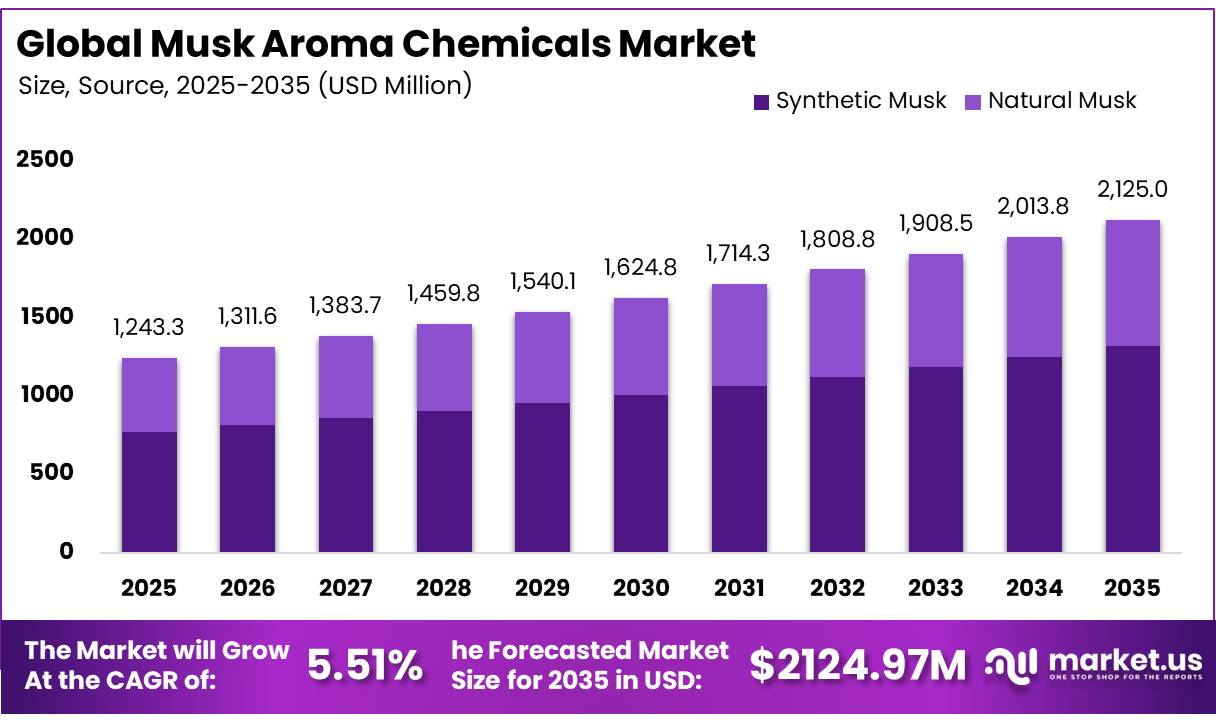
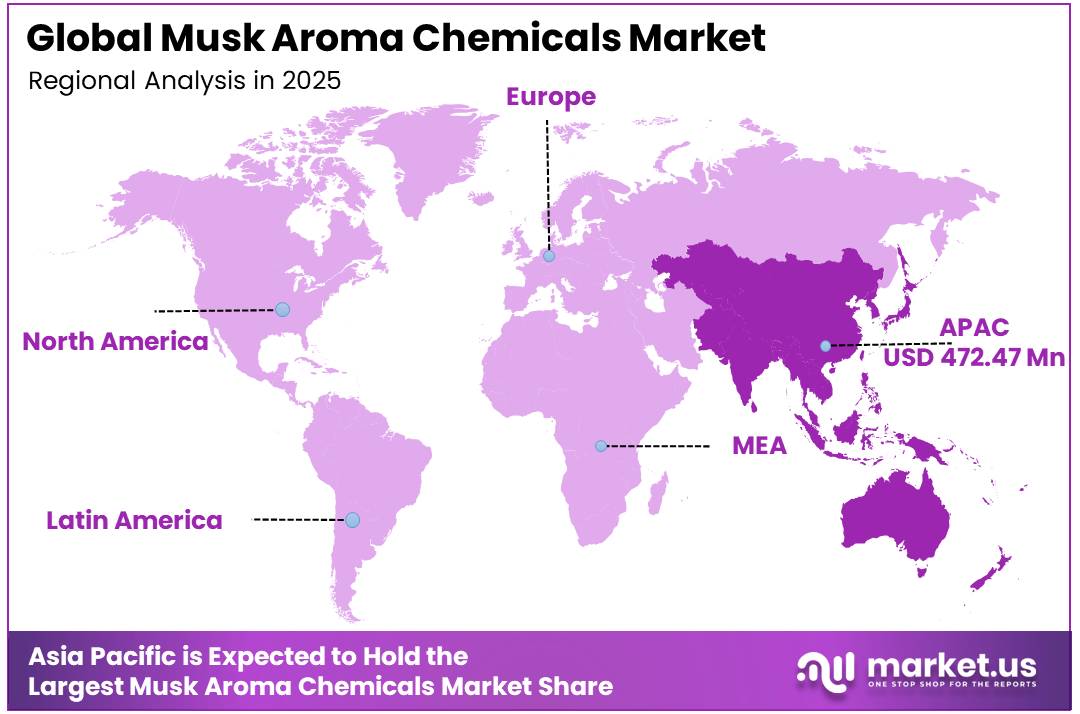
In 2025, the Global Musk Aroma Chemicals Market was valued at USD 1243.33 Million, and between 2026 and 2035, this market is estimated to register a CAGR of 5.51%, reaching about USD 2124.97 million by 2035. Asia Pacific held a dominant market position, capturing more than a 38.0% share, holding USD 472.47 million in revenue.
Musk aroma chemicals are high-value fragrance ingredients used as long-lasting base notes and fixatives in perfumes, cosmetics, soaps, detergents, and household products. The industry has shifted decisively from animal-derived musk toward synthetic and biotechnology-based molecules. CITES states that all musk deer species are listed in Appendix I or II, making wildlife conservation and controlled trade major reasons for replacing natural musk with laboratory-produced alternatives. Demand is supported by the wider fragrance value chain.
- The European Commission’s Scientific Committee on Consumer Safety reported that cosmetics consume about 80% of total fragrance-chemical volume, while household products account for 20%. This broad application base encourages producers to develop musks with strong diffusion, formulation stability, consistent quality, and compatibility with alcohol, oils, surfactants, and water-based systems.
Key Takeaways
- The global musk aroma chemicals market was valued at USD 1,243.33 million in 2025.
- The global market is projected to grow at a CAGR of 5.51% and is estimated to reach USD 2,124.97 million by 2035.
- On the basis of source, synthetic musk dominated the market, constituting 62.00% of the total market share.
- Based on the musk type, macrocyclic musks dominated the musk aroma chemicals market, with a substantial market share of around 38.00%.
- Based on the application, fragrances & fine perfumes led the market, comprising 43.20% of the total market.
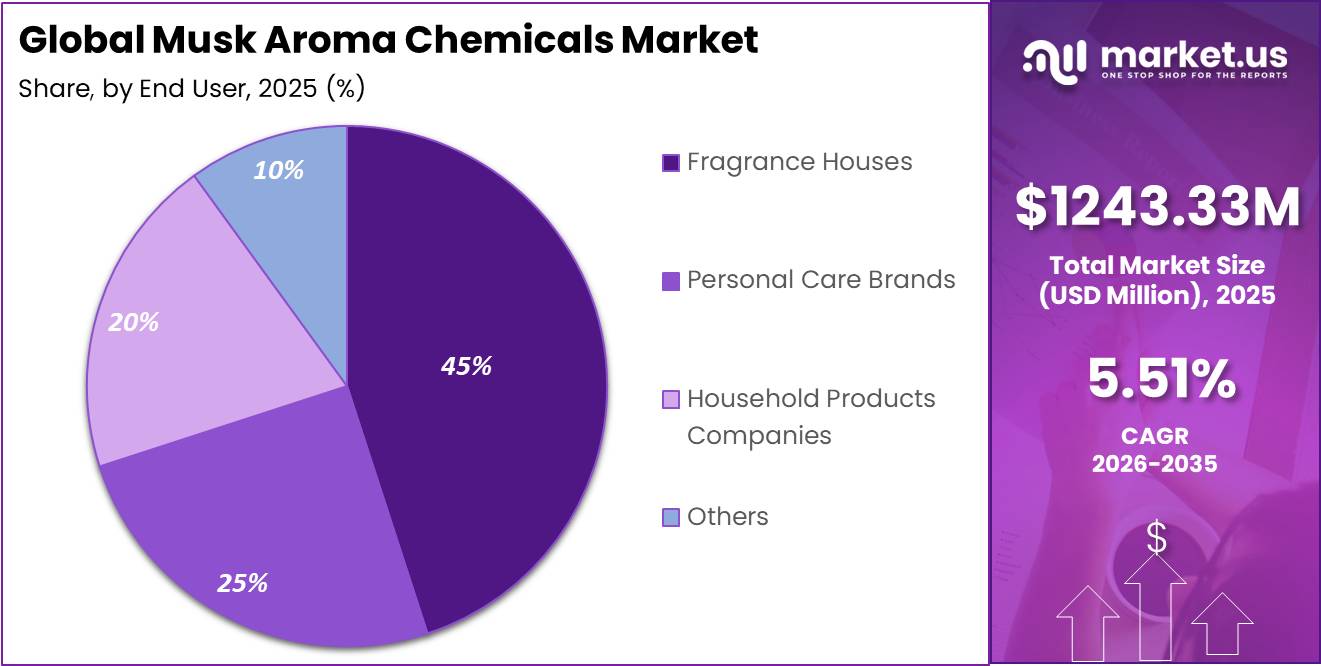
- Among the end users, fragrance houses held a major share in the musk aroma chemicals market, accounting for 45.00% of the market share.
- In 2025, Asia Pacific was the most dominant region in the musk aroma chemicals market, accounting for 38.00% of the total global consumption.
Regulation is reshaping the competitive landscape for musk aroma chemicals. An European Chemicals Agency enforcement project covering 421 inspections found only 3 non-compliance cases, demonstrating strong regulatory implementation across chemical supply chains.
- European Union Regulation 2023/1545 introduced individual labelling provisions for 56 additional fragrance allergens, increasing testing, documentation, traceability, and reformulation requirements across fragrance and personal-care supply chains. These regulatory developments are encouraging manufacturers to strengthen safety assessment, ingredient transparency, environmental testing, and compliance systems while developing alternative musk molecules that meet evolving European fragrance and cosmetic requirements.
Future opportunities are concentrated in macrocyclic musks, renewable feedstocks, fermentation, enzyme-assisted synthesis, and molecules designed for improved biodegradability. These technologies can reduce dependence on petrochemical intermediates while supporting premium fragrances and environmentally focused personal-care products.
- In June 2026, IFRA closed consultation on its proposed 52nd Standards Amendment, which is expected to add 51 restriction standards and revise 18 existing standards. This evolving safety framework should reward companies investing in toxicology, environmental screening, green chemistry, efficient synthesis, and transparent ingredient data over the forecast period ahead.
Source Analysis
Synthetic Musk Leads with 62% as Consistent Quality Supports Large-Scale Fragrance Production
In 2025, Synthetic Musk held a dominant market position, capturing more than a 62% share. Its leadership was supported by dependable supply, consistent odor performance, and suitability for perfumes, cosmetics, detergents, and household products. Synthetic production gives manufacturers better control over purity, scent strength, and batch uniformity while avoiding dependence on scarce animal-derived materials.
- In May 2025, according to the European Chemicals Agency, galaxolide in cosmetic products required ingredient-list disclosure above 0.001% in leave-on products and 0.01% in rinse-off products, with non-compliant products allowed onto the European Union market only until July 31, 2026.
Natural Musk is the fastest growing segment, supported by demand for premium, heritage-inspired, and naturally positioned fragrance concepts. Commercial availability remains limited because wildlife protection, ethical sourcing, traceability, and cost constraints restrict traditional animal-derived supply. This is encouraging fragrance developers to pursue responsible natural alternatives and biotechnology-based molecules that reproduce desirable musk characteristics while meeting modern safety, sustainability, quality, and sourcing expectations across luxury perfumery and specialty personal-care applications.
Musk Type Analysis
Macrocyclic Musks Lead with 38.00% as Refined Scent Quality Supports Premium Formulations
In 2025, Macrocyclic Musks held a dominant market position, capturing more than a 38.00% share. Their leadership was supported by refined odor quality, formulation stability, and suitability for perfumes, personal care, and household fragrance products. Macrocyclic musks provide clean, long-lasting base notes that blend effectively with floral, woody, amber, and gourmand accords. Their sensory similarity to natural musk and positioning in fragrance development support adoption among formulators seeking improved environmental profiles.
- In January 2026, according to the European Chemicals Agency, the polycyclic musk AHTN was limited to 2.5% in fine fragrance, 0.5% in fragrance cream, 1% in certain hydroalcoholic products, and 0.2% in specified rinse-off products under European Union cosmetic rules.
Polycyclic Musks are the fastest growing segment because they provide strong fragrance retention, dependable supply, and cost-efficient performance in detergents, fabric care, soaps, and mass-market perfumes. Manufacturers continue using these materials where durability and formulation efficiency are important, while regulatory scrutiny is encouraging tighter concentration control, improved environmental assessment, and reformulation. Continued technical work on safer use profiles and compliant applications supports their role across high-volume consumer fragrance categories.
Application Analysis
Fragrances & Fine Perfumes Lead with 43.20% as Lasting Scent Performance Supports Demand
In 2025, Fragrances & Fine Perfumes held a dominant market position, capturing more than a 43.20% share. The segment remained ahead because musk aroma chemicals serve as base notes and fixatives in fragrance compositions. They improve depth, diffusion, smoothness, and lasting performance while blending with floral, woody, amber, oriental, and gourmand accords. Perfume manufacturers use musk ingredients to create recognizable dry-down effects and maintain consistency across fragrance lines, supporting demand from fragrance brands and formulation houses.
- In June 2026, according to Cosmetics Europe, Europe’s cosmetics and personal care retail sales were valued at €110 billion in 2025, including €17.1 billion for fragrances and perfumes and €32.3 billion for skin care products.
Cosmetics & Personal Care is the fastest growing segment as musk aroma chemicals are increasingly incorporated into deodorants, lotions, creams, shampoos, soaps, body washes, and grooming products. These ingredients provide soft, clean, and persistent scent profiles that remain noticeable after application. Product developers are also focusing on skin compatibility, ingredient transparency, regulatory compliance, and improved environmental characteristics, supporting broader global consumer adoption of modern musk molecules across personal-care formulations.
End User Analysis
Fragrance Houses Lead with 45.00% Through Formulation Expertise and Broad Customer Reach
In 2025, Fragrance Houses held a dominant market position, capturing more than a 45.00% share. Their leadership was supported by formulation expertise, access to aroma ingredients, and the ability to develop customized scent systems for perfumes, cosmetics, detergents, fabric care, and household products. Musk aroma chemicals remain valuable to fragrance houses because they improve depth, balance, diffusion, and lasting performance. Large formulation teams also support regulatory screening, stability testing, customer adaptation, and consistent quality across product portfolios.
- In July 2026, according to Givaudan, first-half Fragrance & Beauty sales reached CHF 2,010 million, with like-for-like growth of 6.5%; Fine Fragrance sales increased 7.3%, while Consumer Products sales rose 9.2%.
Personal Care Brands are the fastest growing segment as they expand use of musk aroma chemicals in deodorants, lotions, shampoos, soaps, body washes, and grooming products. Demand is supported by consumer preference for soft and long-lasting scents combined with greater attention to safety, traceability, and environmental performance. Brands are increasingly working with fragrance suppliers to develop differentiated scent signatures, improve formulation compatibility, and meet evolving regulatory requirements across markets and personal-care formats.
Key Market Segments
By Source
- Synthetic Musk
- Natural Musk
By Musk Type
- Macrocyclic Musks
- Polycyclic Musks
- Nitro Musks
- Bio-Based / Biotech Musks
By Application
- Fragrances & Fine Perfumes
- Cosmetics & Personal Care
- Household Products & Detergents
- Food & Beverages
- Others
By End User
- Fragrance Houses
- Personal Care Brands
- Household Products Companies
- Others
Driver Analysis
Prestige fragrance premiumisation
Premiumisation expands musk demand disproportionately to fragrance-unit volume because musks are not merely odorants: they provide diffusion, substantivity and dry-down persistence, allowing brands to support higher price points and differentiated scent signatures. The end-market signal remains positive but selective: L’Oréal reported €44.05 billion of 2025 sales, with 4.0% like-for-like growth, while Coty recorded FY2025 like-for-like growth of 9% in ultra-premium fragrance, 2% in prestige fragrance and 8% in consumer-beauty fragrances; Coty also indicated that prestige fragrance grew at a mid-single-digit rate across FY2025.
For musk suppliers, this changes the commercial model from selling interchangeable, high-volume bases toward selling application-tested, traceable and proprietary odor-performance systems. The highest value capture is therefore in macrocyclic or specialty polycyclic options, fragrance-house co-development and multi-year supply agreements rather than spot-volume sales of commodity musk intermediates. This driver is strongest in the United States, Western Europe, China, GCC luxury retail and travel retail, where concentration perfume, refill formats and niche-brand launches raise the value of lasting fragrance performance.
Drivers Impact Analysis
| Driver | (\~) % Impact on CAGR | Geographic Relevance | Impact Timeline |
|---|---|---|---|
| Prestige fragrance premiumisation | +1.3 pp | North America, EU, GCC, China, travel retail | Short term (≤ 2 years) |
| Mass personal-care and home-care penetration | +1.0 pp | India, ASEAN, China, LATAM, Africa | Medium term (2–4 years) |
| Regulatory substitution to compliant musks | +0.9 pp | EU core, UK, North America, export APAC | Short term (≤ 2 years) |
| Macrocyclic and biodegradable-musks mix-upgrading | +0.8 pp | EU, Japan, South Korea, North America | Medium term (2–4 years) |
| Sustainable synthesis and lower-carbon supply | +0.6 pp | EU, North America, Japan, premium APAC | Medium term (2–4 years) |
| Encapsulation-led performance formulations | +0.5 pp | North America, EU, China, India, GCC | Long term (≥ 4 years) |
Restraint Analysis
Regulatory reformulation burden
The most immediate demand restraint is the 2026–2028 compliance cycle affecting fragrance compositions used in cosmetics and detergents: Commission Regulation (EU) 2023/1545 identified 56 additional fragrance allergens requiring individual label disclosure, with thresholds of 0.001% in leave-on cosmetics and 0.01% in rinse-off products; products newly placed on the EU market must comply from 31 July 2026, while existing non-compliant stock can remain available only until 31 July 2028. Although not every musk is directly affected, musk materials are embedded in fragrance accords that must be re-screened, analytically verified, documented and relabelled, creating a formulation bottleneck across personal care and home care.
For a fragrance house managing 500–1,000 active customer formulas, even a 10–20% reformulation incidence can absorb laboratory, regulatory and customer-approval capacity for 12–24 months; consumer-goods customers may defer new launches rather than accept label redesign, stability testing and revised safety-file costs. The effect is negative for volume because customers often simplify formulas, reduce discretionary perfume loadings or select pre-cleared, standardized accords; it is negative for suppliers’ margins because certificate-of-analysis, IFRA documentation, allergen screening and batch traceability costs rise faster than realizable price increases in mass-market detergents and toiletries.
Restraint Impact Analysis
| Restraint | (\~) % Impact on CAGR Forecast | Geographic Relevance | Impact Timeline |
|---|---|---|---|
| Regulatory reformulation burden | -1.2 pp | EU, UK, North America, export APAC | Short term (≤ 2 years) |
| Legacy-musk substitution risk | -1.0 pp | EU core, Japan, South Korea, North America | Medium term (2–4 years) |
| Petrochemical cost volatility | -0.8 pp | Europe, India, China, export markets | Short term (≤ 2 years) |
| Specialty-route cost intensity | -0.7 pp | EU, North America, Japan, premium APAC | Medium term (2–4 years) |
| Freight and feedstock disruption | -0.6 pp | Europe–Asia, India–EU, GCC corridors | Short term (≤ 2 years) |
| Traceability and sustainability friction | -0.5 pp | EU, North America, Japan, South Korea | Long term (≥ 4 years) |
Opportunity Analysis
Bio-based macrocyclic platforms
Bio-based macrocyclic musk production is an opportunity rather than a current driver because the majority of commercial supply still relies on established petrochemical routes, and the white space lies in converting sustainability demand into scalable, contract-backed molecular platforms with documented renewable-carbon and product-carbon-footprint credentials. A producer that develops a fermentation, biocatalytic or renewable-feedstock route can target premium fragrance, beauty and high-end home-care accounts with a 10–25% realized price premium over standard synthetic equivalents, provided odor consistency, purity, biodegradability and supply reliability are maintained; a practical 2026 investment case is a 2,000–5,000 tonne-per-year multi-product asset with a 3–5 year customer offtake base, rather than a single-molecule plant.
BASF’s 2025 lower-product-carbon-footprint aroma-ingredient launch, which cited an approximately 10–15% carbon-footprint reduction versus conventional alternatives, shows that customer qualification can begin with mass-balance and process improvements before full biological conversion is achieved. The opportunity is reinforced by the European Commission’s 2025 Bioeconomy Strategy, which identified €10 billion of potential bio-based-technology investment through 2030. Value creation comes from shifting the business mix toward high-margin, specification-led supply contracts, but execution requires 12–24 months of strain or process optimization, 18–36 months of customer sensory and safety qualification, and enough production scale to prevent bio-route costs from exceeding the premium that fragrance houses can recover downstream.
Opportunity Impact Analysis
| Opportunity | (\~) % Potential CAGR | Geographic Relevance | Execution Window |
|---|---|---|---|
| Bio-based macrocyclic platforms | +1.4 pp | EU, North America, Japan, Korea | Medium term (2–4 years) |
| Biodegradable scent-delivery systems | +1.1 pp | EU, North America, China, India | Medium term (2–4 years) |
| India–ASEAN regional supply hubs | +1.0 pp | India, ASEAN, GCC, East Africa | Short term (≤ 2 years) |
| Compliance-as-a-service bundles | +0.8 pp | EU, UK, North America, export APAC | Short term (≤ 2 years) |
| AI-enabled custom musk platforms | +0.7 pp | North America, EU, Japan, China | Medium term (2–4 years) |
| Specialty-ingredient M&A roll-ups | +0.6 pp | India, China, EU, North America | Long term (≥ 4 years) |
Challenges Analysis
Batch-to-batch odor consistency
Musk aroma chemicals face a continuous quality-reproducibility challenge because commercially acceptable material must meet not only assay and impurity specifications but also an odor profile that remains consistent across lots, seasons, production sites and downstream fragrance applications. A batch can pass conventional purity thresholds yet exhibit trace-level odor deviations caused by isomer distribution, residual solvents, oxidation products, catalyst carryover or thermal exposure during distillation; in practice, a 0.1–0.5% shift in a critical impurity profile can be perceptible to trained evaluators in fine-fragrance or premium fabric-care applications.
This creates a costly operational loop involving gas chromatography, mass spectrometry, sensory panels, retained samples and customer re-approval, with a rejected or downgraded batch potentially losing 15–40% of its intended contribution margin if it is redirected from fine fragrance to lower-value home-care use. Mitigation requires statistically controlled reaction conditions, 12–24 month retain-sample libraries, multi-dimensional sensory standards, tighter incoming-feedstock specifications and digital batch genealogy; these investments increase quality cost but protect customer qualification status and reduce the risk of losing long-duration supply contracts.
Challenges Impact Analysis
| Challenge | (\~) % CAGR Friction | Geographic Relevance | Mitigation Horizon |
|---|---|---|---|
| Batch-to-batch odor consistency | -0.9 pp | Global, EU, North America, Japan | Medium term (2–4 years) |
| Multi-site feedstock qualification | -0.8 pp | China–EU, India–EU, North America | Medium term (2–4 years) |
| Specialist chemistry talent gap | -0.7 pp | EU, India, China, North America | Long term (≥ 4 years) |
| Energy-intensive purification economics | -0.7 pp | EU core, Japan, South Korea | Medium term (2–4 years) |
| Regulatory-data maintenance load | -0.6 pp | EU hubs, UK, North America | Long term (≥ 4 years) |
| Logistics inventory synchronization | -0.5 pp | Asia–Europe, India–EU, GCC routes | Short term (≤ 2 years) |
Geopolitical Impact Analysis
Trade Fragmentation and Shipping Disruptions Reshaping Musk Aroma Chemical Supply Chains
Geopolitical tensions are reshaping the Musk Aroma Chemicals Market through tariff changes, higher logistics risk, energy-price uncertainty, and greater pressure to diversify specialty-chemical sourcing. Musk ingredients used in perfumes, cosmetics, detergents, and household products often move through international fragrance and chemical supply chains.
- In March 2026, the World Trade Organization forecast global merchandise trade growth of 1.9% in 2026, compared with 4.6% in 2025, reflecting a slower and less predictable trading environment.
Trade policy between major manufacturing economies is adding procurement uncertainty. In November 2025, the United States maintained an additional 10% ad valorem tariff on covered imports from China while extending suspension of heightened reciprocal tariffs until November 10, 2026. Such measures can influence sourcing decisions for aroma chemicals, chemical intermediates, packaging materials, and processing inputs.
- United Nations Trade and Development reported in 2025 that maritime transport carries more than 80% of world trade, while maritime trade growth was expected to slow to 0.5% in 2025. Red Sea disruption has forced ships onto longer routes around the Cape of Good Hope, increasing delivery uncertainty and transport costs.
These conditions are encouraging musk aroma chemical suppliers to qualify alternative sources, maintain regional inventories, and expand manufacturing flexibility. Companies with diversified intermediates, multiple logistics routes, and compliant regional supply networks are better positioned to manage tariff changes, freight disruption, energy-cost volatility, and customer requirements across fragrance, personal-care, and household-product markets.
Regional Analysis
Asia Pacific Leads Through Strong Fragrance and Personal Care Manufacturing
In 2025, Asia Pacific held a dominant position in the Musk Aroma Chemicals Market, capturing more than a 38.00% share and generating USD 472.47 million in revenue. The region benefited from its fragrance, cosmetics, detergent, and specialty chemical manufacturing base across China, Japan, South Korea, and Southeast Asia.
- According to the National Bureau of Statistics of China, cosmetics retail sales by enterprises above designated size reached CNY 465.3 billion in 2025, increasing 5.1% year over year. South Korea strengthened fragrance and personal-care demand
In May 2026, the Ministry of Food and Drug Safety reported that Korean cosmetics exports reached USD 11.4 billion in 2025, rising 11.8%, while domestic cosmetics production increased 2.3% to KRW 17.9382 trillion. These trends support demand for musk aroma chemicals used in perfumes, personal care, fabric care, and household products, while tighter safety and environmental requirements continue encouraging investment in compliant synthetic and macrocyclic musk formulations.
Key Regions and Countries Covered
- North America
- The US
- Canada
- Europe
- Germany
- France
- The UK
- Spain
- Italy
- Russia & CIS
- Rest of Europe
- APAC
- China
- Japan
- South Korea
- India
- ASEAN
- Rest of APAC
- Latin America
- Brazil
- Mexico
- Rest of Latin America
- Middle East & Africa
- GCC
- South Africa
- Rest of MEA
Key Players Analysis
Musk aroma chemical manufacturers focus on strengthening fragrance performance, regulatory compliance, product safety, and formulation flexibility to maintain competitiveness. A key priority is the development of macrocyclic, biodegradable, and biotechnology-based musks that provide long-lasting scent profiles while addressing environmental and toxicological concerns. Companies also invest in improved synthesis routes, fermentation technologies, and high-purity production processes to support premium perfumes, cosmetics, detergents, and household applications.
Vertical integration with specialty chemical suppliers helps manufacturers secure aromatic intermediates, solvents, and other essential inputs while improving cost control and supply reliability. Strategic production expansion across Asia Pacific supports access to major fragrance, personal care, and home-care manufacturing hubs. Leading players such as Givaudan, IFF, Symrise, BASF, Takasago, Kao, Bedoukian Research further emphasize patent protection, ingredient traceability, application testing, and consistent quality standards. Long-term collaboration with fragrance houses and personal care brands also supports customer retention and strengthens positioning in high-value scent formulations.
Market Key Players
- Givaudan SA
- International Flavors & Fragrances (IFF)
- Firmenich SA
- Symrise AG
- BASF SE
- Takasago International Corporation
- Kao Corporation
- Solvay SA
- Innospec Inc.
- Bedoukian Research Inc.
- Sunstar Inc.
- Reagen Srl
Key Development
- In February 2026, Givaudan launched Scentaurus™ PolyDoux, expanding its fragrance precursor portfolio with an oxygen-activated technology that releases long-lasting raspberry and powdery vanilla notes. The innovation is designed for applications including shampoos, fabric conditioners, and laundry detergents, strengthening Givaudan’s position in high-performance fragrance ingredients.
- In June 2026, International Flavors & Fragrances (IFF) launched SENSORA™, a patent-pending pro-fragrance technology platform designed to provide sustained fragrance release across home, fabric, and personal care applications. The technology initially targets liquid detergents and responds to demand for longer-lasting and more sophisticated scent experiences.
- In June 2026, BASF launched Micadelva™, a new non-allergenic citrus fragrance ingredient developed as an alternative to orange terpenes. The company also introduced its Safe-by-Design concept to support development of fragrance ingredients that can address changing regulatory and sustainability requirements.
Report Scope
| Report Features | Description |
|---|---|
| Market Value (2025) | USD 1243.33 Mn |
| Forecast Revenue (2035) | USD 2124.97 Mn |
| CAGR (2026-2035) | 5.51% |
| Base Year for Estimation | 2025 |
| Historic Period | 2020-2024 |
| Forecast Period | 2026-2035 |
| Report Coverage | Revenue Forecast, Market Dynamics, Competitive Landscape, Recent Developments |
| Segments Covered | By Source (Synthetic Musk and Natural Musk), By Musk Type (Macrocyclic Musks, Polycyclic Musks, Nitro Musks, and Bio-Based / Biotech Musks), By Application (Fragrances & Fine Perfumes, Cosmetics & Personal Care, Household Products & Detergents, Food & Beverages, and Others), By End User (Fragrance Houses, Personal Care Brands, Household Products Companies, and Others) |
| Regional Analysis | North America – The US & Canada; Europe – Germany, France, The UK, Spain, Italy, Russia & CIS, Rest of Europe; APAC– China, Japan, South Korea, India, ASEAN & Rest of APAC; Latin America– Brazil, Mexico & Rest of Latin America; Middle East & Africa– GCC, South Africa, & Rest of MEA |
| Competitive Landscape | Givaudan SA, International Flavors & Fragrances (IFF), Firmenich SA, Symrise AG, BASF SE, Takasago International Corporation, Kao Corporation, Solvay SA, Innospec Inc., Bedoukian Research Inc., Sunstar Inc., and Reagen Srl. |
| Customization Scope | Customization for segments, region/country-level will be provided. Moreover, additional customization can be done based on the requirements. |
| Purchase Options | We have three licenses to opt for: Single User License, Multi-User License (Up to 5 Users), Corporate Use License (Unlimited Users and Printable PDF) |





































