Quick Navigation
- Report Overview
- Key Takeaways
- Product Analysis
- Connectivity Analysis
- Deployment Analysis
- Power Rating Analysis
- Application Analysis
- Key Market Segments
- Driver Analysis
- Restraint Analysis
- Opportunity Analysis
- Challenges Analysis
- Geopolitical Impact Analysis
- Regional Analysis
- Key Players Analysis
- Key Development
- Report Scope
Report Overview
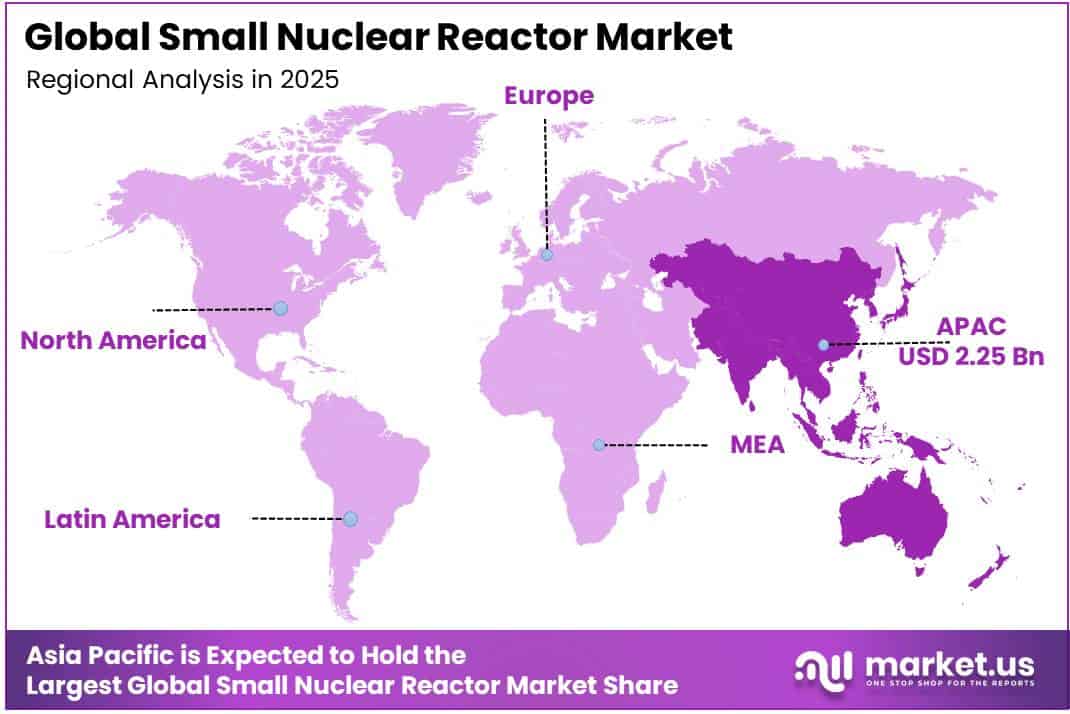
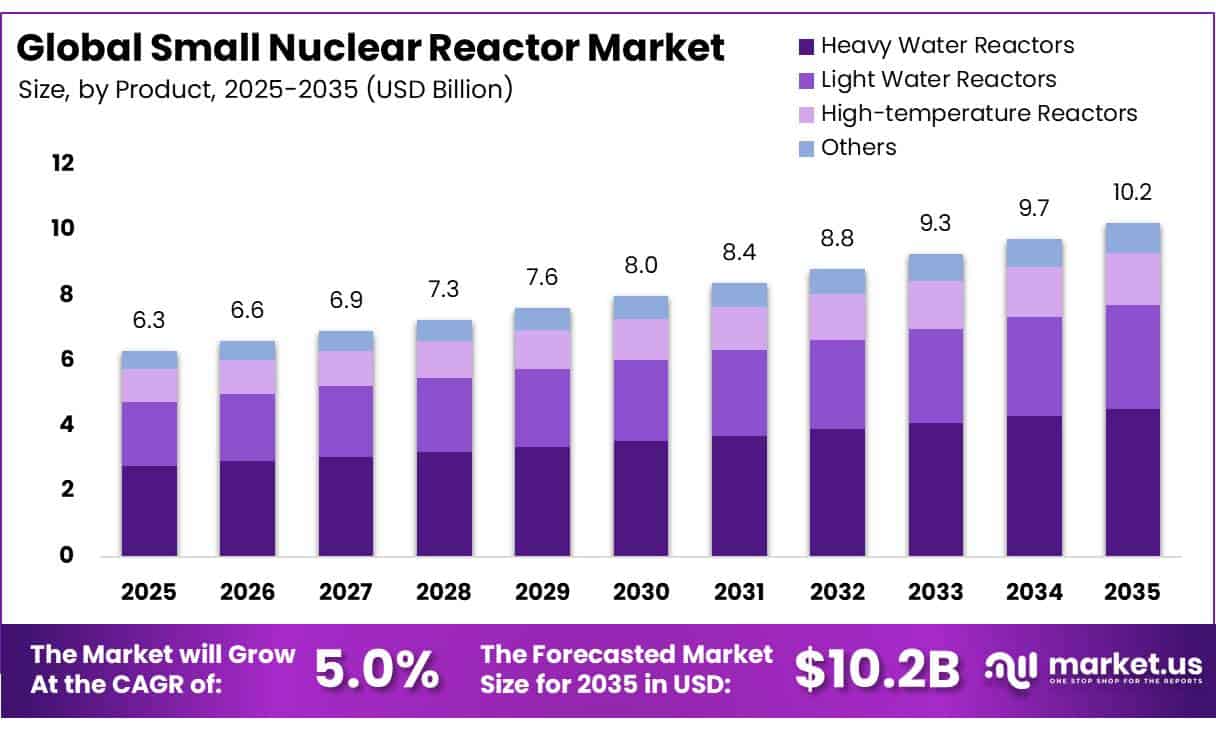
In 2025, the Global Small Nuclear Reactor Market Market was valued at USD 6.3 billion, and between 2026 and 2035, this market is estimated to register a CAGR of 5.0%, reaching about USD 10.2 billion by 2035. Asia-Pacific held a dominant market position, capturing more than a 35.67% share, holding USD 2.25 billion in revenue.
Small nuclear reactors are emerging as an option for utilities, industries, remote systems, and countries seeking firm low-carbon electricity with smaller project sizes than conventional plants.
- In July 2025, the International Atomic Energy Agency reported about 70 small modular reactor designs at active stages of development and deployment worldwide. Its Power Reactor Information System also lists China’s Linglong-1 as under construction with a design net capacity of 100 megawatts electrical, showing movement from design pipelines toward deployment.
Key Takeaways
- The global small nuclear reactor market was valued at USD 6.3 billion in 2025.
- The global market is projected to grow at a CAGR of 5.0% and is estimated to reach USD 10.2 billion by 2035.
- On the basis of product, Heavy Water Reactors dominated the market, constituting 44.21% of the total market share.
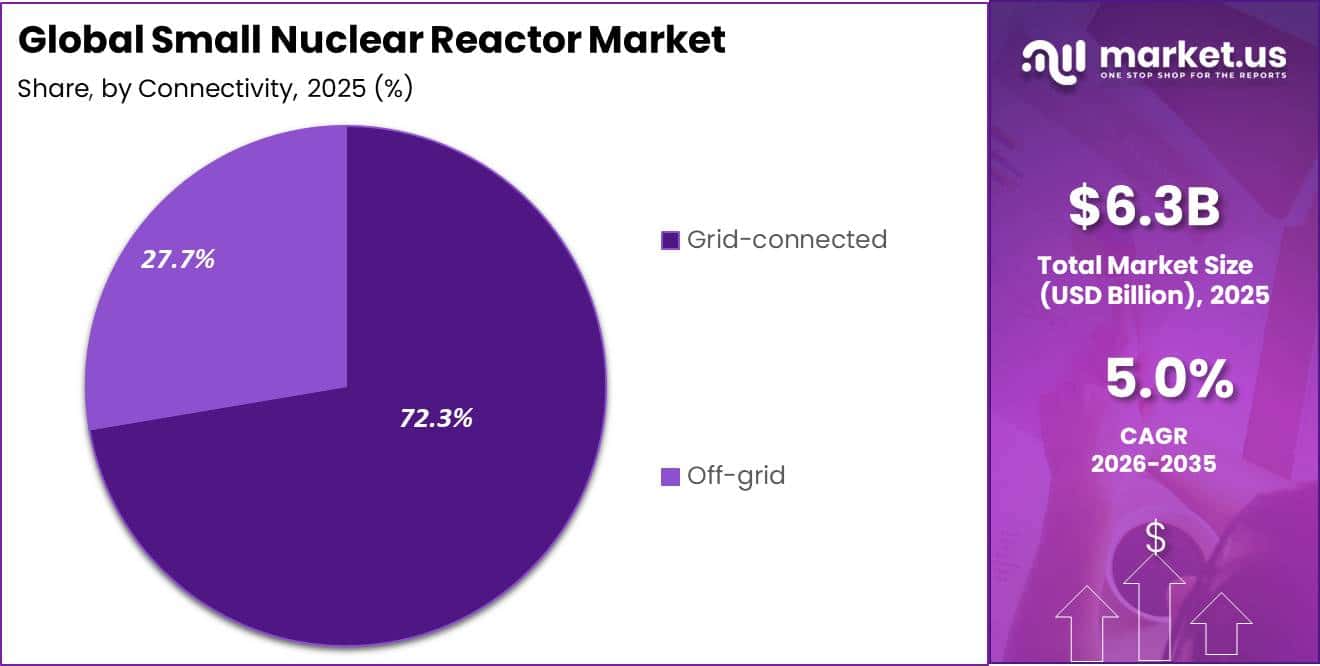
- Based on connectivity, Grid-connected dominated the small nuclear reactor market, with a substantial market share of around 72.34%.
- Based on deployment, Multi-Module Power Plant led the market, comprising 67.80% of the total market.
- Among the power ratings, 101-200 MW held a major share in the small nuclear reactor market, accounting for 62.34% of the market share.
- Among the applications, Industrial was the most considerable within the market, accounting for around 42.12% of the revenue.
- In 2025, Asia-Pacific was the most dominant region in the small nuclear reactor market, accounting for 35.67% of the total market share.
The industrial scenario is shaped by licensing progress and standardized modular configurations. In May 2025, the U.S. Nuclear Regulatory Commission completed its review of NuScale’s US460 standard design approval. The approved light-water configuration specifies 77 megawatts electrical per nuclear power module, six modules, and 462 megawatts electrical of total plant output. Regulatory milestones of this kind can improve confidence among utilities, engineering contractors, equipment suppliers, and investors evaluating repeatable reactor designs for grid and industrial applications.
- Government support is strengthening the supply chain and creating opportunities for reactor vendors, fuel suppliers, fabricators, and engineering companies. In March 2025, the U.S. Department of Energy reissued a $900 million Generation III Plus small modular reactor solicitation. In May 2026, its supply-chain selections included $8.8 million for Framatome to expand fuel fabrication in Washington, adding approximately 200 metric tons of uranium annual capacity.
Deployment opportunities are expanding through national energy-security programmes. In April 2026, Great British Energy Nuclear signed a contract with Rolls-Royce Small Modular Reactor for the United Kingdom’s first project. The planned three-unit development is expected to provide at least 1.4 gigawatts electrical, enough electricity for around three million homes for more than 60 years. The National Wealth Fund committed up to £599 million, supporting technology development, private investment, industrial capability, and global commercialization.
Product Analysis
Heavy Water Reactors dominate with 44.21% through established nuclear operations
In 2025, Heavy Water Reactors held a dominant market position, capturing more than a 44.21% share. Their leadership is supported by established operating experience, strong fuel flexibility, and suitability for countries with existing heavy-water reactor infrastructure. These reactors remain relevant for utilities seeking dependable baseload generation, long operating cycles, and domestic fuel-cycle options within nuclear power systems.
- In May 2025, according to the Government of Ontario, the Darlington New Nuclear Project was approved to begin construction of the first of four small modular reactors. The planned fleet will provide 1,200 megawatts of electricity, enough to power 1.2 million homes, while operations could support up to 2,000 jobs each year.
Light Water Reactors are the growing segment, supported by wider commercial familiarity, standardized reactor technology, and expanding small modular reactor projects. Their use of ordinary water as coolant and moderator simplifies integration with established nuclear supply chains. New light-water designs are attracting utilities because modular construction, repeatable components, and grid-scale deployment can reduce project complexity while supporting cleaner electricity generation, industrial energy demand, and future capacity additions across major markets.
Connectivity Analysis
In 2025, Grid-connected held a dominant market position, capturing more than a 72.34% share. The segment remained prominent because small nuclear reactors can supply electricity into transmission and distribution networks. Utilities can integrate modular reactors with grid infrastructure while supporting baseload generation, system stability, and replacement of retiring thermal capacity across electricity markets.
- In July 2025, according to the U.S. Department of Energy, Westinghouse’s eVinci microreactor was designed to produce 5 megawatts of electricity on sites as small as two acres. Radiant’s Kaleidos design was rated at 1.2 megawatts electric and designed to operate for five years before refueling.
Off-grid is the growing segment, supported by demand for dependable power in remote communities, mining operations, military facilities, data centers, and isolated industrial sites. Compact reactors can serve locations where extending transmission infrastructure is difficult or costly. Factory-built designs, transportable components, long refueling intervals, and continuous generation capability strengthen their suitability for independent microgrids and remote energy systems requiring resilient electricity supplies.
Deployment Analysis
Multi-Module Power Plant dominates with 67.80% through flexible staged capacity
In 2025, Multi-Module Power Plant held a dominant market position, capturing more than a 67.80% share. The segment remained preferred because multiple reactor modules can be added in stages as electricity demand increases. This configuration also allows operators to maintain generation from operating modules while another unit undergoes maintenance, supporting dependable output, flexible capacity planning, and efficient use of shared site infrastructure.
- In December 2025, according to the U.S. Department of Energy, Tennessee Valley Authority and Holtec Government Services were selected to receive up to $800 million in combined federal cost-shared funding. Each project team was allocated up to $400 million, while Holtec planned to deploy two SMR-300 reactors at the Palisades Nuclear Generating Station site in Michigan.
Single-Module Power Plant is the growing segment, supported by simpler project layouts and lower initial capacity requirements. A single reactor module can suit utilities, industrial facilities, remote energy systems, and sites replacing smaller fossil-fuel units. Reduced site complexity, modular construction, and easier capacity matching make this deployment approach attractive where developers seek phased nuclear investment without committing immediately to larger multi-unit projects.
Power Rating Analysis
101-200 MW dominates with 62.34% through balanced power output
In 2025, 101-200 MW held a dominant market position, capturing more than a 62.34% share. This power range remained attractive because it offers a practical balance between electricity output, site requirements, capital exposure, and integration with regional grids. Reactors in this category can support utilities and industrial users seeking dependable generation without the scale and construction complexity associated with larger conventional nuclear plants.
- In May 2025, according to the U.S. Department of Energy, X-energy’s Xe-100 small modular reactor was designed to produce 80 megawatts of electric output or 200 megawatts of process heat. A single reactor was designed to operate for 60 years, while the planned Seadrift facility supports manufacturing of more than 4 billion pounds of chemical products annually.
Upto 100 MW is the growing segment, supported by interest in compact reactors for industrial sites, remote communities, data centers, mines, military facilities, and isolated grids. Smaller units can match local electricity demand more closely while reducing site requirements. Factory fabrication, modular installation, flexible deployment, and suitability for combined electricity and process-heat applications are strengthening interest in lower-capacity nuclear systems.
Application Analysis
Industrial dominates with 42.12% through dependable process energy demand
In 2025, Industrial held a dominant market position, capturing more than a 42.12% share. The segment remained important because small nuclear reactors can provide dependable electricity and process heat for manufacturing, chemicals, metals, mining, and other energy-intensive operations. Their compact design, steady output, and ability to operate near industrial facilities support applications that require reliable power and high-temperature heat with lower carbon emissions.
- In March 2026, according to the U.S. Department of Energy, a $40 billion United States-Japan energy partnership was announced for deployment of BWRX-300 small modular reactors in Tennessee and Alabama, with the planned projects targeting 3 gigawatts of clean baseload power.
Power Generation is the fastest growing segment, supported by rising interest in firm, low-carbon electricity and replacement capacity for retiring fossil-fuel plants. Small nuclear reactors can provide continuous generation while complementing variable renewable resources and strengthening grid reliability. Modular construction also allows utilities to add capacity in stages, match regional demand, and use existing power sites, making these reactors increasingly suitable for future electricity systems requiring dependable generation and greater energy security across major energy markets.
Key Market Segments
By Product
- Heavy Water Reactors
- Light Water Reactors
- High-temperature Reactors
- Others
By Connectivity
- Off-grid
- Grid-connected
By Deployment
- Single-Module Power Plant
- Multi-Module Power Plant
By Power Rating
- Upto 100 MW
- 101-200 MW
- Above 200 MW
By Application
- Industrial
- Power Generation
- Desalination
- Hydrogen Production