


Report Overview
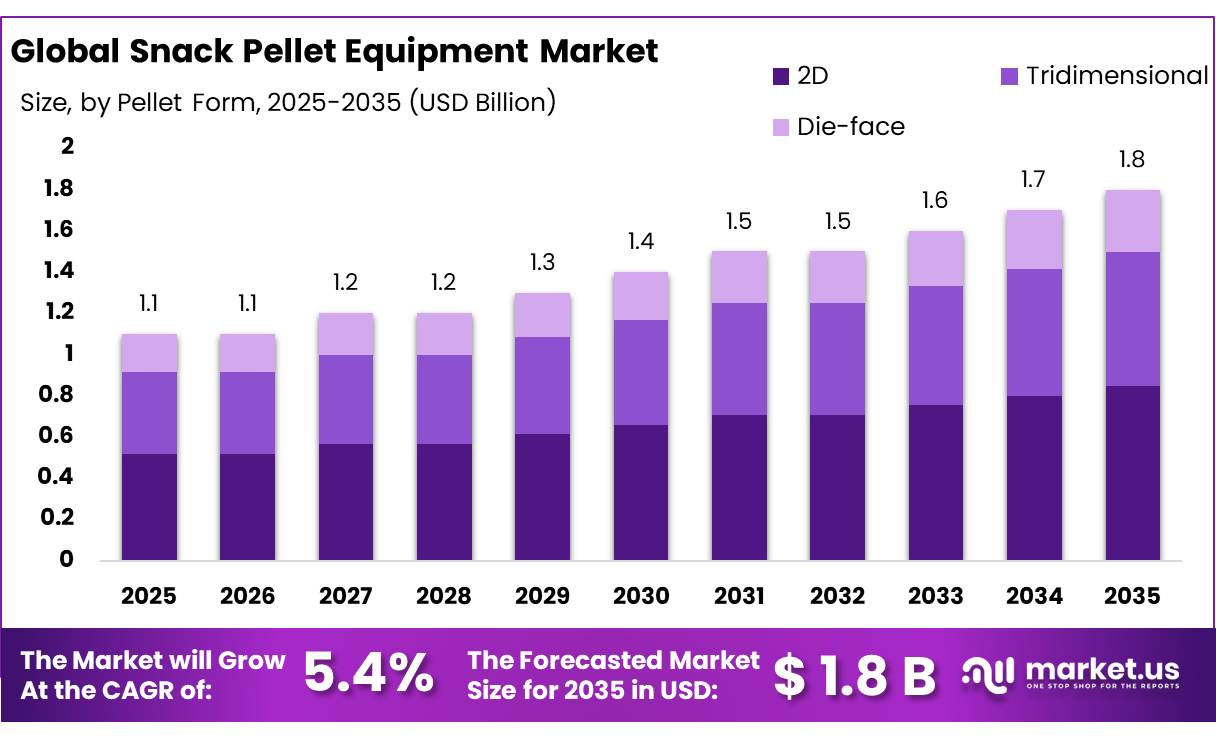
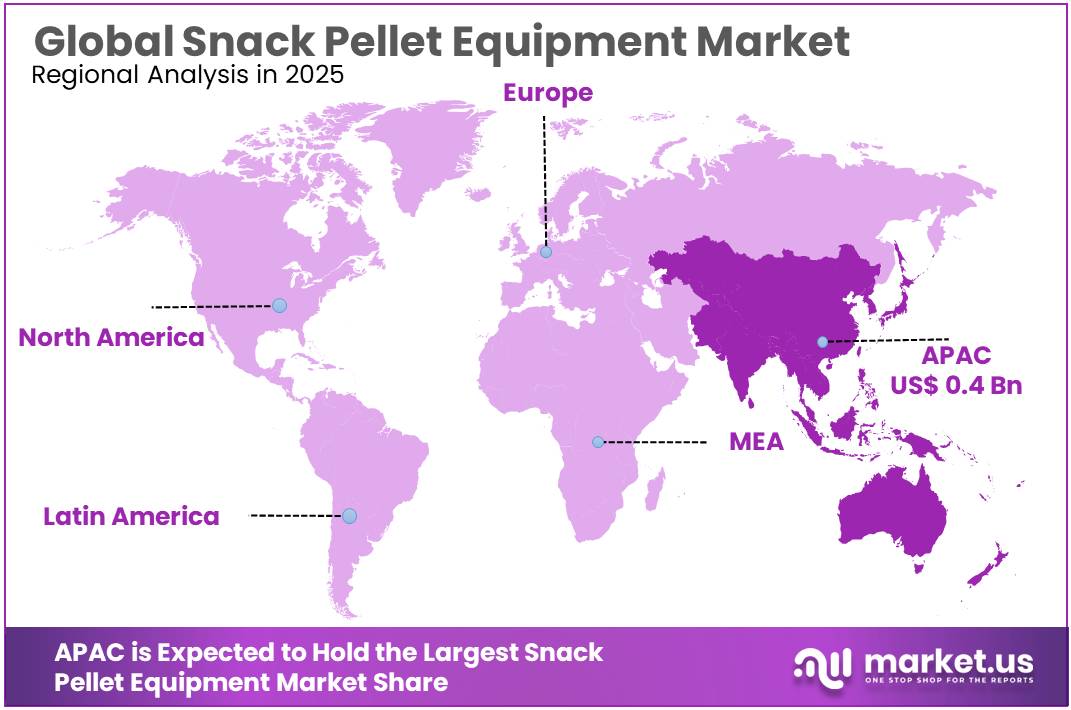
The Global Snack Pellet Equipment Market size is expected to be worth around USD 1.8 Billion by 2035, from USD 1.1 Billion in 2025, growing at a CAGR of 5.4% during the forecast period from 2026 to 2035. In 2025, Asia Pacific held a dominant market position, capturing more than a 37.80% share, holding USD 0.4 Billion revenue.
The Snack Pellet Equipment industry covers machinery used to mix raw ingredients, extrude dough, cut and shape pellets, dry them, fry or expand the product, apply seasoning, cool finished snacks, and prepare them for packaging. Equipment is commonly designed for potato-, corn-, wheat-, rice-, and multi-grain formulations. The industrial base remains large, with FAO estimating global cereal production at 3,043 million tonnes in 2025, up 6.1% from 2024.
Raw-material availability supports continued equipment utilization. USDA estimated U.S. corn production at a record 17.0 billion bushels in 2025, with an average yield of 186.5 bushels per acre across 91.3 million harvested acres. Corn and other cereal ingredients form an important base for expanded and extruded snack pellets, encouraging manufacturers to install flexible equipment that can process different flour blends, moisture levels, shapes, and densities.
- Potato-based pellets provide another substantial processing opportunity. USDA reported that U.S. potato production reached 413 million cwt in 2025, while combined U.S. and Canadian production reached 539 million cwt. The large potato supply supports equipment demand for flour preparation, extrusion, drying, frying, flavoring, and continuous conveying systems used by industrial snack processors.
The industrial scenario is increasingly focused on machinery renewal and automation. PMMI reported in January 2025 that 92% of surveyed snack manufacturers expected some business growth over the following three years, while 88% planned to purchase new machinery through 2027. Around 57% of those purchases were intended to replace existing equipment, including machines that were often 20–30 years old. This replacement cycle supports demand for modern extruders, dryers, fryers, seasoning systems, and automated handling lines.
Energy efficiency creates another important development area. The U.S. Department of Energy identifies more than 30,000 food and beverage manufacturing facilities and states that the sector accounts for around 6% of U.S. industrial energy use. Snack pellet manufacturers therefore have opportunities to adopt efficient dryers, heat-recovery systems, insulated fryers, intelligent temperature controls, and lower-energy expansion technologies. U.S. Department of Energy – Food and Beverage Products
Key Takeaways
- Snack Pellet Equipment Market size is expected to be worth around USD 1.8 Billion by 2035, from USD 1.1 Billion in 2025, growing at a CAGR of 5.4%.
- Extrusion equipment held a dominant market position, capturing more than a 32.00% share.
- Single-screw extruders held a dominant market position, capturing more than a 59.00% share.
- 2D held a dominant market position, capturing more than a 47.00% share.
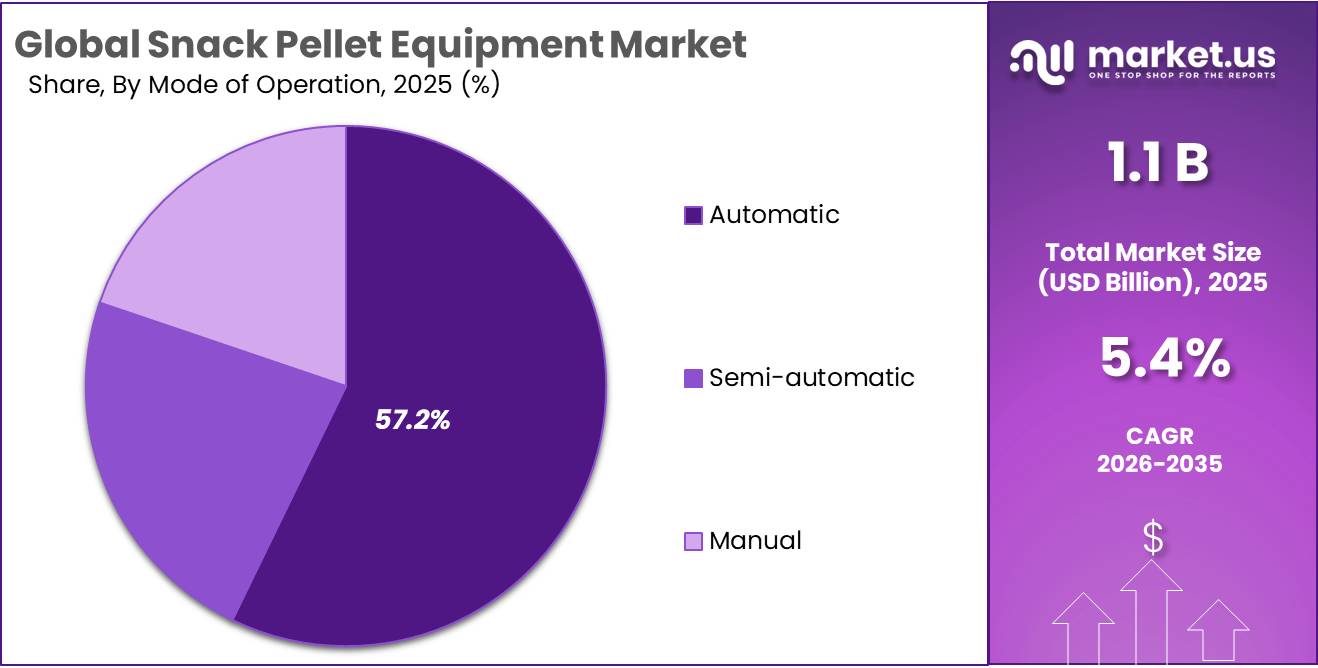
- Automatic held a dominant market position, capturing more than a 57.00% share.
- Asia Pacific held a dominant position in the Snack Pellet Equipment Market, capturing more than a 37.80% share and generating approximately USD 0.40 billion.
By Equipment Type Analysis
Extrusion equipment dominates with more than a 32.00% share, supported by high-volume cereal-based snack production
In 2025, “Extrusion equipment” held a dominant market position, capturing more than a 32.00% share. Extruders remained central to snack pellet production because they combine pressure, heat, moisture, and mechanical force to convert cereal or potato mixtures into uniform pellet shapes. They also allow processors to change dies and recipes to produce different textures, sizes, and shapes without completely rebuilding production lines.
Large cereal supplies support the use of extrusion equipment. USDA reported in January 2026 that U.S. corn production reached a record 17.0 billion bushels for 2025, harvested from 91.3 million acres, with an average yield of 186.5 bushels per acre. U.S. wheat production also reached 1.98 billion bushels from 37.2 million harvested acres in 2025. These large raw-material volumes provide a strong base for corn-, wheat-, and multi-grain snack pellets produced through extrusion.
Mixing equipment remained an important equipment type in the Snack Pellet Equipment Market in 2025. Mixers are used before extrusion to combine cereal flour, potato ingredients, starch, water, oil, seasonings, and other components into a consistent dough. Accurate mixing helps processors maintain uniform moisture, texture, flavor distribution, and extrusion performance while reducing variation between production batches.
By Extruder Type Analysis
Single-screw extruders dominate with more than a 59.00% share, supported by simple operation and high-volume cereal processing
In 2025, “Single-screw extruders” held a dominant market position, capturing more than a 59.00% share. Single-screw systems remained widely used in snack pellet production because they provide continuous processing, relatively simple operation, controlled shaping, and dependable output for corn-, wheat-, and potato-based formulations. Their straightforward design also supports easier cleaning and maintenance during regular production.
Large raw-material availability supports their use. USDA reported in January 2026 that U.S. corn production reached a record 17.0 billion bushels in 2025, produced from 91.3 million harvested acres, with an average yield of 186.5 bushels per acre. U.S. wheat production also totaled 1.98 billion bushels from 37.2 million acres. These large cereal volumes provide a strong processing base for extruded snack pellets.
Twin-screw extruders remained an important extruder type in the Snack Pellet Equipment Market in 2025. Their two interacting screws provide stronger mixing and more controlled movement of dough through the barrel, making them suitable for multi-grain, high-fiber, protein-enriched, and other formulations that require greater processing flexibility. They can also handle wider changes in moisture, ingredients, and recipe structure.
By Pellet Form Analysis
2D pellets dominate with more than a 47.00% share, supported by simple processing and high-volume cereal availability
In 2025, “2D” held a dominant market position, capturing more than a 47.00% share. Two-dimensional pellets remain widely produced because flat shapes such as rings, squares, strips, and wheels can be manufactured efficiently using standard extrusion and cutting systems. Their relatively simple forming process supports high throughput, easy die changes, and consistent product dimensions across large snack-processing lines.
Government crop data supports the raw-material base for this segment. USDA reported in 2026 that U.S. corn production reached 17.02 billion bushels in 2025, while wheat production totaled 1.98 billion bushels. Potato production reached 412.86 million cwt during the same year. Corn, wheat, and potato starches are widely suitable for extruded pellet formulations, giving manufacturers a large supply base for continuous 2D pellet production.
Tridimensional pellets remained an important pellet-form segment in the Snack Pellet Equipment Market in 2025. These products use more complex forming and extrusion systems to create three-dimensional shapes that expand during frying or hot-air processing. Their distinctive appearance helps snack manufacturers differentiate products while supporting a wider range of textures and ingredient combinations.
By Mode of Operation Analysis
Automatic equipment dominates with more than a 57.00% share, supported by faster and more consistent snack production
In 2025, “Automatic” held a dominant market position, capturing more than a 57.00% share. Automatic snack pellet equipment is widely used for continuous mixing, extrusion, cutting, drying, frying, seasoning, and material handling. These systems help manufacturers maintain consistent pellet size and production speed while reducing repetitive manual work across high-volume processing lines.
The large food-processing workforce highlights the scale of operations where automation can be applied. In August 2026, U.S. food manufacturing employed about 1.765 million workers, including approximately 1.390 million production and nonsupervisory employees. In 2025, the industry also employed 168,370 packaging and filling machine operators and 144,690 food batchmakers. These production activities create opportunities for automatic conveying, ingredient dosing, extrusion, inspection, and packaging equipment.
Semi-automatic equipment remained an important operating mode in the Snack Pellet Equipment Market in 2025. These systems combine mechanized processing with operator involvement and are commonly suited to recipe changes, smaller production batches, product trials, and facilities that do not require fully continuous lines. Operators can control ingredient loading, extrusion settings, cutting, seasoning, and product transfer while still gaining higher productivity than manual processing.
Key Market Segments
By Equipment Type
- Extrusion equipment
- Mixing equipment
- Cutting equipment
- Drying equipment
- Frying equipment
- Seasoning equipment
- Other equipment
By Extruder Type
- Single-screw extruders
- Twin-screw extruders
By Pellet Form
- 2D
- Tridimensional
- Die-face
By Mode of Operation
- Automatic
- Semi-automatic
- Manual
Driver Analysis
Packaged-Snack Volume Growth
Urbanization, rising workforce participation, modern retail penetration, and smaller on-the-go eating occasions are structurally increasing throughput requirements for standardized pellets rather than merely lifting finished-snack prices: FAO links urbanization with higher consumption of convenient and processed foods, India’s food retail industry reached approximately $869 billion in 2025 while growing near 7% annually, and Indonesia’s reported snack-sales series rose from roughly 6.26 in 2022 to 7.34 by 2026 in the source’s local market-value series, with urban consumers favoring convenient products and bolder flavors.
For equipment suppliers, the operational conversion is a shift from single-purpose batch machines toward continuous extrusion, drying, expansion, seasoning, and handling systems: commercially available twin-screw platforms span approximately 250–2,500 kg/hour, while modular puffing configurations range from 350–500 kg/hour for a single unit to 1,400–2,000 kg/hour for four-unit systems. A modeled processor adding one 1,000 kg/hour line at 70% utilization over 6,000 annual operating hours can create about 4,200 tonnes of incremental pellet capacity; across only 500 comparable installations, this equates to 2.1 million tonnes of new annual nameplate output and supports an estimated +2.2 percentage points of equipment-market CAGR.
The business-model effect is larger average order values through integrated lines, recipe libraries, dies, dryers, and coating systems, alongside aftermarket demand tied to wear parts and capacity utilization; it also shifts customer acquisition from isolated machine replacement to multi-year plant-expansion programs, making this the strongest near-term driver in APAC and the principal spill-over catalyst in MENA and Latin America.
Drivers Impact Analysis
| Driver(~) | % Impact on CAGR Forecast | Geographic Relevance | Impact Timeline |
|---|---|---|---|
| Packaged-snack volume growth | +2.2% | APAC core; MENA, LatAm spill-over | Short term (≤ 2 years) |
| Health-led product diversification | +1.7% | North America; EU; urban APAC | Medium term (2–4 years) |
| Emerging-market capacity buildout | +1.5% | India; Southeast Asia; Africa | Medium term (2–4 years) |
| Labor-saving line automation | +1.3% | North America; EU; China | Short term (≤ 2 years) |
| Energy and oil efficiency | +1.1% | EU core; APAC industrial hubs | Medium term (2–4 years) |
| Hygiene and digital compliance | +0.8% | EU; North America; export plants | Medium term (2–4 years) |
Restraint Analysis
High Installed CapEx
The largest restraint is the cash burden of buying a complete line rather than an isolated extruder: an analyst-modeled 1 tonne/hour project typically requires the extruder and dies, pre-conditioner, dryer, fryer or oven, seasoning, conveying, controls, utilities, installation and working-capital ramp, making the installed commitment roughly 1.6-2.2 times the core-equipment invoice; at an illustrative US$1.8 million installed cost, 70% debt funding, a seven-year tenor and an 8%-10% borrowing rate, annual debt service approaches US$240,000-US$270,000 before maintenance, while 65% utilization over 6,000 scheduled hours yields only about 3,900 productive hours and embeds US$62-US$69 of financing cost per operating hour.
The financing environment remains restrictive: the effective U.S. federal-funds rate was 3.63% and the bank prime rate 6.75% in September 2026, while the ECB raised its deposit, refinancing and marginal-lending rates to 2.50%, 2.65% and 2.90%, respectively, effective 16 September 2026.
These rates push commercial borrowing materially above policy benchmarks, lengthening modeled payback from approximately 3.5-4.5 years under high utilization to 5.5-7.0 years for smaller processors operating one or two shifts; consequently, firms defer greenfield lines, purchase refurbished extruders, or install only debottlenecking modules, suppressing new-equipment order conversion particularly in South and Southeast Asia, Latin America and Africa despite broader development financing for agribusiness. The modeled -1.7 percentage-point CAGR effect therefore captures postponed orders, smaller line configurations and a shift from turnkey projects toward lower-value retrofits rather than an absence of underlying snack demand.
Restraint Impact Analysis
| Restraint(~) | % Impact on CAGR Forecast | Geographic Relevance | Impact Timeline |
|---|---|---|---|
| High Installed CapEx | -1.7% | APAC, LatAm, Africa | Short term (≤ 2 years) |
| Machinery Cost Inflation | -1.3% | North America, EU | Short term (≤ 2 years) |
| Energy-Heavy Processing | -1.1% | EU core, island markets | Medium term (2-4 years) |
| Processor Margin Volatility | -0.9% | Global; emerging markets | Short term (≤ 2 years) |
| Controls Supply Bottlenecks | -0.8% | EU, North America, APAC | Medium term (2-4 years) |
| Compliance Redesign Burden | -0.7% | EU, North America | Medium term (2-4 years) |
Opportunity Analysis
Nutrition-Adaptive Lines
Nutrition-adaptive extrusion is an unmonetized product-platform opportunity rather than a current demand driver because most installed pellet lines remain optimized around stable potato, wheat or corn recipes, while impending nutrient-profile rules require rapid switching among whole-grain, pulse, vegetable and reduced-sodium formulations with different hydration, shear, die pressure and drying behavior.
In the UK, identifiable less-healthy products—including crisps and savory snacks—have since 5 January 2026 been excluded from paid online advertising at all times and from television and on-demand advertising between 5:30 a.m. and 9:00 p.m., materially increasing the commercial value of reformulated SKUs that fall outside the restricted classification.
An OEM can address this white space with twin-screw platforms offering 20%-30% wider controllable moisture windows, recipe-specific screw sets, gravimetric micro-dosing, inline density/moisture measurement and die-change systems targeting under 30 minutes; under an illustrative model, charging a 12%-18% premium on a US$0.8-1.5 million line, plus US$25,000-US$60,000 per validated recipe family, can raise project gross profit by 300-500 basis points and create follow-on formulation revenue equal to 3%-6% of the equipment sale annually.
If 10%-15% of replacement projects in the U.S., UK and EU migrate from fixed-recipe lines to these premium platforms by 2030, the modeled incremental equipment, controls and application-engineering revenue supports approximately +1.6 percentage points of CAGR above baseline without assuming higher underlying snack consumption.
Opportunity Impact Analysis
| Opportunity(~) | % Potential CAGR Upside | Geographic Relevance | Execution Window |
|---|---|---|---|
| Nutrition-Adaptive Lines | +1.6% | North America, UK, EU | Short term (≤ 2 years) |
| Equipment-as-a-Service | +1.4% | APAC, LatAm, Africa | Short term (≤ 2 years) |
| Retrofit Intelligence SaaS | +1.2% | North America, EU, APAC | Short term (≤ 2 years) |
| Side-Stream Pelletization | +1.0% | EU, APAC agro-clusters | Medium term (2-4 years) |
| Modular Microfactories | +0.9% | India, ASEAN, Africa | Medium term (2-4 years) |
| Energy-Performance Retrofits | +0.8% | EU core, high-tariff markets | Medium term (2-4 years) |
Challenges Analysis
Extrusion Skills Bottleneck
Snack-pellet lines increasingly combine twin-screw process engineering, PLC/servo controls, recipe management, dryers, pneumatic conveying and hygienic changeovers, but the technicians able to diagnose interactions across all six layers remain scarcer than general mechanical labor: the U.S. Bureau of Labor Statistics projects 51,900 annual openings for industrial machinery mechanics, maintenance workers and millwrights during 2025–2035, alongside roughly 867,700 annual openings across production occupations, while Eurofound continues to identify persistent EU skills shortages and earlier found labor shortages limiting production at 39% of manufacturing companies in eastern Europe.
For snack-pellet OEMs, the modeled operational consequence is a 10–20-day extension in commissioning for complex lines, field-engineer coverage rising from an efficient 20–30 to 35–50 installed systems per specialist, and service travel plus overtime adding an estimated 2–4% to delivered project cost; customers then operate at approximately 70–85% of design throughput during ramp-up instead of 90–95%, delaying acceptance payments and weakening reference-site conversion.
This does not prevent sales, so it is a challenge rather than a restraint, but it caps how quickly order backlogs convert into revenue and supports a -1.4-percentage-point friction estimate; sustainable mitigation requires regional application laboratories, certified operator academies, remote-assistance tools, multilingual digital work instructions and OEM–technical-college pipelines, with 18–36 months needed to qualify controls technicians and at least four years to build enough senior process engineers for multi-country scale.
Challenges Impact Analysis
| Challenge(~) | % CAGR Friction | Geographic Relevance | Mitigation Horizon |
|---|---|---|---|
| Extrusion skills bottleneck | -1.4% | North America; EU; India | Long term (≥ 4 years) |
| Formulation-process variability | -1.2% | Global; APAC core | Medium term (2–4 years) |
| Wear-part supply volatility | -1.0% | EU–Asia; Americas | Medium term (2–4 years) |
| Brownfield controls fragmentation | -0.9% | EU; North America; LATAM | Long term (≥ 4 years) |
| Thermal-efficiency optimization | -0.8% | EU core; APAC; MENA | Medium term (2–4 years) |
| OT cybersecurity compliance | -0.6% | EU; North America | Long term (≥ 4 years) |
Geopolitical Impact Analysis
The ongoing Russia–Ukraine war and Middle East shipping disruptions are affecting the Snack Pellet Equipment market through higher energy, freight, grain, and component costs. Snack pellet lines depend on electricity, gas, steel, motors, controls, and steady supplies of corn, wheat, and potato ingredients, so geopolitical shocks can influence equipment investment and operating budgets.
USDA reported in February 2026 that Ukraine’s 2025/26 grain exports were moving more slowly than a year earlier, while future export volumes would depend on the scale of Russian attacks on ports, the energy grid, and inland logistics infrastructure. This creates uncertainty around grain flows used by snack and food processors.
Energy pressure is also significant. The U.S. Energy Information Administration reported that Brent crude averaged USD 91 per barrel in August 2026, USD 7 higher than July, as Middle East exports remained constrained. UNCTAD also noted that shipping disruptions had pushed up energy, transport, logistics, and production costs.
Regional Insights
Asia Pacific Leads the Snack Pellet Equipment Market with 37.80% Share and USD 0.40 Billion
In 2025, Asia Pacific held a dominant position in the Snack Pellet Equipment Market, capturing more than a 37.80% share and generating approximately USD 0.40 billion. The region benefits from large cereal-processing industries, expanding packaged-food production, and growing investment in automated extrusion and frying lines.
USDA forecast China’s 2025/26 corn production at 300 million metric tons, increasing 1.7% from the previous season. This large starch-rich raw-material base supports corn-based pellets and extruded snacks. UNIDO also reported that Asia and the Pacific recorded the strongest regional manufacturing-production growth in the first quarter of 2026.
North America represents a strong faster-growth regional opportunity as snack processors replace aging equipment and increase automation. In January 2025, PMMI reported that 92% of surveyed snack manufacturers expected business growth over the following three years, while 88% intended to purchase new machinery through 2027. Around 57% of planned machinery purchases were replacements for equipment that was often 20–30 years old.
Key Regions and Countries Insights
- North America
- US
- Canada
- Europe
- Germany
- France
- The UK
- Spain
- Italy
- Rest of Europe
- Asia Pacific
- China
- Japan
- South Korea
- India
- Australia
- Rest of APAC
- Latin America
- Brazil
- Mexico
- Rest of Latin America
- Middle East & Africa
- GCC
- South Africa
- Rest of MEA
Key Players Analysis
Bühler Group is a major supplier of extrusion and processing systems for snack pellets, cereals, food ingredients, and animal feed. In 2025, its Grains & Food business generated CHF 2.164 billion in turnover and CHF 2.147 billion in order intake. Bühler operates through representatives in more than 140 countries and provides complete extrusion systems covering weighing, dosing, cooking, shaping, drying, and coating. Its Z-Mission Energy package can reduce dryer energy consumption by up to 45%.
Clextral SAS specializes in twin-screw extrusion lines for directly expanded snacks, filled snacks, multigrain chips, and pellet-based products. The company employs around 300 people and operates through 11 subsidiaries and offices worldwide. Its EVOLUM+ extruders can deliver up to 40% higher production volume than standard EVOLUM models, while Advanced Thermal Control can improve process stability by up to 70% and reduce energy use by as much as 20%. These technologies strengthen its position in flexible snack production.
GEA Group supplies complete snack pellet processing lines covering extrusion, forming, cutting, drying, handling, and flavoring. Its xTru systems support 2D, 3D, multilayer, square, punched, and directly expanded snack products. In 2025, GEA generated EUR 5.495 billion in group revenue, while its Food & Healthcare Technologies division recorded EUR 1.058 billion in revenue and EUR 1.109 billion in order intake. The division achieved 8.2% organic sales growth, supporting continued investment in food-processing and extrusion technology.
Top Key Players Outlook
- Bühler Group
- Clextral SAS
- GEA Group
- Heat and Control
- Baker Perkins
- Kiremko B.V.
- N.P. & Company, Inc.
- Wenger Manufacturing
- AC Horn Manufacturing
- Tsung Hsing Food Machinery
- Jinan Dayi Extrusion Machinery
- JAS Enterprises
- Grace Food Processing & Packaging Machinery
- Mutchall Engineering
- Radhe Equipments India
Recent Developments
June 2026, Kiremko-Idaho Steel-Reyco group completed the acquisition of 100% of Tummers Group and Van der Giessen, adding potato flake processing, drum drying, installation, and industrial service capabilities. The enlarged business reached approximately EUR 400 million in annual revenue and strengthened investment capacity for automation, digital technology, customer service, and resource-recovery systems.
Report Scope
| Report Features | Description |
|---|---|
| Market Value (2025) | USD 1.1 Bn |
| Forecast Revenue (2035) | USD 1.8 Bn |
| CAGR (2026-2035) | 5.4% |
| Base Year for Estimation | 2025 |
| Historic Period | 2020-2024 |
| Forecast Period | 2026-2035 |
| Report Coverage | Revenue Forecast, Market Dynamics, Competitive Landscape, Recent Developments |
| Segments Covered | By Equipment Type (Extrusion equipment, Mixing equipment, Cutting equipment, Drying equipment, Frying equipment, Seasoning equipment, Other equipment), By Extruder Type (Single-screw extruders, Twin-screw extruders), By Pellet Form (2D, Tridimensional, Die-face), By Mode of Operation (Automatic, Semi-automatic, Manual) |
| Regional Analysis | North America – US, Canada; Europe – Germany, France, The UK, Spain, Italy, Rest of Europe; Asia Pacific – China, Japan, South Korea, India, Australia, Singapore, Rest of APAC; Latin America – Brazil, Mexico, Rest of Latin America; Middle East & Africa – GCC, South Africa, Rest of MEA |
| Competitive Landscape | Bühler Group, Clextral SAS, GEA Group, Heat and Control, Baker Perkins, Kiremko B.V., N.P. & Company, Inc., Wenger Manufacturing, AC Horn Manufacturing, Tsung Hsing Food Machinery, Jinan Dayi Extrusion Machinery, JAS Enterprises, Grace Food Processing & Packaging Machinery, Mutchall Engineering, Radhe Equipments India |
| Customization Scope | Customization for segments, region/country-level will be provided. Moreover, additional customization can be done based on the requirements. |
| Purchase Options | We have three licenses to opt for: Single User License, Multi-User License (Up to 5 Users), Corporate Use License (Unlimited User and Printable PDF) |





































