


Report Overview
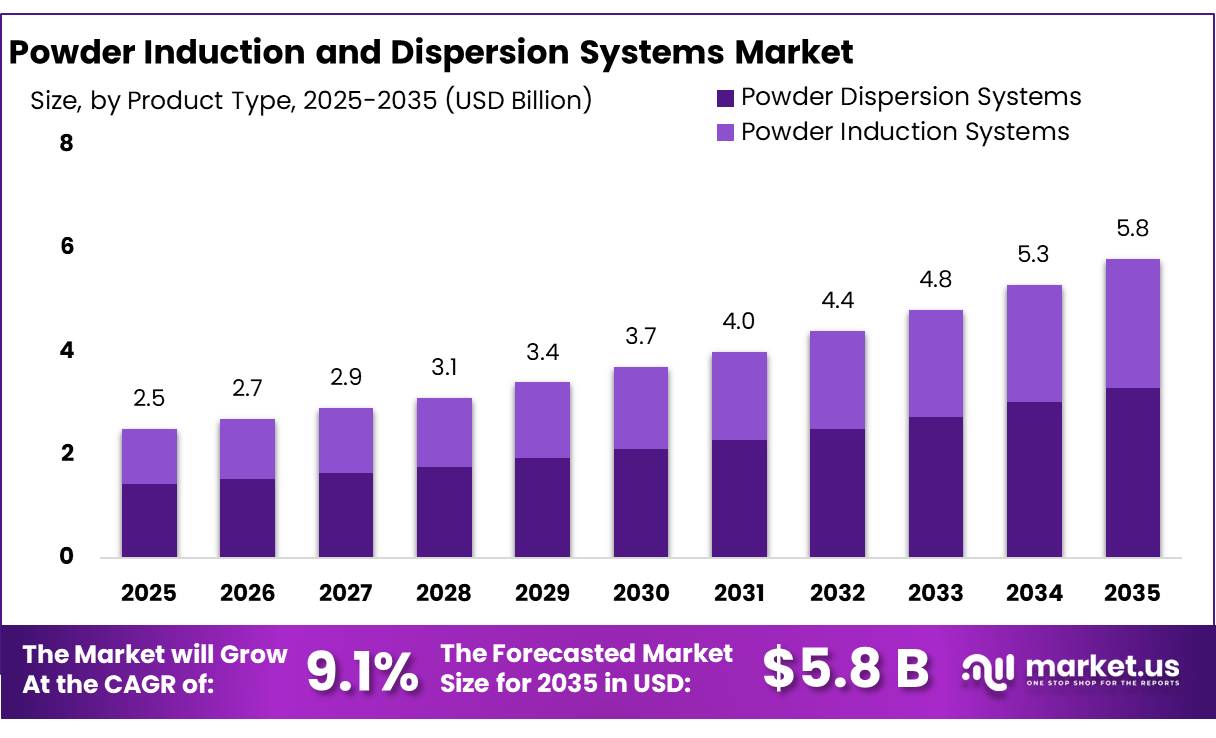
The Global Powder Induction and Dispersion Systems Market size is expected to be worth around USD 5.8 Billion by 2035, from USD 2.5 Billion in 2025, growing at a CAGR of 9.1% during the forecast period from 2026 to 2035. In 2025, North America held a dominant market position, capturing more than a 36.50% share, holding USD 0.9 Billion revenue.
Powder induction and dispersion systems are increasingly used in chemical, food and beverage, pharmaceutical, coatings, personal-care, adhesive, and specialty-material production where dry ingredients must be incorporated into liquids quickly and uniformly. Commercial systems can handle powder induction rates of up to 500 lb/min, while industrial inline dispersers are available with power ratings from 5.5 kW to 250 kW, showing their suitability from smaller processing lines to large industrial plants.
- The broader chemical manufacturing environment provides a large industrial base for this equipment. According to Cefic’s 2025 Facts & Figures, the European chemical industry generates around €635 billion in turnover, directly employs approximately 1.2 million people, and includes nearly 31,000 companies. Europe accounts for about 13% of global chemical sales, while China represents approximately 46%.
Food processing is another important application area because manufacturers regularly disperse proteins, starches, gums, stabilizers, sweeteners, minerals, flavors, and other powdered ingredients. Eurostat reported that the nominal value of EU food-product sold production increased by €52 billion in 2025 compared with 2024. At constant prices, food manufacturing output was also around 11% higher in 2025 than in 2015. This expanding production base creates opportunities for sanitary powder induction systems offering repeatable recipes, faster hydration, improved cleanliness, and automated ingredient handling.
- Pharmaceutical and healthcare manufacturing also strengthens the long-term industrial scenario. The U.S. Food and Drug Administration approved 46 novel drugs during 2025. Of these, 32 drugs, or 70%, received U.S. approval before approval in other countries, while 23 received orphan-drug designation. Continued development of pharmaceutical formulations, suspensions, excipients, coatings, and liquid-based processing is likely to encourage demand for tightly controlled mixing and dispersion equipment where uniformity and repeatability are critical.
Operational efficiency is becoming a major purchasing factor. In one industrial beverage-processing installation reported by Admix, an inline system processed powder at more than 450 lb/min, reduced batch time by 50%, lowered energy consumption by 70%, and routinely produced emulsions in the 3–5 micron range. The processor also reported a payback period of less than 1 year. Although these results relate to one installation rather than the entire industry, they demonstrate the potential economic benefit of replacing conventional manual powder dumping and extended tank recirculation.
Worker safety and dust control are also supporting equipment modernization. Washington State’s Department of Labor & Industries sets an action level for respirable crystalline silica of 25 micrograms per cubic meter over an 8-hour time-weighted average and a permissible exposure limit of 50 micrograms per cubic meter. Regulations encouraging engineering controls strengthen the case for enclosed or vacuum-based powder handling where applicable.
Key Takeaways
- Powder Induction and Dispersion Systems Market size is expected to be worth around USD 5.8 Billion by 2035, from USD 2.5 Billion in 2025, growing at a CAGR of 9.1%.
- Powder Dispersion Systems held a dominant market position, capturing more than a 56.00% share.
- Inline Mixing held a dominant market position, capturing more than a 58.00% share.
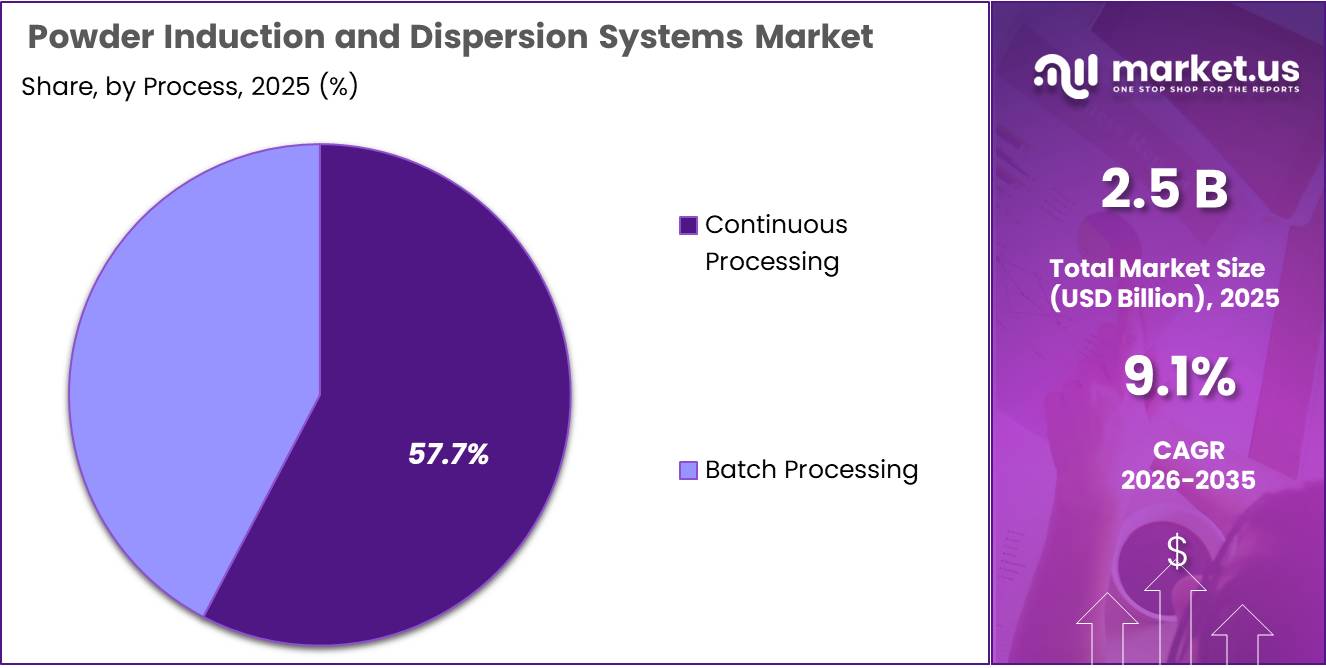
- Continuous Processing held a dominant market position, capturing more than a 57.00% share.
- Food & Beverages held a dominant market position, capturing more than a 48.00% share.
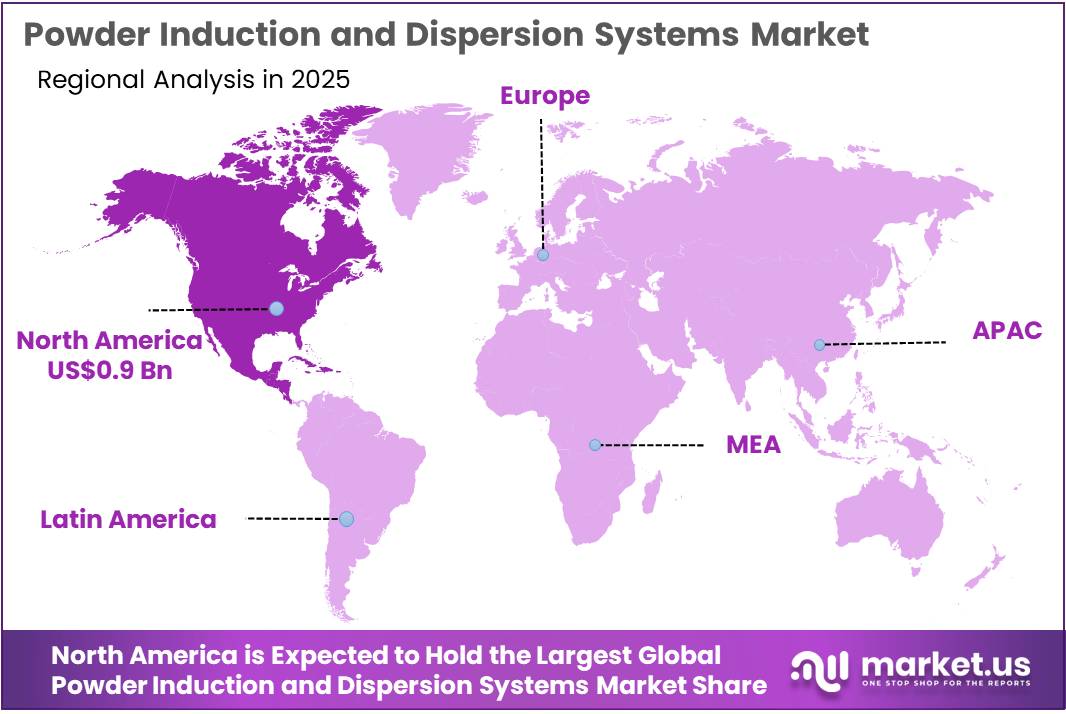
- North America remained the dominant region in 2025, capturing more than a 36.50% share and reaching approximately USD 0.90 billion.
By Product Type Analysis
Powder Dispersion Systems dominate with more than 56.00% share, supported by demand for uniform and high-quality formulations
In 2025, “Powder Dispersion Systems” held a dominant market position, capturing more than a 56.00% share. The segment benefits from its ability to break powder agglomerates, improve particle distribution, shorten mixing cycles, and produce more consistent formulations. These systems are widely used in chemicals, coatings, pharmaceuticals, food processing, cosmetics, adhesives, and other industries where powders need to be uniformly distributed into a liquid phase.
- The large chemical-processing base continues to support the use of advanced dispersion equipment. Cefic reported in its 2025 Facts & Figures that the European chemical industry generated around €635 billion in turnover and included approximately 31,000 companies.
Powder Induction Systems represent an important product type in the Powder Induction and Dispersion Systems Market, particularly in plants seeking faster ingredient charging, lower manual handling, and cleaner transfer of dry materials into liquids. These systems commonly use vacuum or controlled suction to introduce powders directly into a liquid stream, reducing floating powder, incomplete wetting, and excessive dust around the processing area.
By Mixing Type Analysis
Inline Mixing dominates with more than 58.00% share as processors move toward faster and continuous production
In 2025, “Inline Mixing” held a dominant market position, capturing more than a 58.00% share. Inline mixing systems are widely preferred because powder induction, wetting, dispersion, and liquid circulation can take place directly within the production line. This arrangement helps chemical, food, pharmaceutical, coatings, and personal-care manufacturers reduce additional transfer steps, improve batch consistency, and shorten processing cycles. The technology is particularly useful for plants handling gums, pigments, polymers, starches, proteins, stabilizers, and other powders that need rapid incorporation into liquids.
- The large industrial manufacturing base supports the strong position of inline mixing equipment. According to Eurostat data published in 2026, the value of EU industrial sold production increased by 2.9% in constant-price terms during 2025, while its nominal value reached €6,090 billion, compared with €5,869 billion in the previous year. Higher industrial production creates demand for equipment that can improve throughput without requiring substantial additional tank capacity.
In-Tank Mixing remains an important mixing type in the Powder Induction and Dispersion Systems Market, particularly in plants operating batch-based manufacturing lines. The system allows powders and liquids to be mixed within a dedicated vessel, giving operators greater control over mixing time, ingredient sequencing, temperature, viscosity, and formulation changes. It is commonly used for specialty chemicals, pharmaceutical formulations, sauces, personal-care products, paints, coatings, and other products that are produced in separate batches.
By Process Analysis
Continuous Processing dominates with more than 57.00% share as manufacturers focus on faster and more consistent production
In 2025, “Continuous Processing” held a dominant market position, capturing more than a 57.00% share. Continuous processing is widely used in powder induction and dispersion operations because dry ingredients can be introduced, wetted, mixed, and dispersed while the liquid continuously moves through the processing line. This method reduces repeated material transfers and supports stable product quality in chemicals, food products, coatings, pharmaceuticals, adhesives, and personal-care formulations.
- Industrial production activity supports the use of continuous processing systems. Eurostat reported in 2026 that the EU’s value of sold industrial production reached €6,090 billion in 2025, compared with €5,869 billion in the previous year. In constant-price terms, industrial sold production increased by 2.9% during 2025.
Batch Processing remains an important process type in the Powder Induction and Dispersion Systems Market, especially where manufacturers produce different formulations using the same equipment. It allows individual batches to be prepared according to specific recipes, mixing times, temperatures, viscosities, and powder-loading requirements. This flexibility makes batch processing suitable for specialty chemicals, pharmaceuticals, cosmetics, coatings, sauces, and other products where frequent recipe changes are required.
By Application Analysis
Food & Beverages dominates with more than 48.00% share, supported by rising processed-food production and the need for consistent mixing
In 2025, “Food & Beverages” held a dominant market position, capturing more than a 48.00% share. Food and beverage manufacturers use powder induction and dispersion systems to mix proteins, starches, gums, cocoa, stabilizers, sweeteners, milk powders, minerals, flavors, and other dry ingredients into liquids. These systems help reduce lump formation, improve ingredient wetting, and maintain uniform texture across large production runs. Their use is especially important in beverages, dairy products, sauces, bakery preparations, nutritional products, and processed foods where consistent mixing directly affects final product quality.
- Government production data supports this strong application base. Eurostat reported in 2026 that the value of EU food-product sold production increased by 3.8% during 2025 in constant-price terms compared with the previous year. Food-product output was also 11.2% higher than its 2015 level.
Pharmaceuticals represents an important application area for powder induction and dispersion systems because drug manufacturing requires closely controlled mixing of active ingredients, excipients, binders, stabilizers, suspending agents, and coating materials. These systems help pharmaceutical producers achieve more uniform dispersion, reduce agglomeration, improve batch repeatability, and maintain controlled processing conditions. They are useful in liquid medicines, suspensions, creams, gels, coatings, and other formulation processes where material consistency is important.
Key Market Segments
By Product Type
- Powder Induction Systems
- Powder Dispersion Systems
By Mixing Type
- In-Tank Mixing
- Inline Mixing
By Process
- Continuous Processing
- Batch Processing
By Application
- Food & Beverages
- Pharmaceuticals
- Cosmetics & Personal Care
- Chemicals
- Paints & Coatings
- Others
Driver Analysis
Automated Powder Handling
Persistent labor scarcity is converting powder induction from a stand-alone mixer purchase into an automated ingredient-handling proposition: a U.S. manufacturing study estimates that 3.8 million positions may need filling during 2024–2033 and that 1.9 million could remain vacant, while 65% of surveyed manufacturers identified talent attraction and retention as their leading business challenge. Adoption conditions are already visible—542,076 industrial robots were installed globally in 2024, the fourth consecutive year above 500,000; Asia captured 74% of installations, while food and beverage represented only 4% and plastics/chemicals 5%, leaving substantial automation headroom in process industries.
Powder systems address a particularly automatable work package—bag emptying, dosing, wetting, recirculation and recipe verification—while waist-level or enclosed charging reduces lifting, airborne dust and manual intervention. The commercial effect is a shift from selling a rotor-stator mixer to supplying a PLC-integrated cell containing vacuum induction, load cells, bulk-bag discharge, dust extraction, clean-in-place logic and electronic batch records; that raises equipment content per project, creates controls and validation revenue, and supports aftermarket software and service contracts.
A 10–20% reduction in direct charging and rework labor, one fewer operator on selected batches, and 5–10 percentage points better asset utilization constitute a reasonable buyer hurdle for a two-to-three-year payback; applying adoption mainly to brownfield food, coatings and specialty-chemical lines supports an estimated +1.3 percentage-point contribution to sector CAGR through 2031.
Drivers Impact Analysis
| Driver | (~) % Impact on CAGR Forecast | Geographic Relevance | Impact Timeline |
|---|---|---|---|
| Automated powder handling | +1.3 pp | North America, EU, East Asia | Short term (≤ 2 years) |
| Battery-slurry capacity buildout | +1.2 pp | China core; US, EU, Korea | Medium term (2–4 years) |
| Continuous pharma processing | +0.9 pp | US, EU, India, Singapore | Medium term (2–4 years) |
| Waterborne formulation shift | +0.8 pp | EU, North America, China | Medium term (2–4 years) |
| Food-process modernization | +0.7 pp | APAC, MENA, Latin America | Long term (≥ 4 years) |
| Closed dust-safe induction | +0.6 pp | North America, EU, ANZ | Short term (≤ 2 years) |
Restraint Analysis
High Installed CapEx
Powder induction equipment is rarely purchased as a stand-alone mixer: a production-ready installation can require a 316L sanitary skid, hopper or bag-dump station, liquid and powder metering, PLC/HMI, variable-frequency drives, instrumentation, dust extraction, piping, guarding, clean-in-place connections and commissioning, converting an attractive equipment quote into a materially larger installed project; even basic market references span roughly USD 9,885 for a low-shear induction unit and USD 11,900 for a used 200-gpm, 10-hp system, while hygienic systems commonly combine separate pump and mixer drives of 5.5–11.5 kW and 4–15 kW before auxiliary loads are counted.
The adoption hurdle is highest for small and mid-sized processors because benefits such as shorter batch cycles and lower manual handling accrue over several years, whereas engineering deposits, electrical upgrades and downtime are paid upfront; at an illustrative 10–12% hurdle rate, a USD 250,000 installed project delivering USD 70,000 annual gross savings produces a simple payback of about 3.6 years before financing, maintenance and qualification, often outside a two-to-three-year approval threshold.
Financing remains restrictive in 2026: the U.S. federal-funds target upper bound reached 4.00% in September, the ECB deposit facility rate rose to 2.50%, and 7% of surveyed euro-area banks reported tighter enterprise credit standards in Q2, with SME fixed-investment demand still weaker than that of large firms. The modeled -1.2-percentage-point drag therefore reflects deferred projects, reduced specification scope and substitution toward lower-cost eductors, top-entry mixers or manual charging, compressing OEM order intake and shifting revenue from full systems toward retrofits, rentals and phased automation packages.
Restraint Impact Analysis
| Restraint | (~) % Impact on CAGR Forecast | Geographic Relevance | Impact Timeline |
|---|---|---|---|
| High installed CapEx | -1.2 pp | Global; SME-heavy APAC | Short term (≤ 2 years) |
| Retrofit validation burden | -0.9 pp | North America; EU; Japan | Medium term (2–4 years) |
| Difficult-powder limits | -0.8 pp | Global process hubs | Long term (≥ 4 years) |
| Dust-safety compliance | -0.7 pp | North America; EU core | Medium term (2–4 years) |
| Metals and tariff inflation | -0.6 pp | North America; EU exporters | Short term (≤ 2 years) |
| Custom-engineering bottlenecks | -0.5 pp | Global; emerging markets | Medium term (2–4 years) |
Opportunity Analysis
Dispersion-as-a-Service
This is an untapped business-model opportunity rather than a current equipment-demand driver because most suppliers still monetize the mixer, skid, commissioning, and spare parts as transactions instead of underwriting measurable outcomes such as kilograms dispersed per hour, first-pass particle-size compliance, kilowatt-hours per tonne, powder loss, and uptime. Outcome-based industrial contracts explicitly tie payment to throughput, cycle time, OEE, downtime, and unit contribution margin, while connected servitization converts one-off equipment sales into recurring performance and predictive-maintenance revenue.
- A supplier could therefore bundle a closed induction skid, sensors, wear parts, remote monitoring, and process guarantees into a five-to-seven-year contract priced at an illustrative 2.0–3.0% of customer throughput value or 10–16% of equipment price annually; at 25–35% fleet penetration, recurring software/service revenue could rise from a conventional 10–15% of account lifetime value to roughly 25–35%, smooth order cyclicality, and lift blended gross margin by an estimated 3–6 percentage points because monitoring software and optimization support carry lower incremental cost than fabricated hardware.
The customer case can be anchored to verified process economics: modern inline powder-induction systems have reported about 70% lower process-energy input than traditional routes, up to 90% shorter mixing time, and 85–90% energy reductions in selected pigment-paste applications, although results remain formulation-specific.
Commercial execution requires auditable baselines, calibrated power and flow instrumentation, exclusions for off-spec raw materials, shared-savings bands, and availability guarantees rather than unconditional process guarantees; converting only 8–12% of annual new-system revenue into contracted services by 2030 would support an estimated +0.9-percentage-point CAGR upside without assuming additional underlying powder demand.
Opportunity Impact Analysis
| Opportunity | (~) % Potential CAGR Upside | Geographic Relevance | Execution Window |
|---|---|---|---|
| Dispersion-as-a-Service | +0.9 pp | North America, EU | Short term (≤2 years) |
| Recipe Intelligence SaaS | +0.8 pp | North America, EU, East Asia | Medium term (2–4 years) |
| Validated Modular Pharma Skids | +0.8 pp | US, EU, India, Singapore | Medium term (2–4 years) |
| Battery-Recycling Slurry Systems | +0.7 pp | China, EU, North America | Medium term (2–4 years) |
| Plant-Protein Functionality Cells | +0.6 pp | EU, North America, APAC | Short term (≤2 years) |
| Emerging-Market Compact Leasing | +0.5 pp | India, ASEAN, Africa, LATAM | Medium term (2–4 years) |
Challenges Analysis
Variable Powder Rheology
Powder induction performance remains intrinsically lot- and environment-sensitive because flow, aeration, cohesion, permeability, wettability, particle-size distribution, morphology, electrostatics, humidity, and bulk-density state interact rather than behaving as a single controllable variable; published characterization guidance indicates that a Carr Index below 10 corresponds to excellent flow while a value above 38 indicates very poor flow, and a Hausner ratio above 1.4 generally signals cohesive behavior versus below 1.25 for free-flowing material.
This variability does not halt system purchases, but it prevents catalog-rated throughput from transferring reliably across xanthan gum, silica, starch, carbon black, pigments, active pharmaceutical ingredients, and battery powders: the 2026 model assumes that 25–35% of technically addressable installations encounter at least one difficult-powder condition, with commissioning throughput derating of 5–15%, two to six additional recipe trials, and four to eight weeks of applications-engineering effort, producing an estimated 0.9-percentage-point CAGR friction through delayed acceptance, contingency pricing, and narrower performance guarantees.
Suppliers therefore need a material-characterization gate before quotation, instrumented test centers that reproduce hopper consolidation and humidity, modular feeders and wetting heads spanning low- and high-cohesion powders, and performance contracts tied to documented particle-size, temperature, moisture, viscosity, and solids envelopes; otherwise, each formulation change becomes a quasi-custom project, increasing bid risk, warranty reserves, and customer reluctance to standardize fleets.
Challenges Impact Analysis
| Challenge | (~) % CAGR Friction Drag | Geographic Relevance | Mitigation Horizon |
|---|---|---|---|
| Variable Powder Rheology | -1.0 pp | Global; humid APAC core | Long term (≥ 4 years) |
| Nonlinear Process Scale-Up | -0.9 pp | NA, EU, East Asia | Medium term (2–4 years) |
| Hygienic Changeover Validation | -0.8 pp | EU, NA, Japan | Medium term (2–4 years) |
| Dust Safety Engineering | -0.7 pp | EU, NA, ANZ | Long term (≥ 4 years) |
| OT Integration Exposure | -0.6 pp | NA, EU, East Asia | Medium term (2–4 years) |
| Specialist Service Shortage | -0.5 pp | NA, EU, GCC, ANZ | Long term (≥ 4 years) |
Geopolitical Impact Analysis
War-Driven Energy and Supply-Chain Pressures Reshape Powder Induction and Dispersion Systems Market
Wars are reshaping the operating environment for powder induction and dispersion system suppliers in 2026. The Russia–Ukraine war continues to affect European energy, metals, trade routes, and industrial investment, while conflict in the Middle East has added pressure to fuel and maritime logistics. The European Commission reported that EU energy inflation was expected to remain above 10% through the rest of 2026, increasing production costs for machinery manufacturers and chemical processors.
The impact is visible in industrial pricing. Eurostat reported that EU industrial producer prices were 5.6% higher in July 2026 than a year earlier, while energy prices rose 4.7% month over month. Higher electricity, stainless steel, motors, pumps, control equipment, and freight costs can raise manufacturing and installation expenses for powder handling and dispersion systems.
UNCTAD reported that the Strait of Hormuz carries around one-quarter of global seaborne oil trade, and more than 100 days of disruption in 2026 created lasting transport and energy effects. At the same time, the EU’s 21st sanctions package against Russia expanded restrictions on selected metal powders and technologies. These pressures are encouraging equipment buyers to diversify suppliers, hold spare parts, improve energy efficiency, and favor supported automated systems.
Regional Insights
North America Leads with 36.50% Share and USD 0.90 Billion Market Value
North America remained the dominant region in 2025, capturing more than a 36.50% share and reaching approximately USD 0.90 billion. The region benefits from a large base of chemical, pharmaceutical, food, and advanced manufacturing plants that require controlled powder incorporation.
- U.S. Bureau of Economic Analysis data show that new foreign direct investment in U.S. manufacturing reached USD 121.8 billion in 2025, representing 52.5% of total new investment expenditures. Chemicals manufacturing alone attracted USD 45.4 billion. This investment environment supports demand for automated mixers, sanitary powder induction units, inline dispersion systems, and process upgrades across North American factories and processing lines.
Asia Pacific is positioned as the fastest-growing regional market, supported by rapid expansion in chemicals, machinery, food processing, and high-technology manufacturing. China’s National Bureau of Statistics reported that manufacturing value added increased by 6.4% in 2025, while equipment manufacturing grew by 9.2%. Raw chemical materials and chemical products manufacturing increased by 7.8%, and general-purpose machinery production advanced by 8.0%. These trends create a wider installed base for powder handling and dispersion equipment.
Key Regions and Countries Insights
- North America
- US
- Canada
- Europe
- Germany
- France
- The UK
- Spain
- Italy
- Rest of Europe
- Asia Pacific
- China
- Japan
- South Korea
- India
- Australia
- Rest of APAC
- Latin America
- Brazil
- Mexico
- Rest of Latin America
- Middle East & Africa
- GCC
- South Africa
- Rest of MEA
Key Players Analysis
GEA Group Aktiengesellschaft maintains a strong position in powder induction and dispersion through its processing technologies for food, beverages, pharmaceuticals, and chemicals. In 2025, GEA generated approximately EUR 5.5 billion in revenue and recorded EUR 5.9 billion in order intake. The company employed 18,628 FTEs and operated across more than 150 countries. Its mixing, feeding, homogenization, and powder-processing systems support manufacturers seeking controlled dispersion, hygienic production, automation, and higher processing efficiency.
SPX FLOW, now part of ITT Flow Technologies, has a broad position in industrial and hygienic mixing, including powder-liquid dispersion equipment such as the APV Flex-Mix range. The business has more than 5,000 employees, offers over 140,000 products, and holds around 800 patents, supported by approximately 340 years of combined mixing experience across its brands. In 2025, its Brisbane mixing facility expanded from 520 square meters to 2,300 square meters, strengthening regional manufacturing, testing, and service capacity.
Tetra Laval Group participates in powder induction and dispersion mainly through Tetra Pak’s food-processing technologies, including mixing, blending, ingredient handling, and integrated processing lines. In 2025, Tetra Laval generated EUR 15.545 billion in net sales and employed 35,132 people. Tetra Pak contributed EUR 12.350 billion in sales with 24,617 employees, operating in more than 165 countries and supporting 52 production plants. This scale strengthens its position in dairy, beverage, nutritional, and formulated-food processing applications.
Top Key Players Outlook
- GEA Group Aktiengesellschaft
- SPX FLOW, Inc.
- Tetra Laval Group
- IDEX Corporation
- Bühler Holding AG
- Silverson Machines Ltd.
- IKA-Werke GmbH & Co. KG
- Charles Ross & Son Company
- Admix, Inc.
- ystral GmbH
- ProXES GmbH
- INOXPA S.A.U.
- Schenck Process Group
- Schold Manufacturing, LLC
- ARDE Barinco, Inc.
Recent Developments
- In July 2026, Financially, IDEX generated USD 3.46 billion in sales during 2025, while its Health & Science Technologies segment, which includes Material Processing Technologies, produced USD 1.50 billion in sales.
- By February 2026, Bühler reported that it had delivered 113 battery-slurry and dry-compound production systems over the previous 10 years, including more than 70 slurry lines in China; its continuous process uses about 56 kWh per ton of battery slurry. Financially, Bühler generated CHF 2.8 billion in 2025 turnover and improved its EBIT margin to 8.0%, providing further capacity for technology investment and global expansion.
Report Scope
| Report Features | Description |
|---|---|
| Market Value (2025) | USD 2.5 Bn |
| Forecast Revenue (2035) | USD 5.8 Bn |
| CAGR (2026-2035) | 9.1% |
| Base Year for Estimation | 2025 |
| Historic Period | 2020-2024 |
| Forecast Period | 2026-2035 |
| Report Coverage | Revenue Forecast, Market Dynamics, Competitive Landscape, Recent Developments |
| Segments Covered | By Product Type (Powder Induction Systems, Powder Dispersion Systems), By Mixing Type (In-Tank Mixing, Inline Mixing), By Process (Continuous Processing, Batch Processing), By Application (Food & Beverages, Pharmaceuticals, Cosmetics & Personal Care, Chemicals, Paints & Coatings, Others) |
| Regional Analysis | North America – US, Canada; Europe – Germany, France, The UK, Spain, Italy, Rest of Europe; Asia Pacific – China, Japan, South Korea, India, Australia, Singapore, Rest of APAC; Latin America – Brazil, Mexico, Rest of Latin America; Middle East & Africa – GCC, South Africa, Rest of MEA |
| Competitive Landscape | GEA Group Aktiengesellschaft, SPX FLOW, Inc., Tetra Laval Group, IDEX Corporation, Bühler Holding AG, Silverson Machines Ltd., IKA-Werke GmbH & Co. KG, Charles Ross & Son Company, Admix, Inc., ystral GmbH, ProXES GmbH, INOXPA S.A.U., Schenck Process Group, Schold Manufacturing, LLC, ARDE Barinco, Inc. |
| Customization Scope | Customization for segments, region/country-level will be provided. Moreover, additional customization can be done based on the requirements. |
| Purchase Options | We have three licenses to opt for: Single User License, Multi-User License (Up to 5 Users), Corporate Use License (Unlimited User and Printable PDF) |





































