


Report Overview
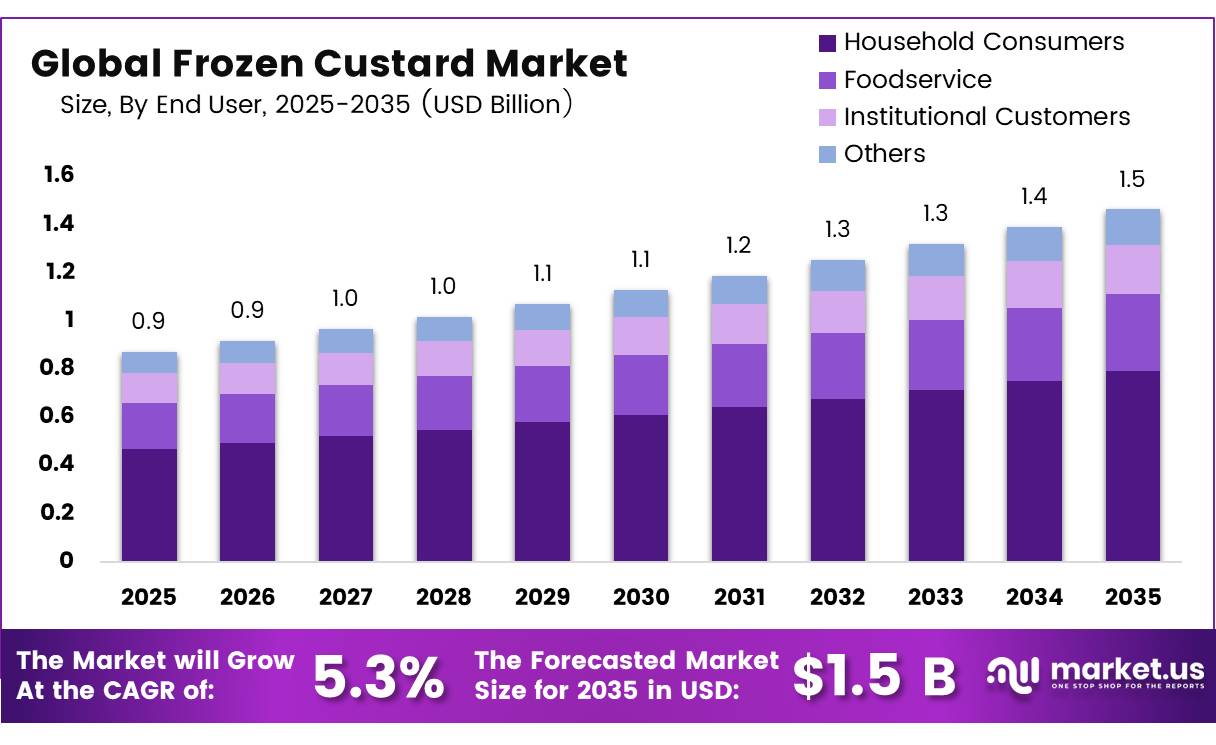
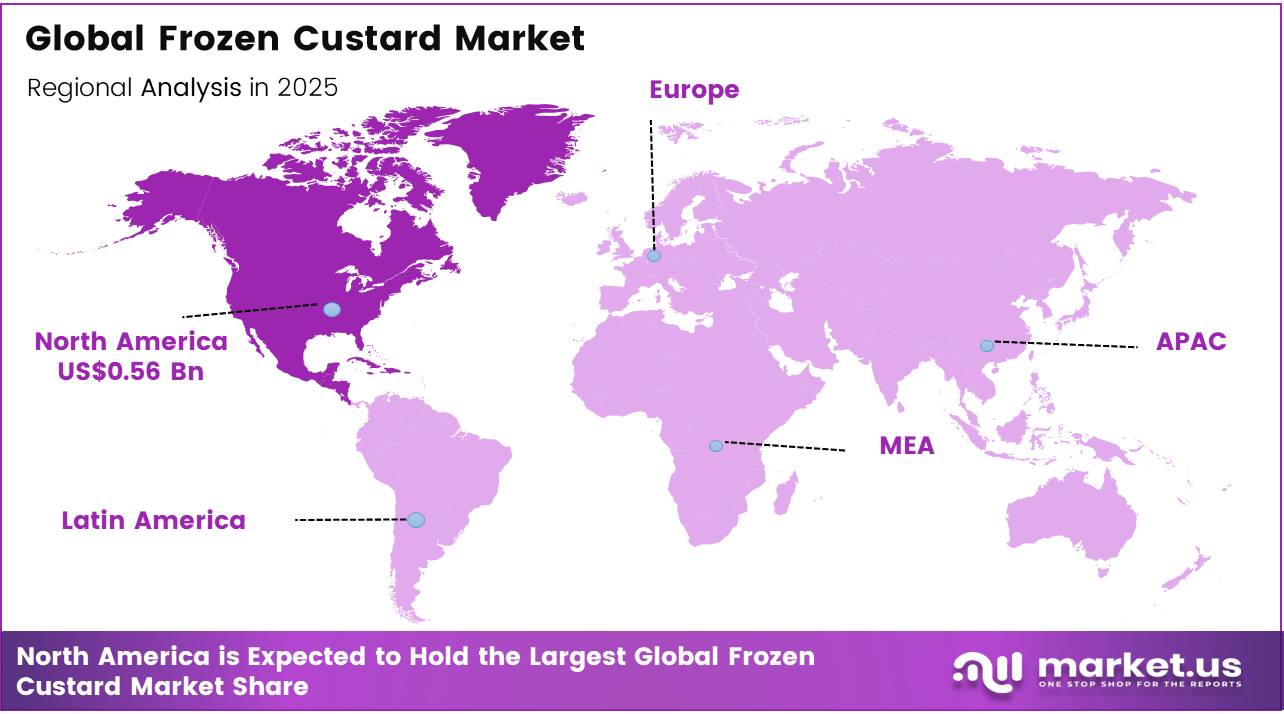
In 2025, the Global Frozen Custard Market was valued at USD 0.9 billion, and between 2026 and 2035, this market is estimated to register a CAGR of 5.30%, reaching about USD 1.5 billion by 2035. In 2025, North America held a dominant market position, capturing more than a 64.53% share, holding USD 0.56 Billion revenue.
The frozen custard industry forms a premium niche within the wider frozen dairy dessert sector, supported by its dense texture, fresh-service positioning and higher egg-yolk content.
- Under U.S. standards, frozen custard follows ice-cream requirements of at least 10% milkfat and 10% nonfat milk solids, while plain products must contain at least 1.4% egg-yolk solids, or 1.12% when bulky flavoring ingredients are added. These specifications strengthen product consistency and distinguish the category from conventional soft serve.
Key Takeaways
- The global Frozen Custard market was valued at USD 0.9 billion in 2025.
- The global market is projected to grow at a CAGR of 5.30% and is estimated to reach USD 1.5 billion by 2035.
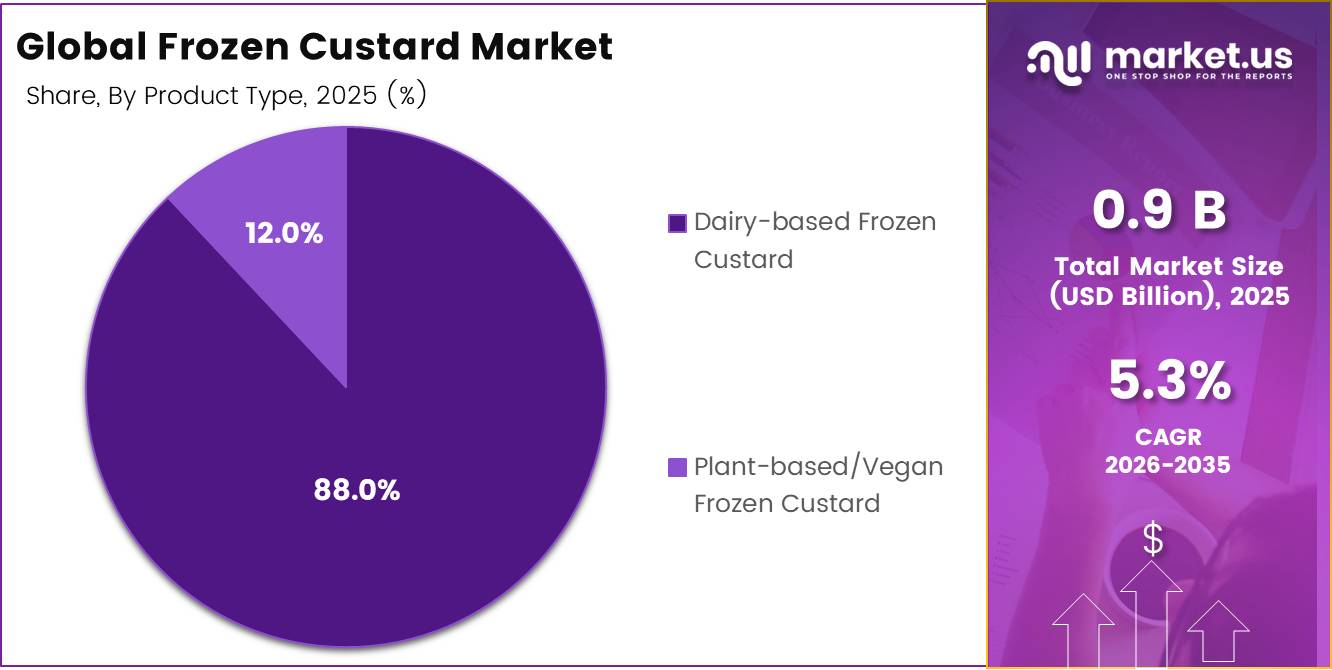
- On the basis of product type, the Dairy-based Frozen Custard dominated the market, constituting 88.0% of the total market share.
- Based on the category, the Conventional dominated the Frozen Custard market, with a substantial market share of around 76.0%.
- Based on the Flavor, Classic Flavors (Vanilla and Chocolate) led the market, comprising 58.0% of the total market.
- Among the Distribution Channel, the Supermarkets and Hypermarkets held a major share in the Frozen Custard market, 36.0% of the market share.
- Among the By End User, the Household Consumers is the most considerable within the market, accounting for around 54.0% of the revenue.
- In 2025, the North America was the most dominant region in the Frozen Custard market, accounting for 64.53% of the total global consumption.
Industry conditions remain favorable because dairy supply is expanding and foodservice demand is resilient. USDA reported that U.S. milk production rose 2.6% in 2025 to 232 billion pounds, while milk marketings reached 231 billion pounds. Meanwhile, U.S. retail and foodservice sales totaled $768.6 billion in June 2026, increasing 6.7% from June 2025, indicating continued consumer spending across restaurant and dessert channels.
Future growth opportunities are expected from premium flavors, smaller serving formats, seasonal menus, digital ordering and franchised outlets. USDA’s Dairy Business Innovation Initiatives awarded more than $11 million in January 2026 to support dairy product development, production, marketing and distribution, creating additional scope for regional processors, specialty frozen-dessert operators and local brand expansion.
Product Type Analysis
Dairy-based Frozen Custard represents dominant Segment in the Market.
Dairy-based frozen custard held the leading market position in 2025, accounting for an 88.00% share. Consumers continue to favor its smooth texture, rich dairy taste and freshly prepared character. The segment benefits from the large scale of the established frozen dairy industry.
- USDA reported that U.S. regular ice cream production totaled 845 million gallons during the year, showing the considerable manufacturing, cold-storage and distribution infrastructure available to dairy dessert producers.
Plant-based frozen custard is gaining momentum as consumers seek products made without conventional milk or eggs. Producers are experimenting with soy, oat, almond and other plant ingredients to deliver a creamier texture and clearer product positioning. In January 2025, the FDA issued labeling guidance covering plant-based alternatives to animal-derived foods. The agency also identifies milk and eggs among the nine major food allergens, creating further scope for clearly labelled alternatives designed for consumers with specific dietary needs.
Category Analysis
Conventional a significant category.
Conventional frozen custard held the leading position, capturing a 76.00% market share. Its strength comes from familiar sweetness, traditional recipes and broad acceptance across restaurants, dessert outlets and retail channels. The segment also benefits from an established sweetener supply chain.
- The USDA Economic Research Service forecasts U.S. sugar deliveries for human consumption at 12.441 million short tons for 2026/27, supporting consistent ingredient availability for conventional frozen desserts.
Sugar-free frozen custard is gaining attention as consumers seek desserts that better match controlled-sugar diets. The CDC’s January 2026 report estimated that 40.1 million Americans, or 12.0% of the population, had diabetes. This creates room for products formulated with alternative sweeteners and clearer nutrition claims. Under FDA requirements, a product labeled “sugar free” must contain less than 0.5 grams of sugar per serving, giving manufacturers a clear formulation benchmark.
Flavor Analysis
Classic Flavors Are the Most Widely Used Flavor.
Classic vanilla and chocolate frozen custard held the leading position, capturing a 58.00% market share. Their dominance reflects strong consumer familiarity, simple menu positioning and suitability for toppings, cones, shakes and packaged desserts.
- The USDA Economic Research Service reported that the United States imported 198,000 metric tons of cocoa beans in 2024, supporting large-scale chocolate production despite global supply constraints. These established supply chains help operators maintain consistent taste and dependable availability.
Innovative and artisanal flavors are gaining momentum as dessert outlets introduce seasonal recipes, local ingredients and limited-edition combinations. Growth is supported by wider access to fruits, nuts, herbs and spices. In September 2025, USDA awarded $72.9 million across 586 specialty-crop projects, strengthening research, marketing and ingredient development that can support more distinctive frozen custard offerings.
Distribution Channel Analysis
Supermarkets and Hypermarkets Held a Major Share of the Frozen Custard Market.
Supermarkets and hypermarkets held the leading position, capturing a 36.00% market share. Their strength comes from high customer traffic, broad freezer space and the convenience of purchasing frozen custard alongside regular groceries. These stores can also carry several pack sizes, flavors and promotional bundles under one roof.
- According to the USDA Economic Research Service, U.S. food-at-home spending reached $1.10 trillion in 2025, showing the large consumer expenditure base supporting frozen dessert sales through grocery-led channels.
Online retail and direct-to-consumer distribution is expanding as shoppers increasingly value home delivery, subscription boxes and easy product comparison. The U.S. Census Bureau reported that retail e-commerce sales reached $326.7 billion in the first quarter of 2026, rising 9.8% from a year earlier. This shift creates room for frozen custard brands to use insulated delivery, local ordering platforms and targeted digital promotions.
End User Analysis
Frozen Custards Are Mostly Utilized by the Household consumers.
Household consumers held the leading position, capturing a 54.00% market share. Packaged frozen custard fits naturally into home consumption because it can be stored, shared and served conveniently for family desserts or small celebrations.
- The U.S. Census Bureau recorded 132,737,146 households in 2024, with an average household size of 2.50 people. This broad household base gives manufacturers considerable scope to expand take-home packs, multipacks and family-oriented flavors through retail and delivery channels.
Foodservice is expanding as restaurants, cafés and dessert outlets add premium frozen treats, seasonal flavors and customizable toppings. USDA data show that inflation-adjusted sales at limited-service establishments reached $516.1 billion in 2025, representing an 88.5% increase from 1997. Growing consumer spending on food prepared away from home creates favorable opportunities for frozen custard operators to expand menus, outlet networks and takeaway services.
Key Market Segments
By Product Type
- Dairy-based Frozen Custard
- Plant-based/Vegan Frozen Custard
By Category
- Conventional
- Sugar-free
- Organic and Clean-label
By Flavor
- Classic Flavors (Vanilla and Chocolate)
- Fruit-based Flavors
- Nut-based Flavors
- Innovative/Artisanal Flavors
- Others
By Distribution Channel
- Quick-service Restaurants
- Specialty Frozen Custard Shops
- Convenience Stores
- Online Retail/Direct-to-Consumer
- Others
By End User
- Household Consumers
- Foodservice
- Institutional Customers
- Others
Driver Analysis
Premiumization of Frozen Desserts Lifting Custard Positioning
Within that context, frozen custard’s sensory profile supports price points typically 15–30% above standard scoop ice cream in QSR and specialty channels, while gross margins can be 200–400 basis points higher when scaled properly despite higher dairy and egg input costs, because consumers accept smaller portion sizes and premium toppings; industry commentary on premium frozen desserts indicates this tier is growing in low double digits in some markets, compared with mid-single to high-single digits for the total category, implying that if custard simply tracks premium’s share gain, it can add around 1.5 percentage points to its own CAGR versus a flat positioning scenario.
Strategically, this driver pushes operators to redesign menus with tiered custard offerings at higher price ladders, prioritize high-income, high-footfall locations, and allocate marketing budgets toward brand narratives around craftsmanship and “small-batch” authenticity rather than discount-led tactics, effectively repositioning custard from a regional novelty into a global premium dessert archetype and thus shifting the revenue mix toward higher-yield SKUs that support faster reinvestment and network expansion.
Drivers Impact Analysis
| Driver | (~) % Impact on CAGR | Geographic Relevance | Impact Timeline |
|---|---|---|---|
| Premiumization of frozen desserts lifting custard positioning | +1.5% | North America core, EU, APAC affluent corridors | Medium term (2–4 years) |
| Urban QSR and specialty dessert chain expansion featuring custard | +1.3% | North America core, APAC corridors, South America spill-over | Medium term (2–4 years) |
| Rising cold-chain penetration enabling custard distribution beyond core metros | +1.1% | APAC corridors, Latin America, MEA emerging | Long term (≥ 4 years) |
| Digital ordering, delivery, and loyalty platforms boosting custard throughput | +1.0% | North America core, EU, APAC tier-1 | Short term (≤ 2 years) |
| Product innovation in textures, inclusions, and flavor architectures | +0.9% | Global, led by North America & EU | Medium term (2–4 years) |
| Tourism and experiential retail growth supporting destination custard formats | +0.8% | North America leisure hubs, EU tourist cities, select APAC | Long term (≥ 4 years) |
Restraint Analysis
Dairy Fat & Egg Yolk Input Cost Volatility
Frozen custard manufacturers face greater raw-material cost pressure because regulations require the product to contain at least 10% milkfat and 1.4% egg yolk solids. Milk prices increased from about $18 per hundredweight in mid-2023 to more than $22 by early 2025, while egg prices rose over 60% year over year as avian influenza affected more than 20 million laying hens.
Because dairy and eggs account for roughly 55–60% of frozen custard production costs, compared with 35–40% for standard ice cream, producers have less flexibility to control expenses. Only around 40–50% of higher input costs can usually be passed to consumers without reducing sales, which may lower margins by 300–450 basis points and reduce the market’s 2026 baseline CAGR by approximately 1.0–1.5 percentage points.
Restraint Impact Analysis
| Restraint | (~) % Impact on CAGR | Geographic Relevance | Impact Timeline |
|---|---|---|---|
| Dairy fat & egg yolk input cost volatility | -1.4% | North America core, EU | Short term (≤2 years) |
| High-fat product facing health/regulatory scrutiny | -0.9% | EU, North America urban | Medium term (2-4 years) |
| Cold-chain & churn-batch capex intensity limiting small-operator scaling | -0.8% | APAC corridors, South America spill-over | Medium term (2-4 years) |
| Seasonality-driven revenue concentration (Q2-Q3) | -0.7% | North America core, EU | Short term (≤2 years) |
| Labor cost inflation in QSR/soft-serve retail formats | -0.6% | North America core | Short term (≤2 years) |
| Substitution pressure from lower-cost frozen yogurt & non-dairy alternatives | -0.5% | Global, concentrated APAC & EU | Long term (≥4 years) |
Opportunity Analysis
Premium Experiential Formats (Multi-Sensory, Layered Custard)
By designing multi-layer custard parfaits and limited-run experiential SKUs priced at a 20–30% premium to standard cups, operators can lift average ticket size by an estimated 10–15% and push gross margins up by 200–300 basis points because incremental ingredient costs are typically only 5–7% of revenue while perceived value is much higher; coupling this with experiential retail formats can also increase visit frequency among urban millennials and Gen Z, where premium frozen dessert spend is growing at high single-digit rates within an overall ice cream and frozen dessert space forecast to grow around the mid-single to high-single digits to 2035, implying an untapped premium niche for custard that could add roughly 1.4 percentage points of upside to baseline category CAGR in North America and EU tier-1 cities if captured quickly.
Opportunity Impact Analysis
| Opportunity | (~) % Potential CAGR | Geographic Relevance | Execution Window |
|---|---|---|---|
| Premium experiential formats (multi-sensory, layered custard) | +1.4% | North America core, EU tier-1 cities | Short term (≤ 2 years) |
| Health-positioned custard (protein-enriched, reduced sugar) | +1.2% | North America core, APAC emerging markets | Medium term (2-4 years) |
| Plant-based and lactose-free custard analogues | +1.0% | APAC emerging markets, EU, Latin America | Long term (≥ 4 years) |
| Direct-to-consumer (D2C) frozen custard via insulated delivery | +0.9% | North America core, EU | Short term (≤ 2 years) |
| Franchise roll-up and brand consolidation platform | +0.8% | North America core | Medium term (2-4 years) |
| Co-branded CPG retail pints with QSR partners | +0.7% | Global, led by North America & EU | Medium term (2-4 years) |
Challenges Analysis
Stricter Low-Temperature Logistics
For custard, which is less forgiving than standard ice cream mixes, this forces operators to over-specify reefer fleets, add redundant temperature monitoring, and contract higher-grade cold chain services whose freight rates can be 15–25% higher than ambient food categories, translating into unit logistics costs that are often 8–12% of net sales versus 4–6% for dry grocery.
The friction drag on CAGR stems from the way these ongoing costs and quality risks deter network expansion into secondary and tertiary cities: each incremental route requires assured access to cold warehouses and reliable -20°C capacity, which in many corridors remains limited, with utilization rates in well-run hubs already at 80–90% and capacity additions requiring 18–30 months of planning and capital deployment.
Strategically, leading custard brands must respond by locking in multi-year contracts with integrated cold chain partners, co-investing in smart-sensor fleets to cut quality losses below 1–2% of shipped volume, and redesigning SKU and packaging formats to tolerate slightly higher logistics temperatures, but these mitigations will realistically take 2–4 years to normalize industry-wide logistics friction and recapture roughly 1-plus percentage point of lost growth potential.
Challenges Impact Analysis
| Challenge | (~) % CAGR Friction | Geographic Relevance | Mitigation Horizon |
|---|---|---|---|
| Stricter low-temperature logistics | -1.3% | North America core, EU logistics hubs, APAC corridors | Medium term (2-4 years) |
| Complex custard process control | -1.1% | North America core, EU regulatory hubs | Long term (≥ 4 years) |
| Fragmented premium cold-chain infrastructure | -1.0% | APAC logistics corridors, Latin America, MEA | Long term (≥ 4 years) |
| Demand volatility and forecast risk | -0.9% | Global, skewed to seasonal markets | Medium term (2-4 years) |
| Skilled operations and food-safety talent gaps | -0.8% | North America core, EU, APAC tier-1 | Long term (≥ 4 years) |
| Margin-sensitive input and energy volatility | -0.7% | Global, especially import-dependent regions | Medium term (2-4 years) |
Geopolitical Impact Analysis
Geopolitical Shipping Diversions and Cocoa Concentration Reshaping Frozen Custard Production.
Red Sea tensions are reshaping shipping routes for cocoa, vanilla, packaging materials and other imported inputs used by frozen custard producers. During the first half of 2025, approximately 4.9 million barrels per day moved through the Suez Canal and SUMED pipeline, while Bab el-Mandeb flows stood at 4.2 million barrels per day. Traffic around the Cape of Good Hope reached 9.1 million barrels per day, reflecting wider route diversion. Longer voyages can raise fuel, insurance and inventory-holding costs, making imported ingredients less predictable for smaller dessert businesses.
- Cocoa supply concentration creates an additional geopolitical risk for chocolate frozen custard. USDA reported that West African suppliers produced 61% of global cocoa beans, leaving international buyers highly exposed to regional instability and crop disruption. Reduced harvests contributed to a 310% increase in global cocoa prices, which peaked at $10,412 per metric ton. Producers may respond by securing longer purchasing contracts, diversifying flavor menus and increasing the use of domestic fruits or locally sourced ingredients to protect margins without weakening product quality.
Frozen custard producers are likely to reduce supply-chain exposure by working with multiple ingredient suppliers, maintaining larger safety stocks and simplifying seasonal menus. Businesses may also favor locally available fruits, dairy inputs and flavor combinations when imported ingredients become expensive or delayed. Flexible recipes, early purchasing agreements and closer distributor relationships can help operators protect product consistency, control menu pricing and maintain consumer trust during periods of geopolitical uncertainty.
Regional Analysis
North America Held the Largest Share of the Global Frozen Custard Market.
North America held the leading position, capturing a 64.53% market share. The region benefits from an established frozen-dessert culture, strong cold-chain infrastructure and wide availability through supermarkets, restaurants and specialty dessert outlets. The U.S. population reached approximately 341.8 million in July 2025, creating a large consumer base for premium, freshly served and take-home frozen custard products. Rising interest in convenient desserts, seasonal flavors and customizable servings further supports regional demand.
Asia Pacific is gaining momentum as urban consumers spend more on packaged foods, online delivery and café-style desserts. China’s retail sales of grain, oil and food increased 9.3% in 2025, while online food sales grew 14.5%. Supermarket sales also rose 4.3%, creating wider distribution opportunities for frozen custard and similar premium frozen desserts.
Key Regions and Countries Covered
- North America
- The US
- Canada
- Europe
- Germany
- France
- The UK
- Spain
- Italy
- Russia & CIS
- Rest of Europe
- APAC
- China
- Japan
- South Korea
- India
- ASEAN
- Rest of APAC
- Latin America
- Brazil
- Mexico
- Rest of Latin America
- Middle East & Africa
- GCC
- South Africa
- Rest of MEA
Key Players Analysis
Frozen Custard manufacturers focus on strengthening product differentiation, operational consistency, and distribution reach to maintain competitiveness. A key priority is continuous flavor and formulation innovation, including the development of premium dairy recipes, plant-based alternatives, reduced-sugar options, and seasonal offerings that respond to changing consumer preferences. Companies also invest in efficient freezing equipment, standardized production processes, and cold-chain improvements to preserve texture, freshness, and quality across multiple locations.
Strategic outlet expansion, particularly through supermarkets, quick-service restaurants, specialty shops, and direct-to-consumer channels, supports access to a wider customer base. Additionally, manufacturers emphasize brand identity, recipe consistency, food-safety compliance, and digital ordering capabilities, while building long-term partnerships with retailers and foodservice operators to strengthen shelf presence, encourage repeat purchases, and improve positioning in premium and convenience-led dessert segments.
The Major Players In The Industry
- Culver Franchising System, LLC
- Freddy’s Frozen Custard & Steakburgers
- Rita’s Franchise Company, LLC
- Shake Shack Inc.
- Andy’s Frozen Custard
- Abbott’s Frozen Custard, Inc.
- Whit’s Frozen Custard
- Kopp’s Frozen Custard
- Ted Drewes Inc.
- Goodberry’s Frozen Custard
- The Meadows Original Frozen Custard
- Kohler Co. – Original Recipe Frozen Custard
- Dreyer’s Grand Ice Cream, Inc.
- Sheridan’s Frozen Custard
- Leon’s Frozen Custard
Key Development
- In August 2025,Culver Franchising System, LLC launched 3 Cereal Concrete Mixer varieties and offered a flight of 3 mini servings for the price of 2 across its 1,000 restaurants in 26 states.
- In September 2025, Freddy’s Frozen Custard & Steakburgers opened its second Canadian and first Western Canada restaurant in Okotoks, hired around 70 employees, and ran a community food drive from September 30 to November 30.
Report Scope
| Report Features | Description |
|---|---|
| Market Value (2025) | USD 0.9 Bn |
| Forecast Revenue (2035) | USD 1.5 Bn |
| CAGR (2026-2035) | 5.30% |
| Base Year for Estimation | 2025 |
| Historic Period | 2020-2024 |
| Forecast Period | 2026-2035 |
| Report Coverage | Revenue Forecast, Market Dynamics, Competitive Landscape, Recent Developments |
| Segments Covered | By Product Type (Dairy-based Frozen Custard and Plant-based/Vegan Frozen Custard), By Category (Conventional, Sugar-free and Organic and Clean-label), By Flavor (Classic Flavors (Vanilla and Chocolate), Fruit-based Flavors, Nut-based Flavors, Innovative/Artisanal Flavors and Others), By Distribution Channel (Quick-service Restaurants, Specialty Frozen Custard Shops, Supermarkets and Hypermarkets, Convenience Stores, Online Retail/Direct-to-Consumer and Others), By End User (Household Consumers, Foodservice, Institutional Customers and Others)) |
| Regional Analysis | North America – The US & Canada; Europe – Germany, France, The UK, Spain, Italy, Russia & CIS, Rest of Europe; APAC– China, Japan, South Korea, India, ASEAN & Rest of APAC; Latin America– Brazil, Mexico & Rest of Latin America; Middle East & Africa– GCC, South Africa, & Rest of MEA |
| Competitive Landscape | Culver Franchising System, LLC, Freddy’s Frozen Custard & Steakburgers, Rita’s Franchise Company, LLC, Shake Shack Inc., Andy’s Frozen Custard, Abbott’s Frozen Custard, Inc., Whit’s Frozen Custard, Kopp’s Frozen Custard, Ted Drewes Inc., Goodberry’s Frozen Custard, The Meadows Original Frozen Custard, Kohler Co. – Original Recipe Frozen Custard, Dreyer’s Grand Ice Cream, Inc., Sheridan’s Frozen Custard, Leon’s Frozen Custard. |
| Customization Scope | Customization for segments, region/country-level will be provided. Moreover, additional customization can be done based on the requirements. |
| Purchase Options | We have three licenses to opt for: Single User License, Multi-User License (Up to 5 Users), Corporate Use License (Unlimited Users and Printable PDF) |





































