


Report Overview
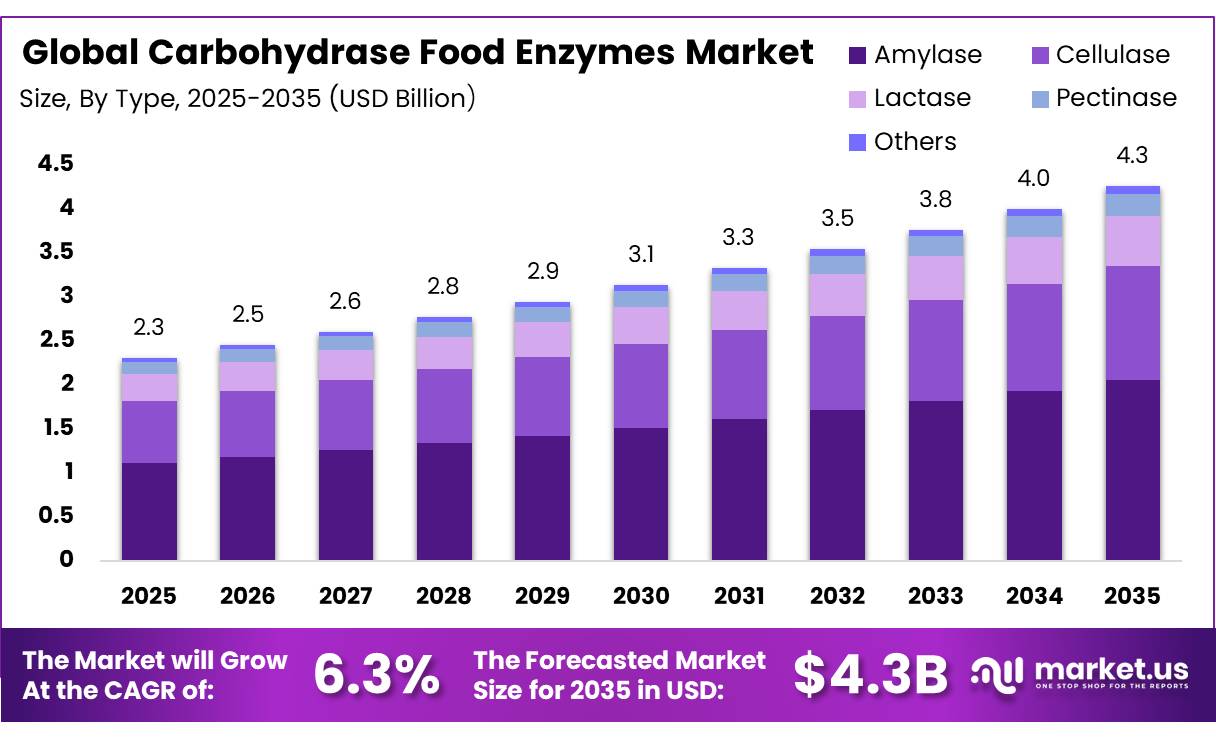
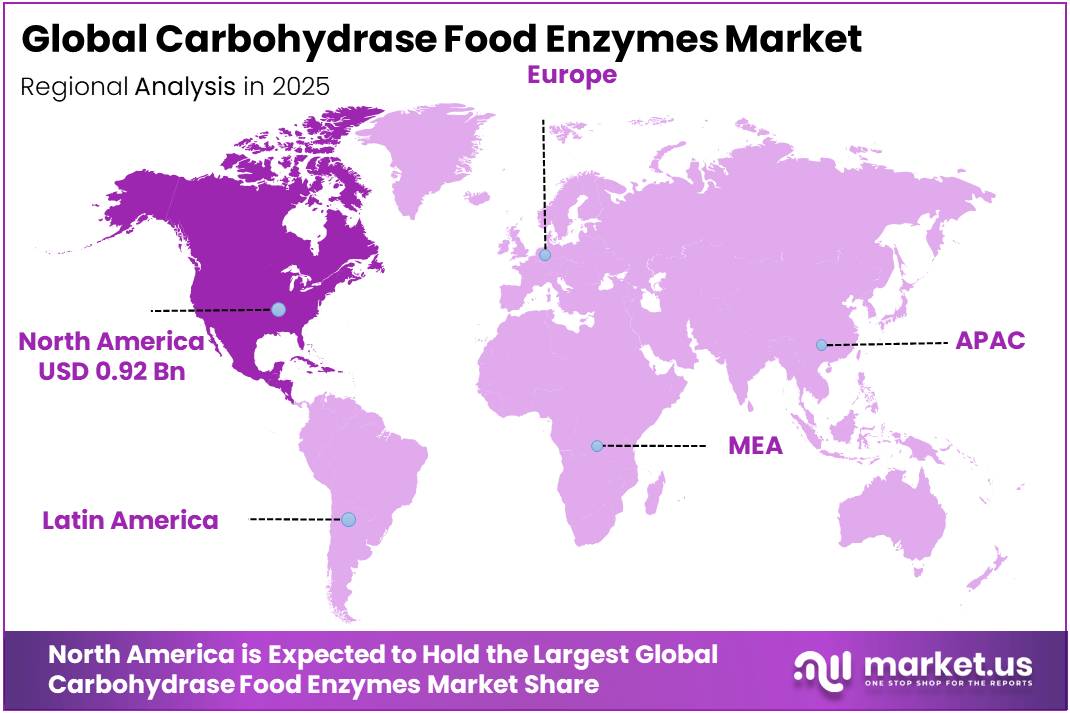
In 2025, the Carbohydrase Food Enzymes Market was valued at USD 2.3 Billion, and between 2026 and 2035, this market is estimated to register a CAGR of 6.3%, reaching about USD 4.3 Billion by 2035. North America held a dominant market position, capturing more than a 39.90% share, holding USD 0.92 Billion in revenue.
The global carbohydrase food enzymes market covers preparations such as amylase, cellulase, invertase, and pectinase that break starches and carbohydrates into simpler sugars for food processing. These enzymes are used in baking, brewing, starch and sweetener production, and beverage clarification.
- Regulatory activity remains current: the European Food Safety Authority (EFSA) continued publishing safety evaluations of new carbohydrase enzymes through 2025 and into 2026, including alpha-amylase preparations from Bacillus licheniformis, Aspergillus niger, and Aspergillus species, confirming active review by food safety authorities.
Key Takeaways
- The Global Carbohydrase Food Enzymes Market was valued at US$2.3 billion in 2025.
- The global carbohydrase food enzymes market is projected to grow at a CAGR of 6.3% and is estimated to reach US$4.3 billion by 2035.
- On the basis of type, Amylase dominated the market, constituting 48.3% of the total market share.
- Based on the source, Microorganisms dominated the market, accounting for 63.10% of the total market share.
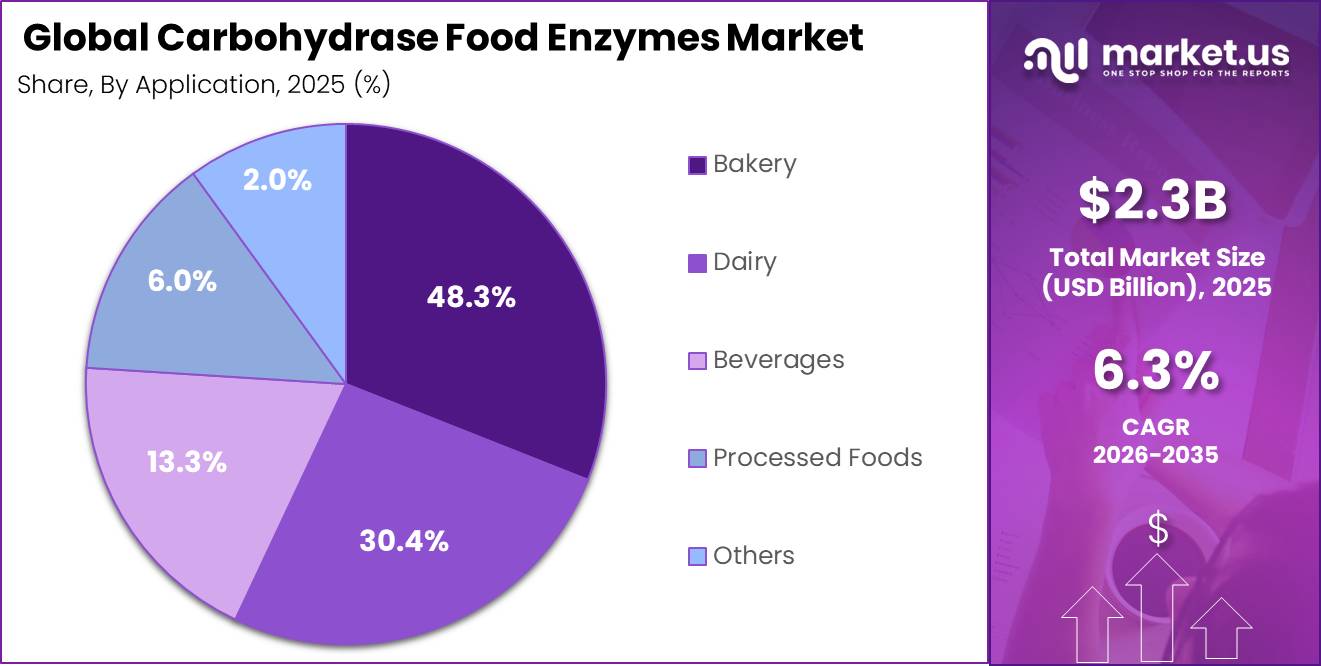
- Based on the application, Bakery dominated the market, accounting for 31.0% of the total market share.
- Based on the form, Powder dominated the market, accounting for 67.70% of the total market share.
- In 2025, North America was the most dominant region in the carbohydrase food enzymes market, accounting for 39.90% of the global market.
Industrially, carbohydrase enzymes support processing of grains and starches into glucose syrups and starch hydrolysates. EFSA’s 2025 evaluation of alpha-amylase from Bacillus licheniformis strain CCTCC M 2023118 describes the enzyme’s use during saccharification of glucose syrups and starch hydrolysates. EFSA opened a public consultation from 26 February to 19 March 2026 on an extension of use for alpha-amylase from a genetically modified Aspergillus niger strain, NZYM-SB, under Regulation (EC) No 1332/2008, indicating continued industry demand for expanded carbohydrase applications in the European Union.
- The United States Department of Agriculture (USDA) Economic Research Service (ERS) reports total corn sweetener availability, including high fructose corn syrup, glucose syrup, and dextrose, stood at 53.0 pounds per person in 2023, the most recent year published, down from 85.7 pounds per person in 1999, while caloric sweetener availability was 123.5 pounds per person in 2023. This decline supports demand for carbohydrase enzymes used in alternative syrup and starch hydrolysate production.
Government oversight continues to evolve. As of July 2025, the United States Food and Drug Administration (FDA) began posting new Generally Recognized As Safe (GRAS) notices, including enzyme preparation submissions, updated approximately monthly. In the European Union, EFSA’s ongoing 2025 and 2026 evaluations under Regulation (EC) No 1332/2008 continue to shape harmonized safety standards for carbohydrase enzymes globally.
By Type
Amylase dominates with 48.3% owing to its broad use in starch conversion across food processing.
In 2025, Amylase held a dominant market position, capturing more than a 48.3% share. The segment maintained its leading position because it plays a vital role in breaking down starch into simpler sugars, making it an essential enzyme across multiple food manufacturing processes. It is widely used to improve dough handling, support consistent product quality, and enhance processing efficiency in a variety of food applications.
Cellulase is projected to witness steady growth during the forecast period. The segment is benefiting from the increasing use of enzymes that improve raw material utilization and processing performance in food production. Food manufacturers are expanding the use of cellulase to support efficient processing of plant-based ingredients while maintaining product quality. During 2025 and into 2026, the growing focus on cleaner processing methods, better ingredient functionality, and improved production efficiency is expected to encourage wider adoption of cellulase across food manufacturing applications.
By Source
Microorganisms dominate with 63.10% due to their reliable enzyme production and efficient large-scale food processing.
In 2025, Microorganisms held a dominant market position, capturing more than a 63.10% share. The segment led the market because microbial sources provide a consistent and efficient way to produce carbohydrase food enzymes used across food manufacturing. These enzymes are widely preferred for their stable production process, dependable quality, and suitability for large-scale commercial operations. Their use also supports standardized food processing and helps manufacturers maintain uniform product performance.
Plants are expected to register steady growth during the forecast period. The segment is gaining attention as food manufacturers continue to explore naturally derived enzyme sources that align with evolving production practices and changing consumer expectations. During 2025 and into 2026, the use of plant-based ingredients in food processing is expected to support the demand for plant-derived carbohydrase enzymes, particularly in applications where natural sourcing and ingredient transparency are becoming increasingly important.
By Application
Bakery dominates with 31% as enzyme use continues to improve baking efficiency and product consistency.
In 2025, Bakery held a dominant market position, capturing more than a 31% share. The segment maintained its leading position because carbohydrase food enzymes are widely used to improve dough performance, enhance texture, support uniform product quality, and increase production efficiency in bakery operations. Their ability to deliver consistent baking results while supporting large-scale manufacturing has made them an essential part of modern bakery processing.
Dairy is expected to witness steady growth during the forecast period. The segment is benefiting from the increasing use of food enzymes to improve dairy processing and enhance product quality across a wide range of dairy products. During 2025 and into 2026, manufacturers are expected to expand enzyme applications to improve processing efficiency, support product innovation, and meet evolving consumer preferences, contributing to the continued growth of the dairy segment.
By Form
Powder dominates with 67.70% due to its ease of handling, storage stability, and suitability for large-scale food production.
In 2025, Powder held a dominant market position, capturing more than a 67.70% share. The segment led the market because powdered carbohydrase food enzymes are easy to store, transport, and handle during food manufacturing. Their longer shelf stability and compatibility with a wide range of production processes make them a preferred choice for commercial food processors. Powder formulations also allow accurate dosing and consistent enzyme performance, helping manufacturers maintain product quality across different batches.
Liquid is expected to witness steady growth during the forecast period. The segment is gaining wider acceptance as food manufacturers seek enzyme solutions that can be easily blended into continuous processing systems. During 2025 and into 2026, the increasing adoption of automated food production and the need for flexible processing methods are expected to support the growing use of liquid carbohydrase food enzymes across various food applications.
Key Market Segments
By Type
- Amylase
- Cellulase
- Lactase
- Pectinase
- Others
By Source
- Microorganisms
- Plants
- Animals
By Application
- Bakery
- Dairy
- Beverages
- Processed Foods
- Others
By Form
- Liquid
- Powder
- Granules
Driver Analysis
Biotech & AI‑driven enzyme engineering boosting performance and application breadth
Advances in enzyme engineering over the last decade—such as directed evolution, rational design, and computational protein modeling—have materially improved enzyme specificity, stability, and catalytic efficiency, allowing food‑grade carbohydrases to function across wider pH and temperature windows and in more complex food matrices. By 2025–2026, AI‑enabled design platforms and high‑throughput screening are increasingly integrated into enzyme R&D pipelines, cutting development cycles from historically 5–7 years down toward 2–4 years for new variants, and reducing experimental load costs through in silico prediction of active‑site modifications and domain swaps.
For food manufacturers, next‑generation carbohydrases deliver operational benefits such as 10–20% higher conversion yields in starch hydrolysis, more consistent crumb structure in industrial baking lines, and better tolerance to process upsets, translating into fewer downtimes and quality deviations; enzyme suppliers, in turn, can segment portfolios more finely, supporting price realization in the mid‑teens per kilogram rather than commodity levels.
As enzyme engineering capacity scales in the US, EU, China, Japan, and India, supported by cross‑industry demand from biofuels and biochemicals, the spill‑over into food carbohydrases will broaden application areas and improve cost‑performance ratios, contributing roughly ~1.2 percentage points of incremental CAGR for the carbohydrase food enzymes market over a long‑term horizon beyond 2028.
Drivers Impact Analysis
| Driver | (~) % Impact on CAGR | Geographic Relevance | Impact Timeline |
|---|---|---|---|
| Clean-label & processed food demand expanding carbohydrase adoption | +2.0% | North America core, EU, APAC corridors, South America spill-over | Medium term (2–4 years) |
| Regulatory tightening on food additives accelerating shift to enzyme-based reformulation | +1.5% | EU, UK, North America, selective APAC | Medium term (2–4 years) |
| Biotech & AI-driven enzyme engineering boosting performance and application breadth | +1.2% | Global R&D hubs (US, EU, Japan, China, India) | Long term (≥ 4 years) |
| Efficiency and yield optimization in bakery, brewing, and starch processing using carbohydrases | +1.0% | APAC manufacturing hubs, EU industrial food clusters, North America | Long term (≥ 4 years) |
| Growth in digestive health, gluten-free, and plant-based nutrition requiring tailored carbohydrases | +0.9% | North America, EU, urban APAC, Latin America emerging | Short–Medium term (≤ 4 years) |
| Expansion of precision fermentation and immobilized enzyme processing in food applications | +0.8% | EU and North America early adopters, APAC scaling | Long term (≥ 4 years) |
Restraint Analysis
Complex regulatory and labeling approvals
Safety dossiers for new carbohydrase strains, particularly those derived from genetically modified microorganisms, typically require multi‑year toxicological, allergenicity, and exposure assessments, and review cycles often span 2–4 years, locking up R&D investment and pushing commercialization beyond typical product planning horizons. Labeling rules add further friction: in Europe and North America, clean‑label strategies can be undermined when enzymes must be declared in ways that consumers find confusing, while retailers increasingly require digital traceability and documentation for every processing aid, increasing non‑productive compliance workload for enzyme suppliers and food processors.
For carbohydrase suppliers, this translates into higher regulatory overhead per product line and a need to prioritize fewer, higher‑volume variants, which slows innovation at the fringe and delays revenue realization; for food manufacturers, uncertainty around future regulatory changes and approvals discourages early adoption and large‑scale reformulation programs, effectively trimming an estimated ~1.2 percentage points from potential market CAGR over the long term by constraining the pipeline of new enzyme solutions and limiting penetration into risk‑averse segments such as mainstream bread, snacks, and infant foods.
Restraint Impact Analysis
| Restraint | (~) % Impact on CAGR | Geographic Relevance | Impact Timeline |
|---|---|---|---|
| Complex regulatory and labeling approvals | -1.2% | EU, North America, selected APAC | Long term (≥ 4 years) |
| High production and downstream processing costs | -1.0% | Global, stronger in emerging markets | Medium–Long term (2–≥4 years) |
| Temperature/pH sensitivity and process robustness issues | -0.8% | Global manufacturing operations | Medium term (2–4 years) |
| Raw material and energy price volatility | -0.7% | APAC corridors, EU, North America | Short–Medium term (≤ 4 years) |
| Limited awareness and adoption among SMEs | -0.6% | India, Southeast Asia, Latin America | Medium term (2–4 years) |
| High R&D and IP intensity for advanced variants | -0.5% | US, EU, Japan, China | Long term (≥ 4 years) |
Opportunity Analysis
Circular economy food‑waste upcycling platforms
Circular economy food‑waste upcycling is an untapped opportunity rather than a driver because current carbohydrase usage is concentrated in primary processing, whereas the emerging white space lies in using enzymes to convert post‑consumer or manufacturing food waste into higher‑value secondary products such as prebiotics, specialty sugars, and fermentation feedstocks.
Carbohydrase suppliers can build dedicated “waste valorization” platforms that integrate immobilized carbohydrases in modular reactors to process bakery waste, off‑spec beverages, or fruit/vegetable surplus into sugar syrups, isomaltulose, and prebiotic fibers like galacto‑ and fructo‑oligosaccharides, creating new revenue pools with EBITDA margins potentially higher than traditional bulk enzyme sales due to value sharing with waste generators and downstream ingredient customers; if such platforms reach only 1–3% of food waste generated in large urban markets and monetize output at specialty ingredient price points, this could unlock hundreds of millions in incremental TAM globally.
Execution involves capex for decentralized enzymatic processing hubs, digital traceability to meet regulatory and food safety requirements, and partnership models with retailers, food service players, and municipal waste authorities, turning current disposal costs into shared profit pools; successfully scaled, this circular economy pivot could add about +1.2 percentage points to carbohydrase market CAGR above baseline over a 5–10‑year horizon, with strongest upside in EU, North America, and urban APAC, where waste regulation, ESG pressure, and infrastructure readiness converge
Opportunity Impact Analysis
| Opportunity | (~) % Potential CAGR Upside | Geographic Relevance | Execution Window |
|---|---|---|---|
| Cross-industry expansion into biofuels and animal nutrition | +1.5% | North America core, EU, APAC industrial hubs | Long term (≥ 4 years) |
| Circular economy food-waste upcycling platforms | +1.2% | EU, North America, urban APAC | Medium–Long term (2–≥4 years) |
| Premium non-GMO and plant-derived carbohydrase portfolios | +1.0% | EU, North America, Japan, affluent urban APAC | Medium term (2–4 years) |
| Bundled enzyme-plus-process optimization service models | +0.9% | Global organized food processing, esp. NA/EU | Short–Medium term (≤ 4 years) |
| SME-focused go-to-market and financing in emerging markets | +0.8% | India, Southeast Asia, Latin America, MEA | Medium term (2–4 years) |
| M&A roll-ups of regional enzyme and formulation specialists | +0.7% | Global, with focus on APAC and Europe | Long term (≥ 4 years) |
Challenges Analysis
Enzyme stability under real‑world processes
Limited enzyme stability under complex food manufacturing conditions is a persistent challenge rather than a hard restraint because carbohydrase solutions are deployed at scale in baking, beverages, and starch processing, yet peer‑reviewed work and industry analyses consistently highlight that many native and even engineered enzymes lose activity rapidly under elevated temperature, shear, moisture swings, and fluctuating pH in actual plant environments, leading to performance variance and under‑utilization.
Typical operational windows cited for industrial enzymes cluster around pH 4.5–8.5 and below roughly 60–65°C, while industrial baking, pasteurization, and extrusion can see localized temperatures in the 90–100°C range and dough environments with varying water activity; in practice, this can cut effective enzyme activity by tens of percent compared with lab benchmarks and reduce reusable cycles in immobilized systems, forcing over‑dosing or premium thermostable variants, both of which penalize unit economics.
Strategically, producers must invest in advanced formulation technologies, multi‑enzyme cocktails tuned to specific matrices, and better integration with process control to narrow the gap between theoretical and achieved performance, which is a multi‑year journey involving capex and deep collaboration with plant operators; until durability and predictability are consistently improved across segments, this stability friction is likely to shave ~1.1 percentage points off the market’s maximum growth potential, turning what could be high‑single‑digit CAGR into more modest mid‑single‑digit realized trajectories.
Challenges Impact Analysis
| Challenge | (~) % CAGR Friction Drag | Geographic Relevance | Mitigation Horizon |
|---|---|---|---|
| Enzyme stability under real-world processes | -1.1% | Global manufacturing, esp. bakery & beverages | Long term (≥ 4 years) |
| Fragmented digital integration and data visibility | -0.9% | North America core, EU regulatory hubs, APAC corridors | Medium term (2–4 years) |
| Supply reliability and logistics complexity | -0.8% | APAC production hubs, EU, North America | Medium term (2–4 years) |
| Specialized bioprocess talent and skills gap | -0.7% | Global, more acute in emerging markets | Long term (≥ 4 years) |
| ESG, allergen and compliance burden | -0.6% | EU regulatory hubs, North America, urban APAC | Long term (≥ 4 years) |
| Customer process variability and standardization limits | -0.5% | India, Southeast Asia, Latin America SME base | Medium term (2–4 years) |
Geopolitical Impact Analysis
Geopolitical Impact Analysis: Ongoing Conflicts Are Reshaping Food Enzyme Supply Chains.
The ongoing Russia–Ukraine war and continued tensions in the Middle East have increased uncertainty across global food supply chains, creating indirect challenges for the carbohydrase food enzymes market. Food enzyme manufacturers depend on reliable supplies of cereals, starches, vegetable oils, fermentation ingredients, and stable shipping networks. Disruptions in Black Sea trade and higher freight and energy costs have increased production expenses for food processors, encouraging greater focus on process efficiency.
- According to the Food and Agriculture Organization (FAO), the FAO Food Price Index averaged 128.0 points in June 2025, reflecting firm prices for several food commodities used throughout the food industry. These conditions have supported the continued use of food enzymes that help manufacturers improve processing efficiency and reduce production losses.
During 2026, geopolitical tensions continued to influence raw material sourcing and logistics rather than reducing demand for food enzymes. The FAO reported that the Food Price Index averaged 130.3 points in June 2026, while remaining 2.2% higher than in June 2025, showing that global food markets continue to experience cost pressure despite improving supply conditions. Food manufacturers have responded by diversifying suppliers, strengthening inventories, and improving manufacturing efficiency to reduce operational risks.
Regional Analysis
Regional Analysis: Stone and Tile Adhesives and Sealants Market.
North America stands as the dominating region in the global carbohydrase food enzymes market, accounting for a 39.90% share and a valuation of 0.92 billion US dollars. This regional strength is underpinned by the scale of the United States grain processing base, a primary raw material source for carbohydrase enzyme applications such as starch hydrolysis and glucose syrup production.
- According to the United States Department of Agriculture (USDA) National Agricultural Statistics Service (NASS), corn for grain production in the United States reached a record high of 17.0 billion bushels in 2025, up 14% from 2024, with average yield reaching a record 186.5 bushels per acre. This expanding corn supply base supports continued demand for starch processing enzymes, including alpha amylase and glucoamylase, across the region.
North America also benefits from an established brewing and baking end use base that consumes carbohydrase enzymes. The Brewers Association, a United States trade association, reports that the domestic beer market was valued at 113 billion US dollars in 2025, with craft brewers holding a 13.4% share of United States beer volume, sustaining demand for carbohydrase enzymes used in mashing and fermentable sugar production.
Key Regions and Countries Covered
- North America
- The US
- Canada
- Europe
- Germany
- France
- The UK
- Spain
- Italy
- Russia & CIS
- Rest of Europe
- APAC
- China
- Japan
- South Korea
- India
- ASEAN
- Rest of APAC
- Latin America
- Brazil
- Mexico
- Rest of Latin America
- Middle East & Africa
- GCC
- South Africa
- Rest of MEA
Key Players Analysis
Manufacturers in the carbohydrase food enzymes market focus on improving enzyme performance, fermentation efficiency, and product consistency to strengthen their competitive position. A major priority is the development of high-activity enzyme formulations that enhance starch, cellulose, lactose, and pectin conversion across food processing applications. Companies continue to invest in advanced microbial fermentation, strain improvement, and enzyme purification technologies to increase production efficiency while maintaining consistent quality.
Process optimization, regulatory compliance, and food safety certification remain essential to meet the requirements of global food manufacturers. Producers also expand application-specific enzyme portfolios for bakery, dairy, beverage, and processed food industries, helping customers improve production efficiency, reduce processing time, and maintain uniform product quality. Continuous investment in research and technical support further strengthens long-term customer relationships and supports product innovation.
Leading companies including Novonesis A/S, International Flavors & Fragrances Inc. (IFF), dsm-firmenich AG, Kerry Group plc, AB Enzymes GmbH, Amano Enzyme Inc., BASF SE, Associated British Foods plc, Advanced Enzyme Technologies Limited, Specialty Enzymes & Probiotics, Biocatalysts Ltd., Enzyme Development Corporation, Puratos Group, Lesaffre, and Nagase Viita Co., Ltd. continue to strengthen their market presence through product innovation, strategic partnerships, and expansion of production capabilities.
Market Key Players
- Novonesis A/S
- International Flavors & Fragrances Inc. (IFF)
- dsm-firmenich AG
- Kerry Group plc
- AB Enzymes GmbH
- Amano Enzyme Inc.
- BASF SE
- Associated British Foods plc
- Advanced Enzyme Technologies Limited
- Specialty Enzymes & Probiotics
- Biocatalysts Ltd.
- Enzyme Development Corporation
- Puratos Group
- Lesaffre
- Nagase Viita Co., Ltd.
Key Development
- April 2026, AB Enzymes GmbH – Won the IFU Innovation Award 2026 for enzyme-driven side-stream valorisation, turning fruit by-products into oils, fibres, and carbohydrate ingredients. Results: oil recovery up to 25% higher, water use down 30–60%, oligosaccharide yields up more than 13-fold.
- April 2026, Kerry Group plc – Opened an expanded biotechnology facility in Carrigaline, Co. Cork, Ireland, boosting industrial-scale lactase enzyme production. The site serves 200+ customers in 80+ countries, processing over 2 million tonnes of milk annually for an estimated 28 million consumers.
- February 2025, Novonesis A/S – Agreed with dsm-firmenich to dissolve their Feed Enzyme Alliance and take over its sales and distribution, for EUR 1.5 billion cash.
Report Scope
| Report Features | Description |
|---|---|
| Market Value (2025) | USD 2.3 Bn |
| Forecast Revenue (2035) | USD 4.3 Bn |
| CAGR (2026 2035) | 6.3% |
| Base Year for Estimation | 2025 |
| Historic Period | 2020-2024 |
| Forecast Period | 2026-2035 |
| Report Coverage | Revenue Forecast, Market Dynamics, Competitive Landscape, Recent Developments |
| Segments Covered | By Type (Amylase, Cellulase, Lactase, Pectinase, Others), By Source (Microorganisms, Plants, Animals), By Application (Bakery, Dairy, Beverages, Processed Foods, Others), By Form (Liquid, Powder, Granules) |
| Regional Analysis | North America The US & Canada; Europe Germany, France, The UK, Spain, Italy, Russia & CIS, Rest of Europe; APAC China, Japan, South Korea, India, ASEAN & Rest of APAC; Latin America Brazil, Mexico & Rest of Latin America; Middle East & Africa GCC, South Africa, & Rest of MEA |
| Competitive Landscape | Novonesis A/S, International Flavors & Fragrances Inc. (IFF), dsm-firmenich AG, Kerry Group plc, AB Enzymes GmbH, Amano Enzyme Inc., BASF SE, Associated British Foods plc, Advanced Enzyme Technologies Limited, Specialty Enzymes & Probiotics, Biocatalysts Ltd., Enzyme Development Corporation, Puratos Group, Lesaffre, and Nagase Viita Co., Ltd. |
| Customization Scope | Customization for segments, region/country level will be provided. Moreover, additional customization can be done based on the requirements. |
| Purchase Options | We have three licenses to opt for: Single User License, Multi User License (Up to 5 Users), Corporate Use License (Unlimited Users and Printable PDF) |





































