


Report Overview
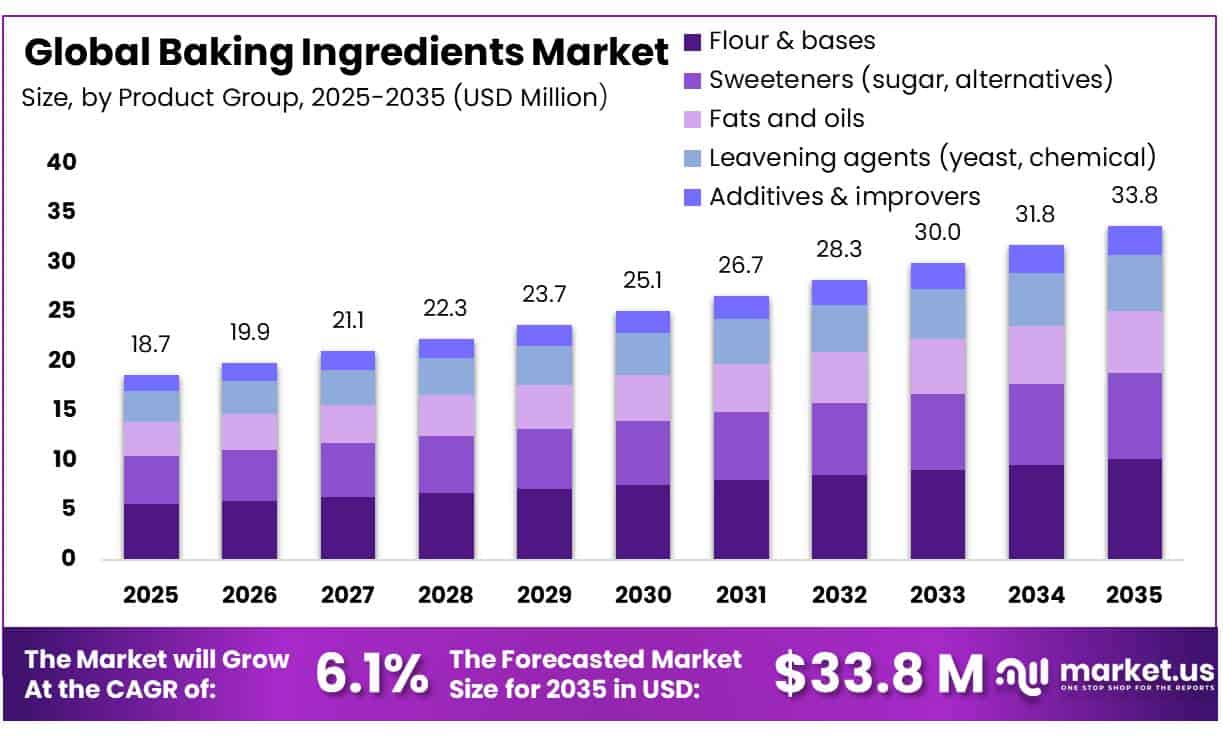
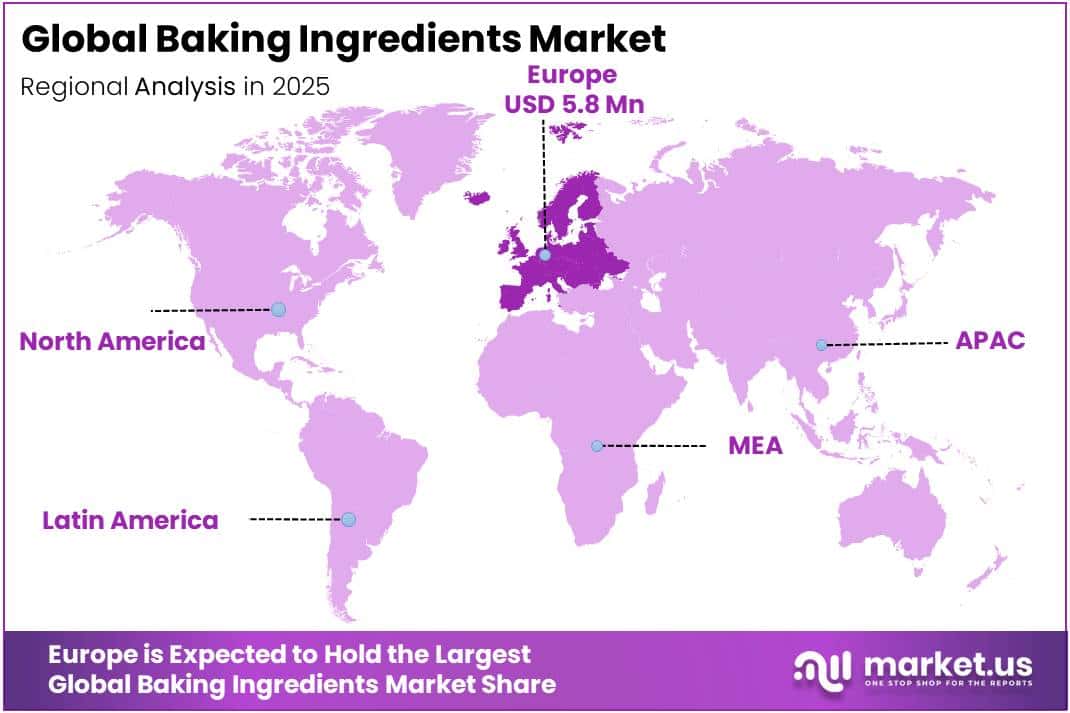
In 2025, the Global Baking Ingredients Market was valued at USD 18.7 Million, and between 2026 and 2035, this market is estimated to register a CAGR of 6.1%, reaching about USD 33.8 Million by 2035. In 2025, Europe led the market, achieving over 31.2% share with a revenue of USD 5.8 Million.
The baking ingredients industry includes flour, yeast, enzymes, emulsifiers, baking powders, sweeteners, fats, dairy ingredients, colors, flavors, and functional blends used in bread, cakes, biscuits, pastries, muffins, and frozen bakery products. In 2025–2026, the sector remained closely linked with grain supply, packaged food demand, and food-service recovery.
- According to the U.S. Department of Agriculture (USDA) Economic Research Service, U.S. per-capita wheat flour use was 6 pounds in 2025, reflecting the continued importance of bread, buns, cakes, cookies, crackers, and other wheat-based bakery products in everyday diets.
Key Takeaways
- The Global Baking Ingredients Market was valued at USD 18.7 Million in 2025.
- The market is projected to grow at a CAGR of 6.1% and is estimated to reach USD 33.8 Million by 2035.
- Emulsifiers are the dominant product type, accounting for 7% of the market in 2025, driven by their broad functional role in improving texture, volume, and shelf stability across bakery formulations.
- Flour and bases is the dominant product group, accounting for 1% of the market in 2025, driven by their status as the foundational ingredient across nearly all bakery product categories.
- Bread is the dominant application, accounting for 5% of the market in 2025, driven by its position as a daily dietary staple and its high-volume production across commercial and retail bakeries.
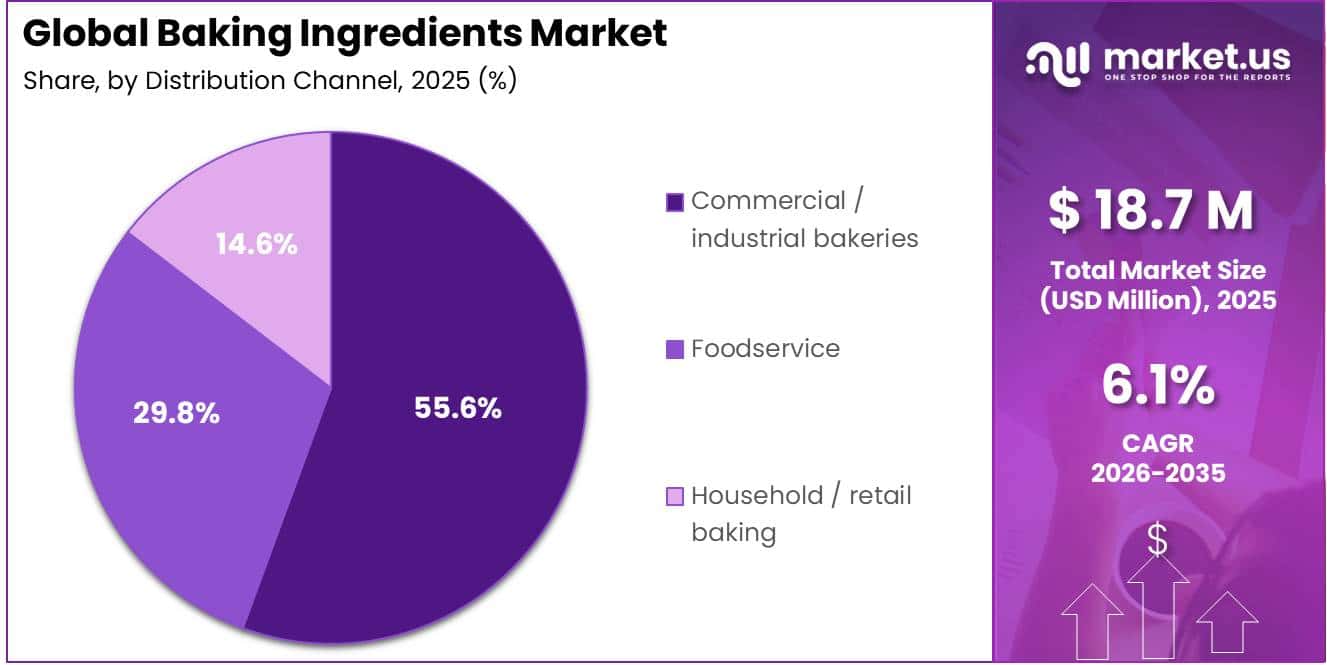
- Commercial/industrial bakeries are the dominant distribution channel, accounting for 6% of the market in 2025, driven by large-scale, consistent ingredient procurement to support high-volume bakery production.
- Europe holds the largest regional share at 2%, driven by an established industrial bakery base and high per-capita consumption of bread and bakery products across the region.
The industrial base stayed strong because bakery products are daily-use foods across North America, Europe, Latin America, the Middle East, and East Asia. The steady consumption has encouraged industrial bakeries to maintain high production volumes and continuous procurement of baking ingredients throughout the year.
- In 2024, the American Bakers Association (ABA) reported that the U.S. baking industry supported nearly 800,000 jobs, generated more than USD 42 billion in direct wages, and contributed over USD 186 billion in total economic impact, highlighting the significant demand for baking ingredients from commercial bakeries and ingredient suppliers.
FAO reported that the Cereal Price Index averaged 107.9 points in 2025, down 4.9% from 2024, marking its third yearly decline and the lowest annual level since 2020. In June 2026, FAO’s Cereal Price Index stood at 110.2 points, down 3.5% from May, while world wheat prices fell 4.4% due to faster harvest progress and better supply prospects. This helped bakeries manage flour costs, although sugar, dairy, vegetable oils, cocoa, energy, and packaging still created pressure on product margins.
Demand growth is being driven by convenience eating, frozen bakery, premium snacks, clean-label formulations, and healthier recipes. The large manufacturing ecosystem supports demand for enzymes, improvers, specialty fats, natural flavors, fiber blends, protein ingredients, and ready-to-use bakery mixes.
The EU’s 2025 Waste Framework Directive amendment set binding 2030 targets to cut food waste by 10% in processing and manufacturing and by 30% per capita across retail, restaurants, food service, and households. This supports demand for shelf-life enzymes, mold inhibitors, dough conditioners, frozen dough systems, and portion-controlled premixes. At the same time, the EU Farm to Fork strategy targets 25% organic agricultural land by 2030, while USDA has committed more than USD 3.1 billion across 141 climate-smart commodity projects. These initiatives can increase opportunities for organic flour, traceable grain ingredients, low-waste bakery technologies, and sustainable ingredient sourcing.
Product Type Analysis
Emulsifiers dominate the Baking Ingredients Market with a 36.7% share, supported by growing demand for consistent bakery quality.
In 2025, Emulsifiers held a dominant market position, capturing more than a 36.7% share of the global Baking Ingredients Market. Their strong position is supported by their ability to improve dough stability, increase loaf volume, extend shelf life, and maintain product freshness across a wide range of bakery products. Commercial bakeries continue to rely on emulsifiers because they help achieve uniform texture and reduce production variations during large-scale manufacturing.
- According to the U.S. Food and Drug Administration (FDA) in current edition 2025, sodium stearoyl lactylate (SSL) is permitted for use as a dough strengthener and emulsifier in baked products, pancakes, and waffles at levels not exceeding 5 part per 100 parts of flour.
Enzymes are the fastest-growing segment in the Baking Ingredients Market due to their ability to improve dough handling, enhance crumb softness, increase product consistency, and naturally extend freshness without relying heavily on chemical additives. During 2025 and into 2026, bakeries have increasingly adopted enzyme-based solutions to support clean-label product development and improve manufacturing efficiency.
Product Group Analysis
Flour & Bases lead the Baking Ingredients Market with a 30.1% share, driven by their essential role in every bakery product.
In 2025, Flour & Bases held a dominant market position, capturing more than a 30.1% share of the global Baking Ingredients Market. The segment maintained its leadership because flour remains the primary ingredient used in bread, cakes, biscuits, pastries, pizza, and other baked products. Strong demand from commercial bakeries, foodservice outlets, and packaged food manufacturers continued to support high consumption throughout 2025.
- In May 2026, USDA NASS reported that U.S. mills ground 222 million bushels of wheat for flour during January–March 2026, producing 103 million hundredweight of flour. Whole wheat flour production was 91 million hundredweight, accounting for 4% of total flour production, while daily 24-hour wheat flour milling capacity was 1.59 million hundredweight.
Additives & Improvers are the fastest-growing segment in the Baking Ingredients Market as commercial bakeries increasingly focus on improving product consistency, freshness, and processing efficiency. Throughout 2025 and into 2026, the use of dough conditioners, improvers, stabilizers, oxidizing agents, and specialty bakery blends increased across industrial baking operations. These ingredients help strengthen dough, improve texture, extend shelf life, and reduce production losses while maintaining consistent product quality. The growing demand for packaged bakery products, frozen dough, and premium baked goods has further supported adoption of advanced bakery improvers. In addition, manufacturers are developing cleaner-label formulations that deliver similar performance with fewer artificial ingredients, helping bakeries meet evolving consumer expectations.
Application Analysis
Bread leads the Baking Ingredients Market with a 41.5% share, supported by its everyday consumption across global households.
In 2025, Bread held a dominant market position, capturing more than a 41.5% share of the global Baking Ingredients Market. The segment remained the largest because bread continues to be a daily staple food in both developed and developing countries. High production volumes of packaged bread, sandwich loaves, rolls, buns, and artisan bread have sustained strong demand for flour, yeast, enzymes, emulsifiers, and other baking ingredients. Commercial bakeries have continued to expand production to meet growing demand from supermarkets, convenience stores, restaurants, and foodservice operators. In 2026, the segment maintained steady growth as consumers increasingly preferred whole-grain, multigrain, high-fiber, and protein-enriched bread varieties.
- According to the UK Department for Environment, Food & Rural Affairs (DEFRA), Household Food and Drink Purchases in the UK (published on 6 November 2025), average household bread purchases reached 466 grams per person per week in the financial year ending (FYE) 2024, highlighting the continued importance of bread in the UK’s regular diet.
Cakes & Pastries are the fastest-growing segment in the Baking Ingredients Market, driven by rising consumer demand for premium desserts, celebration cakes, pastries, and convenient ready-to-eat bakery products. During 2025 and into 2026, the segment benefited from increasing urban lifestyles, higher disposable incomes, and the expansion of café chains, bakery outlets, and online food delivery services. Demand for innovative flavors, healthier recipes, and visually appealing baked products has encouraged manufacturers to use specialty ingredients such as premium cocoa, fruit fillings, natural flavors, enzymes, and clean-label emulsifiers. Seasonal celebrations, birthdays, festivals, and special occasions also continue to support higher sales of cakes and pastries.
Distribution Channel Analysis
Commercial / Industrial Bakeries lead the Baking Ingredients Market with a 55.6% share, driven by large-scale bakery production.
In 2025, Commercial / Industrial Bakeries held a dominant market position, capturing more than a 55.6% share of the global Baking Ingredients Market. The segment remained the largest because industrial bakeries purchase baking ingredients in high volumes to manufacture bread, cakes, biscuits, pastries, and frozen bakery products for supermarkets, foodservice operators, and convenience stores.
Household / Retail Baking is the fastest-growing segment in the Baking Ingredients Market, supported by growing consumer interest in home baking and personalized food preparation. During 2025 and into 2026, demand for retail baking ingredients such as flour, baking powder, yeast, cake mixes, cocoa, and decorating products increased through supermarkets, specialty stores, and online retail platforms. The expansion of e-commerce and wider product availability has further supported retail sales.
Key Market Segments
Product Type
- Emulsifiers
- Baking powders and mixes
- Fats and oils / shortenings
- Flavours and colours
- Starch and fiber
- Enzymes
- Antimicrobials and preservatives
- Others (additives, improvers)
Product Group
- Flour and bases
- Sweeteners (sugar, alternatives)
- Fats and oils
- Leavening agents (yeast, chemical)
- Additives and improvers
Application
- Bread
- Cakes and pastries
- Cookies and biscuits
- Rolls, buns and pies
- Others (pizza dough, specialty items)
Distribution Channel
- Commercial / industrial bakeries
- Foodservice
- Household / retail baking
Driver Analysis
Health-Led Reformulation Demand
Demand for high-protein, high-fibre, lower-sugar and plant-forward bakery products is increasing the ingredient value per kilogram of finished bread, cakes, biscuits and snacks because manufacturers must replace the structural functions of sugar, wheat gluten, dairy solids and conventional fats rather than simply remove them; protein ranked as the most important ingredient for 42% of surveyed consumers in 2026-oriented bakery research, while high-protein bakery is projected to expand at around 7% through 2030, creating an accelerated requirement for whey and pea proteins, vital wheat gluten, soluble fibres, resistant starches, hydrocolloids, enzymes and sweetness-modulation systems.
A standard sweet-bakery sugar reduction of 20–30% can require 2–6% bulk replacement ingredients plus emulsifiers, fibres and flavour systems to restore volume, browning and moisture retention, raising specialty-ingredient spend from roughly 4–7% to 8–15% of formula cost even when total ingredient cost rises by only 3–8%; suppliers that validate dough rheology, shelf life and sensory parity can therefore shift from commodity premix sales to co-development contracts priced at a 10–25% premium.
The resulting model favours application laboratories and customer-specific blends, where a supplier can secure 12–24-month formulation lock-in and higher margins than flour or sugar distribution, because bakeries cannot change fibres, proteins or enzyme systems without revalidating processing parameters, label claims and retail quality standards.
Drivers Impact Analysis
| Driver | (~) % Impact on CAGR Forecast | Geographic Relevance | Impact Timeline |
|---|---|---|---|
| Health-led reformulation demand | +1.9% | North America, EU, APAC urban markets | Medium term (2–4 years) |
| Clean-label enzyme substitution | +1.5% | EU, North America, Australia, Japan | Short term (≤2 years) |
| Packaged bakery expansion | +1.7% | APAC, Middle East, Africa, Latin America | Medium term (2–4 years) |
| Premium indulgence innovation | +1.2% | North America, EU, China, GCC | Short term (≤2 years) |
| Frozen and foodservice recovery | +1.0% | North America, EU, APAC metropolitan markets | Medium term (2–4 years) |
| Functional flour diversification | +1.1% | North America, EU, China, Japan | Long term (≥4 years) |
Restraint Analysis
Wheat and Oil Cost Swings
Baking-ingredient demand is restrained when volatile wheat, vegetable-oil, energy and freight costs prevent ingredient manufacturers from setting reliable price lists and force bakeries to prioritize low-cost formulations over value-added enzymes, fibres, proteins and inclusions; global wheat prices increased 3.4% month on month and 7.8% year on year in May 2026, while the broader FAO food index remained 2.9% above its May 2025 level, demonstrating that overall food-price moderation does not eliminate cereal-input risk.
Flour usually contributes 35–60% of raw-material cost in bread-led formulations, while oils, shortenings and fat systems can account for 8–20% depending on product type, so a 10% wheat-price rise can increase finished-bakery ingredient cost by 3.5–6.0% before energy, packaging and labour effects; when retail contracts constrain price pass-through to 2–4%, bakeries reduce premium ingredient dosage, reformulate toward lower-cost blends, or delay new product launches.
Vegetable-oil prices also showed sharp divergence in 2026, with the FAO oils index down 4.6% in May but rapeseed and sunflower oil still affected by tight supply, creating formulation uncertainty for shortenings, fillings and emulsified systems. Ingredient suppliers must use indexed pricing, 60–120-day hedge coverage, multi-origin procurement and modular formulations, but such measures raise working-capital needs by 5–12% and reduce the commercial ability to secure fixed-price annual contracts with high-volume industrial bakeries.
Restraint Impact Analysis
| Restraint | (~) % Impact on CAGR Forecast | Geographic Relevance | Impact Timeline |
|---|---|---|---|
| Wheat and oil cost swings | -1.7% | Global; MENA, APAC, EU importers | Short term (≤2 years) |
| Clean-label reformulation cost | -1.3% | North America, EU, Australia, Japan | Medium term (2–4 years) |
| Cocoa and specialty-input volatility | -1.2% | EU, North America, Japan, China | Short term (≤2 years) |
| Bakery price sensitivity | -1.1% | Global; emerging markets strongest | Medium term (2–4 years) |
| Allergen segregation CapEx | -0.9% | EU, North America, APAC exporters | Medium term (2–4 years) |
| Fragmented small-bakery demand | -0.8% | Asia, Africa, Latin America | Long term (≥4 years) |
Opportunity Analysis
AI Formulation-as-a-Service
A bakery with 50–200 active SKUs may conduct 10–30 reformulation projects annually, and reducing each development cycle from 8–16 weeks to 3–6 weeks can release 5–10 product-development staff-days per SKU, avoid USD 10,000–50,000 in failed pilot runs, and lower ingredient-cost variance by 2–5% through dynamic substitution of fats, cocoa, fibres, proteins and sweeteners.
The upside is magnified by clean-label, protein and fibre requirements, where replacing 20–30% sugar or adding 5–10 g protein per serving changes water activity, dough rheology, browning and shelf life simultaneously; an AI model trained on dough viscosity, proof time, bake loss, texture and sensory data can recommend ingredient-system changes in hours rather than weeks.
Suppliers can charge annual subscriptions equivalent to 1–3% of a customer’s specialty-ingredient spend, retain 55–70% gross margin after platform development, and use proprietary customer data to improve repeat accuracy, converting a cyclical ingredient account into a 12–36-month digital-service relationship.
Opportunity Impact Analysis
| Opportunity | (~) % Potential CAGR Upside | Geographic Relevance | Execution Window |
|---|---|---|---|
| AI formulation-as-a-service | +2.0% | North America, EU, China, Japan | Medium term (2–4 years) |
| Upcycled ingredient platforms | +1.7% | EU, North America, Australia, Japan | Medium term (2–4 years) |
| GLP-1 portion nutrition systems | +1.5% | North America, EU, GCC, urban APAC | Short term (≤2 years) |
| Natural-colour reformulation hubs | +1.4% | North America, EU, Australia | Short term (≤2 years) |
| Bakery waste-to-value solutions | +1.2% | EU, North America, Japan | Medium term (2–4 years) |
| Regional premix roll-ups | +1.0% | Southeast Asia, Latin America, Africa | Short term (≤2 years) |
Challenges Analysis
Skilled Bakery Labour Shortage
The operational penalty is measurable: a bakery requiring 2–5 skilled workers per high-speed line can lose 5–15% of potential throughput when absenteeism, turnover or poor changeover execution interrupts production, while an untrained operator can create 2–6% more dough waste through incorrect hydration, proof time, ingredient dosing or oven settings. For ingredient suppliers, the result is slower conversion of value-added formulations because customers select simpler recipes with fewer ingredients, demand prolonged trials of 8–16 weeks, and require on-site technical service that can cost USD 500–2,000 per day for application specialists.
The long-term mitigation requires supplier-funded training academies, standardized preweighed premixes, remote line-support tools, automated dosing and digital work instructions, but these investments raise selling and technical-service expense by an estimated 2–5% of revenue before they reduce customer churn or unlock higher-margin product adoption.
Challenges Impact Analysis
| Challenge | (~) % CAGR Friction Drag | Geographic Relevance | Mitigation Horizon |
|---|---|---|---|
| Skilled bakery labour shortage | -1.2% | North America, EU, Australia, Japan | Long term (≥4 years) |
| Variable wheat-quality management | -1.1% | Global; EU, North America, MENA, APAC | Medium term (2–4 years) |
| Multi-function reformulation complexity | -1.0% | North America, EU, China, Japan | Medium term (2–4 years) |
| Traceability data integration | -0.8% | North America, EU, export-oriented APAC | Medium term (2–4 years) |
| Automation commissioning skill gap | -0.9% | North America, EU, Australia, East Asia | Long term (≥4 years) |
| Climate-disrupted ingredient sourcing | -1.0% | Global; cocoa, wheat and oil corridors | Long term (≥4 years) |
Geopolitical Impact Analysis
Ongoing Conflicts Reshape the Global Baking Ingredients Supply Chain
The ongoing geopolitical conflicts, including the Russia-Ukraine war and rising tensions in the Middle East, have continued to influence the global baking ingredients market by creating uncertainty across agricultural supply chains. Wheat, sunflower oil, and other grain-based ingredients remain vulnerable because both Russia and Ukraine are major agricultural exporters. Disruptions in exports, higher freight costs, and trade restrictions have increased the prices of key raw materials used in baking. This has placed additional cost pressure on bakeries and ingredient manufacturers around the world.
Energy prices have also remained unstable due to the conflict in the Middle East, raising production and transportation costs for flour mills, yeast producers, and food processing companies. Many manufacturers have responded by diversifying sourcing strategies, increasing local procurement, and maintaining larger inventories to reduce supply risks. Countries in Europe have accelerated efforts to secure alternative grain supplies from North and South America, while several Asian markets have expanded imports from Australia and Canada.
Despite these challenges, demand for bakery products has remained steady because bread and other baked foods are everyday essentials in many countries. Companies are focusing on supply chain resilience, long-term supplier partnerships, and operational efficiency to manage market uncertainty while ensuring a stable supply of baking ingredients to food manufacturers and commercial bakeries.
Regional Analysis
Europe Held the Largest Share of the Global Baking Ingredients Market.
In 2025, Europe held a dominant position in the global Baking Ingredients Market, accounting for more than 31.2% of the total market, with an estimated value of USD 5.8 million. The region continues to benefit from a well-established bakery industry, high consumption of bread, pastries, cakes, and premium baked products, and strong demand for clean-label and specialty ingredients. Germany, France, Italy, and the United Kingdom remain the leading contributors, supported by a large network of commercial bakeries and food processing companies.
According to the International Association of Plant Bakeries and supplementary European industrial manufacturing data, Europe produces over 35 million tonnes of bakery products annually, making it one of the largest bakery manufacturing regions worldwide. The increasing use of enzyme blends, natural emulsifiers, functional flours, and premium yeast products is helping manufacturers improve product quality while meeting changing consumer preferences.
- According to FoodDrinkEurope, the EU food and drink industry employed 8 million people, generated EUR 1.5 trillion in turnover, and added EUR 300 billion in value in its 2026 industry data.
The Asia-Pacific region is expected to register the fastest growth during the forecast period, supported by rapid urbanization, rising disposable incomes, and changing food consumption habits. Countries such as China, India, Japan, South Korea, and Indonesia are witnessing increasing demand for packaged bakery products, ready-to-eat snacks, and western-style baked foods.
The expansion of organized retail, supermarkets, and online grocery platforms has significantly improved the availability of bakery products across both urban and semi-urban markets. Industry estimates indicate that the bakery sector in Asia-Pacific is growing at a pace higher than the global average, driven by expanding middle-class populations and increasing demand for convenience foods.
Key Regions and Countries Covered
- North America
- The US
- Canada
- Europe
- Germany
- France
- The UK
- Spain
- Italy
- Russia and CIS
- Rest of Europe
- APAC
- China
- Japan
- South Korea
- India
- ASEAN
- Rest of APAC
- Latin America
- Brazil
- Mexico
- Rest of Latin America
- Middle East and Africa
- GCC
- South Africa
- Rest of MEA
Key Players Analysis
The baking ingredients market shows a fragmented to moderately consolidated structure, rather than a monopoly or pure oligopoly. Large global suppliers hold strong positions in enzymes, emulsifiers, sweeteners, starches, yeast, improvers, and specialty bakery systems, but regional producers and local formulation houses still compete strongly on price, distribution, and customized blends.
Corbion N.V. remained a focused bakery-solutions player, supported by €1,288.1 million in 2024 sales and 2,399 FTEs, with bakery emulsifiers, freshness systems, and dough improvers strengthening its share in industrial bread and packaged bakery. Lallemand Inc. held a strong yeast-led position, operating as a private fermentation specialist with more than 4,300 employees across over 45 countries, while its baking unit supplied baker’s yeast and baking ingredient solutions to commercial bakers.
Tate & Lyle plc remained important in bakery through sweetening, fibre, texture, and fortification ingredients; its FY2025 pro-forma revenue was around £2.1 billion, while the proposed $3.6 billion Ingredion takeover signaled further consolidation among specialty ingredient suppliers. Ingredion Inc. was one of the larger competitors, with about $7.2 billion in 2025 annual net sales, offering starches, sweeteners, texture systems, and bakery formulation support across clean-label and egg-replacement needs. Puratos Group kept a premium bakery systems position, serving bakery, patisserie, and chocolate customers in over 100 countries, with strong reach across artisans, industrial producers, retailers, and food-service channels.
The Major Players in The Industry
- Cargill, Incorporated
- Archer Daniels Midland Company (ADM)
- Associated British Foods plc
- Kerry Group plc
- DSM‑Firmenich AG
- International Flavors and Fragrances Inc. (IFF)
- Corbion N.V.
- Lallemand Inc.
- Tate and Lyle plc
- Ingredion Inc.
- Puratos Group
- Lesaffre International
- Bakels Group
- Dawn Food Products Inc.
- Rich Products Corporation
- Other Key Players
Key Development
- In March 2026, Cargill expanded its edible oil plant in Port Klang, Malaysia, with a multi-million-dollar specialty fats production line to strengthen its bakery ingredient portfolio. The upgraded facility produces cocoa butter equivalents, low-trans-fat cocoa butter replacers, and specialty fats for baking and fillings applications. The expansion also supports Cargill’s CremoFLEX, Bakefry, and Bakefill solutions, improving ingredient supply for bakery and confectionery manufacturers.
- In May 2025, DSM-Firmenich opened its Princeton Baking Innovation Center in New Jersey, USA, as part of its broader €700 million investment in global R&D capabilities. The facility supports bakery innovation across bread, rolls, pastries, tortillas, cookies, and snacks, providing advanced testing, product development, and access to solutions including enzymes, sweeteners, hydrocolloids, flavors, preservation systems, and fortification ingredients.
Report Scope
| Report Features | Description |
|---|---|
| Market Value (2025) | US$18.7 Mn |
| Forecast Revenue (2035) | US$33.8 Mn |
| CAGR (2026-2035) | 6.1% |
| Base Year for Estimation | 2025 |
| Historic Period | 2020-2024 |
| Forecast Period | 2026-2035 |
| Report Coverage | Revenue Forecast, Market Dynamics, Competitive Landscape, Recent Developments |
| Segments Covered | By Product Type (Emulsifiers, Baking Powders and Mixes, Fats and Oils/Shortenings, Flavours and Colours, Starch and Fiber, Enzymes, Antimicrobials and Preservatives, and Others (Additives, Improvers)), By Product Group (Flour and Bases, Sweeteners (Sugar, Alternatives), Fats and Oils, Leavening Agents (Yeast, Chemical), and Additives and Improvers), By Application (Bread, Cakes and Pastries, Cookies and Biscuits, Rolls, Buns and Pies, and Others (Pizza Dough, Specialty Items)), By Distribution Channel (Commercial/Industrial Bakeries, Foodservice, and Household/Retail Baking) |
| Regional Analysis | North America – The US and Canada; Europe – Germany, France, The UK, Spain, Italy, Russia and CIS, Rest of Europe; APAC– China, Japan, South Korea, India, ASEAN and Rest of APAC; Latin America– Brazil, Mexico and Rest of Latin America; Middle East and Africa– GCC, South Africa, and Rest of MEA |
| Competitive Landscape | Cargill, Incorporated, Archer Daniels Midland Company (ADM), Associated British Foods plc, Kerry Group plc, DSM‑Firmenich AG, International Flavors and Fragrances Inc. (IFF), Corbion N.V., Lallemand Inc., Tate and Lyle plc, Ingredion Inc., Puratos Group, Lesaffre International, Bakels Group, Dawn Food Products Inc., Rich Products Corporation |
| Customization Scope | Customization for segments, region/country-level will be provided. Moreover, additional customization can be done based on the requirements. |
| Purchase Options | We have three licenses to opt for: Single User License, Multi-User License (Up to 5 Users), Corporate Use License (Unlimited Users and Printable PDF) |





































