


Report Overview
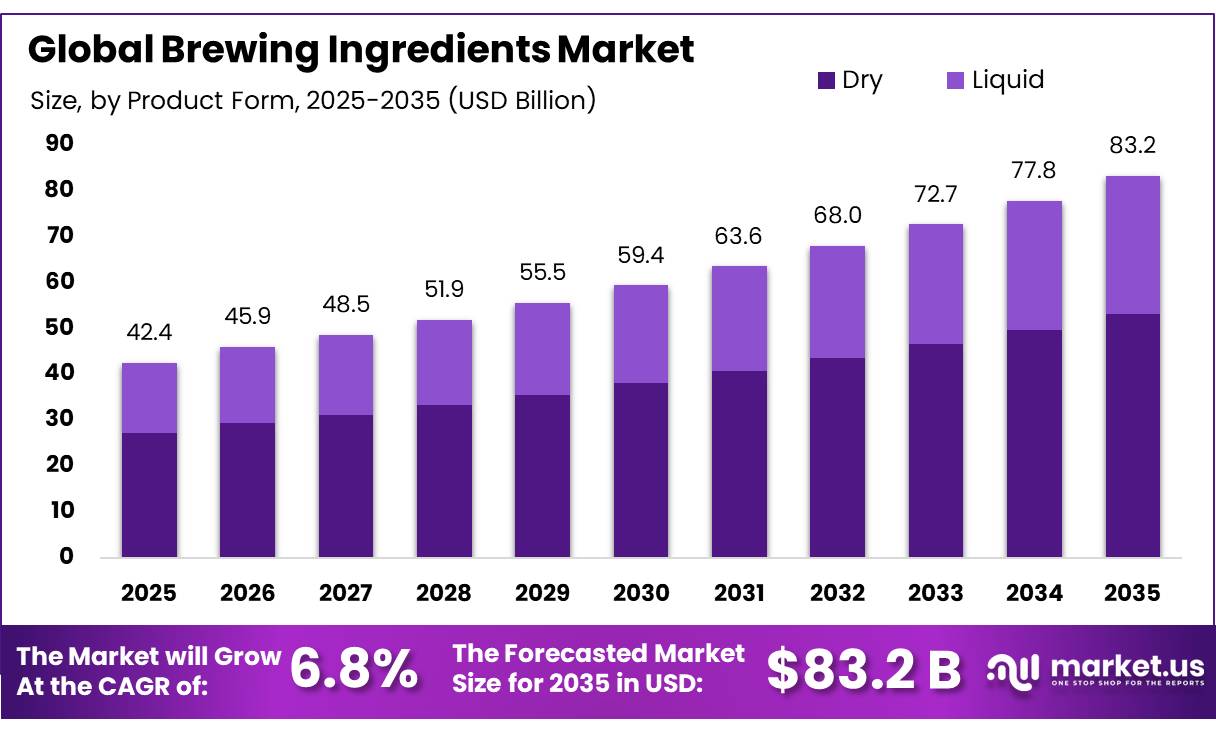
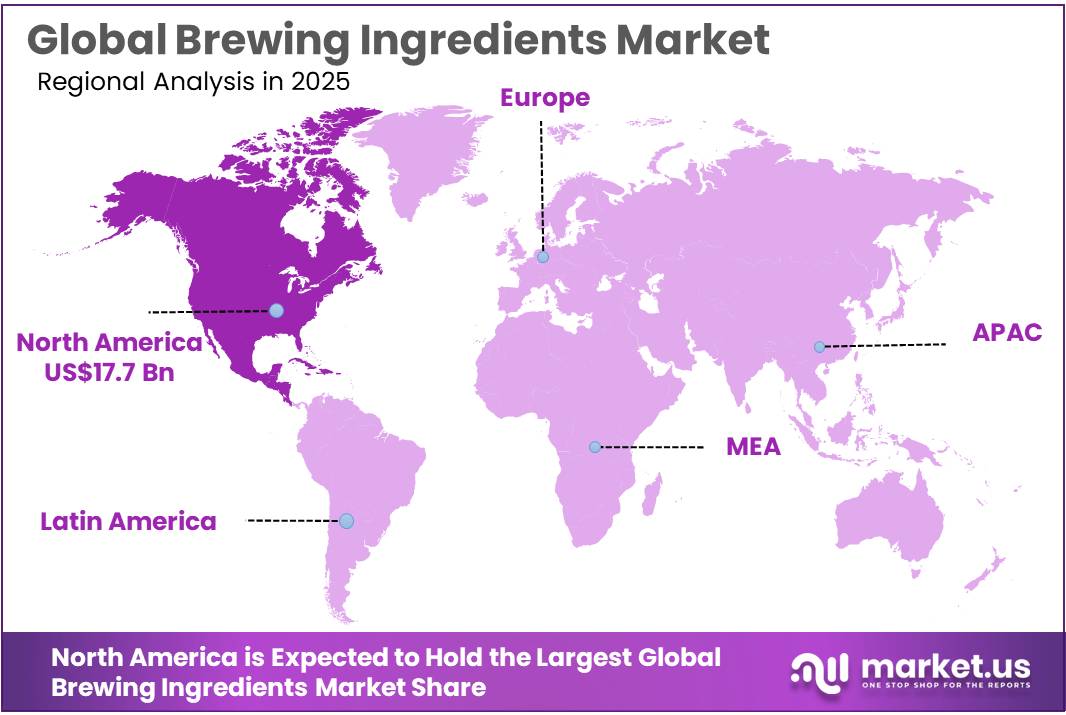
The Global Brewing Ingredients Market size is expected to be worth around USD 83.2 Billion by 2035, from USD 42.4 Billion in 2025, growing at a CAGR of 6.4% during the forecast period from 2026 to 2035. In 2025, North America held a dominant market position, capturing more than a 41.8% share, holding USD 17.7 Billion revenue.
Brewing ingredients form the technical base of beer production and include malted barley, hops, yeast, brewing enzymes, adjunct grains, sugars, flavoring materials, and processing aids. The industry is closely linked with agriculture, fermentation technology, beverage innovation, and brewery efficiency. Demand is increasingly shaped by flavor differentiation, low-alcohol formulations, and cost control.
- Eurostat reported that EU countries produced 34.7 billion litres of beer in 2024, including 32.7 billion litres above 0.5% alcohol and 2.0 billion litres below 0.5% alcohol or alcohol-free. Production of the low/no-alcohol category increased 11.1% from the previous year, supporting demand for specialty malts, tailored yeasts, enzymes, and natural flavor systems.
Key Takeaways
- Brewing Ingredients Market size is expected to be worth around USD 83.2 Billion by 2035, from USD 42.4 Billion in 2025, growing at a CAGR of 6.4%.
- Malt & Malt Extracts” held a dominant market position, capturing more than a 39.20% share.
- Dry” held a dominant market position, capturing more than a 64.00% share.
- Macro / Industrial Breweries” held a dominant market position, capturing more than a 58.60% share.
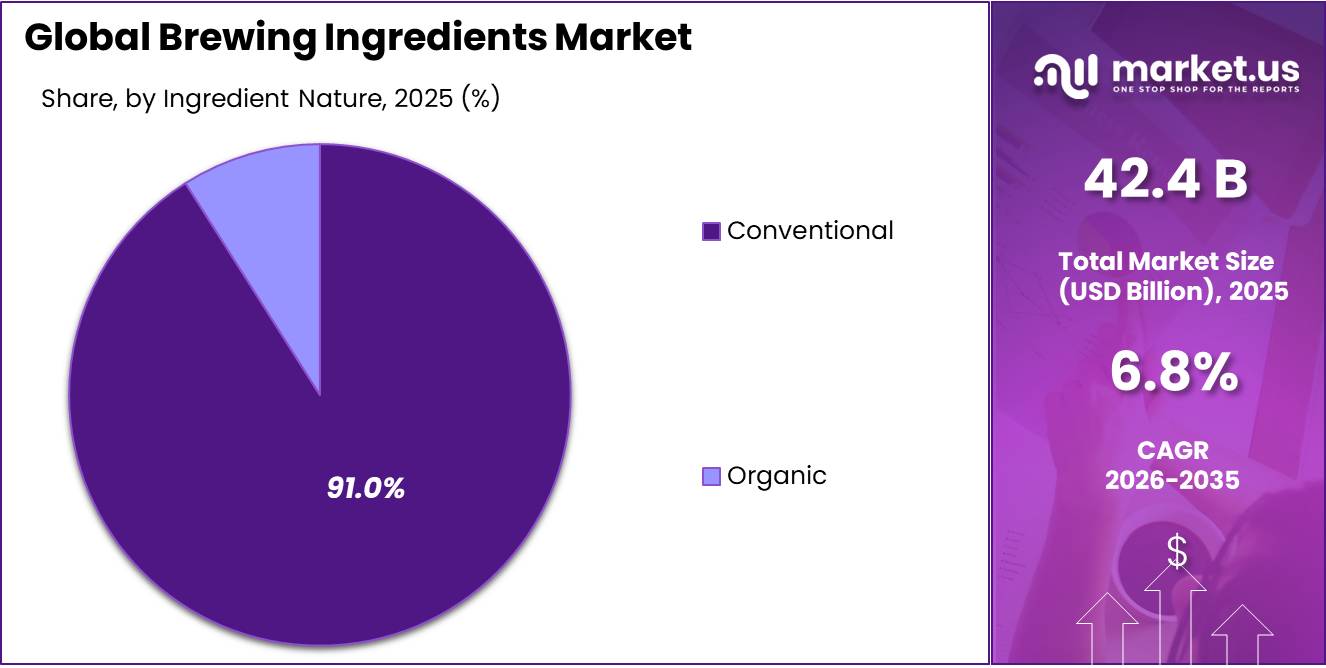
- Conventional” held a dominant market position, capturing more than a 91.00% share.
- North America held the dominant position in the Brewing Ingredients Market in 2025, accounting for more than 41.80% share and reaching USD 17.73 billion.
The industrial scenario remains mixed. BarthHaas reported that global beer production declined 0.7% in 2025 to just below 1.9 billion hectolitres. Global hop production fell 3.8% to 109,188 metric tons, while hop demand decreased by nearly 3% to around 10,700 metric tons of alpha acid. This created an estimated surplus of about 1,200 metric tons. These conditions encourage suppliers to focus on consistent bitterness, aroma retention, concentrated hop products, and more precise raw-material use.
Barley availability remains important because malt is the main solid brewing input. USDA forecast global barley production at 155.0 million metric tons for 2026/27. In the United States, USDA reported 2025 hop production of 83.1 million pounds, down 5% from 2024, while crop value reached USD 447 million. These movements show how weather, acreage, crop quality, and agricultural costs can influence ingredient prices and brewer procurement.
A major growth driver is product differentiation. The expansion of alcohol-free and low-alcohol beer supports yeast strains with controlled fermentation, enzymes that improve attenuation and mouthfeel, malt systems that retain body, and hop products that deliver aroma with lower bitterness. Craft brewing remains an innovation channel. The Brewers Association reported U.S. craft production of 22.034 million barrels in 2025, despite a 4% annual decline, indicating a large customer base for specialty ingredients and formulation support.
Sustainability is also becoming a purchasing factor. In 2026, the Brewers Association introduced a water-risk assessment resource based on location data from 5,832 U.S. breweries, reflecting growing concern over water scarcity, water quality, regulation, and climate disruption. This creates opportunities for lower-water processing, high-yield malt, concentrated hop extracts, energy-efficient enzymes, and fermentation technologies that reduce waste.
Government support can strengthen the upstream ingredient base. Under Germany’s CAP Strategic Plan, EU agricultural funding allocates EUR 2.188 million annually from 2023 through 2027 to the hops sector. Future opportunities are expected in low/no-alcohol brewing, premium and regional flavors, climate-resilient barley and hop varieties, advanced yeast cultures, enzyme-enabled process optimization, and traceable ingredients.
By Ingredient Type Analysis
Malt & Malt Extracts dominates with more than 39.20% share, supported by its essential role in brewing
In 2025, “Malt & Malt Extracts” held a dominant market position, capturing more than a 39.20% share. Malt remains the main source of fermentable sugars, color, body, and characteristic flavor in beer, making it one of the most essential brewing ingredients. Strong availability of malting barley also supports this position. In 2025, U.S. barley production reached 141 million bushels, while the average yield reached a record 80.0 bushels per acre and harvested area stood at 1.76 million acres.
Hops remained an important ingredient type in 2025 because they provide bitterness, aroma, flavor, and natural stability to beer. Demand is increasingly influenced by craft, premium, IPA, and specialty beers that use distinctive hop varieties and concentrated hop products. According to the USDA, U.S. hop production reached 83.1 million pounds in 2025 from 41,654 acres of harvested land. Average hop yield reached 1,996 pounds per acre, while the total value of production was USD 447 million.
By Product Form Analysis
Dry dominates the Brewing Ingredients Market with more than 64.00% share, supported by easier storage, handling, and longer shelf life
In 2025, “Dry” held a dominant market position, capturing more than a 64.00% share. Dry brewing ingredients such as malt, hop pellets, dry yeast, and powdered processing ingredients are widely preferred because they are easier to transport, store, measure, and use across different production volumes. Their lower dependence on refrigerated logistics also makes them practical for breweries sourcing ingredients over longer distances. The USDA reported that U.S. hop production reached 83.1 million pounds in 2025 from 41,654 acres, with an average yield of 1,996 pounds per acre.
Liquid remained an important product form in the Brewing Ingredients Market as breweries increasingly used liquid yeast cultures, malt extracts, hop extracts, syrups, flavors, and enzyme preparations to simplify production and maintain batch consistency. These ingredients can be introduced directly into brewing systems, which reduces preparation work and allows precise dosing in specialty and high-volume recipes. In 2025, U.S. craft brewers produced 22.034 million barrels of beer, while craft beer represented 13.4% of the U.S. beer market by volume and generated USD 28.0 billion in retail sales.
By Brewery Size / End-User Analysis
Macro / Industrial Breweries dominate with more than 58.60% share, driven by large-scale production and continuous ingredient consumption
In 2025, “Macro / Industrial Breweries” held a dominant market position, capturing more than a 58.60% share. Large breweries consume substantial volumes of malt, hops, yeast, enzymes, and brewing adjuncts because their production lines operate continuously and require consistent recipes across multiple batches. According to the U.S. Alcohol and Tobacco Tax and Trade Bureau (TTB), 21 breweries producing more than one million barrels each generated approximately 117.8 million barrels of beer in 2025.
Microbreweries & Craft Breweries remained an important end-user segment in 2025 as smaller brewers continued to differentiate their products through specialty malt, aromatic hops, unique yeast strains, fruit ingredients, and seasonal recipes. The Brewers Association reported that U.S. craft breweries produced 22.034 million barrels of beer in 2025, while production declined by 4% during the year and microbrewery output decreased by 8.9%.
By Ingredient Nature Analysis
Conventional dominates with more than 91.00% share, supported by large-scale barley and hop availability
In 2025, “Conventional” held a dominant market position, capturing more than a 91.00% share. Conventional brewing ingredients remain widely used because large breweries require dependable volumes of malted barley, hops, yeast, adjuncts, and processing aids at competitive costs. USDA reported that U.S. barley production reached 140.849 million bushels in 2025, with an average yield of 80.0 bushels per acre. U.S. hop production also reached 83.143 million pounds during the same year.
Organic remained a developing ingredient category as breweries looked for certified malt, hops, grains, sugars, and other agricultural ingredients that meet stricter sourcing requirements. USDA rules require products marketed as “made with organic” ingredients to contain at least 70% organic ingredients, while as much as 30% may consist of permitted nonorganic ingredients.
Key Market Segments
By Ingredient Type
- Malt & Malt Extracts
- Hops
- Beer Yeast
- Adjuncts & Grains
- Others
By Product Form
- Dry
- Liquid
By Brewery Size / End-User
- Macro / Industrial Breweries
- Microbreweries & Craft Breweries
- Brewpubs & Homebrewers
By Ingredient Nature
- Conventional
- Organic
Driver Analysis
No/Low-Alcohol Beer Reformulation Driving Specialty Malt and Enzyme Substitution
The structural pivot toward no- and low-alcohol (NoLo) beer is reordering the malt and enzyme procurement stack because dealcoholized and low-ABV formulations require different starch conversion profiles than standard lagers, typically substituting 8-15% of conventional base malt volume with high-diastatic specialty malts or exogenous enzyme blends to compensate for truncated fermentation windows.
Category value is projected to move from roughly USD 8.5 billion in 2026 toward the USD 16-25 billion range by the mid-2030s, implying a category CAGR near 7.7-7.9%, well above the base brewing ingredients CAGR, which pulls blended ingredient demand upward as brewers reformulate existing SKUs rather than launch net-new capacity.
Because NoLo lines run on shared brewhouse infrastructure with standard beer, the unit economics shift is primarily in the ingredient bill of materials (BOM): enzyme and specialty malt costs per hectoliter rise 10-20% versus standard lager, but total ingredient cost as a share of retail price stays contained because NoLo commands a 15-30% retail premium in most Western markets.
Strategically, this pushes ingredient suppliers from commodity malt supply contracts toward technical co-formulation partnerships bundling enzymes, dealcoholization aids, and flavor-masking adjuncts, effectively converting a pure ingredient sale into a formulation-as-a-service model with recurring technical support revenue.
Drivers Impact Analysis
| Driver | (~) % Impact on CAGR Forecast | Geographic Relevance | Impact Timeline |
|---|---|---|---|
| No/low-alcohol beer reformulation driving specialty malt and enzyme substitution | +1.6% | North America core, EU, APAC (Japan/China urban) | Medium term (2-4 years) |
| Climate-driven barley yield volatility reshaping malt sourcing and adjunct blending | +1.1% | EU (Mediterranean/France/Germany), North America Great Plains, South America (Mexico/Argentina) spill-over | Short to medium term |
| EU Deforestation Regulation (EUDR) compliance reshaping cocoa/coffee-adjacent flavored beer inputs and traceability costs | +0.7% | EU core, exporting corridors (South America, West Africa, APAC) | Short term (≤2 years), binding Dec 30, 2026 |
| Craft and hybrid-style brewing fueling exotic hops and heritage malt demand | +2.0% | North America core, EU, APAC (China, India, Southeast Asia) | Long term (≥4 years) |
| Functional and adaptogenic ingredient crossover into brewed beverages | +0.9% | North America, EU, APAC (India, China wellness segment) | Medium term (2-4 years) |
| Dry ingredient format shift (DME/dry hops/dry yeast) improving logistics economics | +0.5% | Global, concentrated in export-heavy APAC and Latin America supply corridors | Short term (≤2 years) |
Restraint Analysis
US Section 232/301 Tariffs on Steel, Aluminum, and Imported Malt/Hops
The tariff overlay confronting brewing ingredient supply chains has compounded sharply since March 2025, when the US imposed a 25% Section 232 tariff on steel and aluminum, doubled to 50% by June 4, 2025, and by mid-2026 total effective duties on aluminum cans and ends reached an approximate 75-80% combined rate once the 25% Section 301 duty is stacked on top; simultaneously, a June 2, 2026 USTR forced-labor investigation recommended additional 10-12.5% duties on hops, specialty malts, and brewing equipment from the EU, UK, China, Japan, Australia, and New Zealand, explicitly excluding only Canadian barley and malt under USMCA carve-outs, and separately, EU malt and hops entering the US became subject to a 15% tariff as of July 28, 2025; the compounding effect is that a mid-sized brewery importing pilsner malt from Canada in 40,000-pound increments now faces multi-front cost exposure across both raw grain and finished packaging, forcing procurement teams to model landed-cost scenarios that can swing 15-30% quarter to quarter depending on which tariff tranche is active, which in turn delays capital allocation decisions on new fermentation capacity and pushes smaller brewers toward domestic-only sourcing even where domestic malt carries a 5-10% price premium over pre-tariff import costs.
Restraint Impact Analysis
| Restraint | (~) % Impact on CAGR Forecast | Geographic Relevance | Impact Timeline |
|---|---|---|---|
| US Section 232/301 tariffs on steel, aluminum, and imported malt/hops | -1.8% | North America core (US), Canada, EU, China/Japan/Australia exporters | Short term (≤2 years) |
| Aluminum can and packaging cost inflation squeezing brewer margins | -1.2% | North America core, Canada spill-over | Short term (≤2 years) |
| Declining overall beer volume consumption in mature markets | -1.5% | North America, EU (Western Europe), APAC (Japan, South Korea) | Long term (≥4 years) |
| Craft brewery insolvencies and consolidation reducing ingredient order volume | -0.9% | North America core, EU (UK core) | Medium term (2-4 years) |
| Barley/hops agronomic supply shocks from extreme weather | -0.8% | EU (Germany, France), North America Great Plains, South America | Medium term (2-4 years) |
| Retaliatory trade barriers and cross-border alcohol import bans | -0.6% | North America (US-Canada corridor), EU-US corridor | Short term (≤2 years) |
Opportunity Analysis
Climate-Resilient Ingredient IP & Contract Farming Roll-Up
Climate stress on barley and hop terroirs is already a recognized driver of near-term cost inflation, but the untapped opportunity is the strategic pivot from reactive sourcing to owning drought-tolerant cultivar IP and vertically integrating through contract farming roll-ups in resilient micro-climates, converting a cost headwind into a proprietary supply moat.
Because published modeling shows barley yields could fall as much as 17% under severe drought scenarios with beer prices potentially doubling in worst-case regions, an ingredient supplier that locks in long-duration contracts with growers cultivating heat-tolerant barley varietals in irrigated Australian, Idaho, or Patagonian growing zones could insulate 60-70% of its raw-material base from spot-price shocks, effectively creating a de-risked supply premium it can charge brewers 8-12% above spot exposed competitors.
This is not a current driver because most mid-sized suppliers still operate on 1-2 year procurement cycles and spot/futures hedging rather than owning agronomic IP or farmland-adjacent contracts, meaning the roll-up play acquiring or partnering with 3-5 regional malting/hop cooperatives remains a greenfield M&A opportunity rather than an executed strategy, with margin expansion potential of 300-500 basis points once vertical integration removes intermediary trading margins.
Opportunity Impact Analysis
| Opportunity | (~) % Potential CAGR Upside | Geographic Relevance | Execution Window |
|---|---|---|---|
| NA/Low-ABV Ingredient Platform Pivot | +2.2% | North America core, EU, APAC emerging (India, Vietnam) | Short term (≤2 years) |
| Climate-Resilient Ingredient IP & Contract Farming Roll-Up | +1.6% | US Pacific Northwest, Germany/Czechia (Hallertau/Žatec), Australia | Medium term (2-4 years) |
| Functional & Fermented Adjacent-TAM Expansion (probiotics, adaptogens, hemp-derived) | +1.9% | North America, Western Europe, APAC urban centers | Medium term (2-4 years) |
| Direct-to-Microbrewery Digital Procurement Marketplace | +1.4% | EU fragmented craft base, APAC emerging craft scenes | Short term (≤2 years) |
| Byproduct Circular Monetization (spent grain, spent yeast valorization) | +1.1% | EU (regulatory tailwind), North America | Long term (≥4 years) |
| APAC Localization & Import-Substitution Manufacturing | +2.0% | India, Vietnam, Southeast Asia, China tier-2 cities | Medium term (2-4 years) |
Challenges Analysis
Climate-Driven Yield Volatility
The root structural vulnerability is agronomic concentration: aroma hop cultivation remains geographically clustered in a handful of terroirs, and compound drought-heat events have already cut US hop production by as much as 16% in a single season while extreme hot-dry summers can suppress alpha-acid yield by up to 70% versus a normal year, meaning ingredient buyers face year-to-year supply swings that no single hedge fully neutralizes; the quantitative friction shows up as elevated standard deviation in delivered-cost-per-kilogram plausibly 18-25% year-over-year variance for contract hops versus 6-8% for stable commodities forcing maltsters and brewers to carry 30-45 additional days of safety-stock inventory at an incremental carrying cost of roughly 4-6% of input value annually; the long-term strategic adjustment required is geographic diversification of contracted acreage across at least three non-correlated climate zones plus continued investment in heat-tolerant cultivars, a multi-year breeding and requalification cycle that realistically takes 4-6 years to materially de-risk the supply base, which is why this friction persists as a structural drag rather than resolving on a short cycle.
Challenges Impact Analysis
| Challenge | (~) % CAGR Friction Drag | Geographic Relevance | Mitigation Horizon |
|---|---|---|---|
| Climate-Driven Yield Volatility | -1.8% | US Pacific Northwest, Germany/Czechia, Australia | Long term (≥4 years) |
| Skilled Maltster & Brewer Talent Gap | -0.9% | North America, Western Europe, Australia | Medium term (2-4 years) |
| Fragmented Contract Coverage & Price Discovery | -1.1% | Global hop/barley trading corridors (US, EU, Australia) | Medium term (2-4 years) |
| Logistics & Cold-Chain Yeast Fragility | -0.7% | Cross-border EU-US, APAC import corridors | Short term (≤2 years) |
| Varietal Concentration Risk | -0.6% | Czechia (Žatec/Saaz), Bavaria (Hallertau) | Long term (≥4 years) |
| SME Craft-Tier Working Capital Strain | -0.8% | EU fragmented craft base, emerging APAC craft scenes | Medium term (2-4 years) |
Geopolitical Impact Analysis
The ongoing Russia–Ukraine war and conflict in the Middle East are keeping the Brewing Ingredients Market exposed to grain, energy, fertilizer, and shipping risks. Barley is especially important because it is the main raw material for malt.
- In June 2026, the USDA reduced Ukraine’s 2025/26 barley export forecast from 2.2 million metric tons to 1.7 million metric tons, reflecting weaker trade flows. This can tighten sourcing options for maltsters and breweries that depend on Black Sea grain and encourage buyers to diversify toward Australia, Canada, and the European Union.
Middle East tensions have added another cost layer. UNCTAD reported that disruptions in the Strait of Hormuz caused ship transits to fall by about 95% and affected a route carrying around one-quarter of global seaborne oil trade. Higher fuel, insurance, and tanker costs can raise the delivered cost of hops, malt extracts, yeast, enzymes, and packaging materials moved across regions.
Regional Insights
North America leads with 41.80% share and USD 17.73 billion, while Asia Pacific shows strong growth potential
North America held the dominant position in the Brewing Ingredients Market in 2025, accounting for more than 41.80% share and reaching USD 17.73 billion. The region benefits from a large commercial brewing base, established malt and hop supply chains, and strong demand from industrial and craft breweries.
- In the United States, craft brewers produced 22.034 million barrels of beer in 2025, while craft beer represented 13.4% of the overall U.S. beer market by volume. Canada also recorded CAD 9.1 billion in beer sales during 2024/25. These volumes support steady purchases of malt, hops, yeast, enzymes, adjuncts, and specialty flavor ingredients.
Asia Pacific is expected to be the fastest-growing regional market, supported by large barley trade flows, expanding brewing capacity, premiumization, and wider development of specialty beer products. USDA projected China’s barley imports at 11.0 million metric tons for 2025/26, while Australia’s barley exports were forecast at 9.0 million metric tons.
East Asia’s barley imports were estimated at 10.855 million metric tons during 2025/26. These strong agricultural flows provide an important raw-material base for malt production and brewing activity. Growth in premium beer, alcohol-free beverages, specialty flavors, and advanced fermentation is creating additional opportunities for specialty malts, aroma hops, enzymes, and modern yeast cultures.
Key Regions and Countries Insights
- North America
- US
- Canada
- Europe
- Germany
- France
- The UK
- Spain
- Italy
- Rest of Europe
- Asia Pacific
- China
- Japan
- South Korea
- India
- Australia
- Rest of APAC
- Latin America
- Brazil
- Mexico
- Rest of Latin America
- Middle East & Africa
- GCC
- South Africa
- Rest of MEA
Key Players Analysis
Malteries Soufflet, operating as Soufflet Malt within InVivo Group, is a major global supplier of malt to industrial brewers, craft breweries, and distillers. As of June 2025, the business operated 35 malt houses across 20 countries, employed about 2,200 people, and had annual production capacity of 3.6 million tonnes. During 2025, targeted investments and digital tools lifted its EMEA volume capacity by 5%, strengthening its ability to supply standard and specialty malts across major global brewing regions.
Boortmalt, part of Axéréal Group, remains one of the largest global malt suppliers, serving brewers, distillers, and food manufacturers. In 2025, the company reported annual malting capacity of 3 million tonnes across 25 plants on 5 continents. Its close relationship with Axéréal supports access to malting barley, while its global network improves supply reliability. During 2025, Boortmalt also adjusted selected production assets to match softer beer and whisky demand, showing a stronger focus on operating efficiency and capacity discipline worldwide.
Malteurop, the malting business of VIVESCIA, maintains a broad position across brewing and distilling ingredient markets. In 2025, the company operated 23 production sites in 14 countries and served around 900 customers, including major brewers, distillers, and food companies. Malteurop states that about 2,000 beers made with its malt are consumed every second worldwide. Its parent, VIVESCIA, reported €3.8 billion in revenue and €184 million in EBITDA for the year ended June 2025, supporting continued investment capacity.
Top Key Players Outlook
- Malteries Soufflet/InVivo Group
- Boortmalt/Axéréal Group
- Malteurop Groupe/Vivescia
- Rahr Corporation/RahrBSG
- Viking Malt Group
- Muntons plc
- Simpsons Malt Ltd.
- Briess Malt & Ingredients Co.
- BarthHaas Group
- Hopsteiner
- Yakima Chief Hops
- Lesaffre/Fermentis
- Lallemand Inc.
- Angel Yeast Co., Ltd.
- Kerry Group plc
Recent Developments
- In February 2025, Viking Malt Group signed a EUR 130 million committed and EUR 45 million uncommitted financing agreement with 3 banks, securing 3 years of financing with 2 possible one-year extensions.
- In May 2025, Muntons reported £20.2 million EBITDA and increased business investment to £9.4 million, showing continued spending on sustainable growth and operating capability.
Report Scope
| Report Features | Description |
|---|---|
| Market Value (2025) | USD 42.4 Bn |
| Forecast Revenue (2035) | USD 83.2 Bn |
| CAGR (2026-2035) | 6.8% |
| Base Year for Estimation | 2025 |
| Historic Period | 2020-2024 |
| Forecast Period | 2026-2035 |
| Report Coverage | Revenue Forecast, Market Dynamics, Competitive Landscape, Recent Developments |
| Segments Covered | By Ingredient Type (Malt & Malt Extracts, Hops, Beer Yeast, Adjuncts & Grains, Others), By Product Form ( Dry, Liquid), By Brewery Size / End-User (Macro / Industrial Breweries, Microbreweries & Craft Breweries, Brewpubs & Homebrewers), By Ingredient Nature (Conventional, Organic) |
| Regional Analysis | North America – US, Canada; Europe – Germany, France, The UK, Spain, Italy, Rest of Europe; Asia Pacific – China, Japan, South Korea, India, Australia, Singapore, Rest of APAC; Latin America – Brazil, Mexico, Rest of Latin America; Middle East & Africa – GCC, South Africa, Rest of MEA |
| Competitive Landscape | Malteries Soufflet/InVivo Group, Boortmalt/Axéréal Group, Malteurop Groupe/Vivescia, Rahr Corporation/RahrBSG, Viking Malt Group, Muntons plc, Simpsons Malt Ltd., Briess Malt & Ingredients Co., BarthHaas Group, Hopsteiner, Yakima Chief Hops, Lesaffre/Fermentis, Lallemand Inc., Angel Yeast Co., Ltd., Kerry Group plc |
| Customization Scope | Customization for segments, region/country-level will be provided. Moreover, additional customization can be done based on the requirements. |
| Purchase Options | We have three licenses to opt for: Single User License, Multi-User License (Up to 5 Users), Corporate Use License (Unlimited User and Printable PDF) |





































