


Report Overview
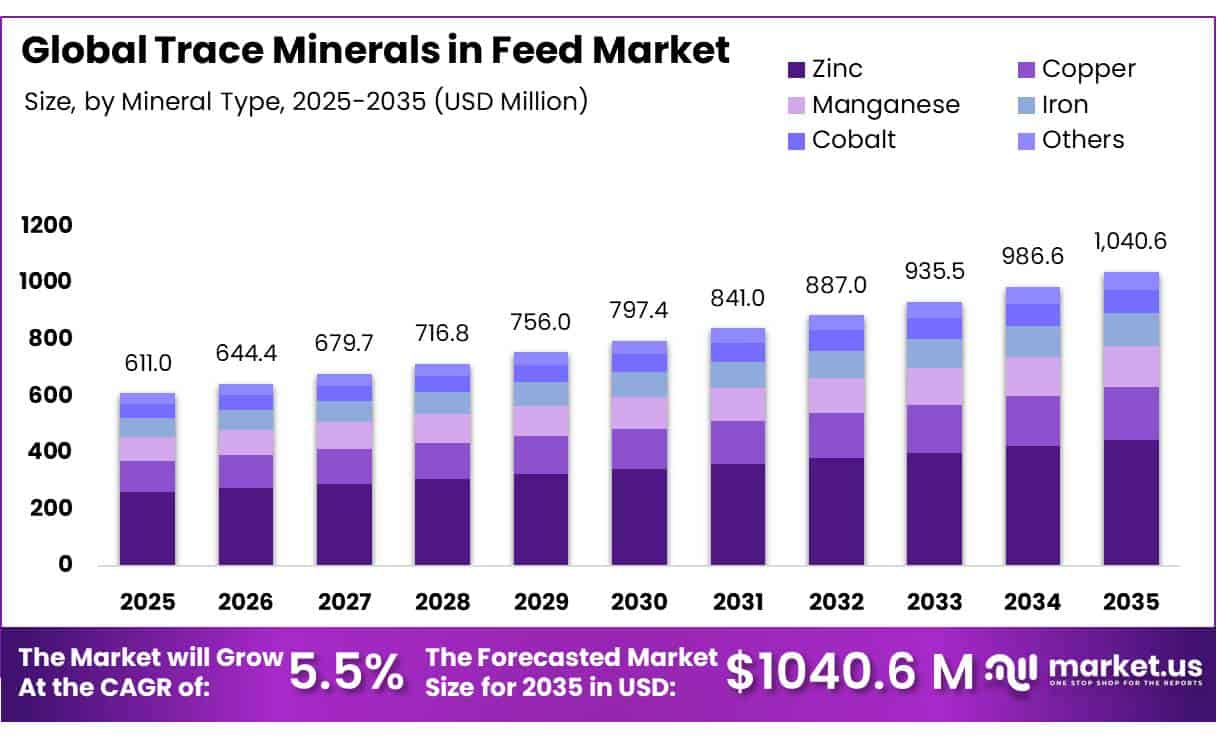
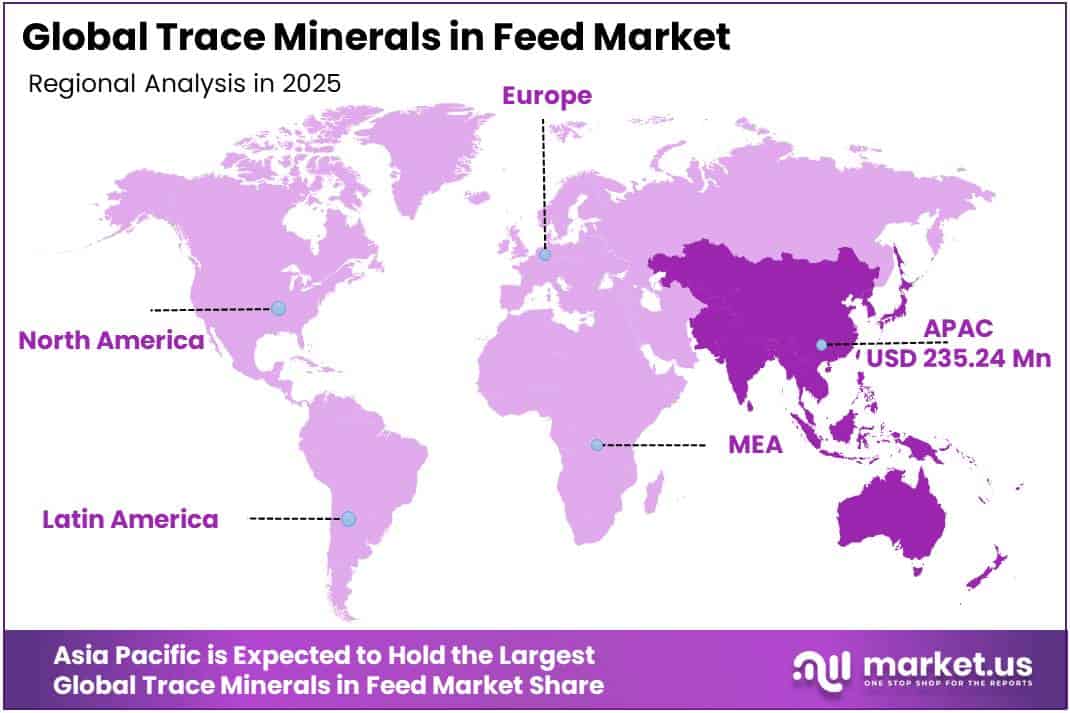
In 2025, the Global Trace Minerals in Feed Market was valued at USD 611.0 million, and between 2026 and 2035, this market is estimated to register a CAGR of 5.5%, reaching about USD 1040.6 million by 2035. Asia Pacific held a dominant market position, capturing more than a 38.50% share, holding USD 235.24 million in revenue.
The Trace Minerals in Feed Market covers additives such as zinc, copper, manganese, iron, and cobalt used to support metabolism, growth, immunity, reproduction, and enzyme activity. Mineral inclusion must balance nutrition with animal, consumer, and environmental safety.
- In April 2025, the European Commission Joint Research Centre documented a zinc lysinate sulfate specification containing at least 20% zinc and 34% lysine, with proposed maximum zinc doses ranging from 120 to 200 milligrams per kilogram of feed.
Key Takeaways
- The global trace minerals in feed market was valued at USD 611.0 million in 2025.
- The global market is projected to grow at a CAGR of 5.5% and is estimated to reach USD 1,040.6 million by 2035.
- On the basis of mineral type, zinc dominated the market, constituting 43.00% of the total market share.
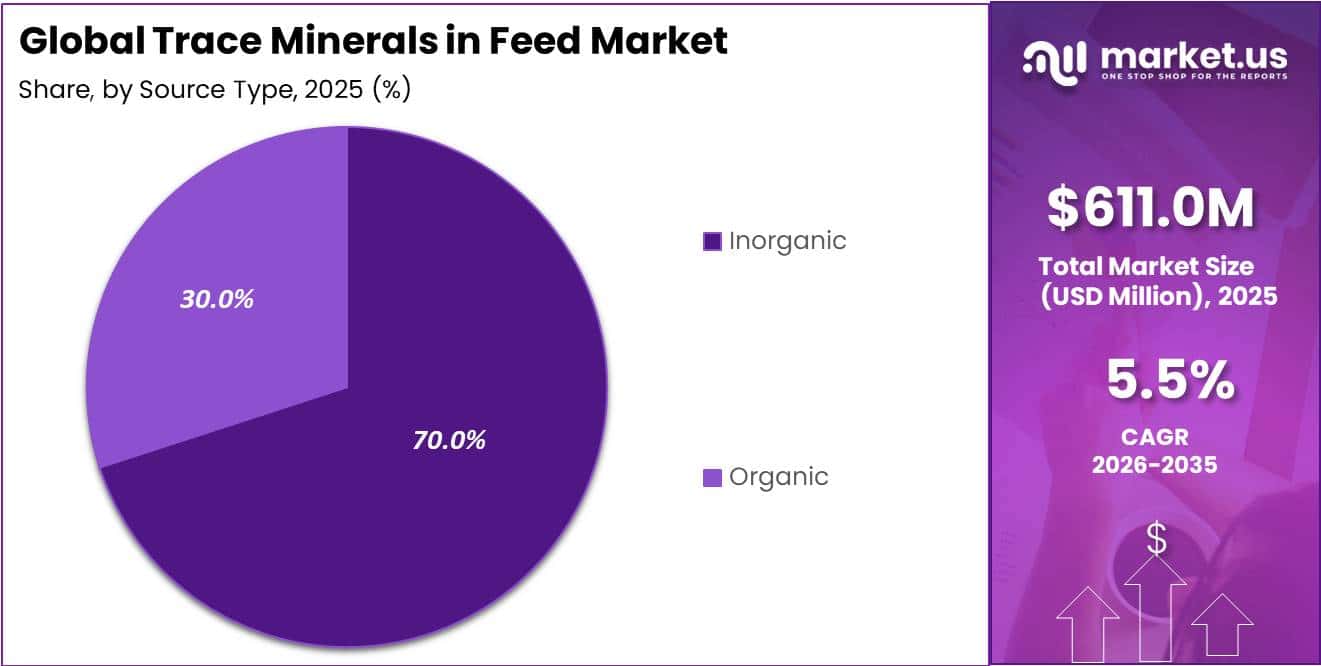
- Based on the source type, inorganic dominated the trace minerals in feed market, with a substantial market share of around 70.00%.
- Based on the chelate type, proteinates led the market, comprising 38.30% of the total market.
- Among the livestock applications, poultry held a major share in the trace minerals in feed market, accounting for 43.70% of the market share.
- Based on the form, dry dominated the trace minerals in feed market, accounting for 86.60% of the total market share.
- In 2025, Asia Pacific was the most dominant region in the trace minerals in feed market, accounting for 38.50% of the total global market.
Industrial demand is supported by the scale of compound feed production and the need for precise premix formulation. In July 2026, the United Kingdom government reported that compound animal feed represented £4.4 billion of agricultural intermediate consumption in 2025. Great Britain compound feed production increased by 221 kilotonnes, or 2.0%, during the year. These volumes create a substantial processing base for mineral premixes used across poultry, cattle, pigs, sheep, aquaculture, and companion animal diets worldwide.
- In June 2026, the Food and Agriculture Organization of the United Nations forecast global meat production at 391.3 million tonnes, with poultry output rising 2.5%. It also projected fisheries and aquaculture production at 200.5 million tonnes, with aquaculture increasing 2.9%. Larger livestock and aquaculture output increases the addressable feed base for carefully formulated organic and inorganic trace mineral systems.
Government oversight shapes formulation and product development. In February 2026, the European Food Safety Authority published an assessment of zinc lysinate sulfate for all animal species. It concluded that the additive was an efficacious zinc source and safe for target species and terrestrial and freshwater ecosystems, but could not conclude on consumer safety without zinc deposition data. The European Commission’s 2026 feed safety framework requires additives to be authorized after safety assessment before market use.
Mineral Type Analysis
Zinc dominates with 43.00% due to its broad use across animal nutrition programs.
In 2025, Zinc held a dominant market position, capturing more than a 43.00% share. Its leadership reflects zinc’s established role as a nutritional trace element across poultry, swine, ruminant, aquaculture, and companion animal feed. Feed formulators use approved zinc compounds in premixes and complete diets to meet species-specific requirements, while different organic and inorganic sources allow manufacturers to balance bioavailability, formulation flexibility, safety, and cost across commercial feeding programs.
- In May 2026, according to the European Feed Manufacturers’ Federation, European Union poultry feed production was forecast at 51.588 million tonnes, pig feed production at 48.520 million tonnes, and cattle feed production at 45.358 million tonnes.
Copper is the growing segment. Feed manufacturers use copper compounds as nutritional trace-element additives across livestock diets, with inclusion managed according to animal category, feed composition, regulatory limits, and production objectives. Demand is supported by greater attention to precision mineral nutrition, premix consistency, and efficient nutrient delivery. Organic and inorganic copper sources also give formulators flexibility when developing mineral programs for poultry, swine, cattle, aquaculture, and specialty animal feeds across regional production systems commercial markets.
Source Type Analysis
Inorganic dominates with 70.00% due to its established use across commercial animal feed formulations.
In 2025, Inorganic held a dominant market position, capturing more than a 70.00% share. Its leadership reflects the widespread use of mineral salts such as sulfates, oxides, carbonates, and chlorides in feed programs. Inorganic sources are commonly selected because they are familiar to formulators, available, easy to incorporate into premixes, and suitable for supplying trace elements across poultry, swine, ruminant, aquaculture, and animal diets.
- In February 2026, according to the European Food Safety Authority, a coated granulated cobalt carbonate feed additive was specified to contain 5% cobalt, while the proposed manufacturing modification included up to 0.2% sepiolite as a binder and anticaking agent.
Organic is the growing segment. These mineral sources are bound to amino acids, peptides, proteinates, or other organic ligands and are considered in precision nutrition programs. Their use is supported by interest in improving mineral delivery, formulation efficiency, and nutrient utilization while reducing unnecessary mineral inclusion. Feed manufacturers are expanding organic mineral options for poultry, swine, dairy, beef, aquaculture, and specialty diets where targeted nutrition, consistency, and environmental management are becoming more important in modern production systems.
Chelate Type Analysis
Proteinates dominate with 38.30% due to their established role in precision trace mineral nutrition.
In 2025, Proteinates held a dominant market position, capturing more than a 38.30% share. Their leadership reflects broad use in precision mineral nutrition, where trace elements are bound to proteins or peptide-based ligands to support stability and utilization. Feed formulators use proteinate forms of zinc, copper, manganese, and iron across poultry, ruminant, swine, and other diets, particularly when programs emphasize mineral availability, controlled inclusion, and reduced interaction with other feed components.
- In October 2025, according to Alltech Biotechnology Centre researchers, a meta-analysis covering 64 global studies, 288 dietary assessments, and 194,356 broilers found that proteinate trace minerals reduced mortality by 10.95% compared with inorganic trace mineral programs while maintaining or improving production performance.
Amino acids is the growing segment. Amino acid chelates bind trace minerals to specific amino acid ligands, creating targeted mineral sources for modern feed formulations. Their adoption is supported by greater focus on nutrient absorption, diet precision, and efficient mineral delivery. Feed manufacturers increasingly consider these chelates for poultry, dairy, swine, aquaculture, and specialty diets where consistent mineral status and lower unnecessary supplementation can support nutrition programs.
Livestock Application Analysis
Poultry dominates with 43.70% due to its extensive use of mineral premixes across commercial feed programs.
In 2025, Poultry held a dominant market position, capturing more than a 43.70% share. Its leadership reflects continuous demand for trace minerals in broiler, layer, and breeder nutrition. Zinc, copper, manganese, iron, and other trace elements are incorporated into poultry feed to support nutrient balance, skeletal development, enzyme activity, reproduction, and overall flock performance. Feed manufacturers also use mineral premixes to deliver controlled inclusion rates across growth stages and production systems.
- In July 2026, according to the United States Department of Agriculture National Agricultural Statistics Service, the United States had 94.2 million head of cattle and calves, including 38.1 million cows and heifers that had calved and 28.5 million beef cows.
Ruminants is the growing segment. Demand is supported by the nutritional requirements of dairy cattle, beef cattle, sheep, and goats across intensive and extensive production systems. Trace minerals are used in premixes, concentrates, mineral blocks, and complete feeds to support metabolism, fertility, immune function, hoof condition, and performance. Greater attention to balanced mineral nutrition and herd productivity is encouraging wider use of trace mineral programs across ruminant operations globally.
Form Analysis
Dry dominates with 86.60% due to convenient handling, storage, and integration into commercial feed formulations.
In 2025, Dry held a dominant market position, capturing more than a 86.60% share. Its leadership reflects the practical use of dry trace mineral products in premixes, concentrates, compound feed, mineral blocks, and specialty formulations. Powdered and granulated forms are easier to weigh, blend, transport, and store, while supporting consistent dosing of zinc, copper, manganese, iron, cobalt, and other essential minerals across commercial animal nutrition programs.
- In August 2025, according to the European Commission Joint Research Centre, a solid molybdenum feed additive contained 27% to 31% molybdenum and was proposed at 2 mg/L in sugar syrup or 8 mg/kg in candy bread.
Liquid is the growing segment. Its adoption is supported by feeding systems that require rapid mixing, flexible dosing, and convenient distribution through liquid feed or water-based applications. Liquid trace mineral products can support targeted supplementation where operators need easier adjustment of mineral delivery across changing diets or animal requirements. Their use is particularly relevant in specialized livestock and production systems where automated dosing equipment can improve handling and simplify integration into daily feeding routines at commercial operating scale.
Key Market Segments
By Mineral Type
- Zinc
- Copper
- Manganese
- Iron
- Cobalt
- Others
By Source Type
- Organic
- Inorganic
By Chelate Type
- Amino acids
- Proteinates
- Polysaccharides
- Propionates
By Livestock Application
- Poultry
- Ruminants
- Swine
- Aquaculture
- Equine
- Pets
By Form
- Dry
- Liquid
Driver Analysis
Compound feed volume expansion
The fundamental demand driver is the expansion of commercial feed volumes in poultry, swine, dairy and aquaculture, which enlarges the addressable inclusion base for zinc, copper, manganese, selenium, iodine, cobalt and iron. Global manufactured feed output reached about 1.44 billion tonnes in 2025, up 2.9% year on year; broiler feed rose 3.7% to roughly 400.4 million tonnes, pig feed increased 3.0% to 380.9 million tonnes, and aquaculture feed expanded 4.7% to 55.5 million tonnes.
This creates a direct volume lever because trace minerals are routinely formulated into premixes and complete feeds at gram-to-milligram inclusion rates, meaning even modest feed-tonnage gains translate into substantial incremental mineral demand. Longer term, OECD–FAO projections indicate global meat output will increase by 46 million tonnes carcass-weight equivalent, or 13%, to approximately 406 million tonnes by 2034; 55% of that growth is expected in Asia, including a 15-million-tonne rise in poultry production. Suppliers with local premix blending, multi-species formulations and reliable regional distribution should capture disproportionate value, because feed mills generally prioritize formulation consistency, contaminant control and delivered cost over standalone mineral commodity pricing.
Drivers Impact Analysis
| Driver | (~) % Impact on CAGR Forecast | Geographic Relevance | Impact Timeline |
|---|---|---|---|
| Compound feed volume expansion | +1.2 pp | APAC core, Latin America, Africa | Medium term (2–4 years) |
| Antibiotic-free health nutrition | +0.9 pp | EU, North America, China, Brazil | Short term (≤ 2 years) |
| Chelated mineral premiumization | +1.0 pp | EU, North America, China, India | Medium term (2–4 years) |
| Mineral-excretion compliance | +0.7 pp | EU core, China, North America | Medium term (2–4 years) |
| Precision feeding integration | +0.6 pp | North America, EU, China, Brazil | Short term (≤ 2 years) |
| India feed quality formalization | +0.5 pp | India, South Asia spill-over | Medium term (2–4 years) |
Restraint Analysis
Metal-input volatility
Trace-mineral suppliers face margin pressure because zinc, copper, manganese and selenium intermediates are procured through mining, refining, chemical conversion and freight-intensive supply chains, while feed customers typically resist immediate pass-through in annual or quarterly premix contracts. Copper prices briefly exceeded USD 14,500 per tonne during 2026, after crossing USD 12,000 per tonne, while the International Energy Agency anticipates that the copper market could face a 30% supply deficit by 2035 under the present project pipeline; zinc also recorded a 7.2% quarter-on-quarter London Metal Exchange increase during the September 2025 quarter.
Although feed-grade copper sulphate represents only a small share of global copper use, elevated industrial demand from electrification, grids and renewable-energy infrastructure raises working-capital requirements and shortens the validity of supplier quotations. A 10–15% increase in a metal-derived ingredient basket can compress gross margin by 150–350 basis points for premix manufacturers that operate on fixed delivered-price contracts, especially where imported sulphates, oxides or organic chelates are priced in U.S. dollars. The resulting commercial friction delays distributor inventory replenishment, pushes feed mills toward minimum-specification inorganic blends and reduces adoption of premium chelated systems, producing an estimated -1.1 percentage-point drag on the market CAGR through 2028.
Restraint Impact Analysis
| Restraint | (~) % Impact on CAGR | Geographic Relevance | Impact Timeline |
|---|---|---|---|
| Metal-input volatility | -1.1 pp | Europe, China, India, Latin America | Short term (≤ 2 years) |
| Inclusion-limit tightening | -0.9 pp | EU core, UK, China | Medium term (2–4 years) |
| Premium-source cost gap | -0.8 pp | India, SE Asia, Africa, LATAM | Medium term (2–4 years) |
| Contamination compliance | -0.6 pp | EU, North America, export markets | Short term (≤ 2 years) |
| Fragmented farm economics | -0.7 pp | India, Africa, SE Asia | Long term (≥ 4 years) |
| Mineral antagonism risk | -0.5 pp | Global ruminant, swine corridors | Medium term (2–4 years) |
Opportunity Analysis
Aquafeed mineral systems
Aquaculture represents an underdeveloped adjacent application rather than a baseline trace-mineral feed driver because mineral formulation in many fish and shrimp operations remains generalized, despite species-specific needs, high feed costs and rapid intensification. Global aquaculture output reached 130.9 million tonnes in 2022, including 94.4 million tonnes of aquatic animals, and surpassed capture fisheries for the first time; inland aquaculture alone accounted for 59.1 million tonnes of aquatic-animal output.
The addressable value is not simply mineral inclusion in conventional aquafeed: it includes hatchery-stage mineral products, stress-period blends, mineral–vitamin packs, disease-recovery feeds and digitally managed feeding programs for high-value species. Suppliers that develop coated or complexed systems able to retain mineral availability after pelleting and immersion could command 25–60% higher realized prices than standard feed-grade mineral salts, while collaborating with aquafeed mills can reduce customer-acquisition expense by embedding products directly into existing formulations.
The opportunity is most actionable in China, India, Vietnam, Indonesia, Norway and Chile, and could add approximately +0.9 percentage points to trace-mineral-market CAGR if scaled through specialized aquafeed partnerships by 2030.
Opportunity Impact Analysis
| Opportunity | (~) % Potential CAGR | Geographic Relevance | Execution Window |
|---|---|---|---|
| Precision-mineral SaaS | +1.1 pp | North America, EU, China, Brazil | Short term (≤ 2 years) |
| Aquafeed mineral systems | +0.9 pp | China, India, SE Asia, Norway, Chile | Medium term (2–4 years) |
| Smallholder dairy micro-packs | +0.8 pp | India, South Asia, East Africa | Medium term (2–4 years) |
| Carbon-verified mineral lines | +0.7 pp | EU, UK, North America | Short term (≤ 2 years) |
| Pet-food functional minerals | +0.6 pp | North America, EU, China, India | Medium term (2–4 years) |
| Premix M&A roll-ups | +0.5 pp | India, LATAM, SE Asia, Africa | Long term (≥ 4 years) |
Challenges Analysis
Livestock disease volatility
Disease outbreaks create recurring demand-planning turbulence rather than a permanent market restraint, because they can simultaneously increase demand for health-oriented mineral programs and sharply reduce feed consumption when animals are culled, movements are restricted or restocking is delayed. Highly pathogenic avian influenza remained particularly disruptive in 2026: FAO reported 209 animal outbreaks or events across 25 countries and territories from 29 June to 27 July, while Europe recorded 2,514 HPAI detections between late November 2025 and late February 2026, including 406 in domestic birds across 32 countries.
Companies need disease-sensitive sales forecasting, multi-species portfolio balance, flexible production planning and inventory redeployment protocols rather than static annual demand assumptions. This does not freeze global sales, but outbreak clusters can create regional demand swings of 10–25% across affected feed categories, generating an estimated -0.7 percentage-point friction drag on achievable near-term market growth.
Challenges Impact Analysis
| Challenge | (~) % CAGR Friction | Geographic Relevance | Mitigation Horizon |
|---|---|---|---|
| Multi-origin supply variability | -0.8 pp | Europe, India, China, LATAM | Medium term (2–4 years) |
| Feed-mill dosing precision | -0.7 pp | APAC, Africa, LATAM | Medium term (2–4 years) |
| Assay and traceability gaps | -0.6 pp | India, Africa, SE Asia | Long term (≥ 4 years) |
| Nutrition talent scarcity | -0.5 pp | Global, emerging markets | Long term (≥ 4 years) |
| Livestock disease volatility | -0.7 pp | Europe, Americas, APAC | Short term (≤ 2 years) |
| Trade-route logistics instability | -0.5 pp | EU–Asia, MENA, India, Africa | Medium term (2–4 years) |
Geopolitical Impact Analysis
Geopolitical Realignment and Mineral Supply Concentration Reshaping Trace Mineral Feed Inputs
Geopolitical tensions are reshaping the Trace Minerals in Feed Market through concentrated mineral supply, export controls, conflict exposure, and sourcing risks. In 2025, the Democratic Republic of the Congo suspended cobalt exports from February to October. The International Monetary Fund reported that the country accounts for about 70% of cobalt production and that the suspension contributed to a nearly 50% increase in cobalt prices. This volatility can affect cobalt-based feed additive costs and procurement planning.
- In 2025, the U.S. Geological Survey reported that China’s share of processing reached 80% for cobalt, 44% for copper, and 48% for zinc. Feed-grade mineral producers depend on intermediates derived from these upstream materials, making such concentration a risk for availability, pricing, and supplier qualification across markets.
Policy responses are increasing attention to supply security. In November 2025, the U.S. Geological Survey finalized a list of 60 critical minerals including cobalt, copper, manganese, and zinc. Its methodology examined more than 1,200 disruption scenarios, showing how governments are placing emphasis on foreign supply dependence and resilience.
These developments are encouraging feed additive manufacturers to diversify mineral origins, establish alternative suppliers, strengthen inventory buffers, and increase traceability. However, export quotas, armed conflict, processing concentration, and changing trade rules can still raise input costs and lengthen procurement cycles for trace mineral premixes and chelated products.
Regional Analysis
Asia Pacific dominates with 38.50% and USD 235.24 million, while Europe is the fastest-growing region.
In 2025, Asia Pacific held a dominant position in the Trace Minerals in Feed Market, capturing more than a 38.50% share and generating USD 235.24 million. The region benefits from large livestock populations, expanding commercial feed production, and growing use of mineral premixes across poultry, swine, dairy, and aquaculture.
- In July 2026, China’s National Bureau of Statistics reported first-half pork, beef, mutton, and poultry output of 50.50 million tonnes, while poultry meat production increased 9.4% year on year, supporting sustained demand for balanced mineral nutrition.
Europe is the fastest growing region, supported by precision feeding, strict feed-additive controls, and wider use of traceable mineral formulations. In March 2026, Eurostat forecast European Union pig production at 61.2 million head in the fourth quarter, up 3.2% from the same period of 2025. Growth in intensive livestock systems is encouraging feed manufacturers to optimize zinc, copper, manganese, iron, and other trace mineral inclusion.
Key Regions and Countries Covered
- North America
- The US
- Canada
- Europe
- Germany
- France
- The UK
- Spain
- Italy
- Russia & CIS
- Rest of Europe
- APAC
- China
- Japan
- South Korea
- India
- ASEAN
- Rest of APAC
- Latin America
- Brazil
- Mexico
- Rest of Latin America
- Middle East & Africa
- GCC
- South Africa
- Rest of MEA
Key Players Analysis
Trace mineral feed suppliers focus on bioavailability, chelation technology, species-specific nutrition, scientific validation, and manufacturing consistency to strengthen competitive positioning. In February 2026, Zinpro Corporation reached its 400th peer-reviewed publication, reinforcing its research-led positioning in organic trace minerals. Novus International also presented 2026 research on bis-chelated trace minerals for poultry and swine, emphasizing feed efficiency, mineral utilization, skeletal integrity, and animal performance.
Competition is increasingly shaped by product differentiation, precision nutrition, sustainability, and technical support. Balchem continues to position KeyShure chelated minerals across zinc, manganese, iron, and other mineral applications, while its 2026 technical programs addressed practical trace mineral management in dairy and beef nutrition. Cargill maintains broad animal nutrition capabilities through premixes, concentrates, additives, and micronutrition solutions, supported by a network spanning 280 locations across 40 countries. These companies increasingly compete through research depth, formulation flexibility, customer support, and differentiated organic mineral technologies.
Market Key Players
- Cargill, Incorporated
- dsm-firmenich
- Zinpro Corporation
- Nutreco N.V. (Trouw Nutrition, SHV)
- Adisseo (Bluestar)
- Archer Daniels Midland (ADM)
- BASF SE
- Alltech, Inc.
- Novus International, Inc.
- Kemin Industries, Inc.
- Phibro Animal Health Corporation
- Balchem Corporation
- Orffa International Holding B.V.
- Tanke International Group Co., Ltd.
- QualiTech, Inc.
Key Development
- In January 2026, BASF’s trinamiX and Eurofins Agro Testing launched a jointly developed mobile feed analysis solution for equine nutrition across Europe. The solution enables on-site forage testing and provides real-time nutritional information to horse owners, feed producers, nutritionists, forage dealers, and veterinary professionals.
- In March 2026, Adisseo launched Sanion Tetra 50 and Sanion Tetra 70, two protected sodium butyrate feed additives containing 50% and 70% active content, respectively. The products were introduced to support animal resilience and provide feed manufacturers with concentrated, free-flowing formulations designed for easier handling.
Report Scope
| Report Features | Description |
|---|---|
| Market Value (2025) | USD 611.0 Mn |
| Forecast Revenue (2035) | USD 1040.6 Mn |
| CAGR (2026-2035) | 5.5% |
| Base Year for Estimation | 2025 |
| Historic Period | 2020-2024 |
| Forecast Period | 2026-2035 |
| Report Coverage | Revenue Forecast, Market Dynamics, Competitive Landscape, Recent Developments |
| Segments Covered | By Mineral Type (Zinc, Copper, Manganese, Iron, Cobalt, and Others), By Source Type (Organic and Inorganic), By Chelate Type (Amino acids, Proteinates, Polysaccharides, and Propionates), By Livestock Application (Poultry, Ruminants, Swine, Aquaculture, Equine, and Pets), By Form (Dry and Liquid) |
| Regional Analysis | North America – The US & Canada; Europe – Germany, France, The UK, Spain, Italy, Russia & CIS, Rest of Europe; APAC– China, Japan, South Korea, India, ASEAN & Rest of APAC; Latin America– Brazil, Mexico & Rest of Latin America; Middle East & Africa– GCC, South Africa, & Rest of MEA |
| Competitive Landscape | Cargill, Incorporated, dsm-firmenich, Zinpro Corporation, Nutreco N.V. (Trouw Nutrition, SHV), Adisseo (Bluestar), Archer Daniels Midland (ADM), BASF SE, Alltech, Inc., Novus International, Inc., Kemin Industries, Inc., Phibro Animal Health Corporation, Balchem Corporation, Orffa International Holding B.V., Tanke International Group Co., Ltd., QualiTech, Inc. |
| Customization Scope | Customization for segments, region/country-level will be provided. Moreover, additional customization can be done based on the requirements. |
| Purchase Options | We have three licenses to opt for: Single User License, Multi-User License (Up to 5 Users), Corporate Use License (Unlimited Users and Printable PDF) |





































