


Report Overview
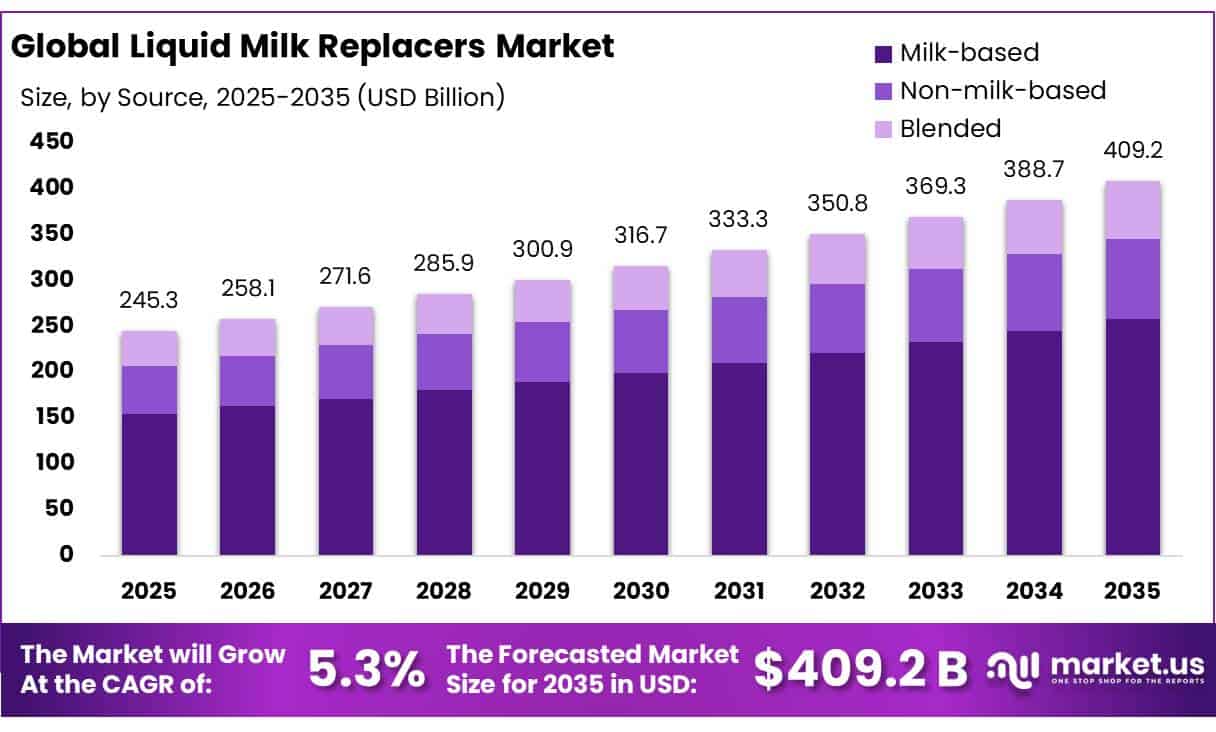
The Global Liquid Milk Replacers Market size is expected to be worth around USD 409.2 Billion by 2035, from USD 245.3 Billion in 2025, growing at a CAGR of 5.3% during the forecast period from 2026 to 2035. In 2025, North America held a dominant market position, capturing more than a 35.00% share, holding USD 0.70 Billion revenue.
Liquid milk replacers are specialized nutritional feeds used to replace or supplement whole milk for young calves, lambs, kids, piglets, and other neonatal livestock. Formulations generally combine dairy proteins, whey, lactose, fats, vitamins, minerals, and functional ingredients to provide consistent early-life nutrition.
- USDA reported 86.2 million cattle and calves on U.S. farms as of January 2026, including 9.57 million milk cows, while the U.S. calf crop for 2025 was estimated at 32.9 million head. These numbers indicate a substantial base of young animals requiring controlled nutrition and create recurring opportunities for liquid feeding programs on professionally managed farms.
Key Takeaways
- Liquid Milk Replacers Market size is expected to be worth around USD 409.2 Billion by 2035, from USD 245.3 Billion in 2025, growing at a CAGR of 5.3%.
- Medicated liquid milk replacers held a dominant market position, capturing more than a 55.00% share.
- Milk-based held a dominant market position, capturing more than a 63.00% share.
- Calves held a dominant market position, capturing more than a 66.00% share.
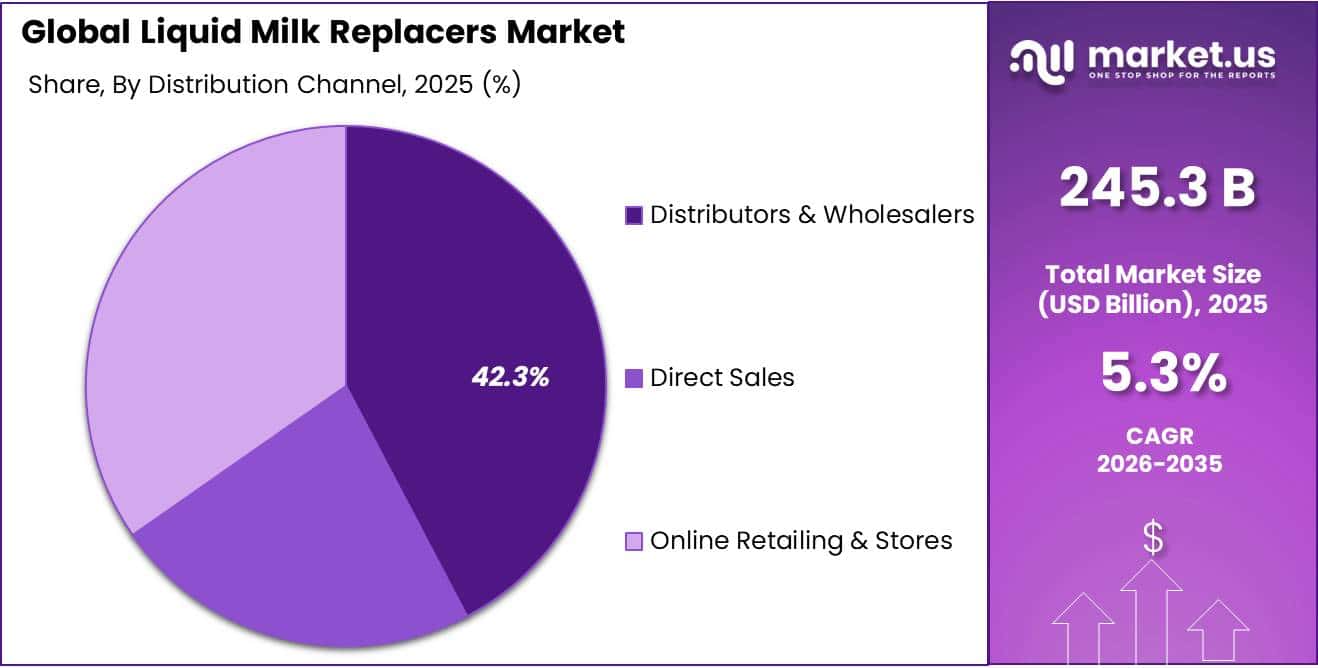
- Direct Sales held a dominant market position, capturing more than a 43.00% share.
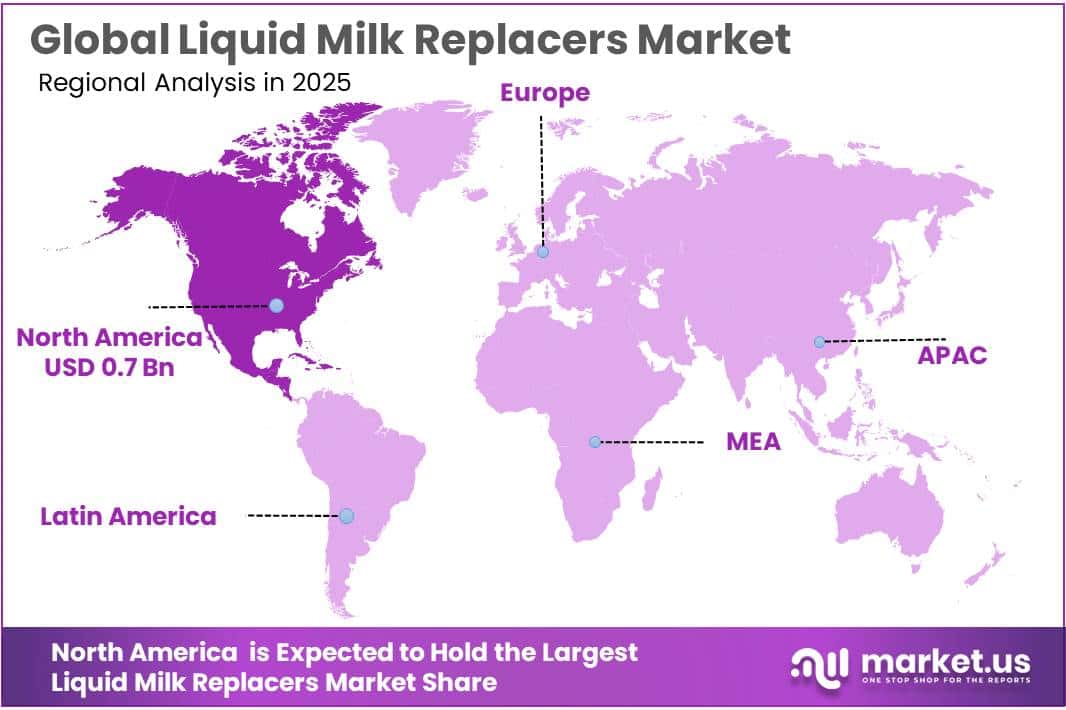
- North America held a dominant market position, capturing more than a 35.00% share and generating about USD 0.70 billion.
The established feed-manufacturing industry also supports wider product availability. FEFAC estimated EU27 industrial compound-feed production at 147.5 million tonnes in 2025, of which cattle feed represented approximately 41.585 million tonnes. Large-scale feed manufacturing, premix production, ingredient distribution, and farm-service infrastructure provide manufacturers with established channels for introducing specialized milk replacers and value-added young-animal nutrition products.
- Dairy-derived ingredient availability is another important industry driver. USDA recorded 818.227 million pounds of U.S. dry whey production for human use during 2025. In January 2026, total dry whey production reached 77.4 million pounds, lactose for human and animal applications reached 94.9 million pounds, and whey protein concentrate production stood at 40.2 million pounds. Whey proteins and lactose are important formulation materials for delivering digestible protein and energy in milk replacers.
Animal-health regulation is also influencing product development. The U.S. FDA requires medicated milk replacers to follow approved conditions under 21 CFR Part 558, reinforcing the importance of controlled formulation and correct product use. U.S. FDA – Medicated Milk Replacers In Europe, antimicrobial medicines for food-producing animals represented about 98% of total veterinary antimicrobial sales in 2024, while sales increased 5% from 2023. European Medicines Agency – Antimicrobial Sales and Use The European Commission is simultaneously targeting a 50% reduction in antimicrobial sales for farmed animals and aquaculture by 2030.
By Type Analysis
Medicated liquid milk replacers dominate with more than 55.00% share, supported by structured calf-health management
In 2025, Medicated liquid milk replacers held a dominant market position, capturing more than a 55.00% share. Their strong position is supported by their use in organized dairy and cattle operations where young-animal nutrition and disease management are handled together under veterinary supervision.
- USDA reported that the U.S. cattle and calf population reached 94.2 million head in July 2026, while the milk-cow population stood at 9.65 million head. The agency also estimated the 2026 U.S. calf crop at 32.5 million head, showing the large population of young animals that can require controlled early-life feeding. The U.S. FDA recognizes medicated milk replacers as feeds containing approved animal drugs and requires them to be prepared and used according to approved labeling.
Non-medicated liquid milk replacers continue to hold an important position in routine calf and young-livestock feeding, particularly where producers need consistent nutrition without incorporating animal drugs into the daily ration.
USDA reported 13.35 million calves under 500 pounds in the United States at the beginning of 2026, while 3.90 million heifers were being maintained for milk-cow replacement. The 2025 U.S. calf crop was also estimated at 32.90 million head.
By Source Analysis
Milk-based liquid milk replacers dominate with more than 63.00% share due to their strong nutritional compatibility with young livestock
In 2025, Milk-based held a dominant market position, capturing more than a 63.00% share. Milk-based formulations remain widely preferred because ingredients such as whey proteins, lactose, skim milk solids, and other dairy components closely match the nutritional requirements of young calves.
- Government dairy statistics provide strong support for the availability of milk-derived raw materials. USDA reported that U.S. milk production reached 232 billion pounds in 2025, while average milk output per cow reached 24,390 pounds. The annual average number of milk cows on U.S. farms stood at 9.50 million head.
Non-milk-based liquid milk replacers serve producers looking for alternatives to conventional dairy-heavy formulations. These products can incorporate plant proteins, processed protein concentrates, vegetable fats, and other nutritional ingredients designed to reduce dependence on milk-derived inputs.
By Livestock Analysis
Calves dominate the Liquid Milk Replacers Market with more than 66.00% share, supported by large-scale dairy and calf-rearing operations
In 2025, Calves held a dominant market position, capturing more than a 66.00% share. Calves remain the largest livestock group for liquid milk replacers because dairy and beef farms require reliable nutrition during the early growth period when young animals depend heavily on milk-based feeding.
- According to the U.S. Department of Agriculture, the United States had 94.2 million cattle and calves as of July 2026, while its annual calf crop was estimated at 32.5 million head. The country’s milk-cow population also reached 9.65 million head, supporting a substantial recurring requirement for calf nutrition and replacement-heifer feeding.
Piglets represent another important livestock segment for liquid milk replacers, particularly on large commercial swine farms where supplemental feeding can support young animals when sow milk availability is limited or litter sizes are high.
USDA reported 73.7 million hogs and pigs on U.S. farms as of June 2026. Between March and May 2026, approximately 33.5 million pigs were weaned, while producers achieved an average of 11.87 pigs per litter.
By Distribution Channel Analysis
Direct Sales leads with more than 43.00% share as suppliers build closer links with commercial livestock farms
In 2025, Direct Sales held a dominant market position, capturing more than a 43.00% share. Direct selling remains important in the liquid milk replacers business because dairy and livestock farms often require regular deliveries, consistent formulations, technical feeding advice, and products suited to specific calf-rearing programs.
- Large commercial farms can also purchase higher volumes directly from manufacturers, helping suppliers maintain closer control over pricing, product handling, and customer support. In 2025, USDA reported that U.S. milk production reached 232 billion pounds, the average dairy herd included 9.50 million milk cows, and approximately 990 million pounds of milk were used on the farms where it was produced.
Distributors & Wholesalers continue to play an important role in the Liquid Milk Replacers Market by connecting manufacturers with smaller dairy farms, livestock dealers, feed stores, veterinary channels, and regional agricultural suppliers.
The potential customer base remains substantial, with USDA recording 94.2 million cattle and calves in the United States in July 2026, including 9.65 million milk cows, while the 2026 calf crop was estimated at 32.5 million head.
Key Market Segments
By Type
- Medicated liquid milk replacers
- Non-medicated liquid milk replacers
By Source
- Milk-based
- Non-milk-based
- Blended
By Livestock
- Calves
- Piglets
- Lambs
- Pets
- Other livestock
By Distribution Channel
- Distributors & Wholesalers
- Direct Sales
- Online Retailing & Stores
Driver Analysis
Rising Whole-Milk Price Spreads Favoring Replacer Economics
Fluid whole-milk prices paid to producers have climbed 8-12% across major North American and EU dairy regions through 2024-2025, while milk-replacer formulations built on whey protein concentrate and dried skim milk co-products have seen input costs rise only 3-5% over the same period, widening the cost-per-liter spread in favor of replacers from an estimated USD 0.15-0.20 differential to USD 0.30-0.40 per liter equivalent; this spread compression directly reshapes calf-rearing unit economics, pushing commercial dairy operations to substitute whole milk with replacer formulations for 40-60% of pre-weaning feeding programs versus 25-35% five years ago, and shifting replacer manufacturers’ commercial models from spot-market commodity sales toward multi-year supply contracts indexed to dairy commodity futures to lock in margin visibility for both producer and buyer.
Drivers Impact Analysis
| Driver | (~) % Impact on CAGR Forecast | Geographic Relevance | Impact Timeline |
|---|---|---|---|
| Rising whole-milk price spreads favoring replacer economics | +2.0% | North America core, EU dairy belt, APAC (China, India) | Short term (≤2 years) |
| Calf-health and antibiotic-reduction protocols boosting fortified replacers | +1.6% | EU, North America | Medium term (2-4 years) |
| Precision feeding and automated calf-feeder integration | +1.4% | North America, EU, APAC premium dairy operations | Medium term (2-4 years) |
| Dairy herd expansion in APAC and Latin America | +1.8% | APAC (China, India, Vietnam), Latin America (Brazil, Mexico) | Medium term (2-4 years) |
| Whey/dairy-protein co-product valorization economics | +1.1% | EU core, North America | Short term (≤2 years) |
| Colostrum-replacer and immunoglobulin-fortified product adoption | +0.9% | North America, EU, APAC emerging | Long term (≥4 years) |
Restraint Analysis
Whey Protein Cost Volatility
Liquid milk replacer economics remain exposed to a narrow pool of dairy-derived inputs—especially sweet whey, whey protein concentrate and skim-derived fractions—whose prices can move faster than farm-gate milk or contracted calf-rearing budgets; U.S. whey values were supported around 70–75 cents/lb in early 2026 as demand for high-protein powders tightened sweet-whey availability, while historical WPC pricing has shown repeated large swings rather than stable long-run pricing.
For a 20%-protein, 20%-fat liquid-equivalent formulation, protein and fat ingredients can represent roughly 55–70% of factory cost, so a 15% rise in whey-protein input cost can raise finished-product cost by approximately 7–10% before freight, packaging and distributor margin; when dairy farms purchase on 3–12-month contracts, manufacturers either absorb a 250–450-basis-point gross-margin loss, surcharge customers and risk substitution to waste milk/whole milk, or reformulate with lower-cost proteins that can impair solubility and early-life performance.
The commercial restraint is therefore not a shortage of demand for calf nutrition, but impaired price pass-through and working-capital intensity: resilient suppliers need indexed purchasing contracts, dual-origin protein sourcing, safety inventories of 45–75 days rather than 20–30 days, and formulation systems able to preserve amino-acid density within about ±3% despite input substitution.
Restraint Impact Analysis
| Restraint | (~) % Impact on CAGR Forecast | Geographic Relevance | Impact Timeline |
|---|---|---|---|
| Whey protein cost volatility | -1.7% | Global; EU, North America, import-dependent APAC | Short term (≤2 years) |
| Whole-milk feeding economics | -1.3% | India, South Asia, Africa, Latin America | Medium term (2-4 years) |
| Antibiotic/residue compliance burden | -1.0% | EU, North America, export-oriented APAC | Medium term (2-4 years) |
| Liquid cold-chain constraints | -1.2% | APAC, Africa, Latin America | Long term (≥4 years) |
| Small-farm affordability limits | -1.1% | India, Africa, Southeast Asia | Long term (≥4 years) |
| Plant-protein performance gap | -0.8% | Global; price-sensitive emerging markets | Medium term (2-4 years) |
Opportunity Analysis
Calf-Health Outcome Subscriptions
Most liquid milk replacer suppliers still sell litres, concentrates or powder-equivalent nutrition as transactional inputs, leaving an unpenetrated recurring-revenue opportunity in outcome-linked calf-health contracts that bundle liquid replacer, mixing protocols, digital intake monitoring, veterinary escalation and mortality/morbidity reporting for a fixed per-calf fee; this is an opportunity rather than a current driver because most farms purchase feed separately from health services and suppliers rarely accept shared performance risk.
A 56–70-day programme at 5–7 litres per calf-day represents about 280–490 litres of feeding volume, so a USD 0.08–0.15 per litre service premium can create USD 22–74 of recurring revenue per enrolled calf while remaining commercially viable if it lowers scours treatment incidence by 10–20%, reduces mortality by 0.5–1.5 percentage points, or improves average daily gain by 0.05–0.10 kg.
Recent evidence that a 46 g whey-based colostrum-replacer supplement delivering 20 g IgG for 14 days reduced diarrhoea-related antibiotic treatment and mortality in commercial calf-rearing settings strengthens the case for selling measurable health outcomes rather than ingredient specifications.
The model also lowers customer-acquisition cost through 12–24-month herd contracts, raises supplier switching costs through farm-level data histories, and can lift a manufacturer’s blended gross margin by an estimated 4–7 percentage points once advisory and analytics costs are spread across more than 5,000–10,000 enrolled calves.
Opportunity Impact Analysis
| Opportunity | (~) % Potential CAGR Upside | Geographic Relevance | Execution Window |
|---|---|---|---|
| Calf-health outcome subscriptions | +2.1% | North America, EU, China, Australia | Medium term (2-4 years) |
| Dairy-beef calf nutrition | +1.8% | North America, EU, Brazil, Australia | Short term (≤2 years) |
| Colostrum-enriched liquid platforms | +1.6% | North America, EU, premium APAC | Medium term (2-4 years) |
| Emerging-market micro-hub distribution | +1.5% | India, Southeast Asia, Africa, Latin America | Long term (≥4 years) |
| Precision-feeder formulation ecosystems | +1.3% | North America, EU, China, Japan | Medium term (2-4 years) |
| Regional blender roll-ups | +1.0% | India, Brazil, China, Eastern Europe | Short term (≤2 years) |
Challenges Analysis
Formula Consistency at Scale
Liquid milk replacer suppliers must maintain reproducible protein, fat, mineral, viscosity and microbiological specifications while moving from small blending batches to multi-plant or cross-border supply networks, yet even minor variation can materially affect calf intake and performance: current calf-welfare guidance supports high-quality replacers with protein above 28% and fat in the 17–25% range, making a 2–3 percentage-point deviation in protein or a poorly dispersed fat system commercially significant rather than cosmetic.
The challenge does not halt sales, but creates chronic quality-cost friction: an 8–15 tonne batch requiring rework, downgrading or disposal can erase contribution margin from several customer deliveries, while more frequent incoming-lot testing, homogenization validation, microbial screening and retained-sample programmes add an estimated 1.5–3.0% to cost of goods sold.
Ingredient substitution compounds the problem because whey fractions, skim-derived proteins, vegetable oils, emulsifiers and functional additives differ in solubility, density and heat stability; scaling therefore demands enterprise-wide digital batch records, near-infrared or wet-chemistry verification, supplier qualification for at least two approved sources per critical ingredient, and target batch-release deviation below ±2% for protein and fat, otherwise distributors and farms experience inconsistent mixing behaviour, treatment events and reduced reorder confidence.
Challenges Impact Analysis
| Challenge | (~) % CAGR Friction Drag | Geographic Relevance | Mitigation Horizon |
|---|---|---|---|
| Formula consistency at scale | -1.4% | Global; North America, EU, APAC | Medium term (2-4 years) |
| Cold-chain last-mile reliability | -1.2% | APAC, Africa, Latin America | Long term (≥4 years) |
| On-farm mixing variability | -1.1% | Global; small and mid-sized dairies | Medium term (2-4 years) |
| Veterinary advisory capacity gap | -0.9% | India, Africa, Latin America, APAC | Long term (≥4 years) |
| Calf-health data fragmentation | -0.8% | North America, EU, China, Australia | Medium term (2-4 years) |
| Dairy-input sourcing complexity | -1.0% | EU, North America, import-dependent APAC | Medium term (2-4 years) |
Geopolitical Impact Analysis
Russia–Ukraine War Continues to Reshape Liquid Milk Replacer Supply Chains
The ongoing Russia–Ukraine war continues to influence the Liquid Milk Replacers Market through higher uncertainty in feed ingredients, energy, transport, and dairy-input supply chains. FAO reported in March 2026 that Ukraine’s 2025 cereal production was about 5% below average and that 2025/26 export volumes were expected to remain below pre-conflict levels. This matters because disruptions in Black Sea grain flows can affect global feed availability and livestock production costs.
The pressure is also visible across European agriculture. Eurostat reported that EU agricultural input prices increased by less than 1% in 2025, while fertilizer and soil-improver prices rose 5% and veterinary expenses increased 3%. In the fourth quarter of 2025, EU feedingstuff prices fell 2.7%, showing some easing, but geopolitical risk remains. For liquid milk replacer producers, the main impact is uneven raw-material pricing, higher logistics risk, and cautious purchasing by livestock farms.
Regional Insights
North America Leads with 35.00% Share, While Asia Pacific Shows Strong Growth Potential
In 2025, North America held a dominant market position, capturing more than a 35.00% share and generating about USD 0.70 billion. The region benefits from a highly organized dairy and cattle industry, established feed distribution, and widespread use of formulated calf nutrition. USDA reported 94.2 million cattle and calves in the United States as of July 2026, including 9.65 million milk cows, while the 2026 calf crop was estimated at 32.5 million head.
Canada further strengthens the regional base, with Statistics Canada reporting 11.1 million cattle and calves at the start of 2026, including 3.6 million calves. These large young-animal populations support regular demand for convenient, nutritionally consistent liquid milk replacers.
Asia Pacific is expected to remain the fastest-growing regional segment as commercial dairy farming, livestock productivity, and specialized animal nutrition expand. China provides a major demand base: the National Bureau of Statistics reported milk production of 40.91 million tonnes in 2025, while the country had 96.08 million cattle at year-end.
Key Regions and Countries Insights
- North America
- US
- Canada
- Europe
- Germany
- France
- The UK
- Spain
- Italy
- Rest of Europe
- Asia Pacific
- China
- Japan
- South Korea
- India
- Australia
- Rest of APAC
- Latin America
- Brazil
- Mexico
- Rest of Latin America
- Middle East & Africa
- GCC
- South Africa
- Rest of MEA
Key Players Analysis
Prysmian S.p.A. is not an established participant in the Liquid Milk Replacers Market; its disclosed operations are centered on cable systems and electrification. In 2025, the company generated €19.65 billion in revenue, recorded €2.40 billion in adjusted EBITDA, and reported €1.27 billion in net profit. Its backlog reached €17 billion, supported by transmission, power-grid, electrification, and digital-solutions activities.
Nexans S.A. does not operate as a recognized liquid milk replacer producer; its business is focused on electrification and cable solutions. In 2025, Nexans reported €6.1 billion in standard sales and €7.8 billion in current sales. Adjusted EBITDA reached €728 million, while net income totaled €358 million. Organic growth stood at 8.3%, and free cash flow reached €344 million.
Nexans S.A. does not operate as a recognized liquid milk replacer producer; its business is focused on electrification and cable solutions. In 2025, Nexans reported €6.1 billion in standard sales and €7.8 billion in current sales. Adjusted EBITDA reached €728 million, while net income totaled €358 million. Organic growth stood at 8.3%, and free cash flow reached €344 million.
Top Key Players Outlook
- Prysmian S.p.A.
- Nexans S.A.
- NKT A/S
- Sumitomo Electric Industries, Ltd.
- LS Cable & System Ltd.
- Southwire Company, LLC
- TE Connectivity Ltd.
- Hitachi Energy Ltd.
- TBEA Co., Ltd.
- Hengtong Group Co., Ltd.
- ZTT Group
- Taihan Cable & Solution Co., Ltd.
- Elsewedy Electric Co. S.A.E.
- Furukawa Electric Co., Ltd.
- Brugg Kabel AG
Recent Developments
- In May 2026, Sumitomo Electric announced a three-year expansion plan covering FY2026–FY2028, including cumulative investment of ¥1 trillion, with targets of ¥6 trillion in sales and ¥600 billion in operating profit.
- By March 2026, LS Cable reported record 2025 consolidated revenue of KRW 7.5882 trillion, operating profit of KRW 279.8 billion, and an order backlog of KRW 7.63 trillion, which had increased by about 22%.
Report Scope
| Report Features | Description |
|---|---|
| Market Value (2025) | USD 245.3 Bn |
| Forecast Revenue (2035) | USD 409.2 Bn |
| CAGR (2026-2035) | 5.3% |
| Base Year for Estimation | 2025 |
| Historic Period | 2020-2024 |
| Forecast Period | 2026-2035 |
| Report Coverage | Revenue Forecast, Market Dynamics, Competitive Landscape, Recent Developments |
| Segments Covered | By Type (Medicated liquid milk replacers, Non-medicated liquid milk replacers), By Source (Milk-based, Non-milk-based, Blended), By Livestock (Calves, Piglets, Lambs, Pets, Other livestock), By Distribution Channel (Distributors & Wholesalers, Direct Sales, Online Retailing & Stores) |
| Regional Analysis | North America – US, Canada; Europe – Germany, France, The UK, Spain, Italy, Rest of Europe; Asia Pacific – China, Japan, South Korea, India, Australia, Singapore, Rest of APAC; Latin America – Brazil, Mexico, Rest of Latin America; Middle East & Africa – GCC, South Africa, Rest of MEA |
| Competitive Landscape | Prysmian S.p.A., Nexans S.A., NKT A/S, Sumitomo Electric Industries, Ltd., LS Cable & System Ltd., Southwire Company, LLC, TE Connectivity Ltd., Hitachi Energy Ltd., TBEA Co., Ltd., Hengtong Group Co., Ltd., ZTT Group, Taihan Cable & Solution Co., Ltd., Elsewedy Electric Co. S.A.E., Furukawa Electric Co., Ltd., Brugg Kabel AG |
| Customization Scope | Customization for segments, region/country-level will be provided. Moreover, additional customization can be done based on the requirements. |
| Purchase Options | We have three licenses to opt for: Single User License, Multi-User License (Up to 5 Users), Corporate Use License (Unlimited User and Printable PDF) |





































