


Report Overview
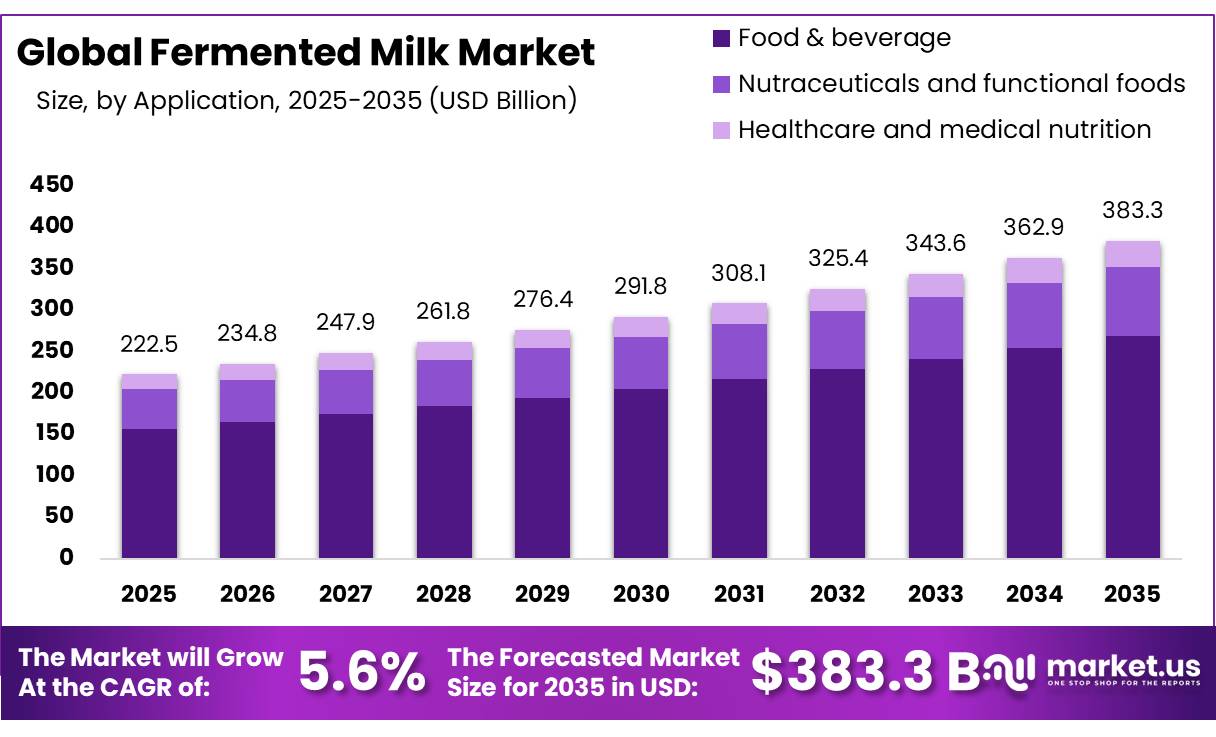
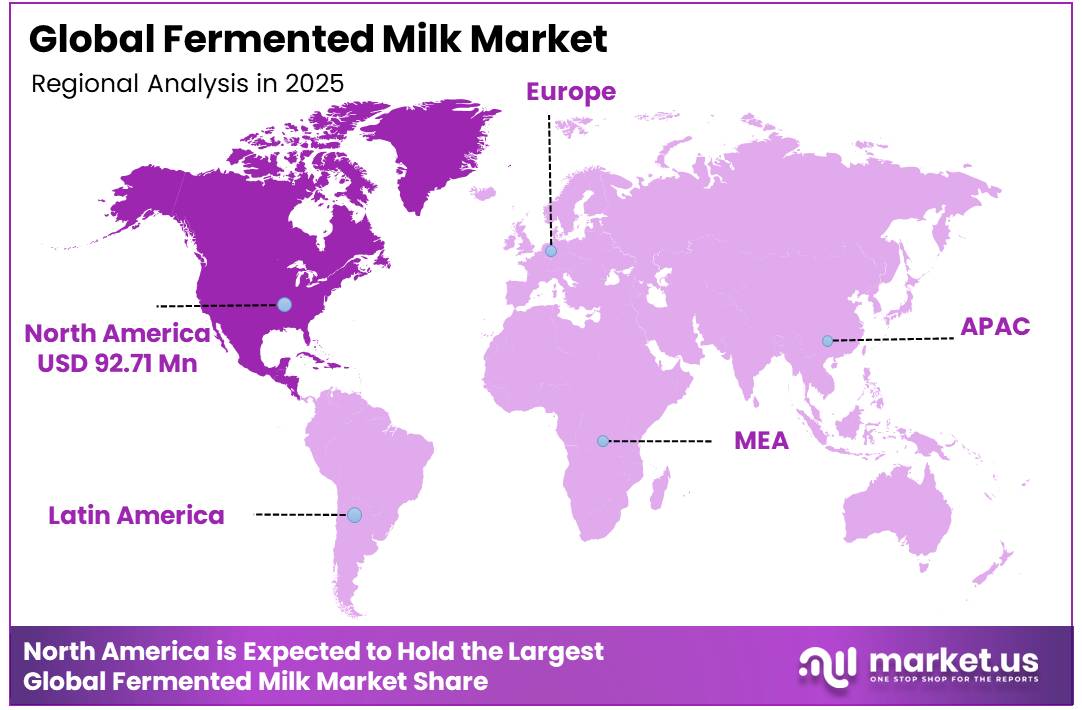
In 2025, the Global Fermented Milk Market was valued at US$222.5 billion, and between 2026 and 2035, this market is estimated to register a CAGR of 5.6%, reaching about US$383.3 billion by 2035. North America held a dominant market position, capturing more than 30.1% share and generating USD 92.71 billion in revenue.
Fermented milk is one of the oldest and most universally consumed food categories in the world and yet it has never felt more relevant than it does today.
- According to the Food and Agriculture Organization (FAO), 2024, more than 6 billion people worldwide consume milk and milk products, demonstrating the broad consumer base available to fermented dairy categories such as yogurt, cheese, kefir, and cultured milk.
Key Takeaways
- The global fermented milk market was valued at USD 222.5 billion in 2025.
- The market is projected to grow at a CAGR of 5.6% and is estimated to reach USD 383.3 billion by 2032.
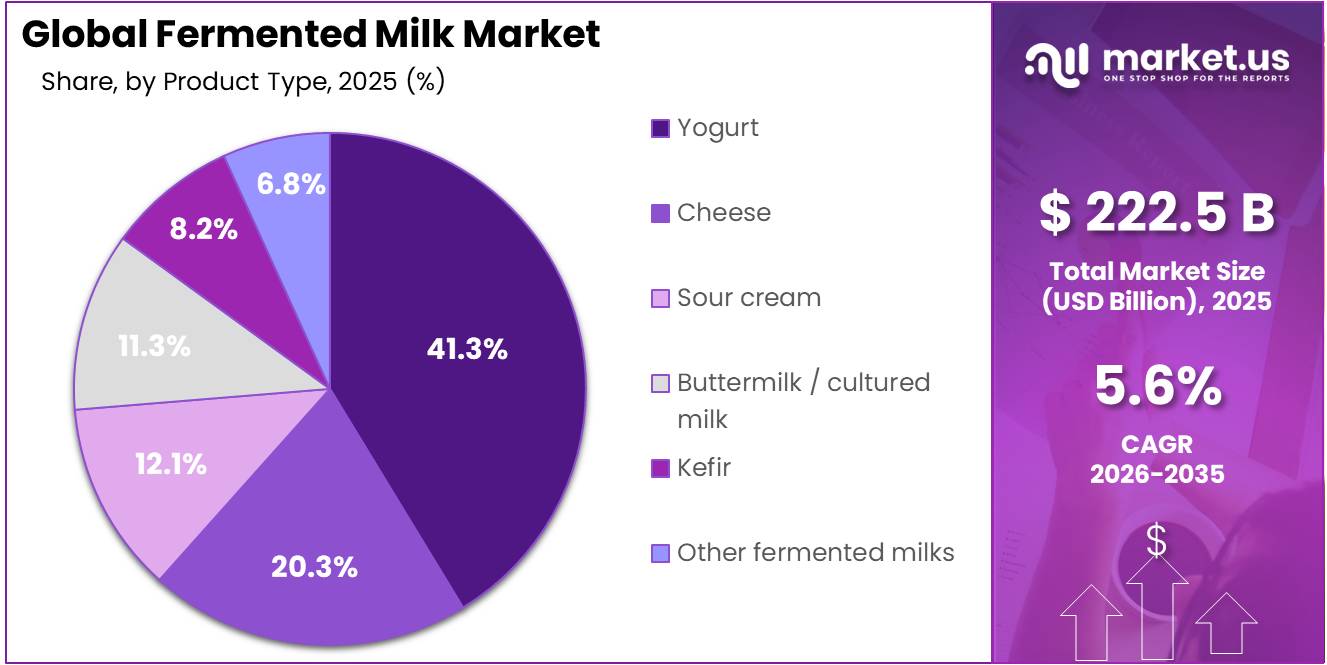
- On the basis of product type, yogurt dominated the market, constituting 41.3% of the total market share.
- Based on the application, food and beverage dominated the fermented milk market, with a substantial market share of around 70.2%.
- Based on the Material type, cups and tubs led the market, comprising 40.3% of the total market.
- In 2025, North America was the most dominant region in the fermented milk market, accounting for 30.1% of the total global consumption.
At its simplest, fermented milk is dairy that has been intentionally transformed through the action of beneficial bacteria, yeasts, or moulds converting lactose into lactic acid and in the process creating products like yogurt, cheese, kefir, sour cream, and buttermilk that are richer in nutrition, easier to digest, and far longer-lasting than fresh milk.
- In November 2025, Eurostat reported that European Union dairies received 150.8 million tonnes of milk during 2024, including milk used to manufacture fresh and fermented dairy products. Germany alone accounted for 27.1% of European Union acidified milk product output, followed by the Netherlands with 16.8% and Poland with 10.4%.
The reason this market keeps growing consistently and across every major geography comes down to one thing that consumers genuinely care about more than ever before is gut health. A growing and increasingly mainstream body of research has established clear connections between the consumption of probiotic-rich fermented dairy products and real improvements in digestive health, immunity, mental wellbeing, and metabolic function.
Consumers are not just buying yogurt or kefir because they taste good they are buying them because they understand, at least intuitively, that these products do something meaningful for their bodies. This health awareness is pulling fermented milk products out of their traditional role as simple dairy staples and repositioning them as functional foods that belong in a healthy and considered lifestyle.
- In January 2026, the European Food Safety Authority reported receiving 340 microorganism notifications between October 2022 and September 2025, including 190 microorganisms intended for food or food-production applications, reflecting continued development of microbial ingredients used across fermented and functional foods.
- In November 2025, Eurostat reported that European Union milk production reached 161.8 million tonnes in 2024, increasing by 0.9 million tonnes from 2023. European Union processors also produced 10.8 million tonnes of cheese during 2024.
Product Type Analysis
Yogurt Represents the Dominant Segment in the Market.
Yogurt leads the fermented milk market with 41.3% share and the integration of yogurt into daily eating habits across global populations has supported its market dominance. It is consumed at breakfast, as a snack, as a cooking ingredient, and as a health supplement and it works equally well in sweet and savoury formats, making it the most versatile product in the entire fermented dairy category.
The probiotic credentials of yogurt are widely understood and well-trusted by mainstream consumers, and the continuous stream of product innovation Greek-style, skyr, drinkable formats, fortified with vitamins and minerals, plant-based alternatives keeps the category fresh and relevant to new consumer demographics without alienating its existing loyal base. For food manufacturers, yogurt is also one of the most commercially flexible fermented dairy products it can be positioned anywhere from budget private label to super-premium artisanal, making it a viable product across every retail channel and income level simultaneously.
- In April 2026, the United States Department of Agriculture’s National Agricultural Statistics Service reported that U.S. production of plain and flavored yogurt reached 5.29 billion pounds in 2025.
Application Analysis
Food & Beverage Represents the Dominant Application Segment in the Market.
Food and beverage accounts for 70.2% of total fermented milk application demand the dominant share because fermented dairy products are first and foremost everyday food items that billions of people consume as a normal and habitual part of their diet. Yogurt at breakfast, cheese in a sandwich, sour cream on a meal these are not considered or deliberate health purchases for most consumers, they are simply part of how people eat.
Healthcare and medical nutrition applications where fermented milk products are used in clinical settings for patient recovery, gut microbiome restoration, and nutritional supplementation are growing steadily as the medical community’s understanding of the gut-health connection deepens and as healthcare providers increasingly incorporate fermented dairy into evidence-based nutritional protocols.
For instance: In June 2025, Dairy Farmers of America secured a multi-year contract to supply private-label yogurt and cultured dairy products to a major North American retailer network directly reflecting the food and beverage segment’s enormous and consistent commercial scale and the growing strategic importance of fermented dairy in mainstream retail supply relationships.
Material Type Analysis
Cups and Tubs Represent the Dominant Packaging Segment in the Market.
Cups and tubs lead the fermented milk packaging segment with 40.3% share and this dominance reflects the format’s perfect alignment with how most fermented dairy products are consumed and purchased. Yogurt, sour cream, and cultured dairy products are primarily sold in single-serve or family-size cups and tubs across supermarket dairy aisles worldwide and this format has become so deeply associated with these products in the minds of consumers that it effectively defines the category’s visual identity on the retail shelf.
Cups and tubs also offer practical advantages that matter commercially they are easy to portion, resalable, suitable for a wide range of product viscosities, and compatible with the high-speed filling and sealing equipment that dairy manufacturers use for large-scale production.
Key Market Segments
By Product Type
- Yogurt
- Cheese (fermented cheeses)
- Sour cream
- Buttermilk / cultured milk
- Kefir
- Other fermented milks
By Application
- Food & beverage
- Nutraceuticals and functional foods
- Healthcare and medical nutrition
By Material Type
- Cups / tubs
- Bottles
- Cartons / Tetra Packs
- Pouches
- Other packaging
Driver Analysis
Dairy portfolio shift toward yogurt and fresh fermented formats
Official dairy outlooks in Europe indicate processors are actively reallocating milk toward higher-value formats, and yogurt is explicitly one of the categories expected to rise while drinking milk declines. This matters because fermented milk captures milk solids more profitably than low-value liquid milk in a mature dairy basin: it improves plant utilization, allows flavor and functional extensions, and supports retailer margin through branded and private-label segmentation.
At the same time, the European Commission’s latest dairy commodity data show materially lower benchmark prices for some industrial dairy commodities versus 2025, with skim milk powder at 374 EUR/100 kg and 23% below 2025 levels, which can encourage processors to prioritize value-added cultured products over powder-heavy exposure. That operating shift supports about +1.1 percentage points to fermented milk CAGR by increasing shelf allocation, SKU innovation, and milk-routing preference within existing dairy infrastructure.
Drivers Impact Analysis
| Driver | (~) % Impact on CAGR Forecast | Geographic Relevance | Impact Timeline |
|---|---|---|---|
| Probiotic-health positioning premiumizes fermented milk | +1.3% | North America core, EU, Japan, South Korea, urban China | Short term (≤ 2 years) |
| Dairy portfolio shift toward yogurt and fresh fermented formats | +1.1% | EU core, UK spill-over, North America, Oceania processors | Short term (≤ 2 years) |
| Codex and national standard tightening improves category formalization | +0.8% | APAC corridors, MENA, EU-export linked markets, Latin America | Medium term (2-4 years) |
| Milk supply normalization lowers input volatility and supports innovation | +0.9% | U.S., EU, Oceania, export-reliant Asia, Middle East importers | Short term (≤ 2 years) |
| Urban dairy intake growth in Asia expands everyday consumption base | +1.4% | China core, Southeast Asia corridors, India premium urban, Gulf Asia-linked imports | Medium term (2-4 years) |
| Retail inflation moderation rebuilds household dairy purchase frequency | +0.7% | U.S., EU, developed APAC, import-dependent urban markets | Short term (≤ 2 years) |
Restraint Analysis
Packaging compliance cost
Regulation (EU) 2025/40 on packaging and packaging waste entered into force in February 2025 and applies from 12 August 2026, introducing life-cycle sustainability and labelling requirements that directly affect high-volume dairy cups, lids, sleeves, and multipack formats. For fermented milk brands selling into the EU, compliance is not a simple labeling tweak; it forces resin qualification work, declaration-of-conformity documentation, traceability upgrades, and redesign of multilayer or difficult-to-recycle packs, which typically adds 3% to 7% to packaging procurement cost and can stretch packaging conversion lead times by roughly 4 to 9 months in a category built on short code-life inventory cycles.
That pressure restrains category growth because packaging can represent a mid- to high-teens share of ex-factory cost in single-serve products, so even a 100 to 150 basis point EBIT squeeze pushes producers toward price hikes, format downsizing, or slower innovation launches, especially in EU chilled dairy aisles and adjacent export corridors.
Restraint Impact Analysis
| Restraint | (~) % Impact on CAGR Forecast | Geographic Relevance | Impact Timeline |
|---|---|---|---|
| Raw milk price volatility | -1.4% | North America core, EU | Short term (≤ 2 years) |
| Packaging compliance cost | -1.1% | EU, UK-linked export corridors | Medium term (2-4 years) |
| Standard-of-identity rigidity | -0.9% | North America core | Short term (≤ 2 years) |
| Allergen and label complexity | -0.7% | North America, EU premium imports | Medium term (2-4 years) |
| Cold-chain and shelf-life loss | -1.0% | APAC corridors, MENA imports, LatAm urban chains | Short term (≤ 2 years) |
| Farm-level sustainability costs | -0.8% | EU, Oceania export chains | Long term (≥ 4 years) |
Opportunity Analysis
Gut-health medical channel
This is an opportunity rather than a baseline driver because mainstream fermented milk already benefits from general wellness positioning today, whereas the untapped upside lies in formalizing entry into pharmacy, clinician-recommended, and condition-specific nutrition channels with evidence-backed strains, compliance-grade labeling, and higher-value pack architecture that can command 20% to 45% price premiums over standard spoonable yogurt and raise gross margins by roughly 300 to 600 basis points if conversion from mass retail to quasi-medical channels succeeds.
The white space is large because fresh dairy products, including fermented milk products, still trade in relatively small amounts globally, which means most value creation must come from domestic premiumization and channel re-segmentation, not export-led scaling; with world milk production at 985 Mt in 2024 and fresh dairy remaining a small traded segment, even redirecting 0.15% to 0.25% of national milk solids into medically positioned fermented formats in high-income markets could create a meaningful multi-billion-dollar addressable pool by 2030 while lowering customer acquisition cost through practitioner endorsement and repeat purchase persistence.
Opportunity Impact Analysis
| Opportunity | (~) % Potential CAGR Upside | Geographic Relevance | Execution Window |
|---|---|---|---|
| Gut-health medical channel | +1.8% | North America core, EU, Japan, South Korea | Short term (≤ 2 years) |
| High-protein fermented milk | +2.1% | North America, EU, Gulf, urban APAC | Short term (≤ 2 years) |
| Lactose-light expansion | +1.5% | APAC emerging, LatAm, Middle East, Africa cities | Medium term (2-4 years) |
| School & public procurement formats | +1.2% | India, ASEAN, Africa, EU public channels | Medium term (2-4 years) |
| Ambient fermented milk | +1.7% | India, Africa, SE Asia, inland LatAm | Medium term (2-4 years) |
| Roll-up of local cultured dairy brands | +2.4% | India, Eastern Europe, LatAm, Africa | Long term (≥ 4 years) |
Challenges Analysis
Fragmented cold chain integration
Cold chain fragmentation creates a persistent structural drag on fermented milk growth because product integrity depends on continuous temperature control across farm collection, primary chilling, processing, and distribution nodes, yet even large producing countries still operate with uneven infrastructure density India, for example, targets a processing capacity of 100 million liters per day by 2028–29 against present chilling capacity of roughly 66 million liters per day, implying a 30–35 percent gap between potential procurement and fully temperature‑controlled handling in peak seasons.
Modeled across APAC, South Asia and parts of Latin America, where organized channels handle closer to 20–30 percent of milk versus 70–80 percent in developed markets, cold chain discontinuities shave an estimated 1.3 percentage points off achievable fermented milk CAGR by forcing conservative shelf‑life profiles, limiting long‑haul distribution beyond 300–500 km, and raising unit logistics costs by 6–10 percent per liter to compensate with redundant icing, smaller batch runs, and buffer inventories.
Strategically, risk‑aware players must increase refrigeration nodes per 100,000 liters collected, push cooperative and private sector capex toward decentralized bulk milk coolers and reefer fleets with 10–15 percent spare capacity, and embed predictive temperature monitoring with 15–30 minute resolution across transit to compress average door‑to‑door time from 18–24 hours to under 12 hours, which over a 3–4 year horizon can halve spoilage variance and recover roughly 0.5–0.7 percentage points of lost growth potential.
Challenges Impact Analysis
| Challenge | (~) % CAGR Friction Drag | Geographic Relevance | Mitigation Horizon |
|---|---|---|---|
| Fragmented cold chain integration | -1.3% | APAC, South Asia, LATAM corridors | Medium term (2-4 years) |
| Quality, hygiene and traceability gaps | -1.1% | South Asia, SSA, LATAM emerging hubs | Medium term (2-4 years) |
| Skilled fermentation talent deficit | -0.9% | Global, strongest in APAC & MENA | Long term (≥ 4 years) |
| Input cost and margin volatility | -1.0% | EU, North America, Oceania export belts | Short term (≤ 2 years) |
| Regulatory standard harmonization lag | -0.8% | EU regulatory hubs, Asia export nodes | Long term (≥ 4 years) |
| Sustainability and methane footprint pressure | -0.7% | Global, high-intensity dairy regions | Long term (≥ 4 years) |
Geopolitical Impact Analysis
Trade Tariffs and Supply Chain Disruptions Are Creating Real Headwinds for the Fermented Milk Market.
The fermented milk market may feel like a domestic and local industry after all, dairy is produced and consumed in virtually every country in the world. But the reality is that the global fermented milk supply chain is deeply interconnected, and geopolitical developments are affecting it in ways that are increasingly difficult to ignore. The 2025 US tariff measures have introduced meaningful trade cost volatility across fermented dairy supply chains affecting the cost of imported dairy ingredients, packaging materials, and speciality probiotic cultures that many manufacturers depend on from overseas suppliers.
Regulatory fragmentation across major trading blocs with the EU, US, UK, and Asian markets each applying different food safety standards, probiotic health claim regulations, and labelling requirements to fermented dairy products is also creating real barriers for dairy companies trying to scale their most innovative functional fermented products internationally, adding cost and complexity to what should be straightforward market expansion decisions.
In 2025, evolving US tariff policies introduced trade cost volatility and supply chain uncertainty across the fermented milk products industry prompting major dairy manufacturers to accelerate domestic sourcing strategies and supplier diversification initiatives to protect their production cost structures and maintain retail price competitiveness across key consumer markets.
Regional Analysis
North America Leads the Global Fermented Milk Market.
In 2025, North America dominated the global fermented milk market with the largest regional share of 30.1% a leadership position built on the region’s deeply embedded health and wellness culture, exceptionally high consumer spending on functional and premium food products, and the most commercially mature and innovation-driven fermented dairy ecosystem in the world.
The United States drives the overwhelming majority of this share home to some of the world’s most recognised and commercially powerful fermented dairy brands and a consumer base that has embraced probiotic-rich dairy products as a core part of an active and health-conscious lifestyle. The premium yogurt segment in particular has seen extraordinary commercial success in North America driven by the Greek yogurt revolution that permanently elevated consumer quality expectations and spending willingness across the entire fermented dairy category.
Strong retail infrastructure, advanced cold chain logistics, and a highly competitive and innovative brand landscape collectively ensure that new product formats, functional innovations, and premium positioning strategies find faster commercial uptake in North America than in virtually any other region globally.
Similarly, Canada contributes meaningfully to North America’s regional dominance through its own strong dairy culture and health-focused consumer base particularly in major urban centres where functional food trends are adopted quickly and premium fermented dairy products command strong retail shelf space.
The region also benefits from the most active and well-funded fermented dairy research and development ecosystem in the world, with leading companies continuously investing in new probiotic strains, fortification strategies, and product formats that keep pushing the category’s commercial boundaries. This combination of consumer health awareness, premium brand investment, and retail sophistication ensures North America remains the benchmark market for fermented dairy innovation and commercial performance globally through the forecast period.
Key Regions and Countries Covered
- North America
- The US
- Canada
- Europe
- Germany
- France
- The UK
- Spain
- Italy
- Russia & CIS
- Rest of Europe
- APAC
- China
- Japan
- South Korea
- India
- ASEAN
- Rest of APAC
- Latin America
- Brazil
- Mexico
- Rest of Latin America
- Middle East & Africa
- GCC
- South Africa
- Rest of MEA
Key Players Analysis
The global fermented milk market is led by a small group of large multinational dairy corporations that collectively hold the dominant share of market revenue through extensive global manufacturing networks, deeply established brand equity, and long-standing relationships with major retail chains, foodservice operators, and distribution partners across every significant consumer market in the world. These companies have the financial scale to invest continuously in new product development, probiotic research, packaging innovation, and marketing advantages that create a compounding competitive moat that smaller and regional players find genuinely difficult to penetrate.
Their ability to simultaneously manage commodity dairy input costs, maintain retail shelf space dominance, and launch new functional and premium product lines across multiple geographies gives them a market presence and commercial resilience that defines the competitive ceiling of the entire category. The largest players are also increasingly using strategic acquisitions and joint ventures to enter fast-growing emerging markets and acquire innovative smaller brands whose health positioning, clean-label credentials, and consumer engagement resonate more authentically with younger demographics than established corporate dairy brands sometimes can.
The Major Players in The Industry
- Danone S.A.
- Nestlé S.A.
- Yakult Honsha Co., Ltd.
- Lactalis Group
- General Mills, Inc.
- Chobani LLC
- FrieslandCampina
- Arla Foods amba
- Fonterra Co‑operative Group Limited
- Müller Group
- Lifeway Foods, Inc. (kefir)
- GCMMF (Amul)
- Meiji Co., Ltd.
- Grupo Lala, S.A.B. de C.V.
- Bright Dairy & Food Co., Ltd.
- Others
Key Development
- In June 2026, Arla Foods amba completed its merger with DMK Group, creating a dairy cooperative with around 11,200 farmers, 28,800 employees, an annual milk pool of 19.4 billion kg and combined pro forma revenue of more than EUR 20 billion.
- In March 2026, Danone S.A agreed to create a dairy joint venture in Argentina, combining Danone Argentina, Mastellone Hermanos, and their shared logistics business. Danone will own a 50% interest in the venture, which will operate through 11 production plants manufacturing yogurt, milk, cheese, cream, butter, and dairy desserts.
Report Scope
| Report Features | Description |
|---|---|
| Market Value (2025) | US$222.5 Bn |
| Forecast Revenue (2035) | US$383.3 Bn |
| CAGR (2026-2035) | 5.6% |
| Base Year for Estimation | 2025 |
| Historic Period | 2020-2024 |
| Forecast Period | 2026-2035 |
| Report Coverage | Revenue Forecast, Market Dynamics, Competitive Landscape, Recent Developments |
| Segments Covered | By Product Type (Yogurt, Cheese (Fermented Cheeses), Sour Cream, Buttermilk/Cultured Milk, Kefir, and Other Fermented Milk Products), By Application (Food & Beverage, Nutraceuticals & Functional Foods, Healthcare & Medical Nutrition), By Packaging Type (Cups/Tubs, Bottles, Cartons/Tetra Packs, Pouches, and Other Packaging) |
| Regional Analysis | North America – The US & Canada; Europe – Germany, France, The UK, Spain, Italy, Russia & CIS, Rest of Europe; APAC– China, Japan, South Korea, India, ASEAN & Rest of APAC; Latin America– Brazil, Mexico & Rest of Latin America; Middle East & Africa– GCC, South Africa, & Rest of MEA |
| Competitive Landscape | Danone S.A. Nestlé S.A. Yakult Honsha Co., Ltd. Lactalis Group General Mills, Inc. Chobani LLC FrieslandCampina Arla Foods amba Fonterra Co‑operative Group Limited Müller Group Lifeway Foods, Inc. (kefir) GCMMF (Amul) Meiji Co., Ltd. Grupo Lala, S.A.B. de C.V. Bright Dairy & Food Co., Ltd. Others |
| Customization Scope | Customization for segments, region/country-level will be provided. Moreover, additional customization can be done based on the requirements. |
| Purchase Options | We have three licenses to opt for: Single User License, Multi-User License (Up to 5 Users), Corporate Use License (Unlimited Users and Printable PDF) |





































