


Report Overview
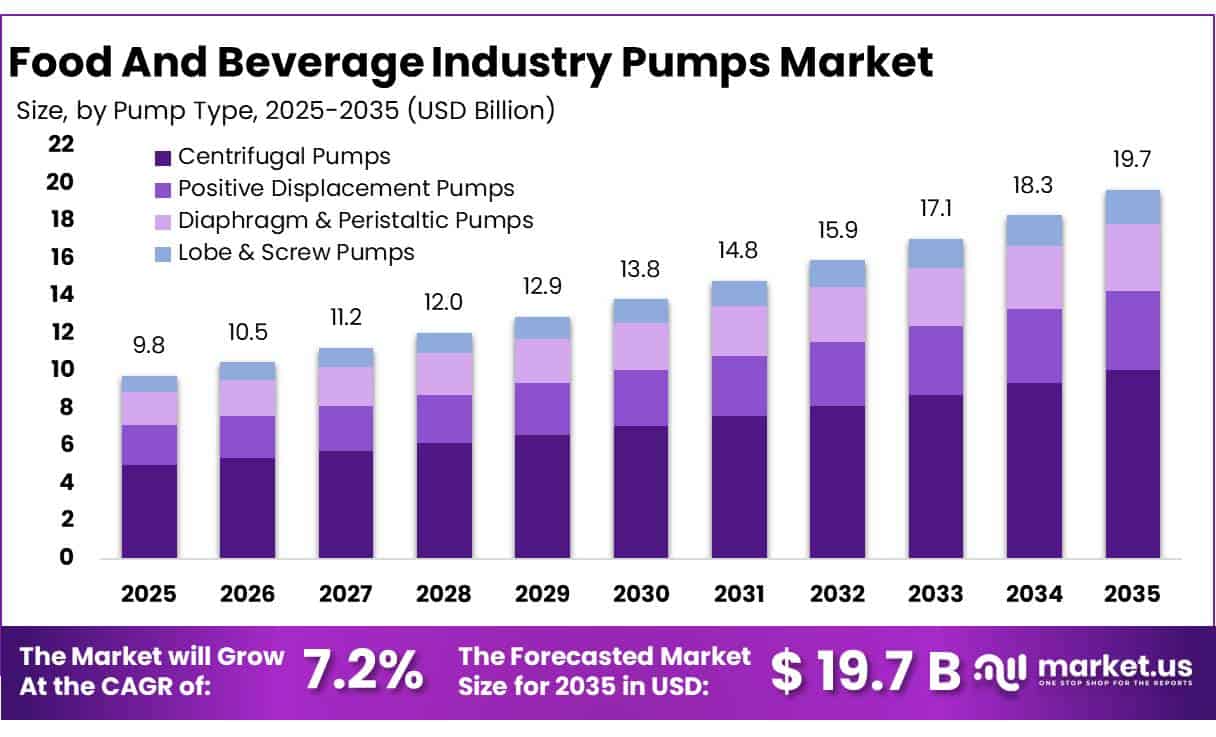
The Global Food And Beverage Industry Pumps Market size is expected to be worth around USD 19.7 Billion by 2035, from USD 9.8 Billion in 2025, growing at a CAGR of 7.2% during the forecast period from 2026 to 2035. In 2025, North America held a dominant market position, capturing more than a 35.5% share, holding USD 3.4 Billion revenue.
The food and beverage industry pump sector is closely linked to the scale, automation, hygiene, and reliability requirements of modern processing plants. Pumps transfer water, milk, beverages, edible oils, syrups, sauces, slurries, cleaning fluids, and wastewater throughout production facilities.
- FoodDrinkEurope reports that the EU food and drink industry generates around €1.2 trillion in turnover, €250 billion in value added, and employs 4.7 million people, demonstrating the large industrial base requiring fluid-handling equipment. In the United States, food-manufacturing sectoral output reached approximately USD 854.9 billion in 2025.
Key Takeaways
- Food And Beverage Industry Pumps Market size is expected to be worth around USD 19.7 Billion by 2035, from USD 9.8 Billion in 2025, growing at a CAGR of 7.2%.
- Centrifugal Pumps held a dominant market position, capturing more than a 51.00% share.
- Dairy Products held a dominant market position, capturing more than a 28.00% share.
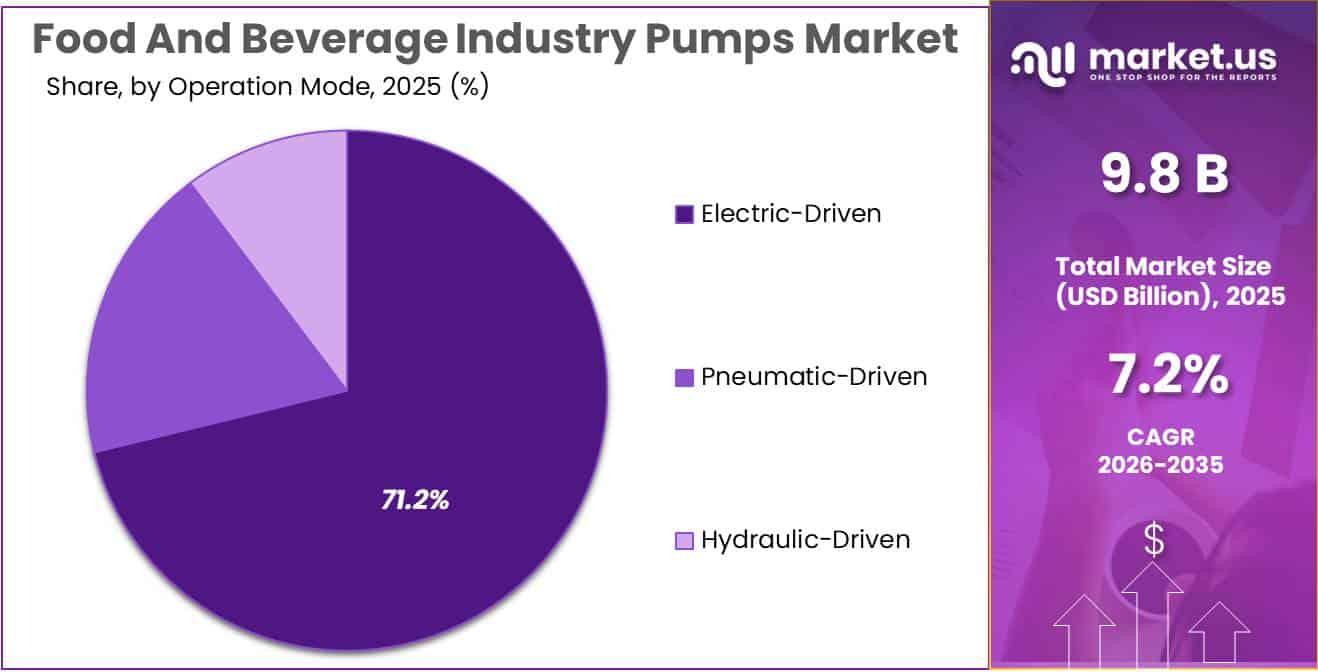
- Electric-Driven held a dominant market position, capturing more than a 71.20% share.
- Sanitary / Aseptic Pumps held a dominant market position, capturing more than a 62.20% share.
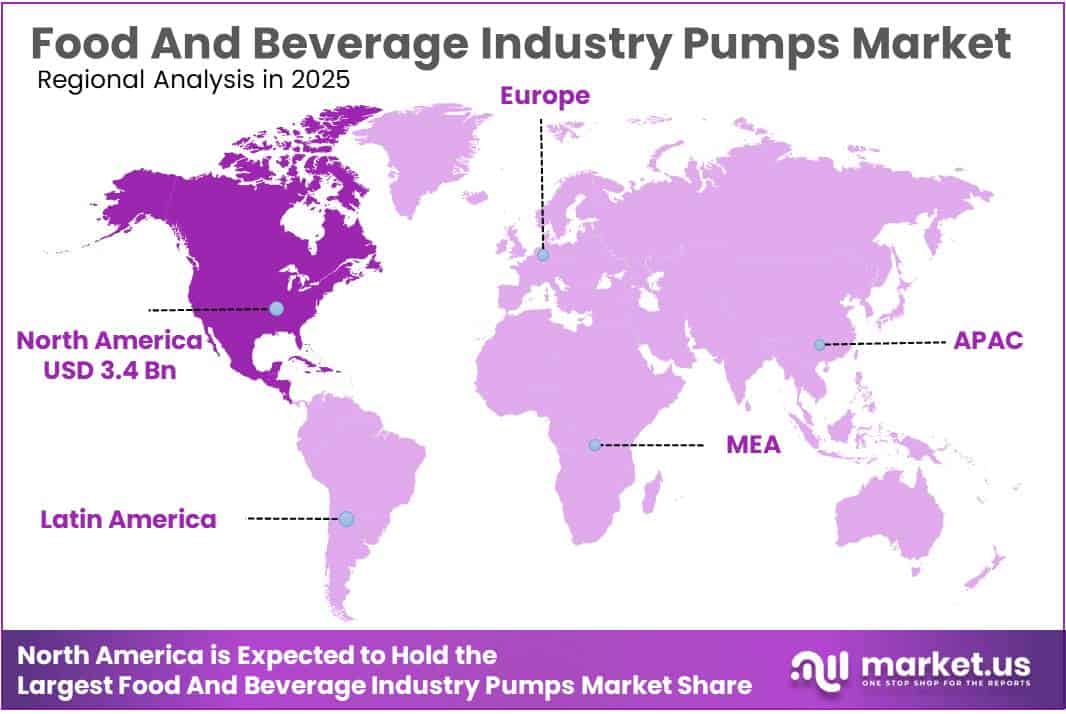
- North America – Dominating Region: In 2025, North America held a dominant position in the Food And Beverage Industry Pumps Market, capturing more than a 35.50% share and reaching approximately USD 3.47 billion.
The operating environment is becoming increasingly continuous, automated, and energy intensive. The U.S. Department of Energy states that the food and beverage subsector includes more than 30,000 facilities and accounts for approximately 6% of total U.S. industrial energy use.
These plants require pumps for ingredient transfer, circulation, cooling, heating, filtration, clean-in-place operations, and wastewater handling. Centrifugal pumps are widely suited to water-like liquids and utility applications, while positive-displacement pumps support viscous, shear-sensitive, and solids-containing products.
- Energy efficiency has also become an important equipment-selection factor. According to the U.S. Department of Energy, pumping systems represent around 27% of electricity used by industrial systems.
European ecodesign regulations estimate a cost-effective energy-efficiency improvement potential of approximately 20%–30% for electric-motor-driven water-pumping systems. This creates opportunities for correctly sized pumps, high-efficiency motors, variable-speed drives, digital monitoring, and predictive maintenance that can reduce electricity consumption while improving production uptime.
Hygiene and chemical-cleaning requirements are further strengthening demand for specialized pumping equipment. An EU implementing regulation covering peracetic-acid disinfection in food and feed industries, including dairies, breweries, and soft-drink facilities, specifies conditions such as 0.15% PAA, a 15-minute contact time, and 1–2 applications per day for certain industrial uses. Such requirements support accurate chemical-dosing, circulation, and clean-in-place pumps capable of handling aggressive cleaning media while maintaining sanitary processing conditions.
Future opportunities will come from higher food output, processing-capacity expansion, water reuse, automation, and plant modernization. The OECD-FAO Agricultural Outlook projects the gross value of global agricultural production to increase by 14% to USD 3.96 trillion by 2034, with livestock production increasing 16%, crop production 14%, and fish and other aquatic-food production 12%.
By Pump Type Analysis
Centrifugal Pumps dominate with a 51.00% share, supported by their strong use in high-volume liquid handling.
In 2025, “Centrifugal Pumps” held a dominant market position, capturing more than a 51.00% share. Their leadership is supported by wide use in transferring milk, water, juices, beverages, cleaning liquids, and other low-to-medium viscosity fluids. These pumps provide continuous flow, simple cleaning, reliable operation, and relatively low maintenance, making them suitable for large food and beverage plants.
USDA National Agricultural Statistics Service reported in April 2026 that U.S. milk production reached 232 billion pounds in 2025, while milk marketed to plants, dealers, and consumers totaled 231 billion pounds. This large volume requires continuous pumping across milk receiving, cooling, processing, cleaning, and filling operations, supporting the strong position of centrifugal pumps.
Positive Displacement Pumps hold an important position in food and beverage processing because they can move viscous and shear-sensitive products at a controlled flow rate. They are commonly suited to applications involving syrups, sauces, dairy concentrates, edible oils, chocolate mixtures, flavor ingredients, and cleaning chemicals. USDA Economic Research Service projected U.S. milk production at 236.6 billion pounds in 2026, indicating a large processing base requiring reliable product-transfer equipment.
By Application Analysis
Dairy Products dominate with a 28.00% share, supported by continuous milk processing and sanitary fluid handling.
In 2025, “Dairy Products” held a dominant market position, capturing more than a 28.00% share. The segment benefits from the continuous movement of raw milk, cream, whey, cultured products, cleaning water, and other dairy fluids across processing plants. Pumps are required during receiving, separation, pasteurization, homogenization, cooling, filling, and clean-in-place operations, making dependable hygienic pumping systems essential.
In August 2026, the USDA projected U.S. milk production at 236.6 billion pounds for 2026, while the average all-milk price was forecast at USD 19.85 per hundredweight. The high volume of milk moving through processing facilities supports steady demand for sanitary centrifugal and positive-displacement pumps designed for reliable flow, gentle product handling, and frequent cleaning.
Non-Alcoholic Beverages represent an important application for food and beverage pumps because soft drinks, juices, bottled water, concentrates, syrups, and functional beverages require repeated pumping during mixing, filtration, carbonation, dosing, cleaning, and filling. Federal Reserve industrial data show that the U.S. soft drink and ice manufacturing production index stood at 94.6529 in 2025.
In 2026, the same industry recorded an index of 94.6692 in Q1 and 93.8325 in Q2, showing that a substantial manufacturing base remained active. This processing activity supports demand for hygienic pumps that can provide stable flow, accurate ingredient transfer, low contamination risk, and reliable performance on high-speed beverage production lines.
By Operation Mode Analysis
Electric-Driven pumps lead with a 71.20% share, supported by reliable operation and easy automation across processing lines.
In 2025, “Electric-Driven” held a dominant market position, capturing more than a 71.20% share. Electric-driven pumps are widely preferred in food and beverage plants because they provide steady flow, precise speed control, easy integration with automated production lines, and lower dependence on compressed-air infrastructure. Their use is especially strong in dairy processing, beverage filling, water circulation, clean-in-place systems, and ingredient transfer.
According to the U.S. Energy Information Administration, industrial users purchased 1.04 trillion kWh of electricity in 2025, accounting for 25.7% of U.S. electricity retail sales. EIA’s 2026 outlook also states that manufacturers represented around 71% of total industrial electricity purchases in 2025, showing the importance of electrically operated machinery across manufacturing facilities.
Pneumatic-Driven pumps remain a useful part of food and beverage processing, particularly for transferring viscous materials, chemicals, concentrates, and fluids in areas where simple air-powered control and safe operation are valued. Their performance is closely connected with the efficiency of a plant’s compressed-air system.
In 2025, the U.S. Department of Energy’s Better Plants program recognized Boardman Foods for upgrading equipment and automated controls in its onion-peeling operation, which reduced compressed-air demand by 70%. This food-industry example shows that pneumatic equipment remains actively used, while processors are increasingly improving air controls to lower energy use and operating costs.
By Hygiene Standard Analysis
Sanitary / Aseptic Pumps dominate with a 62.20% share, driven by strict hygiene and contamination-control needs.
In 2025, “Sanitary / Aseptic Pumps” held a dominant market position, capturing more than a 62.20% share. These pumps are widely used where food, dairy, beverage, and liquid ingredients come into direct contact with processing equipment, as their smooth internal surfaces and hygienic design make frequent cleaning easier and help reduce contamination risk.
In 2026, European Union requirements for food and beverage equipment disinfection specified a 15-minute contact time and 0.15% peracetic acid concentration for treatments effective against bacteria, yeasts, fungi, and viruses.
Industrial / Utility Pumps continue to play an important role in food and beverage facilities because large plants require continuous movement of process water, cooling water, wastewater, cleaning solutions, and other non-product fluids.
The U.S. EPA’s 2026 Water Reuse Action Plan highlights a potato-processing facility where advanced systems treat about 2.3 million gallons of processing water per day, with approximately 1 million gallons per day available for reuse within the site.
U.S. EPA Water Reuse Action Plan 2.0 EPA also notes that equipment cleaning can account for around 50%–70% of total water use in many food, beverage, and pharmaceutical facilities, showing why dependable utility pumping systems remain necessary for sanitation, water circulation, wastewater transfer, and resource-recovery operations. U.S. EPA – Lean & Water Toolkit
Key Market Segments
By Pump Type
- Centrifugal Pumps
- Positive Displacement Pumps
- Diaphragm & Peristaltic Pumps
- Lobe & Screw Pumps
By Application
- Non-Alcoholic Beverages
- Dairy Products
- Alcoholic Beverages
- Fruits & Vegetables
- Bakery & Confectionery
- Meat, Poultry, & Seafood
By Operation Mode
- Electric-Driven
- Pneumatic-Driven
- Hydraulic-Driven
By Hygiene Standard
- Sanitary / Aseptic Pumps
- Industrial / Utility Pumps
Driver Analysis
Tightening Hygienic-Design Mandates Forcing Sanitary-Pump Retrofits
Compliance frameworks such as EHEDG Doc 8, which specifies a minimum 0.8-micron Ra surface finish on product-contact surfaces per ISO 4287:1997, and 3-A Sanitary Standard 02-12 for centrifugal and positive rotary pumps, are increasingly treated as non-negotiable procurement gates rather than optional certifications by large food and beverage processors selling into export markets.
Because EHEDG certification requires a specific equipment design to pass an in-place cleanability test a minimum of three times, and 3-A compliance mandates an on-site inspection by a Certified Conformance Evaluator before a pump can display the 3-A Symbol, manufacturers face materially higher qualification lead times and testing costs per SKU compared to non-certified industrial pump lines, effectively raising the barrier to entry for legacy equipment suppliers.
This regulatory layering forces a structural shift in the addressable installed base: plants operating older, non-EHEDG/3-A pumps must budget for phased retrofit cycles rather than run-to-failure replacement, converting what was historically a reactive capital-expenditure category into a compliance-scheduled, planned-replacement business model.
Drivers Impact Analysis
| Driver | (~) % Impact on CAGR Forecast | Geographic Relevance | Impact Timeline |
|---|---|---|---|
| Tightening hygienic-design mandates (EHEDG, 3-A, FDA 21 CFR) forcing sanitary-pump retrofits | +1.5% | North America core, EU regulatory hubs, APAC export-oriented processors | Medium term (2-4 years) |
| Smart/IoT-enabled pump adoption shifting plants toward predictive-maintenance models | +1.1% | North America, EU, APAC innovation hubs (China, Japan, South Korea) | Medium term (2-4 years) |
| Plant-based dairy and beverage capacity expansion requiring shear-sensitive positive-displacement pumps | +1.3% | North America, EU, APAC emerging urban markets | Long term (≥4 years) |
| Processed-food and packaged-beverage volume growth in APAC driving base installation demand | +1.4% | APAC corridors (China, India, Southeast Asia), South America spill-over | Short term (≤2 years) |
| Energy-efficiency and sustainability regulation pushing VFD-equipped, high-efficiency pump upgrades | +0.9% | EU core, North America, APAC manufacturing clusters | Medium term (2-4 years) |
| Aseptic and CIP/SIP processing expansion for extended-shelf-life products | +0.7% | North America, EU, APAC premium beverage segments | Long term (≥4 years) |
Restraint Analysis
Stainless-Steel Tariff Inflation
The United States raised Section 232 steel and aluminium tariffs from 25% to 50% effective 4 June 2025 for most countries, and the measure covers derivative metal-containing products; analyses cited an approximately 77% widening in U.S.–EU steel price differentials between 7 February and 23 May 2025, while nickel a critical stainless alloy input — remained volatile around USD 15,300 per tonne in June 2025.
A practical 2026 implication is an estimated 8–15% cost uplift on imported hygienic pump assemblies and a 4–9% increase on locally assembled units with imported castings, seals, or valve manifolds; OEMs unable to pass this through immediately face roughly 150–300 basis points of gross-margin compression, while processors defer nonessential replacement projects when bid prices exceed approved CapEx envelopes by 10–20%.
Tariff-driven uncertainty also lengthens procurement cycles as distributors re-quote metal surcharges and customers pursue dual sourcing, reducing order conversion and producing an estimated -1.3 percentage-point drag on achievable market CAGR in North America and trade-linked EU/APAC supply lanes through 2026–2027.
Restraint Impact Analysis
| Restraint | (~) % Impact on CAGR Forecast | Geographic Relevance | Impact Timeline |
|---|---|---|---|
| Stainless-steel tariff inflation | -1.3% | North America core, EU import lanes, APAC exporters | Short term (≤ 2 years) |
| EU machinery compliance reset | -1.0% | EU core, UK-linked suppliers, global OEM exporters | Medium term (2-4 years) |
| High retrofit CapEx burden | -0.9% | North America, EU, mature APAC plants | Medium term (2-4 years) |
| Food-grade component lead times | -0.8% | Global, acute in APAC/EU supply chains | Short term (≤ 2 years) |
| Water and wastewater cost pressure | -0.6% | Southern EU, Middle East, India, South Africa | Long term (≥ 4 years) |
| Technician scarcity and service cost | -0.5% | North America core, EU rural plants, APAC metros | Medium term (2-4 years) |
Opportunity Analysis
Pump-as-a-Service Contracts
A pump-as-a-service model—priced per operating hour, per processed litre, per assured availability rate, or as a monthly bundled fee would convert volatile project revenue into contracted recurring income while solving the customer’s uptime-risk problem; for a USD 15,000–40,000 hygienic lobe or twin-screw pump package, an annual service bundle equal to 8–12% of installed value can generate USD 1,200–4,800 of recurring revenue before high-margin replacement seals, sensors, and field-service labor are added.
This is an opportunity rather than a present driver because connected pumps and service contracts exist mainly as isolated premium offerings, not as an industry-wide standard monetization architecture; vendors that achieve 20–30% service attachment on new sanitary-pump shipments could increase customer lifetime value by an estimated 35–60%, lift blended gross margin by 300–600 basis points, and reduce customer-acquisition costs through multi-year renewal economics.
Predictive-maintenance systems already rely on condition-monitoring sensors and analytics to schedule interventions around production needs rather than after a failure, creating the technical foundation for availability guarantees. The optimal execution window is 2026–2029 in North America, Europe, Japan, and South Korea, where customers have mature maintenance data, higher labour costs, and sufficient installed digital infrastructure to support recurring contracts.
Opportunity Impact Analysis
| Opportunity | (~) % Potential CAGR Upside | Geographic Relevance | Execution Window |
|---|---|---|---|
| Pump-as-a-Service contracts | +1.4% | North America core, EU, Japan, South Korea | Medium term (2-4 years) |
| Digital-twin CIP optimization | +1.2% | EU, North America, APAC automation hubs | Medium term (2-4 years) |
| Water-reuse pump skids | +1.1% | Southern EU, Middle East, India, South Africa | Short term (≤ 2 years) |
| Aseptic UHT pump packages | +1.0% | APAC emerging markets, EU, North America | Medium term (2-4 years) |
| India localized assembly | +0.9% | India, Southeast Asia, Middle East, Africa | Short term (≤ 2 years) |
| Hygienic aftermarket roll-ups | +0.7% | North America, EU, APAC industrial clusters | Medium term (2-4 years) |
Challenges Analysis
Hygienic Design Standard Fragmentation
Hygienic-pump suppliers must engineer against overlapping but non-identical certification and customer-acceptance regimes: 3-A Sanitary Standard 02-12 covers centrifugal and positive rotary pumps in the U.S.; EHEDG evaluates a specific equipment design and, for wet-cleaned equipment, requires in-place cleanability testing; FDA 21 CFR Parts 175–178 addresses food-contact materials rather than entire pump systems; and EU food-contact requirements additionally apply to metals, plastics, rubbers, documentation, and good manufacturing practice.
The operational friction arises because a pump certified to 3-A fabrication requirements does not automatically satisfy EHEDG test evidence, and an FDA-cleared elastomer does not establish sanitary cleanability of the assembled unit; therefore, a global OEM often maintains multiple seal, surface-finish, drainability, documentation, and inspection configurations for what is mechanically a similar hydraulic platform.
The industry can mitigate the drag through a modular global hygienic core, digitally linked material certificates, common 316L surface-finish specifications, and earlier joint design reviews with processors, EPCs, and certification bodies, but country-specific interpretation and customer audit requirements make full harmonization unlikely before 2028–2030, sustaining an estimated -0.9 percentage-point friction drag across EU, North America, and APAC export-oriented plants.
Challenges Impact Analysis
| Challenge | (~) % CAGR Friction Drag | Geographic Relevance | Mitigation Horizon |
|---|---|---|---|
| Hygienic design standard fragmentation | -0.9% | EU, North America, APAC export hubs | Medium term (2-4 years) |
| Viscosity and cavitation variability | -0.8% | Global, acute in dairy, sauces, confectionery | Medium term (2-4 years) |
| Skilled service talent shortage | -0.7% | North America, EU, APAC manufacturing hubs | Long term (≥ 4 years) |
| Smart-pump OT cyber exposure | -0.6% | North America core, EU, Japan, South Korea | Medium term (2-4 years) |
| Qualified component traceability | -0.5% | Global, acute in EU–APAC supply corridors | Medium term (2-4 years) |
| CIP validation water-energy tradeoff | -0.4% | EU, Middle East, India, South Africa | Long term (≥ 4 years) |
Geopolitical Impact Analysis
Middle East and Russia–Ukraine Wars Raise Pump Industry Costs
The Food and Beverage Industry Pumps market is facing pressure as the Russia–Ukraine war and recent Middle East conflict continue to affect energy, metals, shipping, and food-processing costs. Pump manufacturers depend on stainless steel, motors, seals, castings, electronic controls, and international freight, so geopolitical disruption can raise production costs and lengthen equipment delivery schedules.
- In 2026, the World Bank projected global energy prices to rise 24%, while metals and minerals prices were expected to increase 17%, creating direct cost pressure on pump bodies, motors, and related components. UNCTAD reported that global goods trade reached about USD 13.7 trillion in the first half of 2026, but noted that Strait of Hormuz shipping disruptions increased transport, logistics, energy, and production costs.
For food and beverage processors, these conditions may delay plant expansion and raise maintenance budgets. At the same time, they create stronger demand for energy-efficient pumps, local sourcing, predictive maintenance, and water-saving systems that reduce operating risk and dependence on volatile supply chains.
Regional Insights
North America leads with a 35.50% share, valued at USD 3.47 billion, while Asia Pacific shows strong expansion potential.
North America – Dominating Region: In 2025, North America held a dominant position in the Food And Beverage Industry Pumps Market, capturing more than a 35.50% share and reaching approximately USD 3.47 billion. The region benefits from a large food-processing base, highly automated beverage plants, strict sanitary standards, and regular replacement of pumping equipment.
- In December 2025, U.S. food manufacturing employment stood at about 1.77 million workers, highlighting the scale of food-processing operations that depend on pumps for ingredient transfer, cleaning, cooling, wastewater handling, and production lines. U.S. Bureau of Labor Statistics Canada also recorded CAD 13.3 billion in food manufacturing sales in December 2025, up 2.0% from the previous month. Statistics Canada
Asia Pacific – Fastest-Growing Region: Asia Pacific is expected to remain the fastest-growing regional market as food processors expand production capacity, automation, hygienic handling, and water-management systems. China’s National Bureau of Statistics reported that value added from agricultural and sideline food processing increased 5.6% in 2025.
National Bureau of Statistics of China Retail sales of grain, oil, and food products also increased 9.3% in 2025, supporting greater processing volumes and capacity requirements. These trends create opportunities for sanitary centrifugal pumps, positive-displacement pumps, dosing systems, and energy-efficient pumping solutions across dairy, beverages, packaged foods, and food-processing utilities.
Key Regions and Countries Insights
- North America
- US
- Canada
- Europe
- Germany
- France
- The UK
- Spain
- Italy
- Rest of Europe
- Asia Pacific
- China
- Japan
- South Korea
- India
- Australia
- Rest of APAC
- Latin America
- Brazil
- Mexico
- Rest of Latin America
- Middle East & Africa
- GCC
- South Africa
- Rest of MEA
Key Players Analysis
GEA Group AG holds a strong position in food and beverage pumping through its GEA Hilge hygienic pump range, covering centrifugal and positive-displacement solutions for sensitive processing duties. In 2025, GEA generated revenue of EUR 5.495 billion, received orders worth EUR 5.924 billion, and employed 18,628 full-time staff. Its hygienic pumps support dairy, beverage, liquid-food, and pharmaceutical applications, while the company’s broad process-equipment portfolio strengthens its ability to supply integrated pumping, cleaning, and production systems worldwide. Across major international markets.
Alfa Laval AB is a major supplier of hygienic fluid-handling equipment for dairy, food, beverage, and pharmaceutical plants. Its pump portfolio includes centrifugal, rotary-lobe, twin-screw, and circumferential-piston technologies. In 2025, the company recorded SEK 69.6 billion in sales and employed more than 23,670 people across operations serving customers in 100 countries. Its Food & Water division generated SEK 25.635 billion in net sales, highlighting the scale of its exposure to sanitary processing and fluid-handling applications globally. Across major processing markets.
KSB SE & Co. KGaA serves food and beverage processors with hygienic, in-line, high-pressure, positive-displacement, and self-priming centrifugal pumps. In 2025, the group generated EUR 3.035 billion in sales revenue, while order intake reached EUR 3.203 billion. Its Pumps segment recorded EUR 1.618 billion in sales and EUR 1.760 billion in orders. KSB supports applications including brewing, dairy, sugar, soft drinks, and CIP/SIP processes, with hygienic designs aimed at reliable operation, gentle product handling, and energy-efficient production. Across processing plants.
Top Key Players Outlook
- GEA Group AG
- Alfa Laval AB
- KSB SE & Co. KGaA
- SPX FLOW, Inc.
- Grundfos Holding A/S
- Fristam Pumpen KG
- Atlas Copco Group
- JBT Marel Corporation
- Graco Inc.
- Verder Liquids B.V.
- NETZSCH Pumps & Systems
- PCM Group
- Roto Pumps Ltd.
- Charles Austen Pumps Ltd.
- Bominox S.A.
Recent Developments
- In June 2026, Grundfos made two important expansion moves. On June 24, it broke ground on a roughly 143,000-square-foot Texas production facility designed for annual capacity of around 75,000 units, following 15% U.S. growth in 2025.
- September 2025, Fristam Pumpen KG targeting faster and more hygienic powder incorporation in dairy, beverages, brewing, and liquid foods. The FDS Nano can operate at up to 4,000 rpm, handle viscosity up to 1,000,000 cps, and provide CIP flow of up to 3 m³/h, giving processors one system for product transfer, dosing, and cleaning.
Report Scope
| Report Features | Description |
|---|---|
| Market Value (2025) | USD 9.8 Bn |
| Forecast Revenue (2035) | USD 19.7 Bn |
| CAGR (2026-2035) | 7.2% |
| Base Year for Estimation | 2025 |
| Historic Period | 2020-2024 |
| Forecast Period | 2026-2035 |
| Report Coverage | Revenue Forecast, Market Dynamics, Competitive Landscape, Recent Developments |
| Segments Covered | By Pump Type (Centrifugal Pumps, Positive Displacement Pumps, Diaphragm & Peristaltic Pumps, Lobe & Screw Pumps), By Application (Non-Alcoholic Beverages, Dairy Products, Alcoholic Beverages, Fruits & Vegetables, Bakery & Confectionery, Meat, Poultry, & Seafood), By Operation Mode (Electric-Driven, Pneumatic-Driven, Hydraulic-Driven), By Hygiene Standard ( Sanitary / Aseptic Pumps, Industrial / Utility Pumps) |
| Regional Analysis | North America – US, Canada; Europe – Germany, France, The UK, Spain, Italy, Rest of Europe; Asia Pacific – China, Japan, South Korea, India, Australia, Singapore, Rest of APAC; Latin America – Brazil, Mexico, Rest of Latin America; Middle East & Africa – GCC, South Africa, Rest of MEA |
| Competitive Landscape | GEA Group AG, Alfa Laval AB, KSB SE & Co. KGaA, SPX FLOW, Inc., Grundfos Holding A/S, Fristam Pumpen KG, Atlas Copco Group, JBT Marel Corporation, Graco Inc., Verder Liquids B.V., NETZSCH Pumps & Systems, PCM Group, Roto Pumps Ltd., Charles Austen Pumps Ltd., Bominox S.A. |
| Customization Scope | Customization for segments, region/country-level will be provided. Moreover, additional customization can be done based on the requirements. |
| Purchase Options | We have three licenses to opt for: Single User License, Multi-User License (Up to 5 Users), Corporate Use License (Unlimited User and Printable PDF) |





































