


Report Overview
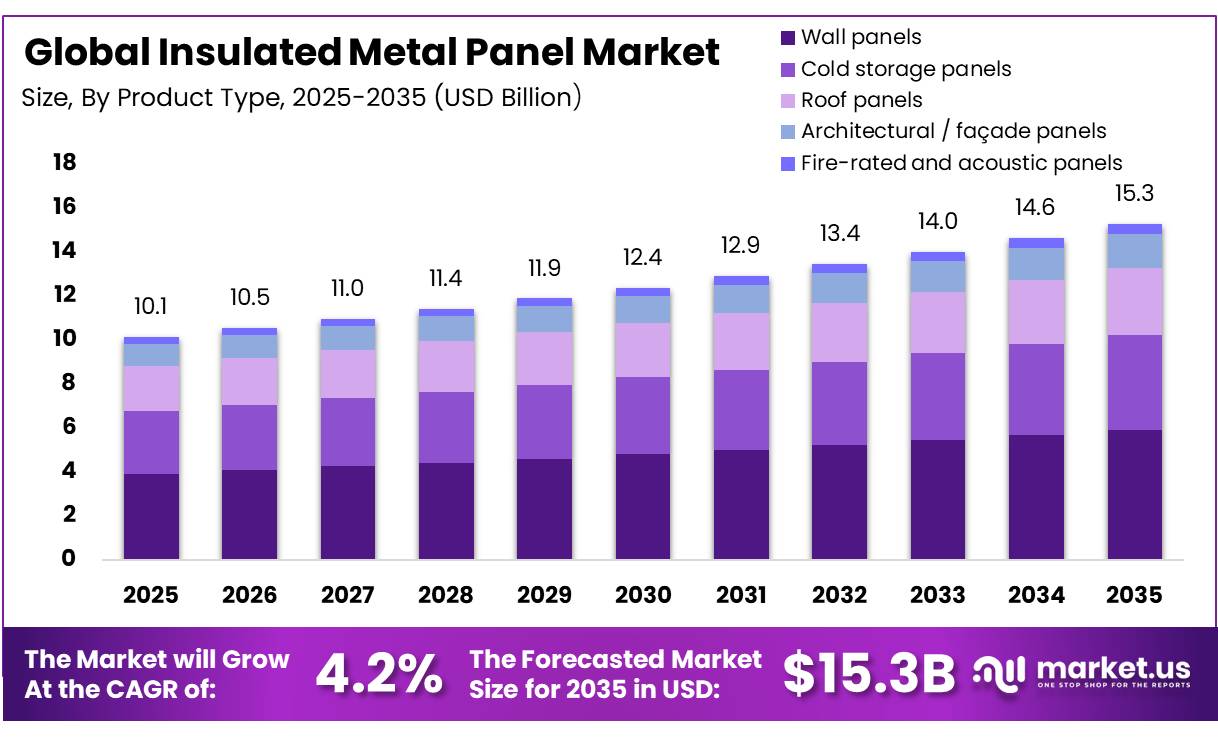
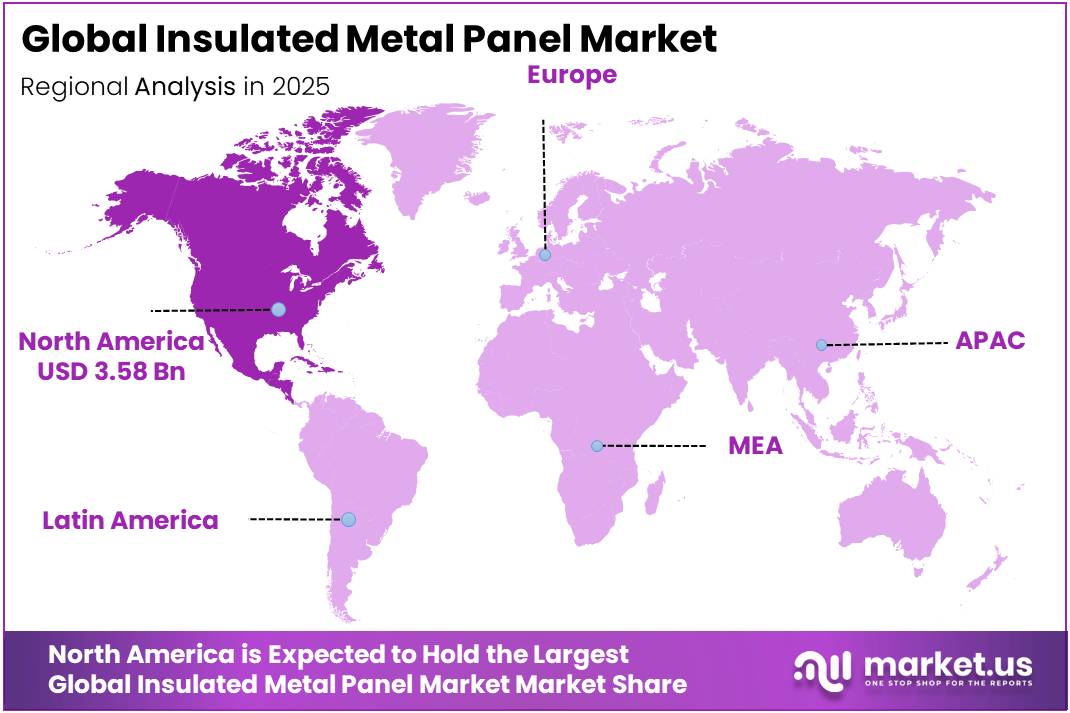
In 2025, the Global Insulated Metal Panel Market was valued at USD 10.1 billion, and between 2026 and 2035, this market is estimated to register a CAGR of 4.2%, reaching about USD 15.3 billion by 2035. North America held a dominant market position, capturing more than a 35.4% share, holding USD 3.58 billion in revenue.
Insulated metal panels combine two metal facings with an insulating core to form lightweight roof and wall systems for commercial, industrial, refrigerated, residential, and data-center buildings. They provide thermal continuity, weather protection, vapor control, and faster enclosure installation. The International Energy Agency reported in 2025 that buildings represented around 30% of global energy demand, contributed about 20% of demand growth since 2019, and used over 450 exajoules of final energy during 2024.
- The Metal Construction Association states that insulated metal wall panels are available in thicknesses from 3 inches to 6 inches. Its industry guidance also describes insulated roofing as using a two-step installation process and lasting more than four decades, supporting faster project delivery, consistent envelope performance, and lower maintenance requirements across construction applications.
Key Takeaways
- The global insulated metal panel market was valued at USD 10.1 billion in 2025.
- The global market is projected to grow at a CAGR of 4.2% and is estimated to reach USD 15.3 billion by 2035.
- On the basis of product type, wall panels dominated the market, constituting 38.7% of the total market share.
- Based on the insulation material, polyurethane (PUR) dominated the insulated metal panel market, with a substantial market share of around 52.2%.
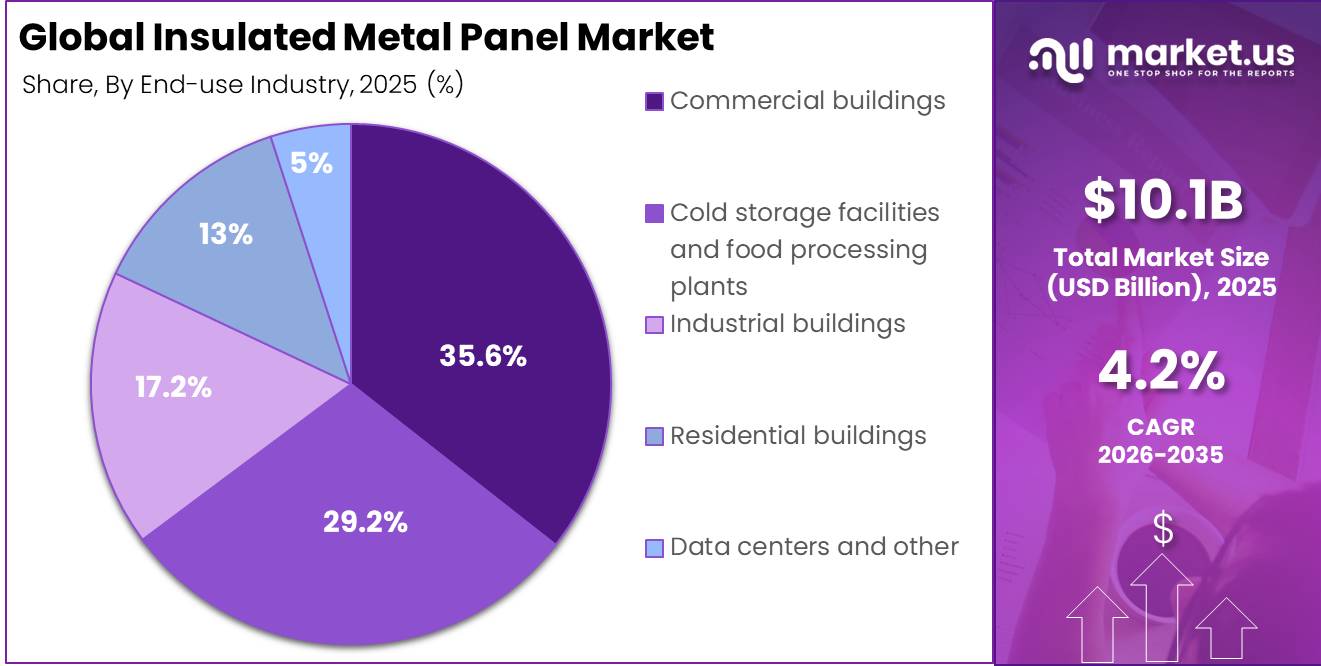
- Based on the end-use industry, commercial buildings led the market, comprising 35.6% of the total market.
- Among the end users, new construction held a major share in the insulated metal panel market, accounting for 60.2% of the market share.
- In 2025, North America was the most dominant region in the insulated metal panel market, accounting for 35.4% of the total global market.
Demand is driven by stricter energy codes, cold-chain expansion, warehouse construction, data-center growth, and the need to reduce heating and cooling loads. European Commission guidance states that zero-emission buildings use about 10 times less energy than the worst-performing buildings. The Energy Efficiency Directive also requires annual renovation of at least 3% of heated or cooled floor area owned by public bodies, supporting opportunities for insulated wall, roof, retrofit, and fire-performance panel systems.
Government policy is strengthening long-term market prospects. The European Union requires new public buildings to meet the zero-emission standard from January 2028 and all new buildings from January 2030. Separately, the United States Department of Energy states that the Inflation Reduction Act provides up to $1 billion for adoption and implementation of updated or zero-energy building codes. These measures encourage higher-performance envelopes, certified materials, renovation investment, and wider use of insulated metal panel assemblies across new construction and renovation markets worldwide.
Product Type Analysis
Wall Panels Lead with 38.7% as Cold Storage Panels Expand Fastest
In 2025, Wall panels held a dominant market position, capturing more than a 38.7% share. Their leadership reflected use across warehouses, factories, offices, retail buildings, data centers, and refrigerated facilities. Factory-produced assemblies combined exterior cladding, insulation, air control, and weather protection in one system. This simplified installation, supported consistent thermal performance, and reduced separate materials required for building envelopes.
- In February 2026, according to the United States Department of Agriculture, United States refrigerated warehouses provided 3.99 billion cubic feet of gross storage capacity, 3.25 billion cubic feet of usable capacity, and 931 operating facilities as of October 1, 2025.
Cold storage panels were the fastest growing segment, supported by expanding refrigerated warehousing, food processing, pharmaceutical storage, and temperature-controlled distribution. Their insulated cores and sealed metal surfaces helped maintain stable indoor conditions, control moisture, and support hygienic cleaning. Demand also benefited from cold-chain modernization and the construction of larger freezer and cooler facilities.
Insulation Material Analysis
Polyurethane (PUR) Leads with 52.2% as Mineral Wool Expands Fastest
In 2025, Polyurethane (PUR) held a dominant market position, capturing more than a 52.2% share. Its leadership reflected strong thermal insulation, low weight, moisture resistance, and compatibility with factory-made wall and roof panels. Manufacturers favored PUR cores because they supported thin panel profiles, rapid installation, and reliable temperature control across warehouses, commercial buildings, factories, and refrigerated facilities.
- In April 2026, according to ROCKWOOL North America, its new stone wool manufacturing facility represented a USD 175 million investment, covered 250 acres, and was designed to support 125 local jobs.
Mineral wool was the fastest growing segment, supported by rising demand for fire-resilient and acoustic building envelopes. Its non-combustible structure made it suitable for industrial buildings, data centers, façades, and projects with strict safety requirements. The material also provided sound absorption, dimensional stability, and dependable thermal performance under changing temperatures. Stronger building codes, renovation activity, and greater attention to occupant safety encouraged wider specification. Expanding production capacity and electrified manufacturing technologies further improved availability for large construction projects.
End-use Industry Analysis
Commercial Buildings Lead with 35.6% as Cold Storage Facilities and Food Processing Plants Expand Fastest
In 2025, Commercial buildings held a dominant market position, capturing more than a 35.6% share. Their leadership reflected broad use of insulated metal panels in offices, retail centers, warehouses, hospitals, schools, and mixed-use properties. These systems combined exterior cladding, insulation, and weather protection within one factory-made assembly, helping contractors shorten enclosure schedules, improve thermal continuity, and reduce the number of separate building materials required on site.
- In April 2026, according to the Global Cold Chain Alliance, the Global Top 25 operators increased capacity by 460 million cubic feet to 7.76 billion cubic feet, while the North American Top 25 reached 5.26 billion cubic feet of temperature-controlled space.
Cold storage facilities and food processing plants were the fastest growing segment. Demand increased as operators expanded refrigerated warehousing, frozen-food handling, meat processing, dairy storage, and temperature-controlled distribution. Insulated metal panels supported stable internal temperatures, hygienic surfaces, moisture control, and rapid construction of chilled rooms. Their suitability for walls, ceilings, partitions, and freezer enclosures strengthened adoption as cold-chain operators pursued larger facilities, lower energy losses, and dependable product protection across major global markets.
End User Analysis
New Construction Leads with 60.2% as Renovation & Retrofit Expands Fastest
In 2025, New construction held a dominant market position, capturing more than a 60.2% share. Its leadership reflected demand for warehouses, factories, retail buildings, data centers, and refrigerated facilities designed with integrated envelope systems. Insulated metal panels supported faster enclosure work, consistent thermal performance, fewer installation stages, and simplified coordination between trades. Their lightweight construction also helped contractors manage structural loads and complete weather-tight buildings efficiently.
- In January 2025, according to the United States Department of Energy, eligible commercial-building projects could receive tax deductions ranging from USD 0.58 to USD 5.81 per square foot, while qualifying projects had to achieve at least 25% energy savings.
Renovation & retrofit was the fastest growing segment as owners upgraded aging roofs, walls, and façades to improve insulation and building performance. Insulated metal panels offered practical overcladding and replacement options while limiting disruption to occupied facilities. Demand was supported by energy-efficiency targets, rising operating costs, stricter building requirements, and the need to extend asset life. Their factory-made design also enabled predictable quality, shorter installation schedules, and improved weather protection across commercial and industrial properties.
Key Market Segments
By Product Type
- Wall panels
- Cold storage panels
- Roof panels
- Architectural / façade panels
- Fire‑rated and acoustic panels
By Insulation Material
- Polyurethane (PUR)
- Polyisocyanurate (PIR)
- Mineral wool
- Expanded / extruded polystyrene (EPS/XPS)
- Other insulation materials
By End-use Industry
- Commercial buildings
- Cold storage facilities and food processing plants
- Industrial buildings
- Residential buildings
- Data centers and other
By End User
- New construction
- Renovation & retrofit
Driver Analysis
Warehouse, cold chain & data center build‑out boosting envelope demand
Between 2024 and 2026, the global construction materials sector has seen high‑single‑digit growth driven by logistics hubs, e‑commerce warehousing and data centers, which are especially insulation‑intensive segments. In logistics, warehouse and distribution center floor space across major economies has expanded at 5–8% annually, with cold storage capacity in some markets rising closer to 8–10% per year to meet food and pharma requirements, all of which need temperature‑controlled envelopes typically specified with insulated panels offering thermal conductivities in the 0.020–0.040 W/m·K range.
Industrial insulated metal panel segments in particular have reported mid‑single‑digit to low‑double‑digit CAGRs through 2030, reflecting strong ordering cycles from cold storage, process industries and logistics facilities. Each new 50,000–100,000 m² logistics warehouse or regional data center campus can consume tens of thousands of square meters of panels, translating into multi‑million‑dollar envelope packages per site at typical installed costs of USD 40–70 per m², depending on thickness and fire rating.
This shifts IMP suppliers’ revenue mix toward high‑usage industrial and infrastructure clients with repeat expansion programs, increasing visibility and shortening sales cycles relative to fragmented small commercial projects. As firms reconfigure supply chains and last‑mile networks, especially across North America, APAC corridors and GCC logistics hubs, insulated panel vendors who align with developers and cold chain operators can capture recurring multi‑site programs, lifting the global market CAGR by roughly 1.8 percentage points in the short to medium term.
Drivers Impact Analysis
| Driver | (~) % Impact on CAGR | Geographic Relevance | Impact Timeline |
|---|---|---|---|
| Energy codes & decarbonization mandates driving high-performance envelopes | +2.0% | North America core, EU, UK, Japan, advanced APAC | Medium term (2–4 years) |
| Warehouse, cold chain & data center build-out boosting envelope demand | +1.8% | North America core, APAC corridors, EU, GCC logistics hubs | Short–Medium term (≤ 4 years) |
| Modular & prefabricated construction adoption favoring IMP systems | +1.5% | North America core, EU, APAC urban clusters | Medium–Long term (≥ 3 years) |
| Industrial capacity expansion in East/South Asia increasing panel procurement | +1.3% | China, East Asia, South Asia, ASEAN | Long term (≥ 4 years) |
| Green building certifications & ESG capital reallocating toward insulated shells | +1.2% | North America, EU, India, Latin America spill-over | Medium term (2–4 years) |
| Metal & insulation price volatility accelerating shift to lightweight, integrated panels | +0.9% | Global construction materials, APAC manufacturing, EU | Short term (≤ 2 years) |
Restraint Analysis
High upfront system cost vs conventional envelopes
In many markets, installed IMP solutions for walls and roofs fall in the equivalent of roughly USD 35–70 per m² depending on thickness, fire rating and coating, which can be 15–30% higher than basic single‑skin metal sheeting plus separate low‑density insulation or masonry with conventional insulation layers, and in India retail pricing examples for insulated roofing PUF panels in 2025–2026 range roughly from the equivalent of INR 500–1,200 per m², underscoring the premium versus simpler cladding options.
For large warehouses, cold storage plants, or data centers above 50,000 m² envelope area, this cost differential can translate into millions of dollars of incremental upfront spend, forcing developers to weigh long‑term 15–30% energy savings against immediate project budget caps and loan covenants that often prioritize minimum capital outlay.
Strategically, this restraint compresses supplier margins—panel manufacturers cannot fully pass raw‑material inflation through to prices without losing bids—and pushes many projects to defer or downgrade envelope performance, leading to delayed CapEx on IMP solutions and shaving an estimated 2.2 percentage points from potential global IMP CAGR over the 2026–2030 window, especially in North America, Europe, India and Latin America where budget‑sensitive logistics and industrial builds dominate.
Restraint Impact Analysis
| Restraint | (~) % Impact on CAGR | Geographic Relevance | Impact Timeline |
|---|---|---|---|
| High upfront system cost vs conventional envelopes | -2.2% | North America core, EU, India, LATAM | Medium term (2–4 years) |
| Raw-material price volatility (steel, PU, mineral wool) | -1.9% | Global, APAC corridors, EU | Short–Medium (≤ 4 years) |
| Limited skilled installers and design know-how | -1.5% | North America, EU, emerging APAC | Medium term (2–4 years) |
| Regulatory complexity and evolving fire/thermal codes | -1.3% | EU, UK, Middle East, China | Long term (≥ 4 years) |
| Logistics, transport cost and plant scale constraints | -1.1% | APAC, LATAM, Africa, remote NA/EU | Medium–Long (≥ 3 years) |
| Competition from lower-cost alternative systems | -1.0% | Global construction markets | Short–Medium (≤ 4 years) |
Opportunity Analysis
Large‑scale retrofit & renovation programs
This opportunity is distinct from current drivers because most insulated metal panel revenue today still comes from new builds, while the retrofit share of aging commercial/industrial stock remains structurally underpenetrated despite clear policy signals. The global building envelope market is sized well above USD 120 billion in 2025, with a substantial fraction tied to existing buildings that will not be demolished before 2035, yet only a minority of these assets have high‑performance insulated shells.
If IMP players orchestrate structured retrofit programs—targeting, for example, even 5–7% of the aging commercial/industrial stock per year in North America, Europe, Japan and key APAC cities—they could tap an incremental TAM in the tens of billions of dollars by 2030, with retrofit projects typically yielding 15–30% reductions in heating/cooling loads and 10–20% lower operational energy bills, improving NOI and asset valuation.
From a unit‑economics standpoint, targeting buildings above 10,000 m² envelope area and bundling design, panels and installation under single performance contracts could lift gross margins by 200–400 basis points versus commodity new‑build supply, due to lower customer acquisition cost per square meter and standardized detailing.
Strategically, this is white space because most owners still treat energy retrofits as discretionary CapEx; if IMP suppliers and financiers build models where 50–70% of project cost is repaid out of guaranteed energy savings over 7–10 years, they unlock latent demand that is not assumed in today’s baseline CAGR projections, plausibly adding around 2.4 percentage points of upside to global IMP growth over the next 4–6 years.
Opportunity Impact Analysis
| Opportunity | (~) % Potential CAGR Upside | Geographic Relevance | Execution Window |
|---|---|---|---|
| Large-scale retrofit & renovation programs | +2.4% | North America core, EU, Japan, urban APAC | Medium term (2–4 years) |
| Modular, IoT-ready panel systems | +2.1% | North America, EU, APAC emerging markets | Medium–Long (≥ 3 years) |
| Performance-linked service & financing models | +1.8% | North America core, EU, India | Medium term (2–4 years) |
| Vertical integration with smart manufacturing & AI design | +1.6% | Global tier-1 producers, APAC hubs | Long term (≥ 4 years) |
| Affordable housing and social infrastructure platforms | +1.5% | India, Africa, LATAM, ASEAN | Medium–Long (≥ 3 years) |
| M&A roll-ups across fragmented regional panel makers | +1.3% | EU mid-tier, India, APAC corridors | Short–Medium (≤ 4 years) |
Challenges Analysis
Skilled installer & workforce gap
The chronic shortage of skilled construction labor and specialist IMP installers is a systemic challenge rather than a pure restraint: projects still proceed, but schedule reliability, cost baselines, and quality outcomes are increasingly volatile, imposing friction on achievable growth rates. Global construction analyses indicate the sector needs roughly 400,000–500,000 additional workers in major regions around 2025–2026, with some reports citing U.S shortfalls of about 349,000 net new workers for 2026 and over 450,000 for 2027 on top of normal hiring, while UK projections call for around 250,000 extra workers by 2028.
Within this deficit, installers experienced in insulated metal panels represent only a small subset; practical evidence from roofing and envelope segments shows that skilled crew scarcity drives wage inflation in the mid‑single‑digit to low‑double‑digit range and introduces schedule slippage of weeks per large project, especially when panel handling, precision joint detailing, and weather‑tightness requirements demand advanced skills. For IMP suppliers, this talent gap translates into higher bid contingencies, rising installation cost per square meter, and a need to fund training academies and certification for contractors, all of which compress margins by an estimated 100–200 basis points and slow conversion of specs into completed installations.
Strategically, companies must pivot toward industrialized construction and modularization to offset labor constraints—e.g., moving more work into factories, leveraging robotics labs like the new industrialized construction facility in Florida, and partnering with modular providers that can pre‑assemble envelope components—while also investing in multi‑year workforce pipelines to reduce dependence on scarce site crews. Until these measures mature, the workforce challenge acts as a persistent drag of roughly 1.7 percentage points on the maximum IMP CAGR, not halting sales but forcing continuous mitigation through automation, training, and risk‑priced contracts.
Challenges Impact Analysis
| Challenge | (~) % CAGR Friction Drag | Geographic Relevance | Mitigation Horizon |
|---|---|---|---|
| Skilled installer & workforce gap | -1.7% | North America core, EU hubs, APAC corridors | Medium term (2–4 years) |
| Multi-node supply chain volatility | -1.5% | Global sourcing, APAC–EU–NA trade lanes | Medium–Long (≥ 3 years) |
| Complex codes & approvals variability | -1.2% | EU regulatory hubs, US states, Middle East | Long term (≥ 4 years) |
| Digitalization & data integration lag | -1.0% | Global mid-tier producers, emerging markets | Medium term (2–4 years) |
| ESG, waste & circularity compliance | -0.9% | EU, UK, North America, advanced APAC | Long term (≥ 4 years) |
| Interest-rate & CapEx cycle sensitivity | -0.8% | Global construction, especially NA/EU | Medium term (2–4 years) |
Geopolitical Impact Analysis
Geopolitical Realignment and Trade Barriers Reshaping Insulated Metal Panel Manufacturing
Geopolitical tensions are reshaping the insulated metal panel market through concentrated steel production, tariffs, carbon-border rules, and sourcing. In January 2026, the World Steel Association reported that crude steel output reached 1,849.4 million tonnes in 2025, while China produced 960.8 million tonnes. This concentration increases exposure to trade restrictions and freight disruption.
Tariff changes are adding uncertainty across construction supply chains. In June 2026, the White House stated that United States metal tariff regimes included 50% duties on aluminum, steel, and copper products, 25% duties on derivative products, and 15% duties on industrial machinery and power equipment. Panel producers may respond through domestic sourcing and contract repricing.
European regulation is changing procurement decisions. The European Commission confirmed that the Carbon Border Adjustment Mechanism entered its definitive phase on January 1, 2026. Importers bringing more than 50 tonnes of goods into the European Union must obtain authorized declarant status, while iron, steel, and aluminum remain covered sectors.
These pressures likely encourage manufacturers to regionalize coating, lamination, and foam-processing operations, qualify alternative suppliers, and increase recycled-metal use. However, production networks, compliance documentation, and longer approvals can raise capital needs and delay projects. Diversified sourcing and manufacturing can protect delivery schedules and margins.
Regional Analysis
North America Leads with 35.4% as Asia Pacific Expands Fastest
In 2025, North America held a dominant position in the Insulated Metal Panel Market, capturing 35.4% of global revenue and generating USD 3.58 billion. Leadership was supported by established commercial construction, refrigerated warehousing, industrial facilities, data centers, and renovation activity. Statistics Canada reported that total building construction investment reached CAD 272.1 billion in 2025, while non-residential investment totaled CAD 76.0 billion, supporting demand for efficient wall and roofing systems throughout the United States and Canada.
Asia Pacific was the fastest-growing region, driven by urban development, logistics facilities, cold storage, manufacturing plants, and stricter building-efficiency requirements. Singapore’s Building and Construction Authority projected 2025 construction demand between SGD 47 billion and SGD 53 billion, with real demand ranging from SGD 35 billion to SGD 39 billion. Expanding food processing, pharmaceutical storage, industrial parks, and data-center capacity are strengthening opportunities for insulated metal panels across new projects during the wider regional forecast period.
Key Regions and Countries Covered
- North America
- The US
- Canada
- Europe
- Germany
- France
- The UK
- Spain
- Italy
- Russia & CIS
- Rest of Europe
- APAC
- China
- Japan
- South Korea
- India
- ASEAN
- Rest of APAC
- Latin America
- Brazil
- Mexico
- Rest of Latin America
- Middle East & Africa
- GCC
- South Africa
- Rest of MEA
Key Players Analysis
In 2026, insulated metal panel manufacturers focused on product differentiation, regional production, and complete building-envelope solutions to protect competitive positioning. Kingspan Group emphasized insulated panels, lower-embodied-carbon products, integrated solar roofing, and a new strategic partnership with Solen Energy. Nucor Corporation strengthened its presence through CENTRIA and Metl-Span, operating nine manufacturing facilities across the United States and Canada and serving architectural, commercial, industrial, and cold-storage projects. BlueScope Steel supported competition through coated-steel production, engineered building systems, and higher-volume North American building operations.
Manufacturers also prioritized thermal efficiency, fire resistance, moisture control, architectural flexibility, and faster installation. Vertical integration with steel coating, panel fabrication, engineering, and distribution helped reduce supply risk and improve delivery control. Companies invested in automation, standardized testing, environmental declarations, and lower-carbon steel inputs to address stricter building requirements. Long-term contractor relationships, technical design support, and manufacturing capacity remained important for winning data-center, warehouse, cold-storage, industrial, and commercial projects.
Market Key Players
- Kingspan Group plc
- Metl-Span LLC
- CENTRIA
- Nucor Corporation
- MBCI (Cornerstone Building Brands)
- Metal Sales Manufacturing Corporation
- Tata Steel Limited
- ArcelorMittal Construction
- BlueScope Steel Limited
- Metecno Group
- Isopan S.p.A.
- Ruukki Construction Oy
- Assan Panel Sanayi ve Ticaret A.S.
- BRUCHA GmbH
- Green Span Profiles
Key Development
- In January 2026, ArcelorMittal Building Solutions introduced its PRT Litecore foam across the Ondatherm T, Ondatherm Deck, and Ondatherm 1150 insulated roofing panel ranges, offering multiple thicknesses and fire-performance classifications for pitched and deck-type roof applications.
- In February 2026, Tata Steel’s Nest-In reported the expansion of its prefabricated building solutions with cyclone-ready strength and zero-energy performance, strengthening its focus on rapid, durable, and energy-efficient construction systems.
- In March 2026, Ruukki Construction announced two new surface patterns for sandwich panels at Nordbygg 2026 and showcased its Ruukki Sono acoustic wall element. The new sandwich-panel designs were scheduled to become commercially available in autumn 2026.
Report Scope
| Report Features | Description |
|---|---|
| Market Value (2025) | USD 10.1 Bn |
| Forecast Revenue (2035) | USD 15.3 Bn |
| CAGR (2026-2035) | 4.2% |
| Base Year for Estimation | 2025 |
| Historic Period | 2020-2024 |
| Forecast Period | 2026-2035 |
| Report Coverage | Revenue Forecast, Market Dynamics, Competitive Landscape, Recent Developments |
| Segments Covered | By Product Type (Wall Panels, Cold Storage Panels, Roof Panels, Architectural / Façade Panels, and Fire-Rated and Acoustic Panels), By Insulation Material (Polyurethane (PUR), Polyisocyanurate (PIR), Mineral Wool, Expanded / Extruded Polystyrene (EPS/XPS), and Other Insulation Materials), By End-use Industry (Commercial Buildings, Cold Storage Facilities and Food Processing Plants, Industrial Buildings, Residential Buildings, Data Centers, and Other), By End User (New Construction and Renovation & Retrofit) |
| Regional Analysis | North America – The US & Canada; Europe – Germany, France, The UK, Spain, Italy, Russia & CIS, Rest of Europe; APAC– China, Japan, South Korea, India, ASEAN & Rest of APAC; Latin America– Brazil, Mexico & Rest of Latin America; Middle East & Africa– GCC, South Africa, & Rest of MEA |
| Competitive Landscape | Kingspan Group plc, Metl-Span LLC, CENTRIA, Nucor Corporation, MBCI (Cornerstone Building Brands), Metal Sales Manufacturing Corporation, Tata Steel Limited, ArcelorMittal Construction, BlueScope Steel Limited, Metecno Group, Isopan S.p.A., Ruukki Construction Oy, Assan Panel Sanayi ve Ticaret A.S., BRUCHA GmbH, and Green Span Profiles. |
| Customization Scope | Customization for segments, region/country-level will be provided. Moreover, additional customization can be done based on the requirements. |
| Purchase Options | We have three licenses to opt for: Single User License, Multi-User License (Up to 5 Users), Corporate Use License (Unlimited Users and Printable PDF) |





































