


Report Overview
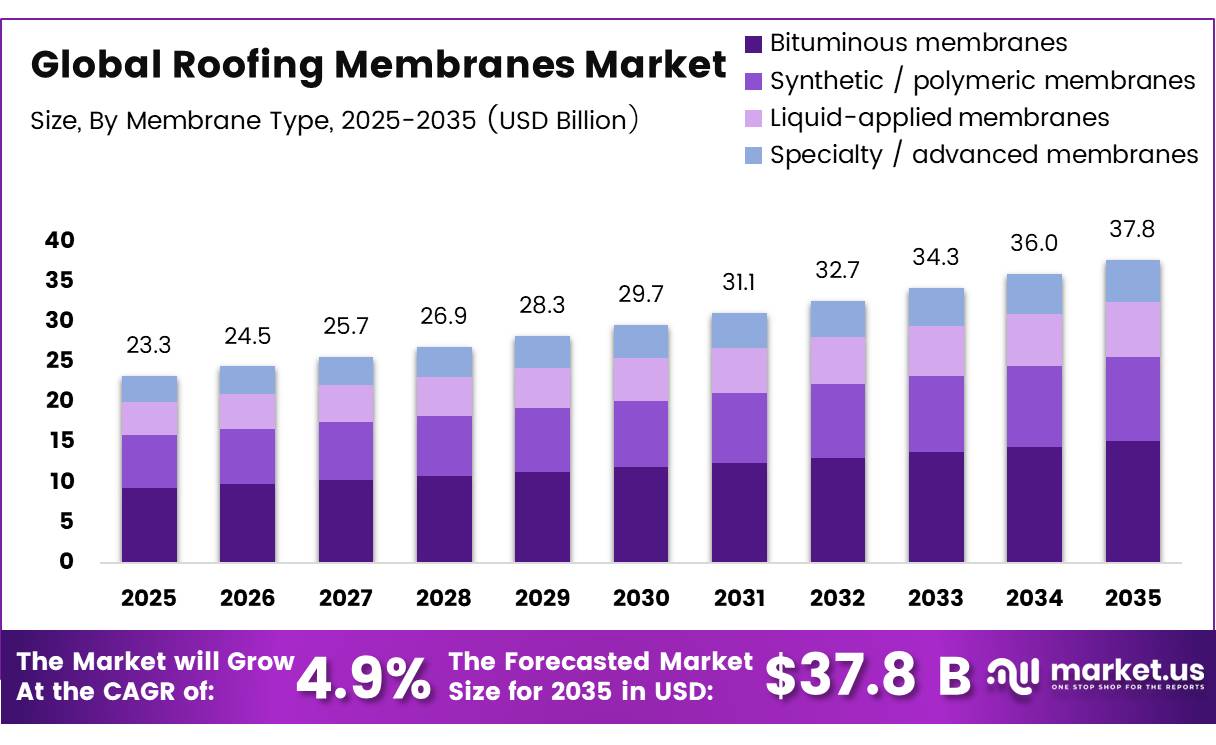
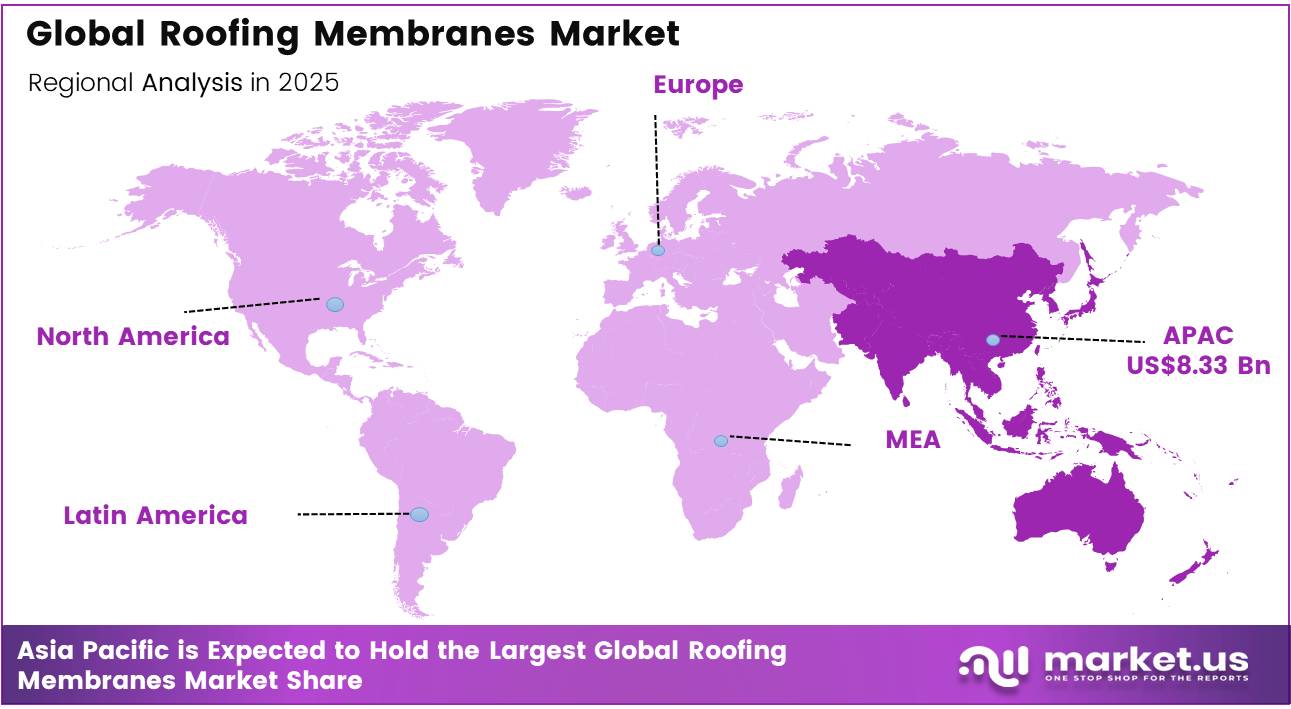
In 2025, the Global Roofing Membranes Market was valued at USD 23.3 billion, and between 2026 and 2035, this market is estimated to register a CAGR of 4.9%, reaching about USD 37.8 billion by 2035. In 2025, North America held a dominant market position, capturing more than a 35.7% share, holding USD 8.33 Billion revenue.
Roofing membranes are becoming critical to commercial, industrial, and residential building envelopes because they provide waterproofing, thermal protection, and compatibility with insulation, green roofs, and solar systems.
- In May 2026, U.S. construction spending reached $2.210 trillion at an annual rate, including $930.2 billion in residential and $738.7 billion in nonresidential construction, creating an installation and replacement base for membrane roofing.
The industry is benefiting from stricter energy and climate requirements. UNEP’s 2025–2026 assessment reported that buildings and construction represent 11–13% of global GDP, employ about 9% of the workforce, generate 37% of global carbon dioxide emissions, and account for nearly 50% of material extraction. Building energy intensity has declined 8.5% since 2015, while green-building certifications have almost tripled, increasing demand for reflective, recyclable, and longer-lasting membranes.
Energy renovation provides a growth path. Around 75% of EU buildings have poor energy performance, 85% were built before 2000, and the annual renovation rate remains only 1%. Cool-roof systems can remain up to 60°F cooler than black roofs, while efficient products can deliver annual energy savings of 1.78 kWh per square foot. Future opportunities include reroofing, cool roofs, vegetated systems, and solar-ready membranes.
Key Takeaways
- The global Roofing Membranes market was valued at USD 23.3 billion in 2025.
- The global market is projected to grow at a CAGR of 4.90% and is estimated to reach USD 37.8 billion by 2035.
- On the basis of Membrane Type, the Bituminous membranes dominated the market, constituting 40.1% of the total market share.
- Based on the Installation Method, the Mechanically attached systems dominated the Roofing Membranes market, with a substantial market share of around 38.1%.
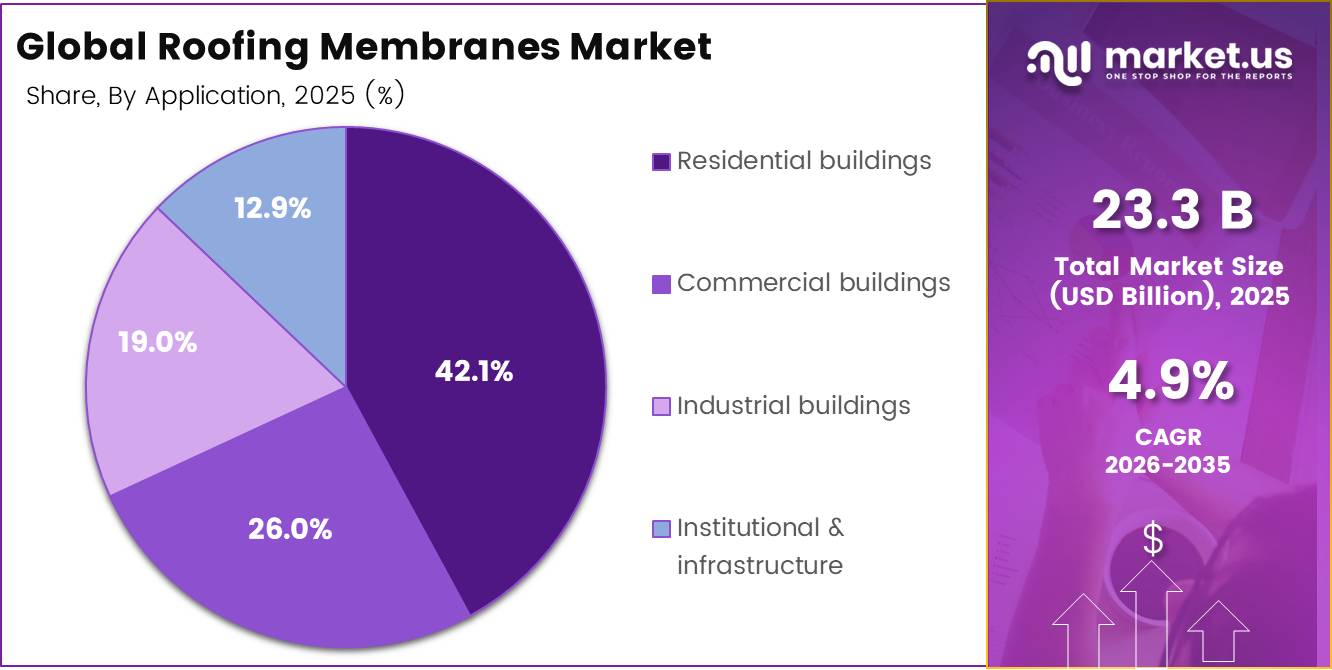
- Based on the Application, Residential buildings led the market, comprising 42.1% of the total market.
- Among the end-uses Construction companies and roofing contractors held a major share in the Roofing Membranes market, 33.6% of the market share.
- In 2025, the Asia Pacific was the most dominant region in the Roofing Membranes market, accounting for 35.7% of the total global consumption.
Membrane Type Analysis
Bituminous membranes represents dominant Segment in the Market.
In 2025, bituminous membranes held a dominant market position, capturing more than a 40.1% share. Their leadership is supported by strong waterproofing, multilayer protection, repair flexibility, and reliable performance on large low-slope roofs.
- In June 2026, the U.S. Census Bureau recorded 1.427 million privately owned housing starts at an annual rate, including 513,000 units in buildings containing five or more homes. This active multifamily construction pipeline creates steady demand for durable membrane systems used on apartment roofs, podium structures, terraces, and shared building areas.
Synthetic and polymeric membranes are the fastest-growing segment due to lightweight sheets, welded seams, reflective surfaces, and compatibility with rooftop solar installations. European Union rules place new public and nonresidential buildings larger than 250 m² within the solar-installation timeline from December 31, 2026, encouraging demand for solar-ready and heat-resistant roofing membranes
Installation Method Analysis
Mechanically attached systems a significant Installation Method.
Mechanically attached systems held a dominant market position, capturing more than a 38.1% share. Their leadership is supported by quick installation, limited adhesive requirements, straightforward repairs, and suitability for wide low-slope roofs.
- The U.S. Department of Energy states that mechanically attached membranes are commonly installed over cover boards. Its technical guidance specifies a 2.0 safety factor for tested wind-uplift pressure, upper-deck fasteners placed at 6-inch centres, and rigid insulation limited to 10 inches, using multiple 2-inch-thick sheets. These requirements support dependable performance while preserving installation efficiency.
Fully adhered systems are gaining demand where wind resistance, smooth finishes, and reduced membrane movement are priorities. A 2026 City of Cortez roofing project specified a fully adhered system with R-30 insulation, a 60-mil TPO membrane, and a 20-year warranty, demonstrating increasing public-sector preference for durable bonded assemblies.
Application Analysis
Residential buildings Held a Major Share of the Roofing Membranes Market.
Residential buildings held a dominant market position, capturing more than a 42.1% share. Roofing membranes remain widely used on apartments, flat-roof homes, terraces, balconies, and mixed-use residential complexes because they provide continuous waterproofing and support insulated roof assemblies.
- In June 2026, U.S. building permits were issued at an annual rate of 1.367 million units, including 871,000 single-family units and 445,000 units in buildings with five or more homes. This active development pipeline supports steady membrane installation and replacement work.
Commercial buildings are the fastest-growing application, driven by large roof areas, energy upgrades, reroofing requirements, and demand for solar-ready surfaces. The U.S. Department of Energy estimates that more than 80 billion square feet of new commercial floor space could be constructed by 2050, creating long-term opportunities for durable, reflective, and easy-to-maintain roofing membranes.
End User Analysis
Construction companies and roofing contractors Are Most Widely Used
Construction companies and roofing contractors held a dominant market position, capturing more than a 33.6% share. Their leadership comes from direct control over membrane purchasing, installation, waterproofing, repairs, and roof refurbishment.
- In the year ending December 2025, English planning authorities decided 154,500 householder development applications, including extensions and loft conversions. Authorities approved 90% of these applications and processed 93% within eight weeks or the agreed period, supporting a steady project pipeline for specialist contractors.
Real-estate developers are growing as planned housing and commercial projects require waterproof roofing systems from the design stage. During October–December 2025, authorities granted 63,000 planning decisions, including 7,300 residential and 1,500 commercial development applications. This approved pipeline supports future membrane procurement across new properties and mixed-use developments.
Key Market Segments
By Membrane Type
- Bituminous membranes
- Synthetic / polymeric membranes
- Liquid‑applied membranes
- Specialty / advanced membranes
Installation Method
- Mechanically attached systems
- Fully adhered systems
- Ballasted systems
- Other methods
By Application
- Residential buildings
- Commercial buildings
- Industrial buildings
- Institutional & infrastructure
By End User
- Construction companies and roofing contractors
- Real‑estate developers
- Industrial facilities and logistics operators
- Government
- Facility management and refurbishment specialists
Driver Analysis
Sustainability & green‑building mandates driving high‑performance membranes
From 2024–2026, sustainability has become the dominant innovation vector in building materials, with green‑building certifications, circular economy targets and low‑carbon procurement rules increasingly baked into public and large private projects. In Europe, green building penetration in new commercial projects is commonly cited above 30–35%, and in North America LEED and similar standards are influencing more than a quarter of major non‑residential builds, pushing roof designers toward thermoplastic polyolefin (TPO), PVC and elastomeric membranes with high reflectance and long service life.
On the demand side, sustainable construction materials markets are expected to grow faster than conventional materials often in the high‑single‑digit CAGR band versus low‑single‑digit for legacy products creating a mix shift: by 2030 it is plausible that more than 40% of global roofing membrane square‑meter installations will be tied to sustainability‑linked projects compared with roughly 25–30% around 2024.
As owners increasingly evaluate roofs on whole‑life carbon and energy performance rather than initial capex, membrane suppliers with verified environmental product declarations, recyclability pathways and take‑back programs can command margin uplift in the 100–200 basis‑point range over undifferentiated competitors, underpinning the estimated +1.3 percentage‑point boost to global roofing membrane CAGR through 2031.
Drivers Impact Analysis
| Driver | (~) % Impact on CAGR | Geographic Relevance | Impact Timeline |
|---|---|---|---|
| Sustainability & green-building mandates driving high-performance membranes | +1.3% | North America, EU core, APAC urban corridors | Long term (≥ 4 years) |
| Construction and reroofing boom in aging and emerging building stock | +1.5% | North America core, APAC (China, India, ASEAN), South America spill-over | Short–Medium (≤ 4 years) |
| Energy-efficiency and cool-roof / insulation codes | +1.1% | North America, Western Europe, advanced APAC (Japan, South Korea, China) | Medium term (2–4 years) |
| Rooftop solar and distributed energy systems needing compatible membranes | +0.9% | EU, North America Sun Belt, APAC (China, India) | Medium–Long (≥ 3 years) |
| Shift to self-adhered, modular and faster-install systems | +0.8% | North America, EU, APAC manufacturing hubs | Short term (≤ 2 years) |
| Innovation in eco-friendly, recyclable and bio-based membrane chemistries | +0.7% | EU, North America, selective APAC & LATAM pilots | Long term (≥ 4 years) |
Restraint Analysis
Raw material price volatility & resin shortages
Volatility in key roofing membrane inputs petroleum‑linked polymers, plastic resins, synthetic rubber, and specialty chemicals—has become structurally higher since the 2020–2022 energy shock, with industry sources citing double‑digit percentage swings in roofing and siding producer price indices over short periods and specific episodes where asphalt, TPO resin, and polyiso feedstocks moved up by 20–40% year‑on‑year. Between 2021 and 2024, resin shortages for TPO and EPDM, combined with methylene diphenyl diisocyanate (MDI) outages affecting insulation, caused backlogs and forced manufacturers to pay premiums to secure supply.
In 2025–2026, even as some bottlenecks ease, crude‑oil price volatility in the 20–30 USD per barrel band and geopolitical risk around shipping lanes translate into input‑cost uncertainty that can easily compress gross margins by 200–300 basis points when contract prices lag material spikes. For roofing membrane producers, this undermines the feasibility of long‑term fixed‑price framework agreements, pushes them to include escalation clauses that many contractors and building owners resist, and complicates CapEx decisions on new lines because payback models must discount higher volatility.
On the demand side, cost‑sensitive projects in emerging markets, small commercial buildings, and price‑driven residential segments delay re‑roofing by 1–3 years when membrane prices rise faster than general construction inflation, reducing annual replacement volumes by mid‑single‑digit percentages in bad years. Strategically, firms respond with hedging, multi‑sourcing, and inventory buffers, but higher working capital ties up cash and can add 50–100 basis points to financing costs in a high‑rate environment, justifying an estimated -1.4 percentage‑point drag on global roofing membrane CAGR through 2031 relative to a stable‑input world.
Restraint Impact Analysis
| Restraint | (~) % Impact on CAGR | Geographic Relevance | Impact Timeline |
|---|---|---|---|
| Raw material price volatility & resin shortages | -1.4% | North America core, EU, APAC corridors | Short–Medium (≤ 4 years) |
| Supply chain disruptions & long lead times | -1.2% | North America, EU, APAC ports, global OEMs | Short term (≤ 2 years) |
| High upfront cost of advanced membrane systems | -1.0% | North America, EU, selected APAC urban | Medium–Long (≥ 3 years) |
| Skilled labor shortages & installation bottlenecks | -0.9% | North America core, Western Europe, Australia | Short–Medium (≤ 4 years) |
| Regulatory complexity & environmental compliance burden | -0.8% | EU core, UK, North America, advanced APAC | Medium term (2–4 years) |
| Competition from low-cost conventional roofing & coatings | -0.7% | Emerging APAC, Latin America, MEA | Long term (≥ 4 years) |
Opportunity Analysis
Circular take‑back and recycled membrane feedstocks
Globally, millions of square meters of membranes reach end‑of‑life each year, representing potential feedstock volumes in the hundreds of thousands of tonnes annually; even if only 20–30% of that is recoverable under realistic logistics constraints, a circular program that pays contractors USD 10–20 per tonne for collected material and sells recycled inputs at a modest discount to virgin material could both lower raw‑material cost volatility and create new revenue pools.
If circular membranes can reduce material cost by 5–10% over a cycle and simultaneously allow 2–3% price premiums due to ESG value, blended margin expansion of 200–300 basis points is plausible in segments where recycling is operationally viable. This is an opportunity, not a current driver, because most markets have not yet adopted standardized take‑back logistics or certified recycled membrane lines at scale; building that infrastructure over 4–8 years could add roughly +1.2 percentage‑points to CAGR as recovered materials reduce supply‑risk constraints and unlock demand from sustainability‑focused owners who represent an increasing share of new projects but currently treat circular roofing as a future aspiration rather than an available option.
Opportunity Impact Analysis
| Opportunity | (~) % Potential CAGR Upside | Geographic Relevance | Execution Window |
|---|---|---|---|
| Roof-as-a-Service and performance-based contracts | +1.5% | North America core, EU, APAC urban corridors | Medium term (2–4 years) |
| Circular take-back and recycled membrane feedstocks | +1.2% | EU core, North America, selective APAC | Long term (≥ 4 years) |
| Monetizing roofs as multi-use platforms (energy, data, adsorption) | +1.3% | North America, EU, APAC megacities | Medium–Long (≥ 3 years) |
| Penetration into pitched roof & facade membranes | +1.0% | EU, APAC emerging markets, Latin America | Medium term (2–4 years) |
| Deep integration with waterproofing & cool-roof ecosystems | +0.9% | APAC emerging, Middle East, Latin America | Short–Medium (≤ 4 years) |
| Digitalized asset management and predictive maintenance layers | +0.8% | North America, EU, high-value industrial clusters | Medium term (2–4 years) |
Challenges Analysis
Persistent raw‑material price volatility
Raw‑material price volatility is an ongoing challenge rather than a strict restraint because it does not freeze membrane production, but it systematically erodes planning confidence and margin capture: roofing‑sector commentary since 2020 has repeatedly highlighted fluctuations in petroleum‑based resins, asphalt, steel and insulation inputs, with some analyses noting that insulation resin prices rose by about 20% over short windows and that commodity volatility linked to political and economic disturbances poses a “serious threat” to free market development.
At the operational level, this friction forces manufacturers to carry higher safety‑stock levels e.g., extending raw‑material days‑of‑inventory from 45 to 60–70 days to buffer against supply shocks, tying up millions of dollars in working capital per plant and increasing exposure to interest rate spreads; simultaneously, pricing committees must adjust list prices and surcharges more frequently, which increases commercial friction with contractors who themselves are bidding projects months ahead with limited ability to reprice mid‑stream.
Modeling the impact, a scenario with annualized input‑cost standard deviations at 2–3× pre‑2020 norms can compress gross margins by 150–250 basis points relative to a stable‑cost environment and induce 3–6‑month delays in CapEx approvals for new capacity lines in petro‑linked hubs such as the U.S. Gulf Coast, Western Europe and parts of APAC; this friction is expected to persist through at least the end of the decade given continued geopolitical risk and energy‑transition dynamics, justifying an estimated -1.0 percentage‑point drag on maximum attainable roofing membrane CAGR until raw‑material hedging, multi‑sourcing and circular feedstock strategies materially dampen volatility.
Challenges Impact Analysis
| Challenge | (~) % CAGR Friction | Geographic Relevance | Mitigation Horizon |
|---|---|---|---|
| Persistent raw-material price volatility | -1.0% | North America core, EU, APAC petro hubs | Long term (≥ 4 years) |
| Global supply chain complexity & long lead times | -0.9% | North America, EU regulatory hubs, APAC logistics corridors | Medium term (2–4 years) |
| Structural skilled labor and roofing talent shortage | -1.1% | North America core, Australia, EU, selected APAC | Long term (≥ 4 years) |
| Installation complexity and quality-assurance risks | -0.8% | North America, EU, high-value industrial clusters | Medium term (2–4 years) |
| Environmental disposal, ESG and circularity pressures | -0.7% | North America, EU, urban APAC | Long term (≥ 4 years) |
| Macroeconomic cyclicality and demand volatility | -0.9% | Global, with amplified impact in emerging markets | Medium–Long (≥ 3 years) |
Geopolitical Impact Analysis
Geopolitical Realignment and Supply Chain Fragmentation Reshaping Roofing Membranes Manufacturing.
Roofing membrane production is becoming more exposed to geopolitical shifts because bitumen, PVC, and polyolefin-based systems rely heavily on petroleum and petrochemical supply chains. In the first quarter of 2026, EU petroleum-oil import value increased by 0.8%, while physical import volume declined by 0.6%, indicating firmer expenditure despite slightly lower supply. The United States supplied 17.8% of EU petroleum imports, followed by Norway at 16.6% and Kazakhstan at 9.6%. This changing supplier mix can affect refinery availability, feedstock specifications, currency exposure, and procurement costs for roofing membrane manufacturers.
Maritime risk is also influencing inventory and manufacturing strategies. The U.S. Energy Information Administration estimated that 79.8 million barrels per day, representing 76% of global petroleum supply, moved through seaborne trade during the first half of 2025. The Strait of Malacca carried 23.2 million barrels per day, while shipments routed around the Cape of Good Hope reached 9.1 million barrels per day. Disruption across these routes can lengthen journeys, tighten feedstock availability, and raise freight costs. Roofing membrane producers are therefore likely to increase safety stocks, approve alternative raw-material suppliers, and place more production capacity closer to major construction markets.
Regional Analysis
Asia Pacific Held the Largest Share of the Global Roofing Membranes Market.
Asia Pacific held a dominant roofing membranes market position, capturing more than a 35.7% share. The region’s lead is supported by dense urban construction, aging building stock, heavy rainfall exposure, and large government-backed housing renovation programs.
- China began renovating 27,000 old urban residential compounds, benefiting approximately 4.99 million households. These projects create substantial demand for bituminous, polymeric, and liquid-applied membranes used to repair leaking roofs, improve insulation, and extend building service life. Continued investment in affordable housing and urban renewal is expected to keep regional membrane consumption strong.
North America is the fastest-growing region, supported by housing investment, multifamily construction, and building renovation. Canada’s total building investment increased 8.5% to CAD 272.1 billion in 2025. Residential construction reached CAD 178.0 billion, with multi-unit projects contributing CAD 98.4 billion, creating strong opportunities for flat-roof and waterproofing membrane suppliers.
Key Regions and Countries Covered
- North America
- The US
- Canada
- Europe
- Germany
- France
- The UK
- Spain
- Italy
- Russia & CIS
- Rest of Europe
- APAC
- China
- Japan
- South Korea
- India
- ASEAN
- Rest of APAC
- Latin America
- Brazil
- Mexico
- Rest of Latin America
- Middle East & Africa
- GCC
- South Africa
- Rest of MEA
Key Players Analysis
Roofing membrane manufacturers focus on improving product durability, installation efficiency, and supply chain control to remain competitive. A key priority is continuous material innovation, including the development of reflective, reinforced, recyclable, and high-performance membranes that improve waterproofing, thermal resistance, fire safety, and long-term weather protection. Companies also invest in automated coating, calendaring, and extrusion lines to achieve consistent thickness, stronger seams, and higher production output.
Closer integration with bitumen, polymer, reinforcement fabric, and insulation suppliers helps stabilize raw material availability and manage cost fluctuations. Strategic manufacturing expansion near high-growth construction markets supports faster delivery and reduces transport dependence.
In addition, manufacturers emphasize product certification, installer training, quality testing, and environmental compliance to maintain performance standards at scale, while forming long-term agreements with roofing contractors, developers, and building-material distributors to strengthen customer relationships and improve their position in commercial, residential, and refurbishment applications.
The Major Players In The Industry
- Carlisle Companies Inc.
- GAF
- Sika AG
- SOPREMA Group
- Holcim Group
- Johns Manville
- Owens Corning
- BMI Group
- IKO Industries
- Kingspan Group
- DuPont
- Duro‑Last Inc.
- Tremco Incorporated
- Nordic Waterproofing
Key Development
- In February 2025, GAF introduced commercial and residential roofing innovations, including a 57-watt solar shingle and primerless self-adhered TPO cover tape, while its TimberSteel system offered installation in half the time of standing-seam metal roofing.
- In January 2025, Sika AG added three Sikalastic cold-applied resin products, including a two-component membrane with 100% solids and approximately 86 g/L VOC content, supported by warranty coverage of up to 20 years for roofing.
Report Scope
| Report Features | Description |
|---|---|
| Market Value (2025) | USD 23.3 Bn |
| Forecast Revenue (2035) | USD 37.8 Bn |
| CAGR (2026-2035) | 4.9% |
| Base Year for Estimation | 2025 |
| Historic Period | 2020-2024 |
| Forecast Period | 2026-2035 |
| Report Coverage | Revenue Forecast, Market Dynamics, Competitive Landscape, Recent Developments |
| Segments Covered | By Membrane Type (Bituminous membranes, Synthetic / polymeric membranes , Liquid‑applied membranes and Specialty / advanced membranes), By Installation Method (Mechanically attached systems, Fully adhered systems, Ballasted systems and Other methods), By Application (Residential buildings, Commercial buildings, Industrial buildings and Institutional and infrastructure), By End User (Construction companies and roofing contractors, Real‑estate developers, Industrial facilities and logistics operators, Government and Facility management and refurbishment specialists) |
| Regional Analysis | North America – The US & Canada; Europe – Germany, France, The UK, Spain, Italy, Russia & CIS, Rest of Europe; APAC– China, Japan, South Korea, India, ASEAN & Rest of APAC; Latin America– Brazil, Mexico & Rest of Latin America; Middle East & Africa– GCC, South Africa, & Rest of MEA |
| Competitive Landscape | Carlisle Companies Inc., GAF, Sika AG, SOPREMA Group, Holcim Group , Johns Manville, Owens Corning, BMI Group, IKO Industries, Kingspan Group, DuPont, Duro‑Last Inc., Tremco Incorporated, Nordic Waterproofing. |
| Customization Scope | Customization for segments, region/country-level will be provided. Moreover, additional customization can be done based on the requirements. |
| Purchase Options | We have three licenses to opt for: Single User License, Multi-User License (Up to 5 Users), Corporate Use License (Unlimited Users and Printable PDF) |





































