


Report Overview
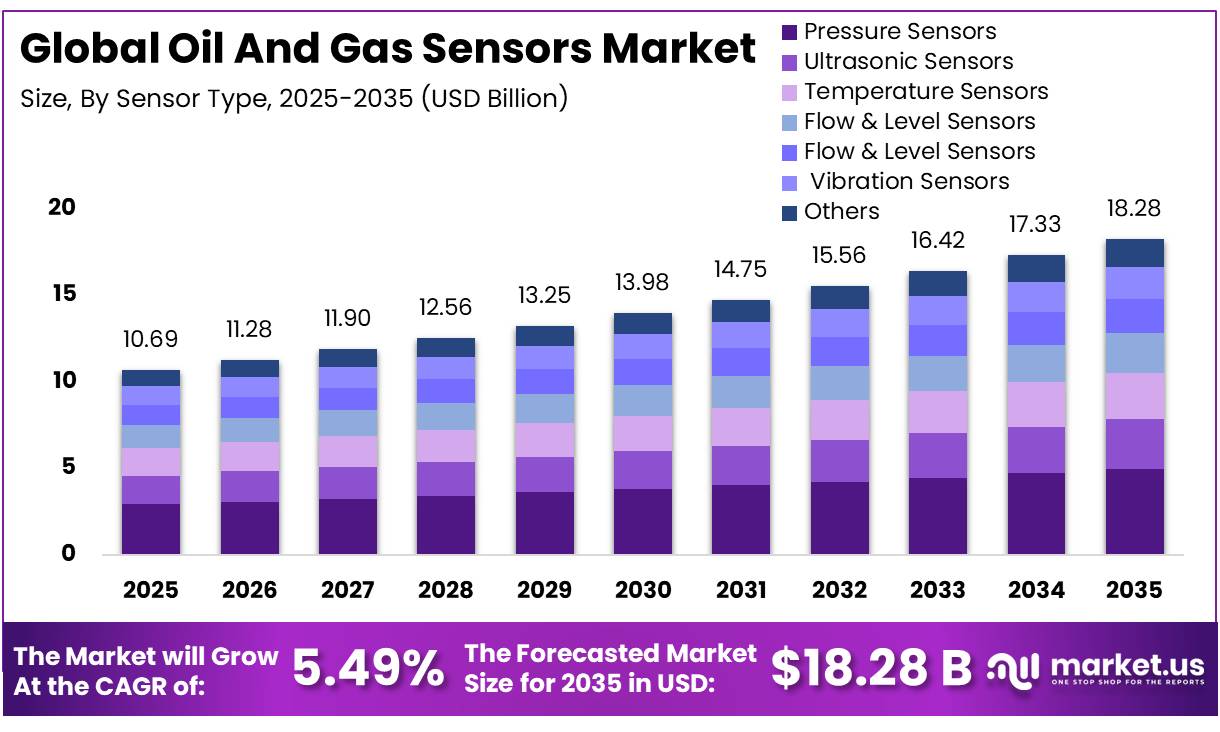
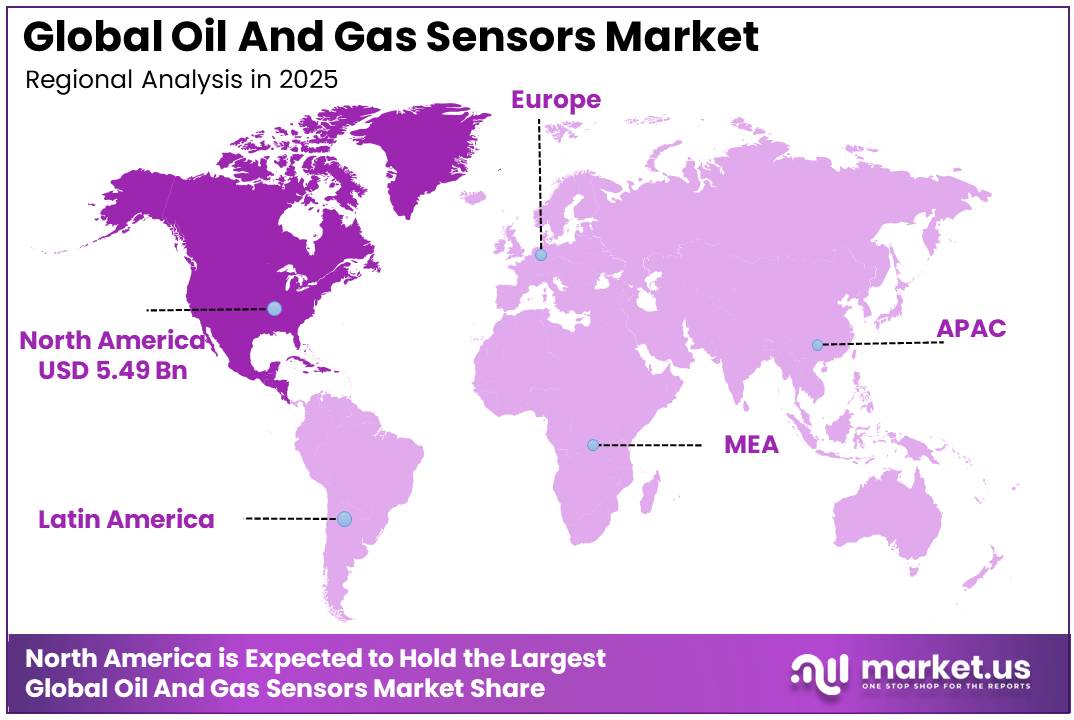
In 2025, the Global Oil And Gas Sensors Market was valued at USD 10.69 billion, and between 2025 and 2035, this market is estimated to register a CAGR of 5.49%, reaching about USD 18.28 billion by 2035. In 2025, North America led the market, achieving over 38.4% share with a revenue of USD 4.11 Billion.
Oil and gas sensors are critical instruments used to measure pressure, temperature, flow, level, vibration, gas composition, corrosion, and equipment condition across upstream, midstream, and downstream facilities. Their use is expanding as operators connect field instruments with industrial networks, edge computing, cloud platforms, and predictive analytics. These systems support safer drilling, pipeline control, refinery automation, emissions measurement, and early fault identification while reducing dependence on manual inspection.
In 2025, U.S. crude oil production averaged a record 13.6 million barrels per day, increasing by 3%, or 350,000 barrels per day, from 2024, according to the U.S. Energy Information Administration. The Lower 48 states, excluding federal offshore production, supplied 11.3 million barrels per day and represented 83% of national output in 2025.
Key Takeaways
- The Global Oil And Gas Sensors Market was valued at USD 10.69 billion in 2025.
- The market is projected to grow at a CAGR of 5.49% and is estimated to reach USD 18.28 billion by 2035.
- On the basis of sensor type, Pressure Sensors dominated the market, constituting 27.2% of the total market share.
- Based on the connectivity, Wired dominated the market, with a substantial market share of around 72.3%.
- Based on the sector, Upstream led the market, comprising 45.5% of the total market.
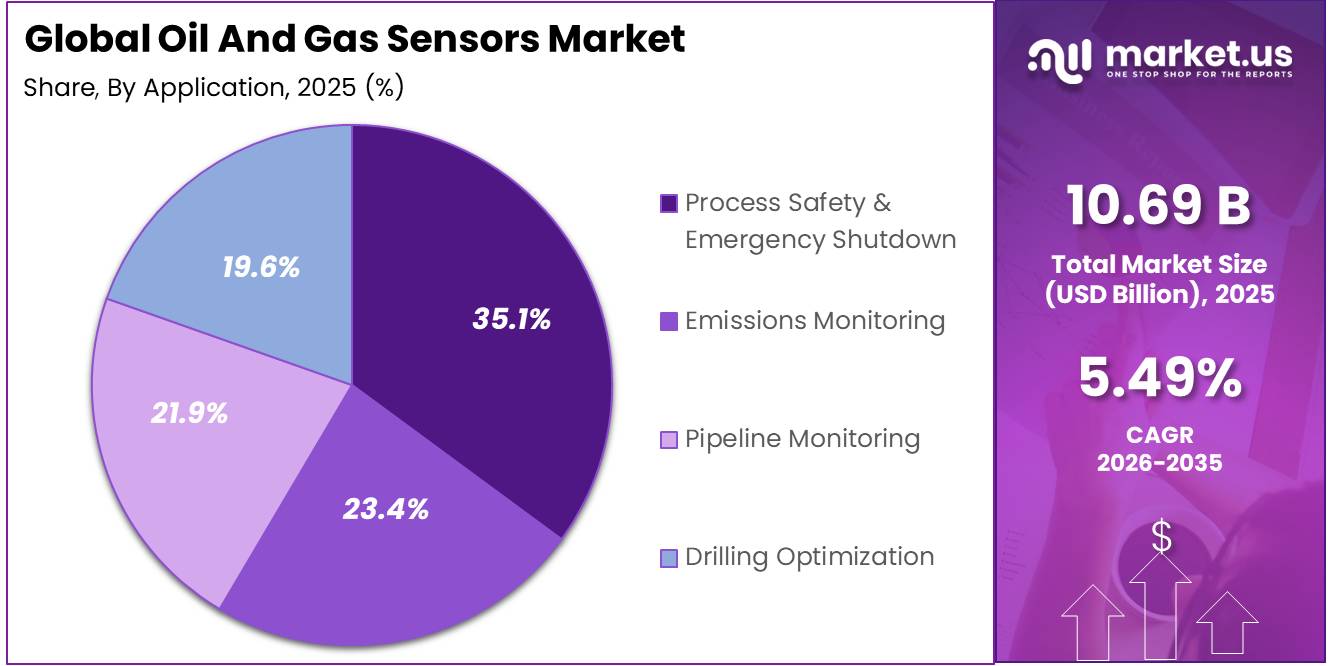
- On the basis of application, Process Safety & Emergency Shutdown dominated the market, constituting 35.1% of the total market share.
- In 2025, North America was the most dominant region in the market, accounting for 38.4% of the total global consumption.
In 2025, the United States operated 2,397,861 miles of gas distribution mains and estimated service lines, according to the Pipeline and Hazardous Materials Safety Administration. PHMSA also reported 413,330 miles of natural gas transmission and gathering pipelines and 227,457 miles of hazardous-liquid and carbon-dioxide pipelines in 2025. Monitoring such infrastructure requires leak detection, pressure control, acoustic sensing, corrosion monitoring, and remote telemetry, particularly in ageing or geographically dispersed networks.
- U.S. LNG exports reached 15.0 billion cubic feet per day in 2025, compared with 0.5 billion cubic feet per day in 2016. In its February 2026 outlook, the EIA forecast exports to exceed 18.1 billion cubic feet per day in 2027. This expansion creates opportunities for cryogenic temperature sensors, tank-level instruments, gas detectors, custody-transfer meters, and predictive-maintenance systems.
Environmental regulation is accelerating methane-monitoring investment. In December 2024, the U.S. Department of Energy and Environmental Protection Agency announced approximately USD 850 million for 43 methane measurement and mitigation projects. The agencies stated that federal standards could reduce covered oil and gas methane emissions by nearly 80% from 2024 to 2038.
Future opportunities will therefore centre on continuous methane detection, wireless sensors, fibre-optic monitoring, digital twins, autonomous operations, and artificial-intelligence-based maintenance. Growth is also expected in subsea production, carbon-dioxide transport and storage, hydrogen blending, and remote asset management, where accurate real-time data improves integrity, compliance, and operating efficiency. Sensor suppliers offering interoperable, low-power, and cybersecurity-ready products are positioned to capture this investment.
Sensor Type Analysis
Pressure Sensors dominate with a 27.2% share as precise pressure control remains essential in oil and gas wells.
In 2025, Pressure Sensors held a dominant market position, capturing more than a 27.2% share. These sensors are widely installed in wellheads, drilling systems, pipelines, compressors, and processing equipment to track pressure changes and maintain stable operating conditions. A 2025 oil-well sensor study available through the U.S. National Institutes of Health tested a pressure sensor across a 0–60 MPa operating range and reported measurement accuracy of 0.5% after temperature compensation.
Ultrasonic Sensors are the fastest-growing segment in the Oil and Gas Sensors Market, accounting for a 15.6% share and expanding at a 6.2% CAGR. Their growth is driven by increasing use in pipeline inspection, flow measurement, corrosion detection, tank-level monitoring, and leak identification. These sensors can examine pipes and equipment without interrupting operations or making direct contact with the measured fluid.
Connectivity Analysis
Wired connectivity dominates with a 72.3% share due to stable and continuous data transmission.
In 2025, Wired held a dominant market position, capturing more than a 72.3% share. Wired sensors remain widely used across pipelines, refineries, processing plants, and storage facilities because they deliver stable signals with minimal interference. They are well suited to fixed installations where pressure, temperature, flow, and equipment conditions must be monitored continuously. The large scale of pipeline infrastructure also supports the need for dependable wired monitoring. In 2025, the U.S. Pipeline and Hazardous Materials Safety Administration recorded 413,330 miles of natural gas transmission and gathering pipelines, creating a broad installed base for permanent sensing and control systems.
Wireless is the fastest growing segment, expanding at a 6.5% CAGR. Its growth is supported by rising demand for flexible monitoring across remote wells, offshore platforms, storage areas, and difficult-to-access pipeline locations. Wireless sensors reduce the need for extensive cabling and can be installed with less disruption to existing operations. They also allow operators to collect equipment data from wider areas and respond more quickly to leaks, abnormal pressure, vibration, or temperature changes.
Sector Analysis
Upstream dominates with a 45.5% share as oil and gas producers expand real-time well monitoring
In 2025, Upstream held a dominant market position, capturing more than a 45.5% share. The segment remained the largest user of oil and gas sensors because exploration and production sites require continuous monitoring of well pressure, flow, temperature, vibration, gas concentration, and equipment condition. According to the U.S. Energy Information Administration, U.S. crude oil production averaged a record 13.6 million barrels per day in 2025. The agency also reported that marketed natural gas production averaged 118.5 billion cubic feet per day during the same year.
Midstream is the fastest growing segment and is expected to expand at a 7% CAGR. Growth is being supported by the increasing use of pressure, flow, temperature, corrosion, methane, and acoustic sensors across pipelines, compressor stations, storage terminals, and natural gas processing facilities. These devices provide continuous information on product movement and infrastructure condition, helping operators identify leaks, pressure changes, equipment wear, and possible pipeline failures.
Application Analysis
Process Safety & Emergency Shutdown leads with 35.1% as operators prioritize rapid hazard detection
In 2025, Process Safety & Emergency Shutdown held a dominant market position, capturing more than a 35.1% share. The segment remained important because oil and gas facilities depend on pressure, temperature, flame, and gas sensors to detect dangerous operating conditions before they develop into major incidents. These sensors support automatic equipment isolation, valve closure, alarms, and emergency shutdown procedures.
Emissions Monitoring is the fastest growing segment. In 2025, the segment accounted for 23.4% of the application market and is expected to expand at a 6.5% CAGR. Growth is supported by the wider use of methane detectors, continuous gas monitors, optical sensors, and remote leak-detection systems. Oil and gas operators are strengthening emissions measurement to identify equipment leaks, improve reporting accuracy, reduce product losses, and meet environmental requirements.
Key Market Segments
By Sensor Type
- Pressure Sensors
- Ultrasonic Sensors
- Temperature Sensors
- Flow & Level Sensors
- Gas Sensors
- Vibration Sensors
- Others
By Connectivity
- Wired
- Wireless
By Sector
- Upstream
- Midstream
- Downstream
By Application
- Process Safety & Emergency Shutdown
- Emissions Monitoring
- Pipeline Monitoring
- Drilling Optimization
Driver Analysis
Offshore leasing and subsea asset instrumentation
BOEM’s 2025–2026 leasing and offshore program activity supports a medium-term rise in demand for subsea and topside sensing. BOEM reported that its proposed 11th National OCS Program includes 34 potential lease sales across 21 of 27 planning areas, while its 2025 year-in-review highlighted a landmark Gulf lease sale that generated $300.4 million in high bids across 181 blocks, with 219 bids from 30 companies and a proposed second Gulf sale in March 2026.
For sensor suppliers, offshore projects are structurally attractive because instrumentation density and qualification thresholds are higher than in many onshore applications. New offshore developments and brownfield platform upgrades need Class I/Div 1 or equivalent hazardous-area compliance, subsea reliability, redundancy, and integration with safety instrumented systems, all of which lift revenue per wellhead, manifold, or processing train.
Driver Impact Analysis
| Driver | (~) % Impact on CAGR | Geographic Relevance | Impact Timeline |
|---|---|---|---|
| Methane compliance monitoring expansion | +2.2% | North America core; EU reference spill-over; select APAC LNG corridors | Short term (≤ 2 years) |
| Pipeline leak detection rule tightening | +1.7% | North America core; offshore gathering systems; Latin America spill-over | Short term (≤ 2 years) |
| Offshore leasing and subsea asset instrumentation | +1.3% | U.S. Gulf core; Brazil/North Sea analog markets; Middle East offshore | Medium term (2-4 years) |
| Refinery and sulfur stream continuous sensing | +1.1% | North America refining hubs; Middle East export refineries; South Asia complexes | Short term (≤ 2 years) |
| Orphan well and remediation monitoring demand | +0.8% | U.S. onshore basins core; Canada spill-over | Medium term (2-4 years) |
| Production resilience and brownfield digital retrofit | +1.0% | North America core; Middle East mature fields; APAC processing nodes | Medium term (2-4 years) |
Restraint Analysis
Certification and compliance drag
OSHA’s process safety management framework requires rigorous controls around hazardous chemical releases, while BSEE’s FY2025 budget justification highlights active rulemaking priorities, stronger decommissioning oversight, inspection-fee structures, and enforcement timelines, all of which increase operator caution on device selection, cybersecurity review, fail-safe architecture, and maintenance traceability; in practice, this can add 3-6 months to project acceptance, raise pre-sale engineering and documentation cost by 5% to 8%, and reduce smaller vendors’ win rates because customers prefer fewer approved suppliers with proven compliance files.
The strategic impact is not just delay but market concentration: procurement shifts toward certified incumbents, distributors demand higher liability cover, and emerging sensor formats face slower qualification, pulling about 1.6 percentage points from baseline CAGR despite healthy long-run need for monitoring.
Restraint Impact Analysis
| Restraint | (~) % Impact on CAGR | Geographic Relevance | Impact Timeline |
|---|---|---|---|
| Upstream CapEx volatility | -2.1% | North America core, MENA, LatAm offshore | Short term (≤ 2 years) |
| Certification and compliance drag | -1.6% | North America core, EU, offshore global | Medium term (2-4 years) |
| Electronics import-cost pressure | -1.4% | North America, EU, APAC export corridors | Short term (≤ 2 years) |
| Offshore decommissioning shift | -1.2% | U.S. Gulf, North Sea, mature APAC basins | Medium term (2-4 years) |
| Brownfield integration complexity | -1.1% | North America shale, Middle East, offshore global | Long term (≥ 4 years) |
| Skilled-labor and commissioning gaps | -0.9% | North America, EU, Australia, GCC | Medium term (2-4 years) |
Opportunity Analysis
Methane MRV platforms
The EU methane framework requires operators to measure, monitor, report, and verify emissions and requires importers to report methane data from 2025 onward, while the U.S. EPA framework explicitly accommodates advanced detection technologies including continuous monitors and defines continuous systems capable of recording emissions at least once per 12-hour block with a detection threshold of at least 0.40 kg/hr; that combination creates a monetizable compliance layer above the baseline hardware market rather than a continuation of today’s replacement demand.
For vendors, this opens an adjacent software-and-services TAM that can lift blended gross margin by roughly 800 to 1,200 basis points versus hardware-only portfolios, reduce churn through multiyear compliance subscriptions, and raise annual revenue per monitored site by an estimated 1.7 times to 2.4 times through recurring verification, calibration, audit trails, and exception management; the strategic white space is that many operators still buy devices, not outcomes, so the upside comes from converting a capex sensor purchase into a recurring MRV operating platform that captures budget from ESG, compliance, and commercial teams simultaneously.
Opportunity Impact Analysis
| Opportunity | (~) % Potential CAGR | Geographic Relevance | Execution Window |
|---|---|---|---|
| Methane MRV platforms | +2.2% | EU, North America, Middle East export corridors | Short term (≤ 2 years) |
| Sensor-as-a-service LDAR | +1.8% | U.S. core, Canada, LatAm shale, APAC | Short term (≤ 2 years) |
| Import-grade certification sensors | +1.5% | EU-linked exporters, Middle East, Africa, U.S. LNG | Medium term (2-4 years) |
| Fiber-optic pipeline retrofit | +1.9% | North America core, EU, offshore corridors | Medium term (2-4 years) |
| Offshore digital safety stacks | +1.3% | Gulf of Mexico, North Sea, Brazil, Middle East offshore | Medium term (2-4 years) |
| Hydrogen-ready gas network sensing | +1.1% | North America, EU, Japan, Korea | Long term (≥ 4 years) |
Challenges Analysis
OT Cyber Hardening Gaps
Connected sensors increasingly sit inside PLC-, SCADA-, and remote-monitoring environments that have become explicit cyber targets, and CISA’s 2026 advisory warned that Iranian-affiliated actors were exploiting internet-connected operational technology devices across U.S. critical infrastructure, with recommended remediation centered on removing PLCs from direct internet exposure, tightening firewall rules, checking logic integrity, and accelerating patching outside normal downtime where necessary.
For oil and gas operators, this turns sensor modernization into a cyber-physical integration problem: adding smart transmitters or wireless gateways often triggers network segmentation work, secure access redesign, historian hardening, and validation delays that can add 8 to 14 weeks to deployment, lift total installed project cost by 10% to 20%, and require annual cybersecurity overhead equivalent to 2% to 4% of system lifecycle cost, especially on brownfield assets where legacy controllers remain embedded.
Challenges Impact Analysis
| Challenge | (~) % CAGR Friction | Geographic Relevance | Mitigation Horizon |
|---|---|---|---|
| Methane Monitoring Burden | -1.2% | North America core, EU regulatory hubs, Middle East export assets | Medium term (2-4 years) |
| Electronics Supply Volatility | -0.9% | APAC manufacturing corridors, North America integrators, EU OEM bases | Medium term (2-4 years) |
| OT Cyber Hardening Gaps | -1.0% | U.S. offshore and pipeline networks, Middle East brownfields, Latin America aging assets | Long term (≥ 4 years) |
| Harsh-Environment Calibration Drift | -0.8% | Offshore basins, Arctic and desert assets, sour-gas fields | Long term (≥ 4 years) |
| Field Retrofit Complexity | -1.1% | North America midstream, North Sea, GCC brownfield clusters, APAC LNG sites | Medium term (2-4 years) |
| Engineering Talent Scarcity | -0.7% | U.S. design centers, EU automation hubs, APAC instrumentation clusters | Long term (≥ 4 years) |
Geopolitical Impact Analysis
War Reshapes Oil and Gas Sensor Demand
The Middle East conflict and the Russia-Ukraine war are changing priorities across the global oil and gas sensor market. Disruptions around the Strait of Hormuz reduced Gulf production and made crude prices volatile during the second quarter of 2026. Meanwhile, repeated attacks on refineries, pipelines, terminals, and export facilities have increased the need for continuous monitoring of pressure, flow, temperature, vibration, gas leakage, and equipment condition.
Operators are responding by strengthening early-warning systems, remote inspection, emergency shutdown networks, and predictive maintenance. This supports demand for rugged, wireless, and cyber-secure sensors that can function at isolated sites where human access is restricted. Pipeline rerouting, higher storage activity, and increased refinery utilization outside conflict zones are also creating fresh installation and replacement requirements.
However, the war is raising costs for sensor manufacturers. Shipping delays, higher insurance charges, volatile energy prices, and limited access to electronic components and specialty metals are affecting production schedules and margins. Some projects may face postponement as operators protect cash and reassess security risks. Even so, spending on safety-critical sensing is expected to remain resilient because energy companies cannot reduce monitoring when infrastructure threats, supply disruptions, and regulatory pressure are increasing.
Regional Analysis
North America Leads While Asia Pacific Accelerates Oil and Gas Sensor Adoption
In 2025, North America held a dominant market position, capturing more than a 38.4% share and generating approximately USD 4.11 billion. The region benefits from extensive shale operations, offshore assets, processing plants, and cross-border pipeline systems that require continuous monitoring.
- U.S. crude oil production reached a record 13.6 million barrels per day in 2025, while marketed natural gas production averaged 118.5 billion cubic feet per day. Canada also produced a record 310.9 million cubic metres of crude oil and equivalent products. This operating scale supports demand for pressure, flow, temperature, vibration, corrosion, and gas detection sensors across critical operating environments.
Asia Pacific is the fastest-growing regional segment, projected to expand at a 7% CAGR. Growth is supported by rising oil and gas production, refinery upgrades, LNG terminals, petrochemical capacity, and wider pipeline networks across China, Southeast Asia, Australia, and other regional markets. China produced 216.05 million tonnes of crude oil and 261.9 billion cubic metres of natural gas in 2025, increasing the need for reliable process control and safety monitoring. Asia Pacific also accounted for 360,000 barrels per day of additional oil demand during 2025.
Key Regions and Countries Covered
- North America
- The US
- Canada
- Europe
- Germany
- France
- The UK
- Spain
- Italy
- Russia & CIS
- Rest of Europe
- APAC
- China
- Japan
- South Korea
- India
- ASEAN
- Rest of APAC
- Latin America
- Brazil
- Mexico
- Rest of Latin America
- Middle East & Africa
- GCC
- South Africa
- Rest of MEA
Key Players Analysis
SKF strengthens its oil and gas sensor position through condition-monitoring systems for pumps, compressors, turbines, motors, and other rotating assets. Its wireless Enlight Collect IMx-1 combines vibration and temperature measurement, while the CMWA 6100-EX sensor carries ATEX Zone 1 certification and its gateway supports ATEX Zone 2 installations. Sensor communication uses 128-bit AES encryption, and gateway-to-network traffic uses 4,096-bit TLS protection.
Baker Hughes serves oil and gas operators through its Bently Nevada machinery-monitoring portfolio, covering pressure, vibration, proximity, speed, and temperature measurement. The 3300 XL 11-millimeter system provides a 4-millimeter linear sensing range and 3.94 volts-per-millimeter output, while its 16-millimeter high-temperature system operates at up to 350°C. Baker Hughes reported USD 27.7 billion in 2025 revenue, invested USD 600 million in research and development, and employed about 56,000 people across more than 120 countries across upstream, midstream, and downstream operations globally.
Thermometrics Corporation, operating within Amphenol Advanced Sensors, supplies customizable temperature, pressure, humidity, and fluid-monitoring solutions for demanding industrial equipment. Its GE-2098 combination sensor measures absolute pressure from 20 to 204 kilopascals, delivers pressure accuracy of ±1%, and operates between -40°C and 135°C. The unit also withstands proof pressure of 22.5 bar and burst pressure of 50 bar.
Bosch Rexroth combines hydraulic sensing, connected controls, and predictive analytics for offshore and industrial energy equipment. Its HM20 pressure transducers cover ratings from 10 to 630 bar and provide either 4–20 milliamp or 0.1–10-volt outputs. The company’s subsea electrification platform supports depths of 4,000 meters, SIL 3 safety, 24-volt power, and a 25-year design life. Bosch Rexroth also operates in more than 80 countries, supported by approximately 32,600 associates and EUR 6.5 billion in 2024 sales globally across industrial markets.
The Major Players in The Industry
- Honeywell International Inc.
- TE Connectivity Ltd.
- Robert Bosch GmbH
- ABB Ltd.
- Siemens AG
- Gems Sensors
- LORD Corporation
- Oxsensis Ltd.
- Opsens Solutions
- SGX Sensortech
- Emerson Electric Co.
- 3M Gas & Flame Detection
- BEI Sensors
- Pyromation
- Smart Fibres Ltd.
- Fafnir GmbH
- SKF
- Baker Hughes
- Thermometrics Corporation
- Bosch Rexroth
- Other Key Players
Key Development
- In May 2025, Bosch Rexroth and WITTENSTEIN introduced the eSEA Spin subsea actuator for precise gas and liquid flow control. The product operates at depths of up to 4,000 metres using a 24-volt power supply, helping offshore operators replace long hydraulic connections with electrically controlled equipment.
- In June 2025, Honeywell completed the USD 2.16 billion acquisition of Sundyne, adding around 1,000 employees and a large installed base of pumps and gas compressors used in refining, LNG and petrochemical facilities. The deal also creates opportunities to connect industrial equipment with Honeywell Forge for remote monitoring and maintenance planning.
Report Scope
| Report Features | Description |
|---|---|
| Market Value (2025) | USD 10.69 Bn |
| Forecast Revenue (2035) | USD 18.28 Bn |
| CAGR (2026-2035) | 5.49% |
| Base Year for Estimation | 2025 |
| Historic Period | 2020-2024 |
| Forecast Period | 2026-2035 |
| Report Coverage | Revenue Forecast, Market Dynamics, Competitive Landscape, Recent Developments |
| Segments Covered | The market is segmented by sensor type (Pressure Sensors, Ultrasonic Sensors, Temperature Sensors, Flow and Level Sensors, Gas Sensors, Vibration Sensors, Others), by connectivity (Wired, Wireless), by sector (Upstream, Midstream, and Downstream), and by application (Process Safety and Emergency Shutdown, Emissions Monitoring, Pipeline Monitoring, Drilling Optimization) |
| Regional Analysis | North America – The US & Canada; Europe – Germany, France, The UK, Spain, Italy, Russia & CIS, Rest of Europe; APAC– China, Japan, South Korea, India, ASEAN & Rest of APAC; Latin America– Brazil, Mexico & Rest of Latin America; Middle East & Africa– GCC, South Africa, & Rest of MEA |
| Competitive Landscape | Honeywell International Inc., TE Connectivity Ltd., Robert Bosch GmbH, ABB Ltd., Siemens AG, Gems Sensors, LORD Corporation, Oxsensis Ltd., Opsens Solutions, SGX Sensortech, Emerson Electric Co., 3M Gas & Flame Detection, BEI Sensors, Pyromation, Smart Fibres Ltd., Fafnir GmbH, SKF, Baker Hughes, Thermometrics Corporation, Bosch Rexroth, Other Key Players |
| Customization Scope | Customization for segments, region/country-level will be provided. Moreover, additional customization can be done based on the requirements. |
| Purchase Options | We have three licenses to opt for: Single User License, Multi-User License (Up to 5 Users), Corporate Use License (Unlimited Users and Printable PDF) |





































