


Report Overview
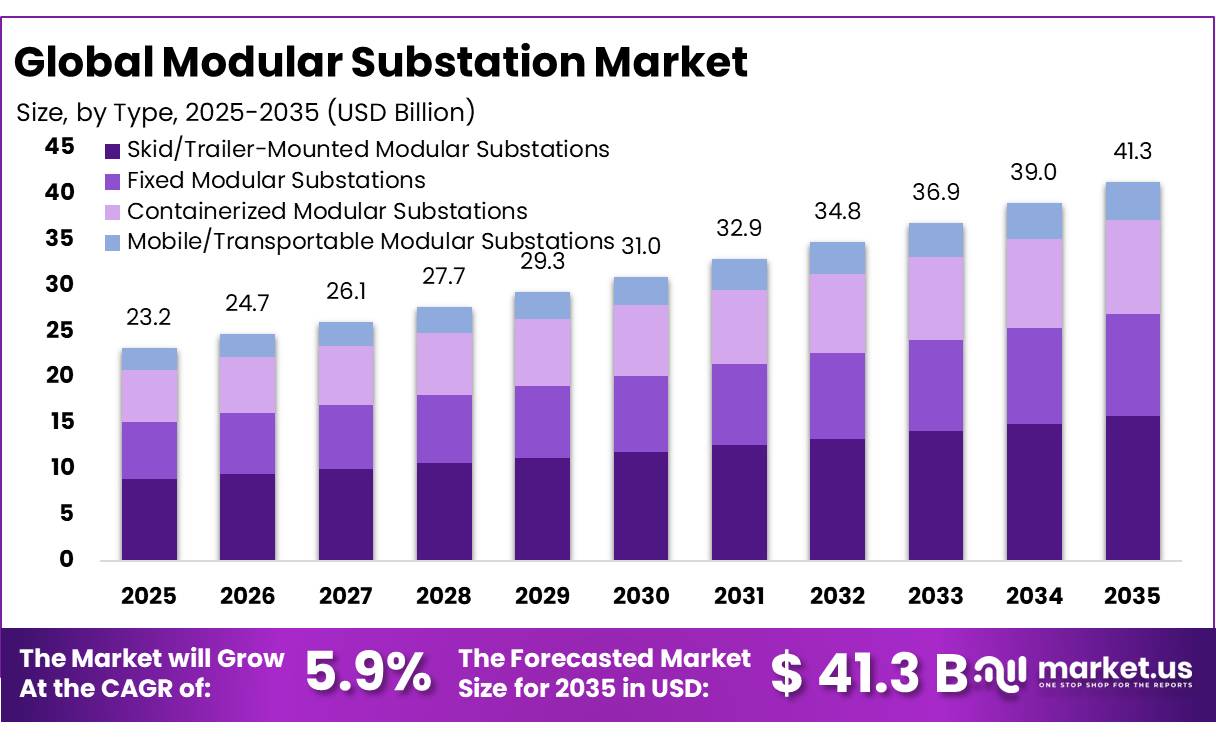
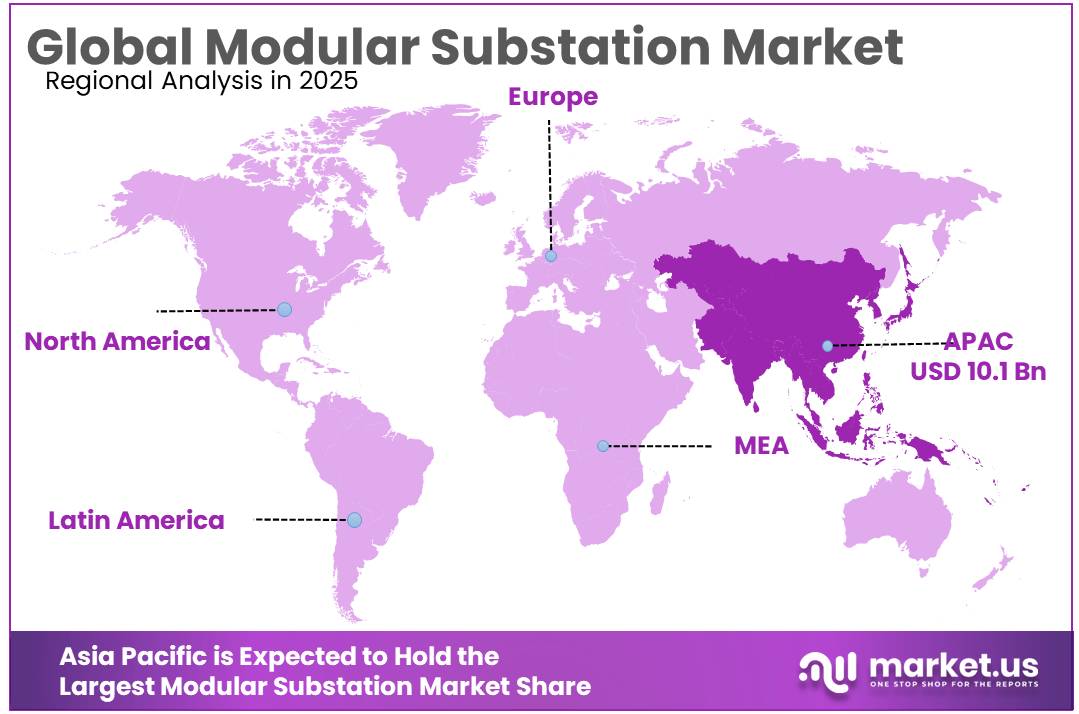
The Global Modular Substation Market size is expected to be worth around USD 41.3 Billion by 2035, from USD 23.2 Billion in 2025, growing at a CAGR of 5.9% during the forecast period from 2026 to 2035. In 2025, Asia Pacific held a dominant market position, capturing more than a 44.00% share, holding USD 10.19 Billion revenue.
The Modular Substation industry is becoming an important part of modern electricity infrastructure as utilities, renewable-energy developers, industrial facilities, data centers, and mining operators look for faster ways to expand power networks. Modular substations are largely engineered and assembled in controlled factory environments before being transported to site, reducing field construction work and helping shorten installation schedules.
- The wider grid investment environment is creating a strong industrial base for modular solutions. The International Energy Agency reported in 2026 that global annual grid investment is around USD 400 billion, but spending needs to rise by roughly 50% by 2030 to meet electricity demand. More than 2,500 GW of renewable generation, storage, and large-load projects are currently waiting in grid connection queues worldwide. These conditions increase demand for quickly deployable substations that can connect new generation and electricity-consuming facilities.
Europe is also entering a major grid-development cycle. The European Commission estimated in 2025 that approximately EUR 730 billion will be required for distribution-grid development and another EUR 477 billion for transmission networks through 2040. Modular substations can support these programs because standardized electrical rooms, switchgear, transformers, protection systems, and control equipment can be integrated before arriving at the final project location.
- The U.S. Department of Energy administers a USD 10.5 billion Grid Resilience and Innovation Partnerships program, designed to improve grid flexibility, reliability, and resilience. By 2026, more than USD 6 billion had been announced through earlier GRIP rounds, while nearly USD 2 billion was announced under the SPARK funding opportunity for advanced transmission upgrades.
Supply-chain investment also shows the strength of the underlying transformer and substation equipment industry. In September 2025, Hitachi Energy announced more than USD 1 billion of U.S. manufacturing investment, including USD 457 million for a large power-transformer facility expected to create more than 825 jobs. In Canada, the company committed another CAD 270 million, or USD 195 million, to nearly triple large-transformer production capacity.
Future growth opportunities are expected around renewable substations, data-center power infrastructure, battery-storage connections, digital protection, remote monitoring, prefabricated e-houses, and mobile substations. IEA data shows grid infrastructure can require 5–15 years to plan and complete, while data centers can be developed in only 1–3 years. This timing gap strengthens the case for modular construction, as utilities and developers increasingly need faster, repeatable, and digitally enabled power-delivery solutions.
Key Takeaways
- Modular Substation Market size is expected to be worth around USD 41.3 Billion by 2035, from USD 23.2 Billion in 2025, growing at a CAGR of 5.9%.
- Skid/Trailer-Mounted Modular Substations held a dominant market position, capturing more than a 38.00% share of the Modular Substation Market.
- Air-Insulated Modular Substations held a dominant market position, capturing more than a 57.30% share of the Modular Substation Market.
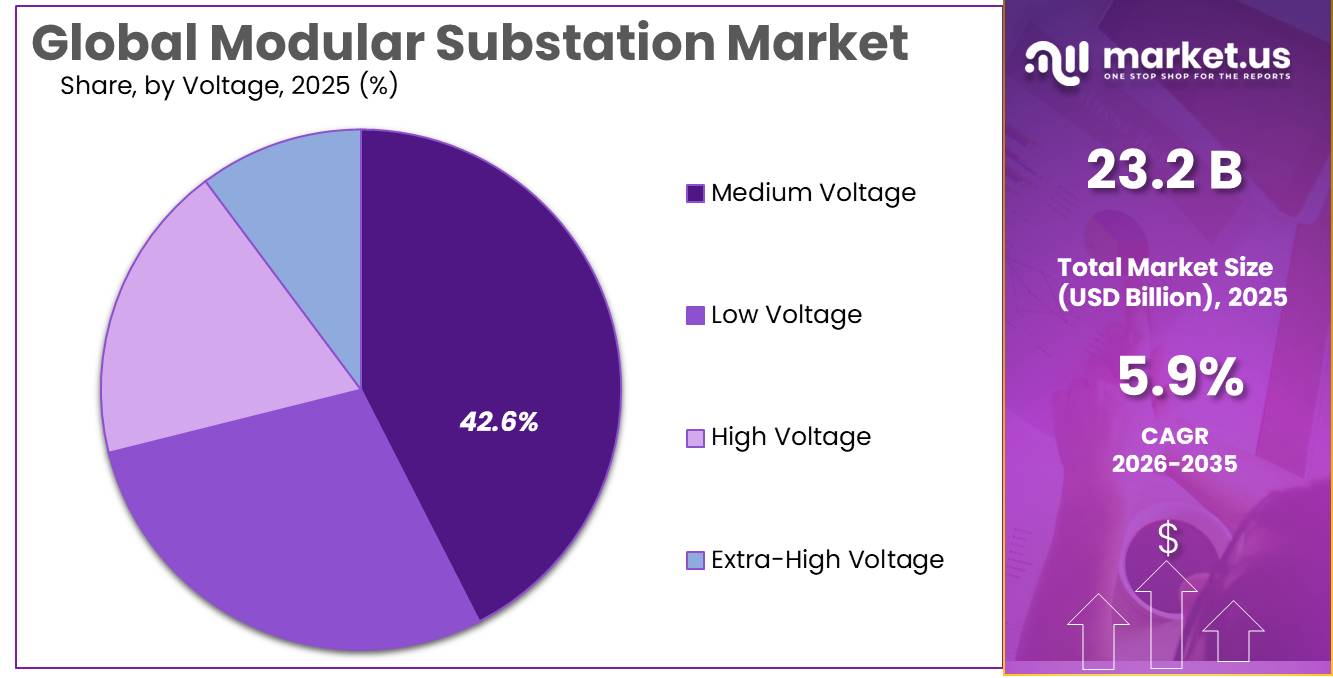
- Medium Voltage held a dominant market position, capturing more than a 42.56% share.
- Power Utilities held a dominant market position, capturing more than a 40.00% share.
- Asia Pacific held a dominant market position in 2025, capturing more than a 44.00% share and reaching USD 10.19 billion. China provides a major demand base for modular substations.
By Type Analysis
Skid/Trailer-Mounted Modular Substations Lead with 38.00% Share as Utilities Prioritize Fast and Flexible Grid Deployment
In 2025, Skid/Trailer-Mounted Modular Substations held a dominant market position, capturing more than a 38.00% share of the Modular Substation Market by type. These systems are preferred where utilities, renewable projects, industrial sites, and emergency-response teams need electrical infrastructure that can be transported and installed quickly. Their factory-built design reduces site work and makes them useful for temporary capacity, maintenance bypasses, storm recovery, and rapidly expanding loads.
- Government grid-resilience investment supports this equipment category. The U.S. Department of Energy is administering USD 10.5 billion through the Grid Resilience and Innovation Partnerships and related grid programs to improve system flexibility and resilience. Eligible technologies include monitoring, control, hardening, communications, and equipment that supports faster grid restoration.
Fixed Modular Substations remain an important segment of the Modular Substation Market because they provide permanent power transformation, protection, switching, and control while retaining the advantages of prefabricated construction. They are increasingly suitable for renewable plants, data centers, industrial facilities, utility distribution networks, and large transmission projects where installation speed and standardized engineering are important.
By Insulation Type Analysis
Air-Insulated Modular Substations Lead with 57.30% Share as Utilities Expand Conventional Grid Infrastructure
In 2025, Air-Insulated Modular Substations held a dominant market position, capturing more than a 57.30% share of the Modular Substation Market by insulation type. Air-insulated designs remain widely used because they offer comparatively simple construction, easier equipment access, and straightforward maintenance where sufficient installation space is available. Their modular form allows switchgear, transformers, protection systems, and control equipment to be factory assembled and deployed faster at utility and industrial sites.
- Grid modernization is creating a large project base for this segment. In September 2026, the U.S. Department of Energy selected 31 grid-improvement projects across 26 states, representing USD 5.25 billion in total investment, including USD 1.9 billion in federal funding. The projects are expected to support about 100 million Americans and add more than 23 GW of electricity capacity.
Gas-Insulated Modular Substations remain an important segment where utilities require compact equipment, enclosed switchgear, and reliable operation in locations with limited space. Their smaller physical footprint makes them suitable for urban substations, industrial plants, renewable-energy connections, tunnels, and other sites where conventional air clearances are difficult to provide.
By Voltage Analysis
Medium Voltage Leads the Modular Substation Market with 42.56% Share as Distribution Networks Expand
In 2025, Medium Voltage held a dominant market position, capturing more than a 42.56% share of the Modular Substation Market by voltage. Medium-voltage modular substations are widely used across utility distribution, industrial facilities, renewable projects, data centers, and commercial infrastructure because they can combine switchgear, transformers, protection, and control systems in compact prefabricated packages. Their shorter installation schedules also make them useful where new electrical capacity must be added quickly.
- Government grid investment supports this segment. In September 2026, the U.S. Department of Energy announced 31 grid-improvement projects across 26 states, representing USD 5.25 billion in total investment, including USD 1.9 billion in federal funding. The projects are expected to improve electricity reliability for around 100 million Americans and add more than 23 GW of capacity. Such grid expansion creates additional requirements for modular distribution substations connecting new loads and generation resources.
High Voltage modular substations are becoming increasingly important for transmission networks, utility interconnections, renewable-energy projects, data centers, and large industrial loads. Prefabricated high-voltage systems can reduce field construction requirements while integrating transformers, protection equipment, controls, and high-capacity switchgear into standardized designs.
By End User Analysis
Power Utilities Lead the Modular Substation Market with 40.00% Share as Grid Modernization Accelerates
In 2025, Power Utilities held a dominant market position, capturing more than a 40.00% share of the Modular Substation Market by end user. Utilities are increasingly using modular substations to expand transmission and distribution capacity, replace aging infrastructure, connect renewable generation, and improve grid resilience. Factory-built designs can reduce site work and help utilities add electrical capacity faster than conventional field-built substations.
- Government investment strongly supports this demand. In September 2026, the U.S. Department of Energy announced 31 grid-improvement projects across 26 states, representing USD 5.25 billion in total investment. The program includes USD 1.9 billion in federal funding and USD 3.35 billion in recipient cost sharing. Projects are expected to rebuild or reconductor more than 1,500 miles of transmission lines and deploy grid-enhancing technologies across nearly 21,000 miles.
Commercial end users represent an important segment of the Modular Substation Market as data centers, office complexes, hospitals, warehouses, retail facilities, and large campuses require reliable and quickly deployable power infrastructure. Modular substations allow these facilities to integrate transformers, switchgear, protection, metering, and control equipment within compact factory-assembled systems.
Key Market Segments
By Type
- Fixed Modular Substations
- Skid/Trailer-Mounted Modular Substations
- Containerized Modular Substations
- Mobile/Transportable Modular Substations
By Insulation Type
- Air-Insulated Modular Substations
- Gas-Insulated Modular Substations
By Voltage
- Low Voltage
- Medium Voltage
- High Voltage
- Extra-High Voltage
By End User
- Power Utilities
- Commercial
- Oil & Gas
- Mining
- Transportation
- Data Centers
- Other Industries
Driver Analysis
Grid Renewal and Capacity Expansion
Aging transmission and distribution infrastructure, combined with rapid load growth from electrification, renewable generation, industrial reshoring, transport, and digital infrastructure, is creating a structural replacement-and-expansion cycle that favors modular substations where utilities need predictable delivery, repeatable engineering, and less on-site construction risk. The global grid investment gap is substantial: annual worldwide grid expenditure is approximately USD 400 billion today, yet the International Energy Agency estimates that annual investment must increase by about 50% by 2030 to meet expected electricity demand and system-expansion requirements.
In Europe, 40% of distribution grids are more than 40 years old, cross-border transmission capacity is expected to double by 2030, and the European Commission estimates that EUR 584 billion of grid investment is required this decade, creating a material pipeline for compact, prefabricated substation packages that can replace constrained urban assets and add capacity without the full construction duration of conventional site-built installations. Modular architectures convert much of the project from field labor into controlled factory production: for a typical 33–132 kV deployment, standardized modules can reduce civil works and on-site electrical installation hours by approximately 25–45%, compress field commissioning from roughly 12–20 weeks to 4–10 weeks, and reduce exposure to weather, skilled-labor shortages, and multi-contractor coordination failures.
This changes the supplier business model from component selling—transformers, switchgear, protection relays, and panels—to higher-value engineered systems including design, prefabrication, digital protection, commissioning, maintenance, and lifecycle monitoring; on a USD 5–25 million substation program, this can increase the systems integrator’s addressable revenue by 20–35% relative to a component-only scope. Grid modernization is therefore not merely a volume driver: it shifts procurement toward framework contracts, utility-standardized module libraries, local assembly capacity, and long-term service agreements, supporting a modeled +2.4-percentage-point uplift to the modular substation market’s baseline CAGR through the early-to-mid 2030s.
Drivers Impact Analysis
| Driver | (~) % Impact on CAGR | Geographic Relevance | Impact Timeline |
|---|---|---|---|
| Grid renewal and capacity expansion | +2.4 pp | North America, EU, China, India | Long term (≥ 4 years) |
| Renewable interconnection acceleration | +2.0 pp | EU, China, India, Middle East, Australia | Medium term (2–4 years) |
| Data-center power-density buildout | +1.8 pp | North America core, EU, APAC hubs | Short term (≤ 2 years) |
| Faster deployment versus conventional yards | +1.6 pp | Emerging APAC, Africa, LATAM, Middle East | Medium term (2–4 years) |
| Industrial electrification and resilience | +1.4 pp | North America, EU, GCC, China | Medium term (2–4 years) |
| Digital protection and asset monitoring | +1.1 pp | North America, EU, Japan, South Korea | Long term (≥ 4 years) |
Restraint Analysis
Transformer Supply Bottleneck
The largest direct restraint on modular substation market expansion is the constrained availability of power transformers, which remain the critical-path component for most 33–400 kV modular projects and cannot be substituted easily by faster-delivery enclosures, switchgear, protection panels, or control buildings.
Average power-transformer delivery times reached roughly 128 weeks in the second quarter of 2025, generator step-up transformers averaged about 144 weeks, and selected high-voltage or extra-high-voltage units can extend toward 36–60 months depending on rating, voltage class, and geographic market. This creates a fundamental contradiction for modular substation suppliers: modularization can reduce civil works and site installation time by 25–50%, yet customers cannot energize the asset until the transformer arrives, converting a potential 6–12-month deployment cycle into a 24–48-month procurement program.
For a USD 10–30 million substation package, the transformer may represent 25–45% of equipment value but determine nearly 100% of the commissioning date; a 12-month transformer delay can force utilities, renewable developers, industrial operators, and data-center customers to defer revenue generation, carry construction financing longer, and incur penalties or capacity shortfalls.
Until capacity additions, refurbishment markets, standardized ratings, and regional sourcing materially normalize supply, transformer scarcity is expected to impose an estimated -2.3-percentage-point drag on the market’s achievable CAGR through the medium term.
Restraint Impact Analysis
| Restraint | (\~) % Impact on CAGR | Geographic Relevance | Impact Timeline |
|---|---|---|---|
| Transformer supply bottleneck | -2.3 pp | North America, EU, India, APAC corridors | Medium term (2–4 years) |
| High equipment-cost inflation | -1.7 pp | North America core, EU, import-dependent markets | Short term (≤ 2 years) |
| Utility approval and interconnection delays | -1.5 pp | North America, EU, India, Australia | Medium term (2–4 years) |
| Site-specific engineering limits | -1.2 pp | Urban EU, North America, Middle East, Japan | Long term (≥ 4 years) |
| Grid-code and certification fragmentation | -1.0 pp | EU, North America, GCC, APAC | Medium term (2–4 years) |
| Project-finance and procurement constraints | -0.9 pp | Emerging APAC, LATAM, Africa, Eastern Europe | Short term (≤ 2 years) |
Opportunity Analysis
Substation-as-a-Service Fleets
This is an opportunity rather than a current market driver because the prevailing market remains based on outright equipment procurement, EPC contracts, and customer-owned assets, with suppliers recognizing most revenue at manufacturing delivery and commissioning; a fleet owner instead retains the mobile or modular asset and sells monthly capacity, emergency availability, maintenance, remote monitoring, and rapid deployment. A USD 3–8 million 33–132 kV modular substation could be contracted under a five- to eight-year service agreement at an indicative USD 55,000–175,000 monthly availability fee, with separate mobilization, fuel or auxiliary-power, engineering, and operating charges, enabling the buyer to avoid a 30–50% upfront deposit and match expenditure to project revenue.
For suppliers, the transition raises lifetime revenue per asset by an estimated 1.4–2.0 times versus a one-time sale, converts maintenance from a low-priority aftermarket stream into contractually embedded revenue, and creates a secondary market for redeployable equipment after project completion; however, commercial success requires utilization rates above approximately 65–70%, residual-value modeling, asset insurance, fast logistics, and bankable performance guarantees.
The timing is favorable because global grid investment must rise by about 50% from today’s annual USD 400 billion level by 2030, but the ability to finance and deliver that investment remains uneven, particularly across emerging markets and smaller utilities. Providers that standardize voltage classes, transformer ratings, protection schemes, and transport dimensions can establish regionally pooled fleets, reduce customer acquisition cost through utility framework contracts, and turn idle equipment into recurring contracted assets, supporting an estimated +1.9-percentage-point CAGR upside across North America, Europe, the GCC, and capital-constrained APAC markets.
Opportunity Impact Analysis
| Opportunity | (\~) % Potential CAGR | Geographic Relevance | Execution Window |
|---|---|---|---|
| Substation-as-a-service fleets | +1.9 pp | North America, EU, GCC, APAC emerging | Short term (≤ 2 years) |
| Mobile resilience and recovery fleets | +1.7 pp | North America, Caribbean, Japan, Australia | Short term (≤ 2 years) |
| Data-center power-block platforms | +1.6 pp | North America core, EU, India, GCC, APAC hubs | Medium term (2–4 years) |
| Renewable hybrid microgrid packages | +1.5 pp | India, Africa, LATAM, Southeast Asia, Middle East | Medium term (2–4 years) |
| Digital lifecycle-service monetization | +1.3 pp | North America, EU, Japan, South Korea | Long term (≥ 4 years) |
| Regional integrator M&A roll-ups | +1.1 pp | India, Southeast Asia, LATAM, Eastern Europe | Medium term (2–4 years) |
Challenges Analysis
Protection Engineering Talent Gap
The modular substation market faces a sustained execution challenge because factory prefabrication reduces field construction but does not eliminate the need for scarce protection-and-control engineers, high-voltage commissioning specialists, relay technicians, power-system modelers, test engineers, field electricians, and interconnection experts who determine whether a modular asset can be safely integrated into a live utility network.
Nearly half of the current U.S. power-sector workforce is expected to retire within the next decade, while 89% of transmission, distribution, and storage construction employers reported at least some difficulty finding qualified workers, illustrating a structural mismatch between grid-investment pipelines and specialist labor availability.
The shortfall is particularly acute in roles requiring 5–10 years of field experience: a 132 kV modular substation may require coordinated protection studies, short-circuit calculations, protection coordination, communications mapping, SCADA point-list validation, relay configuration, secondary injection, end-to-end testing, and utility witness approval, and the absence of one senior engineer can add 4–12 weeks to an otherwise factory-ready deployment.
At the portfolio level, an EPC or OEM with a 20-project annual pipeline may need 15–30 experienced protection-and-control professionals across design, testing, and commissioning; if vacancy rates remain near 10–20%, billable engineering capacity rather than manufacturing capacity becomes the limiting factor, causing higher subcontractor costs, repeated travel, overtime premiums, project sequencing delays, and reduced gross margin.
Firms must respond through standardized protection templates, centralized remote-testing hubs, virtual commissioning, digital relay libraries, apprenticeship pipelines, documented engineering playbooks, and selective automation of configuration checks, but the demographic replacement cycle makes this a long-duration problem across North America, Europe, Japan, and Australia, supporting an estimated -1.3-percentage-point drag on maximum market CAGR.
Challenges Impact Analysis
| Challenge | (\~) % CAGR Friction Drag | Geographic Relevance | Mitigation Horizon |
|---|---|---|---|
| Protection engineering talent gap | -1.3 pp | North America, EU, Japan, Australia | Long term (≥ 4 years) |
| Multi-vendor digital interoperability | -1.2 pp | North America, EU, China, India | Medium term (2–4 years) |
| Transformer logistics coordination | -1.1 pp | North America, EU, India, APAC corridors | Medium term (2–4 years) |
| Cybersecure digital commissioning | -1.0 pp | North America, EU regulatory hubs, advanced APAC | Long term (≥ 4 years) |
| Brownfield grid integration complexity | -0.9 pp | North America core, Western Europe, Japan | Long term (≥ 4 years) |
| Extreme-climate design variability | -0.8 pp | GCC, Australia, coastal Asia, North America | Long term (≥ 4 years) |
Geopolitical Impact Analysis
Russia–Ukraine War Increases Demand for Fast, Resilient Modular Substations
The ongoing Russia–Ukraine war is having a direct impact on the Modular Substation Market by increasing the need for rapid grid restoration, mobile power infrastructure, and resilient replacement systems. Repeated attacks on generation, transmission, and distribution assets have made quick installation and factory-built electrical systems more valuable, particularly where conventional substations take longer to rebuild.
- The World Bank, European Commission, UN, and Government of Ukraine estimated in February 2026 that Ukraine’s total reconstruction and recovery requirement had reached nearly USD 588 billion. Energy-sector recovery needs alone were estimated at nearly USD 91 billion. The same assessment found that damaged or destroyed energy assets increased by about 21% compared with the previous assessment, including transmission and distribution infrastructure.
These conditions support demand for skid-mounted, trailer-mounted, and prefabricated substations that can restore electricity faster and reduce on-site construction work. However, the war is also creating procurement risks through damaged transport routes, higher security costs, transformer shortages, and project delays. World Bank project documents show that work on 9 Ukrainian substations under 6 contracts faced force-majeure conditions because sites could not be accessed, highlighting the operational value of more flexible and rapidly deployable substation designs.
Regional Insights
Asia Pacific Leads the Modular Substation 44.00% Share and USD 10.19 Billion Value
Asia Pacific held a dominant market position in 2025, capturing more than a 44.00% share and reaching USD 10.19 billion. China provides a major demand base for modular substations. The National Energy Administration reported that national grid investment reached CNY 639.5 billion in 2025, including CNY 321.8 billion for distribution networks rated at 110 kV and below. China also operated more than 9 million kilometers of distribution lines between 10 kV and 110 kV. In Southeast Asia, electricity demand is projected to grow 3–4% annually through 2040, requiring more than USD 300 billion of grid investment from 2025 to 2040.
- North America is emerging as the fastest-growing region as grid reliability programs and large-load connections accelerate. The IEA reported that more than 2,500 GW of generation, storage, and large-load projects are waiting for grid connections worldwide, while annual grid investment must rise by about 50% from the current USD 400 billion level by 2030.
North America is emerging as the fastest-growing regional segment, supported by data-center expansion, manufacturing growth, electrification, and transmission modernization. In September 2026, the U.S. Department of Energy announced 31 grid projects across 26 states, representing USD 5.25 billion in investment, including USD 1.9 billion in federal support. These projects are expected to rebuild or reconductor more than 1,500 miles of transmission lines and deploy grid-enhancing technologies across nearly 21,000 miles.
Key Regions and Countries Insights
- North America
- US
- Canada
- Europe
- Germany
- France
- The UK
- Spain
- Italy
- Rest of Europe
- Asia Pacific
- China
- Japan
- South Korea
- India
- Australia
- Rest of APAC
- Latin America
- Brazil
- Mexico
- Rest of Latin America
- Middle East & Africa
- GCC
- South Africa
- Rest of MEA
Key Players Analysis
ABB Ltd. holds a strong position in modular substation solutions through its Electrification portfolio, which includes substations, switchgear, protection, control, and digital power technologies. In 2025, ABB generated USD 33.22 billion in revenue, while its Electrification business delivered USD 17.36 billion in revenue and USD 18.76 billion in orders. Electrification backlog reached USD 9.44 billion, up 26%, showing strong demand from utilities, data centers, buildings, and infrastructure projects.
Siemens Energy AG serves the modular substation market through its Grid Technologies business, supplying transformers, switchgear, substations, grid automation, and high-voltage systems. In fiscal 2025, company revenue reached EUR 39.1 billion, while total orders rose to EUR 58.9 billion. Order backlog increased to a record EUR 138 billion. Grid Technologies recorded orders above EUR 21 billion, supported by strong U.S. demand and growing investment in power transmission, renewable connections, and grid modernization.
Schneider Electric SE supports modular substations through Energy Management technologies covering medium-voltage systems, switchgear, digital power, protection, and integrated electrical distribution. In 2025, group revenue exceeded EUR 40 billion, rising 9% organically, while Energy Management grew 10% organically. Adjusted EBITA reached EUR 7.5 billion with an 18.7% margin, and free cash flow reached EUR 4.6 billion. Strong data-center and infrastructure demand continues to support Schneider’s role in prefabricated and digitally connected substation projects. se.com
Top Key Players Outlook
- ABB Ltd.
- Siemens Energy AG
- Schneider Electric SE
- GE Vernova Inc.
- Eaton Corporation plc
- Hitachi Energy Ltd.
- Mitsubishi Electric Corporation
- Toshiba Energy Systems & Solutions Corporation
- CG Power and Industrial Solutions Limited
- Bharat Heavy Electricals Limited
- SPX Technologies, Inc.
- Skema S.p.A.
- Ormazabal
- Efacec
- ModPower Solutions
Recent Developments
- In July 2026, GE Vernova also won 2 contracts from Stromnetz Berlin for new 110 kV SF₆-free gas-insulated substations, while in August 2026 it signed an agreement with LS Electric to establish a VSC-HVDC joint venture.
- In September 2026, Eaton announced a further USD 242 million investment to double Fibrebond modular electrical enclosure capacity and create about 1,200 jobs, followed by an agreement to acquire COL Group, a supplier of SF₆-free switchgear, grid automation, and modular power systems.
Report Scope
| Report Features | Description |
|---|---|
| Market Value (2025) | USD 23.2 Bn |
| Forecast Revenue (2035) | USD 41.3 Bn |
| CAGR (2026-2035) | 5.9% |
| Base Year for Estimation | 2025 |
| Historic Period | 2020-2024 |
| Forecast Period | 2026-2035 |
| Report Coverage | Revenue Forecast, Market Dynamics, Competitive Landscape, Recent Developments |
| Segments Covered | By Type (Fixed Modular Substations, Skid/Trailer-Mounted Modular Substations, Containerized Modular Substations, Mobile/Transportable Modular Substations), By Insulation Type (Air-Insulated Modular Substations, Gas-Insulated Modular Substations), By Voltage (Low Voltage, Medium Voltage, High Voltage, Extra-High Voltage), By End User (Power Utilities, Commercial, Oil & Gas, Mining, Transportation, Data Centers, Other Industries) |
| Regional Analysis | North America – US, Canada; Europe – Germany, France, The UK, Spain, Italy, Rest of Europe; Asia Pacific – China, Japan, South Korea, India, Australia, Singapore, Rest of APAC; Latin America – Brazil, Mexico, Rest of Latin America; Middle East & Africa – GCC, South Africa, Rest of MEA |
| Competitive Landscape | ABB Ltd., Siemens Energy AG, Schneider Electric SE, GE Vernova Inc., Eaton Corporation plc, Hitachi Energy Ltd., Mitsubishi Electric Corporation, Toshiba Energy Systems & Solutions Corporation, CG Power and Industrial Solutions Limited, Bharat Heavy Electricals Limited, SPX Technologies, Inc., Skema S.p.A., Ormazabal, Efacec, ModPower Solutions |
| Customization Scope | Customization for segments, region/country-level will be provided. Moreover, additional customization can be done based on the requirements. |
| Purchase Options | We have three licenses to opt for: Single User License, Multi-User License (Up to 5 Users), Corporate Use License (Unlimited User and Printable PDF) |





































