


Report Overview
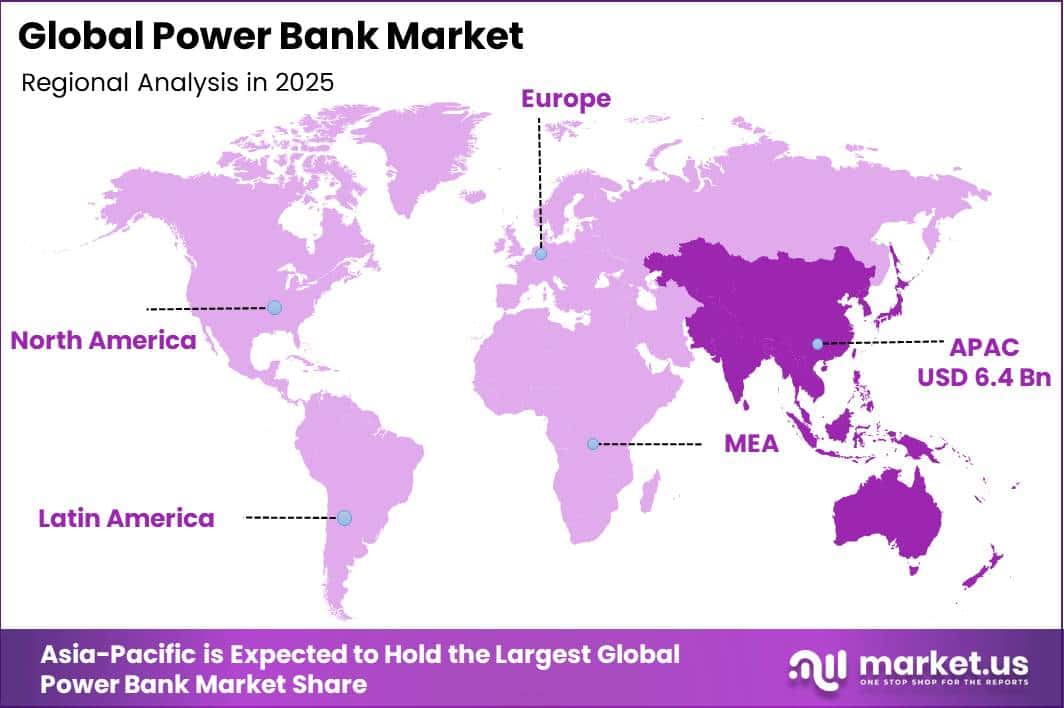
In 2025, the Global Power Bank Market was valued at USD 15.2 billion. The market is projected to grow at a CAGR of 8.6% during 2026–2035, reaching approximately USD 34.7 billion by 2035. Asia-Pacific dominated the global market in 2025, accounting for more than 42.3% of the total market share and generating approximately USD 6.4 billion in revenue.
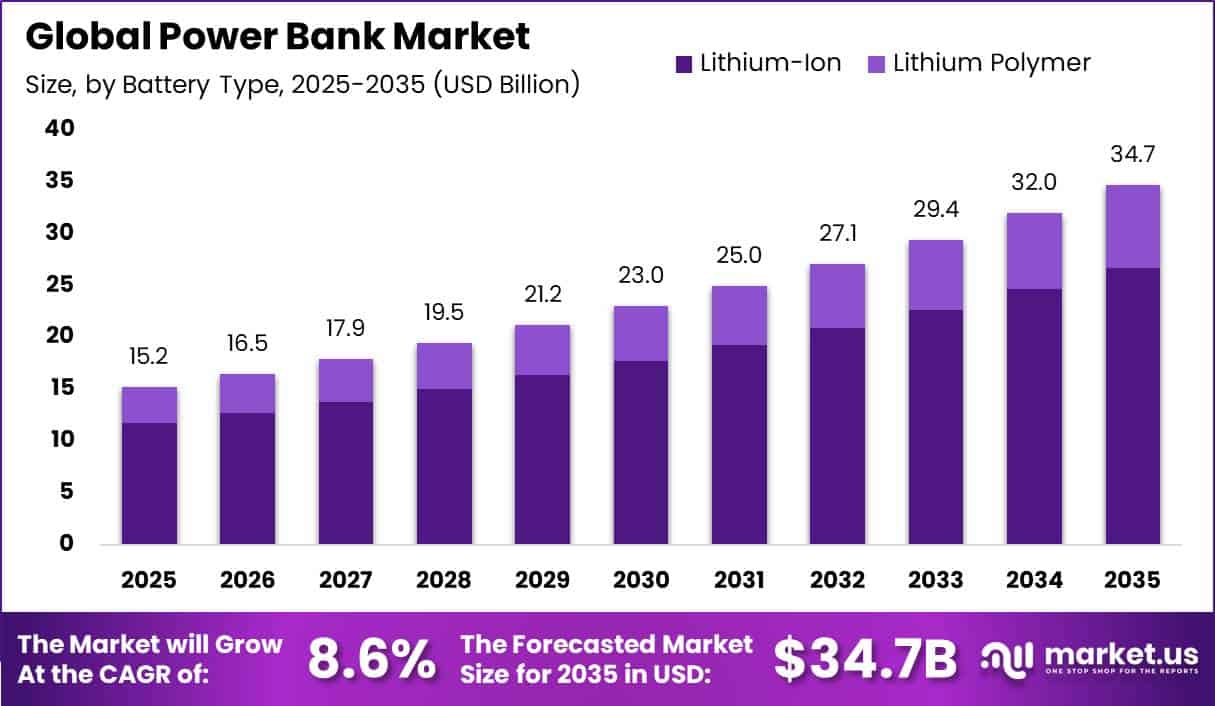
This represents an overall market increase of about USD 19.5 billion. Growth is mainly supported by the rising use of smartphones, tablets, wireless earbuds, smartwatches, and other portable electronic devices. According to GSMA, Asia-Pacific had around 1.56 billion mobile internet users in 2025 and more than 3.05 billion mobile connections, equal to 105.9 connections per 100 people.
As consumers increasingly depend on mobile devices for digital payments, work, navigation, entertainment, education, and delivery services, the need for reliable charging outside the home continues to rise. This is encouraging demand for higher-capacity and fast-charging power banks. GSMA expects mobile internet users in the region to reach 1.8 billion by 2030, creating additional demand for portable charging solutions.
Around 1.5 billion people in Asia-Pacific were still not using mobile internet despite network availability, indicating further growth potential as smartphone access improves. Device replacement is also supporting repeat purchases. ITU and UNITAR reported around 62 million tonnes of global e-waste in 2022, highlighting the rapid replacement cycle of electronic devices and related charging accessories.
Key Takeaway
- The Power Bank Market was valued at USD 15.2 billion in 2025, projected to reach USD 34.7 billion by 2035 at a CAGR of 8.6% (2026–2035)
- Lithium-ion batteries held a 77.1% share, supported by high energy density and falling cell prices
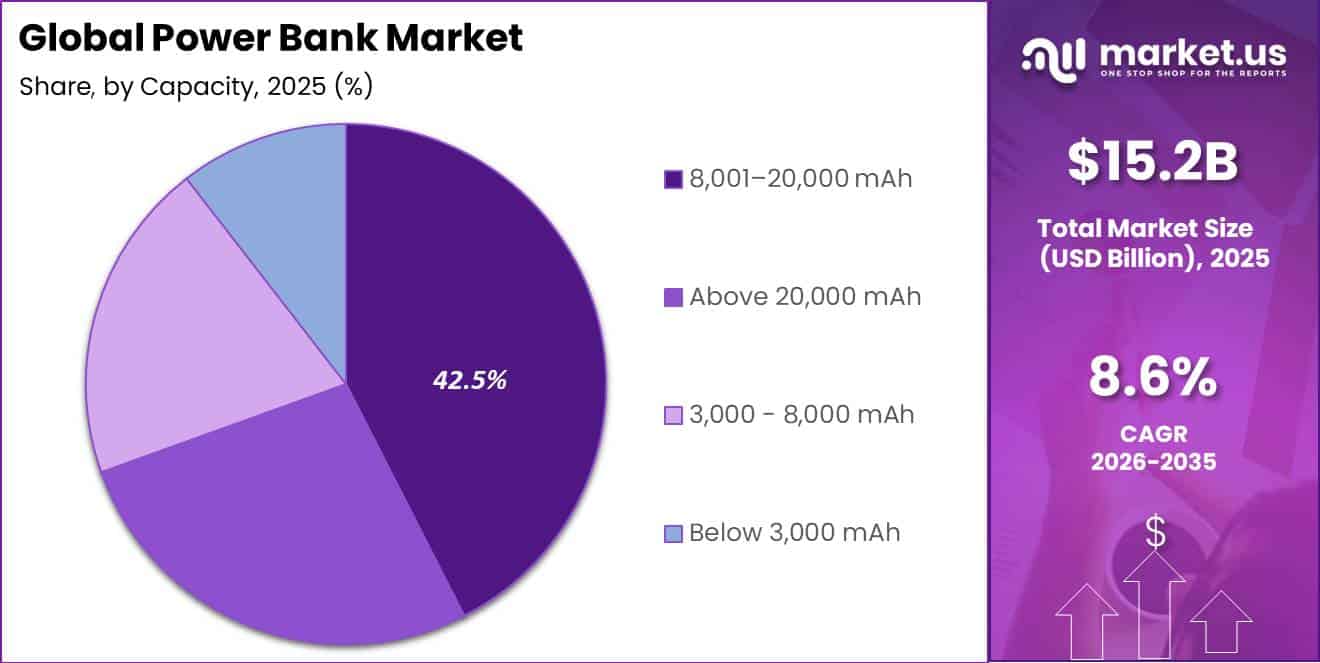
- The 8,001–20,000 mAh capacity segment led with a 42.5% share
- Online platforms accounted for 59.2% of power bank sales
- Asia-Pacific led the market in 2025 with a 42.3% share, generating approximately USD 6.4 billion in revenue
By Battery Type
Lithium-ion batteries held a dominant 77.1% share of the power bank market, supported by their strong balance of energy density, lightweight design, long operating life, and competitive cost. High energy density is especially important for portable charging devices because it allows manufacturers to store more power in smaller and lighter products.
According to the International Energy Agency (IEA), lithium-ion cells provide an energy density of around 90–300 Wh/kg, supporting higher-capacity power banks without significantly increasing product size or weight. IEA data shows that lithium-ion battery pack prices declined from about USD 1,400 per kWh in 2010 to below USD 140 per kWh in 2023, representing a decline of nearly 90%.
This cost improvement allows manufacturers to offer larger capacities, multiple charging ports, and fast-charging features at affordable prices. Large-scale production further strengthens supply availability. China accounted for around 80% of global battery-cell production in 2024 and approximately 85% of global cell manufacturing capacity.
By Capacity
The 8,001–20,000 mAh capacity segment held a leading 42.5% share of the power bank market, mainly because it offers a practical balance of charging capacity, compact size, cost, and travel convenience. At a common nominal battery voltage of 3.7 V, an 8,000 mAh power bank stores around 29.6 Wh, while a 20,000 mAh model stores about 74 Wh.
Both values remain below the 100 Wh limit generally allowed in cabin baggage without airline approval under International Air Transport Association (IATA) and U.S. Transportation Security Administration guidelines. This makes the segment suitable for travelers, students, commuters, and field workers who need reliable charging during the day.
Models below this range may offer limited backup for heavy users, while products above 20,000 mAh are usually heavier, need more time to recharge, and move closer to airline battery restrictions. In addition, USB Power Delivery Revision 3.1 supports charging of up to 240 W through USB-C, increasing the usefulness of mid-capacity power banks that combine fast charging with portable design.
By Distribution Channel
Online platforms accounted for a dominant 59.2% share of power bank sales, as consumers increasingly prefer digital channels to compare product specifications, prices, and user reviews. Power banks are well suited for online purchasing because buyers can easily evaluate features such as battery capacity, charging speed, port type, safety certification, size, weight, and compatibility with USB-C or wireless charging.
Strong growth in e-commerce has further supported this distribution channel. According to UN Trade and Development (UNCTAD), online retail sales across reported economies increased by an average of 21% per year between 2017 and 2023, compared with only 7% annual growth in overall retail sales.
In the United States, the Census Bureau reported retail e-commerce sales of USD 289.2 billion in the first quarter of 2024, representing an 8.6% year-on-year increase, while total retail sales grew by just 1.5%. Online marketplaces also allow power bank brands to offer a wider range of capacities, charging technologies, and price options without physical shelf-space limitations.
Key Market Segments
By Battery Type
- Lithium-Ion
- Lithium Polymer
By Capacity
- Below 3,000 mAh
- 3,000–8,000 mAh
- 8,001–20,000 mAh
- Above 20,000 mAh
By Distribution Channel
- Online Platforms
- Offline Stores
Geopolitical Impact Analysis
Geopolitical risks are increasing both the cost and supply uncertainty of power banks because the industry depends heavily on lithium-ion cells, battery-management chips, USB-C controllers, housings, and China-based manufacturing networks. The U.S. Trade Representative raised the Section 301 tariff on Chinese-origin non-electric-vehicle lithium-ion batteries to 25% from 2026, compared with 7.5% previously.
This directly affects power bank suppliers because battery cells and packs represent a major share of production costs. Manufacturers may need to absorb higher duties, shift sourcing, redesign supply chains, or increase retail prices. The impact is particularly important for high-capacity power banks, where battery cells account for a larger portion of material costs.
The World Bank expects overall commodity prices to decline by about 12% in 2025, which may reduce costs for lithium, copper, and aluminium, but these savings may not fully offset tariffs, compliance expenses, and supply-chain disruption. Regional conflicts are also affecting shipping routes between Asian production hubs and markets in Europe, the Middle East, and Africa.
UN Trade and Development reported that Shanghai-to-Europe spot container rates increased by 256% between early December 2023 and early February 2024, reaching USD 2,648 per TEU as ships avoided the Red Sea and Suez Canal. UNCTAD also estimated that an Asia-Europe round trip costs about USD 1.7 million through the Cape of Good Hope, compared with around USD 1.0 million through the Suez Canal.
Regional Analysis
Asia-Pacific was the dominant region in the global power bank market in 2025, accounting for a 42.3% share and approximately USD 6.4 billion in revenue. The region benefits from a large mobile-device user base, strong electronics manufacturing, established battery supply chains, and expanding online retail networks.
China, India, Japan, South Korea, and Southeast Asian countries remain important centres for smartphone use, electronics production, and accessory sales. GSMA reported that mobile technologies and services contributed around USD 950 billion to the Asia-Pacific economy in 2024, equal to 5.6% of regional GDP.
This contribution is expected to reach nearly USD 1.4 trillion by 2030. In addition, 5G is projected to increase from 18% of regional mobile connections in 2024 to 50% by 2030, supporting greater use of video, gaming, navigation, digital payments, and cloud applications, which increases charging requirements.
North America is expected to be the fastest-growing region, supported by high consumer spending, premium smartphone adoption, USB-C devices, and demand for high-output portable chargers. GSMA expects 5G to represent around 90% of mobile connections in North America by 2030 and contribute approximately USD 210 billion to the regional economy.
This shift supports demand for higher-capacity power banks with Power Delivery, wireless charging, multiple ports, and improved safety features. Online retail also strengthens market access, with the U.S. Census Bureau reporting that e-commerce represented 16.2% of total U.S. retail sales in the fourth quarter of 2024.
Key Regions and Countries
North America
- US
- Canada
Europe
- Germany
- France
- The UK
- Spain
- Italy
- Rest of Europe
Asia Pacific
- China
- Japan
- South Korea
- India
- Australia
- Rest of APAC
Latin America
- Brazil
- Mexico
- Rest of Latin America
Middle East & Africa
- GCC
- South Africa
- Rest of MEA
Market Dynamics
Drivers
| Driver | (~) % CAGR | Geographic Relevance | Impact Timeline |
|---|---|---|---|
| USB-C laptop charging adoption | +1.6% | Global | Short term (2 years or less) |
| Mobile-device use intensity | +1.4% | Asia-Pacific, Africa, Latin America | Short term (2 years or less) |
| Premium fast-charging upgrades | +1.1% | North America, Europe, East Asia | Medium term (2 to 4 years) |
| Travel and outdoor use | +0.9% | Global | Short term (2 years or less) |
| Online accessory retail reach | +0.7% | Global | Medium term (2 to 4 years) |
USB-C laptop charging adoption
USB-C laptop charging is a major demand driver for the power bank market because it moves these products beyond basic smartphone backup into higher-value mobile-work devices. USB Power Delivery Revision 3.1, introduced in 2021, supports charging of up to 240 W through compatible USB-C systems.
Falling battery costs are also supporting higher-output products. IEA data indicates that lithium-ion cell prices declined by roughly 20% in 2024, allowing manufacturers to use larger battery packs and more powerful charging electronics at competitive prices.
This shift supports higher average selling prices, multi-port designs, and replacement demand for premium models. USB-C laptop charging could therefore contribute around +1.6% to the market’s 8.6% baseline CAGR.
Restraints
| Restraint | (~) % CAGR | Geographic Relevance | Impact Timeline |
|---|---|---|---|
| U.S. cell import tariffs | -1.3% | United States, China | Short term (2 years or less) |
| Airline battery carriage limits | -0.8% | Global aviation markets | Short term (2 years or less) |
| Battery safety compliance costs | -0.7% | China, North America, Europe | Medium term (2 to 4 years) |
| Low-cost product price pressure | -0.6% | Asia-Pacific, Latin America | Short term (2 years or less) |
| Counterfeit accessory sales | -0.4% | Global | Medium term (2 to 4 years) |
U.S. cell import tariffs
U.S. import policy is a key restraint for the power bank market because lithium-ion cells and battery packs form a major part of product costs. The U.S. Trade Representative increased the Section 301 tariff on covered Chinese non-electric-vehicle lithium-ion batteries from 7.5% to 25%, effective 1 January 2026.
This represents an increase of 17.5 percentage points, adding direct cost pressure for importers and brands. The World Bank projected overall commodity prices to decline by around 5% in 2025, but lower material costs are unlikely to fully offset the higher tariff burden.
Power bank suppliers may therefore need to increase retail prices, accept lower margins, reduce promotional spending, or diversify sourcing outside China. The estimated impact could reduce the market’s baseline CAGR by around -1.3%, with entry-level and mid-capacity products facing the greatest pressure because these segments are more sensitive to price increases.
Challenges
| Challenge | (~) % CAGR | Geographic Relevance | Mitigation Horizon |
|---|---|---|---|
| Red Sea freight volatility | -1.1% | Asia-Europe, Middle East, Africa | Medium term (2 to 4 years) |
| Cell quality verification | -0.9% | Global | Medium term (2 to 4 years) |
| Thermal safety engineering | -0.8% | Global | Long term (4 years or more) |
| Critical mineral concentration | -0.7% | China, East Asia, North America | Long term (4 years or more) |
| Returns and warranty exposure | -0.5% | North America, Europe | Short term (2 years or less) |
Red Sea freight volatility
Red Sea freight volatility remains a major operational challenge for the power bank market because a large share of products and components are shipped from Asian manufacturing hubs to Europe, the Middle East, and Africa.
UNCTAD reported that Shanghai-to-Europe spot container rates increased by 256% between early December 2023 and early February 2024, reaching around USD 2,648 per TEU as vessels diverted away from the Suez Canal.
UNCTAD also estimated that an Asia-Europe round voyage through the Cape of Good Hope could cost about USD 1.7 million, compared with around USD 1.0 million through the Suez Canal. The estimated market drag of around -1.1% reflects delayed launches, inventory imbalance, and reduced promotional flexibility, encouraging suppliers to use multiple ports, regional warehouses, and more flexible freight contracts.
Opportunities
| Opportunity | (~) % CAGR | Geographic Relevance | Execution Window |
|---|---|---|---|
| Commercial fleet charging bundles | +1.7% | North America, Europe, Asia-Pacific | Medium term (2 to 4 years) |
| Rental and swap networks | +1.3% | Dense urban markets | Medium term (2 to 4 years) |
| Certified refurbished units | +1.0% | Europe, North America | Medium term (2 to 4 years) |
| Rugged emergency power | +0.8% | Disaster-prone regions | Long term (4 years or more) |
| Enterprise device subscriptions | +0.6% | North America, Europe | Long term (4 years or more) |
Commercial fleet charging bundles
Commercial fleet charging is a strong untapped opportunity, as delivery riders, field technicians, warehouse workers, and mobile sales teams depend heavily on smartphones for daily work. The International Labour Organization estimated that digital labour platforms supported more than 43 million workers globally by 2023, while the World Bank reported that urban areas account for more than 56% of the global population.
Falling battery costs can further support business adoption. The International Energy Agency reported that lithium-ion battery pack prices declined by around 20% during 2024, making higher-capacity power banks more affordable for fleet operators.
Suppliers can expand through bulk procurement contracts, charging lockers, replacement programs, and recurring services. Moving from one-time retail sales toward contracted multi-unit supply could improve gross margins by an estimated 3% to 6% and provide potential CAGR upside of around +1.7%.
Key Players Analysis
The power bank market remains fragmented, although the competitive landscape is led by Tier-1 consumer-electronics and charging brands such as Anker Innovations, Xiaomi, Samsung, Belkin, and ASUS. Anker has a strong position because portable charging is a core part of its business. Its revenue reached RMB 24.7 billion in 2024, increasing 41.1% year on year, while R&D spending rose 49.1% to RMB 2.11 billion, equal to 8.53% of sales.
Xiaomi is another major competitor, with its Smartphone × AIoT segment generating RMB 333.2 billion in 2024, while group R&D spending reached RMB 24.05 billion. Its estimated power-bank share remains in the high-single digits. Samsung reported KRW 300.9 trillion in revenue, KRW 35.0 trillion in R&D spending, and KRW 53.6 trillion in capital expenditure in 2024, supporting its premium accessory and device ecosystem.
Tier-2 challengers include ASUS, Lenovo, Sony, Philips, ZAGG, AUKEY, Zendure, and Omnicharge. ASUS generated NT$587.1 billion in revenue and spent NT$22 billion, or about 4% of sales, on R&D in 2024. Lenovo recorded USD 69.1 billion in FY2024/25 revenue and USD 2.29 billion in R&D spending. Sony reported FY2024 revenue of JPY 12.96 trillion and R&D costs of JPY 734.6 billion. However, audited company-level power-bank revenues and exact market shares are generally not separately disclosed.
Top Key Players in the Market
- SAMSUNG
- Anker Innovations
- Belkin
- ASUSTeK Computer Inc.
- Lenovo
- AUKEY
- Xiaomi
- Koninklijke Philips N.V.
- Zendure Power Bank USA Inc.
- Omnicharge
- ZAGG Inc.
- Sony Group Corporation
Recent Developments
- In 2026, Anker Innovations entered into a multi-year partnership with Tomorrowland, becoming its exclusive global Official Portable Power Bank and Power Station Partner. Tomorrowland Belgium attracts around 400,000 visitors from more than 200 countries, giving Anker a large platform for on-site charging services, product demonstrations, and brand exposure.
- In 2026, Xiaomi launched new 20,000 mAh power banks with built-in USB-C cables in 45 W and 67 W versions under China’s GB 47372-2026 safety requirements. The products officially went on sale on August 11, with launch prices of RMB 229 for the 45 W model and RMB 269 for the 67 W model. Both have around 74 Wh of battery energy and include stronger battery-safety, health-monitoring, and product-traceability features.
Report Scope
| Report Features | Description |
|---|---|
| Market Value (2025) | USD 15.2 Billion |
| Forecast Revenue (2035) | USD 34.7 Billion |
| CAGR (2026-2035) | 8.6% |
| Base Year for Estimation | 2025 |
| Historic Period | 2020-2024 |
| Forecast Period | 2026-2035 |
| Report Coverage | Revenue Forecast, Market Dynamics, Competitive Landscape, Recent Developments |
| Segments Covered | By Battery Type (Lithium-Ion, Lithium Polymer); By Capacity (Below 3,000 mAh, 3,000–8,000 mAh, 8,001–20,000 mAh, Above 20,000 mAh); By Distribution Channel (Online Platforms, Offline Stores) |
| Regional Analysis | North America – US, Canada; Europe – Germany, France, The UK, Spain, Italy, Rest of Europe; Asia Pacific – China, Japan, South Korea, India, Australia, Singapore, Rest of APAC; Latin America – Brazil, Mexico, Rest of Latin America; Middle East & Africa – GCC, South Africa, Rest of MEA |
| Competitive Landscape | SAMSUNG, Anker Innovations, Belkin, ASUSTeK Computer Inc., Lenovo, AUKEY, Xiaomi, Koninklijke Philips N.V., Zendure Power Bank USA Inc., Omnicharge, ZAGG Inc., Sony Group Corporation |
| Customization Scope | We will provide customization for segments and region/country levels. Additional customization can be done based on requirements. |
| Purchase Options | We have three licenses to opt for: Single User License, Multi-User License (Up to 5 Users), Corporate Use License (Unlimited Users and Printable PDF) |





































