


Report Overview
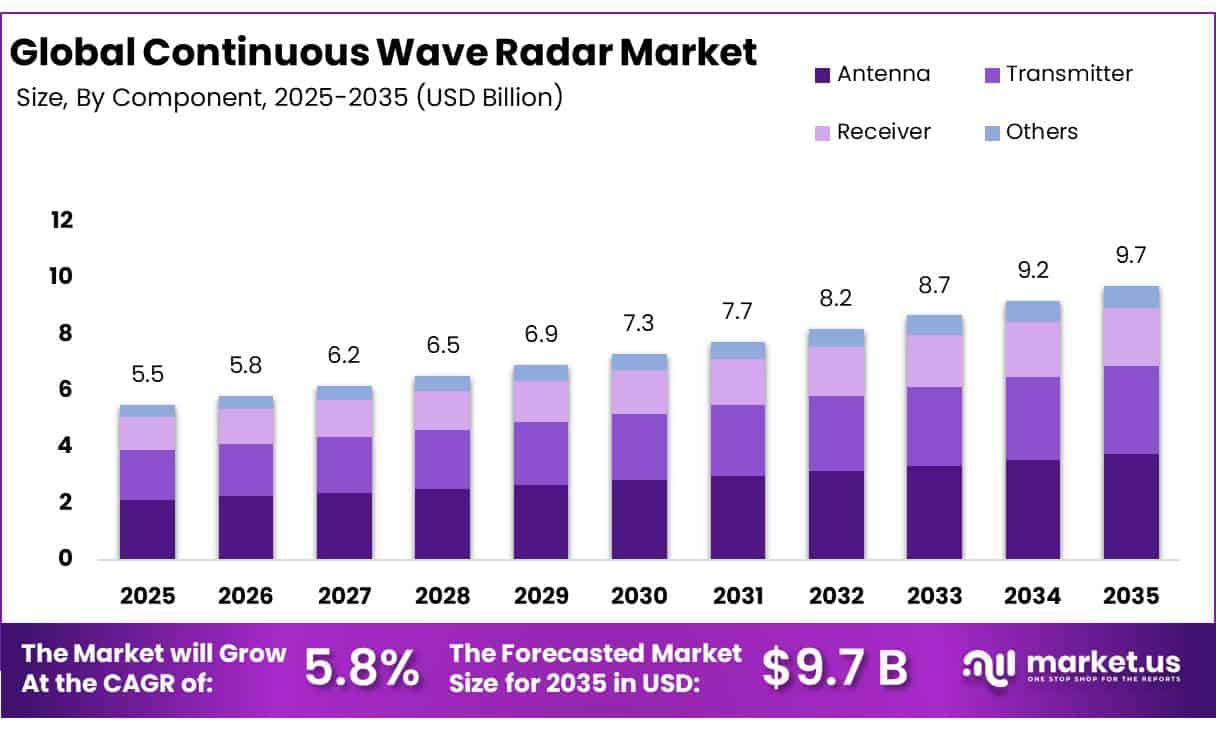
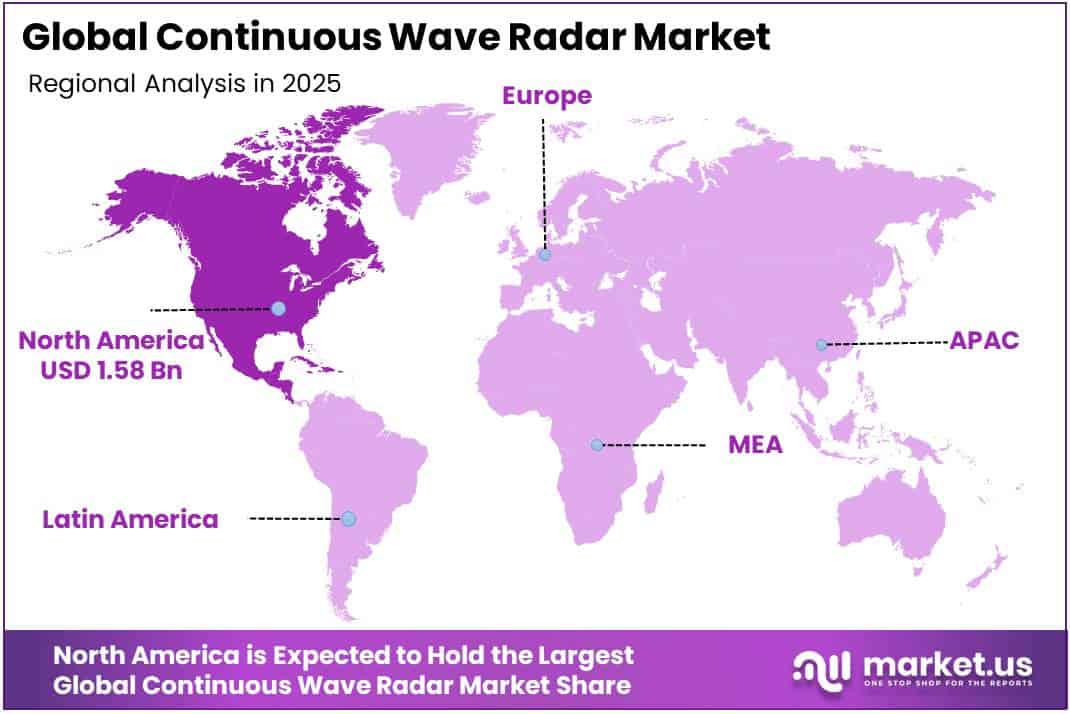
In 2025, the Continuous Wave Radar Market was valued at USD 5.5 Billion, and between 2026 and 2035, this market is estimated to register a CAGR of 5.8%, reaching about USD 9.7 Billion by 2035. North America held a dominant market position, capturing more than a 28.70% share, holding USD 1.58 Billion in revenue.
Continuous wave radar transmits an uninterrupted radio frequency signal, most commonly using the Frequency Modulated Continuous Wave (FMCW) method, to measure distance, speed, and angle of objects from frequency shift. It is deployed across automotive collision avoidance and industrial Level Probing Radar (LPR) applications, where continuous detection is required without the interruption cycles typical of pulsed radar systems.
- The Federal Communications Commission’s Small Entity Compliance Guide, dated March 5, 2024, confirms that vehicular and airport radars operate on a licensed-by-rule basis across a contiguous five gigahertz band at 76 to 81 gigahertz, effective since October 20, 2017, and separately confirms that industrial Level Probing Radars operate on an unlicensed basis in the 75 to 85 gigahertz band under section 15.256 of the Commission’s rules.
Key Takeaways
- The Global Continuous Wave Radar Market was valued at USD 5.5 billion in 2025.
- The global market is projected to grow at a CAGR of 5.8% and is estimated to reach USD 9.7 billion by 2035.
- On the basis of type, Modulated CW Radar dominated the market, constituting 68.50% of the total market share.
- Based on the component, Antenna dominated the market, accounting for 38.60% of the total market share.
- Based on the range, Short Range dominated the market, accounting for 41.00% of the total market share.
- Based on the platform, Ground-Based dominated the market, accounting for 44.00% of the total market share.
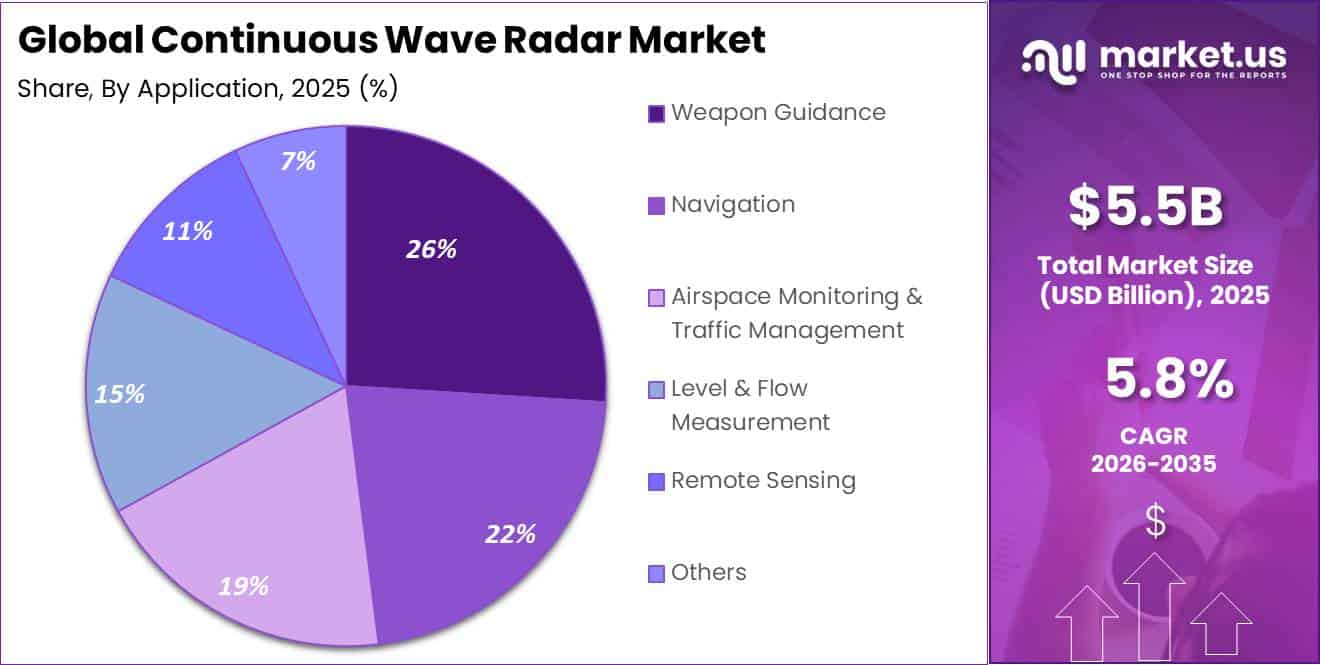
- Based on the application, Weapon Guidance dominated the market, accounting for 26.00% of the total market share.
- Based on the end-use industry, Aerospace & Defense dominated the market, accounting for 39.00% of the total market share.
- In 2025, North America was the most dominant region in the continuous wave radar market, accounting for 28.70% of the global market.
Continuous Wave Radar is increasingly used across automotive safety, industrial automation, traffic monitoring, security, drones, and process industries. A basic CW radar continuously transmits a radio signal and is mainly suited to measuring motion or radial velocity, while frequency-modulated continuous-wave radar can measure both range and velocity. Modern industrial radar chips operate in the 76–81 GHz band, with TI’s IWR2944 offering more than 4.5 GHz of continuous bandwidth. ETSI also identifies 24.05–24.25 GHz and 76–81 GHz for automotive and surveillance radar, supporting spectrum harmonization.
- The automotive sector remains one of the strongest demand drivers. OICA reported global vehicle production of 96.4 million units in 2025, while sales reached 99.8 million units and production increased by 3.9%. This expanding vehicle base supports radar modules for adaptive cruise control, blind-spot detection, parking assistance, and automatic emergency braking.
Smart transportation infrastructure is another growth area. The U.S. Department of Transportation awarded USD 60 million for interoperable V2X deployments in Arizona, Texas, and Utah. The Utah program plans 770 roadside units and 220 additional onboard units, while the Texas deployment builds on signal-phase-and-timing messages at more than 1,000 intersections in Houston. These are not radar-only projects, but they create a connected-sensing ecosystem in which continuous-wave radar can complement cameras, V2X radios, and edge analytics for speed measurement, object detection, and all-weather traffic monitoring.
- The IEA expects global energy investment to reach USD 3.4 trillion in 2026, a 5% increase from the previous year, while clean-energy investment is projected at about USD 2.2 trillion. The U.S. Energy Information Administration also reported existing U.S. LNG export capacity of 15.4 Bcf/d and another 13.9 Bcf/d of planned additions between 2025 and 2029. Expansion of LNG terminals, storage systems, utilities, and automated plants creates opportunities for non-contact radar level measurement and safety sensing where dust, vapor, darkness, or harsh conditions can limit optical technologies.
Government initiatives continue reinforcing adoption. The European Commission confirmed that, from July 7, 2026, all new passenger cars and vans across the European Union must carry advanced emergency braking capable of detecting pedestrians and cyclists, building on safety systems already mandatory for newly registered vehicles since 2024, as part of the bloc’s Vision Zero road safety goal for 2050. The European Automobile Manufacturers’ Association separately confirmed that new EU car registrations grew 1.8% in 2025, within a sector employing 13.6 million people across Europe.
By Type
Modulated CW Radar leads with a 68.50% share through precise range and speed sensing
In 2025, Modulated CW Radar held a dominant market position, capturing more than a 68.50% share of the Continuous Wave Radar Market by type. The segment is mainly supported by frequency-modulated continuous-wave radar, which can determine both target distance and movement, making it useful in automotive sensing, drones, industrial monitoring, security, and traffic systems.
- In 2025, the U.S. National Institute of Standards and Technology demonstrated an FMCW synthetic-aperture radar operating at 10 GHz with 1.5 GHz bandwidth for detecting and characterizing drones in an urban-like environment.
Unmodulated CW Radar is the fastest growing segment in the Continuous Wave Radar Market by type. Its growth is supported by simple design, continuous signal transmission, low processing requirements, and reliable Doppler-based motion detection. These systems are well suited for vehicle-speed monitoring, movement detection, security equipment, industrial sensing, and non-contact monitoring where precise distance measurement is not essential.
By Component
Ground-Based leads with a 38.6% share as fixed radar infrastructure remains essential
In 2025, Ground-Based held a dominant market position, capturing more than a 38.6% share of the Continuous Wave Radar Market by component. Ground-based systems remain widely used for airspace surveillance, traffic monitoring, perimeter security, weather observation, and drone detection because they can provide continuous monitoring from fixed locations. Their ability to operate in darkness, fog, and difficult weather conditions also supports their use alongside cameras and other sensing technologies. Government modernization is strengthening this segment.
- In January 2026, the U.S. Federal Aviation Administration announced plans to replace up to 612 ground-based radars under its air traffic control modernization program, showing the continuing importance of terrestrial radar infrastructure for aircraft detection and tracking.
Transmitter is an important segment of the Continuous Wave Radar Market, supported by rising use of radar in automotive systems, industrial monitoring, aviation, security, and unmanned platforms. The transmitter continuously generates the radio-frequency signal that allows a CW radar system to identify movement, while modulated transmitters can also support accurate distance and target characterization. In 2025, research published by the U.S. National Institute of Standards and Technology demonstrated the use of a frequency-modulated continuous-wave radar system for drone detection and characterization in an urban-like environment.
By Range
Short Range leads with a 41.00% share as close-proximity sensing expands
In 2025, Short Range held a dominant market position, capturing more than a 41.00% share of the Continuous Wave Radar Market by range. Short-range radar is widely suited to close-proximity object detection, parking assistance, blind-spot monitoring, industrial safety, automated equipment, and security applications. Its compact design and ability to detect objects in poor lighting or difficult weather conditions support its wider adoption.
- In 2025, the U.S. National Institute of Standards and Technology conducted close-range radar measurements using human and automated ground vehicle targets, highlighting the importance of accurate radar detection when objects operate close to sensing systems. Another 2025 NIST study demonstrated an FMCW radar system operating at 10 GHz with 1.5 GHz bandwidth for detecting and characterizing drones in a complex urban-like environment, further supporting short-range radar use in advanced monitoring applications.
Medium Range is the fastest growing segment in the Continuous Wave Radar Market by range. In 2025, demand continued to develop across vehicle safety, drone monitoring, defense testing, industrial automation, and perimeter surveillance, where systems need a balance between detection distance, field of view, accuracy, and equipment size. Medium-range radar can support applications such as blind-spot monitoring, lane-change assistance, collision warning, equipment tracking, and detection around larger industrial sites. U.S. government activity also reflects continued interest in this radar class.
By Platform
Ground-Based leads with a 44.00% share as fixed surveillance networks expand
In 2025, Ground-Based held a dominant market position, capturing more than a 44.00% share of the Continuous Wave Radar Market by platform. Ground-based radar systems are widely used for air traffic surveillance, border monitoring, military protection, traffic management, and fixed-site security because they provide continuous observation from stable locations. Government investment in radar infrastructure continues to support this segment.
In January 2026, the U.S. Federal Aviation Administration announced plans to replace up to 612 ground-based radars by June 2028 with modern surveillance systems. The FAA also reported that the National Airspace System currently contains 14 different radar configurations. This large modernization program shows the continued operational importance of ground-based radar infrastructure for reliable aircraft detection, tracking, and surveillance.
Airborne is an expanding segment of the Continuous Wave Radar Market by platform. In 2025, demand remained supported by aircraft, unmanned aerial systems, military surveillance platforms, and airborne mapping systems that require radar sensing while operating over wide areas. Airborne radar provides greater mobility than fixed systems and can support target detection, terrain observation, navigation, weather monitoring, and defense missions from elevated positions.
By Application
Weapon Guidance leads with a 26.00% share as precision radar targeting remains critical
In 2025, Weapon Guidance held a dominant market position, capturing more than a 26.00% share of the Continuous Wave Radar Market by application. Continuous-wave radar remains important in weapon guidance because it can provide steady target illumination for radar-guided missiles during the final engagement stage.
- In December 2025, the U.S. Naval Sea Systems Command reported that the USS Cape St. George operates 4 AN/SPG-62 Fire Control Radars, arranged to provide nearly 360-degree engagement capability. The Navy also stated that its Mark 99 Fire Control System directs radio-frequency energy toward a target so Standard Missiles can maintain the signal needed for guidance during an intercept. This operational role supports continued demand for continuous-wave radar in naval air and missile-defense systems.
Navigation is an expanding application segment of the Continuous Wave Radar Market. In 2026, demand continued to be supported by aviation, autonomous platforms, marine systems, and unmanned vehicles that require reliable distance, altitude, velocity, and obstacle information. Frequency-modulated continuous-wave radar is particularly useful because it can measure distance and velocity at the same time and can operate under difficult weather and visibility conditions.
By End-Use Industry
Aerospace & Defense leads with a 39.00% share as radar spending supports surveillance and fire-control systems
In 2025, Aerospace & Defense held a dominant market position, capturing more than a 39.00% share of the Continuous Wave Radar Market by end-use industry. The segment benefits from strong radar requirements for missile guidance, fire control, aircraft surveillance, target tracking, electronic protection, and battlefield awareness. In July 2025, an official U.S. defense contract notice reported a USD 348.3 million award for fire-control radar systems, highlighting continued spending on radar-based targeting capabilities.
- In June 2025, another government contract provided USD 25.0 million for Sentinel A4 Radar System engineering services, supporting continued radar modernization within defense operations. These programs support demand for advanced radar electronics, transmitters, receivers, antennas, signal processors, and related continuous-wave technologies used across aerospace and defense platforms.
Automotive is an expanding end-use segment of the Continuous Wave Radar Market, supported by wider use of radar in automatic emergency braking, adaptive cruise control, blind-spot detection, parking assistance, and automated-driving functions. Radar is particularly useful in vehicles because it can measure relative speed and distance while continuing to operate in darkness and difficult visibility conditions.
- In January 2025, the U.S. National Highway Traffic Safety Administration released results from its government-industry ADAS study showing that automatic emergency braking reduced front-to-rear crashes by 49.0%. The analysis used information from approximately 98 million vehicles and more than 21.1 million police-reported crashes, demonstrating the growing safety value of advanced vehicle sensing systems.
Key Market Segments
By Type
- Modulated CW Radar
- Unmodulated CW Radar
By Component
- Transmitter
- Receiver
- Antenna
- Others
By Range
- Short Range
- Medium Range
- Long Range
By Platform
- Airborne
- Ground-Based
- Naval
- Space-Based
By Application
- Navigation
- Weapon Guidance
- Airspace Monitoring & Traffic Management
- Level & Flow Measurement
- Remote Sensing
- Others
By End-Use Industry
- Aerospace & Defense
- Automotive
- Marine & Maritime
- Industrial Automation
- Oil & Gas
- Mining
- Others
Driver Analysis
Automotive AEB and ADAS mandates
Automotive safety regulation is the largest volume catalyst because it converts radar from a premium trim feature into a compliance-linked sensor category. In the United States, FMVSS No. 127 requires automatic emergency braking and pedestrian AEB on nearly all new light vehicles from September 1, 2029; the rule requires avoidance of a lead-vehicle collision up to 62 mph, automatic braking for an imminent lead-vehicle collision up to 90 mph, and pedestrian detection/braking performance up to 45 mph.
These thresholds increase the commercial value of 76–81 GHz FMCW radar because radar preserves velocity measurement and all-weather sensing capability when camera performance is constrained by darkness, glare, rain, or obscuration. Europe adds a near-term product-planning incentive: Euro NCAP’s 2026 protocols place greater emphasis on driver-monitoring reliability and the link between driver state and ADAS intervention. The unit-economic consequence is a higher radar fitment rate per vehicle typically a forward sensor plus corner radars, with an additional in-cabin device in some architectures while suppliers shift revenue from discrete sensor shipments toward validated hardware, perception software, calibration, and lifecycle support. The +2.2 percentage-point sensitivity reflects compliance-led penetration growth rather than an assumed increase in vehicle production.
Drivers Impact Analysis
| Driver | (~) % Impact on CAGR Forecast | Geographic Relevance | Impact Timeline |
|---|---|---|---|
| Automotive AEB and ADAS mandates | +2.2% | North America core, EU, China, Japan, Korea | Medium term (2–4 years) |
| 76–81 GHz CMOS integration and edge AI | +1.8% | APAC manufacturing, North America, EU | Short term (≤ 2 years) |
| Counter-UAS and air-defence modernization | +1.6% | EU, North America, Middle East, Indo-Pacific | Medium term (2–4 years) |
| Industrial automation and mobile robotics | +1.3% | China, Japan, Korea, EU, North America | Short term (≤ 2 years) |
| In-cabin sensing and vehicle software features | +1.1% | EU, China, North America, Japan | Medium term (2–4 years) |
| Smart infrastructure, drones and perimeter security | +0.9% | APAC urban corridors, Gulf states, EU, North America | Long term (≥ 4 years) |
Restraint Analysis
CW range and target ambiguity
The fundamental restraint is that conventional unmodulated CW radar excels at radial-velocity sensing but cannot independently determine target range, while objects moving perpendicular to the radar beam produce minimal Doppler shift and can be difficult to distinguish from stationary clutter; FMCW remedies much of this constraint through frequency modulation, but it adds chirp-generation, calibration, signal-processing, and antenna-complexity costs.
At 76–81 GHz, systems gain up to 5 GHz of spectrum for range resolution, but the performance target moves from simple motion detection to high-confidence classification of pedestrians, vehicles, drones, machinery, and multiple reflectors—thereby increasing required transmit/receive channels, processing load, test datasets, and validation expenditure.
In the analyst downside case, a sensor supplier that must add a camera or lidar to resolve edge cases loses 15–30% of its standalone radar bill-of-materials opportunity, while an OEM may defer a radar-only feature launch by one vehicle programme cycle, typically 24–36 months. This produces the estimated -1.7 percentage-point CAGR drag because lower-cost industrial motion sensors remain viable, but high-value autonomy and precision-surveillance applications shift toward fusion architectures rather than pure CW deployments.
Restraint Impact Analysis
| Restraint | (~) % Impact on CAGR Forecast | Geographic Relevance | Impact Timeline |
|---|---|---|---|
| CW range and target ambiguity | -1.7% | Global; industrial, automotive, defence | Medium term (2–4 years) |
| Dense-radar interference risk | -1.4% | China, EU, North America, Japan, Korea | Short term (≤ 2 years) |
| RF supply and export controls | -1.2% | APAC supply chain, North America, EU | Medium term (2–4 years) |
| Safety, EMC and cyber validation | -1.1% | EU, North America, Japan, Korea | Medium term (2–4 years) |
| OEM price pressure and substitutes | -1.5% | China, EU, North America, India | Short term (≤ 2 years) |
| Installation and environment limits | -0.8% | Global; outdoor, maritime, industrial | Long term (≥ 4 years) |
Opportunity Analysis
Privacy-first building sensing
U.S. Department of Energy programmes target around 30% aggregate annual energy savings from correctly implemented building equipment, monitoring, and controls, with a further 10% total-building-energy saving target from more advanced analytics and model-predictive control; even a conservative 3–7% reduction in HVAC and lighting energy at a 100,000-square-foot office can create a payback case below 24–36 months when radar replaces multiple occupancy and people-counting devices.
The FCC’s expanded rules for 57–71 GHz field-disturbance sensors, including mobile applications, make 60 GHz deployments more feasible without individual licences, but vendors must convert RF capability into interoperable BACnet/Modbus interfaces, privacy documentation, and outcome-based contracts. A +1.6% upside assumes 8–15% penetration of premium new-build and deep-retrofit projects in the EU, North America, Japan, and Korea.
Opportunity Impact Analysis
| Opportunity | (~) % Potential CAGR Upside | Geographic Relevance | Execution Window |
|---|---|---|---|
| Radar-as-a-service platforms | +1.9% | North America, EU, Gulf, APAC | Short term (≤ 2 years) |
| Privacy-first building sensing | +1.6% | EU, North America, Japan, Korea | Medium term (2–4 years) |
| 60 GHz UAV sensor modules | +1.4% | North America, EU, APAC | Medium term (2–4 years) |
| In-cabin health analytics | +1.3% | EU, Japan, Korea, North America | Medium term (2–4 years) |
| Retrofit industrial perception | +1.1% | China, India, ASEAN, EU | Short term (≤ 2 years) |
| Radar software and M&A roll-ups | +0.9% | North America, EU, Israel, APAC | Long term (≥ 4 years) |
Challenges Analysis
RF engineering talent gap
Continuous-wave radar scaling requires a scarce combination of RF/mmWave design, antenna engineering, embedded software, digital-signal processing, functional safety, packaging, thermal management, and application-domain expertise; the challenge is not that qualified personnel are unavailable in absolute terms, but that demand is rising faster than the supply of engineers capable of taking a 60–81 GHz design from simulation through certified volume production.
The U.S. semiconductor industry alone is projected to add nearly 115,000 jobs by 2030, with roughly 67,000 positions at risk of remaining unfilled under current completion rates, including approximately 27,300 engineering roles and 13,400 computer-science roles; radar vendors must compete for this talent against AI accelerators, wireless infrastructure, defence electronics, and automotive semiconductors.
In operating terms, a 10–15 engineer radar team losing two senior RF or algorithm leads can extend waveform, antenna, and calibration iterations by 3–6 months, while reliance on contract engineering can add 15–30% to non-recurring engineering spend and weaken intellectual-property retention. The -1.2% friction estimate reflects slower product refreshes, constrained customer-support capacity, and delayed localisation of design expertise; mitigation requires internal RF academies, reusable reference architectures, university partnerships, regional engineering hubs, and automated test workflows that allow scarce experts to supervise rather than manually execute each design cycle.
Challenges Impact Analysis
| Challenge | (~) % CAGR Friction Drag | Geographic Relevance | Mitigation Horizon |
|---|---|---|---|
| RF engineering talent gap | -1.2% | North America, EU, APAC fabs | Long term (≥ 4 years) |
| Perception-data validation burden | -1.4% | North America, EU, China, Japan | Medium term (2–4 years) |
| Component lifecycle volatility | -1.0% | APAC logistics, EU, North America | Medium term (2–4 years) |
| Integration and software debt | -1.3% | Defence, automotive, industrial global | Long term (≥ 4 years) |
| Field calibration complexity | -0.9% | Global outdoor and industrial sites | Medium term (2–4 years) |
| Dual-use compliance fragmentation | -0.8% | North America, EU, China, Middle East | Long term (≥ 4 years) |
Geopolitical Impact Analysis
Geopolitical tensions strengthen demand for Continuous Wave Radar systems despite supply chain challenges.
The ongoing conflicts in Eastern Europe and the Middle East have increased the strategic importance of continuous wave radar systems used for surveillance, target tracking, navigation, and airspace monitoring. Governments have continued to prioritize border security, early warning capability, and protection of critical infrastructure, supporting sustained demand for radar technologies.
- According to the Stockholm International Peace Research Institute (SIPRI), global military expenditure reached USD 2.887 trillion in 2025, marking the 11th consecutive annual increase, while military spending in Europe increased by 14% and Asia and Oceania by 8.1% during the year. These investments have encouraged procurement and modernization of radar equipment across defense and security programs.
At the same time, geopolitical instability has created supply chain and logistics pressures for radar manufacturers. The International Energy Agency (IEA) reported that around 20 million barrels per day of crude oil and oil products moved through the Strait of Hormuz in 2025, representing about 25% of global seaborne oil trade. Any disruption along this route raises transportation costs, affects semiconductor and electronic component shipments, and increases manufacturing uncertainty for radar producers.
Regional Analysis
Regional Analysis: Elevators and Escalators Market.
North America dominates the continuous wave radar market, accounting for 28.70% share and valued at 1.58 billion dollars, supported by a mature regulatory framework governing automotive and industrial radar deployment across the United States and Canada.
- The Federal Communications Commission confirmed, in a Small Entity Compliance Guide dated March 5, 2024, that vehicular and airport radars operate on a licensed by rule basis across a contiguous five gigahertz band spanning 76 to 81 gigahertz, effective since October 20, 2017, while industrial Level Probing Radars operate separately under section 15.256 in the 75 to 85 gigahertz band.
Reinforcing regional demand, the National Highway Traffic Safety Administration finalized Federal Motor Vehicle Safety Standard 127 on April 29, 2024, requiring automatic emergency braking, including pedestrian detection, on all new passenger cars and light trucks by September 2029, a rule projected to save at least 360 lives and prevent at least 24,000 injuries annually across the United States fleet.
Canada complements this regional demand base through Innovation, Science and Economic Development Canada, which issued Radio Standards Specification RSS-251, Issue 2, dated July 30, 2018, harmonizing Canadian vehicular and airport radar certification with the 76 to 81 gigahertz frequency band and mandating that new radar installations comply with this specification from January 1, 2022 onward.
Key Regions and Countries
- North America
- The US
- Canada
- Europe
- Germany
- France
- The UK
- Spain
- Italy
- Russia & CIS
- Rest of Europe
- APAC
- China
- Japan
- South Korea
- India
- ASEAN
- Rest of APAC
- Latin America
- Brazil
- Mexico
- Rest of Latin America
- Middle East & Africa
- GCC
- South Africa
- Rest of MEA
Key Players Analysis
Continuous wave radar manufacturers compete by improving radar accuracy, signal processing capability, and system reliability while expanding their presence across defense, industrial, automotive, and monitoring applications. A major focus is the development of compact, high-performance radar platforms that deliver precise speed and distance measurement with lower power consumption and greater resistance to environmental interference.
Product portfolios are also being expanded to address both short-range and long-range applications, while continuous investment in research and engineering helps manufacturers meet evolving operational requirements. Strong emphasis is placed on system interoperability, modular architecture, and compliance with international safety and performance standards to improve deployment flexibility across multiple industries.
Leading companies including Lockheed Martin Corporation, Northrop Grumman Corporation, RTX Corporation (Raytheon), Thales Group, BAE Systems plc, Collins Aerospace (RTX), Honeywell International Inc., Saab AB, General Dynamics Corporation, Reutech Radar Systems, Banner Engineering Corp., AMETEK Inc. (Drexelbrook), Texas Instruments Incorporated, NXP Semiconductors N.V., and Infineon Technologies AG continue to strengthen their competitive position through technology innovation, strategic partnerships, and long-term customer relationships.
The Major Players in the Industry
- Lockheed Martin Corporation
- Northrop Grumman Corporation
- RTX Corporation (Raytheon)
- Thales Group
- BAE Systems plc
- Collins Aerospace (RTX)
- Honeywell International Inc.
- Saab AB
- General Dynamics Corporation
- Reutech Radar Systems
- Banner Engineering Corp
- AMETEK Inc. (Drexelbrook)
- Texas Instruments Incorporated
- NXP Semiconductors N.V.
- Infineon Technologies AG
Key Development
- In February 2026, Lockheed Martin delivered the first Sentinel A4 radar from a planned 19-system LRIP 2 batch to the U.S. Army. Investment and expansion continued in April 2026, when Lockheed Martin invested USD 25 million in Fortem Technologies to expand counter-UAS production and advance high-resolution radar capabilities, with Fortem expected to at least double manufacturing capacity.
- In June 2026, RTX announced another USD 100 million expansion in Rhode Island to increase LTAMDS testing capacity and add 150 high-tech jobs, showing continued investment in radar-related infrastructure.
- At company level in 2026, Thales reported around €25.3 billion in revenue, more than 85,000 employees, and operations across 65 countries, giving it substantial financial and technical scale to continue investing in advanced radar, AI-based sensing, air surveillance, and defence electronics.
Report Scope
| Report Features | Description |
|---|---|
| Market Value (2025) | USD 5.5 Bn |
| Forecast Revenue (2035) | USD 9.7 Bn |
| CAGR (2026 2035) | 8.2% |
| Base Year for Estimation | 2025 |
| Historic Period | 2020-2024 |
| Forecast Period | 2026-2035 |
| Report Coverage | Revenue Forecast, Market Dynamics, Competitive Landscape, Recent Developments |
| Segments Covered | By Type (Modulated CW Radar, Unmodulated CW Radar), By Component (Transmitter, Receiver, Antenna, Others), By Range (Short Range, Medium Range, Long Range), By Platform (Airborne, Ground-Based, Naval, Space-Based), By Application (Navigation, Weapon Guidance, Airspace Monitoring & Traffic Management, Level & Flow Measurement, Remote Sensing, Others), By End-Use Industry (Aerospace & Defense, Automotive, Marine & Maritime, Industrial Automation, Oil & Gas, Mining, Others) |
| Regional Analysis | North America The US & Canada; Europe Germany, France, The UK, Spain, Italy, Russia & CIS, Rest of Europe; APAC China, Japan, South Korea, India, ASEAN & Rest of APAC; Latin America Brazil, Mexico & Rest of Latin America; Middle East & Africa GCC, South Africa, & Rest of MEA |
| Competitive Landscape | Lockheed Martin Corporation, Northrop Grumman Corporation, RTX Corporation (Raytheon), Thales Group, BAE Systems plc, Collins Aerospace (RTX), Honeywell International Inc., Saab AB, General Dynamics Corporation, Reutech Radar Systems, Banner Engineering Corp., AMETEK Inc. (Drexelbrook), Texas Instruments Incorporated, NXP Semiconductors N.V., and Infineon Technologies AG. |
| Customization Scope | Customization for segments, region/country level will be provided. Moreover, additional customization can be done based on the requirements. |
| Purchase Options | We have three licenses to opt for: Single User License, Multi User License (Up to 5 Users), Corporate Use License (Unlimited Users and Printable PDF) |





































