


Report Overview
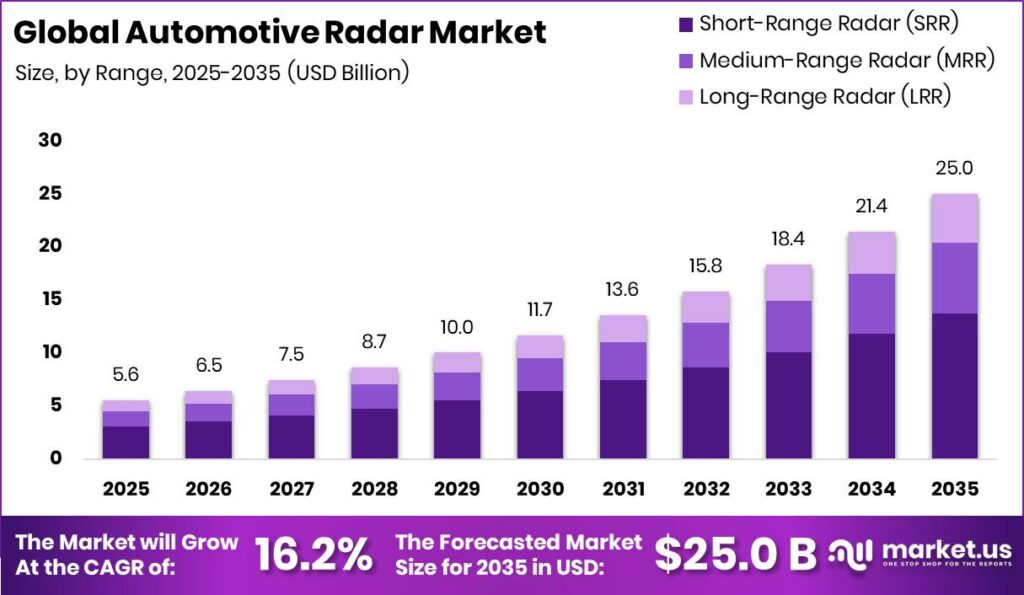
Global Automotive Radar Market size is expected to be worth around USD 25.0 Billion by 2035 from USD 5.6 Billion in 2025, growing at a CAGR of 16.2% during the forecast period 2026 to 2035. This trajectory reflects a structural shift in how carmakers equip vehicles. Radar has moved from a premium add on toward a core safety component fitted across mainstream model lines, which anchors long term revenue for sensor suppliers.
The market covers radar sensors that measure the range, velocity, and angle of objects around a vehicle. However, the structure spans several sensing tiers. Short range units watch corners and blind spots, while long range units scan far ahead for cruise and braking functions. Suppliers sell mostly to Advanced Driver Assistance Systems programs, which ties radar demand directly to each new vehicle platform launched.
Key Takeaways
- Global market reaches USD 25.0 Billion by 2035 from USD 5.6 Billion in 2025 at a CAGR of 16.2%.
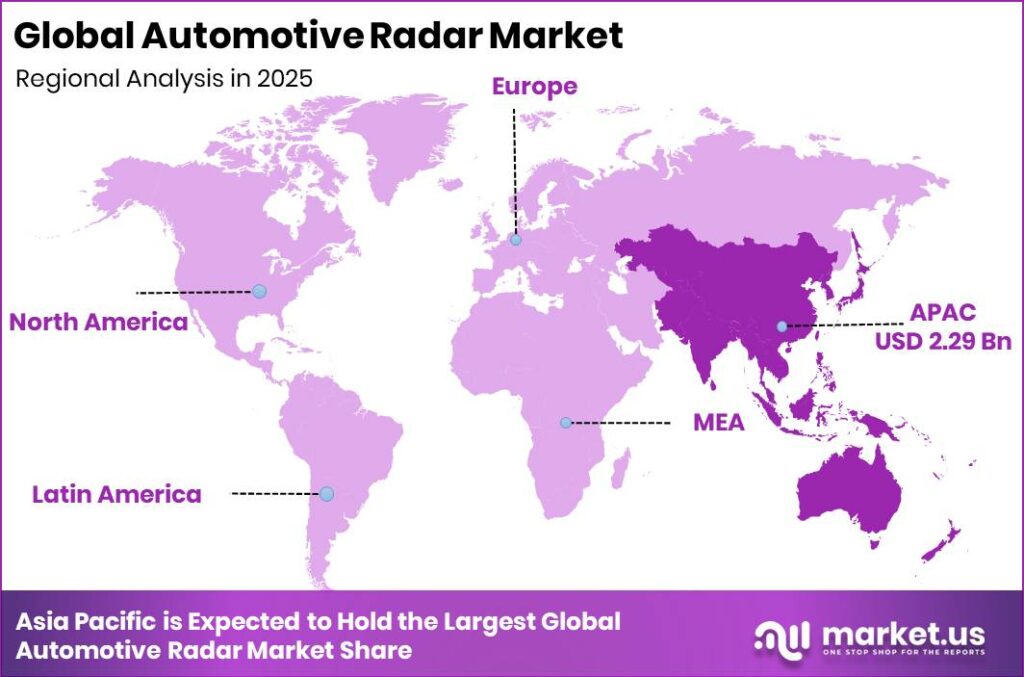
- Asia Pacific leads with a 41.00% share, valued at USD 2.29 Billion in 2025.
- Short Range Radar dominates the range segment with a 55.00% share.
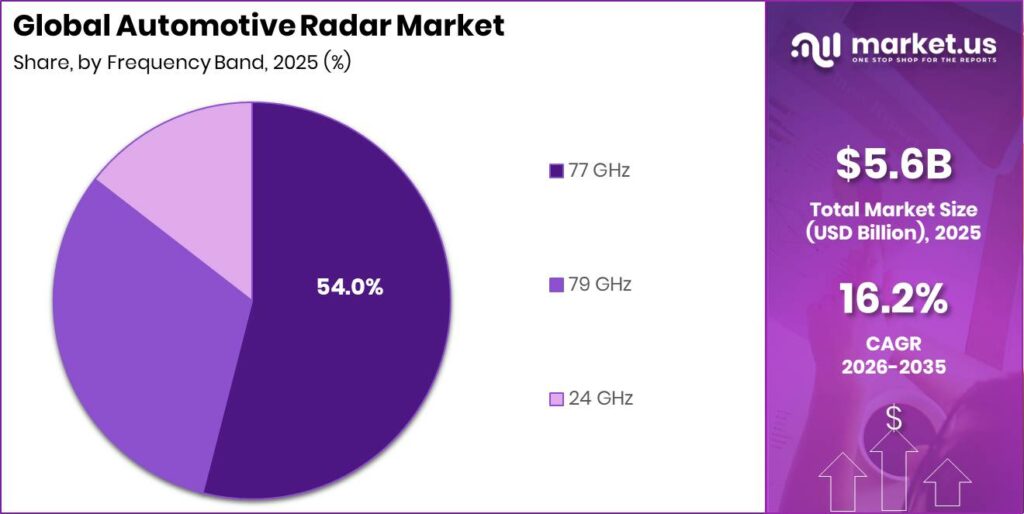
- 77 GHz leads the frequency band segment with a 54.00% share.
- Adaptive Cruise Control holds the top application share at 28.00%.
- Passenger Cars account for 75.00% of radar demand by vehicle type.
- OEM sales channel commands a 93.00% share over aftermarket supply.
Government safety rules push radar adoption faster than voluntary buyer demand. Regulators in Europe and East Asia now mandate active safety features that depend on radar sensing. This regulatory floor removes the guesswork for OEMs, since every applicable new vehicle must carry qualifying sensors. As a result, suppliers gain stable multi year order books instead of relying on shifting consumer option take rates.
As per our research, Continental reached cumulative production of 200 million automotive radar sensors by May 2025, with the second 100 million units built in roughly 4 years against 20 years for the first batch. This sharp acceleration confirms mass market scaling. Consequently, suppliers that lock in platform wide contracts today will amortize tooling faster and defend margins against later entrants.
Mobileye reported in May 2025 that its imaging radar processor supports more than 1,500 virtual channels while running at 20 frames per second. Higher channel counts sharpen object separation in dense traffic. This means chip suppliers who deliver denser channels win design slots in premium autonomy programs, where perception quality directly decides which vendor secures the socket.
Range Analysis
Short-Range Radar dominates with 55.00% due to corner sensing and parking coverage.
In 2025, Short-Range Radar held a dominant market position in the By Range segment of Automotive Radar Market, with a 55.00% share. According to ib-lenhardt automotive radar data, short range units in the 77 to 81 GHz sub band cover distances up to 100 meters with range resolution near 7.5 cm. This close in precision suits corner and parking tasks. This means suppliers can ship multiple low cost SRR units per vehicle, multiplying sensor content per platform.
Long range radar serves forward scanning for cruise and braking functions at highway speed. Based on ib-lenhardt data, long range units in the 76 to 77 GHz sub band reach up to 250 meters with resolution around 15 cm. Bosch pushes this further, listing front radar detection up to 530 meters. This creates a premium tier where detection distance justifies higher module pricing and protects supplier margins.
Medium range radar bridges the gap between close corner coverage and distant forward scanning. Figures from ib-lenhardt show automotive radar around 76 to 81 GHz has a wavelength near 3.9 mm, which supports compact antenna arrays for flexible mounting. This structural trait lets MRR fill lane change and cross traffic roles. This signals a stable mid tier demand pocket where suppliers balance cost against range without premium tooling.
Frequency Band Analysis
77 GHz dominates with 54.00% due to harmonized long-range detection bandwidth.
In 2025, 77 GHz held a dominant market position in the By Frequency Band segment of Automotive Radar Market, with a 54.00% share. Bosch specifies a 76 to 77 GHz band providing 1 GHz of frequency bandwidth for its sensors. This band anchors long range performance. This means suppliers standardizing on 77 GHz gain cross border compliance and larger production runs, lowering unit cost across model lines.
The 79 GHz band supports wideband short range and imaging radar tasks. Data from ib-lenhardt shows imaging radar using as much as 5 GHz across 76 to 81 GHz reaches roughly 5 cm range resolution at up to 200 meters. This fine resolution enables object classification. This creates a high value tier for suppliers targeting autonomous driving programs that need dense point clouds.
The 24 GHz band represents the legacy tier now yielding to higher frequencies. As reported by ib-lenhardt, next generation research above 122 GHz targets resolution below 3 cm, well past current 5 cm imaging radar. This trajectory pressures 24 GHz relevance. Therefore suppliers still selling 24 GHz face shrinking demand and should redirect investment toward the 76 to 81 GHz roadmap.
Application Analysis
Adaptive Cruise Control dominates with 28.00% due to mainstream highway driving demand.
In 2025, Adaptive Cruise Control held a dominant market position in the By Application segment of Automotive Radar Market, with a 28.00% share. Continental states its latest long range radar detects objects at up to 300 meters. This distance directly enables smooth speed control on highways. This means ACC anchors forward radar demand, giving suppliers a high volume application to amortize sensor development.
Autonomous Emergency Braking relies on fast, reliable forward detection to stop vehicles before impact. Continental gives its long range radar a maximum opening angle of ±60 degrees, equal to a 120 degree field of view. Wider coverage catches cross traffic threats. This creates strong pull for AEB since regulators increasingly mandate it, expanding the addressable sensor base.
Blind Spot Detection, Forward Collision Warning, Lane Departure Warning, and Parking Assist together hold the remaining application share. These functions depend on corner and short range units, and Bosch lists compact sensor dimensions of 56 × 76 × 20 mm for tight mounting. This means suppliers offering small, multi role radar modules capture broad demand across these supporting safety features.
Vehicle Type Analysis
Passenger Cars dominate with 75.00% due to high volume safety feature fitment.
In 2025, Passenger Cars held a dominant market position in the By Vehicle Type segment of Automotive Radar Market, with a 75.00% share. Continental reached 200 million cumulative radar sensors by May 2025, a scale driven mainly by passenger platforms. This volume anchors supplier economics. This means passenger cars set the price and technology baseline that every other vehicle class follows.
Light Commercial Vehicles adopt radar to meet fleet safety rules and reduce insurance and collision costs. Mobileye imaging radar processes data at 20 frames per second, giving a 50 millisecond update interval useful for urban delivery routes. Faster updates improve reaction in stop and go traffic. This creates a growing LCV retrofit and fitment channel for suppliers.
Heavy Commercial Vehicles use radar for long stopping distance management and blind spot coverage on large bodies. Bosch lists detection range configurations up to 700 meters for radar sensor variants. This extended reach suits high mass trucks. This signals a niche premium tier where suppliers price on long range capability rather than volume.
Propulsion Type Analysis
Internal Combustion Engine dominates with 68% due to large installed vehicle base.
In 2025, Internal Combustion Engine held a dominant market position in the By Propulsion Type segment of Automotive Radar Market, with a 68% share. ACEA recorded 74.6 million global car sales in 2024, still weighted toward combustion platforms. This wide base carries most radar fitment today. This means suppliers cannot ignore ICE programs even as electrification advances.
Battery Electric Vehicles integrate radar into centralized compute architectures built for automated driving. IEA tracking showed electric car sales exceeding 17 million units and 20% of global car sales in 2024. Rising EV volume expands radar rich platforms. This creates a fast growing pocket where suppliers align sensors with software defined vehicle designs.
Hybrid Electric and Plug in Hybrid vehicles hold the remaining propulsion share and blend combustion reach with electric refinement. These platforms often carry full ADAS suites, and Bosch specifies a compact 85.1 cm³ enclosure volume that eases packaging across varied layouts. This means hybrids offer suppliers a flexible mid volume channel spanning both powertrain worlds.
Sales Channel Analysis
OEM dominates with 93.00% due to factory fitted safety system integration.
In 2025, OEM held a dominant market position in the By Sales Channel segment of Automotive Radar Market, with a 93.00% share. UNECE Regulation No. 152 sets harmonized AEBS requirements for M1 and N1 vehicles at speeds up to 60 km/h. Factory fitment satisfies these rules directly. This means OEM contracts deliver the vast majority of supplier revenue and long term volume certainty.
The Aftermarket channel serves retrofits, replacements, and older vehicles lacking factory radar. Continental produced its second 100 million sensors in roughly 4 years, expanding the future replacement pool as fitted vehicles age. This growing installed base feeds parts demand. This creates a modest but durable aftermarket revenue stream for suppliers with service networks.
Key Market Segments
By Range
- Short-Range Radar (SRR)
- Medium-Range Radar (MRR)
- Long-Range Radar (LRR)
By Frequency Band
- 77 GHz
- 79 GHz
- 24 GHz
By Application
- Adaptive Cruise Control (ACC)
- Autonomous Emergency Braking (AEB)
- Blind Spot Detection (BSD)
- Forward Collision Warning System (FCWS)
- Lane Departure Warning (LDW)
- Parking Assist
By Vehicle Type
- Passenger Cars
- Light Commercial Vehicles (LCVs)
- Heavy Commercial Vehicles (HCVs)
By Propulsion Type
- Internal Combustion Engine (ICE)
- Battery Electric Vehicle (BEV)
- Hybrid Electric Vehicle (HEV/PHEV)
By Sales Channel
- Original Equipment Manufacturer (OEM)
- Aftermarket
Regional Analysis
Asia Pacific Dominates the Automotive Radar Market with a Market Share of 41.00%, Valued at USD 2.29 Billion
Asia Pacific leads the Automotive Radar Market with a 41.00% share worth USD 2.29 Billion in 2025. The region hosts the largest vehicle production hubs and fast electric vehicle adoption. This scale lets suppliers place radar across high volume mass market platforms. This means firms building local capacity here capture the widest design win base and lowest per unit cost.
Europe grows quickly as safety mandates force radar into every applicable new vehicle. The European Union General Safety Regulation extended AEB and ADAS requirements to all newly registered applicable vehicles in July 2024. This rule converts optional features into required content. Therefore suppliers serving European OEMs gain guaranteed volume tied directly to registration rules rather than buyer preference.
North America rounds out the leading regions with strong demand for premium long range and imaging radar. Continued centralized compute adoption across global manufacturing hubs favors dense sensor suites. This creates a high value market where suppliers monetize resolution and channel count. This signals that North America rewards technical leadership over pure price competition.
Key Regions and Countries
North America
- US
- Canada
Europe
- Germany
- France
- The UK
- Spain
- Italy
- Rest of Europe
Asia Pacific
- China
- Japan
- South Korea
- India
- Australia
- Rest of APAC
Latin America
- Brazil
- Mexico
- Rest of Latin America
Middle East and Africa
- GCC
- South Africa
- Rest of MEA
Market Dynamics
Market Opportunity Analysis - Underserved commercial vehicles, non dominant frequency bands, and emerging regions offer entry points for new players
Heavy Commercial Vehicles remain underexploited because passenger cars hold 75.00% of vehicle type demand, leaving trucks as a thin niche. However, HCVs need long range coverage up to 700 meters that few suppliers optimize. This gap lets specialists price on capability rather than volume. This means new entrants can build defensible positions in long range truck radar before large vendors refocus there.
The 79 GHz band sits below the 54.00% held by 77 GHz, yet it enables wideband imaging radar with 5 cm resolution. This underweighted band aligns with the fastest autonomy programs. Therefore suppliers investing early in 79 GHz imaging designs can claim high value sockets while competitors defend legacy 77 GHz volume, converting a smaller share into premium margin.
Light Commercial Vehicles form an underserved pocket between passenger scale and heavy truck niche demand. LCV fleets value the 50 millisecond update interval useful in dense urban routes. This means suppliers offering fleet ready retrofit modules can capture recurring demand. This creates an entry path for challengers shut out of locked passenger car platforms.
The Aftermarket channel holds only 7% against the 93.00% OEM share, marking clear white space. As factory fitted vehicles age, replacement and retrofit needs will rise steadily. Instead of competing head on for OEM design wins, new players can build service networks. This signals a durable secondary revenue stream that rewards distribution reach over factory scale.
Technology and Innovation Landscape - Imaging radar, system on chip integration, and extended range sensing redefine competitive edges
Imaging radar leads current innovation, with Mobileye processors supporting more than 1,500 virtual channels at 20 frames per second. Denser channels sharpen object separation and free space mapping. This means suppliers that master high channel imaging radar win the premium autonomy sockets, where perception quality decides the design outcome rather than unit price alone.
System on chip integration marks the next competitive front, shown by Bosch SX600 and SX601 radar SoC families launched at IAA Mobility 2025. Tighter chip integration cuts module size and boosts processing headroom. This means suppliers embedding compute directly into sensors reduce system cost and packaging burden, giving them an edge in space constrained vehicle designs.
Extended range sensing advances the hardware frontier, with Bosch front radar detecting objects at up to 530 meters and configurations reaching 700 meters. Longer reach supports high speed highway autonomy and heavy vehicle braking distances. This means vendors leading on detection range command premium pricing in applications where early threat detection directly improves safety outcomes.
Digital code modulated imaging radar signals a fresh technical path, as Magna advances Uhnder commercialization for future General Motors programs. Code modulation improves interference resilience in dense multi radar traffic. This means suppliers adopting this method can address the interference floor problem directly, turning a industry wide challenge into a differentiated selling point.
Drivers
The spread of compulsory active safety equipment shifts automotive radar from an optional premium feature toward a high volume platform component. Under the European Union General Safety Regulation, autonomous emergency braking and other ADAS requirements extended from newly approved models to all newly registered applicable vehicles in July 2024. UNECE Regulation No. 152 sets harmonized AEBS requirements for M1 and N1 vehicles at speeds reaching 60 km/h. This mandate creates a direct sensor content multiplier.
Radar delivers robust range and velocity measurement in darkness and bad weather, so OEMs move from single forward units toward front plus corner layouts. ACEA recorded 74.6 million global car sales in 2024, giving a broad production base for mandated fitment to scale. This shifts selling from low volume option packages toward design win contracts covering entire model lines. The estimated +3.2% contribution is an incremental uplift to the 16.2% baseline CAGR, not a standalone growth rate.
| Driver | (~) % Impact on CAGR Forecast | Geographic Relevance | Impact Timeline |
|---|---|---|---|
| Mandatory Active-Safety Fitment | +3.2% | Europe, Japan, South Korea | Short term (2 years or less) |
| ADAS Democratization in Mass-Market Vehicles | +2.5% | Global, led by Asia-Pacific | Short term (2 years or less) |
| Multi-Radar Sensor Architectures | +2.1% | China, Europe, North America | Medium term (2 to 4 years) |
| Electric-Vehicle Platform Expansion | +1.7% | China, Europe, North America | Medium term (2 to 4 years) |
| Centralized Vehicle Compute Adoption | +1.3% | Global automotive manufacturing hubs | Medium term (2 to 4 years) |
Restraints
Automaker pressure to protect vehicle margins builds an immediate barrier to radar revenue, since suppliers must deliver higher angular resolution, more channels, and embedded processing while accepting recurring price cuts. ACEA reported that global car sales rose only 2.5% to 74.6 million units in 2024, showing that radar expansion must come from added content per vehicle rather than fast unit growth. IEA tracking showed electric car sales exceeding 17 million units and 20% of global car sales in 2024, intensifying scrutiny of every electronic bill of material line.
Semiconductor disclosures during 2024 reflected automotive inventory correction and weaker component demand, which reinforced procurement leverage over radar chip and module vendors. Annual price down requirements can outpace yield and integration savings during early production. This compresses gross margins, delays dedicated packaging and antenna investment, and excludes smaller suppliers that cannot spread validation across platforms. The resulting -2.4% CAGR adjustment is the largest immediate deduction from the 16.2% baseline.
| Restraint | (~) % Impact on CAGR Forecast | Geographic Relevance | Impact Timeline |
|---|---|---|---|
| OEM Cost-Down Mandates | -2.4% | Global, strongest in high-volume Asian platforms | Short term (2 years or less) |
| Weak European Vehicle Production | -1.8% | Europe | Short term (2 years or less) |
| High Validation and Tooling Costs | -1.5% | Global, especially emerging OEM ecosystems | Medium term (2 to 4 years) |
| Cross-Border Semiconductor Controls | -1.2% | China, North America, Europe | Medium term (2 to 4 years) |
| Legacy Vehicle Affordability Limits | -0.9% | South Asia, Africa, Latin America | Long term (4 years or more) |
Challenges
As vehicles adopt multiple front, rear, and corner radars, simultaneous transmissions within the harmonized 76–81 GHz band can raise the interference floor above weak reflected signals. This causes ghost targets, missed detections, or temporary receiver saturation in dense traffic. FCC rules provide access to 5 GHz of contiguous spectrum for vehicular radar, yet spectrum alone does not coordinate waveform timing among sensors from different suppliers. ISO 23150:2021 standardizes the logical interface between sensors and fusion units but does not eliminate over the air interference.
Mitigation requires randomized chirps, adaptive waveform scheduling, front end gain control, spatial nulling, and digital interferer removal, which expand processing loads and test matrices. Suppliers must invest in higher dynamic range receivers, interoperable waveform strategies, and scenario based verification across the vehicle lifecycle. This produces an estimated -2.0% drag on attainable CAGR until coordination and suppression techniques mature at fleet scale. This creates a revenue opening for vendors that solve interference first.
| Challenge | (~) % CAGR Friction Drag | Geographic Relevance | Mitigation Horizon |
|---|---|---|---|
| Dense-Radar Interference Management | -2.0% | Global urban and highway markets | Medium term (2 to 4 years) |
| Adverse-Weather Perception Reliability | -1.7% | North America, Europe, East Asia | Long term (4 years or more) |
| Sensor-Fusion Validation Complexity | -1.5% | Global | Medium term (2 to 4 years) |
| Automotive Software Talent Gaps | -1.1% | Europe, North America, Japan | Long term (4 years or more) |
| Regional Spectrum Fragmentation | -0.8% | Global export platforms | Medium term (2 to 4 years) |
Opportunities
Imaging radar software remains future white space rather than a current driver, since most programs monetize radar mainly as hardware while OEMs keep perception stack ownership. Euro NCAP’s 2026–2029 framework moves assessment toward system level ADAS performance, while ISO 23150:2021 provides a standardized interface for radar outputs to feed fusion systems. FCC allocation of the contiguous 76–81 GHz band provides the bandwidth foundation for higher resolution sensing but does not itself create recurring software revenue.
Suppliers that productize object classification, free space mapping, self calibration, interference suppression, and over the air upgrades could shift roughly 10–20% of program economics from one time content toward licensing and feature tier revenue. Shared software across platforms could cut per platform engineering effort by about 15–25%. Capturing this opportunity raises software heavy gross margins and adds up to +2.2% to the 16.2% baseline CAGR.
| Opportunity | (~) % Potential CAGR Upside | Geographic Relevance | Execution Window |
|---|---|---|---|
| Imaging-Radar Software Monetization | +2.2% | China, Europe, North America | Medium term (2 to 4 years) |
| Commercial-Fleet Safety Retrofits | +1.8% | North America, Europe, Asia-Pacific | Short term (2 years or less) |
| In-Cabin Radar Expansion | +1.6% | Europe, China, North America | Medium term (2 to 4 years) |
| Roadside Infrastructure Radar | +1.3% | China, Gulf states, Europe, North America | Long term (4 years or more) |
| Radar-Based Vehicle Analytics | +1.0% | Global connected-vehicle markets | Long term (4 years or more) |
Key Company Insights
Continental holds a structural scale advantage after reaching 200 million cumulative radar sensors by May 2025, building the second 100 million in about 4 years. Its long range radar detects objects at up to 300 meters across a 120 degree field of view. This depth of volume and range lets the firm win platform wide contracts and defend margins, though heavy OEM exposure raises price down risk.
Mobileye positions itself around high resolution imaging radar, with a processor supporting more than 1,500 virtual channels at 20 frames per second and a 50 millisecond update interval. This channel density sharpens object separation for eyes off driving programs. Such capability creates a strong advantage in premium autonomy sockets, but reliance on advanced compute exposes the firm to slower mass market cost tiers.
Key Players
- Continental
- Mobileye
- Bosch
- Magna
- Uhnder
Recent Developments
- August 2025: Bosch introduced the SX600 and SX601 radar system on chip family at IAA Mobility 2025, designed to power next generation high performance radar sensors with improved object detection and resolution.
- September 2025: Bosch unveiled its new SX600 and SX601 radar system on chip family at IAA Mobility 2025, designed to improve high resolution radar perception for next generation ADAS and automated driving systems.
Geopolitical Impact Analysis
According to the WTO, global merchandise trade volume growth slowed to about 2.7% in 2024, tightening the cross border flow of radar chips and modules. As reported by the IEA, electric car sales passed 17 million units in 2024, concentrating advanced sensor demand in regions facing semiconductor export controls. This creates procurement risk for OEMs, since restricted chip access can delay radar module supply and force costly design changes across affected vehicle platforms.
Data from UNCTAD shows that longer shipping reroutes around conflict zones added transit time and cost to electronics logistics, with some container routes lengthening by roughly 10 days. The World Bank reported global growth near 2.7% in 2024, limiting buffer for absorbing higher freight bills. Consequently, radar suppliers face pressure to regionalize antenna and packaging production, protecting delivery timelines but raising near term capital spending on duplicated manufacturing capacity.
Report Scope
| Report Features | Description |
|---|---|
| Market Value (2025) | USD 5.6 Billion |
| Forecast Revenue (2035) | USD 25.0 Billion |
| CAGR (2026-2035) | 16.2% |
| Base Year for Estimation | 2025 |
| Historic Period | 2020-2024 |
| Forecast Period | 2026-2035 |
| Report Coverage | Revenue Forecast, Market Dynamics, Market Opportunity Analysis, Technology and Innovation Landscape, Competitive Landscape, Recent Developments |
| Segments Covered | By Range (Short-Range Radar, Medium-Range Radar, Long-Range Radar), By Frequency Band (77 GHz, 79 GHz, 24 GHz), By Application (Adaptive Cruise Control, Autonomous Emergency Braking, Blind Spot Detection, Forward Collision Warning System, Lane Departure Warning, Parking Assist), By Vehicle Type (Passenger Cars, Light Commercial Vehicles, Heavy Commercial Vehicles), By Propulsion Type (Internal Combustion Engine, Battery Electric Vehicle, Hybrid Electric Vehicle), By Sales Channel (Original Equipment Manufacturer, Aftermarket) |
| Regional Analysis | North America (US and Canada), Europe (Germany, France, The UK, Spain, Italy, and Rest of Europe), Asia Pacific (China, Japan, South Korea, India, Australia, and Rest of APAC), Latin America (Brazil, Mexico, and Rest of Latin America), Middle East and Africa (GCC, South Africa, and Rest of MEA) |
| Competitive Landscape | Continental, Mobileye, Bosch, Magna, Uhnder |
| Customization Scope | Customization for segments, region / country-level will be provided. Additional customization can be done based on requirements. |
| Purchase Options | We have three licenses to opt for: Single User License | Multi-User License (Up to 5 Users) | Corporate Use License (Unlimited User and Printable PDF) |





































