


Report Overview
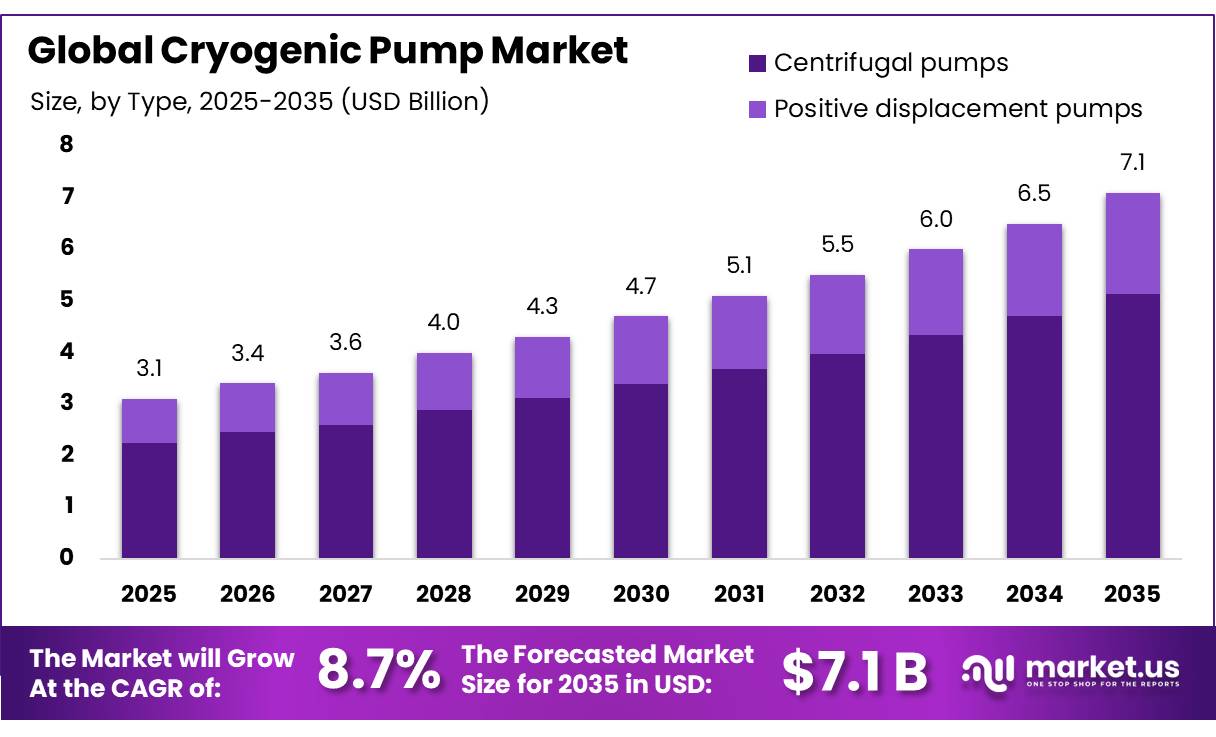
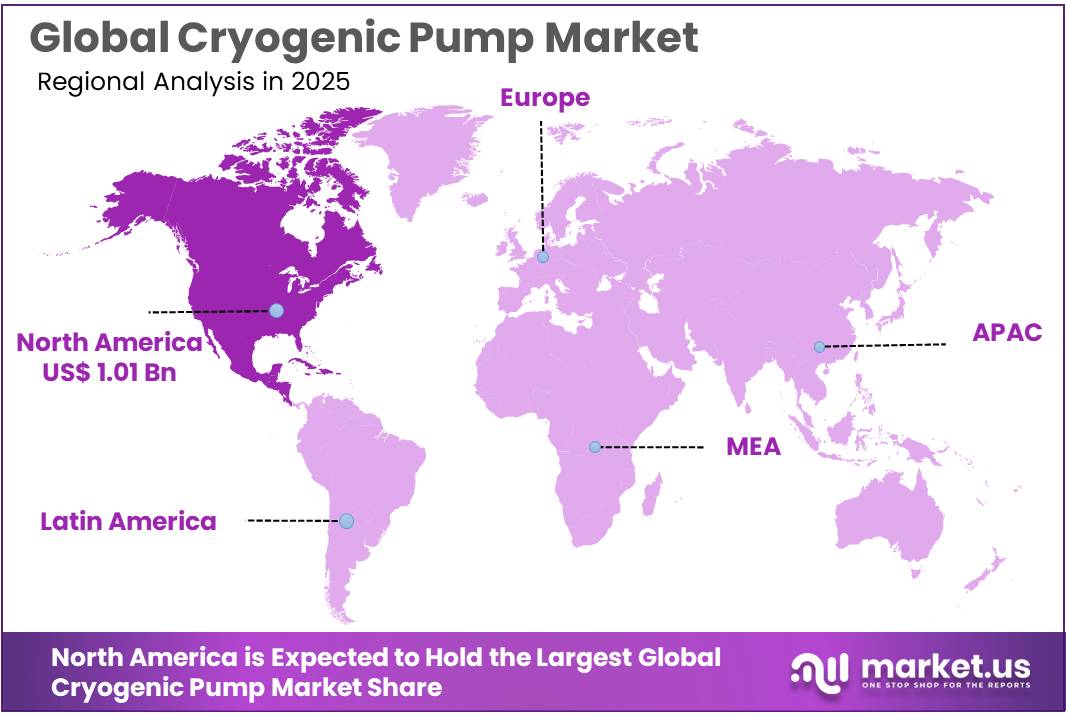
The Global Cryogenic Pump Market size is expected to be worth around USD 7.1 Billion by 2035, from USD 3.1 Billion in 2025, growing at a CAGR of 8.7% during the forecast period from 2026 to 2035. In 2025, North America held a dominant market position, capturing more than a 32.60% share, holding USD 1.01 Billion revenue.
The cryogenic pump industry is an important part of the infrastructure used to transfer and handle liquefied gases at extremely low temperatures. Cryogenic pumps are used for LNG, liquid hydrogen, liquid nitrogen, liquid oxygen, liquid argon, and other low-temperature fluids across energy, industrial-gas, chemical, healthcare, aerospace, and transportation applications.
- Their role is particularly important where liquids must be moved safely between storage tanks, transport systems, processing units, and fueling equipment. The expanding LNG trade is strengthening the industrial base for these systems. Global LNG trade reached a record 56.3 billion cubic feet per day in 2025, increasing 5.4% from the previous year.
The industrial scenario is also being shaped by continued expansion of LNG infrastructure. The United States became the world’s largest LNG exporter, with exports reaching about 15.0 Bcf/d in 2025, compared with only 0.5 Bcf/d in 2016. U.S. LNG exports are forecast to reach 17.4 Bcf/d in 2026 and 18.6 Bcf/d in 2027. Rising liquefaction, storage, marine transportation, and regasification activity creates additional requirements for reliable cryogenic pumping equipment capable of maintaining performance under severe temperature conditions.
Natural-gas supply growth is another supporting factor. U.S. marketed natural-gas production reached a record 118.5 Bcf/d in 2025, increasing by 5.3 Bcf/d from the previous year. The Appalachia, Permian, and Haynesville regions together accounted for 67% of total marketed production and 81% of production growth during the year. This expanding supply base supports investment across LNG liquefaction, transportation, storage, and export infrastructure where cryogenic pumps are essential for liquid transfer and process operations.
- The U.S. Department of Energy’s Regional Clean Hydrogen Hubs program was supported by up to $8 billion under the Infrastructure Investment and Jobs Act to establish interconnected hydrogen production, storage, delivery, and end-use infrastructure. Cryogenic pumps can become increasingly relevant where hydrogen is liquefied for transportation or high-density storage. DOE has also provided $1.66 billion in loan-guarantee support for Plug Power projects involving the production and liquefaction of low-carbon hydrogen, demonstrating growing investment in hydrogen liquefaction infrastructure.
Future opportunities are expected to extend beyond conventional LNG. North American LNG export capacity could increase from 11.4 Bcf/d in 2024 to 28.7 Bcf/d by 2029 if projects under construction proceed as planned. At the same time, DOE-supported hydrogen hubs and clean-energy projects are encouraging development of hydrogen production, transportation, storage, and refueling networks. These developments can create demand for higher-efficiency cryogenic pumps, improved sealing systems, variable-speed drives, remote monitoring, and equipment designed for longer operating cycles.
Key Takeaways
- Cryogenic Pump Market size is expected to be worth around USD 7.1 Billion by 2035, from USD 3.1 Billion in 2025, growing at a CAGR of 8.7%.
- Centrifugal pumps held a dominant market position, capturing more than a 72.00% share.
- Submersible held a dominant market position, capturing more than a 59.00% share.
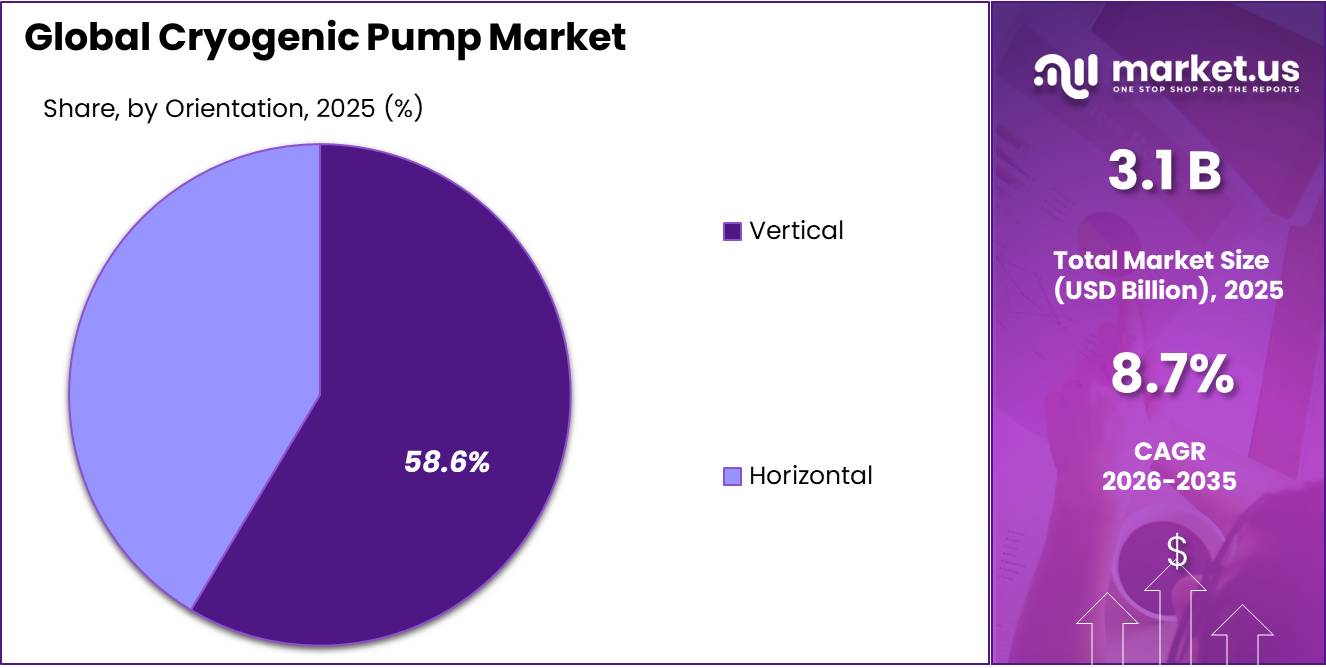
- Vertical held a dominant market position, capturing more than a 58.00% share.
- Industrial Gases held a dominant market position, capturing more than a 44.05% share.
- Energy and power held a dominant market position, capturing more than a 21.00% share.
- North America held a dominant position in the Cryogenic Pump Market, accounting for 32.60%, valued at USD 1.01 billion.
By Type Analysis
Centrifugal Pumps dominate due to high-flow performance in cryogenic service
In 2025, “Centrifugal pumps” held a dominant market position, capturing more than a 72.00% share. Centrifugal pump technology remains important in cryogenic applications because it can handle continuous liquid movement at high flow rates, making it suitable for LNG transfer, storage, loading, and other large-scale operations. NASA describes centrifugal turbopumps as one of the two major technology options used for cryogenic pumping, with the technology using an impeller-inducer combination and high rotational speeds to create differential pressure.
The wider LNG industry continued to create demand for reliable cryogenic pumping equipment during 2025. According to the U.S. Energy Information Administration (EIA), global LNG trade reached 56.3 billion cubic feet per day (Bcf/d) in 2025, representing a 5.4% increase from the previous year. U.S. LNG exports also reached 15.1 Bcf/d in 2025, showing the scale of LNG handling and transfer activity requiring dependable pumping systems.
Positive displacement pumps are an important technology in cryogenic pumping because they move fluid by repeatedly trapping and displacing a defined volume. This operating principle makes them useful where controlled flow and pressure are important. NASA identifies positive displacement pumps alongside centrifugal turbopumps as one of the two major technology options for cryogenic pumping.
By Design Analysis
Submersible pumps dominate through direct immersion and efficient cryogenic transfer
In 2025, “Submersible” held a dominant market position, capturing more than a 59.00% share. Submersible cryogenic pumps are designed to operate while immersed in the liquid being handled, which can help reduce suction-side limitations and support reliable transfer from storage tanks and other cryogenic vessels. This design is particularly relevant for LNG applications where pumps must operate under very low-temperature conditions and maintain stable liquid movement.
The demand environment remained strong in 2025 as global LNG activity increased. According to the U.S. Energy Information Administration (EIA), global LNG trade reached 56.3 billion cubic feet per day (Bcf/d) in 2025, increasing 5.4% from the previous year. U.S. LNG exports also reached 15.1 Bcf/d during 2025, highlighting the expanding volume of cryogenic liquid handled through export terminals and related infrastructure.
In 2026, LNG activity continued to support the need for dependable cryogenic pumping systems. EIA reported that U.S. LNG exports averaged 17.4 Bcf/d during the first six months of 2026, which was 23% higher than during the same period in 2025. The increase was linked to additional capacity from new terminals and expansions at existing facilities.
Non-submersible pumps are used when the pumping equipment is positioned outside the cryogenic liquid storage vessel or transfer system. This design provides flexibility in equipment placement and can allow easier access for inspection and maintenance. It is relevant across LNG, industrial-gas, hydrogen, and other applications where cryogenic liquids must be transferred between storage, processing, transportation, and distribution systems.
By Orientation Analysis
Vertical pumps dominate through efficient space use and reliable cryogenic handling
In 2025, “Vertical” held a dominant market position, capturing more than a 58.00% share. Vertical cryogenic pumps are widely suited to applications where the pump is positioned below or close to the liquid source, helping maintain a practical flow path for very cold fluids. Their design is useful in LNG storage, transfer, industrial gas systems, and other facilities where equipment layout and dependable liquid movement are important. The vertical arrangement can also support compact installation in facilities where floor space is limited.
The operating environment remained strong in 2025 as LNG transportation and handling continued to expand. The U.S. Energy Information Administration (EIA) reported that global LNG trade increased 5.4% in 2025 to a record 56.3 billion cubic feet per day (Bcf/d). U.S. LNG exports increased 26% to 15.1 Bcf/d during the same year. These higher volumes supported continued investment in equipment used for LNG storage, transfer, and export operations.
Horizontal cryogenic pumps are used in applications where the pump and motor assembly can be installed alongside the storage or transfer system. This configuration can provide convenient access for inspection and servicing while offering flexibility in piping and equipment arrangement. Horizontal designs are relevant in LNG facilities, industrial gas plants, and other cryogenic operations where equipment accessibility and plant layout are important considerations.
By Cryogen Type Analysis
Industrial gases dominate through broad use across cryogenic and process industries
In 2025, “Industrial Gases” held a dominant market position, capturing more than a 44.05% share. Industrial gases such as oxygen, nitrogen, argon, and hydrogen require dependable cryogenic equipment during production, liquefaction, storage, and transfer. Cryogenic pumps are important in these operations because liquefied gases must be moved safely and consistently between storage vessels, transport systems, and industrial facilities.
The U.S. Department of Energy notes that nitrogen is used for purging equipment, tanks, and pipelines, while oxygen is used in refinery processes to increase operating capacity. These applications show the importance of reliable industrial-gas infrastructure.
In 2025, the industrial-gas sector remained connected with major manufacturing and energy activities. The U.S. Census Bureau classifies industrial gas manufacturing under NAICS 325120 and includes establishments producing industrial organic and inorganic gases in compressed, liquid, and solid forms. This broad classification covers the production systems that support manufacturing, chemical processing, energy, healthcare, metals, and other industrial applications. (census.gov)
Liquefied natural gas is a major application for cryogenic pumps because LNG must remain at very low temperatures during storage, transportation, loading, and unloading. LNG facilities use specialized pumping systems to transfer the liquid between storage tanks, pipelines, marine loading systems, and processing equipment. The continued expansion of LNG infrastructure therefore creates a steady requirement for reliable cryogenic pumping technology.
By End User Analysis
Energy and power leads through growing demand for reliable cryogenic systems
In 2025, “Energy and power” held a dominant market position, capturing more than a 21.00% share. The energy and power sector uses cryogenic pumps in applications involving LNG, hydrogen, liquid oxygen, nitrogen, and other low-temperature fluids. These pumps support storage, transfer, fuel handling, and related energy infrastructure where stable liquid movement is important. The growing focus on LNG supply and emerging hydrogen infrastructure is also creating additional opportunities for cryogenic pumping equipment.
In 2025, the U.S. Energy Information Administration (EIA) reported that global LNG trade reached 56.3 billion cubic feet per day (Bcf/d), increasing 5.4% from the previous year. U.S. LNG exports reached 15.1 Bcf/d, an increase of 26% from 2024. Higher LNG movement increased the requirement for equipment used in liquefaction plants, storage terminals, transportation systems, and export facilities.
In 2026, U.S. LNG exports continued to rise. EIA reported average exports of 17.4 Bcf/d during the first six months of 2026, representing a 23% increase from the same period in 2025. Additional terminal capacity and expansions at existing facilities contributed to the higher volumes. This continued infrastructure development supports the use of cryogenic pumps across energy facilities. (eia.gov)
Oil and gas is an important end-user sector for cryogenic pumps because LNG production, storage, transportation, and export require equipment capable of handling liquefied natural gas at extremely low temperatures. Cryogenic pumps are used for liquid transfer between storage tanks, pipelines, processing systems, loading facilities, and transportation equipment. Their ability to maintain reliable flow under low-temperature conditions makes them suitable for demanding oil and gas operations.
Key Market Segments
By Type
- Centrifugal pumps
- Positive displacement pumps
By Design
- Submersible
- Non-submersible
By Orientation
- Horizontal
- Vertical
By Cryogen Type
- Liquefied natural gas
- Industrial Gases
- Nitrogen
- Oxygen
- Argon
- Specialty & Clean Energy Gases
- Hydrogen
- Helium
By End User
- Energy and power
- Oil and gas
- Metallurgy
- Chemicals and petrochemicals
- Electronics
- Healthcare and pharmaceuticals
- Aerospace
- Others
Driver Analysis
LNG Export Capacity Wave
The LNG export-capacity wave is the largest 2026 demand driver because each liquefaction train, storage tank, loading jetty, marine terminal, regasification facility, and boil-off-gas system requires cryogenic transfer, submerged, loading, circulation, and auxiliary pumping systems designed for LNG at about -162 degrees Celsius. The IEA expects approximately 345 bcm per year of LNG export capacity already under construction at the start of 2025 to enter operation between 2025 and 2030, the largest comparable capacity wave in LNG history; annual additions are projected to rise from around 35 bcm per year in 2025 to roughly 95 bcm per year in 2028, while three U.S. projects reaching FID by early June 2026 added a further 31 bcm per year of nameplate capacity.
This converts into a multi-year pump-order pipeline because a typical export train requires analyst-modelled USD 8–25 million of cryogenic pumping, transfer, loading, and control-system content, while large terminals can require 10–30 major pump trains across process, tank, marine, and emergency-duty applications. Supplier economics improve as EPCs seek fewer qualified partners capable of supporting pump engineering, cryogenic testing, site commissioning, spares, and 15–25-year lifecycle service; an OEM that secures a USD 15 million greenfield scope can typically attach USD 0.6–1.2 million of annual maintenance, inspection, seal, bearing, and overhaul revenue after commissioning.
North America is especially material because it is expected to contribute more than half of global LNG export-capacity additions through 2029, concentrating demand around U.S. Gulf Coast fabrication, ports, and EPC ecosystems. The resulting combination of equipment, replacement-parts, and service demand is estimated to add +2.5 percentage points to baseline cryogenic-pump CAGR through 2030.
Drivers Impact Analysis
| Driver | (~) % Impact on CAGR Forecast | Geographic Relevance | Impact Timeline |
|---|---|---|---|
| LNG export capacity wave | +2.5% | U.S. Gulf, Qatar, Africa, Australia | Medium term (2-4 years) |
| Semiconductor gas-fab expansion | +1.9% | U.S., Taiwan, Korea, Japan, EU | Short term (≤ 2 years) |
| Liquid-hydrogen terminal buildout | +1.6% | Japan, Korea, EU ports, Middle East | Medium term (2-4 years) |
| Industrial-gas outsourcing | +1.3% | North America, East Asia, EU | Short term (≤ 2 years) |
| LNG reliability retrofits | +1.1% | North America, Asia, Europe, Qatar | Short term (≤ 2 years) |
| Space cryogenic-fluid programs | +0.8% | U.S., EU, Japan, India | Long term (≥ 4 years) |
Restraint Analysis
Hydrogen Project Deferrals
The IEA’s 2026 assessment shows committed low-emissions hydrogen capacity growing only 3% to 4.3 Mt by 2030, while the broader project pipeline fell by 10 Mt to 27 Mt due to postponements, pauses, and cancellations; only about 6 Mt of additional projects have sufficiently strong potential to reach final investment decision in 2026–2027.
Large European projects are expected to begin operating in 2026, but slow policy implementation and unresolved regulatory clarity continue to delay scale-up, while fossil-derived hydrogen remains cheaper than renewable hydrogen in most regions without material policy support. In an analyst equipment model, a 100–300 tonne-per-day liquid-hydrogen plant may require 4–12 specialized transfer, circulation, loading, or process-pump packages valued at USD 0.5–3.0 million each; a 24-month FID delay therefore defers USD 2–36 million of addressable pump revenue per project while vendors retain engineering resources, long-lead inventory, and application-support costs without revenue conversion.
The commercial impact extends beyond units: delayed projects compress service-contract attachment, cause suppliers to compete for fewer awarded packages, reduce pricing power by an estimated 5–12%, and increase bid-and-proposal spend as multiple developers repeatedly rebid designs. This restraint is modeled to deduct 2.3 percentage points from the global cryogenic-pump baseline CAGR through 2030, particularly in Europe, North America, the Middle East, and Australia.
Restraint Impact Analysis
| Restraint | (~) % Impact on CAGR Forecast | Geographic Relevance | Impact Timeline |
|---|---|---|---|
| Hydrogen project deferrals | -2.3% | EU, North America, Middle East, Australia | Medium term (2-4 years) |
| Helium supply disruption | -1.8% | North America, EU, Japan, Korea, China | Short term (≤ 2 years) |
| LNG project geopolitical delays | -1.5% | Qatar, Africa, Arctic, Asia | Medium term (2-4 years) |
| High-specification cost base | -1.3% | Global; emerging-market projects | Short term (≤ 2 years) |
| Export-control friction | -1.0% | China, EU, U.S., Japan, Korea | Medium term (2-4 years) |
| Qualification and certification cycles | -0.9% | Global LNG, hydrogen, aerospace | Long term (≥ 4 years) |
Opportunity Analysis
Hydrogen Terminal Pump Packages
Liquid-hydrogen terminal pump packages are a future white-space opportunity rather than a present baseline driver because global hydrogen investment is currently weighted toward production announcements and early pipeline concepts, while commercial-scale liquid-hydrogen import, storage, truck-loading, bunker-transfer, and regasification systems remain an underdeveloped downstream equipment layer requiring specialized transfer, submerged, circulation, loading, and emergency-recovery pumps.
Japan has started construction of its first commercial-scale liquefied-hydrogen import terminal, while the IEA identifies nearly 50 ports with potential access to at least 200 ktpa of hydrogen if announced projects materialize; however, pure liquid-hydrogen shipping remains commercially immature and has not yet become a standardized terminal-procurement category.
The economics justify a package strategy: shipping pure hydrogen typically imposes a minimum cost of roughly USD 2/kg and consumes more than 10 kWh/kg, over 30% of hydrogen’s energy content, so terminal operators require extremely low boil-off, high availability, and metered transfer performance rather than generic commodity pumps. An analyst model places a 100–300 tonne-per-day import terminal’s pump, vaporization-interface, loading-arm, instrumentation, and boil-off-recovery content at USD 8–30 million, with engineered system integration increasing gross margin from an estimated 25–32% on standalone pumps to 35–45% across the package and generating annual maintenance revenue equivalent to 4–7% of installed value.
This is upside beyond baseline because it requires OEMs to build LH2-specific test capability, standardized marine-terminal interfaces, boil-off performance guarantees, and joint bids with tank, EPC, and port developers before demand is fully visible; early movers can capture preferred-vendor status across Japan, South Korea, European import ports, and Middle Eastern export corridors, adding about +2.1 percentage points to achievable CAGR.
Opportunity Impact Analysis
| Opportunity | (~) % Potential CAGR Upside | Geographic Relevance | Execution Window |
|---|---|---|---|
| Hydrogen terminal pump packages | +2.1% | Japan, Korea, EU ports, Middle East | Medium term (2-4 years) |
| Semiconductor gas utility ownership | +1.8% | U.S., Taiwan, Korea, Japan, EU | Short term (≤ 2 years) |
| Predictive-service subscriptions | +1.5% | Global LNG, industrial-gas hubs | Short term (≤ 2 years) |
| LNG retrofit and boil-off recovery | +1.3% | North America, Qatar, Asia, Europe | Medium term (2-4 years) |
| Space-propellant fluid systems | +1.1% | U.S., EU, Japan, India | Long term (≥ 4 years) |
| Cryogenic pump platform roll-ups | +0.9% | North America, EU, East Asia | Medium term (2-4 years) |
Challenges Analysis
Cryogenic Talent Pipeline
The cryogenic talent pipeline is a persistent capacity challenge because specialized pump design, low-temperature metallurgy, seal and bearing engineering, vacuum systems, hazardous-fluid handling, precision machining, cryogenic welding, non-destructive examination, field commissioning, and failure analysis require cross-disciplinary expertise that cannot be replaced quickly by general mechanical or process engineers. The U.S. Department of Energy’s 2026 energy-workforce program explicitly tracks occupational shortages and calls for workforce-development actions across the energy economy, while the worldwide LNG and hydrogen build-out increasingly competes for the same rotating-equipment engineers, instrument specialists, welders, and commissioning personnel.
ISO 24490:2025, effective from October 2025, formalizes minimum design, material, NDE, testing, and documentation requirements for centrifugal pumps in cryogenic service, raising the technical baseline at the same time as the industry needs to scale manufacturing and field support. An analyst workforce model estimates that one senior cryogenic application engineer can support 8–15 complex project bids or 3–6 simultaneous commissioning packages annually, while a 15% shortfall in qualified personnel extends design-release cycles by 6–12 weeks, pushes factory acceptance tests back 2–4 weeks, and adds 3–7% to installed project cost through overtime, external specialists, rework, and delayed site mobilization.
A typical LNG or liquid-hydrogen package may need 5–12 skilled technical roles across engineering, quality, controls, service, and project management, meaning a supplier attempting to add USD 50 million of annual cryogenic revenue needs roughly 25–45 incremental qualified employees rather than a small group of generalist hires. The long-term corporate response is structured apprenticeships, university partnerships, internal test-facility rotations, digital work instructions, retained-expert programs, and regional commissioning academies; however, the multi-year skill-formation cycle is estimated to impose a -1.4 percentage-point CAGR friction drag across North America, Europe, Japan, Korea, and emerging Asian manufacturing hubs.
Challenges Impact Analysis
| Challenge | (~) % CAGR Friction | Geographic Relevance | Mitigation Horizon |
|---|---|---|---|
| Cryogenic talent pipeline | -1.4% | North America, EU, Japan, Korea, APAC | Long term (≥ 4 years) |
| Helium supply concentration | -1.2% | U.S., EU, China, Japan, Korea | Medium term (2-4 years) |
| Extreme-temperature reliability | -1.1% | Global LNG, hydrogen, space | Long term (≥ 4 years) |
| Long equipment qualification | -1.0% | Global LNG, semiconductors, aerospace | Medium term (2-4 years) |
| Critical-component sourcing | -0.9% | North America, EU, East Asia | Medium term (2-4 years) |
| Trade-control compliance complexity | -0.7% | U.S., EU, China, Japan, Korea | Medium term (2-4 years) |
Geopolitical Impact Analysis
War-Driven Energy Disruptions Reshape Cryogenic Pump Demand
The ongoing Middle East conflict and continued Russia–Ukraine war are increasing uncertainty across global energy supply chains, directly affecting the operating environment for the cryogenic pump market. LNG has become especially important as countries seek alternative gas supplies, while disruptions to production and shipping are encouraging energy companies to strengthen storage, transfer, and import infrastructure.
In 2025, more than 110 billion cubic meters of LNG passed through the Strait of Hormuz, according to IEA-related government monitoring, showing the strategic importance of the route to global cryogenic-gas supply. In 2026, the disruption increased demand for LNG from alternative suppliers. The U.S. Energy Information Administration reported that U.S. LNG exports averaged 17.4 Bcf/d during the first six months of 2026, 23% above the same period in 2025.
Regional Insights
North America Leads Cryogenic Pump Market as LNG Infrastructure Expands
In 2025, North America held a dominant position in the Cryogenic Pump Market, accounting for 32.60%, valued at USD 1.01 billion. The region’s position is supported by strong LNG production, export infrastructure, and continued investment in gas-processing facilities. The U.S. Energy Information Administration reported that U.S. marketed natural gas production reached a record 118.5 Bcf/d in 2025, increasing by 5.3 Bcf/d from 2024. Appalachia, Permian, and Haynesville together represented 67% of U.S. marketed production. U.S. Energy Information Administration
North America is also positioned for continued expansion as new LNG capacity enters operation. EIA reported that North American LNG export capacity could increase from 11.4 Bcf/d in 2024 to 28.7 Bcf/d by 2029, provided projects under construction proceed as planned. Canada and Mexico are also adding capacity, broadening the regional LNG infrastructure base. In 2026, U.S. LNG exports averaged 17.4 Bcf/d during the first six months, 23% higher than the same period in 2025. New capacity from Plaquemines LNG, Corpus Christi Stage 3, and Golden Pass contributed to this increase.
Key Regions and Countries Insights
- North America
- US
- Canada
- Europe
- Germany
- France
- The UK
- Spain
- Italy
- Rest of Europe
- Asia Pacific
- China
- Japan
- South Korea
- India
- Australia
- Rest of APAC
- Latin America
- Brazil
- Mexico
- Rest of Latin America
- Middle East & Africa
- GCC
- South Africa
- Rest of MEA
Key Players Analysis
Nikkiso Co., Ltd. maintains a strong position in cryogenic equipment, with its Clean Energy & Industrial Gases Group employing more than 1,800 people across more than 20 countries. The group develops cryogenic pumps and systems for LNG, hydrogen, nitrogen, oxygen, and other gases. In 2025, Nikkiso reported consolidated revenue of JPY 215.6 billion.
Ebara Corporation provides custom pumps, compressors, and turbines through its Energy business and serves demanding industrial applications. As of December 2025, Ebara Corporation reported revenue of JPY 958.3 billion and 5,489 employees, while the consolidated group had 21,148 employees. The company operates through 112 group companies and has more than 100 years of engineering history, having been founded in 1912.
Fives Group developed specialized cryogenic pumps and heat exchangers for LNG, hydrogen, carbon dioxide, and nitrogen applications. Its former Fives Energy Cryogenics business employed more than 700 people across manufacturing facilities in France, China, and Switzerland and generated approximately EUR 200 million in 2024 revenue.
Top Key Players Outlook
- Nikkiso Co., Ltd.
- Ebara Corporation
- Fives Group
- Flowserve Corporation
- Sulzer Ltd.
- Cryostar SAS
- SHI Cryogenics Group
- Atlas Copco AB
- Trillium Flow Technologies
- Ruhrpumpen Group
- Vanzetti Engineering S.p.A.
- INOXCVA
- PHPK Technologies
- KSB SE & Co. KGaA
- Dover Corporation / PSG Cryogenic Solutions
Recent Developments
- In March 2026, Atlas Copco AB agreed to acquire Stainless Design Concepts, adding 26 employees and a purchase price of approximately USD 16.9 million; the company supplies high-purity gas and liquid chemical delivery systems.
- In 2026, Cryostar reported 770 employees, 6 business centers, and €530 million turnover for December 2025, with 98% of exports coming from its main site, showing its strong international operating base.
- In February 2026, Sulzer reported CHF 3.555 billion in 2025 sales, CHF 556.2 million EBITDA and 13,526 employees across 160 production and service locations. Its Flow division recorded 12.3% sales growth in 2025, supported by strong Energy performance.
Report Scope
| Report Features | Description |
|---|---|
| Market Value (2025) | USD 3.1 Bn |
| Forecast Revenue (2035) | USD 7.1 Bn |
| CAGR (2026-2035) | 8.7% |
| Base Year for Estimation | 2025 |
| Historic Period | 2020-2024 |
| Forecast Period | 2026-2035 |
| Report Coverage | Revenue Forecast, Market Dynamics, Competitive Landscape, Recent Developments |
| Segments Covered | By Type (Centrifugal pumps, Positive displacement pumps), By Design (Submersible, Non-submersible), By Orientation (Horizontal, Vertical), By Cryogen Type (Liquefied natural gas, Industrial Gases, Nitrogen, Oxygen, Argon, Specialty & Clean Energy Gases, Hydrogen, Helium), By End User (Energy and power, Oil and gas, Metallurgy, Chemicals and petrochemicals, Electronics, Healthcare and pharmaceuticals, Aerospace, Others) |
| Regional Analysis | North America – US, Canada; Europe – Germany, France, The UK, Spain, Italy, Rest of Europe; Asia Pacific – China, Japan, South Korea, India, Australia, Singapore, Rest of APAC; Latin America – Brazil, Mexico, Rest of Latin America; Middle East & Africa – GCC, South Africa, Rest of MEA |
| Competitive Landscape | Nikkiso Co., Ltd., Ebara Corporation, Fives Group, Flowserve Corporation, Sulzer Ltd., Cryostar SAS, SHI Cryogenics Group, Atlas Copco AB, Trillium Flow Technologies, Ruhrpumpen Group, Vanzetti Engineering S.p.A., INOXCVA, PHPK Technologies, KSB SE & Co. KGaA, Dover Corporation / PSG Cryogenic Solutions |
| Customization Scope | Customization for segments, region/country-level will be provided. Moreover, additional customization can be done based on the requirements. |
| Purchase Options | We have three licenses to opt for: Single User License, Multi-User License (Up to 5 Users), Corporate Use License (Unlimited User and Printable PDF) |





































