


Report Overview
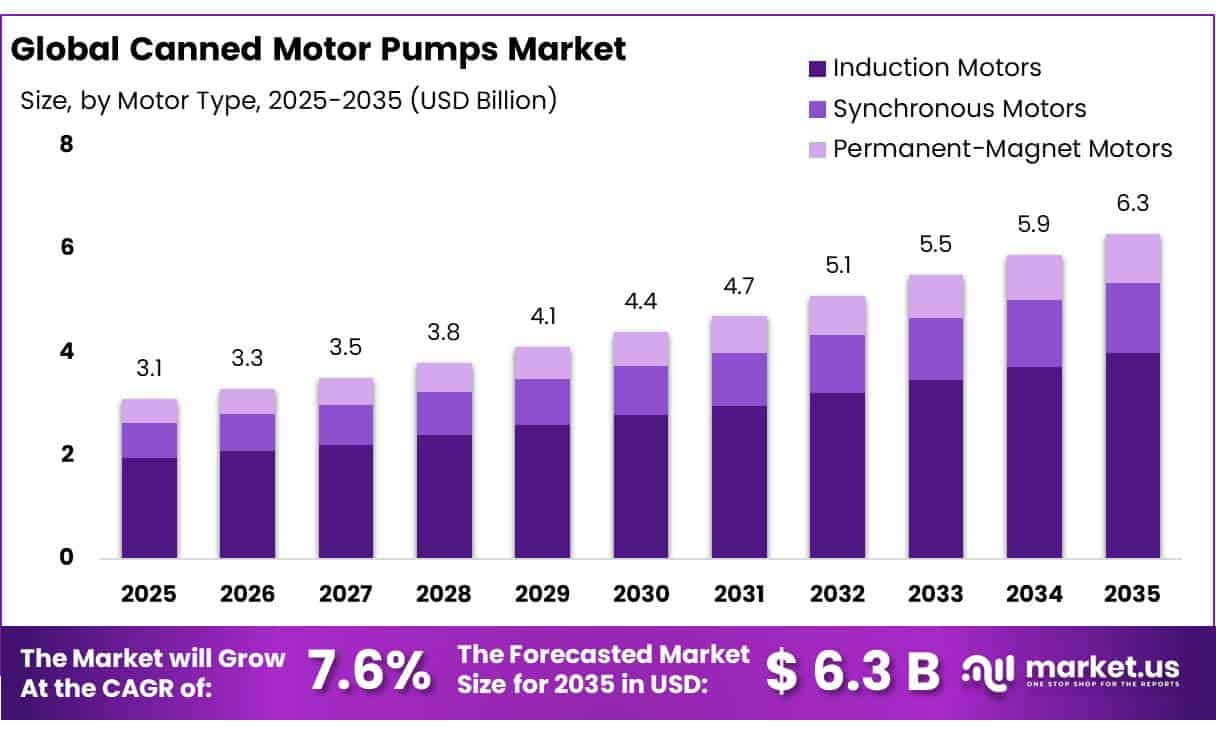
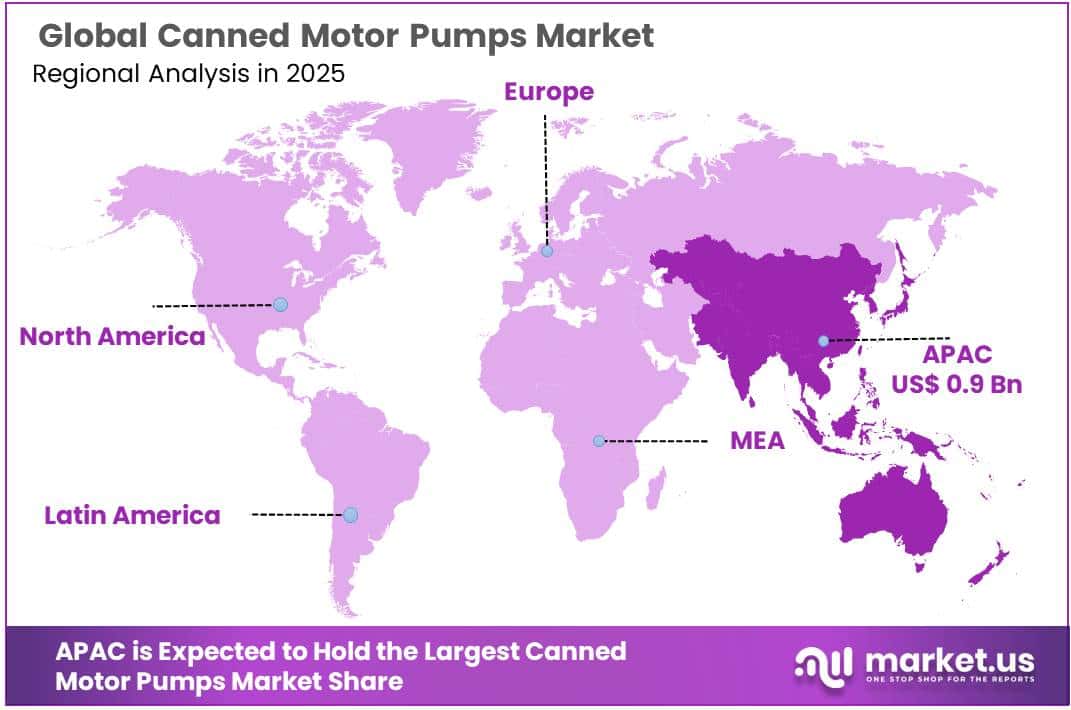
The Global Canned Motor Pumps Market size is expected to be worth around USD 6.3 Billion by 2035, from USD 3.1 Billion in 2025, growing at a CAGR of 7.6% during the forecast period from 2026 to 2035. In 2025, Asia Pacific held a dominant market position, capturing more than a 31.50% share, holding USD 0.9 Billion revenue.
Canned motor pumps are sealless centrifugal pumps in which the pump and electric motor are integrated inside a common pressure boundary. Because the design removes the conventional rotating shaft seal, it is well suited to hazardous, toxic, volatile, corrosive and high-value fluids where leakage control, operator safety and product purity are important. Typical applications include chemical processing, petrochemicals, refrigerants, heat-transfer fluids, liquefied gases and selected energy processes.
- The industrial base supporting these pumps remains substantial. Cefic reports that the European chemical industry generated €635 billion in turnover and employed 1.2 million people, while around 31,000 companies operated across the EU chemical sector. Europe represented about 13% of the global chemical market in Cefic’s 2025 industry assessment.
The United States also provides an important investment pipeline. The American Chemistry Council reported that U.S. chemical-industry capital spending increased 2.4% to $39.8 billion in 2025. Capital expenditure was expected to rise another 1.8% in 2026, followed by approximately 4–5% annual growth in 2027 and 2028. Such investment can support replacement and greenfield demand for canned motor pumps across specialty chemicals, basic chemicals, process cooling and closed-loop fluid-handling systems.
- U.S. OSHA Process Safety Management rules cover certain processes handling at least 10,000 pounds (4,535.9 kg) of qualifying flammable liquids or gases, including relevant flammable liquids with flashpoints below 100°F (37.8°C). EPA leak-detection guidance also recommends an internal leak definition of 2,000 ppm or lower for pumps in light-liquid or gas/vapor service. These requirements strengthen the operational case for technologies that reduce external leakage paths.
European environmental regulation is moving in a similar direction. The revised EU Industrial Emissions Directive entered into force on 4 August 2024 and covers about 37,000 industrial installations, together with other regulated facilities. The European Commission expects implementation to reduce key air pollutants by up to 40% by 2050 compared with 2020 levels. Tighter permitting and stronger hazardous-chemical controls can encourage chemical plants to adopt more contained pumping technologies during modernization programs.
Future opportunities are also developing in cryogenic and liquefied-gas infrastructure. Global LNG trade increased 5.4% to a record 56.3 billion cubic feet per day in 2025. U.S. LNG exports averaged 17.4 billion cubic feet per day in the first half of 2026, representing a 23% year-over-year increase, while EIA projected 18.7 billion cubic feet per day for the first half of 2027. This expansion creates additional scope for specialized canned motor pumps in low-temperature, high-integrity transfer systems.
Key Takeaways
- Canned Motor Pumps Market size is expected to be worth around USD 6.3 Billion by 2035, from USD 3.1 Billion in 2025, growing at a CAGR of 7.6%.
- Standard Basic Pumps held a dominant market position, capturing more than a 42.00% share.
- Single-Stage Pumps held a dominant market position, capturing more than a 68.00% share.
- Induction Motors held a dominant market position, capturing more than a 63.20% share.
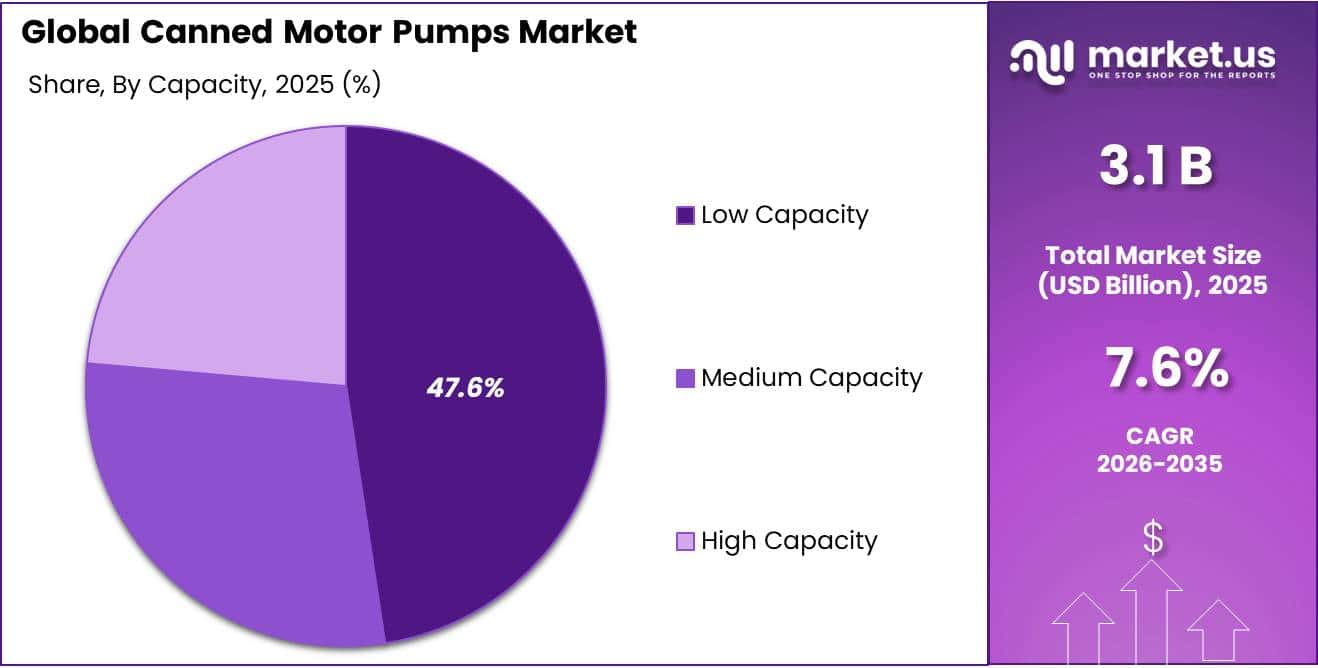
- Low Capacity held a dominant market position, capturing more than a 47.00% share.
- Chemical held a dominant market position, capturing more than a 39.60% share.
- In 2025, Asia Pacific held a dominant market position, capturing more than a 31.50% share, holding USD 0.9 Billion revenue.
By Type Analysis
Standard Basic Pumps dominate the Canned Motor Pumps Market with more than a 42.00% share in 2025.
In 2025, “Standard Basic Pumps” held a dominant market position, capturing more than a 42.00% share. The segment remained widely preferred because its simple sealless construction supports reliable handling of hazardous, corrosive, toxic, and valuable fluids while reducing leakage risk. Standard basic canned motor pumps are commonly used across chemical processing, petroleum refining, refrigeration, power generation, and other continuous-process facilities. TEIKOKU identifies basic canned motor pumps as suitable for low- to medium-temperature, slurry-free liquids where zero-leakage operation is required.
Government industrial data also supports the strong operating base for this pump type. In 2025, the U.S. Energy Information Administration reported 132 operable petroleum refineries with approximately 18.4 million barrels per calendar day of atmospheric crude-oil distillation capacity. Large continuous-processing facilities require dependable pumping systems for hydrocarbons, chemicals, process liquids, and closed-loop services, supporting the continuing use of standard canned motor pump designs.
Reverse Circulation Pumps represent an important specialized type within the Canned Motor Pumps Market. These pumps are designed for highly volatile liquids, liquefied gases, and low-boiling process fluids where vapor formation can cause cavitation or vapor locking. In this design, the circulation liquid used for motor cooling and bearing lubrication is returned to the vapor area of the suction vessel, helping maintain stable pump operation.
By Pump Design Analysis
Single-Stage Pumps dominate the Canned Motor Pumps Market with more than a 68.00% share in 2025.
In 2025, “Single-Stage Pumps” held a dominant market position, capturing more than a 68.00% share. Their strong position is supported by a simple pump arrangement, compact construction, easier operation, and suitability for continuous transfer of chemicals, hydrocarbons, refrigerants, and other process liquids. Single-stage canned motor pumps remove the need for a conventional shaft seal, which makes them useful where leakage control and reliable fluid handling are important. HERMETIC identifies single-stage canned motor pumps for standard chemical processing and applications involving liquefied gases, boiling media, condensates, refrigerants, and heat-transfer fluids.
- Government industrial statistics also indicate a large operating base for this pump design. According to the U.S. Energy Information Administration, U.S. refinery gross input to atmospheric crude-oil distillation units averaged 16.731 million barrels per day in 2025, while operable refinery capacity averaged 18.180 million barrels per day. This large volume of continuously processed liquid supports demand for dependable pumping equipment across refinery circulation, chemical transfer, cooling, feed, and other process services.
Multistage Pumps form an important pump-design segment in the Canned Motor Pumps Market, particularly where industrial processes require higher discharge pressure or greater total head than a single impeller can efficiently provide. Their multiple-impeller arrangement makes them suitable for chemical processing, high-pressure gas handling, semiconductor production, power generation, petroleum refining, boiler plants, and other demanding fluid-transfer operations. TEIKOKU explains that its multistage canned motor pump uses a back-to-back impeller arrangement to balance axial thrust and is designed for high-total-dynamic-head applications.
By Motor Type Analysis
Induction Motors dominate the Canned Motor Pumps Market with more than a 63.20% share in 2025, supported by their proven reliability in continuous industrial pumping.
In 2025, “Induction Motors” held a dominant market position, capturing more than a 63.20% share. Their leading position is supported by simple construction, reliable continuous operation, low maintenance needs, and suitability for chemical, oil and gas, refrigeration, and other process applications. In a conventional canned motor pump, the centrifugal pump and electric motor are integrated into one sealed unit, helping prevent process-fluid leakage. Hydrodyne Teikoku states that its canned motor pumps combine centrifugal pump technology with a three-phase induction motor, showing the established role of this motor design in industrial canned pumping systems.
- Government energy data further supports the importance of induction motors in industrial equipment. In 2026, the U.S. Department of Energy confirmed that its regulated small-electric-motor category covers general-purpose, alternating-current, single-speed induction motors. The DOE’s final determination became effective on March 16, 2026, maintaining the existing energy-conservation framework for these motors.
Synchronous Motors are developing as an important alternative motor type in the Canned Motor Pumps Market. Permanent-magnet synchronous designs can reduce electrical losses in the rotor and provide efficient operation across controlled operating speeds. This makes them suitable for specialized chemical circulation, refrigeration, thermal-management, high-purity fluid, and energy-efficient process applications. KSB notes that permanently excited synchronous motors are particularly efficient drives for canned motor pumps because permanent magnets in the rotor help minimize excitation losses.
By Capacity Analysis
Low Capacity pumps dominate the Canned Motor Pumps Market with more than a 47.00% share in 2025, supported by compact design and dependable low-flow process handling.
In 2025, “Low Capacity” held a dominant market position, capturing more than a 47.00% share. Low-capacity canned motor pumps are widely suited to applications where smaller and controlled volumes of hazardous, corrosive, flammable, or high-value liquids need to be transferred without external leakage. Their compact construction, absence of conventional shaft seals, low maintenance requirements, and ability to operate in closed process systems make them practical for chemical dosing, refrigeration circuits, laboratory processes, semiconductor production, specialty chemicals, cooling systems, and auxiliary refinery operations.
- Government statistics show a substantial industrial operating base supporting these pumping applications. According to the U.S. Energy Information Administration, the United States had 132 operable petroleum refineries on January 1, 2025, with atmospheric crude-oil distillation capacity of approximately 18.4 million barrels per calendar day. EIA subsequently reported that gross input to atmospheric crude-oil distillation units averaged 16.731 million barrels per day during 2025.
Medium Capacity pumps represent an important capacity category in the Canned Motor Pumps Market, particularly across chemical processing, petroleum refining, industrial refrigeration, power generation, and specialty manufacturing. These pumps are selected when process circulation or transfer requirements exceed smaller auxiliary duties but do not require very large pumping systems. Their sealed motor-and-pump arrangement helps reduce the risk of process-fluid escape while supporting continuous operation with hazardous or environmentally sensitive liquids.
By End User Analysis
Chemical dominates the Canned Motor Pumps Market with more than a 39.60% share in 2025, supported by strict leakage-control needs in hazardous fluid processing.
In 2025, “Chemical” held a dominant market position, capturing more than a 39.60% share. Chemical plants widely use canned motor pumps for transferring toxic, corrosive, flammable, and high-value liquids where external leakage must be minimized. Their integrated motor-and-pump construction removes the conventional shaft seal and helps provide closed, reliable fluid handling. TEIKOKU notes that canned motor pumps are particularly suited to chemical plants handling hazardous liquids because the process fluid remains sealed inside the pump structure.
- Government production data also shows the scale of chemical manufacturing activity supporting pump demand. According to the Board of Governors of the Federal Reserve System, the U.S. industrial production index for chemical products stood at 107.2 in August 2026, based on a 2017 index level of 100. Continuous chemical output requires pumps for feed transfer, circulation, reactor services, cooling, intermediate-product movement, and wastewater handling, supporting the use of leak-free canned motor pumping systems.
Oil and Gas represents another important end-user area for canned motor pumps. These pumps are used in petroleum refining, gas processing, petrochemical facilities, terminals, and liquefied-gas applications where hydrocarbons must be moved safely under demanding temperature and pressure conditions. TEIKOKU states that API 685-compliant canned motor pumps are designed for high-temperature and high-pressure hydrocarbons in petroleum refining and petrochemical processes.
Key Market Segments
By Type
- Standard Basic Pumps
- Reverse Circulation Pumps
- High-Temperature Pumps
- Self-Priming Pumps
- Other Pumps
By Pump Design
- Single-Stage Pumps
- Multistage Pumps
By Motor Type
- Induction Motors
- Synchronous Motors
- Permanent-Magnet Motors
By Capacity
- Low Capacity
- Medium Capacity
- High Capacity
By End User
- Chemical
- Oil and Gas
- Power Generation
- Refrigeration and HVAC
- Water and Wastewater
- Pharmaceuticals
- Food and Beverages
- Other End Users
Driver Analysis
Zero-Leakage Compliance
Regulatory tightening is converting sealless pumping from a discretionary reliability upgrade into a compliance-linked capital item: the revised EU Industrial Emissions Directive entered into force in August 2024, mandates stricter emission-limit values and electronic permitting, restricts derogations, and gave member states 22 months to transpose the rules, while the U.S. EPA’s 2024 hazardous-organics framework requires selected chloroprene process vents to achieve at least 98% reduction and is estimated to remove approximately 54 tons per year of ethylene oxide, 14 tons of chloroprene and 6,230 tons of other hazardous air pollutants from covered categories.
Canned motor pumps directly address the rotating-equipment leakage point because the common pump-motor shaft remains inside the pressure boundary, eliminating the dynamic mechanical seal, external coupling alignment and associated seal-support systems; API 685 provides the recognized sealless-pump specification route for petroleum, heavy-chemical and gas service.
This changes procurement economics from comparing pump purchase prices to comparing the avoided lifetime cost of leak detection, seal replacement, environmental reporting, shutdown exposure and secondary containment, supporting an independently modelled +2.1 percentage-point CAGR contribution through accelerated replacements at regulated chemical sites, premium pricing for API 685/ATEX/IECEx configurations, and recurring revenue from bearing-wear, temperature and motor-load monitoring rather than low-margin standalone hardware.
Drivers Impact Analysis
| Driver | (\~) % Impact on CAGR Forecast | Geographic Relevance | Impact Timeline |
|---|---|---|---|
| Zero-leakage compliance | +2.1 pp | North America, EU core | Short term (≤ 2 years) |
| LNG-petrochemical buildout | +1.8 pp | US, China, Middle East, India | Medium term (2–4 years) |
| Nuclear project expansion | +1.4 pp | China, India, Russia, MENA, Europe | Long term (≥ 4 years) |
| Hydrogen-ammonia scale-up | +1.1 pp | China, US, EU, Middle East, APAC | Medium term (2–4 years) |
| Natural-refrigerant conversion | +0.9 pp | EU core, Japan, North America | Medium term (2–4 years) |
| High-purity fab investment | +0.8 pp | US, Taiwan, Korea, China, India | Medium term (2–4 years) |
Restraint Analysis
Higher Upfront Cost
Canned motor pumps typically carry a materially higher acquisition cost than mechanically sealed centrifugal pumps because the purchase scope embeds a hermetic motor can, process-fluid-lubricated bearings, specialized stator isolation, monitoring electronics, engineered containment, and often hazardous-area certification; suppliers themselves acknowledge that mechanical-seal pumps normally cost less initially even where the sealless design lowers lifetime leakage and maintenance exposure.
This creates the largest short-cycle restraint in price-led tenders across India, Southeast Asia, Latin America, Africa, and smaller chemical processors, where an operator may evaluate a 10–20 year lifecycle benefit against a CapEx approval gate based on first-cost variance, short payback thresholds, and constrained maintenance budgets.
The value gap widens where low-to-moderate hazard fluids do not create a quantifiable avoided-emissions or shutdown cost, making a conventional seal plan economically acceptable despite greater leakage risk; as a result, independent modelling applies a -1.7 percentage-point CAGR deduction until manufacturers reduce engineering hours through modular hydraulics, localize assembly, finance critical-service retrofits through total-cost-of-ownership contracts, and prove avoided seal-support, alignment, bearing-frame, and auxiliary-system costs at the customer’s actual duty point.
Restraint Impact Analysis
| Restraint | (\~) % Impact on CAGR Forecast | Geographic Relevance | Impact Timeline |
|---|---|---|---|
| Higher upfront cost | -1.7 pp | APAC emerging, LATAM, MEA | Short term (≤ 2 years) |
| Dry-run sensitivity | -1.4 pp | Global process industries | Medium term (2-4 years) |
| Specialist supply base | -1.2 pp | North America, EU, APAC | Medium term (2-4 years) |
| Alloy-cost volatility | -1.0 pp | Global, import-dependent hubs | Short term (≤ 2 years) |
| Qualification burden | -0.9 pp | EU, US, Japan, Korea | Medium term (2-4 years) |
| Retrofit compatibility | -0.8 pp | Mature plants worldwide | Long term (≥ 4 years) |
Opportunity Analysis
Monitoring-as-a-Service
This is a future monetization white space rather than a current market driver because most canned motor pump suppliers still sell engineered equipment, spares, and periodic service, while the installed base can be converted into recurring software-enabled reliability revenue by combining motor-current signature analysis, bearing-clearance telemetry, cloud diagnostics, and outcome-linked uptime contracts; Teikoku’s Rotary Guardian already provides real-time output of critical running clearances for preventive-maintenance scheduling, and motor-current analysis can assess bearing-rotor condition from the electrical cabinet without breaching the hermetic containment boundary.
A supplier that converts even 20–30% of post-warranty units into annual monitoring contracts priced at approximately 2–5% of original equipment value can increase customer lifetime value, reduce emergency-service cost, generate proprietary failure data, and create switching costs around alarm thresholds, replacement forecasting, and fleet benchmarking; the model assigns +1.8 percentage points of upside because this changes revenue mix from cyclical project CapEx to recurring service revenue, with gross-margin expansion expected from remote triage replacing a portion of on-site inspection and with the strongest near-term conversion opportunity in North America, Europe, Japan, and South Korea.
Opportunity Impact Analysis
| Opportunity | (\~) % Potential CAGR Upside | Geographic Relevance | Execution Window |
|---|---|---|---|
| Monitoring-as-a-service | +1.8 pp | North America, EU, Japan, Korea | Short term (≤ 2 years) |
| Hydrogen-ammonia packages | +1.6 pp | Middle East, China, US, APAC | Medium term (2-4 years) |
| Natural-refrigerant platforms | +1.4 pp | EU core, Japan, North America | Medium term (2-4 years) |
| Semiconductor chemical skids | +1.2 pp | US, Taiwan, Korea, China, India | Medium term (2-4 years) |
| Nuclear lifecycle services | +1.0 pp | China, India, Europe, MENA | Long term (≥ 4 years) |
| Emissions-retrofit roll-ups | +0.9 pp | US Gulf Coast, EU, China | Short term (≤ 2 years) |
Challenges Analysis
Specialist Skills Scarcity
Canned motor pump manufacturing and field support require a narrow combination of hydraulic design, rotor dynamics, electrical winding and insulation, metallurgy, fluid-film bearing behavior, hazardous-area compliance, and process-control expertise, but the skilled industrial workforce is tightening across core production regions: U.S. manufacturing had approximately 409,000 unfilled positions in August 2025 and may need 3.8 million workers by 2033, with nearly 1.9 million positions at risk of remaining unfilled, while 320,500 additional welding professionals are projected to be needed in the U.S. by 2029 and more than 157,000 existing welders are nearing retirement.
For canned motor pump suppliers, the binding constraint is not total headcount but the smaller subset able to weld and inspect thin-wall pressure containment, validate motor-can integrity, commission hermetic systems, diagnose hydrodynamic-bearing failures, and prepare traceable API/ATEX documentation; this increases engineering lead time, elevates labor premiums, and forces senior application specialists into low-value commissioning work instead of design standardization.
The estimated -1.3 percentage-point CAGR friction is therefore long dated: companies must create multi-year apprentice-to-field-engineer pipelines, codify commissioning knowledge in digital work instructions, cross-train electrical and rotating-equipment technicians, use remote support for first-line troubleshooting, and retain critical skills through regional repair hubs, particularly in North America, Europe, and Japan where ageing technical workforces and complex installed bases coincide.
Challenges Impact Analysis
| Challenge | (\~) % CAGR Friction Drag | Geographic Relevance | Mitigation Horizon |
|---|---|---|---|
| Specialist Skills Scarcity | -1.3 pp | North America, EU, Japan | Long term (≥ 4 years) |
| Internal Condition Visibility | -1.1 pp | Global process industries | Medium term (2-4 years) |
| Alloy Supply Concentration | -1.0 pp | Global import hubs | Long term (≥ 4 years) |
| Project Logistics Volatility | -0.9 pp | Europe, MENA, APAC corridors | Medium term (2-4 years) |
| Application Engineering Complexity | -0.8 pp | Global high-hazard sites | Medium term (2-4 years) |
| Customer Qualification Cycles | -0.7 pp | EU, US, Japan, Korea | Long term (≥ 4 years) |
Geopolitical Impact Analysis
Ongoing Wars and Red Sea Disruptions Reshape Canned Motor Pump Demand
The Russia–Ukraine war and conflict in the Middle East and Red Sea are affecting the Canned Motor Pumps market through energy costs and shipping risk. Chemical, refinery, LNG, and petrochemical plants are users of canned motor pumps because these systems handle hazardous and volatile fluids without conventional shaft seals. In 2026, disruptions around the Strait of Hormuz and Bab el-Mandeb tightened oil flows and increased transport uncertainty, raising costs for stainless steel, motors, electrical components, freight, and project delivery.
- The U.S. Energy Information Administration reported that Brent crude averaged USD 91 per barrel in August 2026, while global oil inventories had fallen by about 400 million barrels during the year. These conditions can raise operating and procurement costs for pump manufacturers and end users. At the same time, energy-security investments are creating demand for leak-free pumping systems in LNG terminals, refineries, storage facilities, and chemical plants.
The Russia–Ukraine war is also reshaping European energy sourcing. The European Commission reported that Russia’s share of EU gas imports fell from 45% in 2021 to 12% in 2025, encouraging LNG diversification and new infrastructure, which supports demand for reliable canned motor pumps.
Regional Insights
Asia Pacific Leads the Canned Motor Pumps Market, While the Middle East Builds Strong Growth Momentum
Asia Pacific remains the leading regional market for canned motor pumps, supported by a large base of chemical, petrochemical, refining, LNG, refrigeration, and industrial manufacturing activity. In 2025, the region accounted for a 31.50% share, valued at USD 0.97 billion. The International Energy Agency reported that Asia Pacific contributed 360 thousand barrels per day of oil-demand growth in 2025, while China alone added 220 thousand barrels per day. This industrial scale supports demand for leak-free pumping systems used with hazardous, volatile, corrosive, and high-purity fluids across chemical plants, refineries, gas-processing facilities, and other continuous-process industries across East Asian manufacturing hubs.
Regional demand for canned motor pumps is closely linked with chemical processing, refining, LNG handling, refrigeration, and other industries that require sealed movement of hazardous fluids. In 2025, OPEC reported global refining capacity of 103.66 million barrels per day and refinery throughput of 86.89 million barrels per day. Capacity additions were concentrated mainly in non-OECD markets, including Asia and the Middle East.
This operating base supports demand for sealless pumps in continuous processes where leakage control and reliability are important. Regional growth is therefore strongest around large refining, petrochemical, gas-processing, and specialty chemical manufacturing clusters worldwide across major industrial economies.
Key Regions and Countries Insights
- North America
- US
- Canada
- Europe
- Germany
- France
- The UK
- Spain
- Italy
- Rest of Europe
- Asia Pacific
- China
- Japan
- South Korea
- India
- Australia
- Rest of APAC
- Latin America
- Brazil
- Mexico
- Rest of Latin America
- Middle East & Africa
- GCC
- South Africa
- Rest of MEA
Key Players Analysis
Teikoku Electric Mfg. Co., Ltd., now operating as TEIKOKU CORPORATION, is a major specialist in canned motor pumps for chemical, petrochemical, nuclear, pharmaceutical, food, and railway applications. In fiscal 2025, its pump business generated ¥29.29 billion in external sales, while total company sales reached ¥30.55 billion. By March 2026, the group employed 1,145 people. Its canned motor pump technology, developed in 1960, remains central to its leak-free fluid handling strategy and global industrial presence across demanding process industries worldwide.
Nikkiso Co., Ltd. is an established supplier of canned motor pumps, cryogenic pumps, and process systems for oil and gas, chemicals, power, food, and semiconductor applications. Its standard canned motor pumps handle flow rates up to 1,000 m³/h, heads up to 600 m, temperatures from -130°C to +450°C, and motor power up to 250 kW. In 2026, Nikkiso reported 8,259 consolidated employees and outlined further pump-system expansion across clean-energy and high-pressure applications in major industrial markets worldwide.
HERMETIC-Pumpen GmbH is a long-standing specialist in hermetically sealed centrifugal pumps, including canned motor and magnetic-drive designs. The company traces its pump technology history back 160 years and serves chemical, petrochemical, oil and gas, energy, and industrial refrigeration customers. HERMETIC reports around 750 employees worldwide, including about 400 at Gundelfingen, Germany. Its international support network includes 7 sales companies, 40 agencies and distribution partners, and 13 service centres, strengthening its global aftermarket and engineering reach across major process industries worldwide.
Top Key Players Outlook
- Teikoku Electric Mfg. Co., Ltd.
- Nikkiso Co., Ltd.
- HERMETIC-Pumpen GmbH
- KSB SE & Co. KGaA
- Iwaki Co., Ltd.
- Kirloskar Brothers Limited
- Klaus Union GmbH & Co. KG
- OPTIMEX
- Dynamic Pumps
- Flowserve Corporation
- ITT Inc. (Goulds Pumps)
- Zhejiang Dayuan Pumps Industrial Co., Ltd.
- Shanghai East Pump Group Co., Ltd.
- Dalian Huanyou Pump Industry Co., Ltd.
- Hayward Tyler Limited
Recent Developments
- In June 2026, KSB also began a major Frankenthal production expansion involving more than €70 million, with Eta pump capacity planned to rise from about 54,000 units to 65,000 units by 2030.
- In June 2026, Iwaki approved a capital increase for its Shanghai subsidiary, lifting capital from US$600,000 to US$1.0 million, with a US$400,000 additional contribution aimed at strengthening its Chinese sales and business platform.
- By March 2026, KBL’s consolidated order book had increased 27% year-on-year, while FY2026 revenue reached ₹45.38 billion.
Report Scope
| Report Features | Description |
|---|---|
| Market Value (2025) | USD 3.1 Bn |
| Forecast Revenue (2035) | USD 6.3 Bn |
| CAGR (2026-2035) | 7.6% |
| Base Year for Estimation | 2025 |
| Historic Period | 2020-2024 |
| Forecast Period | 2026-2035 |
| Report Coverage | Revenue Forecast, Market Dynamics, Competitive Landscape, Recent Developments |
| Segments Covered | By Type (Standard Basic Pumps, Reverse Circulation Pumps, High-Temperature Pumps, Self-Priming Pumps, Other Pumps), By Pump Design (Single-Stage Pumps, Multistage Pumps), By Motor Type (Induction Motors, Synchronous Motors, Permanent-Magnet Motors), By Capacity (Low Capacity, Medium Capacity, High Capacity), By End User (Chemical, Oil and Gas, Power Generation, Refrigeration and HVAC, Water and Wastewater, Pharmaceuticals, Food and Beverages, Other End Users) |
| Regional Analysis | North America – US, Canada; Europe – Germany, France, The UK, Spain, Italy, Rest of Europe; Asia Pacific – China, Japan, South Korea, India, Australia, Singapore, Rest of APAC; Latin America – Brazil, Mexico, Rest of Latin America; Middle East & Africa – GCC, South Africa, Rest of MEA |
| Competitive Landscape | Teikoku Electric Mfg. Co., Ltd., Nikkiso Co., Ltd., HERMETIC-Pumpen GmbH, KSB SE & Co. KGaA, Iwaki Co., Ltd., Kirloskar Brothers Limited, Klaus Union GmbH & Co. KG, OPTIMEX, Dynamic Pumps, Flowserve Corporation, ITT Inc. (Goulds Pumps), Zhejiang Dayuan Pumps Industrial Co., Ltd., Shanghai East Pump Group Co., Ltd., Dalian Huanyou Pump Industry Co., Ltd., Hayward Tyler Limited |
| Customization Scope | Customization for segments, region/country-level will be provided. Moreover, additional customization can be done based on the requirements. |
| Purchase Options | We have three licenses to opt for: Single User License, Multi-User License (Up to 5 Users), Corporate Use License (Unlimited User and Printable PDF) |





































