


Quick Navigation
Report Overview
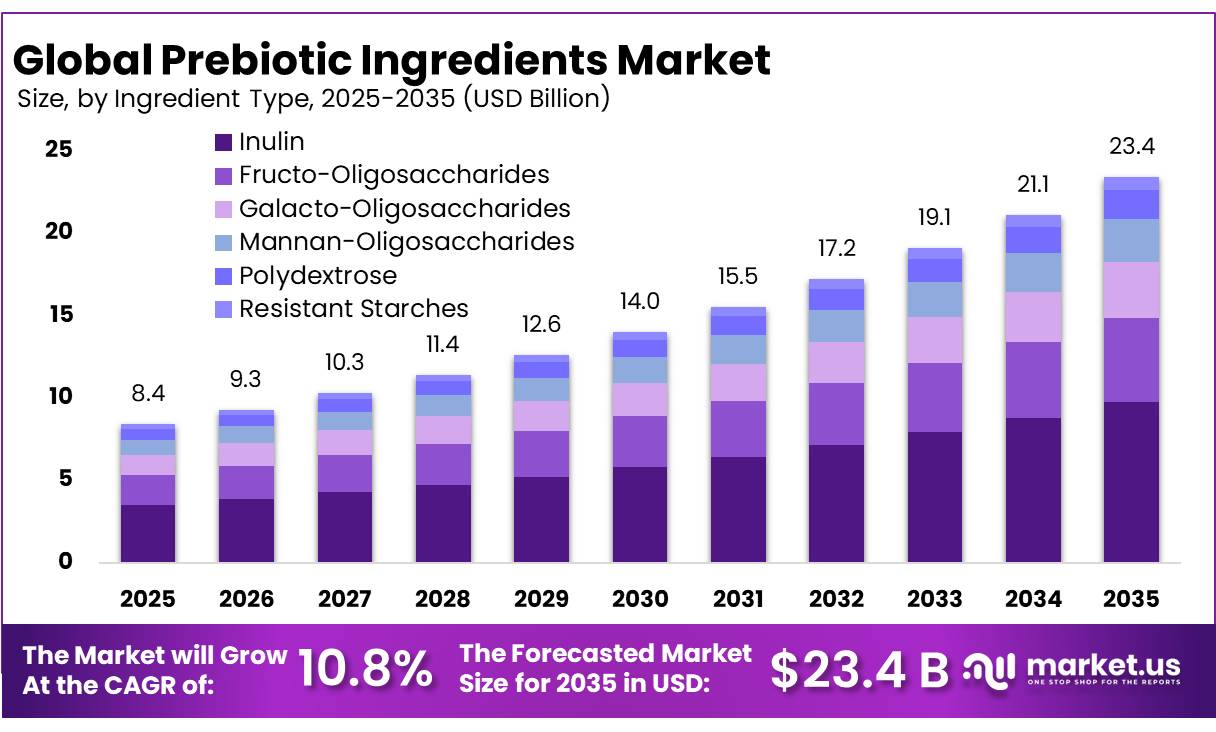
In 2025, the Global Prebiotic Ingredients Market was valued at USD 8.4 Billion, and between 2026 and 2035, this market is estimated to register a CAGR of 10.8%, reaching about USD 23.4 Billion by 2035. North America held a dominant market position, capturing more than a 35.0% share, holding USD 2.94 Billion in revenue.
The prebiotic ingredients industry is becoming an important part of the functional food and nutrition sector, supported by rising attention to digestive health, dietary fibre, and microbiome-focused products. Ingredients such as inulin, fructooligosaccharides, galactooligosaccharides, resistant starches, and selected soluble fibres are being incorporated into dairy products, beverages, bakery foods, cereals, nutrition bars, supplements, and specialized nutrition.
- In the United States, the FDA sets the Daily Value for dietary fibre at 28 g, while 20% of the Daily Value per serving is considered high and 5% or less is considered low. These benchmarks support food reformulation with fibre-rich ingredients that can also provide prebiotic functionality.
Key Takeaways
- Prebiotic Ingredients Market was valued at USD 8.4 Billion, to register a CAGR of 10.8%, reaching about USD 23.4 Billion by 2035.
- Inulin held a dominant market position, capturing more than a 41.60% share.
- Plant-Based held a dominant market position, capturing more than a 88.20% share.
- Powder held a dominant market position, capturing more than a 77.60% share.
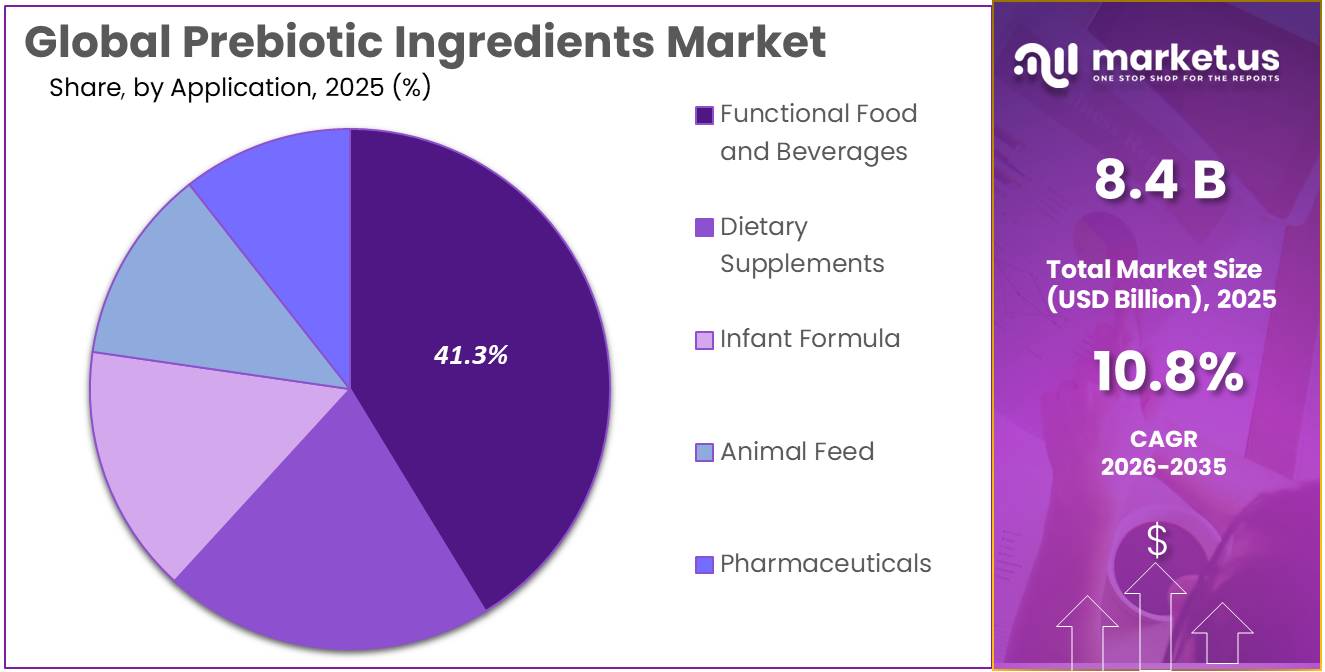
- Functional Food and Beverages held a dominant market position, capturing more than a 42.90% share.
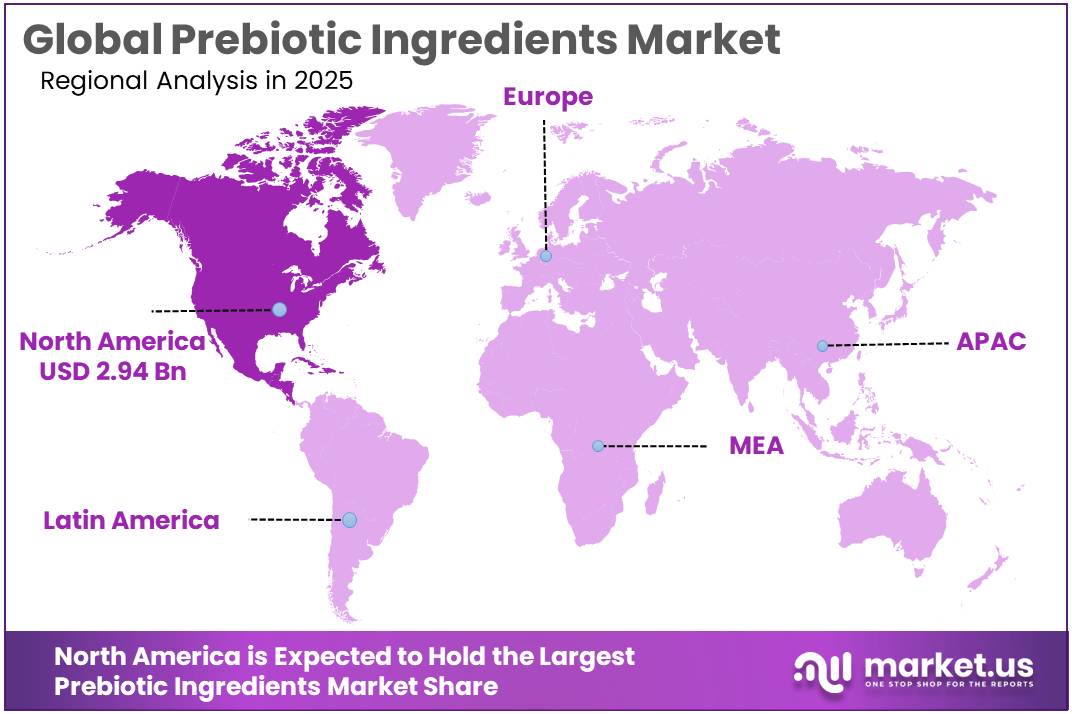
- North America remained the dominant region in the Prebiotic Ingredients Market in 2025, accounting for more than a 35.00% share and generating about USD 2.94 billion.
The industrial scenario is also influenced by the growing burden of diet-related health problems. The World Health Organization reported that 2.5 billion adults were overweight in 2022, including more than 890 million adults living with obesity, while 35 million children under five were overweight in 2024. Prebiotic ingredients are not treatments for obesity, but these figures are increasing attention toward healthier food composition, fibre enrichment, metabolic wellness, and digestive support.
- Government nutrition policy is strengthening this direction. The USDA and HHS released the Dietary Guidelines for Americans, 2025–2030, in January 2026, emphasizing whole and nutrient-dense foods while limiting highly processed foods. USDA stated that nearly 90% of U.S. healthcare spending goes toward chronic disease, more than 70% of American adults are overweight or obese, and nearly 1 in 3 adolescents has prediabetes.
Regulation remains a major competitive factor. The FDA originally identified 7 isolated or synthetic non-digestible carbohydrates in its dietary fibre definition and later identified 8 additional carbohydrates, including inulin and inulin-type fructans, galactooligosaccharide, polydextrose, and resistant maltodextrin/dextrin. In Europe, EFSA reported that it has evaluated more than 2,300 health-claim applications, while over 260 claims had been approved and more than 70% of evaluated claims had been rejected for insufficient evidence.
Future growth opportunities are expected in high-fibre snacks, functional beverages, infant and specialized nutrition, synbiotic products, and precision microbiome formulations. Cost and accessibility will remain important. FAO reported that the global cost of a healthy diet reached 4.46 PPP dollars per person per day in 2024, increasing 3.7%, while about 2.6 billion people were unable to afford a healthy diet. This creates a long-term opportunity for producers to develop affordable prebiotic ingredients for everyday foods rather than only premium supplements.
By Ingredient Type Analysis
Inulin dominates the Prebiotic Ingredients Market with a 41.60% share, supported by its wide use in fibre-enriched foods and supplements.
In 2025, Inulin held a dominant market position, capturing more than a 41.60% share. Its strong position is supported by its use as a soluble dietary fibre in functional foods, beverages, dairy products, bakery products, and dietary supplements. The U.S. FDA includes inulin and inulin-type fructans among non-digestible carbohydrates that can be declared as dietary fibre based on its scientific review.
In FDA’s substance database accessed in 2025, inulin was associated with 420 dietary supplement label products, showing its established presence across commercial nutrition formulations. The FDA’s GRAS database, updated in 2026, also returned 8 records related to inulin, including long-chain inulin, oligofructose and inulin, and inulin from artichoke. These regulatory recognitions support continued use of inulin by food producers seeking fibre enrichment, digestive-health positioning, and improved product functionality.
Fructo-Oligosaccharides (FOS) are gaining stronger attention in the Prebiotic Ingredients Market because they can be incorporated into functional foods, beverages, dietary supplements, and specialized nutrition products. Regulatory activity also supports wider commercial use. In March 2026, the U.S. FDA closed GRAS Notice 1271 for short-chain fructooligosaccharides with a “no questions” response. The notice covers use in cow-milk-based infant formula and also includes use as a bulking agent and ingredient across additional food categories.
By Source Analysis
Plant-Based dominates the Prebiotic Ingredients Market with an 88.20% share due to broad availability of natural fibre sources.
In 2025, Plant-Based held a dominant market position, capturing more than a 88.20% share. The segment benefits from the broad availability of plant-derived prebiotic ingredients such as inulin, fructans, resistant starch, arabinoxylan, and other dietary fibres sourced from chicory, agave, artichoke, cereals, fruits, and vegetables.
- In 2026, the U.S. Food and Drug Administration database listed 8 GRAS records related to inulin, including inulin from artichoke, agave-derived inulin, chicory flour, long-chain inulin, and oligofructose with inulin. The large agricultural raw-material base also supports ingredient processing. USDA reported that U.S. wheat production reached 1.98 billion bushels in 2025, including 1.40 billion bushels of winter wheat.
In April 2025, the U.S. Food and Drug Administration closed GRAS Notice 1216 for galacto-oligosaccharides, covering use in infant formula at up to 7.8 g/L and several additional food categories. A strong dairy supply base also provides an important feedstock environment for lactose-derived ingredients. USDA reported in February 2026 that U.S. milk production exceeded 231 billion pounds per year, while the national dairy herd reached 9.49 million cows in 2025.
By Form Analysis
Powder dominates the Prebiotic Ingredients Market with a 77.60% share
In 2025, Powder held a dominant market position, capturing more than a 77.60% share. Powdered prebiotic ingredients are widely preferred because they can be easily measured, transported, stored, and blended into bakery products, cereals, nutritional powders, supplements, dairy formulations, and other functional foods. Government food records also show their established use in commercial formulations.
- On an FDA record updated in 2026, powdered inulin from artichoke is listed for use at 0.25 g per serving as a bulking agent, sugar replacer, humectant, fat replacer, and texture modifier across multiple food categories. Another FDA record updated in 2025 covers oligofructose and inulin in powdered amino-acid-based infant formula at a level of up to 6.8 g per liter as consumed.
Liquid prebiotic ingredients are finding wider use where manufacturers require fast dispersion, smooth processing, and direct incorporation into beverages, dairy products, sauces, syrups, and liquid nutritional products. An FDA record updated in 2026 lists artichoke-derived inulin in syrup form for use at 0.35 g per serving, including applications as a bulking agent, sugar replacer, humectant, fat replacer, and texture modifier. In 2025, the FDA also closed GRAS Notice 1242 for short-chain fructooligosaccharides, covering food applications such as beverages, juices, cultured dairy beverages, drinkable yogurt, and meal-replacement shakes at use levels ranging from 0.4% to 15%.
By Application Analysis
Functional Food and Beverages dominate the Prebiotic Ingredients Market with a 42.90% share
In 2025, Functional Food and Beverages held a dominant market position, capturing more than a 42.90% share. The segment benefits from the easy addition of prebiotic fibres to beverages, cereals, dairy products, yogurt, bakery foods, nutrition bars, and meal-replacement products. In July 2025, the U.S. Food and Drug Administration closed GRAS Notice 1242 for short-chain fructooligosaccharides with a “no questions” response.
- In February 2026, the FDA also closed GRAS Notice 1266 for wheat fibre extract with a “no questions” response, covering energy and sports drinks at 1.4 to 2.1 g per 100 g and ready-to-eat breakfast cereals at 8.3 to 33.3 g per 100 g. These government records show the broad formulation scope available for fibre-based ingredients in functional food and beverage products.
Dietary Supplements represent an important application for prebiotic ingredients because powdered fibres, inulin, fructooligosaccharides, and related ingredients can be formulated into capsules, powders, sachets, gummies, and nutrition blends. In May 2026, the U.S. Centers for Disease Control and Prevention reported that 60.2% of adults aged 20 and older had used a dietary supplement during the previous 30 days, while 38.7% had used two or more supplements. Among adults aged 60 and older, supplement use reached 75.9%.
Key Market Segments
By Ingredient Type
- Inulin
- Fructo-Oligosaccharides (FOS)
- Galacto-Oligosaccharides (GOS)
- Mannan-Oligosaccharides (MOS)
- Polydextrose
- Resistant Starches
By Source
- Plant-Based
- Dairy-Based
By Form
- Powder
- Liquid
By Application
- Functional Food and Beverages
- Dietary Supplements
- Infant Formula
- Animal Feed
- Pharmaceuticals
Driver Analysis
Fibre-gap fortification
The most dependable volume driver is the mismatch between recommended and actual fibre intake, which creates a formulation need across bakery, dairy alternatives, cereals, nutrition bars and supplements rather than reliance on a single “gut-health” product claim. Adult reference targets in the United States are 25 g/day for women aged 50 or below and 38 g/day for comparable men, whereas observed food-and-beverage intake is roughly 16 g/day; bridging even one-quarter of a 9–22 g daily gap through packaged food materially enlarges demand for inulin, FOS, GOS, resistant dextrins and soluble corn fibre.
Commercially, this shifts procurement from low-volume nutraceutical orders toward recurring food-system contracts: at the EU threshold, “source of fibre” requires 3 g/100 g or 1.5 g/100 kcal, while “high fibre” requires 6 g/100 g or 3 g/100 kcal. Suppliers that deliver these thresholds at 2–5 g serving doses without unacceptable viscosity, sweetness, browning, grit, gas-related intolerance, or shelf-life loss can capture a wider SKU base and reduce the customer’s reformulation cycle time. The modeled +1.6 pp contribution is therefore volume-led, with the strongest realization in products consumed daily rather than in premium capsules.
Drivers Impact Analysis
| Driver | (~) % Impact on CAGR | Geographic Relevance | Impact Timeline |
|---|---|---|---|
| Fibre-gap fortification | +1.6 pp | North America, EU, urban APAC | Medium term (2–4 years) |
| US fibre-label eligibility | +1.1 pp | United States, Canada spill-over | Short term (≤2 years) |
| Sugar-reduction reformulation | +1.0 pp | EU, North America, GCC, APAC | Medium term (2–4 years) |
| Gut-health functional beverages | +1.3 pp | North America, Europe, China, India | Short term (≤2 years) |
| Precision fermentation HMOs | +0.9 pp | North America, EU, Japan, China | Long term (≥4 years) |
| Feed antibiotic substitution | +0.7 pp | China, India, Brazil, EU | Medium term (2–4 years) |
Restraint Analysis
Dose-tolerance ceiling
The central formulation constraint is that the dose needed for a differentiated benefit can exceed the dose that some consumers tolerate comfortably, particularly in single-serve products and among sensitive gastrointestinal populations. A 2026 review of 22 randomized controlled trials found that established inulin-type fructans and GOS commonly require approximately 5–16 g/day for bifidogenic effects, at least 5–8 g/day for more consistent bowel-habit benefits, and 12–15 g/day for selected metabolic or inflammatory endpoints; meanwhile, a 20 g inulin dose has been reported as significantly less well tolerated than 10 g, with bloating, flatulence, abdominal discomfort and loose stools arising from rapid colonic fermentation.
The commercial friction is substantial: the EU’s 12 g/day chicory-inulin claim threshold can require several portions, while a beverage, bar, gummy, infant formulation, or low-FODMAP-positioned product often cannot carry this level without texture, sweetness, osmolality, sensory, or consumer-experience trade-offs. This imposes a -1.1 pp forecast deduction through lower permissible inclusion rates, split-dose product architectures, elevated sensory-development expense, increased customer-service risk, and a migration toward lower-dose products whose claims and price premium are less compelling.
Restraint Impact Analysis
| Restraint | (~) % Impact on CAGR | Geographic Relevance | Impact Timeline |
|---|---|---|---|
| Health-claim restrictions | -1.4 pp | EU core, US, India | Medium term (2–4 years) |
| Dose-tolerance ceiling | -1.1 pp | North America, EU, urban APAC | Short term (≤2 years) |
| Feedstock cost volatility | -1.0 pp | EU, China, India, Brazil | Short term (≤2 years) |
| Freight and trade disruption | -0.7 pp | EU–Asia, US–Asia corridors | Short term (≤2 years) |
| Evidence-transfer gap | -0.9 pp | Global, EU and US acute | Medium term (2–4 years) |
| Low awareness and substitution | -0.8 pp | India, SEA, MEA, LatAm | Medium term (2–4 years) |
Opportunity Analysis
Fermentation-capacity roll-up M&A
Precision-fermentation and enzymatic-synthesis capacity for advanced prebiotics remains fragmented across venture-backed startups, university spin-outs, and single-strain specialists, most of which are capital-constrained and sub-scale typically operating single fermentation trains in the 10,000–50,000 liter range rather than the 100,000+ liter integrated capacity needed for cost-competitive commercial supply; this fragmentation is a future consolidation opportunity, not a current driver, because today’s baseline forecasts assume organic capacity build-out by existing players rather than inorganic capacity acquisition.
A well-capitalized acquirer executing a roll-up strategy acquiring 3–5 sub-scale fermentation assets at distressed or venture-markdown valuations could achieve utilization-driven unit-cost reductions of 20–35% through shared downstream purification, quality systems, and commercial sales infrastructure, compressing the multi-year capital and regulatory lead time otherwise required to build HMO-grade capacity from scratch.
This is a distinctly forward-looking, capital-allocation-driven opportunity: it requires access to acquisition capital and integration capability that is not embedded in the current organic-growth baseline, and the payoff accrues disproportionately to the first mover who completes 2–3 acquisitions within the next 24–36 months before valuations normalize upward.
Opportunity Impact Analysis
| Opportunity | (~) % Potential CAGR | Geographic Relevance | Execution Window |
|---|---|---|---|
| Pet nutrition and companion-animal white space | +1.2 pp | North America, EU, China | Medium term (2–4 years) |
| Personalized-dose subscription models | +0.9 pp | North America, EU urban | Short term (≤2 years) |
| GLP-1 adjunct and satiety co-formulation | +1.4 pp | North America, EU | Short term (≤2 years) |
| Fermentation-capacity roll-up M&A | +1.0 pp | Global, EU/US acquirer base | Medium term (2–4 years) |
| B2B ingredient-as-a-service licensing | +0.7 pp | North America, EU, APAC | Long term (≥4 years) |
| Emerging-market mass-fortification staples | +1.1 pp | India, SEA, Sub-Saharan Africa, LatAm | Long term (≥4 years) |
Challenges Analysis
Crop-to-spec yield variability
Prebiotic supply is exposed to a continuing quality-and-yield management problem rather than an absolute material shortage: chicory-root inulin depends on root yield, harvest timing, sucrose-to-inulin conversion, soil and weather conditions; GOS depends on lactose-stream consistency; and starch- or sugar-derived fibres depend on reliable substrate, enzyme and utility inputs, so the operational objective is not simply tonnes procured but tonnes delivered within degree-of-polymerisation, moisture, purity, colour and low-sugar specifications. Food-commodity volatility remains elevated, with FAO’s Food Price Index at 131.1 points in July 2026, 0.6% above June, illustrating the continuing movement in agricultural input benchmarks even when individual feedstocks may diverge from the aggregate index.
A 5–10% shortfall in extractable inulin yield or a 1–2 percentage-point decline in compliant solids recovery can force a processor to run longer campaigns, blend batches, purchase spot material, or downgrade output to less profitable applications; for a facility operating at 75–85% capacity utilization, such disruption can translate into a 300–700 basis-point gross-margin swing on exposed product lines. The estimated -1.0 pp drag reflects recurring safety-stock requirements of roughly 45–90 days, multi-origin contracting, agronomy support, storage investment and formulation requalification, with mitigation requiring 2–4 years of diversified crop zones, root-data systems and customer specifications designed to tolerate controlled raw-material variation.
Challenges Impact Analysis
| Challenge | (~) % CAGR Friction | Geographic Relevance | Mitigation Horizon |
|---|---|---|---|
| Crop-to-spec yield variability | -1.0 pp | EU chicory belt, North America | Medium term (2–4 years) |
| Multi-matrix formulation instability | -1.2 pp | Global, APAC beverage hubs | Medium term (2–4 years) |
| Clinical evidence translation gap | -0.9 pp | North America, EU, Japan | Long term (≥4 years) |
| Analytical-method inconsistency | -0.7 pp | US, EU, global exporters | Medium term (2–4 years) |
| Fermentation scale-up scarcity | -1.1 pp | North America, EU, China | Long term (≥4 years) |
| Specialist talent bottlenecks | -0.6 pp | EU, US, China, India | Medium term (2–4 years) |
Geopolitical Impact Analysis
Geopolitical Pressure Reshapes the Prebiotic Ingredients Supply Chain
The ongoing Russia-Ukraine war and wider Middle East conflict are creating supply-chain pressure for the Prebiotic Ingredients Market. Producers depend on agricultural inputs such as wheat, corn, chicory, sugar crops, starches, and dairy streams, making the sector sensitive to disruptions in farming, energy, fertilizers, and freight.
- In June 2026, the European Commission reported that around 90% of Ukraine’s grain, oilseed, and related exports moved through Black Sea ports, while about 10% moved through EU-Ukraine Solidarity Lanes. The Black Sea corridor alone handled about 3.8 million tonnes during the month. These flows remain important for European food-processing supply chains and ingredient availability.
The Middle East conflict is adding another cost layer. The World Bank reported that its fertilizer price index increased by more than 12% in the first quarter of 2026 as Strait of Hormuz disruptions tightened supplies. Higher fertilizer, fuel, and transport costs can raise prices for crops used to produce fibre and carbohydrate-based prebiotics. FAO also reported that its cereal price index in June 2026 remained 2.7% above the previous year.
Regional Insights
North America Dominates the Prebiotic Ingredients Market, while Asia-Pacific shows the fastest growth momentum
North America remained the dominant region in the Prebiotic Ingredients Market in 2025, accounting for more than a 35.00% share and generating about USD 2.94 billion. The region benefits from strong consumption of dietary supplements, fibre-enriched foods, functional beverages, and digestive-health products. In May 2026, the U.S. CDC reported that 60.2% of adults aged 20 years and above had used a dietary supplement during the previous 30 days, while 38.7% used two or more supplements.
The FDA also maintains a Daily Value of 28 g for dietary fibre, supporting food reformulation toward higher-fibre products. Canada adds another supportive demand base, with Statistics Canada reporting fresh-fruit availability of 77.9 kilograms per person in 2025, up 3.7% year over year. These dietary patterns, established food-processing capacity, and regulatory acceptance of fibre ingredients continue to support commercial use of inulin, FOS, GOS, resistant starch, and other prebiotic ingredients across North America.
Key Regions and Countries Insights
- North America
- US
- Canada
- Europe
- Germany
- France
- The UK
- Spain
- Italy
- Rest of Europe
- Asia Pacific
- China
- Japan
- South Korea
- India
- Australia
- Rest of APAC
- Latin America
- Brazil
- Mexico
- Rest of Latin America
- Middle East & Africa
- GCC
- South Africa
- Rest of MEA
Key Players Analysis
BENEO GmbH, part of Südzucker’s Special Products segment, strengthens the prebiotic ingredients space through Orafti inulin and oligofructose. In 2025/26, the parent segment generated €2,216 million in revenue, €266 million in operating EBITDA, and €177 million in operating profit. BENEO operates a sales network covering more than 80 countries. Its chicory-root fibres are backed by more than 25 years of research, while 3 g per day supports prebiotic activity in global food formulations.
Cargill maintains a strong position in functional nutrition through soluble corn fibre and formulation solutions for digestive health. In fiscal 2025, the company recorded USD 154 billion in revenue after 160 years in global food and agriculture. Its soluble corn fibre contains at least 70% fibre on a dry basis and can support prebiotic positioning at suitable use levels. Cargill also demonstrates beverage formulations containing 5 g of soluble fibre per serving, supporting fibre enrichment and reduced-sugar product development.
Ingredion strengthens its prebiotic portfolio through NUTRAFLORA soluble prebiotic fibre and other fibre solutions for food, beverage, and supplement applications. In 2025, the company generated approximately USD 7.2 billion in net sales, served customers in more than 120 countries, and employed over 11,000 people. NUTRAFLORA contains at least 95% short-chain fructooligosaccharides on a dry basis and is around 30% as sweet as sugar. Its safety and effectiveness are supported by more than 20 years of research in digestive-health applications.
Top Key Players Outlook
- BENEO GmbH (Südzucker)
- Cargill, Incorporated
- Ingredion Incorporated
- ADM
- Tate & Lyle PLC
- Roquette Frères S.A.
- FrieslandCampina Ingredients
- Kerry Group plc
- IFF (Danisco/DuPont Nutrition)
- Royal Cosun (Sensus BV)
- Cosucra Groupe Warcoing SA
- Nexira
- Samyang Corporation
- Yakult Pharmaceutical Industry Co., Ltd.
- Tereos (Beghin Meiji)
Recent Developments
In March 2026, Roquette inaugurated a new starch and polyol pilot center in Lianyungang covering more than 1,000 m², expanding localized R&D, pilot testing, and scale-up capabilities for food and specialized nutrition ingredients. Roquette also reported €4.9 billion turnover and €612 million current EBITDA for 2025, with demand improving particularly for fibre and protein products.
In April 2026, Kerry highlighted its 4-year partnership with Concern Worldwide under Project ALIVE, which had screened more than 24,000 children and provided nutrition education to nearly 15,000 mothers, supporting Kerry’s wider nutrition strategy.
July 2026, Cosun formally unified its ingredient activities under Cosun Ingredients, creating a dedicated growth platform for proteins, fibres, prebiotics, and plant-based solutions. This expansion is backed by a group that generated €3.2 billion in revenue and €269 million in EBITDA in 2025, while employing more than 4,500 people globally.
Report Scope
| Report Features | Description |
|---|---|
| Market Value (2025) | USD 8.4 Bn |
| Forecast Revenue (2035) | USD 23.4 Bn |
| CAGR (2026-2035) | 10.8% |
| Base Year for Estimation | 2025 |
| Historic Period | 2020-2024 |
| Forecast Period | 2026-2035 |
| Report Coverage | Revenue Forecast, Market Dynamics, Competitive Landscape, Recent Developments |
| Segments Covered | By Ingredient Type (Inulin, Fructo-Oligosaccharides (FOS), Galacto-Oligosaccharides (GOS), Mannan-Oligosaccharides (MOS), Polydextrose, Resistant Starches), By Source (Plant-Based, Dairy-Based), By Form (Powder, Liquid), By Application (Functional Food and Beverages, Dietary Supplements, Infant Formula, Animal Feed, Pharmaceuticals) |
| Regional Analysis | North America – US, Canada; Europe – Germany, France, The UK, Spain, Italy, Rest of Europe; Asia Pacific – China, Japan, South Korea, India, Australia, Singapore, Rest of APAC; Latin America – Brazil, Mexico, Rest of Latin America; Middle East & Africa – GCC, South Africa, Rest of MEA |
| Competitive Landscape | BENEO GmbH (Südzucker), Cargill, Incorporated, Ingredion Incorporated, ADM, Tate & Lyle PLC, Roquette Frères S.A., FrieslandCampina Ingredients, Kerry Group plc, IFF (Danisco/DuPont Nutrition), Royal Cosun (Sensus BV), Cosucra Groupe Warcoing SA, Nexira, Samyang Corporation, Yakult Pharmaceutical Industry Co., Ltd., Tereos (Beghin Meiji) |
| Customization Scope | Customization for segments, region/country-level will be provided. Moreover, additional customization can be done based on the requirements. |
| Purchase Options | We have three licenses to opt for: Single User License, Multi-User License (Up to 5 Users), Corporate Use License (Unlimited User and Printable PDF) |





































