


Report Overview
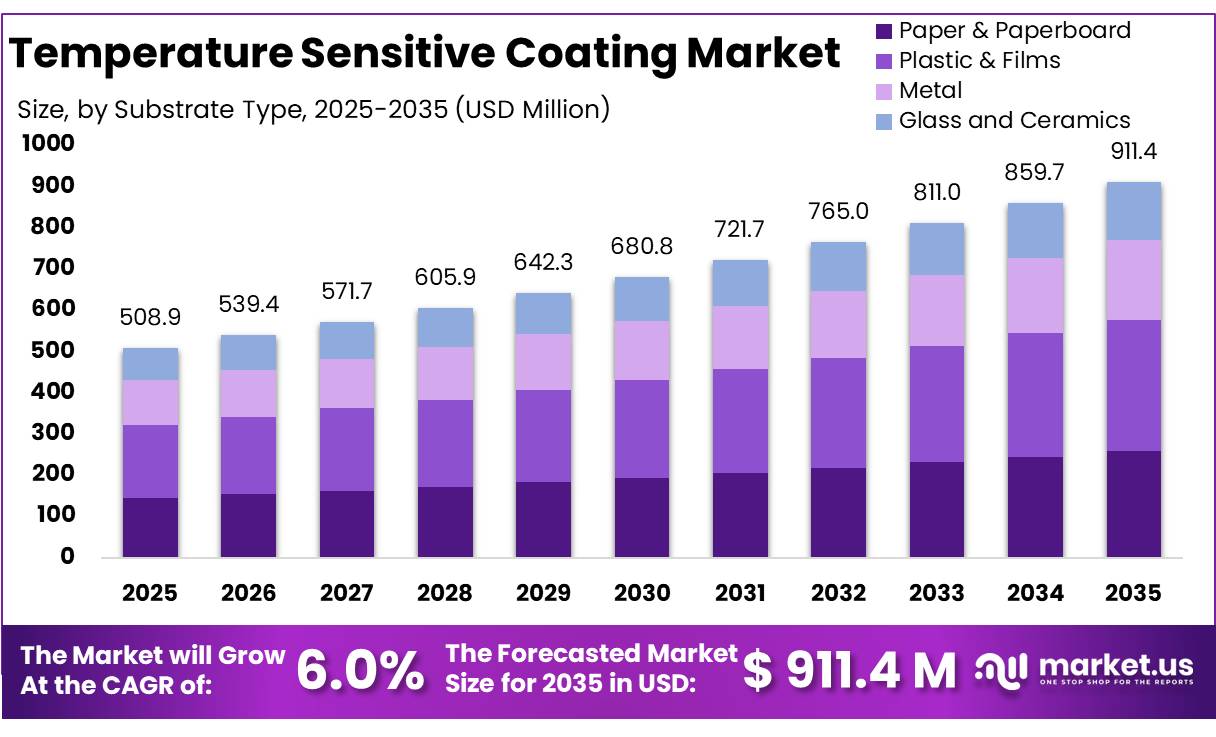
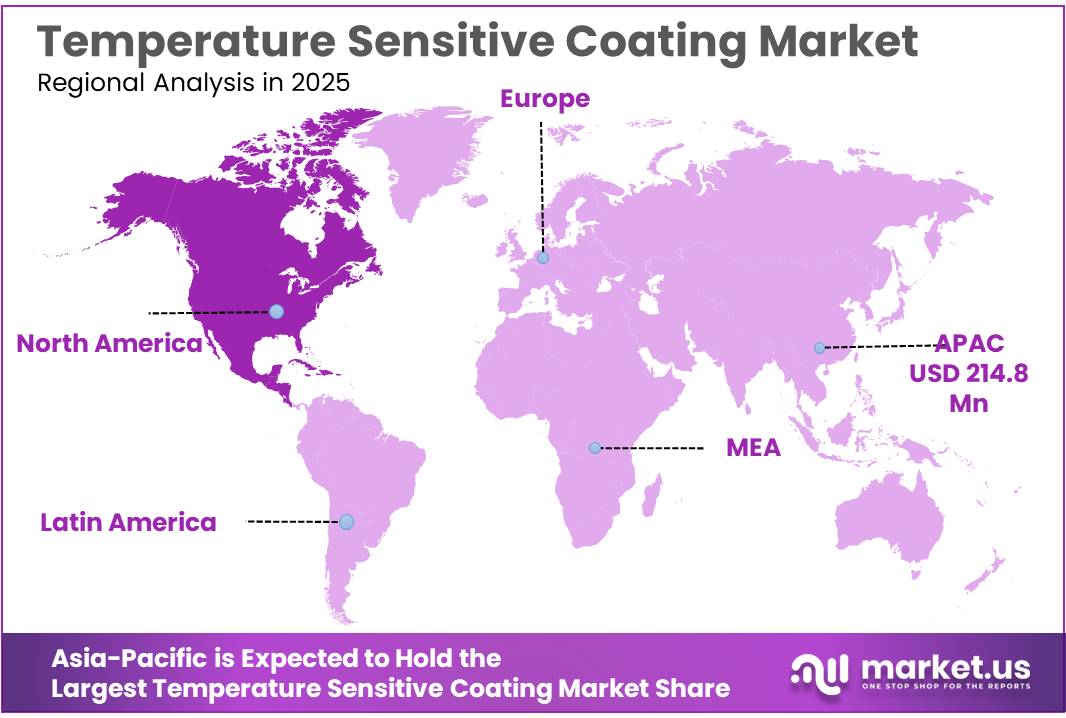
The Global Temperature Sensitive Coating Market size is expected to be worth around USD 911.4 Million by 2035, from USD 508.9 Million in 2025, growing at a CAGR of 6.0% during the forecast period from 2026 to 2035. In 2025, Asia-Pacific held a dominant market position, capturing more than a 42.3% share, holding USD 214.8 Million revenue.
Temperature-sensitive coatings are specialty coating systems designed to respond to heat through color change, reflectivity, insulation, corrosion protection, or thermal indication. Industrial demand is supported by asset-protection needs in oil & gas, power, aerospace, automotive, building envelopes, and process equipment, where coating failure can raise downtime and safety risk.
The sector is increasingly linked with energy efficiency because cool and reflective coatings reduce heat absorption; the U.S. DOE states that conventional roofs can reach 150°F or more, while cool roofs reflect more sunlight and lower building temperature. The opportunity is supported by the fact that buildings represent about 30% of global final energy consumption, rising to 34% when cement, steel, and aluminium for construction are included, according to the IEA.
The industrial scenario is driven by operators seeking lower maintenance, safer thermal management, and reduced energy losses. In U.S. manufacturing, process heating accounts for 35% of manufacturing energy use, while the U.S. Department of Energy also estimates that 36% of process-heating energy is lost across manufacturing, making insulation, heat-control, and monitoring coatings relevant for plants, tanks, pipes, ovens, cold rooms, and process equipment.
Driving factors include industrial decarbonization, energy codes, heat-island mitigation, and corrosion-under-insulation prevention. The U.S. DOE industrial roadmap identifies four decarbonization pillars, including energy efficiency, while a U.S. program announced $6 billion for 33 industrial decarbonization projects across 20 states, targeting 14 million metric tons of annual pollution reduction. In Europe, building policy also supports thermally efficient surfaces: the revised Energy Performance of Buildings Directive targets an 11.7% reduction in energy consumption by 2030, with zero-emission requirements for public new buildings from 2028 and all other new buildings from 2030.
Government and safety policies also strengthen demand. The U.S. EPA states that HFC production and consumption are being phased down to 15% of baseline levels by 2036, creating pressure on refrigeration and cold-chain operators to reduce leakage, condensation, and thermal inefficiency.
The EU F-gas Regulation 2024/573, adopted on 7 February 2024 and applied from 11 March 2024, similarly covers products and equipment using fluorinated gases. Regulation and sustainability are key driving factors. The EU Energy Performance of Buildings Directive supports an 11.7% energy-consumption reduction target by 2030, while the U.S. EPA states that cool-roof solar reflectance can reduce peak cooling demand by 11–27% in air-conditioned residential buildings.
PPG’s 2025 developments indicate continued focus on high-performance coatings. In June 2025, PPG showcased innovations across protective, industrial, powder, packaging, traffic, and specialty coatings, including protective coating solutions and application services for data centers. In Q1 2025, PPG reported net sales of US$3.7 billion, with organic sales up 1%, while its industrial coatings segment recorded US$1.562 billion in sales.
Key Takeaways
- Temperature Sensitive Coating Market size is expected to be worth around USD 911.4 Million by 2035, from USD 508.9 Million in 2025, growing at a CAGR of 6.0%.
- Plastic & Films held a dominant market position, capturing more than a 34.8% share.
- Thermochromic held a dominant market position, capturing more than a 38.4% share.
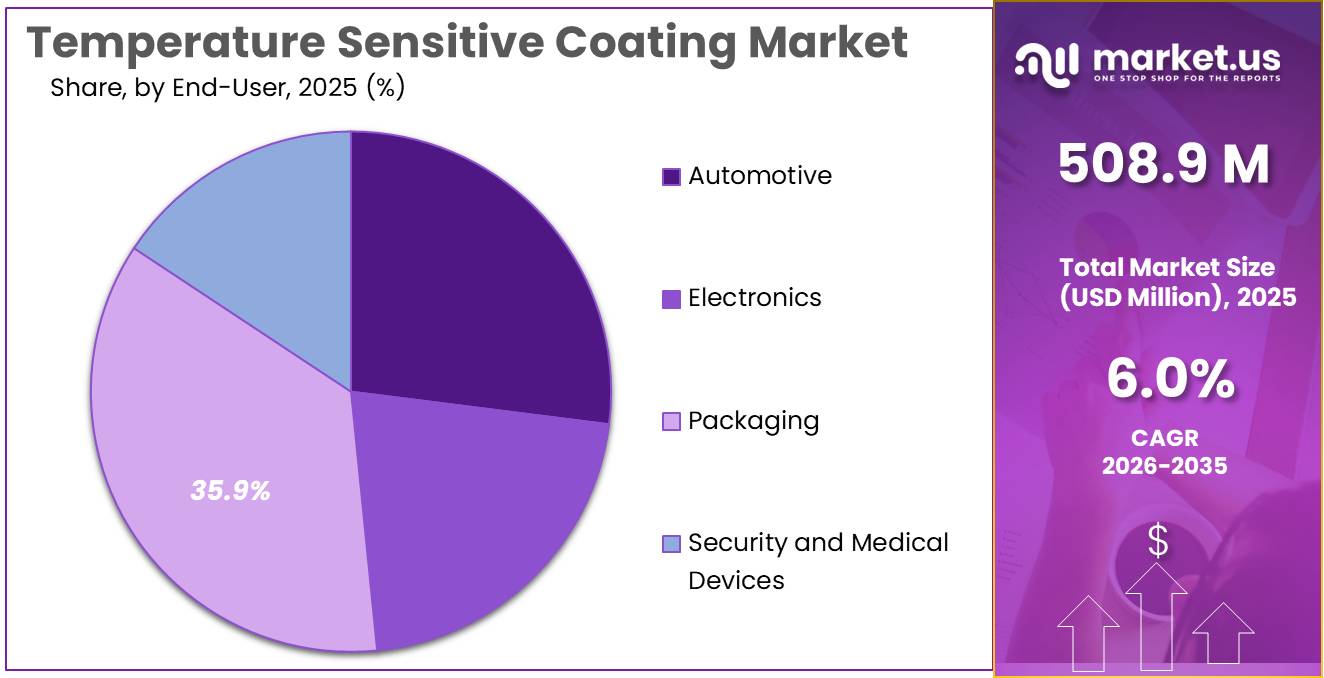
- Packaging held a dominant market position, capturing more than a 35.9% share.
- Asia-Pacific held the leading position in the Temperature Sensitive Coating Market, accounting for 42.3% share with a value of USD 214.8 Mn.
By Substrate Type Analysis
Plastic & Films dominate with 34.8% driven by flexibility and wide industrial usage
In 2025, Plastic & Films held a dominant market position, capturing more than a 34.8% share. This segment continues to lead mainly because of its lightweight nature, easy adaptability, and cost efficiency across multiple industries. Temperature sensitive coatings are widely applied on plastic surfaces and flexible films used in packaging, healthcare products, and consumer goods, where visual temperature indication is important.
By Technology Analysis
Thermochromic leads with 38.4% as demand grows for color-changing temperature indicators
In 2025, Thermochromic held a dominant market position, capturing more than a 38.4% share. This growth is mainly driven by its ability to change color with temperature shifts, making it highly useful in real-time monitoring applications. These coatings are widely used in packaging, medical labels, and consumer products where quick visual indication is needed without any electronic support. The ease of use and clear response make thermochromic technology popular across industries.
By End-User Analysis
Packaging dominates with 35.9% as temperature monitoring becomes essential in supply chains
In 2025, Packaging held a dominant market position, capturing more than a 35.9% share. This segment leads mainly because of the rising need to monitor temperature changes in products during storage and transportation. Temperature sensitive coatings are widely used on packaging materials for food, beverages, and pharmaceuticals, where maintaining the right temperature is critical for safety and quality. These coatings help provide a quick visual check, reducing the risk of spoilage or damage. By 2026, the demand stays strong as cold chain logistics continue to expand and companies focus more on product safety and compliance. The shift toward smart and functional packaging also supports the steady growth of this segment.
Key Market Segments
By Substrate Type
- Paper & Paperboard
- Plastic & Films
- Metal
- Glass and Ceramics
By Technology
- Thermochromic
- Fluorescent
- Phosphorescent
- Photochromic
- Optically Variable
By End-User
- Automotive
- Electronics
- Packaging
- Security and Medical Devices
Emerging Trends
Shift Toward Smart and Real-Time Monitoring Technologies
A clear trend in the temperature sensitive coating market is the growing shift toward smart and real-time monitoring solutions across food supply chains. Food loss is still a major concern globally, with 13.2% of food lost between harvest and retail stages. Because of this, industries are now moving beyond traditional methods and adopting technologies that can give immediate feedback on temperature changes.
Governments and global organizations are encouraging better monitoring as part of food security and sustainability goals. For example, initiatives linked to reducing food loss under global sustainability targets are pushing companies to adopt real-time tracking systems. These coatings fit well because they provide a simple visual alert without needing complex electronics. As supply chains become more advanced, especially in export-driven sectors, the demand for coatings that can work alongside digital systems is increasing.
Integration with Sustainable Cold Chain Solutions
Another important trend is the integration of temperature sensitive coatings with sustainable cold chain development. Around 526 million tonnes of food—about 12% globally—are lost due to insufficient refrigeration, which highlights the urgent need for better temperature-controlled systems. At the same time, food loss and waste contribute nearly 8–10% of global greenhouse gas emissions.
Governments and international bodies are promoting energy-efficient cold chains and better storage infrastructure to reduce both waste and emissions. As part of this effort, industries are adopting solutions that are not only effective but also low-cost and easy to implement. Temperature sensitive coatings are gaining traction because they support these goals without adding heavy energy requirements. In regions like Asia and Africa, where infrastructure is still developing, these coatings provide a practical way to improve monitoring while larger systems are being built.
Drivers
Rising Food Loss Due to Poor Temperature Control Drives Demand
One of the biggest drivers for temperature sensitive coatings is the growing problem of food loss across the supply chain, especially where temperature control is weak. According to the Food and Agriculture Organization, around 13.2% of food is lost between harvest and retail stages, and an additional large portion is wasted later in the chain. A major reason behind this loss is the lack of proper temperature monitoring during storage and transport. In fact, nearly 526 million tonnes of food—about 12% globally—are lost due to insufficient refrigeration.
This is where temperature sensitive coatings become important. These coatings act as simple visual indicators, helping stakeholders quickly identify whether products have been exposed to unsafe temperatures. Governments and global organizations are actively pushing for better cold chain systems to reduce these losses. For example, initiatives linked to food security and sustainability goals encourage the use of monitoring technologies across logistics and packaging.
High Food Waste in India and Developing Markets Supports Adoption
In developing regions, the issue becomes even more serious, making temperature monitoring solutions more essential. In India, reports linked to the Food and Agriculture Organization and UN estimates show that over 40% of food produced is wasted before reaching consumers. Additionally, about 30% of fruits and vegetables are lost due to poor storage and transport conditions. These losses are largely due to gaps in cold chain infrastructure and lack of real-time temperature tracking.
To tackle this, government-backed programs and agricultural initiatives are focusing on improving logistics, storage, and monitoring systems. Temperature sensitive coatings fit well into this effort because they are simple, cost-effective, and easy to apply on packaging materials. They help farmers, distributors, and retailers quickly check if products have been exposed to harmful conditions during transit.
Restraints
High Cost of Cold Chain and Monitoring Systems Limits Adoption
One of the key restraints for temperature sensitive coatings is the high cost and complexity of maintaining proper cold chain infrastructure. While these coatings themselves are relatively simple, their real value depends on a well-functioning temperature-controlled system. According to the Food and Agriculture Organization and UN-backed reports, 526 million tonnes of food—around 12% of global production—are lost every year due to lack of proper refrigeration systems. This clearly shows that many regions still struggle with basic temperature control, especially in developing markets.
Building and maintaining cold storage, refrigerated transport, and monitoring systems requires heavy investment in energy, infrastructure, and training. Governments and global initiatives are working to improve this through sustainable cold chain programs, but progress is uneven. For small-scale producers and local distributors, the cost of adopting advanced monitoring tools, including coatings, often becomes an additional burden rather than a priority. Even when coatings are applied, the absence of a reliable cold chain reduces their effectiveness.
Energy Demand and Environmental Concerns Restrict Expansion
Another major challenge comes from the high energy demand linked to refrigeration and temperature-controlled systems. Expanding cold chain infrastructure is not just expensive—it also requires continuous power supply, which is still unreliable in many regions. According to FAO and UN-supported findings, refrigeration systems depend heavily on electricity and often use cooling agents that can impact the environment if not managed properly
Governments are promoting energy-efficient and sustainable cooling solutions, but adoption takes time and investment. For many industries, especially in rural and emerging economies, balancing energy costs with operational needs is still a major concern. This limits the scale at which temperature monitoring solutions, including coatings, can be used effectively. Without stable energy access and eco-friendly systems in place, companies hesitate to invest further in temperature-sensitive technologies.
Opportunity
Expansion of Cold Chain Infrastructure Creates Strong Growth Opportunity
One of the biggest growth opportunities for temperature sensitive coatings comes from the rapid expansion of cold chain infrastructure across the food industry. Globally, food loss remains a major issue, with about 13.2% of food lost after harvest before reaching retail. At the same time, nearly 526 million tonnes of food—around 12%—are lost every year due to lack of proper refrigeration. These numbers clearly show how important temperature control has become in modern food logistics.
Governments and global bodies are now actively investing in cold chain systems as part of food security and sustainability goals. Programs linked to the UN Sustainable Development Goals are pushing for better storage, transportation, and monitoring solutions. As these systems expand, there is a natural need for simple tools that can quickly show whether the right temperature has been maintained. This is where temperature sensitive coatings fit perfectly.
Rising Focus on Reducing Food Waste and Emissions Drives Adoption
Another strong opportunity lies in the increasing global focus on reducing food waste and its environmental impact. Studies show that food loss and waste contribute around 8–10% of global greenhouse gas emissions. In addition, nearly one-third of all food produced globally is lost or wasted, highlighting a serious inefficiency in the system. Governments, along with organizations like FAO and UNEP, are now encouraging solutions that improve monitoring and reduce spoilage throughout the supply chain.
Temperature sensitive coatings are gaining attention because they directly support this goal. By providing a clear visual signal when products are exposed to unsafe temperatures, they help reduce unnecessary disposal of food and improve overall quality control. In countries like India, where around 40% of food is lost and about 30% of fruits and vegetables spoil due to poor storage, improving monitoring becomes even more important.
Regional Insights
Asia-Pacific dominates with 42.3% share driven by rising cold chain demand and food loss challenges
Asia-Pacific held the leading position in the Temperature Sensitive Coating Market, accounting for 42.3% share with a value of USD 214.8 Mn, making it the most dominant regional segment. This strong position is mainly supported by the region’s large food production base, growing pharmaceutical sector, and increasing need for temperature-controlled logistics.
Countries like China, India, and Southeast Asian nations are experiencing rapid growth in food exports and urban consumption, which directly increases the demand for reliable temperature monitoring solutions. According to the Food and Agriculture Organization (FAO), around 13.2% of food is lost globally between harvest and retail, with a significant portion occurring in developing regions such as Asia-Pacific due to gaps in storage and transportation systems.
Key Regions and Countries Insights
- North America
- US
- Canada
- Europe
- Germany
- France
- The UK
- Spain
- Italy
- Rest of Europe
- Asia Pacific
- China
- Japan
- South Korea
- India
- Australia
- Rest of APAC
- Latin America
- Brazil
- Mexico
- Rest of Latin America
- Middle East & Africa
- GCC
- South Africa
- Rest of MEA
Key Players Analysis
The Sherwin-Williams Company reported revenues of around USD 23 billion in 2025, maintaining a strong global coatings presence. The company operates in over 120 countries with more than 4,900 stores worldwide. Its performance coatings segment contributes nearly 35% of total revenue, supporting growth in specialty coatings like temperature-sensitive solutions. Investment in R&D stands close to USD 500 million annually, helping expand advanced coating technologies.
PPG Industries Inc generated approximately USD 18 billion in revenue in 2025, with operations across more than 70 countries. The company serves over 100,000 customers globally, including industrial and packaging sectors. Around 40% of its revenue comes from performance coatings, where temperature-sensitive solutions are gaining traction. PPG invests nearly USD 450 million yearly in innovation, focusing on smart coatings and sustainability. Its strong presence in automotive and packaging industries supports steady demand growth.
Akzo Nobel NV recorded revenues of about USD 12 billion in 2025, with operations in over 150 countries. The company employs around 34,000 people globally and focuses heavily on sustainable coatings. Nearly 60% of its portfolio is aligned with eco-friendly solutions. Annual R&D investment is close to USD 300 million, supporting innovation in functional coatings, including temperature-sensitive applications. Its strong distribution network and focus on industrial coatings help maintain its competitive position.
Top Key Players Outlook
- The Sherwin Williams Company
- PPG Industries Inc
- Akzo Nobel NV
- Nippon Paint Holdings Co Ltd
- RPM International Inc
- Asian Paints Limited
- Axalta Coating Systems Ltd
- Kansai Paint Co Ltd
- Jotun AS
- Hempel AS
Recent Industry Developments
The Sherwin-Williams Company has a strong and growing role in the temperature sensitive coating sector, mainly through its performance coatings and advanced materials business. In 2025, the company reported total sales of about USD 23.57 billion, showing steady growth of around 2.1% year-on-year, with a large portion coming from coatings used in industrial, packaging, and specialty applications
PPG Industries Inc has been steadily strengthening its position in the temperature sensitive coating space through its broader performance and industrial coatings portfolio. In 2025, the company reported total net sales of about USD 15.9 billion, with organic sales growth of nearly 2%, supported by higher pricing and stable demand across regions
In 2025, Akzo Nobel NV reported total revenue of around €10.16 billion (approx. USD 11.49 billion), with adjusted EBITDA reaching nearly €1.44 billion and margins improving to about 14.2%, showing better operational efficiency despite softer volumes.
Report Scope
| Report Features | Description |
|---|---|
| Market Value (2025) | USD 508.9 Mn |
| Forecast Revenue (2035) | USD 911.4 Mn |
| CAGR (2026-2035) | 6.0% |
| Base Year for Estimation | 2025 |
| Historic Period | 2020-2024 |
| Forecast Period | 2026-2035 |
| Report Coverage | Revenue Forecast, Market Dynamics, Competitive Landscape, Recent Developments |
| Segments Covered | By Substrate Type (Paper And Paperboard, Plastic And Films, Metal, Glass and Ceramics), By Technology (Thermochromic, Fluorescent, Phosphorescent, Photochromic, Optically Variable), By End-User (Automotive, Electronics, Packaging, Security and Medical Devices) |
| Regional Analysis | North America – US, Canada; Europe – Germany, France, The UK, Spain, Italy, Rest of Europe; Asia Pacific – China, Japan, South Korea, India, Australia, Singapore, Rest of APAC; Latin America – Brazil, Mexico, Rest of Latin America; Middle East & Africa – GCC, South Africa, Rest of MEA |
| Competitive Landscape | The Sherwin Williams Company, PPG Industries Inc, Akzo Nobel NV, Nippon Paint Holdings Co Ltd, RPM International Inc, Asian Paints Limited, Axalta Coating Systems Ltd, Kansai Paint Co Ltd, Jotun AS, Hempel AS |
| Customization Scope | Customization for segments, region/country-level will be provided. Moreover, additional customization can be done based on the requirements. |
| Purchase Options | We have three licenses to opt for: Single User License, Multi-User License (Up to 5 Users), Corporate Use License (Unlimited User and Printable PDF) |





































