Report Overview
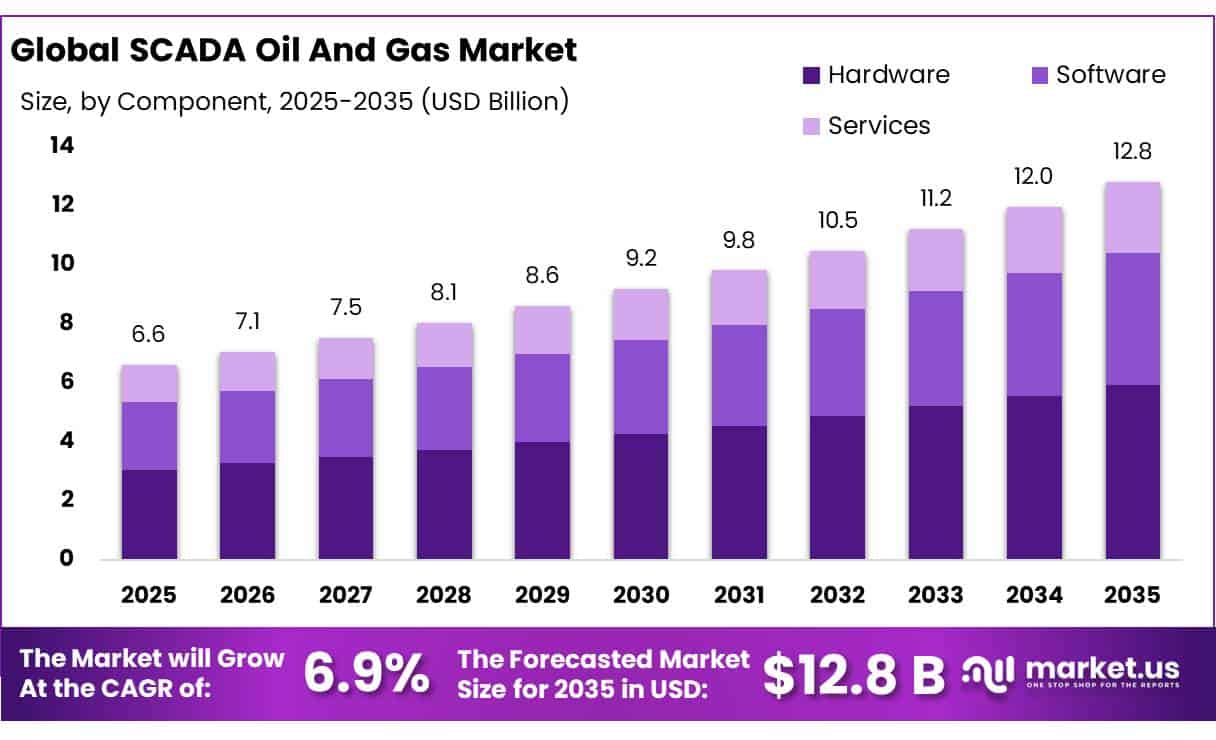
The Global SCADA Oil And Gas Market size is expected to be worth around USD 12.81 Billion by 2035, from USD 6.60 Billion in 2025, growing at a CAGR of 6.9% during the forecast period from 2026 to 2035. In 2025, North America held a dominant market position, capturing more than a 38.60% share, holding USD 0.5 Billion revenue.
The Supervisory Control and Data Acquisition (SCADA) system is an important technology in the oil and gas industry, supporting real-time monitoring, process control, and operational management across upstream, midstream, and downstream activities.
It enables operators to collect data from sensors, instruments, pumps, compressors, pipelines, storage tanks, and drilling equipment while controlling operations remotely through centralized control systems. SCADA improves operational visibility, reduces manual intervention, enhances safety, and supports efficient resource management.
- According to the U.S. Pipeline and Hazardous Materials Safety Administration (PHMSA), the United States operates an extensive pipeline infrastructure transporting energy commodities and hazardous liquids, highlighting the importance of continuous monitoring and automated control systems.
The industrial scenario for SCADA in oil and gas is evolving with increasing digitalization, infrastructure modernization, and demand for operational efficiency. Oil and gas companies are adopting centralized monitoring systems to manage geographically dispersed assets, including offshore platforms, refineries, gathering networks, and transmission pipelines.
According to the International Energy Agency (IEA), global upstream oil and gas investment is expected to reach approximately USD 565 billion in 2025, reflecting continued capital allocation toward exploration, production, and infrastructure development. These investments create opportunities for SCADA deployment across new facilities and existing operations requiring system upgrades.
Cybersecurity and government regulations are further influencing industry adoption. The U.S. Transportation Security Administration (TSA) has introduced pipeline cybersecurity directives requiring designated operators to implement security measures, report cybersecurity incidents, appoint cybersecurity coordinators, and assess vulnerabilities. These initiatives are encouraging oil and gas companies to strengthen SCADA security, modernize legacy control systems, and invest in secure operational technology infrastructure.
Key Takeaways
- SCADA Oil And Gas Market size is expected to be worth around USD 12.81 Billion by 2035, from USD 6.60 Billion in 2025, growing at a CAGR of 6.9%.
- Hardware held a dominant market position, capturing more than a 46.43% share.
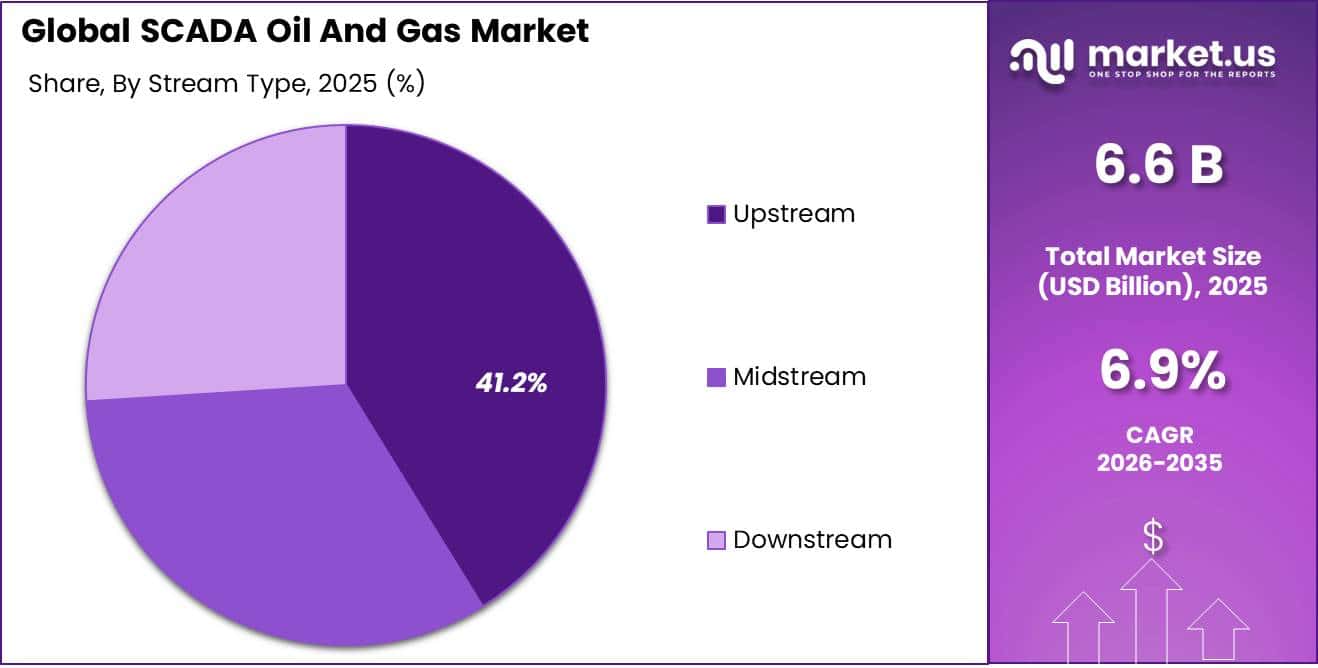
- Upstream held a dominant market position, capturing more than a 41.21% share.
- Pipeline Monitoring held a dominant market position, capturing more than a 34.21% share.
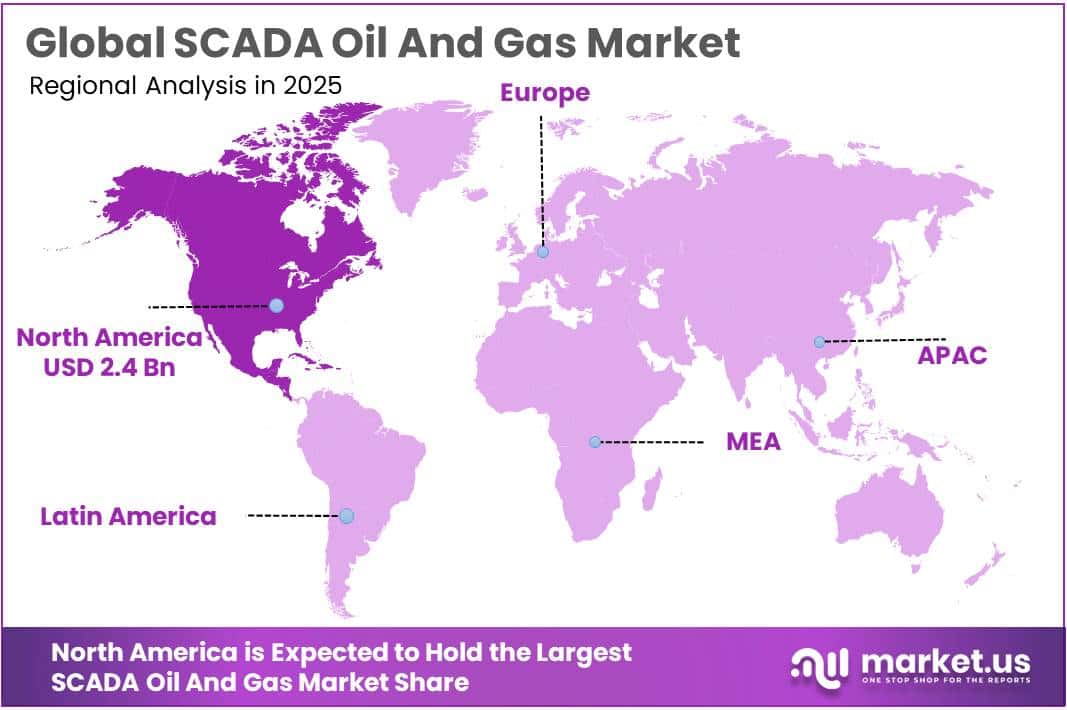
- North America dominates the SCADA Oil and Gas Market, accounting for 37.67% of the market and USD 2.4 billion in revenue.
By Component Analysis
Hardware dominates with reliable monitoring and control of critical oil and gas operations
In 2025, “Hardware” held a dominant market position, capturing more than a 46.43% share. Hardware components remain essential to SCADA systems as they enable real-time data collection, monitoring, and control across oil and gas operations. Sensors, programmable logic controllers (PLCs), remote terminal units (RTUs), communication devices, and control panels support the continuous monitoring of pressure, temperature, flow, and equipment performance.
Their deployment across drilling sites, pipelines, refineries, and processing facilities strengthens operational reliability and safety. In 2025, the demand for dependable industrial monitoring equipment was supported by infrastructure modernization and automation investments. According to the U.S. Environmental Protection Agency, methane monitoring and measurement technologies are important for identifying and reducing emissions across oil and gas operations, supporting the need for reliable field instrumentation and monitoring hardware.
Software is becoming increasingly important in the SCADA oil and gas market in 2025, as operators seek better data visualization, centralized monitoring, process automation, and predictive maintenance. SCADA software enables companies to collect, analyze, and interpret field data while providing operators with real-time information about equipment performance and operational conditions. Human-machine interface (HMI), supervisory control applications, alarm management, and historical data analytics improve decision-making and reduce operational inefficiencies.
Software integration with artificial intelligence and cybersecurity tools further supports remote operations and infrastructure protection. According to the U.S. Cybersecurity and Infrastructure Security Agency (CISA), industrial control systems require continuous monitoring and cybersecurity protection, encouraging oil and gas operators to modernize software platforms and strengthen digital security.
By Stream Type Analysis
Upstream dominates with growing demand for exploration and production monitoring
In 2025, “Upstream” held a dominant market position, capturing more than a 41.21% share. The upstream segment plays an important role in the SCADA oil and gas market as exploration and production activities require continuous monitoring of drilling operations, well performance, pressure levels, and production equipment. SCADA systems help operators collect real-time field information, remotely manage operations, and improve safety while reducing equipment failures and unplanned downtime.
In 2025, investments in exploration, drilling, and production infrastructure supported the adoption of automated monitoring and control technologies. According to the U.S. Energy Information Administration (EIA), the United States produced approximately 13.2 million barrels of crude oil per day in 2024, highlighting the scale of production activities requiring advanced monitoring and operational control systems.
Midstream is gaining importance in the SCADA oil and gas market in 2025 as companies increasingly focus on the safe and efficient transportation, storage, and distribution of crude oil and natural gas. SCADA systems enable remote monitoring of pipeline pressure, flow rates, compressor stations, storage facilities, and pumping operations.
These capabilities help operators identify leaks, detect abnormal operating conditions, and maintain consistent transportation performance across geographically dispersed infrastructure. In 2025, pipeline modernization and infrastructure reliability requirements continued to support the adoption of advanced SCADA technologies. According to the U.S. Pipeline and Hazardous Materials Safety Administration (PHMSA), the United States operates approximately 3 million miles of natural gas pipelines, demonstrating the substantial infrastructure requiring automated monitoring and control.
By Application Analysis
Pipeline Monitoring dominates with increasing focus on infrastructure safety and operational reliability
In 2025, “Pipeline Monitoring” held a dominant market position, capturing more than a 34.21% share. Pipeline monitoring represents a major application of SCADA technology as oil and gas companies require continuous supervision of pipeline networks to ensure safe and efficient transportation. SCADA systems monitor pressure, flow, temperature, and pipeline conditions while helping operators identify leaks, abnormal activities, and potential equipment failures. These capabilities reduce operational risks, improve maintenance planning, and support uninterrupted transportation.
In 2025, investments in pipeline modernization and safety management strengthened demand for automated monitoring solutions. According to the U.S. Pipeline and Hazardous Materials Safety Administration (PHMSA), the United States operates approximately 3 million miles of natural gas pipelines, creating significant requirements for continuous monitoring, operational control, and infrastructure protection.
Oil and Gas Production Monitoring is gaining importance in 2025 as energy companies focus on improving production efficiency, equipment performance, and operational visibility across extraction facilities. SCADA systems enable operators to monitor wellhead pressure, production volumes, fluid flow, temperature, and equipment status in real time. These systems support timely operational decisions, reduce manual inspections, and help identify production abnormalities before they affect output.
The growing adoption of digital oilfield technologies and remote monitoring solutions is further supporting this application. According to the U.S. Energy Information Administration (EIA), the United States produced approximately 13.2 million barrels of crude oil per day in 2024, highlighting the scale of production infrastructure that requires effective monitoring and automated control.
Key Market Segments
By Component
- Hardware
- Software
- Services
By Stream Type
- Upstream
- Midstream
- Downstream
By Application
- Pipeline Monitoring
- Oil and Gas Production Monitoring
- Refinery Automation
- Others
Driver Analysis
LNG-Linked Network Expansion — +0.7 Percentage Points
New LNG capacity generates SCADA procurement through associated gathering pipelines, compressor stations, storage interfaces and export-terminal utilities—not by converting the full cost of liquefaction facilities into supervisory-control spending. IEA’s updated LNG capacity tracker identifies approximately 345 bcm per year of additions expected during 2025–2030 from projects already reaching final investment decision and construction, with annual additions peaking near 95 bcm in 2028; this is an updated project schedule, whereas Gas 2025 used an approximately 300 bcm figure.
In a constructed portfolio of fifteen LNG-linked network developments, each with forty remote stations, 600 SCADA nodes require procurement or integration. At an assumed USD 35,000 per node for eligible RTUs, communications hardware and implementation, field-system revenue is USD 21 million; USD 800,000 per project for supervisory software, historians and central integration adds USD 12 million, producing USD 33 million of addressable scope before recurring licenses. These figures exclude the liquefaction DCS and avoid treating bcm of capacity as a direct pricing denominator.
The +0.7-point sensitivity assumes 20% of terminal counterfactual revenue is LNG-network-sensitive and achieves approximately 17% cumulative outperformance, adding 3.4% terminal market revenue. Suppliers benefit from repeatable station templates and EPC framework agreements, but schedules, host-country execution and final network boundaries determine how much of the capacity pipeline becomes recognized SCADA sales.
Drivers Impact Analysis
| Driver | (~) % Impact on CAGR Forecast | Geographic Relevance | Impact Timeline |
|---|---|---|---|
| LNG-linked network expansion | +0.7 pp | US, Qatar, Canada, Mozambique | Medium term (2–4 years) |
| Remote-field operating economics | +0.6 pp | US, Canada, Middle East, Australia | Short term (≤ 2 years) |
| Pipeline integrity requirements | +0.6 pp | US; Canada, EU operators | Medium term (2–4 years) |
| Operational cybersecurity upgrades | +0.5 pp | US; Canada, EU export markets | Medium term (2–4 years) |
| Emissions-data integration | +0.4 pp | US, EU, Norway, Canada | Medium term (2–4 years) |
| Software-defined platform renewal | +0.4 pp | US, EU, Middle East, India | Medium term (2–4 years) |
Restraint Analysis
Upstream Budget Compression — −0.5 Percentage Points
Reduced upstream investment restricts SCADA procurement when operators prioritize maintaining production and meeting essential obligations over discretionary remote-operations expansion. IEA’s World Energy Investment 2025 estimated a roughly 4% decline in upstream oil-and-gas investment to just below USD 570 billion, while its accompanying announcement distinguished an expected 6% decline in upstream oil investment, driven particularly by US tight oil; these were 2025 estimates, not evidence that every operator subsequently cut automation expenditure by the same amount. In a constructed producer with a USD 500 million annual capital budget, a 10% reduction removes USD 50 million.
If a USD 10 million SCADA program loses 30% of its allocation because management protects drilling, production maintenance and mandatory expenditure, procurement falls by USD 3 million; that disproportionate reduction is a scenario, not a measured industry budgeting pattern. At 100 remote sites costing an assumed USD 30,000 each, the reduction could eliminate a complete deployment phase, whereas cybersecurity-critical or demonstrably high-payback projects may proceed.
The −0.5-point sensitivity assumes 25% of terminal counterfactual revenue is exposed to discretionary upstream spending and experiences a 9.2% realization shortfall, producing approximately 2.3% market-wide terminal erosion. Suppliers face smaller award packages, longer approvals and greater reliance on existing-customer expansion rather than greenfield rollout. The deduction counts cancelled scope or expenditure pushed beyond 2031—not every short-term order delay, and not the value of upstream investment outside SCADA.
Restraint Impact Analysis
| Restraint | (~) % Impact on CAGR Forecast | Geographic Relevance | Impact Timeline |
|---|---|---|---|
| Upstream budget compression | −0.5 pp | US shale, Canada, selected ASEAN assets | Short term (≤ 2 years) |
| Brownfield replacement economics | −0.5 pp | US, Canada, EU, Middle East | Long term (≥ 4 years) |
| Secure-architecture investment burden | −0.4 pp | US pipelines; EU, Canada operators | Medium term (2–4 years) |
| Small-site telemetry payback | −0.3 pp | US marginal fields, India, Africa | Medium term (2–4 years) |
| Emissions-compliance spending deferral | −0.3 pp | US; suppliers serving US operators | Short term (≤ 2 years) |
| LNG-project procurement slippage | −0.4 pp | Qatar, UAE; linked supplier markets | Medium term (2–4 years) |
Opportunity Analysis
Managed Small-Site SCADA — +0.5 Percentage Points
The opportunity is to bring currently uneconomic small production sites onto a standardized, subscription-based supervisory platform, rather than relabel existing enterprise licenses as recurring revenue. Emerson’s April 2025 DeltaV SaaS SCADA with Edge Connect launch provides a commercial precedent: its preconfigured edge solution connects existing RTUs, flow computers, valves and sensors to cloud-hosted SCADA through native protocols, with the stated objective of reducing traditional integration effort; the claimed rapid connection does not imply complete site commissioning, safety validation or communications provisioning in minutes.
In a constructed offering, a customer pays USD 2,000 upfront and USD 200 monthly per site, creating USD 14,000 of five-year nominal supplier revenue. Assuming USD 1,500 initial equipment and onboarding cost plus USD 90 monthly platform and support cost, five-year contribution is USD 7,100 per site before customer acquisition, product development and corporate overhead. A portfolio of 2,000 newly connected sites therefore generates USD 4 million initial revenue and USD 4.8 million annual recurring revenue at full deployment, excluding telecommunications.
These are target economics, not supplier quotations or a measured attainable market. The +0.5-point sensitivity requires approximately 2.4% incremental terminal market revenue from genuinely new customers and additional functionality, after legacy maintenance or licenses displaced are deducted. Execution requires low-touch onboarding, bounded service obligations, local fallback and viable connectivity; moving an already served customer from capital expenditure to subscription does not automatically expand constant-price market revenue.
Opportunity Impact Analysis
| Opportunity | (~) % Potential CAGR Upside | Geographic Relevance | Execution Window |
|---|---|---|---|
| Managed small-site SCADA | +0.5 pp | US, Canada, India, ASEAN | Short term (≤ 2 years) |
| Vendor-neutral edge retrofits | +0.5 pp | US, EU, Middle East, Australia | Medium term (2–4 years) |
| Pipeline decision-support overlays | +0.4 pp | US, Canada, EU | Medium term (2–4 years) |
| Verified emissions-response workflows | +0.4 pp | US, EU, Norway, Canada | Medium term (2–4 years) |
| Oilfield water-network orchestration | +0.3 pp | US shale, Canada, Middle East | Medium term (2–4 years) |
| Capability-led acquisition platforms | +0.3 pp | US, Canada, UK, Singapore | Short term (≤ 2 years) |
Challenges Analysis
Field-Data Integrity Management — −0.4 Percentage Points
Distributed SCADA must preserve the distinction between when an event occurs, when it reaches the supervisory host and when an operator acknowledges it, particularly where remote devices buffer information during communications interruptions. Schneider Electric’s technical documentation distinguishes RTU-generated event timestamps from host receipt timestamps and explains that polling, network traffic and buffered transmission can create substantial differences; its time-synchronization guidance recommends keeping supervisory servers aligned within a few milliseconds, but that recommendation is product-specific rather than a universal regulatory threshold.
In a constructed 500-site network transmitting 100 points per site once per minute, nominal traffic reaches 72 million point updates daily; a 0.1% delayed, duplicated or otherwise exception-flagged share produces 72,000 exceptions, not necessarily 72,000 independent operational incidents. If automated grouping reduces these to thirty engineering investigations daily at fifteen minutes each, annual workload is approximately 2,738 hours, costing USD 274,000 at USD 100 per hour. A further USD 150,000 of timestamp, buffering and historian remediation produces approximately USD 424,000 of annual execution burden before communications expense.
The −0.4-point sensitivity assumes 20% of terminal opportunity-enabled revenue is data-sensitive and experiences a 9.5% realization shortfall, equivalent to approximately 1.9% aggregate terminal friction through slower acceptance and weaker analytics conversion. Mitigation requires explicit data-quality flags, clock supervision, stale-data handling and separation of live operational views from reconstructed history; paid remediation offsets some supplier loss, so expense alone is not treated as reduced market revenue.
Challenges Impact Analysis
| Challenge | (~) % CAGR Friction Drag | Geographic Relevance | Mitigation Horizon |
|---|---|---|---|
| Field-Data Integrity Management | −0.4 pp | US, Canada, Middle East, ASEAN | Medium term (2–4 years) |
| Multi-Vendor Configuration Consistency | −0.3 pp | US, EU, India, Middle East | Long term (≥ 4 years) |
| Operational Cybersecurity Lifecycle Management | −0.3 pp | US, Canada, EU, UK | Long term (≥ 4 years) |
| Alarm and Controller Workload | −0.3 pp | US, Canada, EU, Australia | Medium term (2–4 years) |
| Backup and Cutover Validation | −0.3 pp | US, EU, Middle East, ASEAN | Medium term (2–4 years) |
| Specialist Workforce Knowledge Transfer | −0.2 pp | US, Canada, EU, India | Long term (≥ 4 years) |
Geopolitical Impact Analysis
Geopolitical Impact of Recent Wars on the SCADA Oil and Gas Market
The ongoing wars in the Middle East and the Russia-Ukraine conflict have increased pressure on the global Supervisory Control and Data Acquisition (SCADA) Oil and Gas market. Attacks on oil fields, refineries, pipelines, and shipping routes have raised concerns about operational safety, supply disruptions, and energy security. The International Energy Agency (IEA) reported that disruptions in the Strait of Hormuz affected nearly 20% of global oil supply, highlighting the vulnerability of critical energy infrastructure.
These developments are increasing demand for SCADA systems that provide real-time monitoring, remote control, and early detection of equipment failures and pipeline leaks. Oil and gas operators are investing in automated monitoring and digital technologies to maintain stable operations, reduce human exposure to dangerous environments, and improve emergency response. At the same time, geopolitical tensions have increased cybersecurity risks, as energy infrastructure remains a potential target for cyberattacks and digital sabotage.
The U.S. Cybersecurity and Infrastructure Security Agency (CISA) continues to emphasize the protection of industrial control systems against cyber threats. Rising equipment costs, supply chain delays, and uncertain investment conditions may slow some SCADA projects. However, the growing need for secure, resilient, and remotely managed energy infrastructure is expected to strengthen SCADA adoption across the oil and gas industry.
Regional Insights
Dominating Region: North America (37.67%, USD 2.4 Billion)
North America dominates the SCADA Oil and Gas Market, accounting for 37.67% of the market and USD 2.4 billion in revenue. The region’s leadership is supported by extensive oil and gas production, established pipeline networks, advanced industrial automation, and strong investments in digital infrastructure. The United States and Canada have substantial upstream, midstream, and downstream operations that require continuous monitoring and reliable process control.
According to the U.S. Energy Information Administration (EIA), the American natural gas pipeline network comprises approximately 3 million miles, connecting production sites, storage facilities, and consumers. This extensive infrastructure creates strong demand for SCADA systems for pressure monitoring, flow measurement, leak detection, and remote operations.
Asia Pacific is emerging as a key growth region for the SCADA Oil and Gas Market, supported by rising energy consumption, expanding natural gas infrastructure, and investments in exploration, refining, and liquefied natural gas (LNG) facilities. The International Energy Agency (IEA) projects that global natural gas demand will increase by approximately 380 billion cubic metres between 2024 and 2030, with Asia Pacific accounting for a significant portion of this growth.
Countries across the region are strengthening energy infrastructure to improve supply reliability and operational efficiency. This expansion is encouraging oil and gas companies to adopt advanced SCADA solutions for real-time monitoring, remote asset management, pipeline operations, and predictive maintenance. Growing attention to automation, operational safety, and cybersecurity is further supporting demand.
Key Regions and Countries Insights
- North America
- US
- Canada
- Europe
- Germany
- France
- The UK
- Spain
- Italy
- Rest of Europe
- Asia Pacific
- China
- Japan
- South Korea
- India
- Australia
- Rest of APAC
- Latin America
- Brazil
- Mexico
- Rest of Latin America
- Middle East & Africa
- GCC
- South Africa
- Rest of MEA
Key Players Analysis
Baker Hughes is a major energy technology provider offering digital solutions for oil and gas production, asset monitoring, automation, and operational optimization. In 2025, the company reported total revenue of approximately USD 27.7 billion, with USD 14.3 billion generated from Oilfield Services and Equipment and USD 13.4 billion from Industrial and Energy Technology. It invested approximately USD 600 million in research and development and received more than 1,400 patents worldwide.
Schneider Electric is a global energy management and industrial automation company providing SCADA software, control systems, industrial cybersecurity, and digital energy solutions. Its EcoStruxure platform supports real-time monitoring, process optimization, and integrated control across oil and gas operations. In 2024, the company reported approximately EUR 38.2 billion in revenue and operated in more than 100 countries, supported by approximately 168,000 employees.
Rockwell Automation is a leading industrial automation provider offering control systems, SCADA software, programmable logic controllers, and digital monitoring solutions for oil and gas facilities. In fiscal year 2025, the company generated approximately USD 8.3 billion in sales and operated across more than 100 countries. Its FactoryTalk software portfolio supports visualization, data management, process control, and industrial connectivity.
Top Key Players Outlook
- Baker Hughes
- Schneider Electric
- Rockwell Automation
- Siemens
- Inductive Automation
- Bentek Systems
- Iconics
- Mitsubishi Electric Automation, Inc.
- Petro Cloud
- Omron Automation-Americas
- Yokogawa
- Weatherford
- Other Key Players
Recent Developments
- December 2025 – Custom Flavors opened its 53,000-square-foot East Coast production facility, strengthening manufacturing and distribution operations. The facility was designed to increase liquid and powdered flavor production and improve delivery capabilities.
- September 2026 – Inductive Automation announced plans for a new East Coast office in Maryland and a unified Client Services Team to strengthen customer support, training, and regional service capabilities. The company also reported achieving ISO 27001 and ISO 14001 certifications.
Report Scope
| Report Features | Description |
|---|---|
| Market Value (2025) | USD 6.60 Bn |
| Forecast Revenue (2035) | USD 12.81 Bn |
| CAGR (2026-2035) | 6.9% |
| Base Year for Estimation | 2025 |
| Historic Period | 2020-2024 |
| Forecast Period | 2026-2035 |
| Report Coverage | Revenue Forecast, Market Dynamics, Competitive Landscape, Recent Developments |
| Segments Covered | By Component (Hardware, Software, Services), By Stream Type (Upstream, Midstream, Downstream), By Application (Pipeline Monitoring, Oil and Gas Production Monitoring, Refinery Automation, Others) |
| Regional Analysis | North America – US, Canada; Europe – Germany, France, The UK, Spain, Italy, Rest of Europe; Asia Pacific – China, Japan, South Korea, India, Australia, Singapore, Rest of APAC; Latin America – Brazil, Mexico, Rest of Latin America; Middle East & Africa – GCC, South Africa, Rest of MEA |
| Competitive Landscape | Baker Hughes, Schneider Electric, Rockwell Automation, Siemens, Inductive Automation, Bentek Systems, Iconics, Mitsubishi Electric Automation, Inc., Petro Cloud, Omron Automation-Americas, Yokogawa, Weatherford, Other Key Players |
| Customization Scope | Customization for segments, region/country-level will be provided. Moreover, additional customization can be done based on the requirements. |
| Purchase Options | We have three licenses to opt for: Single User License, Multi-User License (Up to 5 Users), Corporate Use License (Unlimited User and Printable PDF) |