Report Overview
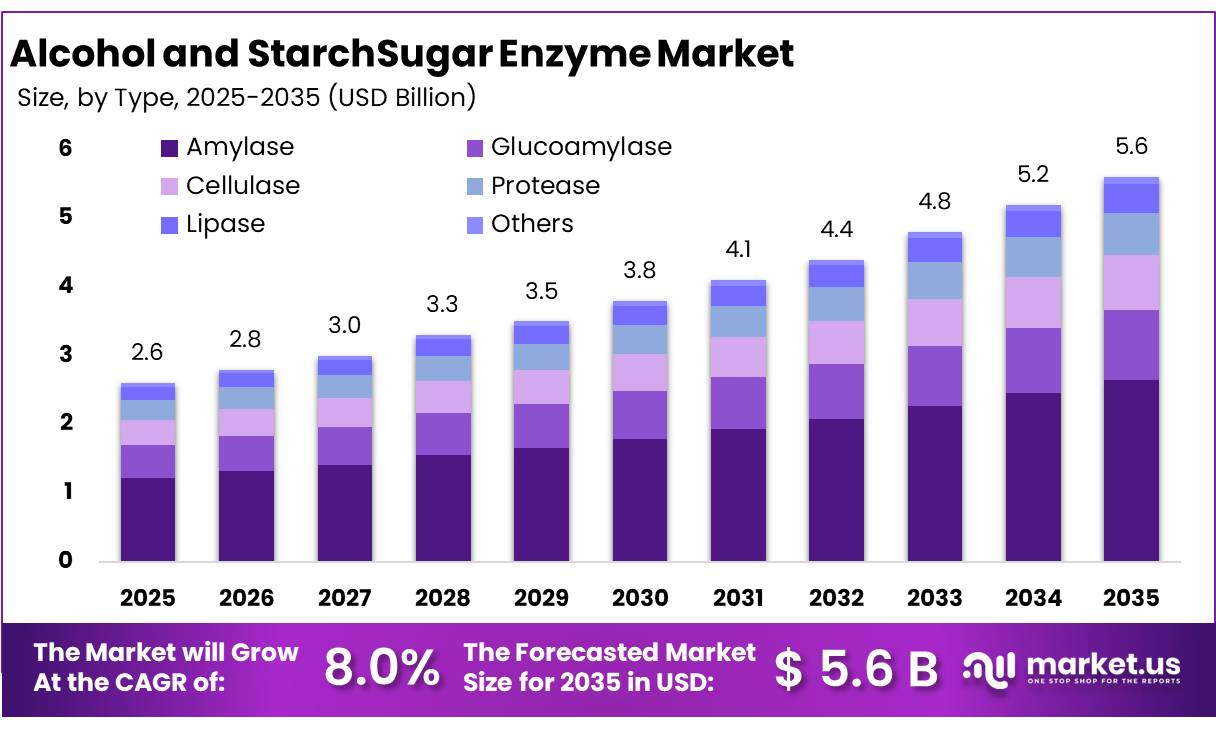
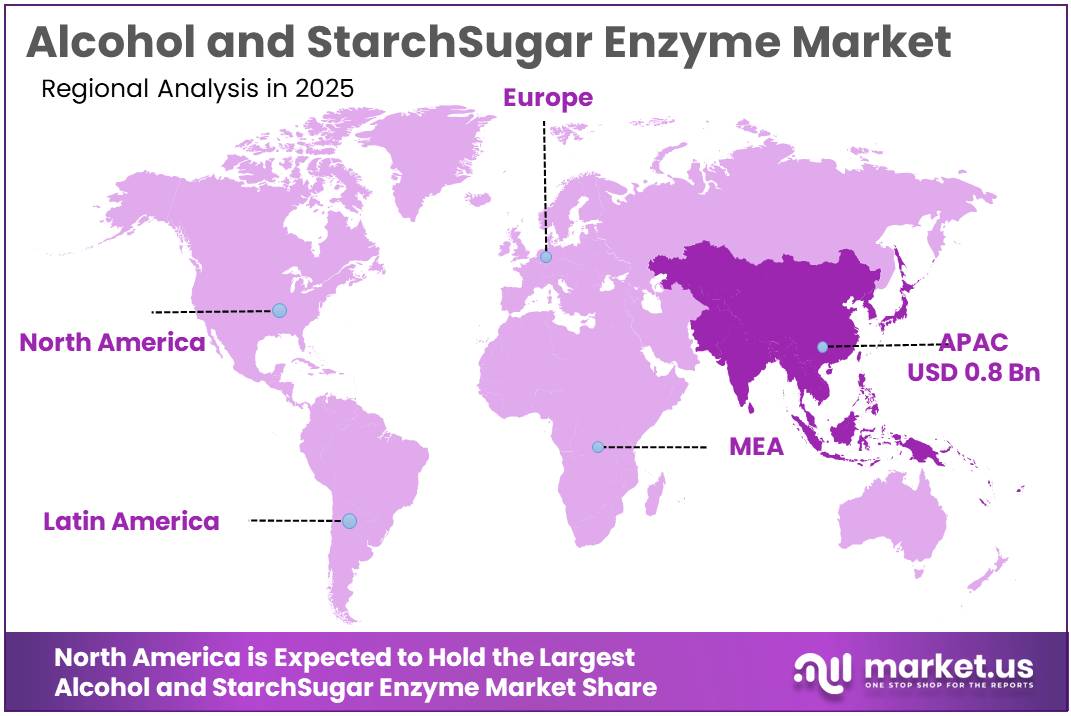
The Global Alcohol and StarchSugar Enzyme Market size is expected to be worth around USD 5.6 Billion by 2035, from USD 2.6 Billion in 2025, growing at a CAGR of 8.0% during the forecast period from 2026 to 2035. In 2025, Asia-Pacific held a dominant market position, capturing more than a 34.56% share, holding USD 0.8 Billion revenue.
The alcohol and starch-sugar enzymes industry plays an important role in food processing, beverage production, biofuel manufacturing, and industrial biotechnology. These enzymes help convert starch into fermentable sugars and improve the processing of sugar-based raw materials. Amylases break down starch into smaller carbohydrates, while glucoamylases help release glucose for fermentation. Other enzymes support sugar processing, improve yields, and reduce unwanted by-products.
- According to the United States Department of Agriculture, US ethanol production reached approximately 15.4 billion gallons in 2022, demonstrating the scale of a major enzyme-consuming application. Enzymes are used during starch conversion before yeast fermentation transforms the resulting sugars into alcohol. Corn is the principal feedstock in the United States, while sugarcane and sugar beet are important sources in other markets.
The starch and sugar processing sector also supports enzyme demand through food ingredients, syrups, brewing, baking, and confectionery production. The European Commission reports that the European Union produces an average of approximately 18 million tonnes of sugar annually. Sugar and starch conversion processes use enzymes to improve product quality and processing efficiency. Food enzymes can offer greater process specificity than some traditional chemical methods, potentially reducing unwanted side reactions and waste.
Key growth drivers include demand for biofuels, expansion of processed food production, the need for efficient raw-material conversion, and efforts to lower industrial energy use. Government renewable fuel policies also support ethanol production and influence enzyme demand. In the United States, nearly all gasoline sold contains approximately 10% ethanol by volume, supporting the established role of ethanol in fuel blending.
Key Takeaways
- Alcohol and StarchSugar Enzyme Market size is expected to be worth around USD 5.6 Billion by 2035, from USD 2.6 Billion in 2025, growing at a CAGR of 8.0%.
- Amylase held a dominant market position, capturing more than a 47.21% share.
- Liquid held a dominant market position, capturing more than a 62.34% share.
- Microbial held a dominant market position, capturing more than a 76.34% share.
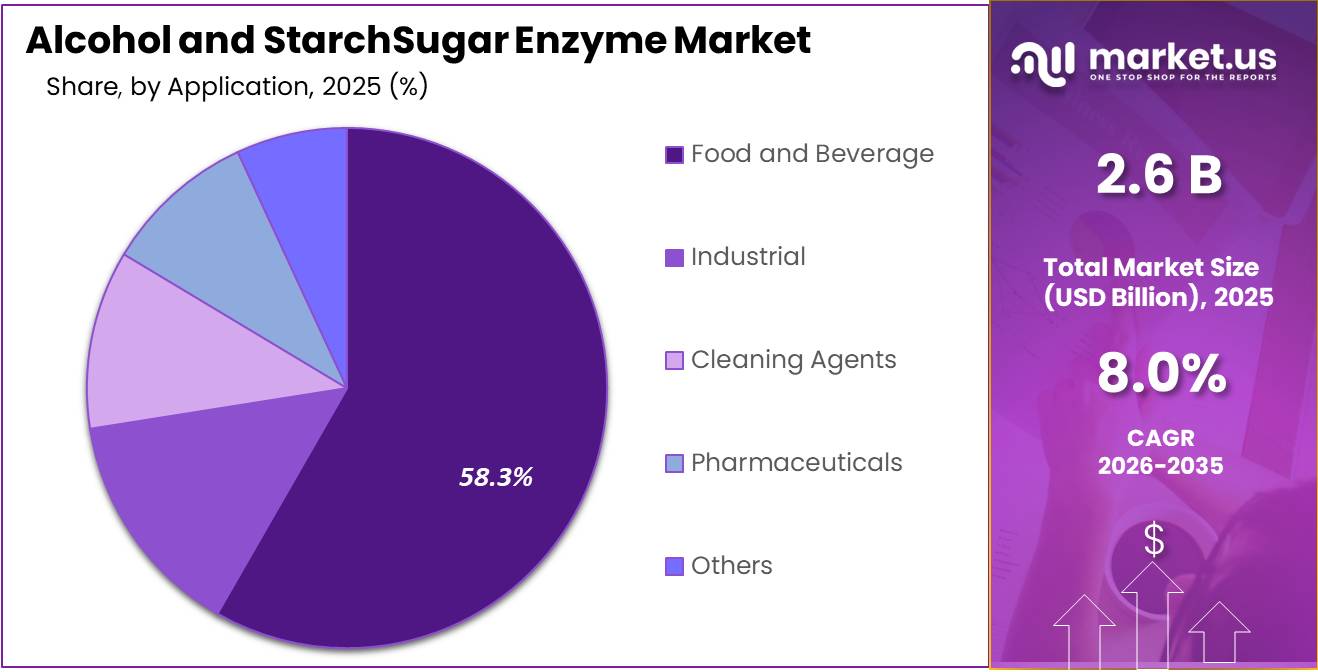
- Food and Beverage held a dominant market position, capturing more than a 58.34% share.
- Asia-Pacific held a dominant market position in the Alcohol and Starch-Sugar Enzyme Market, capturing 34.56% share, valued at USD 0.8 billion.
By Type Analysis
Amylase leads the market through its essential role in starch conversion and alcohol production.
In 2025, “Amylase” held a dominant market position, capturing more than a 47.21% share. Amylase is widely used to break down starch into smaller carbohydrates during ethanol production, brewing, and starch processing. It helps manufacturers prepare fermentable sugars, improve processing efficiency, and maintain consistent production quality. Demand is supported by the use of starch-rich feedstocks, particularly corn, in industrial fermentation. The United States Department of Agriculture provides data on the scale of the US biofuel industry, while the US Energy Information Administration explains how starch is converted into sugars before fermentation.
Glucoamylase is an important enzyme in ethanol manufacturing and starch processing because it breaks down smaller starch-derived carbohydrates into glucose, which yeast can convert into alcohol. In 2025, its industrial relevance remained closely linked to corn-based ethanol production, sugar syrup manufacturing, and fermentation processes. Research published by the United States Department of Agriculture explains that glucoamylase helps convert corn starch into glucose for ethanol and other fermentation products. This conversion step is important for improving sugar availability during fermentation and supporting consistent production.
By Form Analysis
Liquid enzymes lead through easy dosing, efficient mixing, and suitability for continuous industrial processing.
In 2025, “Liquid” held a dominant market position, capturing more than a 62.34% share. Liquid enzyme formulations are widely used in ethanol production, starch conversion, and sugar processing because they can be measured and blended directly into process streams. Their convenient handling supports automated production systems and helps manufacturers maintain consistent enzyme dosing. Liquid amylase and glucoamylase formulations are particularly useful in large-scale fermentation operations, where controlled starch breakdown and sugar release are important for production efficiency. The United States Department of Agriculture provides official information on the scale and operation of the biofuel industry, illustrating the industrial setting in which these enzyme formulations are used.
Powder enzyme formulations are used in alcohol production, starch processing, and food manufacturing where dry ingredients and controlled dosing are required. Their concentrated form can simplify storage and transport, while suitable packaging helps maintain stability during handling. In 2025, powder enzymes remained a useful alternative for manufacturers seeking flexibility in inventory management and process preparation. The United States Food and Drug Administration provides regulatory information on enzymes used in food processing, including requirements for safe use and compliance with applicable food regulations. These requirements encourage manufacturers to select suitable enzyme preparations and follow established handling procedures.
By Source Analysis
Microbial enzymes lead through scalable production, consistent performance, and suitability for industrial fermentation.
In 2025, “Microbial” held a dominant market position, capturing more than a 76.34% share. Microbial enzymes are produced using selected bacteria, fungi, and yeasts, making them suitable for large-scale alcohol production and starch-sugar processing. They are widely used in amylase and glucoamylase formulations to break down starch and release fermentable sugars. Manufacturers value microbial sources for their production flexibility and potential to develop enzymes with specific operating characteristics. The United States Department of Energy supports research into industrial biotechnology and microbial processing to improve the conversion of biomass into useful fuels and chemicals.
Plant-derived enzymes are obtained from sources such as germinating grains and other plant materials that naturally produce starch-degrading enzymes. In alcohol and starch-sugar processing, malted barley and other germinated cereals can provide amylase activity for breaking starch into smaller carbohydrates. These enzymes may suit traditional brewing and selected food-processing applications, although their use in large-scale industrial production depends on enzyme activity, raw-material availability, and process requirements. In 2025, plant-derived enzymes continued to serve as an alternative to microbial preparations where specific processing characteristics were needed. The United States Department of Agriculture provides official information on barley production and its use in food and brewing supply chains.
By Application Analysis
Food and beverage leads through the widespread use of enzymes in brewing, starch conversion, and food processing.
In 2025, “Food and Beverage” held a dominant market position, capturing more than a 58.34% share. Amylase and glucoamylase are used in brewing, syrup production, and other food-processing applications to break down starch and release fermentable sugars. These enzymes help manufacturers improve processing consistency and manage production efficiency. Their use is supported by demand for processed foods, beverages, and starch-based ingredients. The United States Food and Drug Administration provides guidance on food ingredients and enzyme preparations, helping manufacturers assess applicable safety and regulatory requirements.
Industrial applications use amylase and glucoamylase to convert starch into fermentable sugars for ethanol production and other bio-based products. In 2025, these enzymes remained important for manufacturers seeking efficient raw-material conversion and consistent fermentation performance. According to the US Department of Energy’s Alternative Fuels Data Center, nearly 90% of US ethanol plants are dry mills, where corn is processed and fermented to produce ethanol and related products. This established production base supports demand for enzymes used during starch breakdown. Further opportunities exist in processing agricultural residues into sugars for advanced biofuels and industrial chemicals.
Key Market Segments
By Type
- Amylase
- Glucoamylase
- Cellulase
- Protease
- Lipase
- Others
By Form
- Powder
- Liquid
By Source
- Microbial
- Plant-derived
- Animal-derived
By Application
- Industrial
- Food and Beverage
- Cleaning Agents
- Pharmaceuticals
- Others
Driver Analysis
Ethanol Mandates and Capacity Ramp-Up
This is the largest near-term demand engine because every incremental litre of grain- or starch-based ethanol requires liquefaction and saccharification performance, directly pulling thermostable alpha-amylase, glucoamylase, protease and increasingly debranching-enzyme formulations into recurring plant operating expenditure.
The U.S. entered 2026 with 191 fuel-ethanol plants and 18.477 billion gallons/year of nameplate capacity as of January 2025, while actual 2025 output reached a record 16.49 billion gallons; EPA’s March 2026 rule maintained 15 billion gallons of conventional biofuel for both 2026 and 2027 and set total renewable-fuel obligations at 26.81 billion and 27.02 billion ethanol-equivalent gallons, respectively. India’s blending rate advanced from 12.06% in 2022–23 to 14.60% in 2023–24 and 17.98% by February 2025, then reached 20% in 2025–26; procurement is projected above 12 billion litres and installed ethanol capacity reached about 20 billion litres/year in 2026, versus 4.21 billion litres in 2014.
Brazil produced 33.72 billion litres in 2025–26, including 9.19 billion litres of corn ethanol, up 12.26%, while OECD–FAO expects Brazilian ethanol output and consumption to rise about 2.1% annually over the coming decade. These committed volumes improve enzyme suppliers’ visibility, favour multiyear dosing and technical-service contracts over spot sales, and justify the estimated +2.2 percentage-point CAGR uplift; upside is strongest in India and Brazil, while mature U.S. demand shifts toward higher enzyme value per gallon rather than plant-count growth.
Drivers Impact Analysis
| Driver | (~) % Impact on CAGR Forecast | Geographic Relevance | Impact Timeline |
|---|---|---|---|
| Ethanol mandates and capacity ramp-up | +2.2 pp | India, U.S., Brazil core; Southeast Asia spill-over | Short term (≤ 2 years) |
| Low-temperature raw-starch conversion | +1.5 pp | North America, China, EU; India and Brazil scale-up | Medium term (2–4 years) |
| Functional starch-sugar diversification | +1.2 pp | North America, EU, China, Japan, South Korea | Medium term (2–4 years) |
| Feedstock flexibility and grain volatility | +0.9 pp | India, Brazil, China, Southeast Asia, Africa | Short term (≤ 2 years) |
| No/low-alcohol beverage innovation | +0.7 pp | EU and North America core; Japan and urban APAC | Medium term (2–4 years) |
| Yield-led decarbonization and plant optimization | +0.8 pp | EU and North America core; global export plants | Long term (≥ 4 years) |
Restraint Analysis
Mature Beer and HFCS Demand
Structural weakness in conventional brewing and corn-sweetener demand removes throughput from two large, enzyme-established applications and limits the number of greenfield dosing points: EU beer output fell 2.9% in 2025, consumption declined 3.2%, and production and consumption stood 8.6% and 9.2% below 2019, respectively; Germany sold about 7.8 billion litres in 2025, down 6%, while the UK brewery count contracted from 1,715 to 1,578 in one year, a net loss of 137 sites or nearly three closures per week.
EU output was still a substantial 34.4 billion litres in 2025, but underutilized brewhouses optimize existing enzyme dosage rather than install new treatment capacity, and smaller closures eliminate customers whose application-support cost per account is comparatively high.
In U.S. wet milling, HFCS used about 361 million bushels of corn annually—roughly 3% of domestic corn use—yet deliveries declined another 3.5% in the first half of 2025/26 while cane and beet sugar deliveries rose 0.6%; total corn use for HFCS, glucose syrup and dextrose was about 745 million bushels, or 5% of annual production, defining the addressable volume exposed to sweetener substitution. Non-alcoholic beer’s 5.9% European growth partly offsets the loss but does not compensate tonne-for-tonne because it represented only about one in twelve EU beers in 2025–26.
The modeled -1.6-point CAGR effect therefore reflects lower treated substrate volume, plant closures, intensified tender competition and a mix shift from high-volume commodity amylase and glucoamylase toward smaller specialty formulations, compressing supplier asset utilization and forcing growth to depend on share capture rather than end-market expansion.
Restraint Impact Analysis
| Restraint | (~) % Impact on CAGR Forecast | Geographic Relevance | Impact Timeline |
|---|---|---|---|
| Mature beer and HFCS demand | -1.6 pp | EU, North America core | Short term (≤ 2 years) |
| Customer margin and CapEx pressure | -1.3 pp | EU, China, India; North America | Short term (≤ 2 years) |
| Regulatory approval fragmentation | -1.0 pp | EU core; UK and APAC spill-over | Medium term (2–4 years) |
| Feedstock and energy volatility | -1.1 pp | Global; EU, India, China core | Short term (≤ 2 years) |
| Qualification and performance risk | -0.9 pp | Global installed plants | Medium term (2–4 years) |
| Fermentation scale and supply risk | -0.7 pp | APAC import markets; EU and Americas | Long term (≥ 4 years) |
Opportunity Analysis
Alcohol-to-Jet Enzyme Platforms
The U.S. SAF objective is 3 billion gallons annually by 2030 and 35 billion by 2050 versus only a few million gallons at the program’s outset, with a minimum 50% lifecycle-emissions reduction; ethanol-derived ATJ-SPK is already recognized under ASTM D7566 and may be blended up to 50%, providing a technical route but not yet mass commercialization.
ICAO identifies starches, sugars, waste biomass and waste gases as ATJ feedstocks and allows producers to claim an actual lifecycle value below the default when supported by plant-level evidence, creating room for enzyme developers to monetize lower-temperature hydrolysis, higher alcohol yield and feedstock-specific carbon-intensity improvement rather than sell generic amylase.
A modeled 100-million-gallon ATJ complex requiring roughly 160–180 million gallons of ethanol feedstock could support $4–9 million annually in premium enzyme, yeast, contamination-control and analytics revenue at an assumed 2.5–5.0 cents per ethanol gallon; capturing only 10% of the U.S. 2030 SAF target through ATJ would therefore open approximately 5–6 such enzyme-intensive production equivalents.
The best go-to-market model is a consortium with ethanol producers, ATJ licensors and airlines, using multiyear offtake-backed qualification and pricing linked to gallons on-spec and verified carbon intensity; the +2.0-point upside reflects this large adjacency, but execution is medium term because project finance, hydrogen supply, certification, tax-credit treatment and ethanol carbon intensity remain gating factors.
Opportunity Impact Analysis
| Opportunity | (~) % Potential CAGR Upside | Geographic Relevance | Execution Window |
|---|---|---|---|
| Alcohol-to-jet enzyme platforms | +2.0 pp | North America, EU; Brazil and India | Medium term (2–4 years) |
| Rare-sugar bioconversion | +1.7 pp | North America, Japan, South Korea; EU later | Short term (≤ 2 years) |
| Enzyme-as-a-service | +1.3 pp | North America, EU, China, India, Brazil | Short term (≤ 2 years) |
| Fiber and coproduct upgrading | +1.1 pp | U.S. core; Brazil, China, India | Medium term (2–4 years) |
| Low-carbon value sharing | +0.9 pp | U.S. core; EU and Brazil spill-over | Medium term (2–4 years) |
| Emerging-market localization | +0.8 pp | South Asia, Southeast Asia, Africa | Long term (≥ 4 years) |
Challenges Analysis
Variable Feedstock Performance
Alcohol and starch-sugar plants must continuously recalibrate enzyme systems as crop genetics, weather, storage and sourcing alter amylose-to-amylopectin ratio, granule size, gelatinization, protein, fibre and endogenous inhibitors; this is an operating challenge rather than a restraint because production continues, but yield variance consumes technical-service capacity and prevents one formulation from scaling uniformly.
USDA work across four corn hybrids found end-liquefaction dextrose-equivalent means of 12.8–13.9% for yellow dent, 11.2% for waxy and 9.7% for high-amylose corn, while increasing enzyme dose from 25 to 200 microlitres per 50 g slurry moved mean DE from 8.5% to 16.4%; another USDA study found amylose content had a statistically significant effect on ethanol conversion and that high-amylose material required at least 160°C cooking to match normal-corn efficiency.
Cassava is similarly variable: amylose spans roughly 13–29.5%, protein 0.10–4.85%, lipid 0.08–1.59% and fibre 0.04–3.14%, while reported gelatinization temperatures range from 69.15°C to 85.1°C and enthalpy from 4.8 to 17.4 J/g; variety-specific hydrolysis changed water-holding capacity by 10–14% and water-binding capacity by 16%, showing why dose-transfer between origins is unreliable. Climate amplifies the friction because drought and heat alter starch content and granule structure, starch synthase becomes largely non-functional above 35°C in wheat, and heat during maize grain filling raises amylose and short-chain amylopectin while weakening granule structure.
Under an analyst scenario, a 1.0% substrate-conversion shortfall in a 1,000-tonne/day plant strands 10 tonnes of starch-equivalent daily; mitigation requires near-infrared feedstock fingerprinting, lot-specific dosing curves, multi-enzyme libraries and procurement-to-process data integration, but biological and climatic variability cannot be eliminated, supporting a -1.3-point drag over a horizon beyond four years.
Challenges Impact Analysis
| Challenge | (~) % CAGR Friction Drag | Geographic Relevance | Mitigation Horizon |
|---|---|---|---|
| Variable Feedstock Performance | -1.3 pp | India, China, Brazil, Southeast Asia | Long term (≥ 4 years) |
| Fermentation Scale-Up Variability | -1.1 pp | North America, EU, China | Medium term (2–4 years) |
| Enzyme Stability Trade-Offs | -0.9 pp | Global processing hubs | Long term (≥ 4 years) |
| Bioprocess Talent Scarcity | -0.8 pp | North America, EU, APAC hubs | Long term (≥ 4 years) |
| Logistics and Activity Loss | -0.7 pp | APAC–EU; Africa and Latin America | Medium term (2–4 years) |
| Data and Biosecurity Complexity | -0.6 pp | North America, EU, China | Long term (≥ 4 years) |
Geopolitical Impact Analysis
Geopolitical Impact of Ongoing Wars on the Alcohol and Starch-Sugar Enzyme Market
Ongoing conflicts in Ukraine and the Middle East are affecting the alcohol and starch-sugar enzyme market through higher energy costs, agricultural supply disruptions, and changes in transport routes. Enzyme manufacturers depend on stable supplies of corn, starch, fermentation materials, and energy to produce amylase and glucoamylase for ethanol and sugar processing. In August 2026, European ethanol producers faced tighter corn supplies as the Ukraine war disrupted traditional trade routes, while heat-related crop losses added further pressure.
The Middle East conflict has added pressure through higher fuel, fertilizer, and shipping costs. The World Bank reported in April 2026 that Brent crude prices were more than 50% higher in mid-April than at the beginning of the year, increasing costs across production and transport networks.
These conditions can raise operating expenses for enzyme producers and ethanol plants, particularly where production depends on energy-intensive processing or imported inputs. Higher corn prices may also encourage manufacturers to seek alternative starch sources and improve enzyme efficiency. However, greater interest in fuel security and bioethanol can support demand for industrial enzymes.
Regional Insights
Dominating Region: Asia-Pacific
In 2025, Asia-Pacific held a dominant market position in the Alcohol and Starch-Sugar Enzyme Market, capturing 34.56% share, valued at USD 0.8 billion. Regional demand is supported by food processing, brewing, starch conversion, and bioethanol production. China, Japan, and Southeast Asian countries have established food and industrial processing sectors that use enzymes such as amylase and glucoamylase to improve starch breakdown and fermentation efficiency.
The United States Department of Agriculture’s International Agricultural Trade Report and food-grain statistics provide useful evidence of the region’s substantial agricultural processing base. Across Asia-Pacific, investment in industrial biotechnology and demand for processed foods support enzyme use in syrup production, brewing, and other fermentation-based applications. Growth prospects remain linked to grain availability, energy costs, manufacturing investment, and food-processing output.
The Japan Ministry of Economy, Trade and Industry reported that China produced approximately 10.3 million kilolitres of bioethanol in 2023, representing 7.8% of global production, while Thailand produced around 1.5 million kilolitres, equivalent to 1.1%. These figures demonstrate the region’s established ethanol production base and its relevance to industrial enzyme demand.
Key Regions and Countries Insights
- North America
- US
- Canada
- Europe
- Germany
- France
- The UK
- Spain
- Italy
- Rest of Europe
- Asia Pacific
- China
- Japan
- South Korea
- India
- Australia
- Rest of APAC
- Latin America
- Brazil
- Mexico
- Rest of Latin America
- Middle East & Africa
- GCC
- South Africa
- Rest of MEA
Key Players Analysis
Associated British Foods (ABF) participates in the enzyme market through AB Enzymes, part of its ingredients business. Its 2025 annual report recorded group revenue of £19.5 billion and operations in 56 countries. ABF’s ingredients division reported revenue of £2.041 billion, covering enzymes and other specialty ingredients. Its wider yeast and bakery business also serves alcoholic beverage and bioethanol applications, supporting its relevance to fermentation-related markets. The company’s international customer base and technical capabilities provide opportunities to serve industrial processing and food manufacturers.
Advanced Enzyme Technologies develops and manufactures enzymes for food processing, animal nutrition, and industrial applications. In fiscal year 2024–2025, the company reported consolidated operating revenue of ₹6,369 million, up from ₹6,239 million in the previous year, representing approximately 2% growth. International sales reached ₹3,464 million, accounting for around 54% of operating revenue. Its enzyme development expertise supports opportunities in starch processing and fermentation-related applications.
Amano Enzyme Inc. is a Japanese manufacturer of specialty enzymes serving food, pharmaceutical, and industrial customers. Established on 26 August 1948, the company traces its origins to 1899 and reports capital of ¥390 million and 480 employees. Its manufacturing network includes 3 plants in Japan, located in Nagoya, Yoro, and Shiga, alongside international operations in markets including the United States, Europe, China, and Thailand. Its enzyme expertise supports applications in food processing and industrial production.
Top Key Players Outlook
- ABF PLC
- Advanced Enzyme Technology Ltd.
- Amano Enzyme Inc.
- Codexis Inc.
- Dupont DE Nemours and Co.
- Dyadic International Inc.
- Lesaffre
- Novozymes A/S
- Roquette Freres
- The Soufflet Group
- Other Key Players
Recent Developments
- In March 2026, Codexis reported full-year 2025 revenue of USD 70.4 million, up 19% from USD 59.3 million in 2024, and confirmed completion of the Merck technology transfer agreement. In July 2026, the company raised approximately USD 25 million in net proceeds through an equity financing. In August 2026, it reported second-quarter revenue of USD 14.9 million and continued developing its enzyme-driven manufacturing platforms.
- In May 2026, DuPont reported first-quarter net sales of USD 1.681 billion, up 4% year over year, and confirmed the completion of its Aramids business divestiture on April 1, 2026. In August 2026, second-quarter net sales reached USD 1.819 billion, an increase of 4% year over year.
Report Scope
| Report Features | Description |
|---|---|
| Market Value (2025) | USD 2.6 Bn |
| Forecast Revenue (2035) | USD 5.6 Bn |
| CAGR (2026-2035) | 8.0% |
| Base Year for Estimation | 2025 |
| Historic Period | 2020-2024 |
| Forecast Period | 2026-2035 |
| Report Coverage | Revenue Forecast, Market Dynamics, Competitive Landscape, Recent Developments |
| Segments Covered | By Type (Amylase, Glucoamylase, Cellulase, Protease, Lipase, Others), By Form (Powder, Liquid), By Source (Microbial, Plant-derived, Animal-derived), By Application (Industrial, Food and Beverage, Cleaning Agents, Pharmaceuticals, Others) |
| Regional Analysis | North America – US, Canada; Europe – Germany, France, The UK, Spain, Italy, Rest of Europe; Asia Pacific – China, Japan, South Korea, India, Australia, Singapore, Rest of APAC; Latin America – Brazil, Mexico, Rest of Latin America; Middle East & Africa – GCC, South Africa, Rest of MEA |
| Competitive Landscape | ABF PLC, Advanced Enzyme Technology Ltd., Amano Enzyme Inc., Codexis Inc., Dupont DE Nemours and Co., Dyadic International Inc., Lesaffre, Novozymes A/S, Roquette Freres, The Soufflet Group, Other Key Players |
| Customization Scope | Customization for segments, region/country-level will be provided. Moreover, additional customization can be done based on the requirements. |
| Purchase Options | We have three licenses to opt for: Single User License, Multi-User License (Up to 5 Users), Corporate Use License (Unlimited User and Printable PDF) |