Report Overview
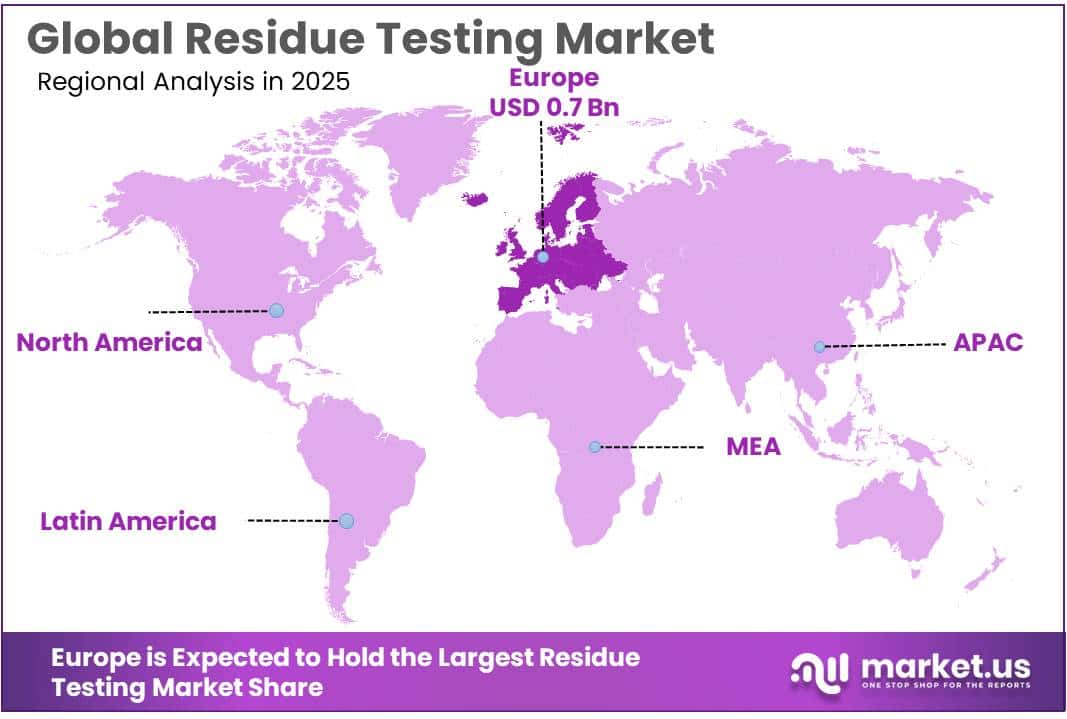
The Global Residue Testing Market size is expected to be worth around USD 4.1 Billion by 2035, from USD 2.2 Billion in 2025, growing at a CAGR of 6.4% during the forecast period from 2026 to 2035. In 2025, Europe held a dominant market position, capturing more than a 34.80% share, holding USD 0.7 Billion revenue.
Residue testing is an essential part of the food safety, agricultural, pharmaceutical, chemical, and environmental testing industries. It identifies and measures unwanted substances, including pesticide residues, veterinary drug residues, antibiotics, heavy metals, and industrial contaminants in food, animal feed, water, and other materials. The industry uses advanced analytical methods such as liquid chromatography, gas chromatography, and mass spectrometry to detect trace-level chemicals.
- The industrial scenario is shaped by stricter food safety regulations, growing international trade, and increasing demand for reliable laboratory results. In the United States, the Food and Drug Administration’s fiscal year 2024 monitoring programme examined 781 different pesticides and selected industrial compounds in human and animal foods collected between October 2023 and September 2024. The programme demonstrates the scale and technical complexity of residue monitoring across food supply chains.
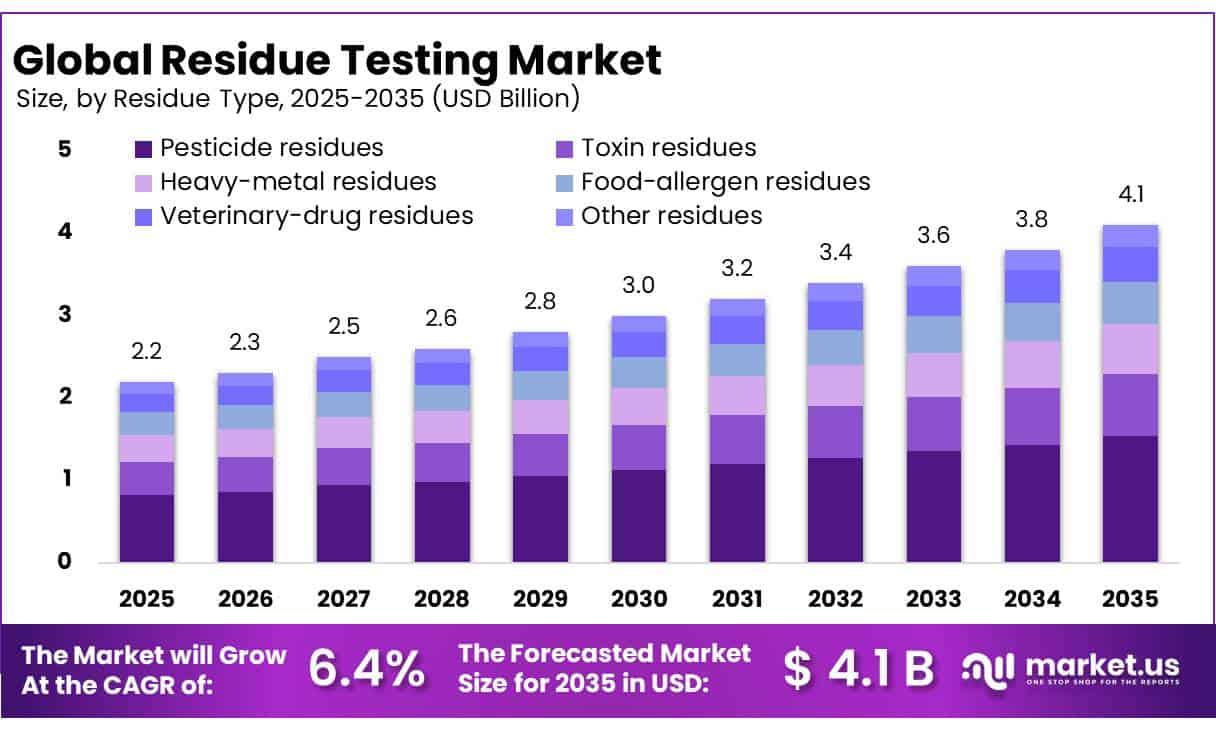
Regulatory requirements are a major driving factor for the residue testing industry. The United States Environmental Protection Agency establishes maximum permissible pesticide residue limits for individual food commodities, while the Food and Drug Administration and the United States Department of Agriculture conduct monitoring and enforcement activities. In Europe, Regulation (EC) No. 396/2005 provides the framework for maximum residue levels in food and feed.
Recent monitoring results also demonstrate the continuing need for reliable residue analysis. According to the European Food Safety Authority’s 2024 report, 9,842 samples were examined under the coordinated European monitoring programme. Of these, 98.8% complied with European Union legislation, while 1.2% were confirmed as non-compliant after measurement uncertainty was considered. These results highlight the importance of accurate testing, consistent sampling, and effective regulatory oversight across food supply chains.
The United States Food and Drug Administration’s analytical methods programme includes testing for 30 per- and polyfluoroalkyl substances (PFAS) in food using liquid chromatography-tandem mass spectrometry, demonstrating the expansion of testing beyond conventional pesticide analysis.
Key Takeaways
- Residue Testing Market size is expected to be worth around USD 4.1 Billion by 2035, from USD 2.2 Billion in 2025, growing at a CAGR of 6.4%.
- Pesticide residues held a dominant market position, capturing more than a 37.60% share.
- Chromatography held a dominant market position, capturing more than a 44.70% share.
- Fruits and vegetables held a dominant market position, capturing more than a 40.00% share.
- Food and beverages held a dominant market position, capturing more than a 66.00% share.
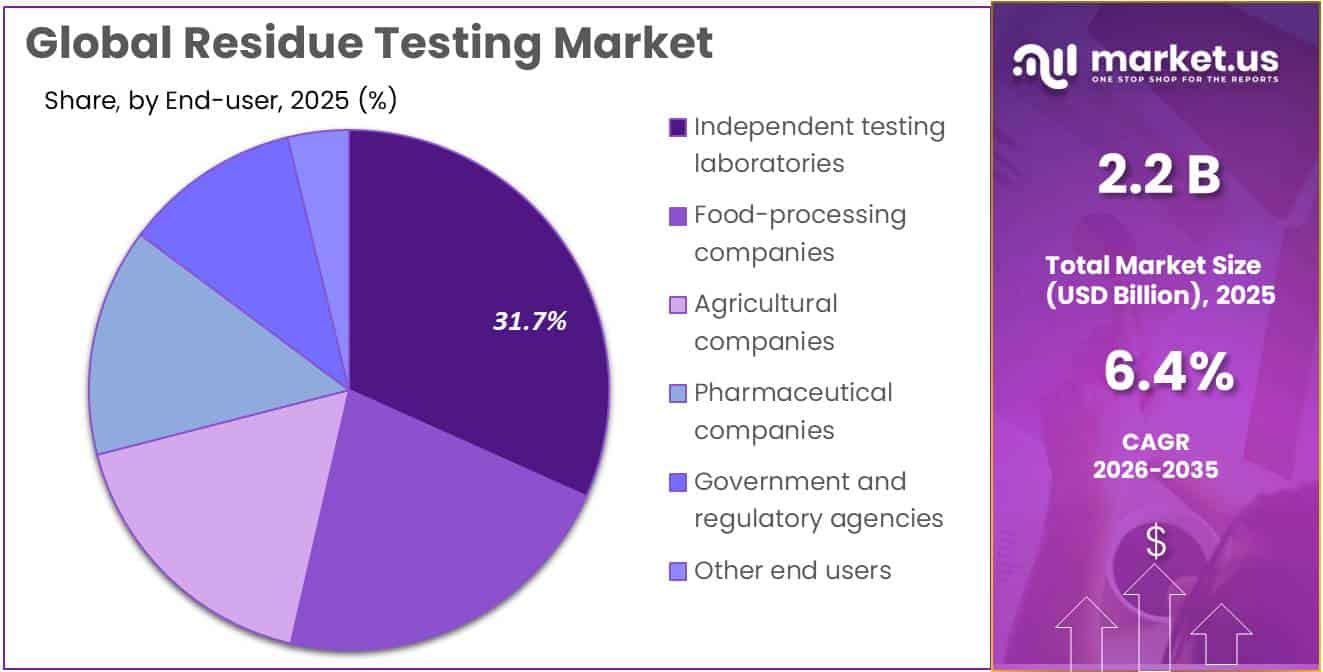
- Independent testing laboratories held a dominant market position, capturing more than a 31.00% share.
- Europe held the dominant regional position in the Residue Testing Market in 2025, accounting for 34.80% of the market, with a reported value of USD 0.7 billion.
By Residue Type Analysis
Pesticide Residues: Dominant Segment in the Residue Testing Market
In 2025, “Pesticide residues” held a dominant market position, capturing more than a 37.60% share of the Residue Testing Market by Residue Type. The segment’s position is supported by the need to monitor pesticide traces in food products and agricultural commodities to ensure compliance with established safety limits. Government monitoring programmes help identify residue violations and strengthen food safety controls across supply chains. The United States Food and Drug Administration’s fiscal year 2024 monitoring programme examined 781 different pesticides and selected industrial compounds, highlighting the breadth of chemical screening required for food safety.
Toxin residues remain an important category in the Residue Testing Market because naturally occurring toxins, including aflatoxins and other mycotoxins, can contaminate crops and processed food products. In 2025, testing requirements continued to be supported by food safety programmes that monitor potentially harmful substances in agricultural commodities. The United States Food and Drug Administration uses a validated liquid chromatography-tandem mass spectrometry method to measure 12 mycotoxins in human food. This method supports the detection of multiple toxins in a single analytical process and helps laboratories assess food safety risks.
By Technology Analysis
Chromatography: Leading Technology Driven by Accurate Multi-Residue Detection
In 2025, “Chromatography” held a dominant market position, capturing more than a 44.70% share of the Residue Testing Market by Technology. Its leading position is supported by its ability to separate chemical compounds in complex samples and help laboratories identify pesticide residues, veterinary drug residues, and other contaminants. Gas chromatography and liquid chromatography, often combined with mass spectrometry, are widely used for reliable residue identification and measurement.
In 2025, the U.S. Food and Drug Administration continued to list validated methods using gas chromatography-tandem mass spectrometry and liquid chromatography-tandem mass spectrometry for pesticide and industrial chemical analysis in food. These methods support regulatory monitoring and help food businesses verify product safety.
Spectroscopy plays an important role in the Residue Testing Market by helping laboratories identify and measure chemical substances through their interaction with light or other forms of electromagnetic radiation. Techniques such as infrared spectroscopy, Raman spectroscopy, and atomic spectroscopy support the analysis of contaminants in food and agricultural products.
In 2025, the U.S. Department of Agriculture continued to support pesticide residue monitoring through its Pesticide Data Program, which covers 135 commodities, including fruits, vegetables, meat, dairy products, grains, and drinking water. Spectroscopy-based approaches may complement established laboratory methods by supporting rapid screening, while confirmatory testing may still be required to establish residue identity and concentration.
By Food Tested Analysis
Fruits and Vegetables: Leading Food Category Due to Regular Pesticide Monitoring
In 2025, “Fruits and vegetables” held a dominant market position, capturing more than a 40.00% share of the Residue Testing Market by Food Tested. This leading position is supported by the need to monitor pesticide residues in fresh produce and ensure that food meets established safety limits. Fruits and vegetables can be exposed to pesticides during cultivation, making residue testing important for growers, food processors, retailers, and importers.
The United States Food and Drug Administration conducts pesticide residue monitoring on domestic and imported foods to assess compliance with regulatory requirements. These monitoring activities support consumer protection and strengthen confidence in the safety of fresh produce traded through domestic and international supply chains.
Meat and poultry remain important categories in the Residue Testing Market because testing helps detect veterinary drug residues, antibiotics, and other chemical contaminants that may remain in animal products. In 2025, the United States Department of Agriculture’s Food Safety and Inspection Service continued its National Residue Program, which monitors chemical residues in domestic and imported meat, poultry, and egg products.
The programme uses scheduled sampling and additional inspections when chemical residue concerns arise, helping authorities identify products that may not meet regulatory requirements. This government-led monitoring supports food safety, regulatory compliance, and confidence among processors, retailers, and consumers.
By Application Analysis
Food and Beverages: Leading Application Driven by Food Safety Requirements
In 2025, “Food and beverages” held a dominant market position, capturing more than a 66.00% share of the Residue Testing Market by Application. The segment’s leading position reflects the need to check food products for pesticide residues, veterinary drug residues, and other chemical contaminants before they reach consumers. Food manufacturers, processors, importers, and retailers rely on residue testing to meet regulatory requirements and maintain product quality.
The United States Food and Drug Administration’s fiscal year 2024 monitoring programme examined 781 different pesticides and selected industrial compounds in human and animal foods, demonstrating the breadth of chemical monitoring used to support food safety and regulatory compliance.
Agriculture is an important application of residue testing because farmers, crop buyers, and agricultural exporters need to verify chemical residues in crops and raw materials. Testing helps identify pesticide residues and supports compliance with permitted residue limits before agricultural products enter food processing or distribution channels.
In 2025, the United States Environmental Protection Agency continued to regulate pesticide residues in food through legally established tolerances under the Federal Food, Drug, and Cosmetic Act. These limits help determine the maximum pesticide residue levels permitted on or in food commodities and provide a regulatory basis for agricultural residue testing. Demand is supported by food safety requirements, export standards, and the need for reliable crop monitoring.
By End User Analysis
Independent Testing Laboratories: Leading End User Through Specialized Testing Services
In 2025, “Independent testing laboratories” held a dominant market position, capturing more than a 31.00% share of the Residue Testing Market by End User. These laboratories play an important role by providing impartial testing services to food producers, agricultural businesses, importers, and retailers. Their specialized equipment and trained analysts help detect pesticide residues, veterinary drug residues, and other chemical contaminants in different samples.
Independent laboratories also help businesses meet regulatory requirements and verify product safety before distribution. Government monitoring programmes further support demand for reliable analytical services. The United States Food and Drug Administration’s fiscal year 2024 monitoring programme examined 781 different pesticides and selected industrial compounds in human and animal foods, reflecting the broad scope of residue analysis required for food safety oversight.
Food-processing companies use residue testing to check raw materials and finished products for unwanted chemical substances before they enter the market. Testing helps manufacturers manage contamination risks, verify supplier quality, and meet food safety requirements. In 2025, the U.S. Food and Drug Administration’s pesticide monitoring programme reported that it analyzed 3,528 human food samples during fiscal year 2024, including 893 domestic samples and 2,635 imported samples.
The programme found that 98.2% of domestic samples and 84.4% of imported samples complied with federal standards. These findings highlight the importance of chemical residue monitoring for food manufacturers and their supply chains.
Key Market Segments
By Residue Type
- Pesticide residues
- Toxin residues
- Heavy-metal residues
- Food-allergen residues
- Veterinary-drug residues
- Other residues
By Technology
- Chromatography
- Spectroscopy
- Immunoassay
- Polymerase chain reaction
- Rapid test kits
- Other technologies
By Food Tested
- Meat and poultry
- Dairy products
- Processed foods
- Fruits and vegetables
- Cereals, grains and pulses
- Nuts, seeds and spices
- Beverages
- Other food products
By Application
- Food and beverages
- Agriculture
- Pharmaceuticals
- Environmental monitoring
- Other applications
By End User
- Independent testing laboratories
- Food-processing companies
- Agricultural companies
- Pharmaceutical companies
- Government and regulatory agencies
- Other end users
Driver Analysis
Mandatory Surveillance Scale-Up
Regulatory surveillance is the strongest near-term volume driver because it converts residue analysis from discretionary quality assurance into recurring, budgeted and auditable testing: Europe collected more than 125,000 food samples in 2024 and generated approximately 19 million individual pesticide-residue results per year, while the representative EU-coordinated subset achieved 98.8% compliance and national programmes tested 86,449 samples at 98.2% compliance, demonstrating that high compliance does not remove the statutory need to verify it.
The EU programme is continually renewed—Regulation 2025/854 covers 2026–2028 and Regulation 2026/748 already establishes the 2027–2029 cycle—while the preceding design required 683 sample units per commodity group to estimate an exceedance rate above 1% with a 0.75% margin of error and imposed electronic reporting deadlines through August 2028. The United States adds another stable demand pool: USDA’s 2024 Pesticide Data Program analyzed 9,872 samples across 19 commodities, including 9,165 fruit and vegetable samples screened for 597 parent pesticides and metabolites, with 76 samples, or 0.77%, exceeding tolerance.
These programmes create predictable instrument utilization, reference-standard consumption, proficiency-testing activity and multi-year public contracts rather than incident-only work, allowing laboratories to amortize LC-MS/MS and GC-MS/MS platforms across recurring sample batches. The modeled +2.0-percentage-point CAGR contribution reflects direct sample-volume continuity plus rising results density per sample, with the largest 2026–2028 value capture accruing to accredited laboratories serving the EU, North America and export-certification hubs.
Drivers Impact Analysis
| Driver | (~) % Impact on CAGR Forecast | Geographic Relevance | Impact Timeline |
|---|---|---|---|
| Mandatory surveillance scale-up | +2.0 pp | EU core; North America; export hubs | Short term (≤ 2 years) |
| Import compliance intensification | +1.6 pp | EU trade lanes; APAC; LatAm; Africa | Medium term (2–4 years) |
| Animal-residue control expansion | +1.3 pp | EU; UK; GCC; export APAC | Short term (≤ 2 years) |
| Emerging contaminant testing | +1.2 pp | EU core; North America spill-over | Medium term (2–4 years) |
| Multi-residue automation | +1.0 pp | Global laboratory hubs | Medium term (2–4 years) |
| Digital supplier assurance | +0.8 pp | North America; EU; global retail | Long term (≥ 4 years) |
Restraint Analysis
High Instrument CapEx
Residue testing remains capital intensive because an enforceable multi-class laboratory needs complementary LC-MS/MS, GC-MS/MS, ICP-MS, sample homogenization, QuEChERS extraction, nitrogen generation, cold-chain storage, certified standards, uninterrupted power, LIMS and ISO 17025-quality infrastructure rather than a single analyzer; an Indian public procurement benchmark placed one LC-MS/MS system for pesticide testing at about INR 20 million, implying that a credible three-platform residue laboratory can require an analyst-estimated USD 0.8–1.8 million before fit-out, accreditation and working capital.
Annual service contracts, source and pump consumables, gases, columns, proficiency testing, reference materials and software commonly consume an estimated 8–15% of equipment value, while instrument downtime directly removes billable batches; at an assumed USD 100–150 realized average revenue per sample and 40–50% contribution margin, a USD 1.2 million installation requires roughly 16,000–30,000 additional samples to recover core equipment investment before financing, rent and commercial overhead.
Smaller domestic markets cannot provide this utilization, and imported instruments expose laboratories to exchange-rate movement, delayed spare parts and prolonged qualification cycles, forcing samples toward regional hubs instead of creating local testing capacity. This restrains laboratory rollout, reduces competitive density outside export clusters and delays public-sector CapEx, producing an estimated -1.6-percentage-point drag on attainable 2026–2031 CAGR in Africa, South Asia and Latin America.
Restraint Impact Analysis
| Restraint | (~) % Impact on CAGR Forecast | Geographic Relevance | Impact Timeline |
|---|---|---|---|
| High Instrument CapEx | -1.6 pp | Africa; South Asia; LatAm | Long term (≥ 4 years) |
| Accreditation Capacity Gaps | -1.3 pp | Africa; LMIC Asia; small islands | Long term (≥ 4 years) |
| Routine Panel Price Erosion | -1.1 pp | North America; EU; APAC labs | Medium term (2–4 years) |
| Risk-Based Sampling Shift | -1.0 pp | EU; North America | Medium term (2–4 years) |
| Method Validation Burden | -0.9 pp | Global multi-residue labs | Long term (≥ 4 years) |
| Traceability Data Fragmentation | -0.7 pp | North America; APAC; LatAm | Medium term (2–4 years) |
Opportunity Analysis
Residue-Intelligence SaaS
This is an untapped monetization opportunity rather than a present market driver because most laboratories still sell an analytical certificate, while the commercial white space is converting accumulated results into subscription-based regulatory intelligence, supplier scoring, dynamic MRL comparison, pre-shipment release workflows and predictive sampling decisions.
EFSA has harmonized pesticide residues, veterinary medicinal product residues, chemical contaminants, food additives and flavourings under its chemical-monitoring framework since 2019, and the 2026 cycle requires complete electronic data transmission by 30 June, validation by 31 August and use of the Standard Sample Description 2 data model, creating a clear technical basis for structured, machine-readable residue data products.
A laboratory processing 100,000 samples annually could convert a USD 80–150 transactional test into an analyst-modeled USD 10–30 monthly supplier-compliance subscription across 2,000–5,000 farms, processors and exporters; even 15–25% adoption could add 8–15% recurring revenue with software gross margins potentially 25–40 percentage points above traditional wet-lab services.
The strategic pivot reduces dependence on sample-volume growth by monetizing change alerts, destination-specific legal-limit libraries, trend analytics and automated corrective-action recommendations, while integrated customer data lowers acquisition cost through workflow lock-in. Successfully executed, this opportunity could add +1.7 percentage points to baseline CAGR across North America, the EU and APAC export corridors during 2026–2030.
Opportunity Impact Analysis
| Opportunity | (~) % Potential CAGR | Geographic Relevance | Execution Window |
|---|---|---|---|
| Residue-Intelligence SaaS | +1.7 pp | North America; EU; APAC exporters | Medium term (2–4 years) |
| PFAS Multi-Matrix Platforms | +1.5 pp | EU; North America; Japan; Korea | Medium term (2–4 years) |
| Emerging-Market Lab Networks | +1.4 pp | Africa; South Asia; LatAm | Long term (≥ 4 years) |
| Novel-Food Dossier Testing | +1.2 pp | EU; North America; Singapore; APAC | Medium term (2–4 years) |
| At-Line Rapid Screening | +1.1 pp | EU; North America; China; India | Short term (≤ 2 years) |
| Traceability-Linked Assurance | +0.9 pp | North America; EU; global retail | Long term (≥ 4 years) |
Challenges Analysis
Matrix-Method Complexity
Residue laboratories must continuously manage matrix effects because the same analyte panel behaves differently in high-water produce, acidic fruit, oily seeds, spices, tea, cereal, milk, meat, eggs, infant food and feed, forcing separate extraction, cleanup, calibration and validation approaches even when the customer purchases a nominally identical “multi-residue” test.
The EU’s 2026 SANTE guidance requires official-control laboratories to establish expanded measurement uncertainty under ISO/IEC 17025, participate regularly in proficiency testing and demonstrate that their laboratory-specific uncertainty does not exceed the 50% default expanded uncertainty used in EU enforcement decisions; this means a result near an MRL cannot be treated as a simple pass/fail output without controlled recovery, reproducibility and uncertainty calculations.
A typical expansion into one additional complex matrix can require an analyst-estimated 40–120 senior-scientist hours, 3–5 validation batches, 20–60 fortified replicates, 10–30 matrix blanks and USD 5,000–25,000 of standards, consumables and instrument time, delaying commercial launch by 6–16 weeks while tying up LC-MS/MS capacity. The friction becomes cumulative when a customer requires 200–600 analytes across 15–30 matrices: a 2% recovery bias or ion-suppression event can generate repeat analysis, disputed certificates and delayed lot release.
Companies must maintain matrix libraries, isotopically labelled internal standards, automated dilution protocols and centralized validation teams, but continuous introduction of new food formats and contaminants makes full normalization a long-horizon challenge, creating an estimated -0.9-percentage-point CAGR drag globally.
Challenges Impact Analysis
| Challenge | (~) % CAGR Friction Drag | Geographic Relevance | Mitigation Horizon |
|---|---|---|---|
| Matrix-Method Complexity | -0.9 pp | Global multi-residue labs | Long term (≥ 4 years) |
| Skilled Analyst Shortage | -0.8 pp | Africa; APAC; LatAm; EU | Long term (≥ 4 years) |
| Reference Material Volatility | -0.7 pp | Global import-dependent labs | Medium term (2–4 years) |
| Cross-Border Sample Logistics | -0.7 pp | Africa; APAC; LatAm corridors | Medium term (2–4 years) |
| Data Standardization Gaps | -0.6 pp | EU; North America; global exporters | Medium term (2–4 years) |
| Instrument Uptime Risk | -0.5 pp | Emerging markets; regional hubs | Medium term (2–4 years) |
Geopolitical Impact Analysis
Geopolitical Impact of Ongoing Wars on the Residue Testing Market
Ongoing conflicts, particularly the Russia-Ukraine war and instability affecting shipping routes in the Middle East, can influence the Residue Testing Market by disrupting agricultural trade, increasing transport costs, and creating uncertainty in chemical and laboratory supply chains. Delays in the movement of food commodities can increase the need for import inspections and residue checks as buyers seek to confirm product safety and compliance with destination-country regulations.
The scale of these disruptions is reflected in official data. In March 2026, the Food and Agriculture Organization warned that shipping through the Strait of Hormuz had fallen by more than 90%, threatening energy, fertilizer, and agricultural supply chains. These pressures can indirectly raise operating costs for residue testing laboratories and food producers.
In response, testing providers may benefit from stronger demand for import screening, food safety verification, and traceability checks. However, this potential demand growth may be offset by higher costs and delayed supplies. The overall impact depends on the duration of conflicts, shipping stability, and the ability of laboratories to maintain reliable testing services.
Regional Insights
Dominating Region: Europe
Europe held the dominant regional position in the Residue Testing Market in 2025, accounting for 34.80% of the market, with a reported value of USD 0.7 billion. The region benefits from established food safety regulations, strong laboratory infrastructure, and strict monitoring of pesticide residues in imported and locally produced food.
The European Food Safety Authority reported in May 2026 that 9,842 food samples were assessed under the European Union’s coordinated monitoring programme for 2024, with 98.8% compliant with European Union legislation. This regulatory framework supports consistent demand for residue testing among food manufacturers, agricultural producers, importers, and independent laboratories.
North America presents growth opportunities driven by food safety enforcement, advanced analytical technologies, and demand for reliable testing across agricultural and food supply chains. In the United States, the Food and Drug Administration’s fiscal year 2024 programme tested 3,528 human food samples, including 893 domestic samples and 2,635 imported samples. Compliance reached 98.2% for domestic samples and 84.4% for imported samples. These results highlight the importance of risk-based monitoring, particularly for imported food products.
Continued investment in chromatography, mass spectrometry, laboratory automation, and multi-residue screening can support demand for faster and more comprehensive testing services across the region. However, the fastest-growing regional position should be confirmed against the market’s forecast growth rates, as government monitoring statistics alone do not establish regional market growth rankings.
Key Regions and Countries Insights
- North America
- US
- Canada
- Europe
- Germany
- France
- The UK
- Spain
- Italy
- Rest of Europe
- Asia Pacific
- China
- Japan
- South Korea
- India
- Australia
- Rest of APAC
- Latin America
- Brazil
- Mexico
- Rest of Latin America
- Middle East & Africa
- GCC
- South Africa
- Rest of MEA
Key Players Analysis
Eurofins Scientific SE is a major laboratory services provider offering food, feed, environmental, and chemical testing. Its analytical capabilities support the detection of pesticide residues, contaminants, and other unwanted substances in food products. In 2025, the company reported revenue of €7,296 million, representing a 5.0% increase from 2024. Its laboratory network and investment in digital systems support testing efficiency and reliable analytical results.
SGS SA provides testing, inspection, and certification services to food producers, agricultural businesses, and supply-chain operators. Its laboratory services help customers assess product quality, identify contaminants, and meet food safety requirements. The company published its 2025 full-year results on February 11, 2026, reflecting its continued focus on operational performance and global testing services. Its broad service portfolio and laboratory capabilities support demand for residue analysis across food and agricultural supply chains.
Bureau Veritas SA provides laboratory testing, inspection, and certification services that help businesses maintain product quality and meet regulatory requirements. Its testing expertise supports food safety, agricultural supply-chain monitoring, and the identification of chemical contaminants. In 2025, the company reported revenue of €6,466.4 million, up 3.6% from 2024, while adjusted operating profit reached €1,052.9 million.
Top Key Players Outlook
- Eurofins Scientific SE
- SGS SA
- Bureau Veritas SA
- Intertek Group plc
- ALS Limited
- Mérieux NutriSciences
- Thermo Fisher Scientific Inc.
- NSF International
- TÜV SÜD AG
- AsureQuality Limited
- Microbac Laboratories, Inc.
- Fera Science Limited
- Neogen Corporation
- Romer Labs
- SCIEX
Recent Developments
- In May 2026, ALS reported total company revenue of A$3.32 billion, up 10.7% from FY25, while its Food business achieved 7.2% organic revenue growth, supported by volume and price increases. For expansion, ALS continued a laboratory investment programme of approximately A$230 million across four hub locations, including Sydney, Bangkok, Prague, and Lima, with A$93.7 million spent on these projects during FY26.
- In August 2026, Mérieux NutriSciences it entered an agreement to acquire Certified Group, which generates approximately US$300 million in revenue and operates 31 laboratories across North America.
Report Scope
| Report Features | Description |
|---|---|
| Market Value (2025) | USD 2.2 Bn |
| Forecast Revenue (2035) | USD 4.1 Bn |
| CAGR (2026-2035) | 6.4% |
| Base Year for Estimation | 2025 |
| Historic Period | 2020-2024 |
| Forecast Period | 2026-2035 |
| Report Coverage | Revenue Forecast, Market Dynamics, Competitive Landscape, Recent Developments |
| Segments Covered | By Residue Type (Pesticide residues, Toxin residues, Heavy-metal residues, Food-allergen residues, Veterinary-drug residues, Other residues), By Technology (Chromatography, Spectroscopy, Immunoassay, Polymerase chain reaction, Rapid test kits, Other technologies), By Food Tested (Meat and poultry, Dairy products, Processed foods, Fruits and vegetables, Cereals, grains and pulses, Nuts, seeds and spices, Beverages, Other food products), By Application (Food and beverages, Agriculture, Pharmaceuticals, Environmental monitoring, Other applications), By End User (Independent testing laboratories, Food-processing companies, Agricultural companies, Pharmaceutical companies, Government and regulatory agencies, Other end users) |
| Regional Analysis | North America – US, Canada; Europe – Germany, France, The UK, Spain, Italy, Rest of Europe; Asia Pacific – China, Japan, South Korea, India, Australia, Singapore, Rest of APAC; Latin America – Brazil, Mexico, Rest of Latin America; Middle East & Africa – GCC, South Africa, Rest of MEA |
| Competitive Landscape | Eurofins Scientific SE, SGS SA, Bureau Veritas SA, Intertek Group plc, ALS Limited, Mérieux NutriSciences, Thermo Fisher Scientific Inc., NSF International, TÜV SÜD AG, AsureQuality Limited, Microbac Laboratories, Inc., Fera Science Limited, Neogen Corporation, Romer Labs, SCIEX |
| Customization Scope | Customization for segments, region/country-level will be provided. Moreover, additional customization can be done based on the requirements. |
| Purchase Options | We have three licenses to opt for: Single User License, Multi-User License (Up to 5 Users), Corporate Use License (Unlimited User and Printable PDF) |