Report Overview
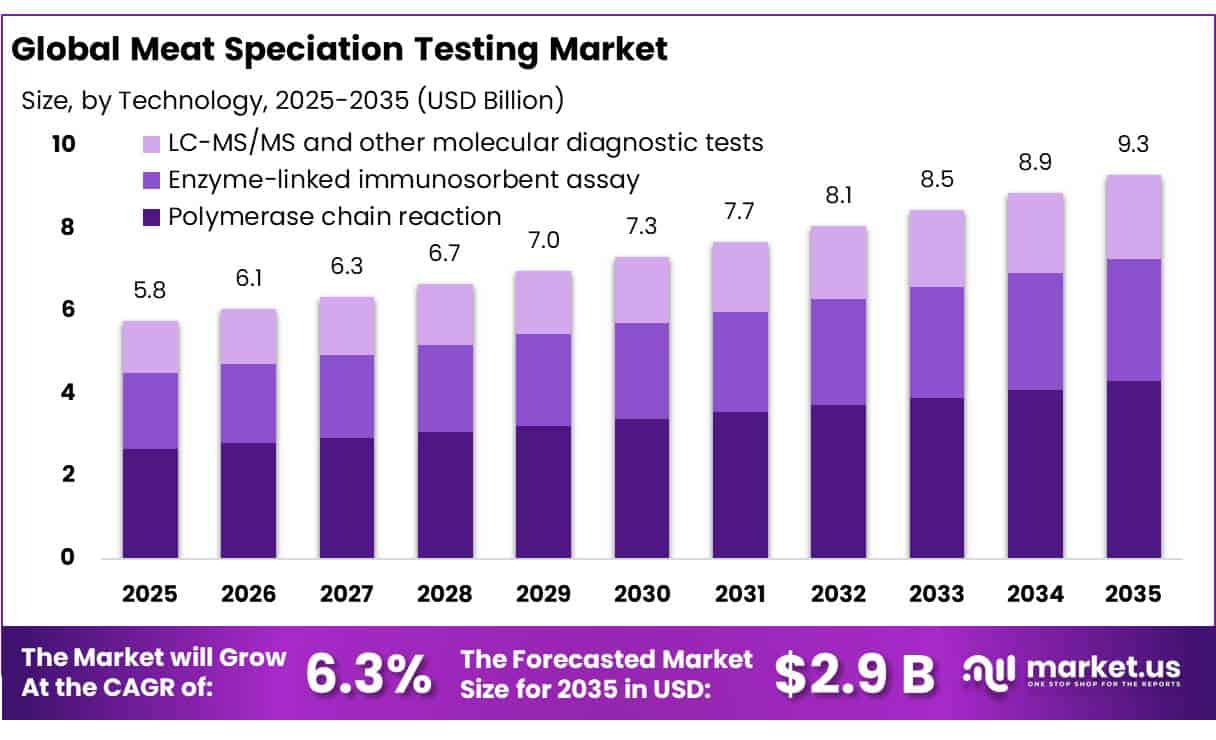
The Global Meat Speciation Testing Market size is expected to be worth around USD 2.9 Billion by 2035, from USD 1.5 Billion in 2025, growing at a CAGR of 6.3% during the forecast period from 2026 to 2035. In 2025, Europe held a dominant market position, capturing more than a 35.80% share, holding USD 0.5 Billion revenue.
Meat speciation testing is an important part of food safety, quality control, and authenticity verification. It identifies the animal species present in meat and meat-based products through methods such as polymerase chain reaction (PCR), real-time PCR, DNA sequencing, and immunological testing. These methods help food manufacturers, processors, retailers, and regulatory authorities detect undeclared animal species, prevent food fraud, and verify product labels.
- The industry is shaped by international meat trade, processed-food production, and stricter expectations for accurate food labelling. The European Commission coordinated DNA testing in 2014, conducting 2,622 tests across the European Union and participating countries to detect horse meat DNA in beef products. 16 samples tested positive, representing 0.61% of the total.
One of the major driving factors is the increasing focus on food authenticity and transparent product labelling. Meat processors, retailers, importers, and food inspection agencies use species identification to verify ingredient declarations and investigate suspected adulteration.
Government initiatives also support demand for reliable analytical procedures. In the United States, the Food Safety and Inspection Service maintains a laboratory guidebook that includes Method 20.02, a real-time polymerase chain reaction method for species identification in meat and poultry products, effective September 30, 2024. The availability of documented testing procedures supports consistent laboratory analysis and strengthens confidence in meat product verification.
Key Takeaways
- Meat Speciation Testing Market size is expected to be worth around USD 2.9 Billion by 2035, from USD 1.5 Billion in 2025, growing at a CAGR of 6.3%,
- Pork/swine held a dominant market position, capturing more than a 40.30% share.
- Polymerase chain reaction held a dominant market position, capturing more than a 46.20% share.
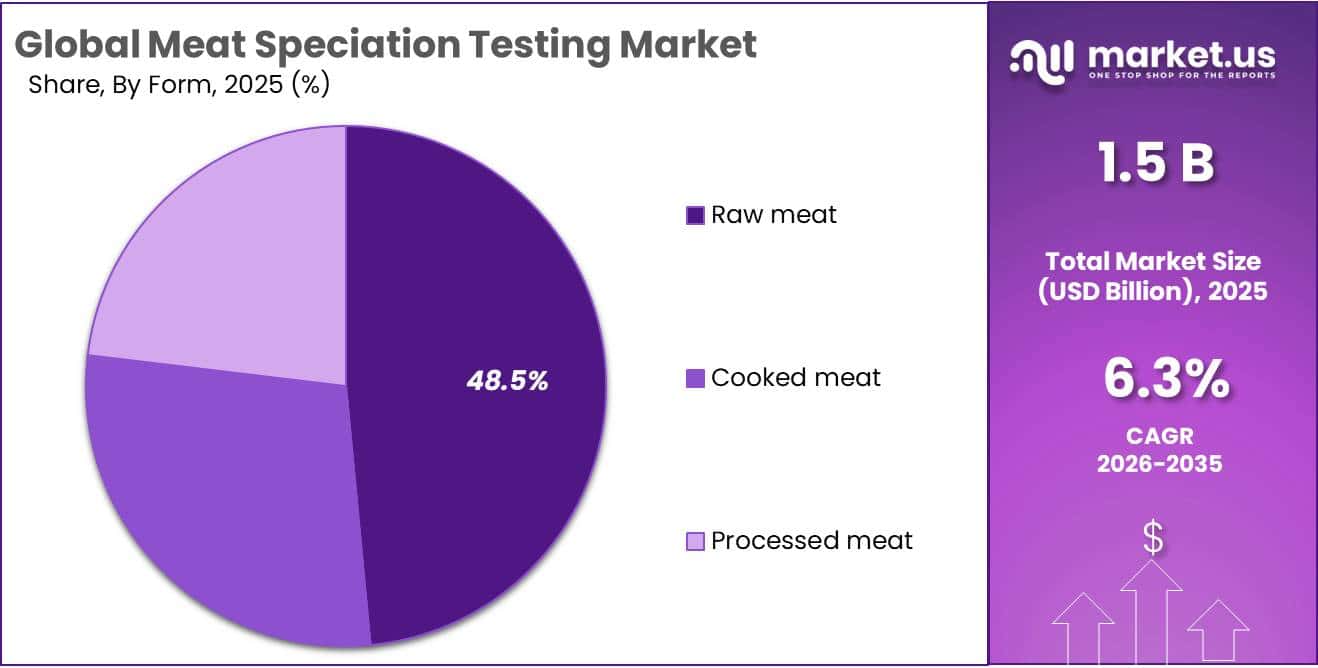
- Raw meat held a dominant market position, capturing more than a 48.50% share.
- Food authenticity and adulteration detection held a dominant market position, capturing more than a 51.20% share.
- Food manufacturers held a dominant market position, capturing more than a 43.60% share.
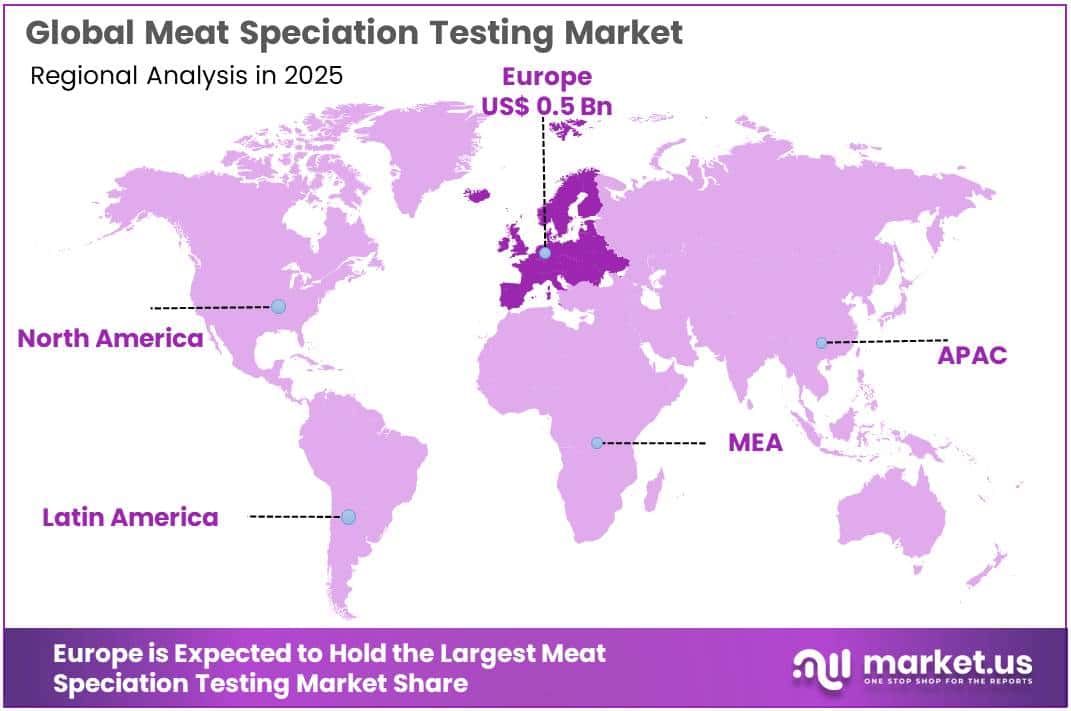
- Europe held a dominant position in the Meat Speciation Testing Market in 2025, accounting for 35.80% of the market, with a reported value of USD 0.5 billion.
By Species Analysis
Pork/swine leads due to the need for accurate species identification and reliable meat labelling.
In 2025, “Pork/swine” held a dominant market position, capturing more than a 40.30% share of the Meat Speciation Testing Market by species. Demand for pork/swine testing is supported by the need to verify product composition, detect undeclared animal ingredients, and maintain accurate labelling across processed meat and mixed-protein products.
Meat processors, food manufacturers, and testing laboratories use DNA-based methods to confirm species identity, particularly when processing makes visual identification difficult. Official food authenticity controls and the need to prevent mislabelled products support the use of these tests. The segment’s reported share is 40.30%; no additional market-share figures are introduced.
Beef/cow testing plays an important role in verifying the identity and composition of fresh beef, minced meat, processed foods, and ready-to-eat products. In 2025, demand for beef speciation testing was supported by the need to prevent food fraud, maintain accurate ingredient declarations, and strengthen consumer confidence.
DNA-based testing helps laboratories identify whether products labelled as beef contain undeclared meat from other animal species. The European Commission reported that 2,622 tests were conducted in 2014 to detect horse DNA in beef products, with 16 positive results and an overall positive rate of 0.61%. This official evidence highlights the importance of species verification in beef supply chains.
By Technology Analysis
Polymerase chain reaction leads through reliable DNA-based identification and effective detection of undeclared animal species.
In 2025, “Polymerase chain reaction” held a dominant market position, capturing more than a 46.20% share of the Meat Speciation Testing Market by technology. Polymerase chain reaction (PCR) is widely used to identify animal species by detecting specific DNA sequences in meat and processed food products. Its ability to detect species-specific genetic material makes it useful for checking product authenticity, verifying ingredient declarations, and identifying possible meat adulteration.
Food testing laboratories and meat processors rely on PCR because it can be applied to different sample types, including products that have undergone processing. Demand is supported by food safety requirements and the need for dependable species identification across meat supply chains.
Enzyme-linked immunosorbent assay (ELISA) is used in food testing to detect specific proteins associated with animal species. In meat speciation testing, it can help identify undeclared animal ingredients in suitable meat and processed food samples. The method is useful for laboratories and food manufacturers seeking practical screening solutions for product authenticity and ingredient verification. However, heat treatment and other processing conditions can affect protein detection, making method selection important.
In 2025, the United States Department of Agriculture’s Food Safety and Inspection Service continued to provide official laboratory procedures covering meat and poultry testing, supporting the wider need for standardized analytical controls.
By Form Analysis
Raw meat leads as direct species verification supports accurate labelling and meat authenticity.
In 2025, “Raw meat” held a dominant market position, capturing more than a 48.50% share of the Meat Speciation Testing Market by form. Raw meat testing is important for confirming animal species before products enter further processing, packaging, and distribution. Meat processors, food inspection laboratories, and suppliers use DNA-based methods to verify species identity and identify possible substitution or undeclared ingredients.
Testing raw samples can also provide a useful starting point for traceability checks because the material has generally undergone less processing than cooked products. The need for accurate product declarations and dependable quality control continues to support this segment.
Cooked meat testing is important for verifying species identity in ready-to-eat meals, canned meat, sausages, and other heat-treated products. Cooking can degrade DNA and alter proteins, so laboratories select suitable analytical methods based on the degree of processing and the sample composition.
Polymerase chain reaction methods can identify species-specific DNA when sufficient target material remains, while protein-based methods may be useful in suitable applications. Food manufacturers and inspection laboratories use these tests to check ingredient declarations, investigate suspected adulteration, and maintain product quality. In 2025, the United States Department of Agriculture’s Food Safety and Inspection Service continued to provide official laboratory guidance for meat and poultry testing, supporting standardized analytical practices.
By Application Analysis
Food authenticity and adulteration detection leads as manufacturers strengthen species verification and product labelling.
In 2025, “Food authenticity and adulteration detection” held a dominant market position, capturing more than a 51.20% share of the Meat Speciation Testing Market by application. This segment is driven by the need to verify that meat products contain the animal species declared on their labels. Food manufacturers, processors, importers, and testing laboratories use DNA-based methods to identify undeclared species and investigate possible substitution in fresh and processed meat.
These checks help protect product quality, support traceability, and maintain consumer confidence. The European Commission conducted 2,622 tests for horse DNA in beef products in 2014, with 16 positive samples, equivalent to 0.61%. These government findings highlight the importance of species verification in food supply chains.
Halal and kosher verification uses meat speciation testing to help confirm whether products contain animal species permitted under the relevant dietary requirements. Food manufacturers, certification bodies, and independent laboratories can use DNA-based methods to identify species in raw meat, processed foods, and products containing mixed ingredients.
Testing is particularly useful when ingredients are difficult to distinguish visually or when products pass through several processing stages. In 2025, the need for accurate ingredient declarations and reliable product verification supported the relevance of species testing in religiously certified food supply chains. The United States Department of Agriculture’s Food Safety and Inspection Service provides official guidance on meat and poultry labelling, including requirements related to product identity and labelling claims.
By End User Analysis
Food manufacturers lead demand as species testing helps protect product authenticity and meet labelling requirements.
In 2025, “Food manufacturers” held a dominant market position, capturing more than a 43.60% share of the Meat Speciation Testing Market by end user. Food manufacturers use meat speciation testing to confirm ingredient composition, identify undeclared animal species, and maintain accurate product labels.
These checks are important for processed meat, ready-to-eat meals, sausages, and other products where the original animal material may be difficult to identify visually. DNA-based testing helps manufacturers investigate suspected adulteration and maintain quality control across production and supply chains.
Government data further illustrates the scale of food inspection. The United States Department of Agriculture’s Food Safety and Inspection Service reported that its personnel carried out 7.7 million food safety and food defense procedures across 7,100 regulated establishments in its 2024 inspection statistics.
Key Market Segments
By Species
- Beef/cow
- Pork/swine
- Chicken
- Horse
- Sheep
- Other species
By Technology
- Polymerase chain reaction
- Enzyme-linked immunosorbent assay
- LC-MS/MS and other molecular diagnostic tests
By Form
- Raw meat
- Cooked meat
- Processed meat
By Application
- Food authenticity and adulteration detection
- Halal and kosher verification
- Allergen and cross-contamination testing
- Regulatory compliance
- Meat-traceability testing
By End User
- Meat processors
- Food manufacturers
- Independent testing laboratories
- Government and regulatory agencies
- Retailers and food-service companies
Driver Analysis
Food-Fraud Enforcement
Regulatory and intelligence-led enforcement against substitution, adulteration, undeclared species, and illegal meat diversion is the strongest immediate demand driver because it converts authenticity testing from an episodic crisis expense into a recurring procurement, import-control, and supplier-audit activity. The UK Food Standards Agency’s National Food Crime Unit made adulteration and substitution of lamb, beef, poultry, and dairy a dedicated 2025/26 control-strategy priority, alongside origin misrepresentation and diversion of animal by-products, while its current strategy extends through March 2027; the agency uses targeted sampling and supply-chain intelligence to identify high-risk products and disrupt suspect flows.
In the EU, the 2013 horse-meat incident triggered more than 7,000 coordinated DNA and phenylbutazone tests in a single February–March control exercise, and the Commission’s 2025 Health and Food Audits programme schedules 259 audits across Member States, third-country exporters, and candidate countries, sustaining a high-compliance operating environment. For processors, retailers, importers, and foodservice groups, routine DNA verification reduces the asymmetric cost of a recall, delisting, civil claim, or lost certification; suppliers are therefore migrating from single-species, incident-led testing to quarterly or lot-based panels covering bovine, porcine, equine, ovine, caprine, poultry, and undeclared species.
This changes laboratory economics from low-frequency sample testing to framework contracts, retained reference-library access, chain-of-custody management, and faster turnaround, with multiplex PCR panels typically generating 2–4 times the revenue per sample of a basic single-target screen. The model attributes +2.0 percentage points of 2026–2031 CAGR contribution to this enforcement-led shift, with strongest near-term impact in the EU, UK, North America, and GCC import markets.
Drivers Impact Analysis
| Driver | (~) % Impact on CAGR | Geographic Relevance | Impact Timeline |
|---|---|---|---|
| Food-fraud enforcement | +2.0 pp | EU, UK, North America, GCC | Short term (≤ 2 years) |
| Cross-border meat trade | +1.5 pp | China, EU, MENA, Asia-Pacific | Medium term (2–4 years) |
| Premium-label verification | +1.4 pp | EU, North America, Japan, Gulf states | Short term (≤ 2 years) |
| Halal and kosher assurance | +1.2 pp | GCC, Southeast Asia, EU, North America | Medium term (2–4 years) |
| Traceability digitization | +1.0 pp | North America, EU, China, Australia | Medium term (2–4 years) |
| Multiplex molecular testing | +0.9 pp | Global laboratory hubs | Long term (≥ 4 years) |
Restraint Analysis
Weak Routine-Testing Mandates
The largest restraint is that, outside high-enforcement import markets and formal retail supply chains, routine animal-species verification is often voluntary, reactive, or limited to crisis investigations rather than built into annual control plans, meaning processors can continue selling product without recurring DNA-screening expenditure. The EU horse-meat event illustrates the difference that mandated surveillance can make: in 2013, authorities conducted 7,259 tests and food businesses conducted a further 7,951 tests for horse DNA, yet the 2014 follow-up involved only 2,622 competent-authority tests after the positive rate fell from 4.66% to 0.61%, showing how testing volumes can fall rapidly when enforcement intensity recedes.
In lower-resource markets, food-control agencies must allocate limited laboratory budgets among microbiological safety, veterinary-drug residues, heavy metals, pesticides, pathogens, and animal disease surveillance, leaving economically motivated species substitution below the sampling threshold unless a fraud incident occurs; a public authority with a food-control budget supporting only 100–500 authenticity samples annually cannot sustain a commercially meaningful regional laboratory ecosystem.
The business result is concentrated demand in premium retail, export processing, and certification programs while domestic wet markets, independent foodservice, and small processors remain largely untested, limiting sample density and forcing laboratories to maintain high per-test prices. Until governments issue risk-based annual sampling quotas, integrate species authentication into import and market-surveillance plans, and impose meaningful recall or penalty risk, the addressable routine-testing market remains restricted; this is modeled as a -1.1-percentage-point CAGR deduction across India, Africa, Latin America, and Southeast Asia through at least 2030.
Restraint Impact Analysis
| Restraint | (~) % Impact on CAGR | Geographic Relevance | Impact Timeline |
|---|---|---|---|
| Weak routine-testing mandates | -1.1 pp | India, Africa, LatAm, Southeast Asia | Long term (≥ 4 years) |
| High accreditation cost | -0.9 pp | Emerging APAC, Africa, LatAm | Medium term (2–4 years) |
| Low-margin processor budgets | -0.8 pp | Global commodity meat markets | Short term (≤ 2 years) |
| Fragmented method standards | -0.7 pp | Global cross-border trade | Medium term (2–4 years) |
| Sample logistics degradation | -0.6 pp | Africa, LatAm, remote APAC, MENA | Short term (≤ 2 years) |
| Traceability-rule deferral | -0.5 pp | North America, export suppliers | Medium term (2–4 years) |
Opportunity Analysis
Retail Fraud-Intelligence Subscriptions
The future white space is to convert species testing from a reactive per-sample laboratory purchase into a retailer-funded fraud-intelligence subscription that combines risk scoring, routine DNA surveillance, supplier benchmarking, data dashboards, alerts, and corrective-action workflow management across private-label meat portfolios. This is not a current driver because most retailers still buy testing episodically after a supplier concern, claim dispute, or regulatory signal, rather than committing to a multi-year data platform that uses product category, origin, price anomaly, supplier history, fraud alerts, seasonality, and prior DNA outcomes to determine the next sample.
The EU Food Fraud Network has connected the Commission with liaison bodies in all Member States, Switzerland, Norway, and Iceland since 2013, while the Commission now publishes monthly cross-border fraud-suspicion reports through the Alert and Cooperation Network; this creates a more usable external-data layer for risk-based retail sampling. An operator serving a retailer with 2,000–5,000 meat SKUs could sell a EUR 50,000–250,000 annual program incorporating 300–1,500 multiplex DNA tests, supplier scorecards, escalation protocols, and API-linked certificates, increasing revenue per customer by an estimated 2–4 times versus ad hoc testing while lowering the retailer’s fraud-investigation cycle from weeks to days.
The opportunity is commercially viable because Operation OPSON XIV conducted 31,165 checks, reported 631 individuals to judicial authorities, and removed almost 11,567 tonnes of food including meat and seafood in 2025, evidencing a persistent fraud environment that supports proactive surveillance rather than event-led testing. If leading laboratories secure managed-testing contracts with the largest retailers and foodservice groups in the EU, UK, North America, and GCC, the model estimates +1.5 percentage points of potential CAGR upside.
Opportunity Impact Analysis
| Opportunity | (~) % Potential CAGR | Geographic Relevance | Execution Window |
|---|---|---|---|
| Retail fraud-intelligence subscriptions | +1.5 pp | EU, UK, North America, GCC | Short term (≤ 2 years) |
| Pet-food and feed expansion | +1.3 pp | North America, EU, China, Japan | Medium term (2–4 years) |
| Halal certification platforms | +1.1 pp | GCC, Indonesia, Malaysia, EU | Short term (≤ 2 years) |
| Portable multiplex testing | +1.0 pp | APAC, LatAm, Africa, MENA | Medium term (2–4 years) |
| Laboratory-network roll-ups | +1.0 pp | EU, North America, India, Brazil | Medium term (2–4 years) |
| Forensic e-commerce surveillance | +1.0 pp | EU, UK, North America, China | Long term (≥ 4 years) |
Challenges Analysis
Processed-Matrix DNA Degradation
Meat-speciation testing becomes technically less reliable as product transformation intensifies because heating, pressure cooking, fermentation, salting, curing, smoking, enzymatic hydrolysis, mechanical separation, lipid content, spices, sauces, and preservatives fragment target DNA and introduce PCR inhibitors, increasing extraction failure, false-negative risk, repeat testing, and confirmatory-sequencing cost.
A raw-muscle sample can yield high-molecular-weight DNA suitable for standard qPCR, whereas canned meat, retorted ready meals, rendered protein meals, gelatin-containing formulations, and heavily spiced sausages can reduce recoverable amplifiable DNA by an analyst-estimated 50–95%, forcing laboratories to use shorter amplicons, inhibitor-removal kits, duplicate extraction, and elevated internal-control thresholds.
The standardization gap is visible in EN 18033:2024, which specifies quantitative real-time PCR for equine DNA relative to mammalian DNA only in raw beef, not in cooked, cured, fermented, rendered, or multi-ingredient matrices. This creates an operational penalty: a routine single extraction and multiplex qPCR workflow may require 2–4 hours and cost USD 20–50 in consumables and labor, while difficult processed samples can require two extraction attempts, dilution series, purification, replicate PCR, and sequencing confirmation, raising direct analytical cost by 40–120% and extending turnaround from 24–48 hours to 3–7 days.
Laboratories must invest continuously in matrix-specific extraction libraries, short-fragment assays, internal amplification controls, automated inhibitor screening, and client sampling protocols, but product innovation ensures the matrix challenge persists. This generates a modeled -0.8-percentage-point CAGR friction drag globally because high-risk processed categories are simultaneously the most commercially valuable and the most technically difficult to test consistently.
Challenges Impact Analysis
| Challenge | (~) % CAGR Friction | Geographic Relevance | Mitigation Horizon |
|---|---|---|---|
| Processed-Matrix DNA Degradation | -0.8 pp | Global processed-meat markets | Long term (≥ 4 years) |
| Quantitation Method Variability | -0.7 pp | EU, UK, North America, APAC | Medium term (2–4 years) |
| Reference-Material Supply Gaps | -0.6 pp | Global laboratory hubs | Medium term (2–4 years) |
| Molecular Skills Shortage | -0.6 pp | Emerging APAC, Africa, LatAm, MENA | Long term (≥ 4 years) |
| Fragmented Sample Traceability | -0.6 pp | Global trade corridors | Medium term (2–4 years) |
| Rapid-Test Validation Burden | -0.5 pp | EU, North America, GCC, APAC | Long term (≥ 4 years) |
Geopolitical Impact Analysis
Geopolitical Impact Analysis: Impact of Ongoing Wars on the Meat Speciation Testing Market
Ongoing conflicts, particularly the Russia–Ukraine war and instability in the Middle East, can affect the Meat Speciation Testing Market through higher transport costs, disrupted trade routes, and uncertainty in food supply chains. When meat and processed food shipments face delays, manufacturers and importers may rely more heavily on authenticity checks to verify product composition and maintain traceability.
The United Nations World Food Programme reported on 8 October 2026 that conflicts affecting the Strait of Hormuz, Red Sea, and Black Sea were disrupting major trade routes for food, fuel, and fertilisers. Longer shipping routes and rising transport costs can place additional pressure on meat supply chains and the cost of laboratory supplies.
These pressures may encourage food manufacturers, importers, and retailers to strengthen species testing to reduce the risk of mislabelling and supply-chain disputes. However, higher operating costs may delay testing investments among smaller businesses. Overall, geopolitical instability is likely to affect the Meat Speciation Testing Market mainly through indirect cost pressures and the growing need for product verification, rather than through a direct increase in testing demand alone.
Regional Insights
Dominating Region: Europe
Europe held a dominant position in the Meat Speciation Testing Market in 2025, accounting for 35.80% of the market, with a reported value of USD 0.5 billion. Regional demand is supported by food authenticity requirements, strict labelling rules, established testing laboratories, and cross-border meat trade. European food businesses use species identification methods to verify meat composition and detect undeclared animal ingredients in fresh and processed products.
The European Commission’s coordinated testing programme detected horse meat DNA in 16 of 2,622 samples tested in 2014, equivalent to 0.61% of samples. This official evidence demonstrates the role of laboratory testing in identifying meat mislabelling and protecting supply-chain integrity.
Beyond Europe, growth opportunities are linked to expanding processed-food production, international meat trade, and stronger food authenticity controls in North America and other developed markets. Food manufacturers and independent laboratories are increasingly reliant on DNA-based testing to verify ingredients, investigate suspected adulteration, and support product traceability.
Real-time polymerase chain reaction offers targeted species detection, while sequencing methods can help investigate complex samples containing multiple animal species. The European Commission’s food fraud monitoring resources also show the continuing importance of identifying authenticity and traceability concerns across food categories.
Key Regions and Countries Insights
- North America
- US
- Canada
- Europe
- Germany
- France
- The UK
- Spain
- Italy
- Rest of Europe
- Asia Pacific
- China
- Japan
- South Korea
- India
- Australia
- Rest of APAC
- Latin America
- Brazil
- Mexico
- Rest of Latin America
- Middle East & Africa
- GCC
- South Africa
- Rest of MEA
Key Players Analysis
Eurofins Scientific SE is a major laboratory testing provider with services covering food safety, food authenticity, and animal species identification. In 2025, the company reported revenue of €7,296 million, compared with €6,951 million in 2024, representing reported growth of 5.0%. Its food and feed testing network supports manufacturers and suppliers with analytical services that help identify food fraud and verify product composition.
SGS SA provides food testing, inspection, and certification services to food manufacturers, processors, and suppliers. Its services include food authenticity, contaminants, microbiology, and composition analysis, which are relevant to meat speciation and adulteration detection. In 2025, SGS reported that its Health & Nutrition division generated CHF 882 million in sales, up from CHF 835 million in 2024, representing growth of 5.6%. The division recorded 7.3% organic growth, supported by strong demand for food-related services. These capabilities position SGS to support customers seeking independent food authenticity verification.
Bureau Veritas SA provides testing, inspection, and certification services, including solutions for food quality, safety, and supply-chain compliance. Its Agri-Food & Commodities business supports companies that require independent checks across agricultural and food supply chains. In 2025, Bureau Veritas recorded total revenue of €6,466.4 million, compared with €6,240.9 million in 2024, an increase of 3.6%. Its Agri-Food & Commodities business generated €1,163.7 million in revenue during 2025.
Top Key Players Outlook
- Eurofins Scientific SE
- SGS SA
- Bureau Veritas SA
- Intertek Group plc
- ALS Limited
- Mérieux NutriSciences
- Neogen Corporation
- LGC Group
- QIAGEN N.V.
- Thermo Fisher Scientific Inc.
- Bio-Rad Laboratories, Inc.
- SCIEX
- Romer Labs
- AsureQuality Limited
- FoodChain ID Group, Inc.
Recent Developments
- In May 2026, ALS reported FY2026 revenue of A$3.32 billion, up 10.7% year over year. These developments reflect its wider investment in laboratory capacity and analytical services.
- In August 2026, Mérieux NutriSciences announced an agreement to acquire Certified Group, which generates approximately US$300 million in revenue through 31 laboratories in North America; the transaction is expected to close by the fourth quarter of 2026, subject to customary conditions.
- In October 2026, Neogen outlined plans to increase research and development investment by approximately 50% in fiscal 2027, targeting investment equal to around 5% of revenue by fiscal 2031.
Report Scope
| Report Features | Description |
|---|---|
| Market Value (2025) | USD 1.5 Bn |
| Forecast Revenue (2035) | USD 2.9 Bn |
| CAGR (2026-2035) | 6.3% |
| Base Year for Estimation | 2025 |
| Historic Period | 2020-2024 |
| Forecast Period | 2026-2035 |
| Report Coverage | Revenue Forecast, Market Dynamics, Competitive Landscape, Recent Developments |
| Segments Covered | By Species (Beef/cow, Pork/swine, Chicken, Horse, Sheep, Other species), By Technology (Polymerase chain reaction, Enzyme-linked immunosorbent assay, LC-MS/MS and other molecular diagnostic tests), By Form (Raw meat, Cooked meat, Processed meat), By Application ( Food authenticity and adulteration detection, Halal and kosher verification, Allergen and cross-contamination testing, Regulatory compliance, Meat-traceability testing), By End User (Meat processors, Food manufacturers, Independent testing laboratories, Government and regulatory agencies, Retailers and food-service companies) |
| Regional Analysis | North America – US, Canada; Europe – Germany, France, The UK, Spain, Italy, Rest of Europe; Asia Pacific – China, Japan, South Korea, India, Australia, Singapore, Rest of APAC; Latin America – Brazil, Mexico, Rest of Latin America; Middle East & Africa – GCC, South Africa, Rest of MEA |
| Competitive Landscape | Eurofins Scientific SE, SGS SA, Bureau Veritas SA, Intertek Group plc, ALS Limited, Mérieux NutriSciences, Neogen Corporation, LGC Group, QIAGEN N.V., Thermo Fisher Scientific Inc., Bio-Rad Laboratories, Inc., SCIEX, Romer Labs, AsureQuality Limited, FoodChain ID Group, Inc. |
| Customization Scope | Customization for segments, region/country-level will be provided. Moreover, additional customization can be done based on the requirements. |
| Purchase Options | We have three licenses to opt for: Single User License, Multi-User License (Up to 5 Users), Corporate Use License (Unlimited User and Printable PDF) |