Report Overview
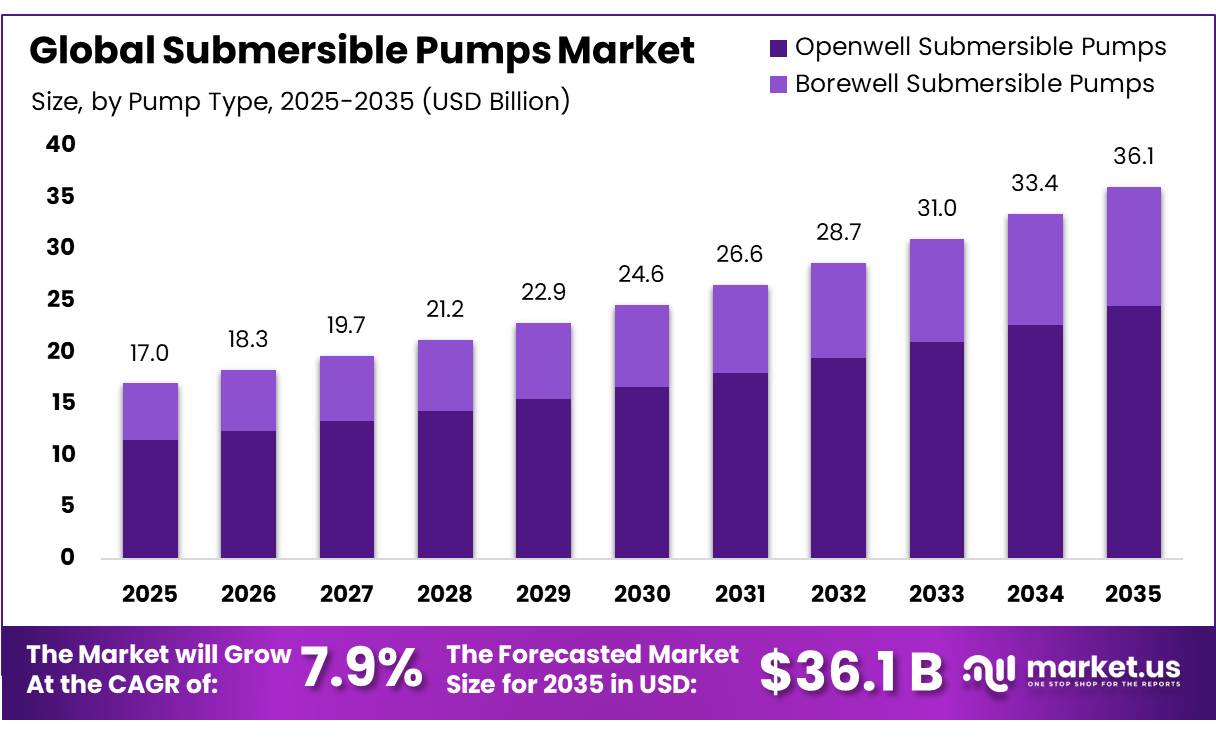
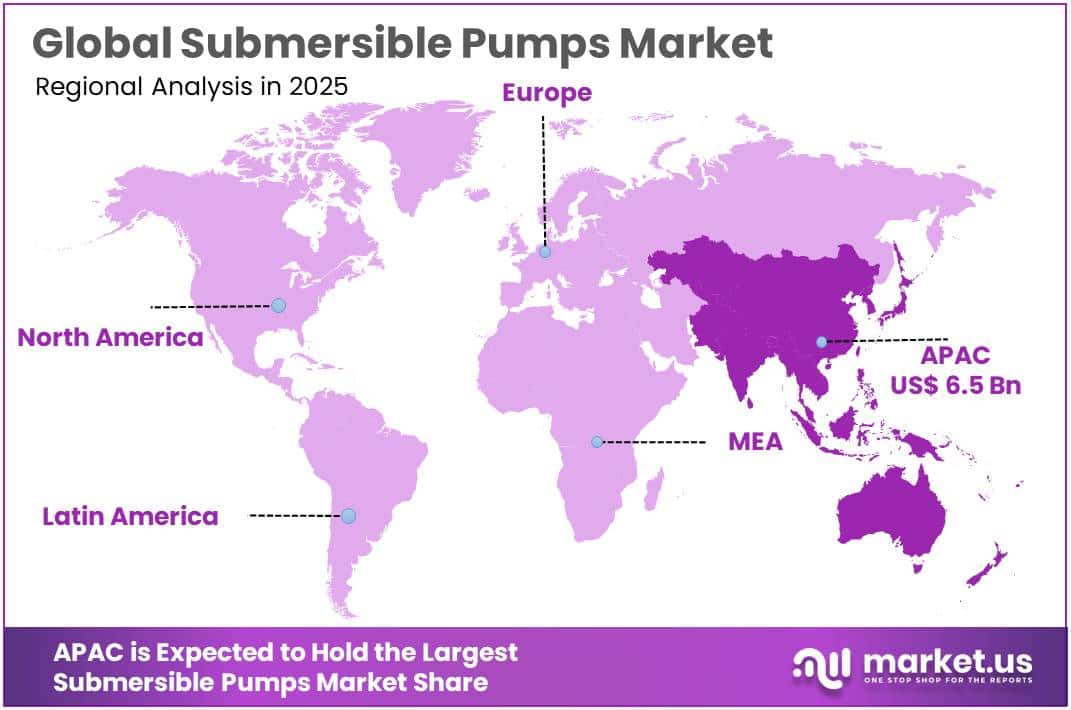
The Global Submersible Pumps Market size is expected to be worth around USD 36.1 Billion by 2035, from USD 17.0 Billion in 2025, growing at a CAGR of 7.9% during the forecast period from 2026 to 2035. In 2025, Asia-Pacific held a dominant market position, capturing more than a 38.45% share, holding USD 6.5 Billion revenue.
Submersible pumps are essential equipment for moving water, wastewater, sewage, and industrial liquids from below the liquid surface to the required discharge point. Their sealed motor and compact design allow them to operate underwater, making them suitable for groundwater extraction, agricultural irrigation, municipal water supply, mining, construction, and industrial processing. Compared with conventional surface pumps, submersible pumps can reduce suction-related operating problems and support efficient liquid transfer in deep wells, drainage pits, and submerged installations.
- According to the United States Environmental Protection Agency (EPA), the 2022 Clean Watersheds Needs Survey identified approximately USD 630.1 billion in clean-water infrastructure requirements over the 20-year period beginning in 2022. The estimate includes wastewater treatment, conveyance systems, stormwater management, and other water-quality projects.
Agriculture remains another important demand driver because submersible pumps provide groundwater for irrigation and support water distribution in locations where surface water is insufficient. The United States Geological Survey reported that crop irrigation accounted for approximately 110,904 million gallons per day of water withdrawals across the contiguous United States in 2020, with groundwater contributing around 63.5% of irrigation withdrawals.
Energy efficiency is becoming a major consideration in pump selection, as electricity consumption affects operating costs throughout the equipment’s service life. The United States Department of Energy highlights opportunities to reduce pumping costs through appropriate equipment sizing, variable-speed control, improved maintenance, and system optimisation. Manufacturers can respond by developing high-efficiency motors, corrosion-resistant materials, variable-frequency drives, and monitoring systems that identify performance problems before equipment failure.
Future growth opportunities are expected to emerge from wastewater treatment upgrades, smart pumping technologies, flood-control projects, and industrial water reuse. The European Union’s revised Urban Wastewater Treatment Directive, which entered into force on 1 January 2025, expands treatment requirements and establishes progressive energy targets for wastewater facilities. For plants treating loads of at least 10,000 population equivalents, renewable energy generation must equal at least 20% of annual energy use by 2030, increasing to 40% by 2035 and 70% by 2040.
Key Takeaways
- Submersible Pumps Market size is expected to be worth around USD 36.1 Billion by 2035, from USD 17.0 Billion in 2025, growing at a CAGR of 7.9%.
- Openwell Submersible Pumps held a dominant market position, capturing more than a 67.89% share.
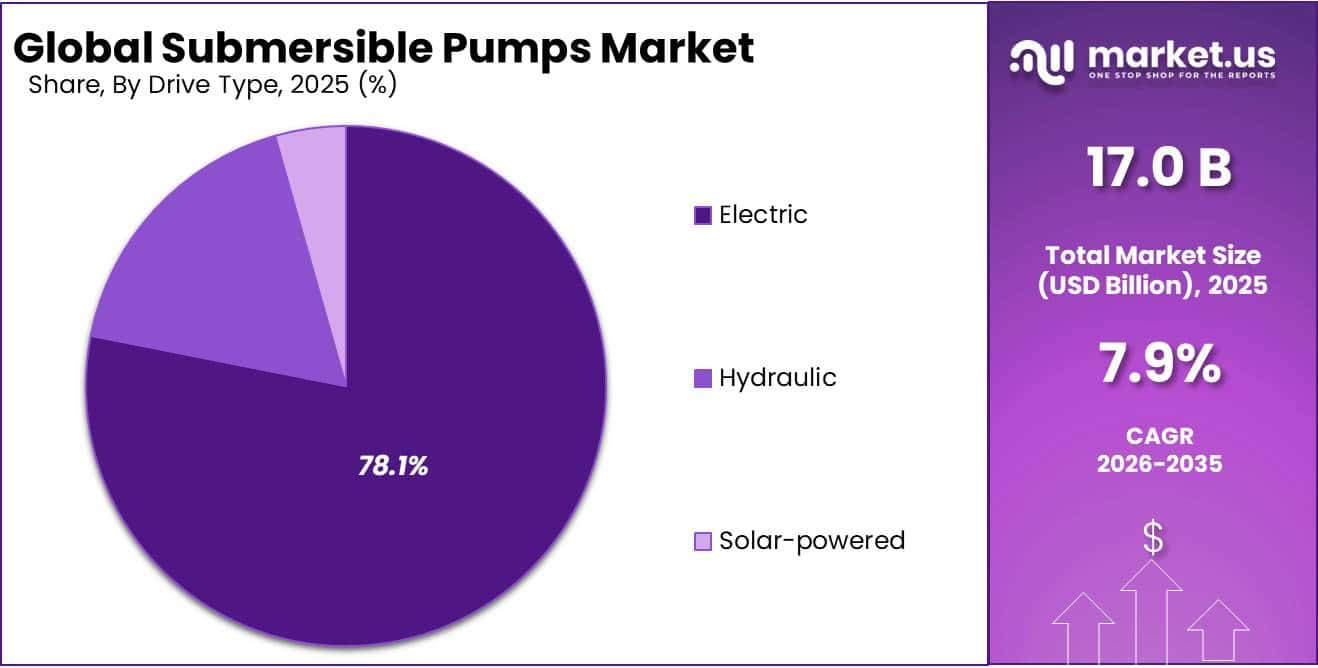
- Electric held a dominant market position, capturing more than a 78.11% share.
- Oil and Gas (Artificial-Lift) held a dominant market position, capturing more than a 68.21% share.
- Asia-Pacific held a dominant position in the Submersible Pumps Market, accounting for 38.45%, with a reported market value of USD 6.5 billion.
By Pump Type Analysis
Openwell Submersible Pumps Dominate Through Versatile Water-Lifting Applications
In 2025, “Openwell Submersible Pumps” held a dominant market position, capturing more than a 67.89% share of the Submersible Pumps Market by pump type. Their demand is supported by their suitability for water transfer from open wells, reservoirs, sumps, and water storage tanks. These pumps are used in agricultural irrigation, residential water supply, and selected commercial and industrial applications.
Their installation flexibility and ability to handle water at relatively shallow depths make them a practical choice for many water-lifting requirements. In 2025, demand for openwell submersible pumps was also supported by the need for dependable water distribution and efficient pumping equipment. The 67.89% share is the supplied market figure; no separate government statistic directly verifying this segment share is available.
Borewell Submersible Pumps are designed to extract groundwater from narrow, deep boreholes and supply it for agricultural irrigation, residential use, and industrial operations. Their long, compact construction allows them to operate in confined wells where conventional surface pumps may not be suitable. Demand is influenced by groundwater access requirements, irrigation needs, and the availability of reliable water supplies in areas with limited surface-water resources.
Government groundwater monitoring and water-resource management programmes provide important context for this segment. The United States Geological Survey reported that groundwater supplied approximately 63.5% of irrigation withdrawals in the contiguous United States in 2020, highlighting the importance of groundwater in agricultural water supply.
By Drive Type Analysis
Electric Drive Type Dominates Through Reliable and Efficient Pump Operation
In 2025, “Electric” held a dominant market position, capturing more than a 78.11% share of the Submersible Pumps Market by drive type. Electric submersible pumps are widely used because they provide consistent pumping performance and can be integrated into residential water systems, agricultural irrigation, municipal water supply, and industrial operations. Their ability to operate automatically with suitable controls also supports convenient water management and reduces the need for continuous manual supervision.
In 2025, demand for electric-driven pumps was supported by the need for dependable water transfer, wastewater handling, and energy-efficient equipment. The 78.11% share represents the supplied market figure. For supporting industry context, the United States Department of Energy provides guidance on pump-system efficiency, motor performance, and system optimisation.
Hydraulic submersible pumps are used in specialised applications where hydraulic power is suitable for the operating environment. They can support drainage, construction, and selected industrial tasks, particularly where equipment must work in challenging conditions or where conventional electric power is less practical. Their selection depends on operating pressure, flow requirements, site conditions, and the availability of a compatible hydraulic power unit.
Hydraulic systems can also be useful in portable pumping applications where flexibility and equipment mobility are important. However, the segment’s adoption depends on application-specific operating costs, maintenance requirements, and system complexity. No verified government statistic directly quantifying the hydraulic submersible pump segment’s market share was identified, so no unsupported numerical value has been assigned to it.
By End User Analysis
Oil and Gas (Artificial-Lift) Leads Demand Through Reliable Well Production
In 2025, “Oil and Gas (Artificial-Lift)” held a dominant market position, capturing more than a 68.21% share of the Submersible Pumps Market by end user. Submersible pumps play an important role in artificial-lift operations by helping bring oil and associated fluids from underground reservoirs to the surface when natural reservoir pressure is insufficient.
Electric submersible pump systems are used in suitable oil wells to support continuous production and handle changing well conditions. Demand is influenced by mature oilfield operations, production optimisation, and the need to recover more fluids from existing wells. The 68.21% share is the supplied market figure and is not independently verified by a government source.
Water and Wastewater Utilities play an important role in the Submersible Pumps Market because these systems are used to move water, transfer sewage, manage drainage, and support wastewater treatment operations. Municipal utilities depend on reliable pumping equipment to maintain water distribution and handle wastewater flows across treatment plants and collection networks. In 2025, demand from this segment was supported by the need to upgrade ageing infrastructure, improve water management, and strengthen wastewater treatment capacity.
According to the United States Environmental Protection Agency, the 2022 Clean Watersheds Needs Survey identified USD 630.1 billion in clean-water infrastructure requirements over the 20-year period from 2022 to 2041. These requirements include wastewater infrastructure, stormwater management, and related improvements, supporting the need for dependable pumping equipment. The figure represents infrastructure investment needs, not submersible pump spending.
Key Market Segments
By Pump Type
- Borewell Submersible Pumps
- Openwell Submersible Pumps
By Drive Type
- Electric
- Hydraulic
- Solar-powered
By End User
- Water and Wastewater Utilities
- Oil and Gas (Artificial-Lift)
- Mining and Construction Dewatering
- Agriculture and Irrigation
- Municipal Flood Control
Driver Analysis
Rural Water-Supply Expansion
Rural drinking-water infrastructure is a high-volume driver because every new or rehabilitated borewell, sump, intake point, treatment reservoir, elevated tank, and distribution zone requires reliable water lifting, dewatering, and wastewater handling; in India, Jal Jeevan Mission had reached 15.82 crore rural households with tap-water supply by March 2026, while the 2026-27 Union Budget proposed INR 67,670 crore and the program was extended through 2028.
JJM 2.0 further raised the overall outlay to INR 8.69 lakh crore, with central support increased to INR 3.59 lakh crore, and targets universal Functional Household Tap Connections for 19.36 crore rural households by December 2028; this changes pump demand from a construction-only cycle into an operations-and-maintenance market centered on continuous service, water-quality compliance, remote monitoring, and replacement availability.
An original system-level estimate of one 3-7.5 kW submersible pump per 250-600 rural household connections implies that the remaining uncovered Indian household base alone can require tens of thousands of primary, standby, and replacement units, excluding motors used for raw-water abstraction, sewage lift stations, and localized source augmentation.
Suppliers able to bundle high-efficiency motors, dry-run protection, soft starters, level controls, remote telemetry, corrosion-resistant wetted parts, and five-year service contracts will capture more value than commodity-pump sellers, making rural water-supply rollout an estimated +2.2 percentage-point medium-term contribution across India, South Asia, Africa, and ASEAN.
Drivers Impact Analysis
| Driver | (~) % Impact on CAGR Forecast | Geographic Relevance | Impact Timeline |
|---|---|---|---|
| Rural water-supply expansion | +2.2% | India, South Asia, Africa, ASEAN | Medium term (2-4 years) |
| Wastewater upgrade mandates | +1.8% | EU, North America, China, Japan | Long term (≥ 4 years) |
| Irrigation groundwater demand | +1.5% | India, MENA, Africa, Latin America | Medium term (2-4 years) |
| Flood-resilience pumping | +1.3% | Coastal Asia, EU, North America | Medium term (2-4 years) |
| Energy-efficient pump retrofits | +1.1% | EU, North America, India, China | Short term (≤ 2 years) |
| Digital monitoring adoption | +0.9% | North America, EU, GCC, advanced APAC | Medium term (2-4 years) |
Restraint Analysis
Groundwater Depletion Limits
Groundwater depletion is the strongest long-term restraint because it directly reduces the viable operating window for borewell submersible pumps: FAO reports that domestic, industrial, and agricultural pumping is exhausting recoverable groundwater storage in many regions, while water scarcity increasingly threatens food systems and increases competition between household, farm, industry, and ecosystem uses.
As water tables fall, farms and utilities must deepen wells, increase lift height, replace lower-head units with higher-head models, use longer cables and riser pipes, and consume more electricity per cubic meter; an illustrative well declining from a 50-meter to an 80-meter dynamic water level adds 30 meters of head, increasing theoretical hydraulic energy requirement by 60% before friction losses and motor inefficiency.
A 5 kW pump operating 1,000 hours annually may become unable to maintain required discharge at the new duty point, forcing an upgrade to a 7.5 kW or 10 kW unit, while groundwater permits, seasonal pumping restrictions, metering, and abstraction caps can prevent replacement demand from translating into additional units.
Suppliers can redirect portfolios toward high-efficiency deep-well systems, variable-frequency drives, water-level protection, recharge projects, and surface-water alternatives, but declining aquifers progressively erode the addressable market for new agricultural borewell installations; this produces an estimated -2.0 percentage-point long-term CAGR drag across India, MENA, China, and the US West.
Restraint Impact Analysis
| Restraint | (~) % Impact on CAGR Forecast | Geographic Relevance | Impact Timeline |
|---|---|---|---|
| Groundwater Depletion Limits | -2.0% | India, MENA, China, US West | Long term (≥ 4 years) |
| High Borewell Installation Cost | -1.6% | India, Africa, MENA, Latin America | Short term (≤ 2 years) |
| Metals And Electronics Inflation | -1.3% | North America, EU, import markets | Medium term (2-4 years) |
| Energy-Efficiency Compliance Cost | -1.0% | EU, UK, Japan, export APAC | Medium term (2-4 years) |
| Unreliable Rural Grid Supply | -0.9% | Africa, India, MENA, ASEAN | Long term (≥ 4 years) |
| Fragmented Service Coverage | -0.7% | Africa, ASEAN, Latin America | Long term (≥ 4 years) |
Opportunity Analysis
Pump-as-a-Service Contracts
Pump-as-a-Service is an untapped monetization model rather than a present market driver because submersible pumps are still predominantly sold as one-time hardware despite customers valuing uninterrupted flow, energy efficiency, and predictable maintenance more than ownership of the motor-hydraulic assembly. A provider can bundle the pump, variable-frequency drive, sensors, retrieval labor, spares, remote condition monitoring, and uptime guarantees into a 5- to 10-year contract; the US Department of Energy notes that energy-savings performance contracts are commonly structured so financing is repaid from verified energy savings, usually over 5-10 years and up to 20 years for larger projects.
An original operating case for a wastewater station with three 15 kW pumps running 5,000 hours annually consumes 225,000 kWh; a 12% energy reduction from duty-point optimization, VFD control, and preventive maintenance saves 27,000 kWh each year, creating an investable cash-flow stream before avoided seal, blockage, and emergency-callout costs.
At a blended subscription of USD 4,000-8,000 per pump per year, a supplier managing 2,000 installed units creates USD 8-16 million in recurring revenue, while remote triage can reduce field-service dispatches by 15-30% and expand gross-margin visibility. This is not baseline demand because it requires balance-sheet capacity, performance measurement, utility procurement acceptance, insurance, and service density; successfully implemented, it could add +2.1 percentage points to market CAGR in Europe, North America, India, and the GCC.
Opportunity Impact Analysis
| Opportunity | (~) % Potential CAGR Upside | Geographic Relevance | Execution Window |
|---|---|---|---|
| Pump-as-a-Service Contracts | +2.1% | EU, North America, India, GCC | Short term (≤ 2 years) |
| Solar Borewell Packages | +1.8% | India, Africa, MENA, Latin America | Medium term (2-4 years) |
| Wastewater Retrofit Platforms | +1.6% | EU, North America, China, Japan | Medium term (2-4 years) |
| Connected Asset Fleets | +1.4% | India, EU, North America, APAC | Short term (≤ 2 years) |
| Decentralized Sanitation Systems | +1.2% | Africa, ASEAN, South Asia, Latin America | Long term (≥ 4 years) |
| Service-Dealer Roll-Ups | +1.0% | India, ASEAN, Africa, Latin America | Medium term (2-4 years) |
Challenges Analysis
Deep-Well Duty Escalation
Deep-well duty escalation is a persistent engineering challenge rather than an immediate demand restraint because falling dynamic water levels do not eliminate pump sales but continuously shift operating points beyond the original design envelope, increasing head, cable length, motor load, thermal stress, sand ingress exposure, and retrieval cost; FAO confirms that pumping for domestic, industrial, and agricultural uses is depleting recoverable groundwater storage in numerous regions.
A borewell whose dynamic level moves from 60 meters to 100 meters adds 40 meters of static lift, increasing theoretical hydraulic energy per delivered cubic meter by roughly 67% before pipe friction and motor losses; a 5.5 kW pump selected for 35 cubic meters per hour at 70 meters may deliver only 20-25 cubic meters per hour at 110 meters, causing longer runtime, higher kWh per cubic meter, and accelerated winding temperature rise.
Every additional 30-50 meters can also add USD 150-500 in cable, riser pipe, clamps, and installation labor, while abrasive solids at greater depth raise impeller, diffuser, and seal wear. Suppliers must establish dynamic water-level sensing, sand-resistant hydraulics, high-head modular stages, VFD control, retrieval tooling, and design rules that account for projected drawdown instead of static borewell depth; however, hydrogeological uncertainty and weak monitoring infrastructure leave an estimated -1.4 percentage-point long-term friction drag in India, MENA, China, and the US West.
Challenges Impact Analysis
| Challenge | (~) % CAGR Friction Drag | Geographic Relevance | Mitigation Horizon |
|---|---|---|---|
| Deep-Well Duty Escalation | -1.4% | India, MENA, China, US West | Long term (≥ 4 years) |
| Wastewater Ragging Complexity | -1.2% | EU, North America, APAC cities | Medium term (2-4 years) |
| Field-Service Skills Gap | -1.1% | Africa, India, ASEAN, Latin America | Long term (≥ 4 years) |
| Connected-Pump Interoperability | -1.0% | EU, North America, GCC, APAC | Medium term (2-4 years) |
| Flood-Resilience Retrofit Burden | -0.9% | Coastal US, EU, Asia-Pacific | Long term (≥ 4 years) |
| Energy-Duty Point Drift | -0.8% | EU, India, China, global utilities | Medium term (2-4 years) |
Geopolitical Impact Analysis
Geopolitical Impact of the Iran War and Russia–Ukraine Conflict on the Submersible Pumps Market
The ongoing Iran war and Russia–Ukraine conflict are creating uncertainty for the Submersible Pumps Market, particularly in oil and gas production, industrial operations, and international supply chains. Disruptions to shipping routes and energy supplies can increase transportation costs, metal prices, and manufacturing expenses for pump producers. The International Energy Agency reported in September 2026 that global oil supply was projected to decline by 5.7 million barrels per day in 2026, reflecting the impact of Middle East disruptions.
These pressures may raise procurement and operating costs for oilfield pumping systems and delay some industrial projects. At the same time, the need to maintain production from existing oil wells can support demand for artificial-lift equipment, including electric submersible pumps. Water utilities and wastewater operators may also face higher equipment and energy costs, potentially delaying infrastructure upgrades.
However, investments in water security, drainage, and wastewater treatment may provide some stability to demand. Overall, the conflict creates both risks and opportunities, with market performance depending on energy prices, shipping conditions, component availability, and the pace of infrastructure spending.
Regional Insights
In 2025, Asia-Pacific held a dominant position in the Submersible Pumps Market, accounting for 38.45%, with a reported market value of USD 6.5 billion. Regional demand is supported by expanding urban water infrastructure, agricultural irrigation, industrial development, mining activities, and wastewater treatment requirements.
Growing cities require reliable water distribution and sewage management systems, while industrial facilities depend on submersible pumps for drainage and liquid transfer. Government investment in water infrastructure and flood management also supports demand across the region. These applications create opportunities for manufacturers offering durable, energy-efficient pumps with lower maintenance requirements. The regional share and value represent the supplied market figures and are not independently verified by government statistics.
Asia-Pacific is also positioned for further growth as water utilities and industrial operators modernise pumping infrastructure and improve water-use efficiency. Agricultural irrigation remains an important application, while wastewater treatment upgrades create opportunities for sewage and drainage pumps. As an indication of the wider importance of irrigation, the United States Geological Survey reported that approximately 110,904 million gallons per day of water was withdrawn for crop irrigation across the contiguous United States in 2020, including 70,434 million gallons per day from groundwater. These figures are not Asia-Pacific statistics, but they demonstrate the scale of pumping requirements associated with irrigation.
Key Regions and Countries Insights
- North America
- US
- Canada
- Europe
- Germany
- France
- The UK
- Spain
- Italy
- Rest of Europe
- Asia Pacific
- China
- Japan
- South Korea
- India
- Australia
- Rest of APAC
- Latin America
- Brazil
- Mexico
- Rest of Latin America
- Middle East & Africa
- GCC
- South Africa
- Rest of MEA
Key Players Analysis
Baker Hughes is a key participant in the submersible pumps market, supplying oilfield technologies and artificial-lift solutions for hydrocarbon production. Its portfolio includes electric submersible pump systems used to improve well production and support demanding operating conditions. In 2025, Baker Hughes reported total revenue of USD 27.733 billion, compared with USD 27.829 billion in 2024. Its Oilfield Services and Equipment segment generated USD 14.324 billion in 2025. These figures reflect broader company and segment operations, rather than submersible pump sales alone.
SLB is an important competitor in the submersible pumps market through its artificial-lift technologies, including electric submersible pumps designed for conventional, offshore, and mature oil wells. Its solutions help operators improve production performance and monitor pump operations under changing well conditions. In 2025, SLB reported fourth-quarter Production Systems revenue of USD 4.1 billion, supported partly by the integration of its acquired artificial-lift business. This segment figure reflects broader production equipment and services, not electric submersible pump revenue alone.
Halliburton participates in the submersible pumps market through artificial-lift technologies and production-related services that support oil and gas well performance. Its offerings include electric submersible pumps and related equipment designed to help operators maintain production from wells with declining natural pressure. The company’s 2025 Form 10-K, filed in February 2026, identifies artificial lift as part of its production-focused service portfolio. Halliburton’s strategy also emphasises international artificial-lift growth and digital technologies. Its reported company-wide financial results cover multiple oilfield services and should not be interpreted as submersible pump sales.
Top Key Players Outlook
- Baker Hughes Co.
- Schlumberger Ltd.
- Halliburton Co.
- Weir Group PLC
- Sulzer AG
- Grundfos Holding A/S
- Flowserve Corporation
- Xylem Inc.
- Atlas Copco AB
- Ebara Corporation
- Franklin Electric Co. Inc.
- KSB SE & Co. KGaA
- Other Key Players
Recent Developments
- In June 2026, Weir Group Plc secured a multimillion-dollar contract to supply 2 WARMAN MCR 450 cyclone feed pumps and 9 WARMAN AHPP 20/18 tailings transfer pumps for a copper mine expansion in Xizang, China.
- In January 2026, Sulzer launched a global Water Treatment Center of Excellence to bring its water-treatment expertise and brands together, supporting integrated solutions for water and wastewater customers. The company reported CHF 3.555 billion in sales for 2025, up 5.6% organically, and operated 160 production and service locations worldwide.
- In August 2026, Grundfos reported first-half revenue of DKK 17.9 billion, growth of 7.7%, and announced a DKK 400 million investment to expand high-efficiency motor production capacity by 50% at its facilities in Mexico and Hungary.
Report Scope
| Report Features | Description |
|---|---|
| Market Value (2025) | USD 17.0 Bn |
| Forecast Revenue (2035) | USD 36.1 Bn |
| CAGR (2026-2035) | 7.9% |
| Base Year for Estimation | 2025 |
| Historic Period | 2020-2024 |
| Forecast Period | 2026-2035 |
| Report Coverage | Revenue Forecast, Market Dynamics, Competitive Landscape, Recent Developments |
| Segments Covered | By Pump Type (Borewell Submersible Pumps, Openwell Submersible Pumps), By Drive Type (Electric, Hydraulic, Solar-powered), By End User (Water and Wastewater Utilities, Oil and Gas (Artificial-Lift), Mining and Construction Dewatering, Agriculture and Irrigation, Municipal Flood Control) |
| Regional Analysis | North America – US, Canada; Europe – Germany, France, The UK, Spain, Italy, Rest of Europe; Asia Pacific – China, Japan, South Korea, India, Australia, Singapore, Rest of APAC; Latin America – Brazil, Mexico, Rest of Latin America; Middle East & Africa – GCC, South Africa, Rest of MEA |
| Competitive Landscape | Baker Hughes Co., Schlumberger Ltd., Halliburton Co., Weir Group PLC, Sulzer AG, Grundfos Holding A/S, Flowserve Corporation, Xylem Inc., Atlas Copco AB, Ebara Corporation, Franklin Electric Co. Inc., KSB SE & Co. KGaA, Other Key Players |
| Customization Scope | Customization for segments, region/country-level will be provided. Moreover, additional customization can be done based on the requirements. |
| Purchase Options | We have three licenses to opt for: Single User License, Multi-User License (Up to 5 Users), Corporate Use License (Unlimited User and Printable PDF) |