


Report Overview
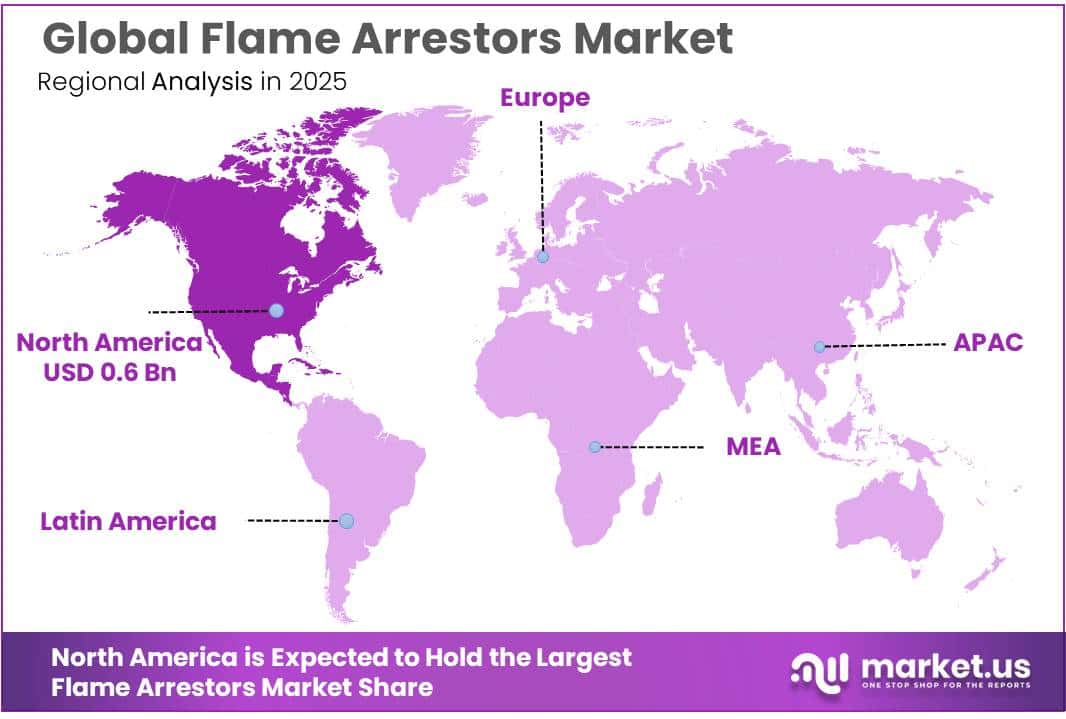
The Global Flame Arrestors Market size is expected to be worth around USD 2.9 Billion by 2035, from USD 1.8 Billion in 2025, growing at a CAGR of 4.6% during the forecast period from 2026 to 2035. In 2025, North America held a dominant market position, capturing more than a 34.21% share, holding USD 0.6 Billion revenue.
Flame arrestors are passive safety devices designed to stop the propagation of flames through pipelines, vents, storage tanks, process equipment, and gas-handling systems while allowing normal vapor or gas flow. They are widely used across oil and gas, petrochemicals, chemicals, pharmaceuticals, terminals, tank farms, and other industries where flammable gases or vapors can form. The industrial importance of flame arrestors is closely linked to the handling of hazardous liquids.
- In the U.S., OSHA defines flammable liquids as those with a flash point at or below 93°C (199.4°F) and classifies them into four categories based on flash point and boiling point. OSHA also requires approved flame arresters or suitable venting arrangements for certain storage tanks containing Category 2 and Category 3 flammable liquids.
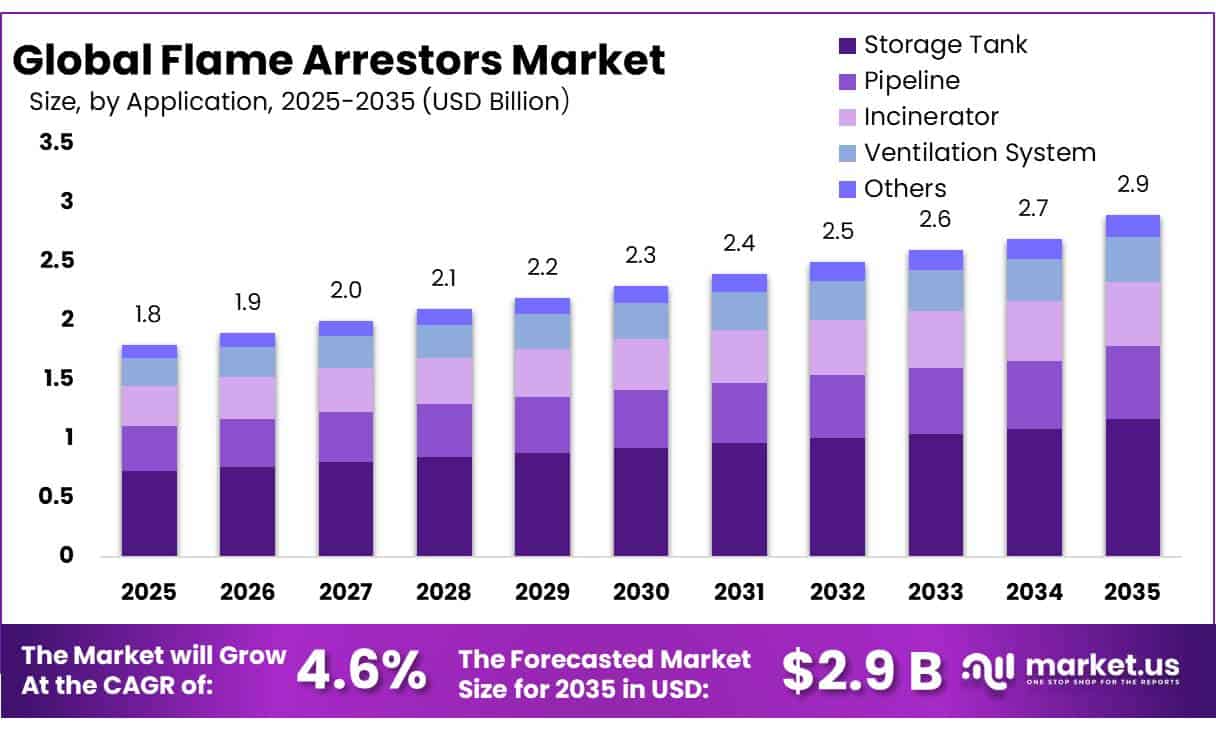
The industrial scenario remains strongly connected with petroleum refining, chemical processing, bulk storage, and transportation infrastructure. OSHA’s process safety management regulation covers processes involving 10,000 pounds (4,535.9 kg) or more of Category 1 flammable gas or certain flammable liquids, highlighting the scale at which fire and explosion prevention becomes a major industrial requirement.
In Europe, the ATEX framework covers equipment and protective systems intended for potentially explosive atmospheres, including applications in petrochemical plants and offshore oil and gas facilities. The framework specifically recognizes protective systems designed to halt or limit explosions, supporting the continued requirement for engineered flame-control technologies.
Industry standards also continue to support safer tank and process design. The American Petroleum Institute lists API Standard 2000, 8th Edition, for venting atmospheric and low-pressure storage tanks, with the latest edition dated August 13, 2026, while API also maintains standards covering tank facilities and pressure-relief systems.
The chemical and petrochemical industries provide an important long-term application base. Cefic reports that the European chemical sector generated €635 billion in turnover and employed 1.2 million people, with around 31,000 companies operating across the region. Petrochemicals and specialty chemicals together account for more than half of EU27 chemical sales, creating a broad installed base of processes where flammable materials require engineered protection.
- Globally, the IEA reported that oil demand increased by 0.65 million barrels per day in 2025, while petrochemical feedstocks remained an important source of future demand growth. Its 2025 outlook projected 860,000 barrels per day of additional oil demand in 2026, with petrochemical feedstocks expected to account for more than 60% of growth.
Demand is also likely to move toward higher-performance arrestors capable of handling different gases, pressures, temperatures, and flow conditions while reducing pressure drop and maintenance requirements. Increasing digital monitoring and condition-based maintenance can further improve inspection and operational reliability. With more than 12,000 major-hazard establishments reported across the EU and EEA in the European Commission’s eSPIRS system, the installed industrial base requiring effective hazardous-material safety management remains substantial.
Key Takeaways
- Flame Arrestors Market size is expected to be worth around USD 2.9 Billion by 2035, from USD 1.8 Billion in 2025, growing at a CAGR of 4.6%.
- Inline Arrestor held a dominant market position, capturing more than a 63.00% share.
- Storage Tank held a dominant market position, capturing more than a 40.21% share.
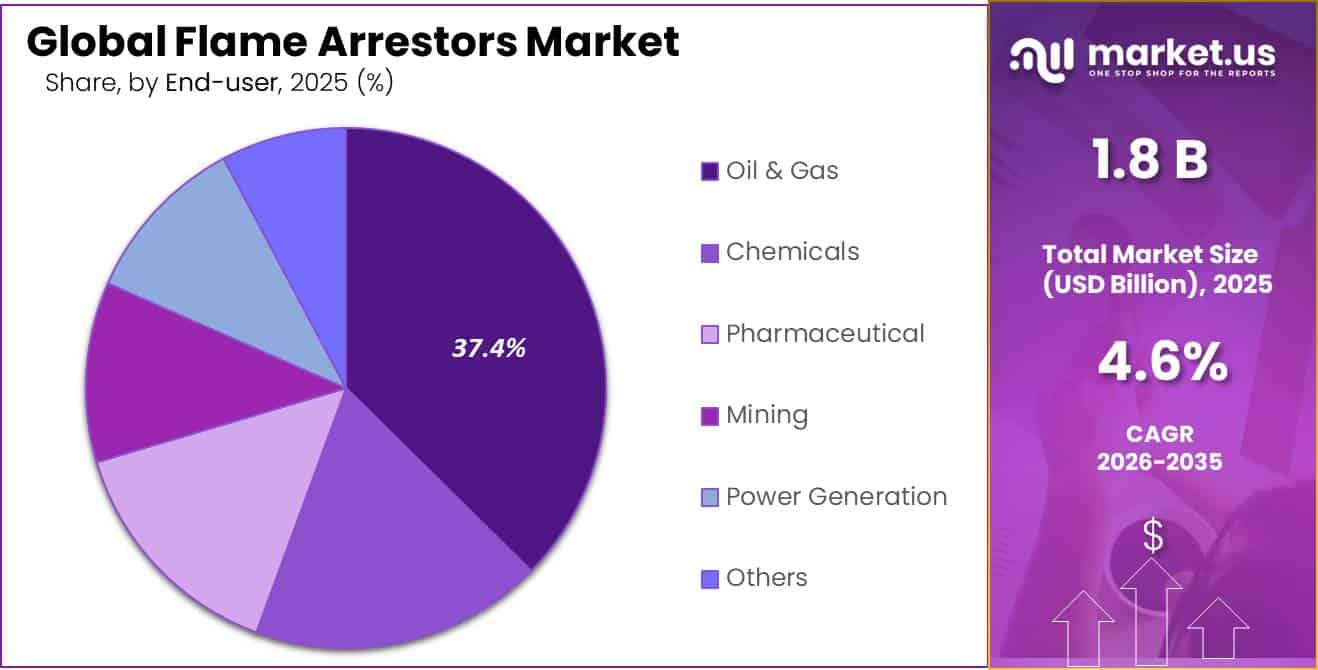
- Oil & Gas held a dominant market position, capturing more than a 37.45% share.
- North America held a dominant position in the flame arrestors market in 2025, accounting for 34.21% and approximately USD 0.6 billion.
By Type Analysis
Inline Arrestor leads the market with a 63.00% share in 2025
In 2025, Inline Arrestor held a dominant market position, capturing more than a 63.00% share. Inline arrestors are widely used within pipelines and process lines because they provide flame protection while allowing continuous movement of gases and vapors. Their importance is particularly high in chemical processing, petroleum handling, gas systems, and other operations involving flammable materials. In 2025, the segment continued to benefit from industrial safety requirements that emphasize protection against flame transmission through connected process equipment.
U.S. OSHA regulations specify that tanks and pressure vessels containing Category 2 flammable liquids and certain Category 3 flammable liquids can use approved flame arresters as part of their venting protection. OSHA also specifies that vent pipes should be at least 1¼ inch in nominal inside diameter, providing a clear engineering reference for venting systems connected to flame-protection equipment.
End-of-line Arrestor is an important flame-arrestor type used at the termination of vent and exhaust systems, particularly where storage tanks and process vessels release flammable vapors into the atmosphere. In 2025, this segment remained relevant because industrial facilities continued to require protection at vent outlets where an external ignition source could potentially transmit a flame into the connected tank or vessel.
U.S. OSHA specifically states that for certain flammable-liquid tanks, an approved flame arrester can be installed in the vent line at the outlet or within an approved distance from the outlet. The regulation also requires relevant vent outlets to be positioned at least 12 feet above adjacent ground level in specified applications, supporting the importance of engineered end-of-line vent protection.
By Application Analysis
Storage Tank dominates flame arrestor applications with a 40.21% share
In 2025, “Storage Tank” held a dominant market position, capturing more than a 40.21% share. Storage tanks represent a major application area for flame arrestors because they store flammable liquids that can generate combustible vapors during filling, emptying, and temperature changes. In 2025, the segment continued to benefit from safety requirements for tank venting and vapor control.
The U.S. Occupational Safety and Health Administration (OSHA) states that atmospheric storage tanks must be adequately vented to prevent excessive pressure or vacuum, while tanks storing Category 2 flammable liquids and certain Category 3 flammable liquids can use approved flame arresters as part of their venting protection.
Pipeline applications remain an important area for flame arrestors because pipelines can provide a direct pathway for flame propagation between connected equipment. In 2025, pipeline-based protection remained relevant in facilities transporting flammable gases and vapors between storage, processing, and transfer systems.
Flame arrestors are installed to interrupt flame travel while maintaining the required flow through the pipeline. OSHA’s flammable-liquid requirements also provide specific engineering provisions for tank vent piping, including a minimum 1¼-inch nominal inside diameter for vent pipes and requirements for approved flame arresters in certain vent-line configurations.
By End User Analysis
Oil & Gas leads flame arrestor demand with a 37.45% share
In 2025, “Oil & Gas” held a dominant market position, capturing more than a 37.45% share. The oil and gas industry remains a major end user of flame arrestors because crude oil, natural gas, and hydrocarbon vapors can create fire and explosion risks across production, processing, storage, and transportation operations. In 2025, U.S. crude oil production reached a record 13.6 million barrels per day, while dry natural gas production reached about 39 trillion cubic feet, showing the large operating base of hydrocarbon facilities requiring process-safety equipment. U.S. Energy Information Administration
OSHA requirements further support the need for flame-protection equipment, stating that certain tanks containing Category 2 flammable liquids and Category 3 flammable liquids with a flash point below 37.8°C must use appropriate venting devices or approved flame arresters. OSHA
Chemicals remain an important end-user segment for flame arrestors because chemical plants routinely handle flammable liquids, gases, solvents, and vapors during processing, storage, mixing, and transfer. In 2025, chemical facilities continued to require engineered protection where flammable vapor-air mixtures could develop. OSHA identifies industrial operations such as mixing, drying, evaporating, filtering, and distillation as activities involving flammable liquids and requires appropriate fire and explosion controls.
Key Market Segments
By Type
- Inline Arrestor
- End-of-line Arrestor
By Application
- Storage Tank
- Pipeline
- Incinerator
- Ventilation System
- Others
By End User
- Oil & Gas
- Chemicals
- Pharmaceutical
- Mining
- Power Generation
- Others
Driver Analysis
LNG Capacity Build-Out
LNG capacity build-out is the largest direct demand driver because every liquefaction train, LNG storage tank, boil-off-gas header, loading arm, marine transfer line, vapor-recovery system, and terminal vent network requires certified end-of-line or in-line flame-arresting protection wherever a flammable methane-air mixture can propagate toward a vessel, tank, process unit, or discharge source. The IEA expects about 345 bcm per year of LNG export capacity from projects already under construction at the beginning of 2025 to come onstream during 2025–2030, with annual additions rising from roughly 35 bcm in 2025 to about 95 bcm in 2028, creating an unusually concentrated procurement window for cryogenic, corrosion-resistant, and high-flow safety equipment.
An analyst engineering model assumes a major LNG export train or terminal phase deploys 40–120 flame arrestors across atmospheric tanks, vapor-return lines, flare and vent systems, fuel-gas interfaces, loading infrastructure, and auxiliary process vessels, with unit values ranging from USD 3,000–15,000 for standard stainless configurations to USD 25,000–150,000 for large-diameter, low-pressure-drop, cryogenic-duty, detonation-rated assemblies; total flame-arrestor content can therefore reach USD 1–6 million per large development before inspection spares and maintenance kits.
The business model shifts toward EPC-approved engineered packages carrying performance documentation, pressure-drop calculations, hazardous-area traceability, and 15–25-year replacement-part support, enabling 30–45% gross margins for certified assemblies and recurring inspection or element-replacement revenue equal to 3–6% of installed value annually. The resulting LNG equipment cycle is estimated to add +2.3 percentage points to baseline flame-arrestor CAGR across U.S. Gulf Coast, Qatar, East Africa, Australia, and Asian terminal supply chains through 2030.
Drivers Impact Analysis
| Driver | (\~) % Impact on CAGR | Geographic Relevance | Impact Timeline |
|---|---|---|---|
| LNG capacity build-out | +2.3% | U.S. Gulf, Qatar, Africa, APAC | Medium term (2-4 years) |
| Methane-control retrofits | +1.8% | North America core, EU, Middle East | Short term (≤ 2 years) |
| Combustible-dust enforcement | +1.5% | North America, EU, China, India | Short term (≤ 2 years) |
| Biofuels and renewable fuels | +1.2% | North America, EU, Brazil, Southeast Asia | Medium term (2-4 years) |
| Hydrogen handling expansion | +1.0% | EU, U.S., China, Japan, Korea | Medium term (2-4 years) |
| Aging asset safety upgrades | +0.9% | North America, Europe, mature APAC | Short term (≤ 2 years) |
Restraint Analysis
Certification Cost Barrier
Certification is an immediate market-access restraint because flame arrestors are autonomous explosion-protection systems rather than interchangeable pipe fittings, and a supplier cannot legally or commercially substitute an uncertified geometry, material, diameter, gas group, pressure envelope, or installation configuration into a hazardous service: ISO/IEC 80079-49:2024 replaced ISO 16852:2016, extended the standard temperature range from 150°C to 200°C under defined ignition-temperature conditions, and revised operating-condition, burn-time, construction, and test-evaluation requirements, forcing active portfolio review and, where certificates or regional harmonisation demand it, additional engineering evidence or retesting.
EU ATEX rules require conformity assessment before market placement, permit only properly notified bodies to issue legally recognised certificates, require CE/Ex marking where applicable, and obligate manufacturers to retain conformity documentation for 10 years; the process may include EU-type examination, production-quality assurance, representative test samples, risk assessment, drawings, operating limits, and surveillance of manufacturing quality. U.S. marine-vapor applications create a separate approval track: Coast Guard guidance requires endurance-burn, deflagration, detonation, and hydrostatic performance, including repeated events under specified test media and operating limits, while installation must follow the manufacturer’s acceptance letter and can require straight pipe runs extending 120 pipe diameters around line expansions unless closer placement is supported by test data.
A bottom-up certification model therefore allocates approximately USD 150,000–600,000 and 9–18 months to qualify one core family across several sizes and gas groups, with another USD 40,000–150,000 for material or temperature extensions; spread across only 100–300 annual units, compliance absorbs roughly USD 500–6,000 per unit before fabrication, discourages small entrants, strands low-volume variants, and delays customer-specific launches. The result is an estimated -1.8 percentage-point CAGR deduction through 2028 as manufacturers rationalise product lines, exporters finance parallel ATEX, IECEx, marine, and national approvals, and buyers defer purchases where the exact certified envelope is unavailable.
Restraint Impact Analysis
| Restraint | (\~) % Impact on CAGR | Geographic Relevance | Impact Timeline |
|---|---|---|---|
| Certification cost barrier | -1.8% | EU core, global exporters | Short term (≤ 2 years) |
| Alloy and tariff inflation | -1.5% | North America, import corridors | Short term (≤ 2 years) |
| End-market CapEx deferrals | -1.4% | EU, North America, Northeast Asia | Medium term (2-4 years) |
| Pressure-drop operating penalty | -1.1% | Global process industries | Long term (≥ 4 years) |
| Regulatory demand dilution | -0.9% | U.S. oil-and-gas core | Short term (≤ 2 years) |
| Project cancellation exposure | -0.8% | Hydrogen and LNG corridors | Medium term (2-4 years) |
Opportunity Analysis
Hydrogen-Ready Safety Platforms
Hydrogen-ready safety platforms are a future white space rather than a current baseline driver because most installed flame-arrestor fleets were specified for hydrocarbon vapors, whereas hydrogen service requires purpose-built quenching geometries, low-ignition-energy validation, minimized pressure drop, hydrogen-compatible metallurgy, thermal-cycle endurance, and clear certification envelopes across compression, liquefaction, storage, loading, ammonia cracking, and venting; a vendor that converts this from a bespoke engineering task into a family of certified modules can capture project specification before facility design freezes.
Low-emissions hydrogen production was still below 1 Mt in 2025, although installed electrolyzer capacity exceeded 4 GW after doubling during the year and more than 2.5 GW was under construction for 2026, indicating that the installed safety base remains small relative to potential buildout. The IEA reports 40,000 km-plus of announced hydrogen pipelines to 2035 but only 9% operational or committed, while announced underground storage could reach 11 TWh but only just over 7% has reached FID or construction; this gap represents an addressable design-in opportunity, not booked baseline demand.
An analyst platform model estimates that a hydrogen-certified portfolio covering 1–24 inch diameters, three pressure classes, four connection standards, and in-line/end-of-line configurations could convert USD 0.4–2.5 million of arrester content per large storage, import, or fueling hub, with 30–70% price premiums over conventional hydrocarbon units and 5–8% annual aftermarket value from inspections, elements, and recertification; reducing customer-specific validation from 9–15 months to 8–12 weeks would increase design-win conversion by an estimated 15–25%.
Because the IEA warns that more than 100 GW of announced electrolysis may miss 2030 operation if no investment decision is made by end-2027, vendors should co-develop with EPCs and electrolyzer OEMs now, using framework supply agreements and qualification support to capture projects that survive FID attrition; successful execution could add approximately +2.2 percentage points above baseline CAGR across Europe, the United States, China, Japan, and South Korea.
Opportunity Impact Analysis
| Opportunity | (\~) % Potential CAGR | Geographic Relevance | Execution Window |
|---|---|---|---|
| Hydrogen-ready safety platforms | +2.2% | EU, U.S., China, Japan, Korea | Medium term (2-4 years) |
| Connected arrester lifecycle SaaS | +1.7% | North America, EU, mature APAC | Short term (≤ 2 years) |
| PFAS-treatment vapor packages | +1.4% | North America core, EU | Medium term (2-4 years) |
| Retrofit-as-a-service bundles | +1.3% | North America, Europe, Middle East | Short term (≤ 2 years) |
| Emerging-market channel roll-ups | +1.1% | India, ASEAN, GCC, Latin America | Medium term (2-4 years) |
| Modular certification licensing | +0.9% | Global exporters, APAC manufacturing | Long term (≥ 4 years) |
Challenges Analysis
Certification-Transition Complexity
Certification-transition complexity is an ongoing operational challenge rather than an immediate sales restraint because suppliers can continue selling qualified legacy equipment, but must progressively reconcile installed portfolios, test records, product markings, technical files, distributor training, and customer specifications with ISO/IEC 80079-49:2024, which superseded ISO 16852:2016 and requires performance-based classification, construction controls, marking, defined limits of use, and test methods spanning deflagration, detonation, short-duration burn, endurance burn, and gas-conveyance applications.
A manufacturer with 60–120 active SKUs, 8–20 body sizes, three to six gas groups, and multiple materials can face 400–1,500 valid configuration combinations; mapping each to legacy evidence, retesting gaps, revised instructions, and jurisdictional certificates can consume 2,000–8,000 engineering hours and USD 0.3–1.5 million across a product family, while a missing test envelope may delay an EPC submittal by 8–20 weeks.
The friction is amplified because customer datasheets often reference old standards for 10–20-year asset lives, whereas new projects increasingly require current standard references, leaving sales teams to manage dual documentation, inventory separation, and costly “like-for-like” replacement rulings. Suppliers must build centralized certificate master data, parameter-controlled product configurators, crosswalks between ISO 16852 and ISO/IEC 80079-49, and region-specific approval governance; until then, duplicate testing, slower bid turnaround, and lower engineering utilization impose an estimated -1.3 percentage-point drag on achievable CAGR across Europe, North America, and export-oriented manufacturing hubs.
Challenges Impact Analysis
| Challenge | (\~) % CAGR Friction Drag | Geographic Relevance | Mitigation Horizon |
|---|---|---|---|
| Certification-transition complexity | -1.3% | EU, North America, global exporters | Medium term (2-4 years) |
| Specialist fabrication talent gap | -1.1% | North America, EU, mature APAC | Long term (≥ 4 years) |
| Alloy-component supply volatility | -1.0% | Global, APAC–EU corridors | Medium term (2-4 years) |
| Application-data uncertainty | -0.9% | Global process industries | Long term (≥ 4 years) |
| Aftermarket traceability gaps | -0.8% | North America, EU, Middle East | Medium term (2-4 years) |
| Hydrogen validation immaturity | -0.8% | EU, U.S., China, Japan, Korea | Long term (≥ 4 years) |
Geopolitical Impact Analysis
Geopolitical Conflicts Increase Flame Arrestor Demand Through Energy Infrastructure Risk
The ongoing Russia–Ukraine war and wider geopolitical tensions in 2026 are affecting the flame arrestors market mainly through higher risks around oil, gas, refining, storage, and energy infrastructure. Repeated attacks on energy facilities have increased the need to protect hydrocarbon-processing and storage assets, while also creating demand for replacement and maintenance equipment.
The International Energy Agency reported that Russia has 32 major refineries with around 6.5 million barrels per day of installed refining capacity, and refinery throughput fell to 3.8 million barrels per day in June 2026, about 30% below the previous year.
The conflict is also increasing investment in energy resilience. The European Commission stated that more than €4 billion has been provided for Ukraine’s energy security since the full-scale invasion, while a further €920 million support package was announced for winter 2026–2027.
The broader impact is significant for industrial safety equipment because damaged or rebuilt energy facilities require reliable protection for tanks, pipelines, vents, and processing systems. In February 2026, the joint Ukraine recovery assessment estimated nearly $91 billion in long-term energy-sector reconstruction needs, creating a substantial future requirement for industrial safety and protection equipment.
Regional Insights
North America Leads the Flame Arrestors Market with 34.21% Share
North America held a dominant position in the flame arrestors market in 2025, accounting for 34.21% and approximately USD 0.6 billion. The region benefits from its large oil and gas, refining, petrochemical, and chemical-processing base, where flame arrestors are used across storage tanks, pipelines, processing equipment, and vapor-handling systems.
- The U.S. recorded 13.6 million barrels per day of crude oil production in 2025, up 3% from 2024, while dry natural gas production reached a record 39 trillion cubic feet. These production levels support continued investment in process safety and equipment protection across hydrocarbon facilities.
The U.S. chemical industry also recorded estimated USD 676.0 billion in shipments in 2025, with capital spending of USD 39.8 billion, providing another important industrial base for flame-arrestor applications.
North American Oil and Gas Applications: Within the regional landscape, oil and gas applications represent a strong growth area as production, processing, storage, and pipeline infrastructure continue to require reliable fire and explosion protection. In 2025, the Permian region alone accounted for 48% of U.S. crude oil production, reaching 6.6 million barrels per day.
- In 2026, EIA expected U.S. crude oil production to remain near the 13.6 million barrels per day record achieved in 2025, supporting continued demand for safety equipment in upstream and downstream facilities.
Key Regions and Countries Insights
- North America
- US
- Canada
- Europe
- Germany
- France
- The UK
- Spain
- Italy
- Rest of Europe
- Asia Pacific
- China
- Japan
- South Korea
- India
- Australia
- Rest of APAC
- Latin America
- Brazil
- Mexico
- Rest of Latin America
- Middle East & Africa
- GCC
- South Africa
- Rest of MEA
Key Players Analysis
Emerson Electric Co. has a broad industrial automation and process-safety portfolio, with flame-arrestor solutions associated with its Enardo business. In 2025, Emerson reported USD 18.016 billion in net sales, compared with USD 17.492 billion in 2024. Its 2025 backlog reached USD 8.629 billion, supporting its strong position across industrial customers. The company serves applications where reliable equipment is required for oil and gas, chemical processing, and other hazardous environments.
The Protectoseal Company focuses strongly on flame arresters, pressure-vacuum vents, emergency relief vents, and tank blanketing equipment. The company has operated for more than 95 years and currently lists 25 flame-arrester products, including 11 end-of-line deflagration models, 7 in-line/vent-line deflagration models, and 7 in-line detonation models. Its products are used across chemicals, petrochemicals, oil and gas, bulk storage, pharmaceuticals, and other industries.
L&J Technologies has more than 95 years of experience in tank equipment and industrial safety solutions. Its portfolio includes tank-level gauging, conservation vents, specialty valves, tank fittings, and flame, deflagration, and detonation arresters. The company designs, tests, and manufactures its products in the United States, with its corporate headquarters in Hillside, Illinois. Its flame-arrestor solutions support chemical and petrochemical facilities and bulk-storage applications requiring vapor and explosion protection.
Top Key Players Outlook
- Emerson Electric Co.
- The Protectoseal Company
- L&J Technologies
- Elmac Technologies
- Braunschweiger Flammenfilter GmbH
- Westech Industrial Ltd.
- Essex Industries, Inc.
- Cashco
- Arm-Tex
- FLUIDYNE INSTRUMENTS PVT. LTD
- Other Key Players
Recent Developments
- In January 2026, Westech Industrial Ltd. continued publishing technical information on industrial safety and process-control solutions, while on January 30, 2026, Hoskin Group completed its acquisition of Westech; the acquisition was publicly announced on February 3, 2026. Westech operated through 5 Canadian locations and had served Canadian industry for more than 60 years at the time of the announcement.
- In April 2026, Cashco acquired 3B Controls, a UK-based manufacturer of storage-tank safety equipment. The acquisition expanded Cashco’s product range in flame arresting, pressure and vacuum relief, and gas blanketing, while adding a UK manufacturing and service location to support European customers and international markets.
Report Scope
| Report Features | Description |
|---|---|
| Market Value (2025) | USD 1.8 Bn |
| Forecast Revenue (2035) | USD 2.9 Bn |
| CAGR (2026-2035) | 4.6% |
| Base Year for Estimation | 2025 |
| Historic Period | 2020-2024 |
| Forecast Period | 2026-2035 |
| Report Coverage | Revenue Forecast, Market Dynamics, Competitive Landscape, Recent Developments |
| Segments Covered | By Type (Inline Arrestor, End-of-line Arrestor), By Application (Storage Tank, Pipeline, Incinerator, Ventilation System, Others), By End User (Oil & Gas, Chemicals, Pharmaceutical, Mining, Power Generation, Others) |
| Regional Analysis | North America – US, Canada; Europe – Germany, France, The UK, Spain, Italy, Rest of Europe; Asia Pacific – China, Japan, South Korea, India, Australia, Singapore, Rest of APAC; Latin America – Brazil, Mexico, Rest of Latin America; Middle East & Africa – GCC, South Africa, Rest of MEA |
| Competitive Landscape | Emerson Electric Co., The Protectoseal Company, L&J Technologies, Elmac Technologies, Braunschweiger Flammenfilter GmbH, Westech Industrial Ltd., Essex Industries, Inc., Cashco, Arm-Tex, FLUIDYNE INSTRUMENTS PVT. LTD, Other Key Players |
| Customization Scope | Customization for segments, region/country-level will be provided. Moreover, additional customization can be done based on the requirements. |
| Purchase Options | We have three licenses to opt for: Single User License, Multi-User License (Up to 5 Users), Corporate Use License (Unlimited User and Printable PDF) |





































