


Report Overview
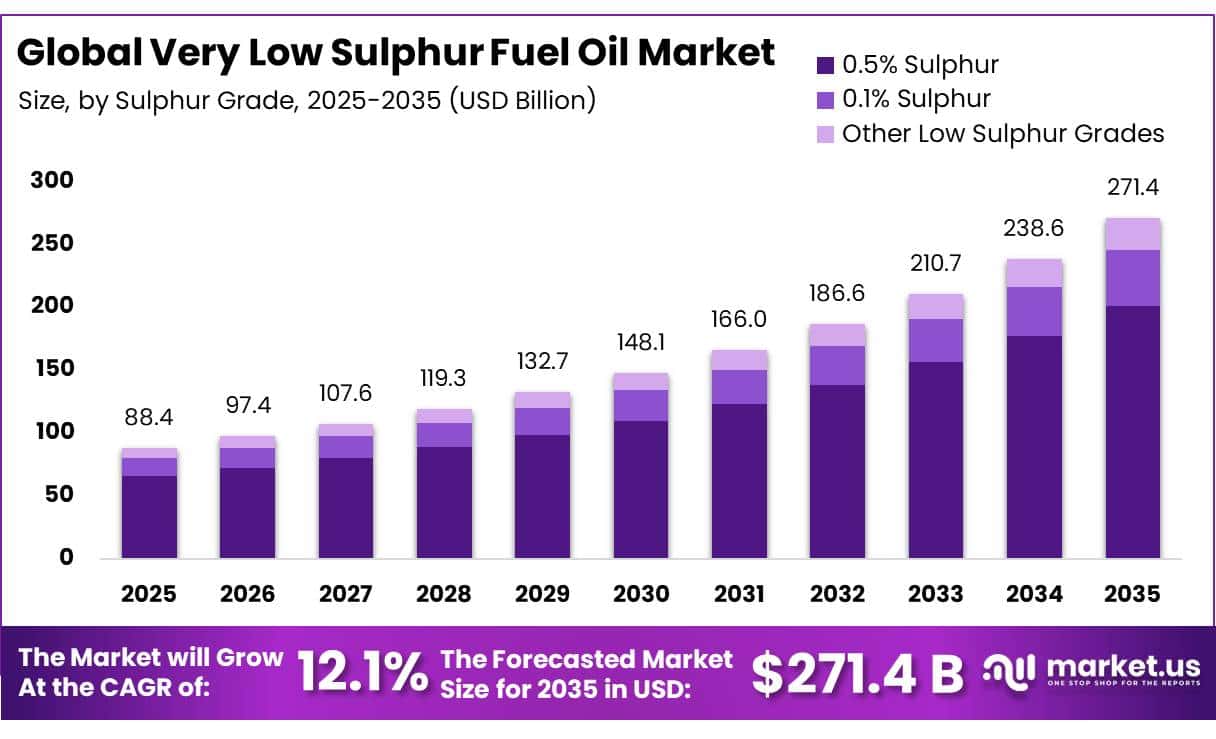
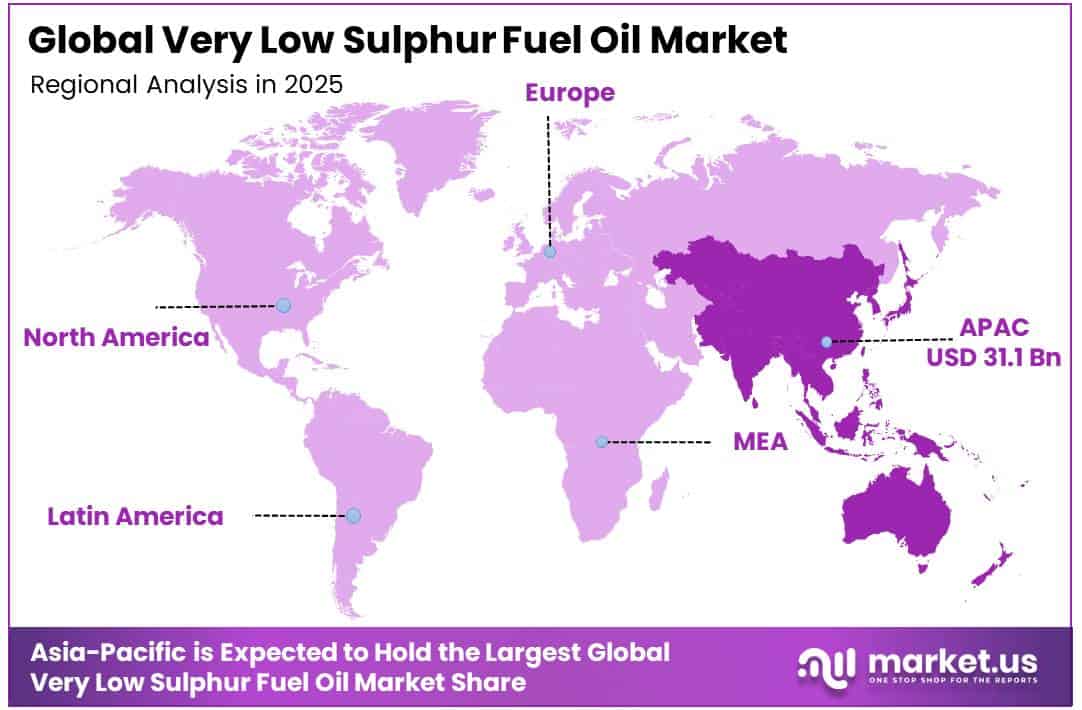
In 2025, the Global Very Low Sulphur Fuel Oil Market was valued at USD 88.4 billion, and between 2026 and 2035, this market is estimated to register a CAGR of 12.1%, reaching about USD 271.4 billion by 2035. In 2025, Asia-Pacific led the market, achieving over 35.2% share with a revenue of USD 31.1 billion.
Very Low Sulphur Fuel Oil (VLSFO) has become an important marine fuel for ship operators seeking compliance with increasingly strict air-emission requirements. It is generally produced by blending refinery streams to achieve lower sulphur content while maintaining suitable viscosity, stability and combustion properties.
- According to the International Maritime Organization (IMO), from May 2025, ships operating within the Mediterranean Sulphur Emission Control Area must use fuel containing no more than 0.10% sulphur, compared with the 0.50% limit applicable outside designated sulphur-control areas. These requirements continue to support demand for compliant low-sulphur bunker fuels.
Key Takeaways
- The Global Very Low Sulphur Fuel Oil Market was valued at USD 88.4 billion in 2025.
- The market is projected to grow at a CAGR of 12.1% and is estimated to reach USD 271.4 billion by 2035.
- On the basis of sulphur grade, 0.5% Sulphur dominated the market, constituting 74.2% of the total market share.
- Based on the application, Marine Shipping dominated the market, with a substantial market share of around 63.5%.
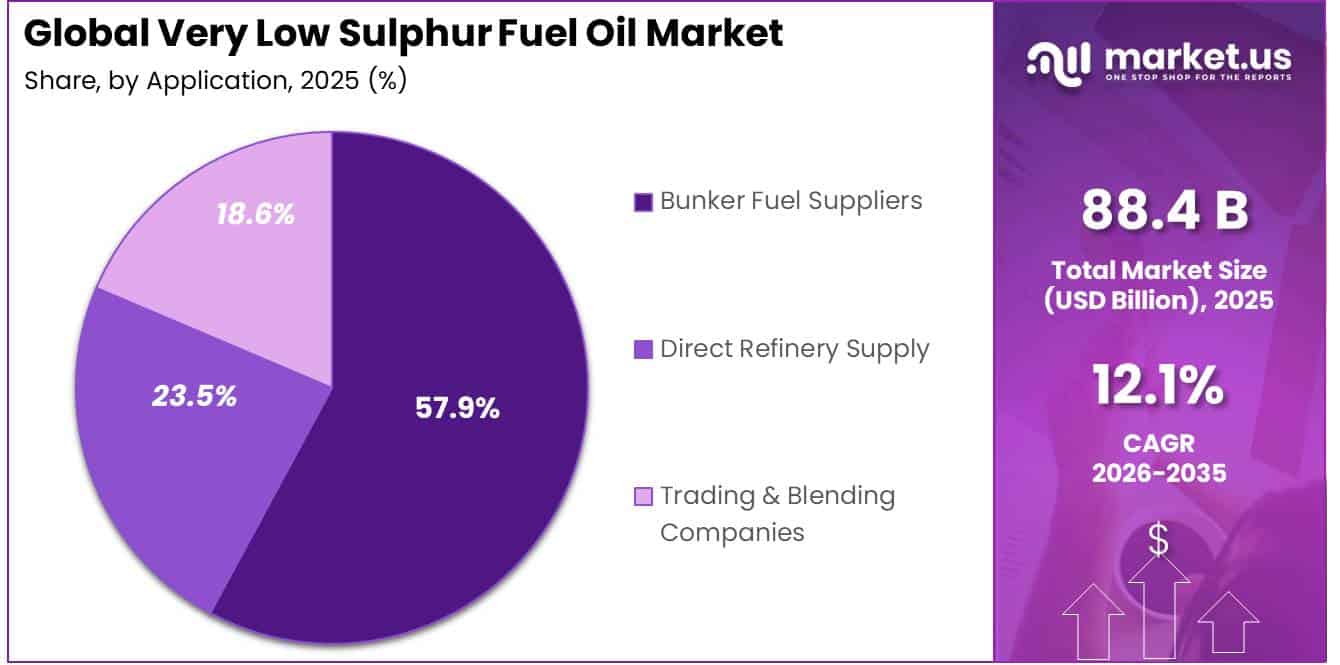
- Based on the end user, Bunker Fuel Suppliers led the market, comprising 57.9% of the total market.
- In 2025, Asia-Pacific was the most dominant region in the market, accounting for 35.2% of the total global consumption.
The industrial scenario remains favourable because conventional marine fuels still serve most operating vessels. According to UN Trade and Development (UNCTAD), more than 80% of international merchandise trade by volume is transported by sea. Global seaborne trade expanded by 2.2% in 2024 and was estimated to grow by 0.5% in 2025, followed by average annual growth of approximately 2% during 2026–2030. This large maritime transport base provides continuing fuel demand across container vessels, tankers, bulk carriers and other commercial shipping categories.
- According to UNCTAD’s Review of Maritime Transport 2025, more than 90% of the active global shipping fleet continued to operate on conventional fuels, although alternative-fuel-capable vessels represented more than 50% of new-order tonnage. By January 2025, the global commercial fleet had reached approximately 112,500 vessels, representing around 2.44 billion deadweight tonnes of carrying capacity. This installed fleet limits the speed at which conventional bunker fuels can be completely displaced.
Major bunkering hubs further demonstrate the scale of the addressable market. According to the Maritime and Port Authority of Singapore, marine fuel sales reached a record 56.77 million tonnes in 2025, increasing 3.4% from 2024. Alternative marine fuel sales increased from 1.35 million tonnes in 2024 to 1.95 million tonnes in 2025. Despite rapid alternative-fuel growth, these figures indicate that conventional marine fuels, including VLSFO, continue to account for the majority of bunker demand at major international ports.
- According to the European Commission, the FuelEU Maritime Regulation became fully applicable from January 2025 and requires ships above 5,000 gross tonnes calling at European ports to reduce the greenhouse-gas intensity of onboard energy by 2% in 2025, rising to 14.5% by 2035 and80% by 2050. This creates opportunities for refiners and bunker suppliers to develop lower-carbon VLSFO blends containing sustainable bio-components while improving fuel quality and lifecycle-emission performance.
Future opportunities are therefore expected to shift toward bio-blended and lower-carbon marine fuel formulations. According to the Port of Rotterdam, ships bunkered approximately 9.8 million tonnes of fuel in 2025, while bio-LNG reached 17,644 m³ and biomethanol reached 11,819 tonnes. In the first quarter of 2026, fossil VLSFO volumes fell 44% year over year. These developments indicate that VLSFO will remain commercially relevant, but future value creation is increasingly likely to come from cleaner blending components, refinery optimization, fuel-quality assurance and compatibility with shipping decarbonization requirements.
Sulphur Grade Analysis
0.5% Sulphur dominates the market with a 74.2% share
In 2025, 0.5% Sulphur held a dominant market position, capturing more than a 74.2% share of the Very Low Sulphur Fuel Oil Market. Its strong position is mainly supported by widespread use across international commercial shipping. This fuel grade helps vessel operators comply with global marine sulphur regulations while continuing to use conventional marine engines. It is commonly preferred by bulk carriers, container ships, tankers, and other ocean-going vessels because of its availability across major bunkering ports.
- Growing international maritime trade, stricter emission requirements, and the need for cleaner bunker fuels continue to support the use of 0.5% sulphur fuel oil.
0.1% Sulphur is the fastest growing segment in the Very Low Sulphur Fuel Oil Market. Its growth is mainly supported by stricter emission requirements in environmentally sensitive shipping zones and regulated coastal areas. Shipping companies operating frequently within Emission Control Areas are increasingly using lower-sulphur fuels to meet tighter environmental standards. The segment also benefits from growing attention toward cleaner marine operations, lower sulphur emissions, and improved air quality around ports. Expansion of regulated shipping areas and increasing environmental compliance across the maritime industry are expected to strengthen demand for 0.1% sulphur fuel oil.
Application Analysis
Marine Shipping dominates the VLSFO market with a 63.5% share
In 2025, Marine Shipping held a dominant market position, capturing more than a 63.5% share of the market. The segment remains the main consumer of VLSFO because commercial cargo vessels, container ships, bulk carriers, and tankers require compliant bunker fuels for regular international operations. Government shipping data supports this strong fuel-consumption base.
- According to the Maritime and Port Authority of Singapore, Singapore recorded 56.77 million tonnes of marine fuel sales in 2025, while vessel arrivals reached 3.22 billion gross tonnage and container throughput reached 44.66 million TEUs. These figures show the large scale of marine operations that continue to support demand for compliant low-sulphur bunker fuels.
Power Generation is the fastest growing segment in the Very Low Sulphur Fuel Oil Market. In 2025, the segment gained importance where liquid-fuel power plants, island electricity systems, industrial generators, and emergency generation facilities required lower-sulphur fuel alternatives. VLSFO can support these facilities where existing fuel-oil infrastructure makes an immediate switch to gas or renewable energy difficult. As environmental rules become stricter, power producers using residual fuel systems are expected to increasingly consider lower-sulphur grades while maintaining existing generation assets.
End User Analysis
Bunker Fuel Suppliers dominate the end-user segment with a 57.9% share, supported by strong marine fuel distribution networks
In 2025, Bunker Fuel Suppliers held a dominant market position, capturing more than a 57.9% share of the Very Low Sulphur Fuel Oil Market by end user. The segment benefits from a broad network of licensed suppliers that provides ship operators with reliable access to compliant marine fuels at major bunkering ports.
- Supporting this dominance, the Maritime and Port Authority of Singapore reported that 39 licensed bunker fuel suppliers were operating in Singapore as of June 2026, supplying marine fuels such as MFO, MGO, and MDO. This established supplier base strengthens fuel availability, delivery flexibility, and procurement efficiency for commercial shipping companies.
Direct Refinery Supply is the fastest growing segment in the Very Low Sulphur Fuel Oil Market by end user. The segment is gaining importance as large shipping companies and fuel buyers increasingly prefer sourcing directly from refiners to improve product consistency, reduce intermediary handling, and secure dependable volumes. Direct refinery relationships can also provide better control over sulphur specifications, blending quality, documentation, and long-term supply planning. Growing attention to fuel traceability and compliance is further encouraging large marine operators to build closer procurement links with refiners, supporting the continued expansion of this supply model.
Key Market Segments
By Sulphur Grade
- 5% Sulphur
- 1% Sulphur
- Other Low Sulphur Grades
By Application
- Marine Shipping
- Power Generation
- Industrial Boilers
By End User
- Bunker Fuel Suppliers
- Direct Refinery Supply
- Trading & Blending Companies
Driver Analysis
ECA expansion to Canadian Arctic and Norwegian Sea
The upcoming sulphur-emission-control-area expansion creates a regional demand-quality upgrade: the Canadian Arctic Waters and Norwegian Sea ECAs are scheduled to enter into force on 1 March 2026 and take effect from 1 March 2027, applying a 0.10% sulphur limit rather than the global 0.50% maximum. This does not directly expand conventional 0.50% VLSFO demand inside the designated waters; instead, it raises the value of suppliers able to provide segregated 0.10% marine gasoil, ultra-low-sulphur blends, and reliable change-over support while sustaining VLSFO consumption on approach, departure, and non-ECA legs.
The commercial consequence is a more complex northern-Europe and Arctic fuel portfolio, higher working-capital needs for separate tanks, tighter bunker-quality controls, and an incentive for suppliers to package multi-grade contracts rather than compete solely on delivered VLSFO price. The effect is modeled at +0.6 percentage points to CAGR through 2027–2030 because the new ECA zones increase compliant-fuel logistics intensity even as they redirect a fraction of local energy demand away from 0.50% VLSFO.
Driver Impact Analysis
| Driver | (~) % Impact on CAGR Forecast | Geographic Relevance | Impact Timeline |
|---|---|---|---|
| MARPOL 0.50% sulphur compliance | +1.4% | Global core; Asia–Europe, Middle East, Americas | Short term (≤ 2 years) |
| ECA expansion to Canadian Arctic and Norwegian Sea | +0.6% | Northern Europe, Canada, Arctic routes | Medium term (2–4 years) |
| Fleet capacity and seaborne-trade growth | +1.0% | APAC, Middle East, Europe, North America | Medium term (2–4 years) |
| Longer voyage distances and route disruption | +0.7% | Red Sea–Suez, Cape route, Europe–Asia | Short term (≤ 2 years) |
| EU ETS and FuelEU compliance economics | +0.5% | EU ports; EU-linked global fleets | Short term (≤ 2 years) |
| Low-carbon fuel substitution and pooling | -1.2% | EU, Northern Europe, Singapore, North America | Long term (≥ 4 years) |
Restraint Analysis
Lifecycle-Carbon Displacement
VLSFO’s core limitation in 2026 is that compliance with the 0.50% sulphur ceiling no longer secures its competitiveness against lifecycle-carbon rules: FuelEU Maritime has applied from 1 January 2025 to ships above 5,000 GT calling at European ports and requires a 2% reduction in the annual well-to-wake GHG intensity of onboard energy versus 2020, tightening to 6% in 2030, 14.5% in 2035 and 80% by 2050; because the accounting includes CO₂, methane and N₂O across the full fuel lifecycle, conventional residual VLSFO has little structural route to comply other than blending, pooling, efficiency gains or displacement by lower-carbon fuels.
The regulation also requires container and passenger ships above 5,000 GT to use onshore power or zero-emission technology at berth from 2030 at specified EU ports, directly removing a portion of auxiliary-engine bunker demand. Consequently, VLSFO suppliers face declining contract duration, higher certification and traceability costs, and a growing risk that investments in desulphurisation, blending tanks and conventional bunker infrastructure become underutilized before their economic life; this is modeled as a -2.3 percentage-point drag on the 2026 baseline CAGR, principally through long-run volume substitution rather than an immediate loss of sulphur-compliant demand.
Restraint Impact Analysis
| Restraint | (~) % Impact on CAGR Forecast | Geographic Relevance | Impact Timeline |
|---|---|---|---|
| Lifecycle-carbon displacement | -2.3% | EU, UK, North Europe | Long term (≥ 4 years) |
| EU carbon-cost escalation | -1.4% | EU routes, Mediterranean | Medium term (2-4 years) |
| ECA distillate substitution | -1.1% | Mediterranean, North America, North Europe | Medium term (2-4 years) |
| Scrubber-enabled HSFO arbitrage | -0.9% | Asia, Middle East, global tramp trade | Medium term (2-4 years) |
| Bunker-demand contraction | -1.3% | Northwest Europe, major hubs | Short term (≤ 2 years) |
| Blend-quality and supply volatility | -0.8% | APAC, Middle East, import-dependent markets | Short term (≤ 2 years) |
Opportunity Analysis
Monetizing IMO Net-Zero Framework Surplus/Remedial Unit Trading
The IMO’s Net-Zero Framework, approved at MEPC 83 in April 2025 and scheduled for phased entry into force from 2027, introduces a two-tier GHG Fuel Intensity (GFI) compliance structure with Remedial Unit pricing set at USD 380 per tonne of CO2-equivalent for base-tier breaches and USD 100 per tonne for direct-compliance-tier breaches, alongside tradable Surplus Units for over-compliant vessels.
Refiners and bunker suppliers that develop in-house GFI-optimized blending capability (targeting an 8% GFI reduction by 2030 under Tier 1, scaling to 65% by 2040) could convert compliance risk into a tradable asset, potentially capturing 150–300 basis points of incremental EBITDA margin per tonne sold via brokered Surplus Unit arbitrage once the fund becomes operational in 2027–2028. Given that vessels above 5,000 GT representing roughly 85–90% of international shipping CO2 emissions fall under scope, the addressable credit-trading TAM is structurally large but entirely uncaptured today, since no exchange infrastructure or standardized RU/SU settlement mechanism yet exists at scale. First movers building credit desks now, ahead of the 2027 entry into force, stand to lock in advisory and market-making fee streams that sit entirely outside the current VLSFO sales-volume baseline.
Opportunity Impact Analysis
| Opportunity | (~) % Potential CAGR Upside | Geographic Relevance | Execution Window |
|---|---|---|---|
| Monetizing IMO Net-Zero Framework surplus/remedial unit trading | +2.2% | Global; hub concentration in Singapore, Rotterdam, Fujairah | Medium term (2–4 years) |
| EU ETS/FuelEU Maritime compliance-as-a-service bundling | +1.6% | EU/EEA core, transshipment corridors (Mediterranean, North Sea) | Short term (≤2 years) |
| Blending-economics arbitrage and residue upgrading roll-ups | +1.9% | APAC refining hubs (Singapore, South Korea, India), Middle East | Medium term (2–4 years) |
| Emission Control Area (ECA) expansion first-mover positioning | +1.4% | Mediterranean Sea, Canadian Arctic, Norwegian waters | Long term (≥4 years) |
| Digital bunkering platforms and B2B fuel-quality data monetization | +1.1% | Global, led by Singapore MPA-regulated hub, Gulf ports | Short term (≤2 years) |
| Transitional VLSFO-to-alternative-fuel supply chain hedging (methanol/LNG blend infrastructure) | +2.0% | Northern Europe, East Asia bunkering corridors | Long term (≥4 years) |
Challenges Analysis
Refinery Yield Reconfiguration
The central production challenge is the refinery system’s limited ability to increase VLSFO output rapidly without changing crude slates, cutter-stock availability, residue-upgrading severity, or the value balance among diesel, gasoline, asphalt, and high-sulphur residual streams; consequently, VLSFO availability can remain adequate in aggregate while becoming economically thin at specific ports or during demand spikes. The 0.50% mass-by-mass sulphur ceiling remains the global marine-fuel standard outside designated emission control areas, compared with the prior 3.50% threshold, structurally tying marine demand to deeper desulphurization and blending discipline.
The model attributes a -1.0-point drag to yield inflexibility: a 200,000-barrel-per-day refinery cannot redirect even a 1–2% share of output toward compliant residual fuel without altering intermediate-stream routing, hydrogen consumption, catalyst cycles, or cutter-stock economics, while a 3–7-day unit outage can force replacement cargoes and disrupt a terminal’s normal 10–20-day supply cover. Producers therefore need multi-refinery blend optimization, optional low-sulphur feedstock contracts, 20–30-day strategically positioned inventory in core hubs, and digital yield models that optimize VLSFO against distillate and residual margins in near-real time.
Challenges Impact Analysis
| Challenge | (~) % CAGR Friction Drag | Geographic Relevance | Mitigation Horizon |
|---|---|---|---|
| Blendstock Quality Variability | -0.8% | Asia hubs, Middle East, Europe | Medium term (2–4 years) |
| Refinery Yield Reconfiguration | -1.0% | Asia refining centers, US Gulf, Europe | Long term (≥4 years) |
| Chokepoint Supply Disruption | -1.4% | Hormuz-linked Asia, Europe, East Africa | Medium term (2–4 years) |
| Carbon-Compliance Cost Layering | -1.1% | EU regulatory hubs, global deep-sea routes | Long term (≥4 years) |
| Alternative-Fuel Fleet Switching | -0.9% | Europe, China, Singapore, North America | Long term (≥4 years) |
| Bunker Assurance Capability Gap | -0.6% | Secondary ports, Africa, Latin America | Medium term (2–4 years) |
Geopolitical Impact Analysis
Ongoing Middle East Conflict Intensifies VLSFO Market Volatility
The ongoing Middle East conflict is influencing the Very Low Sulphur Fuel Oil market by increasing shipping risk, bunker costs, and uncertainty around refinery supply. The Strait of Hormuz remains especially important because it carries large volumes of crude oil and refined products used across marine fuel networks.
- U.S. Energy Information Administration data show that oil flows through Hormuz fell from 20.7 million barrels per day in the fourth quarter of 2025 to 14.6 million barrels per day in the first quarter of 2026. During the second quarter, Brent crude futures moved between $72 and $118 per barrel as supply disruptions affected international petroleum trade.
The impact is also visible in marine logistics. The International Maritime Organization reported 46 attacks on international shipping around the Strait of Hormuz by June 2026, while renewed attacks in the Red Sea continued to threaten commercial routes. These conditions encourage vessel operators to avoid high-risk corridors, take longer routes, and carry additional fuel reserves.
Regional Analysis
Very Low Sulphur Fuel Oil Market Regional Analysis
In 2025, Asia-Pacific held a dominant market position, capturing more than a 35.2% share and generating approximately USD 31.1 billion. The region benefits from extensive maritime trade and major bunkering locations, particularly Singapore. According to the Maritime and Port Authority of Singapore, marine fuel sales reached a record 56.77 million tonnes in 2025, increasing 3.4% from 2024. Singapore also handled 44.66 million TEUs of container throughput and recorded 3.22 billion gross tonnage of vessel arrivals during 2025.
Middle East & Africa is expected to emerge as the fastest-growing regional segment, supported by refinery expansion and rapidly developing bunkering infrastructure. Fujairah is recognized as one of the world’s three largest bunkering hubs, while the Fujairah Oil Industry Zone provides approximately 70 million barrels of oil-product storage capacity. The Port of Fujairah also operates four dedicated bunker-barge berths for low-sulphur oil tankers. In Oman, OQ8 increased Duqm refinery processing capacity from 230,000 barrels per day to 255,000 barrels per day in 2025, reaching 110% of nameplate capacity.
Key Regions and Countries Covered
- North America
- The US
- Canada
- Europe
- Germany
- France
- The UK
- Spain
- Italy
- Russia & CIS
- Rest of Europe
- APAC
- China
- Japan
- South Korea
- India
- ASEAN
- Rest of APAC
- Latin America
- Brazil
- Mexico
- Rest of Latin America
- Middle East & Africa
- GCC
- South Africa
- Rest of MEA
Key Players Analysis
Eni S.p.A. maintains a strong refining platform supporting its participation in low-sulphur marine fuel supply. In 2025, Eni’s refineries processed nearly 25 million tonnes of crude oil, an increase of 3% year-on-year. Eni reported €8.5 billion in capital expenditure, strengthening its capacity to modernize refining assets and improve fuel quality performance globally and competitively.
ConocoPhillips contributes to the VLSFO value chain mainly through large-scale crude oil production and marketing rather than direct downstream refining. In 2025, companywide production reached 2.375 million barrels of oil equivalent per day, an increase of approximately 20% year over year, while operating cash flow reached $19.8 billion. The company also invested $12.6 billion in capital projects and ended 2025 with 7.6 billion BOE in proved reserves globally.
China National Petroleum Corporation, primarily through PetroChina, holds a significant position in marine fuels and refining. In 2025, PetroChina processed 1.38 billion barrels of crude oil and produced 117 million tonnes of refined oil products. The company stated that its domestic market share in bonded marine fuel oil remained ranked first, reinforcing its competitive position in supplying low-sulphur marine fuels to shipping and international bunker markets worldwide.
Petróleo Brasileiro S.A. is a major global supplier of low-sulphur fuel oil and marine bunker products. In 2025, Petrobras’s refining system achieved a total utilization factor of 91%, with higher value-added products such as diesel, gasoline, and jet fuel accounting for nearly 70% of output. In February 2025, Petrobras completed its first Asian sale of VLSFO B24, blending 76% mineral fuel oil with 24% renewable UCOME for the Singapore bunker market, in partnership with Golden Island, a licensed bunker supplier in Singapore.
The Major Players in The Industry
- Exxon Mobil Corporation
- Shell International B.V
- Chevron Corporation
- TotalEnergies SE
- BP plc
- Marathon Petroleum Corporation
- Valero Energy Corporation
- Hess Corporation
- Eni S.p.A
- ConocoPhillips
- China National Petroleum Corporation
- Petróleo Brasileiro S.A
- Other Key Players
Key Development
- In September 2025, ExxonMobil started new proprietary processing technology at its Singapore complex, converting fuel oil and other lower-value refinery streams into higher-value fuels and lubricants. The site represents more than S$30 billion in fixed-asset investment and added 20,000 barrels per day of Group II base-stock capacity.
- In April 2025, Shell International completed the acquisition of 100% of Pavilion Energy Pte. Ltd., adding around 6.5 million tonnes per year of contracted LNG supply, about 2 million tonnes per year of regasification capacity and an LNG bunkering business. The portfolio also included 3 MEGI LNG vessels and 2 TFDE vessels, widening Shell’s marine-fuel supply capability alongside VLSFO.
Report Scope
| Report Features | Description |
|---|---|
| Market Value (2025) | USD 88.4 Bn |
| Forecast Revenue (2035) | USD 271.4 Bn |
| CAGR (2026-2035) | 12.1% |
| Base Year for Estimation | 2025 |
| Historic Period | 2020-2024 |
| Forecast Period | 2026-2035 |
| Report Coverage | Revenue Forecast, Market Dynamics, Competitive Landscape, Recent Developments |
| Segments Covered | by sulphur grade (0.5% Sulphur, 0.1% Sulphur, Other Low Sulphur Grades), by application (Marine Shipping, Power Generation, Industrial Boilers), and by end user (Bunker Fuel Suppliers, Direct Refinery Supply, Trading & Blending Companies) |
| Regional Analysis | North America – The US & Canada; Europe – Germany, France, The UK, Spain, Italy, Russia & CIS, Rest of Europe; APAC– China, Japan, South Korea, India, ASEAN & Rest of APAC; Latin America– Brazil, Mexico & Rest of Latin America; Middle East & Africa– GCC, South Africa, & Rest of MEA |
| Competitive Landscape | Exxon Mobil Corporation, Shell International B.V, Chevron Corporation, TotalEnergies SE, BP plc, Marathon Petroleum Corporation, Valero Energy Corporation, Hess Corporation, Eni S.p.A, ConocoPhillips, China National Petroleum Corporation, Petróleo Brasileiro S.A, Other Key Players |
| Customization Scope | Customization for segments, region/country-level will be provided. Moreover, additional customization can be done based on the requirements. |
| Purchase Options | We have three licenses to opt for: Single User License, Multi-User License (Up to 5 Users), Corporate Use License (Unlimited Users and Printable PDF) |





































